Talent challenges in the core and energy industry are converging, creating something of a perfect storm. It’s a potent mix of an ageing workforce, rapid technological shifts, and a deepening skills gap. This isn’t just an HR headache; it’s a structural crisis that threatens innovation, project timelines, and the bottom line.
Navigating the Perfect Storm in Energy Sector Talent
The core and energy industry has hit a critical juncture. The cyclical talent shortages we used to see have morphed into something more permanent and far more complex—a crisis that demands the full attention of the C-suite.
What we’re facing isn’t one single problem. It’s a combination of forces creating a perfect storm for Chief Human Resources Officers (CHROs) and their teams.
A massive wave of experienced professionals, the very generation that built much of today’s energy infrastructure, is heading for retirement. This “great crew change” is leaving a huge knowledge vacuum in its wake, and organisations are scrambling to fill it. At the same time, the industry is in the midst of a profound technological shift, creating urgent demand for new skills in data analytics, automation, and renewable energy.
The Widening Gap Between Demand and Supply
The space between the skills companies need and the talent actually available on the market is widening at an alarming pace. The old recruitment pipelines simply can’t keep up with the demand for specialised roles. This isn’t a minor inconvenience; it’s a direct threat to operational continuity and future growth.
This infographic paints a clear picture of what’s driving this talent crisis.
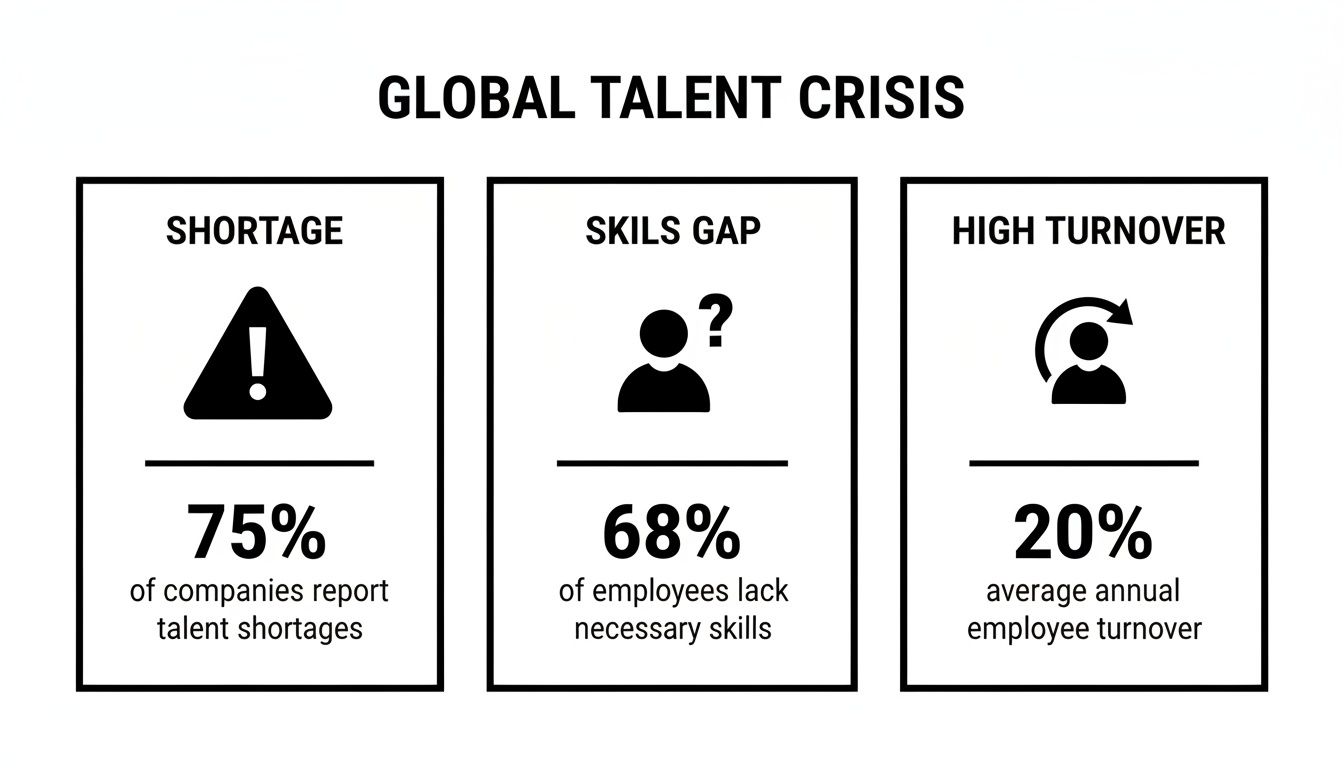
As you can see, talent shortages, skills gaps, and high turnover aren’t separate issues. They’re interconnected, feeding into each other and creating a cycle that’s incredibly difficult to break. The hard data backs this up.
The energy industry, for instance, is projected to be short as many as 40,000 competent workers by 2025. This critical shortage is made worse by post-pandemic employment trends. Non-retirement turnover has climbed to 9% at cooperative utilities, which is significantly higher than the 7% average across the wider industry.
To get a feel for the numbers, let’s quickly look at the primary challenges and what they really mean for business operations.
Key Talent Challenges and Their Business Impact at a Glance
| Talent Challenge | Primary Driver | Direct Business Impact |
|---|---|---|
| Talent Shortage | Ageing workforce and mass retirements (“Great Crew Change”) | Project delays, reduced operational capacity, increased labour costs |
| Skills Gap | Rapid technological adoption (automation, renewables, AI) | Difficulty innovating, lower productivity, safety and compliance risks |
| High Attrition | Increased competition for talent; changing worker expectations | Loss of institutional knowledge, high recruitment costs, unstable teams |
These aren’t abstract problems—they have a real, tangible impact on day-to-day operations and long-term strategic goals.
A Call for a New Strategic Approach
Fixing this requires more than just aggressive recruiting. It demands a fundamental shift in how energy companies think about and manage talent. Organisations have to look beyond traditional hiring methods and start building a sustainable workforce with modern strategies.
The current talent challenges are not simply recruitment hurdles; they are fundamental business risks. A failure to adapt threatens an organisation’s ability to compete, innovate, and deliver on critical projects.
This guide is designed to move beyond just diagnosing the problem. We’ll provide a practical framework for CHROs to build a modern talent playbook. You can get a head start by exploring the latest core and energy sector hiring trends. We’ll cover everything from pinpointing specific skills gaps to implementing strategic solutions like Recruitment Process Outsourcing (RPO) that can give you a genuine competitive edge.
Understanding the Skills Gaps and Demographic Shifts
The talent challenges shaking the core and energy industry aren’t coming from one direction. They’re the result of two powerful, intertwined forces: a widening technical skills gap and a massive demographic shift. Think of it as a pincer movement on your talent pipeline.
The first force is the industry’s own rapid transformation, which is creating a desperate need for new skills. The second is a generational handover, as seasoned experts leave the workforce and a new generation with completely different expectations arrives.

This isn’t just about finding more people; it’s about finding the right people with the right skills at the right time. For any CHRO, getting to grips with these twin challenges is the essential first step toward building a resilient talent strategy that can weather the storm.
The New Technical Skills Frontier
Let’s be honest, the energy sector of today is almost unrecognisable from what it was just a decade ago. The seismic shift toward renewables and the blanket digitalisation of operations have created an urgent demand for a completely new kind of professional. Traditional roles are being reshaped, and entirely new ones are being created almost overnight.
Organisations are no longer just looking for petroleum engineers and geologists. Suddenly, they’re in a fierce competition for talent in fields that were once barely on the industry’s radar.
This technological leap means the old, reliable talent pipelines are drying up. A university programme that churned out top-tier mechanical engineers for 30 years might not be equipping its graduates with the data science or automation skills needed for today’s smart grids or predictive maintenance platforms.
The core challenge is this: the industry is trying to build the future of energy with a workforce that was trained for its past. This gulf between existing competencies and future needs is the heart of the talent crisis.
Just look at the specific skills that are now red-hot in terms of demand:
- Data Scientists and AI Specialists who can turn vast datasets into actionable insights, optimising production and predicting equipment failures before they happen.
- Renewable Energy Technicians with deep expertise in solar, wind, and cutting-edge battery storage technologies.
- Automation Engineers who can design and manage the robotic systems that are making operations safer and more efficient.
- Cybersecurity Experts capable of defending critical infrastructure against ever-more-sophisticated digital threats.
These roles demand a unique blend of traditional engineering principles and advanced digital literacy. It’s a combination that’s incredibly scarce and highly sought after by literally every other industry.
The Great Crew Change and Generational Divides
Compounding this skills gap is a massive demographic tidal wave often called the “great crew change.” An entire generation of experienced Baby Boomers is heading into retirement, taking decades of priceless institutional knowledge and hands-on expertise with them.
In many companies, for every five skilled veterans who hang up their hard hats, only two new recruits are coming in to replace them. This creates a huge vacuum, not just in headcount, but in the kind of mentorship and practical wisdom that you just can’t capture in a manual.
At the same time, the industry is battling a serious perception problem among younger generations. Millennials and Gen Z often see the energy sector as old-fashioned, environmentally questionable, and lacking the kind of purpose-driven work they crave. This makes attracting fresh talent an uphill battle from the start.
This demographic shift brings a mix of opportunity and complex retention challenges. While Millennials now make up 38% of all energy sector jobs and Gen Z’s share jumped from a tiny 1.5% to 9% in just one year, these numbers hide a deeper problem. Over 55% of all energy employees have fewer than 10 years of service, and a sobering study revealed that a staggering 62% of younger workers find careers in oil and gas unappealing. You can find more details in this in-depth analysis of the energy workforce. These stats paint a picture of a clear and urgent disconnect.
To bridge this chasm, organisations have to modernise their employer brand and overhaul their talent management practices. You might find our guide on actionable workforce planning strategies useful for aligning with these new expectations. Successfully navigating this new landscape requires a deep understanding of both the technical skills you need and the cultural shifts required to attract and keep the next generation of energy leaders.
Of course. Here is the rewritten section, crafted to sound completely human-written, following the style of the provided examples.
How Talent Shortages Impact Your Bottom Line
When we talk about talent shortages in the core and energy industries, we’re not just discussing an HR headache. We’re talking about a direct, measurable threat to your organisation’s financial health. When critical roles sit empty, the impact isn’t contained within one department; it sends shockwaves from the project site right up to the boardroom, leaving a trail of real operational and financial damage.
This isn’t some abstract risk you can park in a future-planning deck. It’s the harsh reality of a multi-million-dollar project grinding to a halt because you can’t find enough skilled technicians. It’s innovation stalling because the data scientists you need—the ones who truly understand your sector’s unique challenges—are nowhere to be found. Every empty seat is a potential point of failure, a delay waiting to happen, and a direct hit to your profitability.
For CHROs, the mission is clear: translate these operational pains into the language the C-suite lives and breathes—cost, risk, and revenue.
The Financial Drain of Project Delays
Projects in our sector are massive, capital-intensive undertakings bound by iron-clad deadlines. A shortage of just one specialisation, like certified welders or automation engineers, can bring the whole operation to a standstill. These aren’t just minor frustrations; they set off a domino effect of costly consequences.
- Budget Overruns: Every single day a project is delayed, the costs pile up. You’re paying for idle equipment, escalating labour, and potentially facing steep penalties for missing contractual milestones.
- Lost Revenue Opportunities: When a new plant’s launch is pushed back or an expansion is delayed, you’re not just late—you’re postponing the revenue that project was meant to generate, directly impacting quarterly earnings and rattling shareholder confidence.
- Damaged Client Relationships: In a market this competitive, your reputation is everything. Consistently missing deadlines erodes trust with clients and partners, making it that much harder to win the next contract.
The skilled trades gap is especially severe. Take welding, for example. The American Welding Society forecasts a staggering deficit of around 320,000 welders by 2029. When you consider that welding is part of over 70% of all manufactured products, you can see how this one gap directly threatens the development of our entire energy infrastructure. And it’s not an isolated problem— 74% of employers across all industries are struggling to find skilled talent, a pain the energy sector feels more acutely than most. You can explore more research on how the clean energy transition impacts these job demands.
Stifled Innovation and Competitive Disadvantage
Looking beyond today’s projects, talent shortages put a chokehold on your company’s future. The energy transition isn’t optional, and it demands a workforce that speaks the language of digital technology—from AI-powered predictive maintenance to sophisticated grid management software. Without these skills, you’re not just standing still; you’re falling behind.
When you can’t find the digital and data experts you need, you can’t fully implement technologies that boost efficiency and cut costs. Meanwhile, your competitors who can attract this talent will operate leaner, make smarter decisions with their data, and get new solutions to market faster. Before you know it, a small gap has become a gaping competitive disadvantage that’s incredibly difficult to close.
When teams are chronically understaffed or undertrained, safety protocols can weaken under the pressure of maintaining output. This isn’t just a compliance issue; it’s a fundamental threat to your people and your brand’s reputation.
Amplified Safety and Operational Risks
Perhaps the most alarming impact of a talent shortage is the surge in safety and operational risks. When your teams are stretched thin, your most experienced people are overworked, and new hires aren’t getting the mentorship they desperately need. It’s a perfect storm for mistakes and accidents.
An undertrained or exhausted workforce is far more likely to miss a critical safety step, leading to incidents that can cause serious injuries, expensive equipment damage, and crippling regulatory fines. The cost of a single major safety incident—both in financial terms and to your reputation—can easily eclipse the investment needed to build a fully staffed, well-supported team. Tackling the talent challenge isn’t just a strategic priority; it’s an operational necessity.
Building a Modern Talent Acquisition Playbook
It’s one thing to acknowledge the damage talent shortages are doing to your bottom line. It’s another thing entirely to build a modern, resilient talent acquisition playbook that stops the bleeding for good. This isn’t just about filling roles faster; it’s about a ground-up re-engineering of how your organisation finds, grows, and keeps the people who will define its future.
A modern playbook treats talent acquisition like any other core business function—deeply woven into long-term strategy, not siloed in HR. This demands a multi-pronged approach that actually anticipates needs, builds capability from the inside out, and expands the very definition of a qualified candidate. For CHROs, the mission is clear: champion a forward-looking strategy that can weather the sector’s constant shifts.
Forecast the Future with Proactive Workforce Planning
Traditional recruiting is a waiting game. A vacancy opens, a scramble begins. A modern strategy flips the script, looking three to five years ahead and using data to map out the skills your business will need not just to survive, but to win. Think of it as moving from firefighting to strategic forecasting.
This proactive approach means digging into business goals, upcoming projects, and technology roadmaps to build a detailed picture of your future workforce. By anticipating which skills will become non-negotiable—like long-duration battery storage expertise or AI-driven grid management—you can start building talent pipelines long before demand turns into a crisis. This foresight transforms recruitment from a constant emergency into a managed, strategic process.
Revitalise Your Employer Brand for the Next Generation
For far too long, the core and energy sectors have been saddled with an outdated image. If you want to attract younger generations, your employer brand has to tell a completely different story—one centred on innovation, purpose, and sustainability. Millennials and Gen Z aren’t just hunting for a job; they’re looking for a mission.
Your brand story needs to shine a spotlight on your company’s role in the energy transition and its commitment to game-changing technology. This requires a complete overhaul of your recruitment marketing, from your careers page to your social media feeds. Showcase the groundbreaking work of your renewable energy teams, highlight investments in green tech, and give a platform to the younger employees who are already making a real impact.
The core and energy industry’s biggest recruitment challenge isn’t a lack of opportunities—it’s a failure to communicate them in a way that resonates with a new generation of talent. Your brand must be a magnet for those who want to build a cleaner, more efficient world.
To make this real, consider taking these steps:
- Showcase Impactful Projects: Feature case studies on your latest renewable installations or carbon capture initiatives.
- Emphasise Tech and Innovation: Create content that highlights how you’re using data analytics, AI, and automation in your day-to-day operations.
- Promote a Modern Culture: Talk openly about flexible work, employee resource groups, and clear paths for professional growth.
Build Your Talent from Within Through Upskilling
Let’s be realistic: the perfect candidate with ten years of experience in a brand-new technology probably doesn’t exist. Often, the most powerful solution to the skills gap is right in front of you: build the talent you need from within. Robust internal upskilling and reskilling programmes are no longer a “nice-to-have”—they’re an economic necessity.
Investing in your current employees sends a powerful signal that you value their growth and see a long-term future for them at the company. It’s also far more cost-effective than getting into a bidding war for scarce external talent. By identifying employees with adjacent skills and giving them targeted training, you create a loyal, agile workforce that’s ready for what’s next. For example, a skilled mechanical engineer can be retrained to manage automated systems, or an IT professional can be upskilled in operational technology cybersecurity.
Diversify Your Talent Sources and Pipelines
If you’re only recruiting from traditional engineering schools, you’re already falling behind. The skills you need today are being developed in a much wider range of places. A modern talent playbook demands that you diversify your sourcing strategy to find these untapped pools of talent.
This means looking beyond the usual suspects and building relationships with new partners.
- Tech Bootcamps and Coding Academies: These institutions are churning out graduates with practical, job-ready skills in data science, software development, and cybersecurity.
- Adjacent Industries: Look for talent in sectors like manufacturing, aerospace, or telecommunications, where people possess highly transferable technical skills.
- Veterans Programmes: Military veterans often bring exceptional training in logistics, mechanics, and leadership that translates directly to the demands of the energy sector.
By widening your search, you don’t just expand your applicant pool. You bring in fresh perspectives and diverse experiences—the very fuel for innovation.
Leveraging RPO as a Strategic Talent Partner
Let’s be honest. Executing a modern talent playbook requires some serious capability, specialised knowledge, and a level of agility that many in-house HR teams just aren’t built for. This is precisely where Recruitment Process Outsourcing (RPO) enters the picture—not as a simple vendor, but as a true strategic talent partner.
Think of an RPO partner as an external centre of excellence for your talent acquisition. It’s a dedicated team of specialists who embed themselves within your organisation, acting as a direct extension of your HR function. They don’t just fill empty seats; they build the entire recruitment engine you need to win in today’s fiercely competitive market.
This partnership model is designed from the ground up to tackle the unique talent challenges we see in the core and energy industry. It provides the strategic firepower, market intelligence, and scalable resources needed to actually execute a forward-looking talent plan.

Beyond Transactional Recruiting
A strategic RPO partnership is worlds away from the transactional nature of traditional staffing agencies. While an agency is focused on filling a single role and moving on, an RPO partner takes ownership of the entire recruitment process, or at least a significant part of it. This covers everything from workforce planning and employer branding to sourcing, screening, and onboarding.
The real difference lies in the depth of integration. Your RPO team learns your business, understands your culture, and aligns its efforts directly with your long-term strategic goals. They effectively become your in-house specialists for the external talent market, bringing expertise you might not have on your payroll.
For instance, they can build dedicated talent pipelines for those high-demand, niche roles like renewable energy engineers or cybersecurity experts. This means that when a position opens up, you already have a pool of pre-qualified, engaged candidates ready to go, which dramatically slashes your time-to-fill.
Building Agility for a Dynamic Industry
The energy sector is defined by its project-based nature and constantly shifting demands. One quarter you might need to hire a hundred skilled technicians for a new plant; the next, your focus could pivot to a dozen data scientists for a digital transformation project. Internal teams, understandably, often struggle to scale up and down with this kind of volatility.
This is a key area where an RPO provides a massive advantage.
- Scalability for Major Projects: An RPO partner can rapidly deploy recruitment resources to support large-scale hiring pushes, ensuring major projects are staffed on time without completely overwhelming your core HR team.
- Access to Specialised Recruiters: Need to find experts in hydrogen fuel cell technology? A good RPO provider has recruiters who live and breathe that specific niche, giving you immediate access to their networks and market knowledge.
- Executing Targeted Campaigns: Revitalising your employer brand requires more than a new slogan. An RPO can design and execute sophisticated marketing campaigns to attract younger generations, showcasing your commitment to sustainability and innovation.
An RPO partner provides the operational muscle to turn your talent strategy into reality. They bring the processes, technology, and specialised expertise needed to build a resilient, high-performing workforce capable of meeting future demands.
The table below really brings home the differences between a standard internal approach and what a strategic RPO partnership can offer.
Comparing In-House Recruitment and a Strategic RPO Partnership
| Capability | Traditional In-House TA | Strategic RPO Partner |
|---|---|---|
| Sourcing Strategy | Often reactive, focused on active job seekers. | Proactive, building passive candidate pipelines for future needs. |
| Market Intelligence | Limited to internal data and general industry reports. | Provides deep, real-time data on talent availability and competitor activity. |
| Scalability | Fixed team size, difficult to adjust to project demands. | Flexible and scalable resources to handle hiring surges and lulls. |
| Technology Stack | Often relies on a single Applicant Tracking System (ATS). | Brings a suite of advanced recruitment tools and analytics platforms. |
| Employer Branding | Managed internally, often with limited marketing resources. | Executes targeted employer branding campaigns to specific talent pools. |
Ultimately, a strategic RPO partnership allows your internal HR team to focus on its most critical mission: employee development, retention, and culture. By outsourcing the operational complexities of recruitment, you gain a powerful ally dedicated to solving your most pressing talent challenges. To dive deeper, you can explore five ways RPO can improve hiring results and drive real business success.
Your Action Plan for Talent Success
Knowing you have a talent problem is one thing; doing something about it is another entirely. For leaders in the core and energy sectors, tackling these massive challenges demands more than just awareness. It requires a clear, structured plan.
This is your roadmap. It distils everything we’ve talked about into a set of practical priorities. Think of it as a framework to build momentum and drive real, lasting change in your organisation—not just a theoretical exercise. By breaking the journey down into what you can do now, next, and in the future, you can start making a measurable impact today while building the foundations for a workforce that’s ready for anything.
The key is to start now.
Immediate Priorities: Building Momentum
Your first moves should be all about gaining clarity. The goal here is to get the data you need to make smart, informed decisions in the coming months. You can get these initiatives rolling within the next quarter.
- Audit Your Employer Value Proposition (EVP): Take a hard, honest look at what you’re offering. Does your EVP actually connect with younger generations? Or is it stuck in the past? Get real feedback from new hires and your current team to pinpoint where the message is falling flat.
- Launch a Comprehensive Skills Gap Analysis: Stop guessing. Use data to map the skills you have against the skills you’ll desperately need over the next three to five years. This analysis isn’t just a report; it’s the blueprint for every recruitment and upskilling effort you make from here on out.
Medium-Term Goals: Driving Change
Once you know where you stand, the next six to twelve months are about action. This is where you start piloting new approaches and forging the partnerships that will feed your talent pipeline for years to come.
Tackling the talent crisis is a marathon, not a sprint. The organisations that win will be the ones that commit to a phased, strategic approach, not those looking for a quick fix.
A critical step is to pilot an RPO engagement with a single, high-stakes business unit or for a specific set of roles that are notoriously difficult to fill. This lets you test the model, prove the ROI, and build an undeniable business case for expanding the partnership. At the same time, start building formal relationships with technical colleges and universities to shape curricula that directly address your future skills needs.
Long-Term Vision: Sustaining Success
Looking out over the next one to three years, your focus shifts to embedding these new talent strategies deep into your company’s DNA. This is the point where your hard work moves beyond a series of projects and becomes the new way you operate.
The ultimate goal is the full integration of workforce planning with your core business strategy. Talent can no longer be an afterthought; it needs to be at the table for every major decision. This goes hand-in-hand with fostering a true culture of continuous learning and development, where upskilling isn’t a one-off event but a constant, expected part of the job.
Get this right, and you’ll transform your organisation from a reactive hirer into a proactive talent powerhouse, ready for whatever the industry throws at you.
Common Questions Answered
When you’re trying to navigate the talent maze in the core and energy sectors, a lot of questions come up. Leaders are often grappling with the same core challenges, just in different forms. Let’s tackle some of the most frequent queries head-on, building on the strategies we’ve already discussed.
How Can We Actually Get Younger Talent Interested in an Industry They Think Is Outdated?
Let’s be honest, the old narrative isn’t working. To bring in the next generation, you have to fundamentally change how you talk about your work. It’s time to shift your employer brand’s focus to what truly matters to them: innovation, sustainability, and a genuine sense of purpose.
Start showcasing your role in the clean energy transition. Talk about your cutting-edge projects in renewables, carbon capture, or grid modernisation. Forget the tired, old job descriptions. Use your social media channels and careers page to give a behind-the-scenes look at the high-tech, data-heavy work your teams are doing. Highlight clear paths for career growth, mentorship, and a culture that doesn’t just tolerate fresh ideas but actively seeks them out. You need to show them that a career in energy isn’t just a job; it’s a chance to build the future.
What’s the Single Most Effective First Step to Tackle a Skills Gap?
Before you do anything else, you need to run a comprehensive skills gap analysis. You simply cannot solve a problem you don’t fully understand. A proper analysis takes you out of the realm of guesswork and into the world of data, giving you a clear map of the specific skills your organisation is missing versus what it will need in the next three to five years.
This isn’t just an academic exercise. This analysis should become the bedrock of your entire talent strategy. It’s what will guide your decisions on:
- Which roles you absolutely must prioritise for external hiring.
- Where to funnel your budget for internal upskilling and training programmes.
- How to structure your recruitment efforts to find people with valuable, adjacent skills you can build on.
Is an RPO Partnership Really a Good Fit for a Company Our Size?
This is a common question, and the answer is yes—RPO isn’t just for the giants of the industry anymore. Modern Recruitment Process Outsourcing solutions are incredibly flexible and can be scaled to fit exactly what you need. Many providers now offer project-based or even role-specific RPO engagements. This allows you to bring in expert firepower for your most critical hiring needs without signing up for a massive, full-scale overhaul.
Think of it this way: a mid-sized company could bring in an RPO partner specifically to staff a brand-new renewable energy division. Or they could use them to finally fill a handful of highly specialised engineering roles that have been sitting vacant for months. The whole key is finding a partner who can customise their services to your specific challenges and budget.
One of the biggest misconceptions about RPO is that it’s an all-or-nothing commitment. The reality is, the most effective partnerships are highly targeted, delivering specialised expertise precisely where your internal team needs the most support. This makes it a smart, viable strategy for businesses of almost any size.
Ready to finally overcome the Talent Challenges in the Core and Energy Industry that are holding you back? At Taggd, we deliver strategic RPO solutions designed to build resilient, high-performing workforces. Discover how we can help you secure the talent you need to succeed.