Tackling the talent challenges in EdTech isn’t your standard recruitment puzzle. It demands a specialised approach because hiring for key product roles has moved beyond a simple skills gap, it’s become a strategic crisis. The answer lies in ditching generic recruitment methods and building a hiring process that specifically finds professionals who can fuse pedagogy, technology, and user-centric design. It’s a rare and incredibly valuable combination.
The Perfect Storm Facing EdTech Talent Acquisition

The EdTech sector is facing a talent crunch that’s both unique and intense. This isn’t just about filling seats. It’s a perfect storm where explosive market growth is colliding with a critically shallow pool of specialised product talent.
For Chief Human Resources Officers (CHROs), this puts them on the front lines of a fierce battle. The competition isn’t just coming from other EdTech firms. High-paying sectors like FinTech and the rapidly expanding global capability centres (GCCs) are aggressively poaching top performers, making the hunt for qualified candidates tougher than ever.
The Core of the Challenge
So, what makes these roles so hard to fill? It boils down to finding a professional who can seamlessly blend three very different disciplines:
- Pedagogy: A real understanding of learning science, instructional design, and the diverse needs of both learners and educators.
- Technology: Fluency in modern product development cycles, data analytics, and user experience (UX) principles.
- User-Centric Design: Deep empathy for the end-user, whether they’re a primary school student, a university professor, or a corporate trainee.
Finding someone who genuinely embodies all three is like finding a needle in a haystack. This scarcity drives salaries up and turns retention into a constant strategic battle for leadership teams.
Here’s the hard truth: you can’t just drop a brilliant product manager from e-commerce or SaaS into an EdTech role and expect them to succeed. Without a foundational understanding of how people learn, they risk building products that are technologically brilliant but pedagogically useless.
A Market in Hyper-Growth
This scarcity is only getting worse because of the sector’s incredible growth. In India’s booming EdTech space, the shortage of skilled product managers is one of the biggest roadblocks. The market is projected to rocket from a valuation of US$7.5 billion to US$29 billion by 2030.
This explosive growth has created a fierce war for product talent, with nearly 84% of tech employers reporting struggles to find the skilled professionals they need. You can find more data on this in our detailed guide on EdTech hiring trends.
All this pressure lands squarely on hiring teams. They need to find these rare candidates and do it fast to keep up with product roadmaps and market demands. The ability to source, assess, and keep this specific type of talent has become the key differentiator between EdTech companies that thrive and those that fall behind.
Defining Your Ideal EdTech Product Manager Profile

Before you even think about solving talent challenges, you need a crystal-clear picture of who you’re actually looking for. Let’s be honest: posting a generic Product Manager job description is the fastest way to a bad hire. What you really need is a detailed blueprint for an ideal EdTech product leader, one who genuinely connects with your company’s mission and learners.
This profile becomes the bedrock of your entire hiring strategy. It shapes where you source candidates, the questions you ask in interviews, and how you assess their true potential. Without this clarity, you risk hiring a skilled PM who just doesn’t get the unique context of education. That’s a costly mistake.
The Non-Negotiable Competencies
In EdTech, the best product leaders have a unique blend of skills that go way beyond typical product management. These are the competencies that separate a good hire from a truly great one.
Think of these as the three pillars of any effective EdTech PM:
- Genuine Pedagogical Understanding: This isn’t just about knowing the latest education buzzwords. It’s a real appreciation for learning science, curriculum design, and the day-to-day realities of a classroom. They need to understand how people learn to build products that actually help them do it.
- Deep User Empathy: Your users aren’t just “customers.” They’re students, teachers, parents, and administrators, all with complex needs and backgrounds. An ideal candidate can easily step into the shoes of a struggling student or an overworked teacher to feel their pain points.
- Fluency in Learning Analytics: Data in EdTech is different. It’s not just about conversion rates; it’s about measuring learning outcomes, engagement, and student progress. Your PM has to be able to interpret this specific type of data to make smart product decisions.
A product manager who doesn’t grasp the difference between formative and summative assessment will struggle to build an effective learning tool. It’s this specialised knowledge that prevents costly product mistakes and ensures you’re building something that actually helps learners succeed.
Translating Skills into Real-World Impact
Knowing the theory is one thing, but applying it is everything. The true value of these competencies shines when you see how they translate into tangible product success. A candidate with this profile won’t just manage a backlog, they will actively drive your educational mission forward.
Here’s what that looks like in practice:
- They can design a gamified assessment that isn’t just fun but measurably improves knowledge retention.
- They can craft a product roadmap that navigates the maze of educational regulations and data privacy laws.
- They can collaborate effectively with curriculum designers and subject matter experts, translating educational goals into solid technical requirements.
Ultimately, a strong candidate can clearly articulate how a specific feature will lead to a better learning outcome, not just a higher user count. This distinction is critical and separates true EdTech product talent from everyone else. For a closer look at the specific accountabilities of these roles, you might find it useful to read about product owner roles and responsibilities.
Building Your Candidate Persona
With these core competencies in mind, you can start building a detailed persona for your ideal hire. This isn’t just a boring list of skills; it’s a narrative about the exact person you need to find.
Ask yourself these questions to really flesh out your profile:
- What specific learner segment will this person serve? (e.g., K-12, higher education, professional development)
- What is the core educational problem our product is solving?
- What technical and pedagogical trade-offs will they need to make?
Answering these questions helps you move beyond a generic wishlist to create a targeted, actionable profile. This detailed persona will become your most powerful tool for overcoming the unique talent challenges in EdTech and hiring the right product leader for your team.
Building a Strategic Sourcing and Attraction Engine
Finding exceptional product talent isn’t as simple as posting a job ad and waiting for the magic to happen. If you want to overcome the very real talent crunch in EdTech, you have to get proactive. It’s about building a multi-channel strategy to find and engage these professionals right where they are.
This means leaving the old “post and pray” method behind and engineering a deliberate sourcing machine that’s fine-tuned for the unique landscape of education technology.
Relying on the usual suspects like LinkedIn is a recipe for hiring average talent. The best candidates, those who have that rare blend of pedagogical insight and product savvy, are usually passive. They’re happy and deeply engaged in their current roles. Reaching them takes a bit of creativity and a willingness to look in some unexpected places.
Expanding Your Talent Search
Here’s a thought: your perfect candidate might not even have “Product Manager” in their current job title. The real goal is to look for the underlying skills and passion, not just a specific job history.
Think about tapping into these often-overlooked talent pools:
- Educators Transitioning to Tech: Tech-savvy teachers, instructional designers, and curriculum specialists can be a goldmine. They bring an unparalleled level of user empathy and a deep, firsthand understanding of the problems you’re aiming to solve.
- Product Experts from Adjacent Fields: Look for talent in sectors with similar user engagement challenges. Product managers from gaming, digital content platforms, or community-building apps often have sharp skills in user retention and behavioural design that translate beautifully to EdTech.
- Internal Talent Development: Don’t forget about the passionate people already working with you. A subject matter expert or a customer success manager with a strategic mindset could, with the right mentorship, become your next product superstar.
Casting a wider net is absolutely essential in a competitive market. The tech sector in India, for instance, is staring down a 20% year-over-year increase in vacancies. This pressure is even more intense for EdTech companies that need specialised skills in AI, data analytics, and hybrid learning models. You can dive deeper into these trends by exploring insights on how India is rethinking talent for a skills-first economy.
Crafting a Magnetic Employer Brand
Sourcing is only half the job; attraction is the other critical piece. In a field where candidates are often driven by more than just a salary, your employer value proposition (EVP) is your most powerful tool. Top EdTech talent wants to make a real difference. Your job is to show them exactly how they can do that with you.
Your mission shouldn’t just be a plaque on the wall; it should be your number one recruiting asset. Weave it into every single touchpoint, from the first outreach message to the final offer conversation.
The most compelling pitch you can make to a product candidate isn’t about features or funding rounds. It’s about the tangible impact they will have on a learner’s life. Frame the opportunity around solving real educational problems, and you’ll attract people who are motivated by purpose, not just a pay cheque.
To build this kind of magnetic brand, you need to focus on authenticity and powerful storytelling.
Putting Your Brand into Action
Let’s turn your EVP from a lofty concept into a concrete attraction strategy with these practical steps.
- Rewrite Job Descriptions for Impact: Ditch the boring laundry list of responsibilities. Start with the “why”, the problem this role exists to solve. Instead of saying, “Manage the product backlog,” try something like, “Own the roadmap for our flagship literacy tool that helps 10,000 children learn to read each year.” Frame every task in terms of its contribution to the mission.
- Showcase Your Team’s Stories: People connect with people. Use your company blog, social media, and career page to feature your current product team. Let them share, in their own words, what it’s truly like to work on your products. A short video of an engineer talking about the pride they feel seeing their code help a student is far more powerful than any marketing copy.
- Leverage Your Mission in Outreach: When you find a promising candidate, your first message needs to be personal and mission-focused. Mention a specific project they worked on that aligns with your goals or an article they wrote that resonated with your company’s values. Show them you’ve done your homework and genuinely believe they are a perfect fit for the impact you’re trying to make. This thoughtful approach cuts through the noise of generic recruiting emails and signals that you value what they could bring to your team.
Designing an Assessment That Reveals True Potential
Resumes tell you where a candidate has been, not where they can go. Standard interview questions often just test how well someone can prepare, not how well they can think on their feet. If you really want to solve your EdTech talent challenges, you have to look beyond the surface and create an assessment process that shows you who has the potential to truly succeed in your unique environment.
Let’s be clear: this isn’t about brain teasers or trick questions. The aim is to simulate the real, messy, and complex world of building educational products. This calls for a mix of sharp behavioural interviews and practical, hands-on tasks.
Before you even get to the assessment, a lot of groundwork needs to be done. Sourcing, attracting, and engaging the right people is the critical first step.
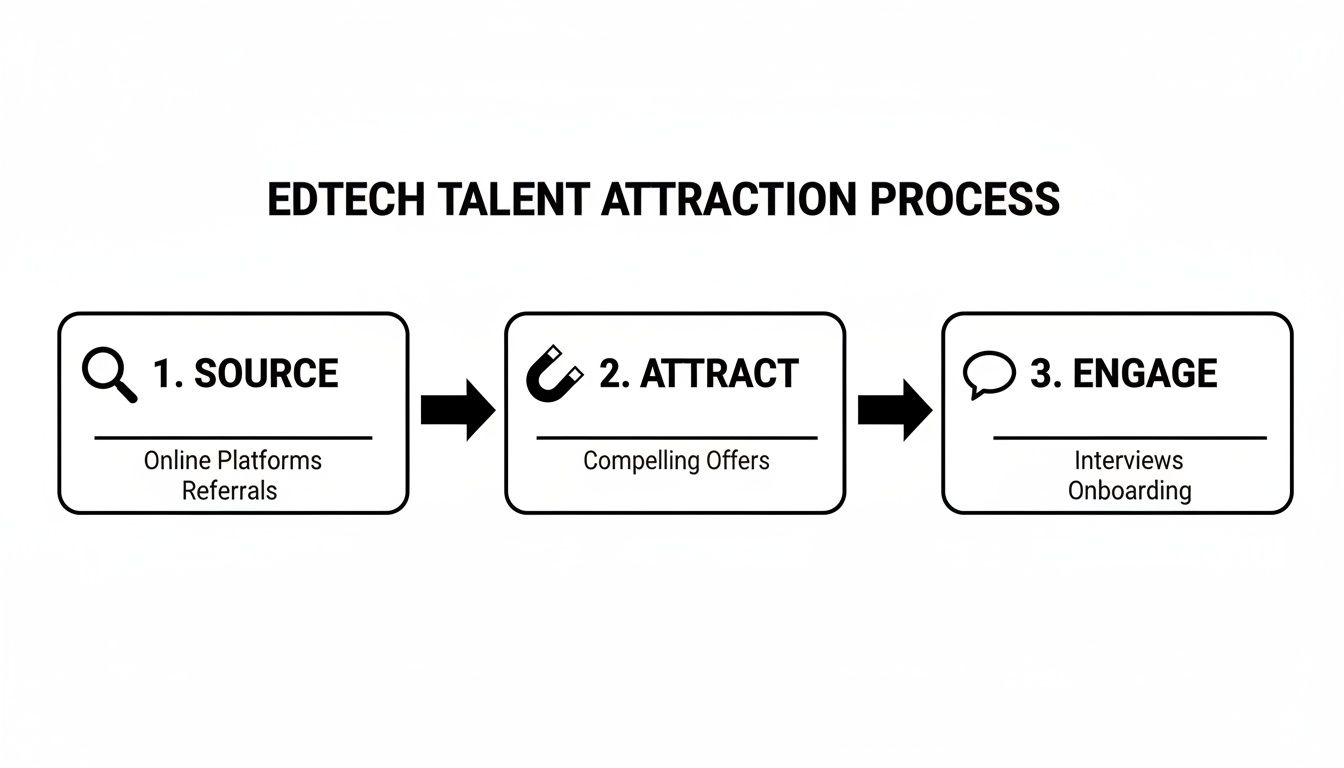
This flow shows just how important a proactive strategy is for the top of your hiring funnel. Get this right, and you’ll have a fantastic pool of candidates to assess.
Probing for EdTech Competencies with Behavioural Interviews
Behavioural questions are incredibly powerful because they force candidates to talk about what they did, not what they would do. This grounds the entire conversation in reality and helps you spot genuine patterns of behaviour.
For any EdTech product role, you need to zero in on the specific skills that matter in our sector.
- To check for User Empathy: “Tell me about a time you had to build something for a user group you knew very little about. How did you get up to speed on their real needs and pain points?”
- To gauge Pedagogical Curiosity: “Describe a situation where you had to balance a really cool user feature with a solid learning objective. How did you handle the trade-offs?”
- To assess Data-Driven Decision Making: “Walk me through a time you used learner data to make a big product decision. What was the metric, what did you discover, and what was the result?”
Questions like these push candidates beyond canned answers, giving you a much clearer sense of their actual capabilities.
The Centrepiece: Your Take-Home Assessment or Live Case Study
Frankly, the best way to see how a candidate thinks is to give them a real problem to chew on. A well-designed take-home assessment or a live case study is the heart of any solid evaluation process. It’s where talk stops and skills are demonstrated.
The trick is to make the task hyper-relevant to the challenges they’d actually face in the role. A generic business case study just won’t cut it; it has to be rooted in an educational context.
Imagine asking a candidate to: ‘Develop a high-level product strategy to improve engagement for a secondary school mathematics module, specifically targeting learners in Tier-2 and Tier-3 cities in India.’
This single prompt forces them to flex so many muscles at once. You get to see their strategic thinking, their empathy for a specific user demographic, their understanding of accessibility, and their ability to turn a broad goal into a tangible product direction. It reveals far more than five standard interview questions ever could.
Designing a Fair and Effective Task
To make sure your assessment is both insightful and respectful of a candidate’s time, stick to these principles:
- Be Specific but Not Too Prescriptive: Give them enough context to understand the problem, but leave them room to be creative. You want to see how they frame the problem, not just if they can follow a rigid set of instructions.
- Set Clear Time Expectations: Be upfront about the time commitment. A good take-home task shouldn’t take more than 3-4 hours. Any more than that, and you risk losing great candidates who are already busy with their current jobs.
- Define the Deliverable: Be crystal clear about what you expect back. Is it a short presentation deck? A two-page strategy document? A few user stories? Clarity prevents confusion and helps you compare candidates fairly.
Building an Objective Scorecard for Evaluation
An assessment is only as good as your ability to evaluate it consistently. A subjective, “I just liked their ideas” approach is a recipe for bias. An objective scorecard is your best friend for making fair, data-driven hiring decisions.
Your scorecard should tie directly back to the core competencies you defined for the role. It forces a structured, consistent evaluation for every single candidate.
Here’s a simple scorecard you can adapt to ensure you’re evaluating everyone on a level playing field.
EdTech Product Manager Interview Scorecard Example
A sample scorecard for evaluating candidates based on key competencies, ensuring a consistent and data-driven assessment process.
| Competency | Evaluation Criteria | Scoring (1-5) | Interviewer Notes |
|---|---|---|---|
| Strategic Thinking | Did they identify the core problem? Was their solution aligned with business and learning goals? | ||
| User Empathy | How well did they consider the needs and constraints of the target learners and educators? | ||
| Data Fluency | Did they outline which metrics they would use to measure success? Was their approach data-informed? | ||
| Communication | Was their strategy presented clearly and persuasively? Could they articulate their thought process? |
Using a structured scorecard like this ensures every candidate is measured against the same yardstick. It turns the assessment from a simple chat into a powerful data collection tool, giving you the confidence that you’re hiring not just a good candidate, but the right product leader for your EdTech mission.
When to Partner with an RPO to Scale Hiring
For any EdTech company on a high-growth trajectory, the hiring process for specialised product roles can quickly turn into a serious bottleneck. Your internal team is probably already running at full capacity, and in a market this competitive, you just can’t afford to slow down.
This is that critical point where bringing on a Recruitment Process Outsourcing (RPO) partner goes from being a “nice-to-have” to an absolute necessity.
An RPO isn’t just some external agency firing resumes over the fence. Think of them as a powerful, embedded extension of your own team. It’s like instantly adding a dedicated squad of expert recruiters who live and breathe the tech talent market, freeing up your internal people to focus on culture, onboarding, and keeping your best talent happy.
Recognising the Tipping Point
So, how do you know it’s the right moment to bring in a partner? There are usually a few clear signals that your internal hiring engine is sputtering and could use some outside expertise.
Keep an eye out for these tell-tale signs:
- Your Time-to-Hire is Creeping Up: If it’s taking longer and longer to get critical product roles filled, you’re losing your competitive edge. A good RPO can slash this timeline dramatically.
- Candidate Quality is All Over the Place: Are you seeing a massive difference in the quality of candidates reaching the final interviews? A specialised partner introduces a standardised, rigorous screening process that brings much-needed consistency.
- Your Team Lacks Market Intelligence: You don’t have solid data on what to pay people, what your competitors are doing, or where to find untapped talent pools. RPOs bring this crucial intelligence to the table as part of their service.
- Hiring Needs are Spiking Unpredictably: Rapid growth often means you need to hire several complex roles all at once. An RPO gives you the flexibility to handle these surges without having to hire more full-time internal recruiters.
If any of this sounds familiar, your growth is almost certainly outpacing your recruitment capabilities. This is exactly the scenario where an RPO partnership can make the biggest difference.
How a Specialised RPO Amplifies Your Efforts
A modern RPO partner does a lot more than just find candidates. They bring a powerful mix of deep industry networks, advanced tech, and battle-tested processes that your internal team might not have access to. It’s this integrated approach that really helps overcome the talent challenges in EdTech product hiring.
They do this by focusing on a few key areas. First, they use AI-powered sourcing tools to scan the entire market and uncover passive candidates, those high-performers who aren’t actively job hunting but are open to the perfect opportunity. This expands your talent pool far beyond the usual inbound applicants.
Next, they put skills-first assessments into practice at scale. Instead of just skimming resumes, they use structured evaluations and practical tasks to pinpoint candidates with the right real-world skills, ensuring you’re judging potential, not just pedigree.
A strong RPO partner acts as your strategic advisor, not just an order-taker. They should challenge your assumptions, provide honest feedback on your employer brand, and help you craft offers that actually win in a competitive market.
Building a Successful Partnership
The success of any RPO engagement really boils down to building a true partnership. This means clear communication, shared goals, and deep alignment right from the start. To make it work, you have to treat your RPO team like they’re part of your company, not just another vendor.
For a deeper look into how this partnership model drives better outcomes, you can learn more about how Recruiting Process Outsourcing can improve hiring results.
Here’s what a great collaboration looks like in practice:
- Deep Cultural Alignment: The RPO team has to get your mission, your values, and the unique quirks of your company culture. After all, they’re your brand ambassadors in the talent market.
- Clear Goal Setting: Define what success looks like from day one. Set clear, measurable KPIs for things like time-to-hire, candidate quality, and offer acceptance rates.
- Transparent Communication: Set up a regular rhythm for updates and feedback. The RPO needs insights from your hiring managers, and your team needs to see what’s happening in the hiring pipeline.
By strategically partnering with an RPO, you can speed up your hiring, raise the quality of your candidates, and build the world-class product team you need to drive your EdTech mission forward, all without burning out your internal team.
Answering Your Top EdTech Hiring Questions
Trying to hire great product people in EdTech will inevitably throw some tough questions your way. The strategies we’ve covered so far will give you a solid playbook, but sometimes you just need a straight answer to a specific challenge.
Think of this section as a quick-fire Q&A, tackling the most common hurdles leaders face when they’re trying to find the best product minds for their mission.
How Can We Compete Against High-Paying GCCs and FinTech?
That’s the million-dollar question, isn’t it? Let’s be honest: if you try to go head-to-head on salary with a Global Capability Centre or a top FinTech firm, you’re probably going to lose.
So, don’t play their game. Play yours. Your biggest weapon isn’t your bank account; it’s your mission.
You have to amplify what makes you unique, focusing on the things they simply can’t offer:
- Mission-Driven Impact: Really drive home the chance to change how people learn and make a genuine social impact. For so many A-players, the opportunity to build something that truly matters is a pull that a pure-play tech or finance company just can’t replicate.
- Autonomy and Innovation: Frame the role as a chance to build from scratch, not just tweak an existing machine. Highlight the creative freedom and ownership that comes with working in a sector that’s still being defined.
- Long-Term Growth: Back up the mission with competitive equity packages and a clear, transparent career ladder. This signals to candidates that you’re invested in their future, not just trying to fill a seat for the next 12 months.
What is the Biggest Mistake When Hiring a First EdTech PM?
Without a doubt, the single most common mistake is pulling a generic Product Manager job description off the shelf. EdTech isn’t e-commerce, and it isn’t your standard B2B SaaS. This space demands a rare mix of product fundamentals and a deep, authentic empathy for learners and educators.
You could hire a brilliant PM from another industry who builds a technically perfect product, but one that completely misses the mark on learning outcomes. They might not grasp the nuances of curriculum design, accessibility standards, or what truly engages a student.
To sidestep this costly mistake, you have to be precise from the get-go. Define the role around EdTech-specific challenges. Your entire hiring process, especially the practical task, needs to be grounded in a realistic educational scenario to find someone who actually gets the space.
Should I Hire for Tech Skills or an Education Background?
Ah, the classic EdTech hiring dilemma. The dream candidate is a master of both, but let’s be realistic, they’re incredibly rare. A far more practical (and successful) strategy is to prioritise core product management skills first.
You need a solid foundation in:
- Strategic thinking
- User-centricity
- Data fluency
- Agile methodologies
Once you’ve confirmed that foundation, screen relentlessly for learning agility and a genuine, provable passion for education. Frankly, it’s easier to teach a great PM the nuances of pedagogy than it is to teach a passionate educator the craft of product management. In interviews, dig into their curiosity about learning science. Look for personal projects, volunteer work, or even online courses that prove their interest in the mission is real.
How Can a Recruitment Partner Actually Help Us Hire Faster?
A good Recruitment Process Outsourcing (RPO) partner gives you a speed advantage through three things: specialisation, scale, and technology. Your internal team is likely juggling roles across the entire business. A specialised RPO partner has recruiters living and breathing the tech and product talent market every single day.
They come to the table with established networks of qualified, passive candidates, the kind of people you’d probably never find on your own. They also bring the operational horsepower to run multiple, complex searches at the same time, using sourcing tools that can scan the market far more efficiently than an in-house team ever could.
It’s this blend of expertise, resources, and tech that slashes your time-to-hire, giving you a massive advantage when speed is everything.
Navigating these talent challenges in EdTech requires a focused approach, whether you’re building your own team or bringing in an expert partner. Taggd provides the deep market knowledge and recruitment scale to help you find the product leaders who will drive your mission forward. Learn how our RPO solutions can accelerate your growth.