Artificial Intelligence isn’t just tweaking technology hiring—it’s completely rewriting the rulebook. We’re witnessing a massive shift away from the old, manual, and reactive ways of recruiting towards an automated, skills-first strategy. By taking over high-volume tasks like sifting through resumes and offering sharp, data-driven insights, AI frees up recruiters to do what they do best: build relationships and strategically find the perfect talent. This isn’t some far-off future; it’s the new standard of operations.
The New Reality of AI-Driven Recruitment
For years, tech recruitment has been stuck in a broken loop. A job opens up, a mountain of resumes appears, and recruiters burn countless hours manually digging through them, just hoping to strike gold. This reactive cycle is painfully slow, wildly inefficient, and often lets unconscious bias creep in, meaning incredible talent frequently gets missed.
Now, AI is flipping the script entirely. Think of the old method as fishing with a single line, hoping the right candidate swims by. AI-powered hiring is like using a sophisticated sonar system that maps the entire talent ocean. It doesn’t just spot active job seekers; it pinpoints ideal passive candidates—those brilliant professionals who aren’t even looking—with absolute precision.
Shifting from Pedigree to Skills
This is more than just a tool upgrade; it’s a fundamental change in how we identify and value talent. Traditional hiring has always leaned heavily on pedigree—fancy university names or big-shot companies on a resume. AI, on the other hand, is a master of skills-first evaluation. It can analyse a developer’s code on GitHub, check out project portfolios, and assess real technical skills through automated challenges. This gives you a much clearer picture of what a person can actually do.
This focus on provable skills makes the hiring process far more democratic. It opens the door for talented people from non-traditional backgrounds who might have been overlooked before. Most importantly, it aligns hiring directly with what the business needs, ensuring every new person has the exact skills to make an impact right away.
The bottom line is clear: when a tech leader collaborates with an AI-enabled recruitment process, they create a powerful, future-proof talent engine that goes far beyond just filling seats.
A Market in Rapid Transition
The move towards AI in recruitment isn’t happening in a bubble; it’s a direct response to a workforce that’s changing at lightning speed. Recent data shows that over 40% of India’s IT and gig workforce now uses AI tools every day, which has dramatically boosted employability and forced companies to rethink their old hiring methods.
With 70% of IT firms already using AI-based recruitment systems, the race is on. This shift is crucial for managing a talent pool where the number of applicants for each role has doubled since 2022. You can explore more on this workforce evolution in this report from The Economic Times.
Understanding the role of AI in HR tech is the first step for organisations to prepare for this new era. This guide will walk you through exactly how AI is reshaping every single stage of the hiring journey.
Traditional vs AI-Powered Hiring Models At A Glance
To really grasp the scale of this change, it helps to see the old and new models side-by-side. This table breaks down the key differences, showing just how profoundly AI is upgrading the entire recruitment process.
| Hiring Stage | Traditional Model (Manual & Reactive) | AI-Powered Model (Automated & Proactive) |
|---|---|---|
| Sourcing | Posting on job boards and waiting for applicants | Proactively identifying passive and active talent from diverse sources |
| Screening | Manual resume review, often taking hours or days | Automated screening based on skills and experience in minutes |
| Assessment | Standardised, often subjective technical interviews | Objective, role-specific coding challenges and skill assessments |
| Engagement | Generic, one-size-fits-all communication | Personalised, automated outreach and chatbot interactions |
| Decision Making | Based on gut feelings and limited interview data | Guided by predictive analytics and comprehensive data insights |
As you can see, the AI-powered model isn’t just faster—it’s smarter, more objective, and ultimately more effective at finding the right people for the right roles.
Breaking Down the AI-Powered Hiring Funnel
To really get a grip on how AI is changing tech hiring, it’s best to move past the theory and see it in action. Think of the traditional hiring funnel, but imagine it supercharged with smart automation at every single stage. AI doesn’t just make things faster; it makes each step more precise, fair, and ultimately, more effective.
Let’s break down exactly where AI is making a real difference across the hiring journey, from the first moment you find a candidate to the day you welcome them aboard. Each stage is getting a fundamental upgrade, shifting the focus from tedious manual tasks to high-value strategic decisions.
Sourcing The Unseen Talent Pool
The first hurdle, sourcing, is where AI delivers one of its biggest wins. In the past, recruiters would post a job and just… wait. Today, AI actively hunts for top-tier talent, including those incredibly valuable passive candidates—skilled professionals who aren’t pounding the pavement for a new job but are open to the right opportunity.
AI algorithms can sift through massive datasets from places like code repositories, professional networks, and online portfolios. They’re looking for patterns that signal real expertise and potential, identifying engineers with niche skills or data scientists who have contributed to relevant open-source projects. This proactive approach uncovers a hidden pool of talent that competitors, still stuck on job boards, will simply never see.
Screening with Speed and Precision
Once applications start flooding in, AI turns the screening process from a major bottleneck into an incredibly efficient filtering system. We all know manual resume reviews are slow and riddled with human bias, where a fantastic candidate might get overlooked because of an unconventional CV format or a missed keyword.
AI-powered screening tools, on the other hand, can parse thousands of applications in seconds. They are programmed to look beyond simple keywords, focusing instead on the skills, experience, and qualifications that actually matter for the role. This ensures every application is judged fairly on its merits, saving countless hours and letting recruiters focus their energy on the most promising people.
This visual shows the evolution from manual, paper-based processes to the streamlined precision AI brings to hiring.
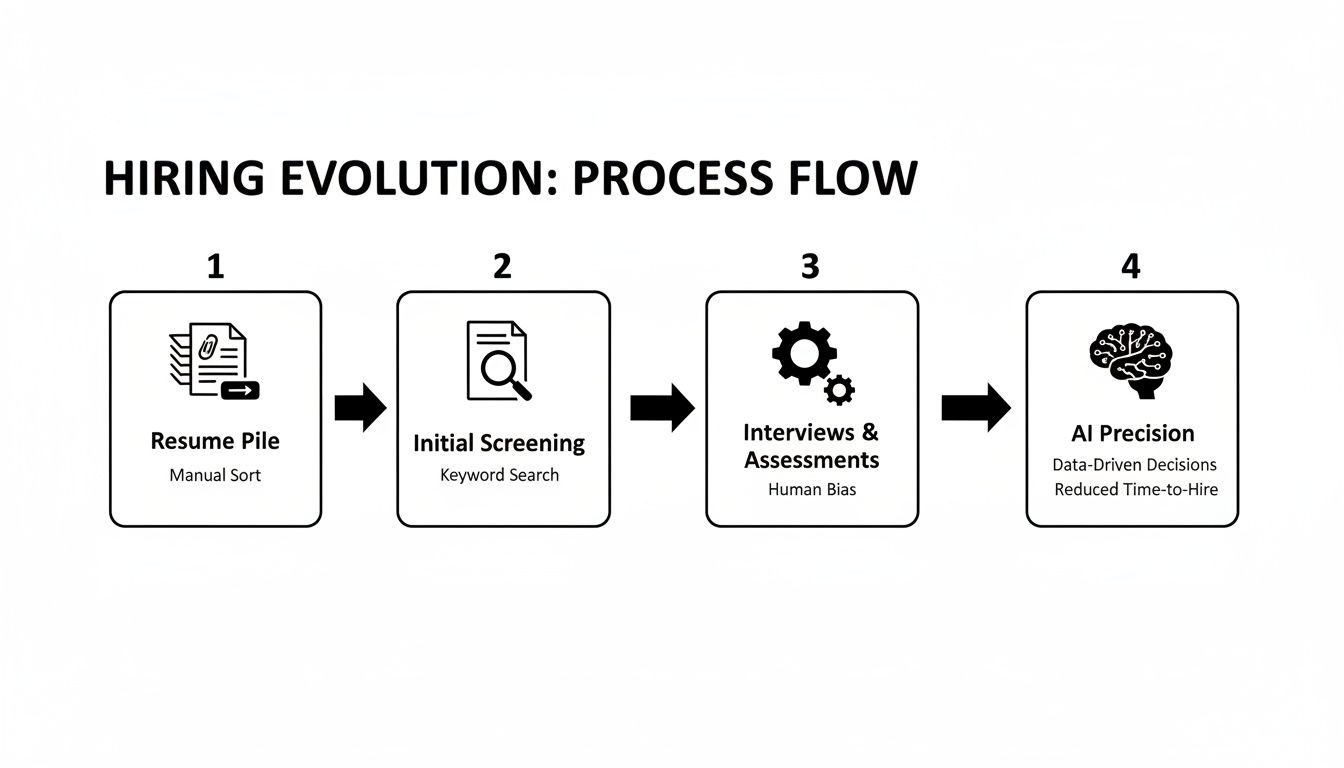
The transition really highlights the shift away from slow, subjective methods towards a data-driven model that puts skills and efficiency first.
The demand for these smarter hiring methods is accelerating fast, especially in high-growth markets. Take India’s AI revolution, which is set to create over 1 million jobs by 2026 and completely reshape technology hiring. Despite ranking first globally in AI skill penetration, the country faces a projected shortfall of 1.4 million AI professionals, with a staggering 51% of AI/ML roles currently unfilled. This massive skills gap makes AI-powered sourcing and screening a necessity, not just a nice-to-have. You can read more about these projections from ETEdge Insights.
Assessing Real-World Abilities
The assessment stage is where AI helps measure what truly matters: can the candidate actually do the job? Traditional interviews can be subjective, but AI introduces a layer of objectivity and standardisation that’s tough to achieve manually.
AI-driven assessments don’t just ask about skills; they validate them. By evaluating candidates on their actual ability to solve real-world problems, organisations can make hiring decisions with far greater confidence.
Modern AI platforms deliver dynamic, role-specific challenges that simulate on-the-job tasks. A few examples include:
- Coding Sandboxes: For developers, these platforms present real coding problems and evaluate the solution’s efficiency, accuracy, and style.
- Situational Judgement Tests: AI can present candidates with realistic work scenarios and analyse their responses to gauge problem-solving and decision-making skills.
- Automated Video Interviews: These tools can conduct initial interviews, asking consistent questions to all candidates and using natural language processing to analyse responses for key competencies.
Personalising Offers and Onboarding
Finally, AI helps smooth out the last mile of the hiring journey. After you’ve identified your top candidate, AI can help personalise the offer and onboarding experience to significantly boost acceptance rates.
By analysing market data, AI can suggest competitive compensation packages perfectly tailored to the candidate’s skills and location. Once an offer is accepted, AI-powered chatbots can guide new hires through the onboarding maze, answering common questions and making sure all the paperwork is completed seamlessly. This creates a positive and welcoming experience from day one, setting the stage for long-term success and retention.
Why AI is a Strategic Imperative for Tech Leaders
For tech leaders and Chief Human Resources Officers (CHROs), weaving AI into the hiring process isn’t about getting a slight edge anymore—it’s a matter of survival. The old ways of recruiting are simply too sluggish and hit-or-miss for the fast-paced world of tech talent. Making AI part of your strategy is a fundamental necessity that changes how you plan for, attract, and keep your most important asset: your people.
This isn’t just an upgrade; it’s a total transformation. It shifts talent acquisition from a reactive function that costs money to a proactive, smart engine that drives business growth. For company leaders, this means finally getting a clear view of insights that used to be buried in spreadsheets or based on gut feelings.
Empowering Data-Driven Workforce Planning
AI-powered hiring platforms give you a sharp, real-time picture of the entire talent landscape. Leaders can instantly pull up key data points and analytics, turning workforce planning from a guessing game into a precise science.
This newfound clarity leads to much smarter strategic decisions. Imagine being able to:
- Track Diversity Metrics in Real-Time: AI tools can scan your candidate pipeline to spot and fix diversity gaps, making sure your hiring actually matches your company’s DE&I commitments.
- Optimise Cost-Per-Hire: By automating the tedious, time-draining tasks and showing you which sourcing channels actually work, AI brings recruitment costs down significantly.
- Predict Future Talent Needs: Predictive analytics can look ahead and forecast the skills your organisation will need down the road. This lets you start building talent pipelines before you’re facing a critical shortage.
This kind of insight gives CHROs a stronger voice in the boardroom. They can now have strategic conversations backed by hard data, drawing a direct line from talent acquisition to business results.
Elevating the Role of RPO Partners
For Recruitment Process Outsourcing (RPO) providers, AI is a complete game-changer. It elevates their role from just filling seats to becoming a deeply strategic partner. An RPO armed with AI doesn’t just find people; it gives its clients a serious competitive advantage in the war for talent.
This evolution is happening at a critical time, as companies increasingly rely on specialised leaders to steer their tech strategy. The market is making a huge move towards skills-based hiring over traditional pedigree. A massive 83% of Indian organisations are expected to appoint dedicated AI executives by 2026, and another 15% are planning to hire Chief AI Officers. This executive pivot is a direct answer to a staggering 1.4 million AI talent shortfall, which is putting immense pressure on mid-to-senior level hiring. You can dive deeper into these talent predictions by reading the full 2026 job predictions report from Zyoin.
The collaboration between a tech leader and an AI-enabled RPO creates a powerful synergy. Together, they build a future-proof talent acquisition engine that moves far beyond simply filling empty seats and drives long-term organisational success.
From Transaction to Strategic Partnership
AI-powered RPOs can offer a much more sophisticated level of service. They use advanced tools to deliver:
- Deeper Market Intelligence: AI crunches data on market trends, salary benchmarks, and what competitors are doing, giving clients insights they can actually use.
- Predictive Hiring Forecasts: By modelling hiring data, RPOs can help clients see what’s coming and proactively build pools of talent for future needs.
- Faster Access to Higher Calibre Talent: AI sourcing tools are brilliant at uncovering top-tier passive candidates—the ones who aren’t actively looking but are perfect for the role. This gives clients faster access to better-quality talent.
Ultimately, this partnership changes the entire hiring process. It’s no longer a one-off task to fill a current vacancy. It becomes a continuous, strategic effort to build the skilled, adaptable, and diverse workforce your company needs to succeed in a world of constant technological change. Once you understand how AI is changing technology hiring models, the message is clear: standing still is not an option.
Navigating the Risks and Ethics of AI in Hiring
While AI brings incredible power to technology hiring, it also hands us a hefty dose of responsibility. Jumping into AI-driven recruitment without a solid ethical framework is like sailing in uncharted waters without a compass—you might move fast, but you could be heading straight for a storm. For tech leaders, getting a grip on these risks isn’t just about ticking compliance boxes; it’s about building a hiring process that’s fair, transparent, and trustworthy.
To really make AI work for you, there are three critical areas you need to tackle head-on. These aren’t just technical glitches; they are fundamental challenges that get to the heart of fairness, security, and the all-important human side of recruitment.
Confronting Algorithmic Bias
The single biggest ethical landmine is algorithmic bias. An AI model is only as smart as the data it’s fed. If your company’s historical hiring data carries unconscious biases—maybe favouring candidates from certain universities or backgrounds—the AI will learn and then amplify those very same patterns, but on a massive scale.
Just imagine an AI trained on a decade of data from a company that almost exclusively hired male engineers. The algorithm could wrongly conclude that being male is a key marker for success and start automatically downgrading highly qualified female candidates. This kicks off a biased feedback loop that becomes incredibly difficult to break.
To get ahead of this, you have to be proactive:
- Conduct Regular Data Audits: Scrutinise your training data to find and weed out any skewed or unrepresentative information before it poisons the AI.
- Demand Transparency: Only partner with vendors who offer Explainable AI (XAI). These are systems that can give you clear reasons for their recommendations, pulling you out of the “black box” guesswork.
- Maintain Human Oversight: Always have a human recruiter review AI-shortlisted candidates. This person acts as the final sanity check against algorithmic mistakes and adds crucial context.
The core principle is simple: AI should be a tool to reduce human bias, not a machine to automate it. Without careful governance, you risk cementing past inequalities into your future hiring decisions.
Upholding Data Privacy and Security
Recruitment means handling a huge amount of sensitive personal information, from résumés to assessment scores. Bringing AI into the mix adds another layer of complexity to data management, making privacy and security non-negotiable. A data breach doesn’t just tarnish your brand’s reputation; it can land you in serious legal and financial trouble.
Choosing the right vendor is a massive decision here. You have to be certain they follow strict data protection standards and are completely transparent about how they store, process, and secure candidate data. Getting this wrong exposes both your company and your applicants to needless risk. If this is a hurdle for you, it might be helpful to look into the common AI recruitment challenges that organisations are facing today.
Protecting the Candidate Experience
Finally, there’s a real danger that leaning too heavily on automation can make the hiring process feel cold, impersonal, and downright frustrating for candidates. Technology should enhance the human touch, not get rid of it. A bad experience can scare top talent away and do lasting damage to your employer brand.
The key is to find the right balance. Use AI for the high-volume, repetitive stuff, but keep human interaction where it truly matters—in building relationships, having meaningful conversations in interviews, and giving personalised feedback.
Be open with candidates about where and how you’re using AI in the process. Clear communication and giving them a way to provide feedback shows you respect their time and effort. This balance ensures you get the efficiency gains you want without treating people like just another data point.
Measuring the ROI of Your AI Hiring Strategy
Bringing AI into your recruitment process is more than just a tech upgrade; it’s a business decision that needs to deliver a clear return. To justify the investment and make a solid case for doing more, you need to track its return on investment (ROI). This goes way beyond just hiring faster – it’s about looking at how AI really impacts your efficiency, the quality of people you bring in, and your bigger company goals.
Think of it like swapping out the engine in a car. You wouldn’t just clock its new top speed. You’d also look at its fuel economy, how much you’re saving on maintenance, and its overall reliability. In the same way, a smart AI hiring strategy adds value on multiple levels, and you need to measure the whole picture.
Focusing on Efficiency Metrics
The first and most obvious wins from AI in hiring usually pop up in your efficiency numbers. These are the metrics that directly point to savings in time and money, making them a fantastic way to show quick ROI. AI takes over the high-volume, repetitive work that eats up a recruiter’s day, and the improvements can be huge.
Key efficiency metrics to keep an eye on include:
- Time-to-Fill: AI speeds up the heavy lifting of sourcing and screening, which can slash the average time it takes to fill a role. Some organisations have seen this metric fall by as much as 50%.
- Cost-per-Hire: By automating manual tasks and finding the best sourcing channels, AI cuts down your operational spend. This naturally leads to a lower overall cost for every great person you hire.
Evaluating Quality Metrics
Speed is great, but the real prize is hiring better people. Quality metrics help you prove that AI isn’t just about filling roles faster, but filling them with the right individuals who will stick around and make an impact. These numbers connect your hiring choices to actual business outcomes.
An AI-powered hiring model should do more than just make things smoother; it must raise the bar for the talent joining your organisation. Measuring quality-of-hire is your proof that efficiency isn’t coming at the cost of long-term performance.
To get a handle on this, focus on:
- Quality-of-Hire: You can measure this through things like performance reviews for new hires, retention rates after the first year, and direct feedback from hiring managers. A jump in quality-of-hire is a powerful sign that AI is helping you make smarter, data-backed decisions.
- Offer Acceptance Rate: A slick, personalised hiring process driven by AI creates a much better candidate experience. This often leads directly to a higher offer acceptance rate, showing that top candidates are choosing you over the competition.
Of course, tracking these metrics is the key to understanding the full value AI brings. Below is a breakdown of the key performance indicators that matter most.
Key Metrics For Evaluating AI Recruitment ROI
This table showcases the key performance indicators (KPIs) that organisations should track to measure the impact of their AI hiring initiatives.
| Metric Category | Specific KPI | How AI Impacts It |
|---|---|---|
| Efficiency Metrics | Time-to-Fill | Automates sourcing and screening, shortens interview scheduling, and identifies qualified candidates faster. |
| Cost-per-Hire | Reduces manual labour costs, optimises ad spend by targeting the right channels, and lowers administrative overhead. | |
| Quality Metrics | Quality-of-Hire | Uses data to match skills and potential to role requirements, leading to better long-term performance. |
| Offer Acceptance Rate | Improves candidate experience with faster communication and a more personalised process, making offers more attractive. | |
| First-Year Attrition | Predicts candidate success and cultural fit more accurately, reducing the number of hires who leave within a year. | |
| Strategic Metrics | Diversity & Inclusion | Can be configured to anonymise profiles and focus on skills, helping to reduce unconscious bias in screening. |
| Candidate NPS (cNPS) | Provides instant, 24/7 communication via chatbots and automated updates, keeping candidates engaged and informed. | |
| Sourcing Channel Effectiveness | Analyses data to show which sources deliver the best candidates, allowing for smarter budget allocation. |
By consistently tracking these KPIs, you can build a comprehensive view of your ROI, moving the conversation from “How much does it cost?” to “Look at the value it creates.”
Tracking Strategic Metrics
Finally, strategic metrics show how AI helps you achieve the big-picture goals that matter to leadership, like building a more diverse team or strengthening your reputation as an employer. These are the high-level numbers that prove the lasting, game-changing value of your AI investment.
A couple of key strategic metrics are:
- Diversity and Inclusion: AI tools can be set up to hide personal details and focus only on skills and experience, which helps minimise unconscious bias. Keep a close watch on the diversity stats in your candidate pipeline and among new hires to demonstrate real progress.
- Candidate Net Promoter Score (cNPS): This is all about how candidates feel after interacting with your hiring process. AI-powered chatbots and automatic status updates keep people in the loop and feeling valued, which can seriously boost your cNPS and make your employer brand shine.
Your Roadmap to Implementing AI in Hiring
Making the move to an AI-powered hiring model is a big step, but it doesn’t have to be a daunting one. The key is to see it as a phased journey, ensuring a smooth and successful integration. This roadmap gives you a clear, step-by-step guide to building a smarter, more effective tech recruitment engine.
Think of this process not as flipping a switch, but as carefully laying down a new foundation. Each stage builds on the last, giving your team time to adapt, learn, and see the value for themselves before you commit to a full-scale overhaul.
Phase 1: Assessment and Goal Setting
Before you even glance at any software, you need to know your starting point. Kick things off with a thorough audit of your current hiring process. Get honest about the biggest bottlenecks, pain points, and areas where you’re losing efficiency.
Is your team getting buried under résumés for high-volume tech roles? Is your time-to-fill metric falling behind industry standards? Nailing down these problems lets you set specific, measurable goals for your AI rollout. For example, a goal might be to reduce screening time by 75% or to improve the diversity of shortlisted candidates by 20% within six months.
Phase 2: Vendor Selection and Pilot Programme
With clear goals in hand, you can start looking at potential technology partners. Choosing the right vendor is absolutely crucial, so you need to look past the marketing noise. A key part of how AI is changing technology hiring models is the sheer variety of solutions out there; finding the perfect fit is everything. You can learn more about picking the right tools by checking out different AI recruitment platforms and what they bring to the table.
Create a checklist to compare vendors on the things that really matter:
- Ethical Safeguards: Does the vendor offer transparent, explainable AI (XAI) to help tackle bias?
- Integration Capabilities: How easily will the platform plug into your existing applicant tracking system (ATS) and other HR tech?
- Scalability: Can the solution grow with you, from a small pilot to an enterprise-wide system?
- Support and Training: What kind of ongoing support will the vendor provide to make sure your team succeeds?
Once you’ve shortlisted a vendor, don’t dive into a full rollout. Instead, launch a small-scale pilot programme. Pick one or two specific roles and run the AI tool in parallel with your traditional process. This lets you test its actual effectiveness, get feedback from your team, and build a solid business case based on real results.
Implementing AI isn’t a one-and-done project; it’s an ongoing cycle of improvement. Treat your initial rollout as the beginning of a continuous optimisation journey, where data guides your every move.
Phase 3: Change Management and Training
Technology is only half of the equation; your people are the other. A successful AI adoption depends on brilliant change management. Your recruitment team will likely have valid concerns about how their roles might change, so it’s vital to communicate the “why” behind this shift.
Frame AI not as a replacement for recruiters, but as a powerful assistant that frees them from repetitive, administrative tasks. This lets them focus on more strategic work, like building genuine relationships with candidates and acting as a trusted advisor to hiring managers. Provide comprehensive training to ensure everyone feels confident and competent using the new tools.
Phase 4: Continuous Optimisation
Your work isn’t finished after the rollout. The most successful organisations treat this as a continuous process of refinement. Regularly review your key metrics—time-to-fill, quality-of-hire, candidate satisfaction—to see how you’re performing against your initial goals.
Use these insights to fine-tune your AI models and workflows. This data-driven approach ensures your hiring engine gets progressively smarter and more efficient over time, delivering better results and strengthening your competitive edge in the talent market.
Frequently Asked Questions
Jumping into AI-driven recruitment is a big move, and it naturally brings up some important questions. For tech leaders and CHROs thinking about this shift, getting to grips with the practical side of things is crucial for making smart, confident decisions. Here are the answers to the most common queries we hear.
Getting these questions answered helps turn the big idea of “AI in hiring” into a practical tool for your business. The real goal is to strike the right balance between smart automation and the human judgment you can’t replace.
Will AI Completely Replace Human Recruiters in Tech Hiring?
Not a chance. AI is here to help human recruiters, not make them obsolete. Think of it as a powerful assistant that takes on the high-volume, repetitive tasks—like sifting through hundreds of résumés, doing initial candidate matching, and scheduling interviews.
This frees up your recruitment team to do what they do best: building genuine relationships with candidates, digging into cultural fit, and advising hiring managers on those tricky, nuanced decisions. The future isn’t about machines taking over; it’s a partnership. AI provides the speed and data, while your people bring the empathy, strategy, and final say.
How Can We Ensure Our AI Hiring Tools Are Free From Bias?
This is the big one, and making sure your process is fair is non-negotiable. First off, you need to demand transparency from your vendors. Ask them how their algorithms are built and, more importantly, how they’ve been tested for bias. Look for tools with Explainable AI (XAI), which can actually show you why a certain recommendation was made, so you’re not just dealing with a “black box.”
Next, you have to keep an eye on how your AI is performing over time. Regularly compare the diversity of your shortlisted candidates against your total applicant pool. If you spot any strange patterns or emerging biases, you can step in and correct them. And finally, always keep a human in the loop for the final hiring decision. AI should be a tool that supports your team, not a replacement for their critical judgment.
The best setup is an augmented intelligence model. AI does the heavy lifting with the data, while your team provides the essential context, empathy, and strategic thinking that machines just can’t replicate.
What Is the First Practical Step to Start Using AI in Recruitment?
The smartest way to begin is to start small. Run a focused pilot programme that tackles a specific, high-impact problem. For most tech companies, the biggest headache is the sheer number of applications you get right at the top of the hiring funnel.
Because of this, bringing in an AI-powered résumé screening tool is usually the most effective first move.
- Pick a few high-volume roles to be your testing ground.
- Run the AI tool at the same time as your usual manual process so you can compare them directly.
- Check the results. Look at the speed, the quality of the candidates who get shortlisted, and what your recruiters think of the process.
This approach lets you show some quick wins, get your team on board, and learn some valuable lessons before you even think about a full, company-wide rollout.
At Taggd, we specialise in building future-ready talent acquisition strategies that merge the power of AI with the expertise of seasoned recruitment professionals. Discover how our RPO solutions can transform your technology hiring by visiting https://taggd.in.