For CHROs, the conversation around hiring legal counsel has fundamentally changed. It’s no longer about just plugging a gap in risk management. Today, it’s about finding a strategic partner who can navigate the complexities of a fast-evolving market and turn compliance into a genuine competitive advantage. We’re talking about hyper-specialised talent in fields like data privacy and corporate governance.
The right legal hire is no longer a cost centre. They are a critical driver of business growth.
Why Strategic Legal Hiring Is Your New Top Priority

The days when the legal team was a siloed department, only brought in when a fire started, are well and truly over. For Chief Human Resources Officers in India, the mandate has shifted. The legal function is now a proactive, strategic pillar of the organisation, and getting this hire right has become a top-tier business imperative.
This isn’t just a trend; it’s a direct response to an increasingly complex and unforgiving regulatory minefield. Sweeping new laws are completely reshaping how businesses operate, demanding far more than a generalist’s grasp of the law.
The New Regulatory Minefield
Just look at the impact of recent Indian regulations. The Digital Personal Data Protection (DPDP) Act has single-handedly rewritten the rules on data handling, privacy policies, and consent management. A misstep here isn’t just about facing fines; it’s about eroding customer trust and permanently damaging your brand.
Then you have the new Bharatiya Nyaya Sanhita (BNS), which replaces archaic criminal codes with modernised laws that have huge implications for corporate liability and governance. To navigate these waters, you need a legal expert who isn’t just up-to-date, but who can translate dense legal text into actionable business strategy.
The core challenge for CHROs is to hire legal counsel who can do more than just interpret laws. They need professionals who can anticipate regulatory shifts, advise on product development, and guide corporate strategy to turn compliance into a competitive edge.
It’s become incredibly clear that hiring a generalist lawyer is no longer a winning strategy for ambitious companies.
The table below breaks down some of the key regulatory changes in India and the specialised skills they now demand from legal hires.
Key Regulatory Drivers Shaping Legal Hiring in 2026
| Regulatory Change | Required Legal Specialisation | Business Impact |
|---|---|---|
| Digital Personal Data Protection (DPDP) Act | Data privacy law, technology contracts, incident response planning. | Alters data collection, storage, and processing; requires robust consent mechanisms and data breach protocols. |
| Bharatiya Nyaya Sanhita (BNS) | Updated corporate criminal liability, procedural law, and internal investigations. | Changes how corporate fraud, negligence, and other offences are prosecuted, increasing director and officer liability. |
| ESG Reporting Mandates (BRSR) | Environmental law, corporate governance, sustainable finance, and disclosure regulations. | Mandates detailed reporting on environmental, social, and governance performance, affecting investor relations and brand reputation. |
These regulations are not just legal hurdles; they are strategic challenges that demand specialised legal expertise to navigate successfully.
From Cost Centre to Business Enabler
The market is already voting with its feet. Forward-thinking organisations are actively beefing up their legal departments, recognising them as crucial partners in hitting business goals. This is a massive mindset shift from the old view of legal as a necessary but expensive overhead.
In fact, Indian businesses are projected to increase their hiring of in-house legal counsel by an impressive 11% in aggregate intent in 2026. You can explore more on these corporate legal job trends to get a better sense of the market. This investment isn’t just about adding headcount; it’s about acquiring specific, high-value expertise that drives the business forward.
As a CHRO, embracing this paradigm shift is your first and most critical step. Your ability to identify, attract, and hire legal counsel with the right specialisations will directly impact your company’s resilience, agility, and long-term growth. The goal is simple: build a legal function that not only protects the business but actively propels it forward.
Defining the Modern Legal Role You Actually Need
Before you write a single line of a job description, stop. The most common trap CHROs fall into when they decide to hire legal counsel is rushing the process without defining what success in the role actually looks like for their business. Generic JDs attract generic candidates; strategic organisations map their legal needs directly to business goals.
The first step is to move beyond broad titles. Are you just looking for a “lawyer,” or do you need a specialist who can navigate the complex web of the Digital Personal Data Protection (DPDP) Act for your new app launch? The difference is critical.
Generalist vs Specialist: A Crucial Distinction
Think of it like this: a General Counsel is like a family doctor, fantastic for overall corporate health, managing routine check-ups, and knowing exactly when to call in a specialist. But a specialist, like a Data Privacy Officer or a Corporate Litigation expert, is the surgeon you bring in for a specific, high-stakes procedure.
Consider these real-world situations:
- A fintech firm on the verge of launching a new lending product doesn’t just need a lawyer. It needs someone who lives and breathes the Reserve Bank of India’s latest directives on digital lending and NBFC compliance.
- A manufacturing giant aiming to hit ambitious sustainability targets requires an ESG expert. This person must understand the fine print of the National Green Hydrogen Mission and be able to translate it into actionable corporate policy.
In both these cases, a generalist would be completely out of their depth. The wrong hire leads to reactive, inefficient legal support that costs you time, money, and missed opportunities.
The goal isn’t to find a lawyer who knows a little about everything. It’s to find the expert who knows everything about the one or two areas that pose the biggest risk or offer the greatest strategic advantage to your company.
Getting to this level of clarity means taking a deep dive into your business’s vulnerabilities and growth plans. What’s keeping your CEO up at night? Is it the threat of a data breach, a tricky cross-border merger, or a looming intellectual property dispute? The answer points you directly to the kind of specialist you need. For more on building a solid legal foundation, you can explore the fundamentals of legal and compliance functions to better understand their strategic importance.
Building a Detailed Role Charter
Once you’ve pinpointed the core specialisation, it’s time to build a detailed role charter. This document is much more than a job description. It’s your internal blueprint, making sure the entire leadership team is aligned on the purpose and expectations for this critical hire.
A strong role charter should clearly outline:
- Strategic Imperatives: Which specific company goals will this role drive? (e.g., “Ensure 100% compliance with the DPDP Act for the launch of Project X” or “Reduce external litigation costs by 30% within two years.”)
- Key Competencies: What are the non-negotiable technical skills? (e.g., “Must have hands-on experience structuring venture debt deals” or “Proven track record in managing SEBI investigations.”)
- Business Acumen: How will they operate as a true business partner? This covers skills like cross-functional collaboration, risk-weighted decision-making, and the ability to explain complex legal issues to a non-legal audience.
- First-Year Success Metrics: What does this person absolutely have to accomplish in their first 3, 6, and 12 months to be seen as a success? Setting clear, measurable KPIs from the very beginning is vital.
Creating this charter forces you to think with precision. It transforms the hiring process from a vague search for a “good lawyer” into a targeted mission to find the right strategic legal partner. This document becomes your North Star, guiding your sourcing, assessment, and interviewing to ensure you attract and identify a candidate who is perfectly aligned with your business needs from day one.
Okay, you’ve meticulously defined the perfect legal role. Now comes the real challenge: where do you actually find this person?
When you need to hire legal counsel with specialised skills, a reactive “post and pray” approach is a recipe for failure. The market is just too competitive. You need a proactive, strategic game plan that weighs the pros and cons of building your own team versus tapping into external experts.
As a CHRO, this is one of your most critical decisions. It’s not just a budget line item; it’s a strategic choice that shapes your company’s legal agility, expertise, and long-term direction. Let’s break down the two main paths and figure out which one makes sense for you.
In-House vs External Counsel: A Critical Choice
Building an in-house legal team is a major investment. You’re bringing on a dedicated resource who will live and breathe your business, developing deep institutional knowledge. This person is right there in the trenches, understanding the commercial drivers behind legal questions and giving instant advice to leadership.
The flip side? It comes with the significant fixed cost of a salary, benefits, and long-term overhead. And even with a great in-house lawyer, you’ll probably still need to bring in outside specialists for really niche or high-stakes issues.
Relying on an external law firm gives you a deep bench of experts you can call on anytime. This model is all about flexibility, you pay for what you need, when you need it. It’s perfect for complex M&A deals or major litigation where you need top-tier firepower without the long-term commitment.
But there are downsides. External counsel rarely has the same level of business immersion as an in-house lawyer. Their advice can be legally sound but commercially naive. And for day-to-day legal support, the billable hours can quickly become unsustainable.
To help you map out the best approach, this table breaks down the key factors to consider when deciding between hiring an in-house lawyer and engaging an external firm.
In-House Counsel vs External Law Firm: A Strategic Comparison
| Factor | In-House Counsel | External Law Firm | Strategic Recommendation |
|---|---|---|---|
| Cost Structure | High fixed costs (salary, benefits). Predictable annual spend. | Variable costs based on billable hours. Can be very high for complex matters. | Use in-house for predictable, ongoing work. Use external firms for high-stakes, infrequent projects. |
| Business Acumen | Deep understanding of company culture, goals, and risk tolerance. | Limited business context. Advice is often purely legal, not commercial. | Rely on in-house counsel for strategic advice that balances legal risk with business objectives. |
| Availability | Immediately accessible for day-to-day advice and emergencies. | Availability depends on the firm’s other client commitments. | An in-house team is crucial for businesses needing constant, real-time legal guidance. |
| Specialised Expertise | Expertise is limited to the individual’s background. | Access to a wide range of specialists across various legal domains. | A hybrid model works best: an in-house generalist supported by a panel of specialised external firms. |
| Long-Term Alignment | Fully aligned with the company’s long-term strategic goals. | Transactional relationship focused on specific legal tasks. | Build an in-house team to foster a proactive, strategic legal function that grows with the business. |
Ultimately, a purely in-house or purely external model rarely works for a growing company.
The most effective solution is often a hybrid model. This means having a core in-house team to manage daily operations and strategic oversight, backed by a roster of trusted external firms for hyper-specialised or high-volume work. It’s a powerful blend of dedicated partnership and on-demand expertise.
Getting this structure right starts with defining the roles clearly. This process map shows how to translate your high-level business goals into a concrete role charter that will guide your entire search.
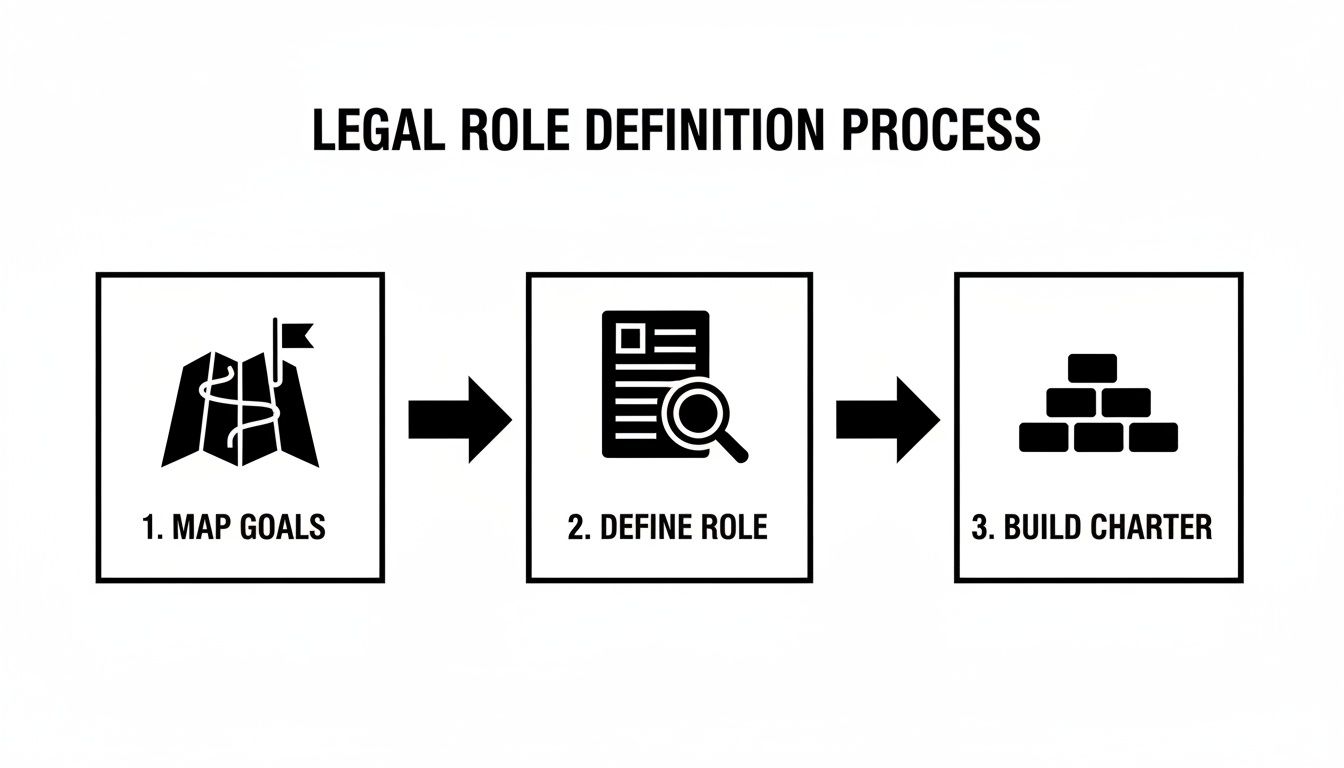
As you can see, a successful legal hire doesn’t happen by accident. It’s the result of a structured approach that connects every aspect of the role back to what the business is trying to achieve.
Tapping into New Talent Pools
The traditional legal talent hubs like Mumbai and Delhi are incredibly saturated. The competition is fierce, and the costs are soaring. Smart organisations are now looking beyond the usual suspects to Tier-2 cities like Pune and Ahmedabad.
These emerging markets offer access to a growing base of skilled legal professionals, often at a more sustainable cost. But making this move requires sharp market intelligence.
An RPO partner like Taggd can give you the ground-level data you need on talent density, compensation benchmarks, and the competitive landscape in these cities. This helps you make an informed decision on where to build or expand your legal team. This kind of informed strategy is especially critical for senior roles, a topic we cover in our guide to executive search best practices.
The Rise of Law Firm Poaching
There’s another major trend you can’t ignore: the growing demand for corporate lawyers who have cut their teeth at a law firm. For many MNCs, this has become a non-negotiable requirement.
We estimate that 15-20% of middle-management legal hires now require previous law firm experience. This is especially true in high-growth sectors like TMT (Technology, Media, and Telecom), projects, and banking. You can read the full research about the state of legal careers to get a deeper insight into this trend.
Why the demand? These candidates bring a level of technical rigour, commercial sharpness, and high-stakes transactional experience that’s tough to replicate in a purely in-house environment.
Winning this talent requires more than just a good salary. These professionals are used to hefty compensation packages and a high-performance culture. Your sourcing strategy needs a compelling value proposition that highlights career growth, strategic influence, and a better work-life balance, three areas where corporate roles can genuinely outshine the grind of law firm life.
Here’s how you separate the true legal strategists from the book-smart technicians.
Identifying an elite legal mind goes way beyond a fancy law degree and a polished CV. When you hire legal counsel, you’re not just bringing on a lawyer; you’re recruiting a strategic business partner. Your entire assessment process has to be built around finding that crucial difference.
The interview is where you make this distinction. The real goal isn’t just to test their legal knowledge, but to probe their commercial awareness, their problem-solving instincts, and how they communicate under pressure. This means ditching the standard, tired “tell me about a time when…” questions.
Instead, you need to build your interview framework around real-world scenarios and sharp behavioural questions that simulate the actual challenges they’ll face in your organisation. This is how you find out if they have the mix of technical chops and business foresight you actually need.
Moving Beyond Technical Questions
Any qualified candidate can recite a section from a statute. An elite one can apply that statute to a messy, high-stakes business problem and guide your leadership team to a commercially smart solution. The key is to see how they think.
Your assessment should really zero in on three core areas:
- Legal Acumen and Application: How do they connect their technical knowledge to practical, real-world scenarios where the stakes are high?
- Commercial and Business Insight: Do they get the financial and operational fallout of their legal advice? Can they strike the right balance between managing risk and seizing an opportunity?
- Communication and Influence: Can they break down complex legal jargon for non-lawyers and actually persuade stakeholders to follow their guidance?
A candidate who nails all three is the one who will create genuine value. They won’t just tell you what the law says; they’ll tell you what your business should do.
A great in-house counsel doesn’t just say “no.” They say, “Here is the risk, but here are three alternative paths we can take to achieve our business goal while managing that risk.” This problem-solving mindset is what you must screen for.
Behavioural Questions to Uncover Core Competencies
Behavioural questions are powerful because they use past performance as a solid predictor of future success. Make sure you tailor your questions directly to the specific competencies you laid out in your role charter.
Try using prompts that really dig into their experience:
- “Describe a time you had to give difficult legal advice to a senior executive who was pushing back. What was the situation, how did you handle it, and what was the final outcome?”
- “Walk me through the most complex contract you’ve ever negotiated. What made it so challenging, and what was your exact role in getting it over the line?”
- “Tell me about a situation where you had to get up to speed on a completely new area of law, fast. What was your process, and how did you apply that new knowledge?”
Listen for answers that are structured and packed with specifics. The best candidates will clearly lay out the situation, the task they were given, the action they took, and the result of their efforts. Vague, rambling answers are a huge red flag.
Scenario-Based Questions to Test Real-World Judgment
This is where you truly see if a candidate can think on their feet. Give them a hypothetical but realistic business problem that’s tailored to your industry and its current headaches. The point isn’t to get a perfect answer, but to see how they analyse the problem.
Here are a few potent examples:
- For a Data Privacy Role: “Imagine our marketing team is eager to launch a new loyalty programme that involves collecting significant user data. Walk me through how you would advise them on staying compliant with the DPDP Act, from the initial design right through to launch.”
- For a Corporate Governance Role: “Our company is eyeing a major acquisition in Southeast Asia. How would you structure the due diligence process to uncover and mitigate the key legal risks, especially around anti-corruption and local labour laws?”
- For an ESG-focused Role: “The board is feeling the pressure from investors to significantly improve our ESG ratings. Outline the first 90-day plan you would put in place to assess where we stand and build a roadmap for improvement.”
So, what should you listen for? You’re looking for a blend of technical accuracy, strategic thinking, and clear communication. A top candidate will identify the core legal issues, weigh the commercial pros and cons, and lay out a clear, actionable plan. That comprehensive approach is the hallmark of someone who can be a true business partner and guide your organisation effectively.
Benchmarking Compensation and Crafting an Irresistible Offer
You’ve found them. The perfect candidate, a legal mind with sharp commercial instincts and the specialised expertise your business desperately needs. Now comes the moment of truth: making an offer they simply can’t refuse.
In today’s market, a half-hearted attempt to hire legal counsel is a surefire way to fail. You need to come to the table with a compelling, data-backed compensation package that proves you understand their strategic value. Get this wrong, and you’ll lose your top choice, often to a competitor and have to restart the entire gruelling search.
Get it right, and you secure a vital business partner who will safeguard and drive your company’s growth for years. The stakes are incredibly high.
Understanding the Current Salary Landscape
First things first, you have to anchor your offer in reality. Compensation for legal professionals in India isn’t static; it’s a dynamic field shaped by specialisation, years of experience, and even tech-savviness. Relying on outdated salary bands is a recipe for a swift rejection.
Today’s market puts a clear premium on niche skills. For instance, a fresher who can show demonstrable expertise in AI and its legal implications can command a starting package of ₹16-20 LPA. That figure directly reflects the huge demand for professionals who can navigate the complex intersection of law and technology.
At the other end of the spectrum, senior partners with massive books of business and deep industry sway are looking at compensation packages anywhere from ₹1.26 to ₹2.27 crore. These numbers show just how much top-tier organisations are willing to invest in strategic legal leadership.
When you decide to hire legal counsel, you aren’t just filling a vacancy; you’re making a strategic investment. Your offer has to reflect the real market value of the specific skills and experience you need, not just a generic job title.
The numbers for in-house roles are just as compelling. A General Counsel in India now commands an average salary of ₹37 lakhs. For leadership roles at top-tier MNCs and large Indian conglomerates, that figure can easily climb to ₹87.7 lakhs or more. This isn’t just about a base salary; it’s a total package that reflects their critical seat in the C-suite.
Structuring a Multi-Faceted Offer
A winning offer is about so much more than the base salary. Top legal talent looks at opportunities holistically. Your package has to be structured thoughtfully to appeal to their long-term professional and financial goals.
A truly comprehensive offer should weave together these four key components:
- Competitive Base Salary: This is the foundation. It must be accurately benchmarked against current market data for similar roles, industries, and locations. A lowball base signals that you don’t truly value the position.
- Performance-Based Bonus: This is what aligns your counsel’s success with the company’s bottom line. Tie bonuses to clear, measurable KPIs like litigation cost savings, successful M&A integrations, or hitting key compliance milestones.
- Long-Term Incentives (LTIs): For senior roles, equity, stock options, or phantom stocks are incredibly powerful retention tools. LTIs give your legal counsel a real stake in the company’s future, shifting their mindset from employee to owner.
- Non-Monetary Perks: Never underestimate the pull of a better work-life balance, real opportunities for professional development, a clear path for career progression, or a more influential seat at the table. For many lawyers trying to move from a demanding law firm environment, these factors can be just as persuasive as cash.
For a deeper dive into building effective compensation frameworks, you can learn more about the factors to consider for crafting customised compensation strategies in our detailed guide.
Navigating the Negotiation with Confidence
Expect to negotiate. The best candidates absolutely know their worth and will almost certainly have competing offers. You should approach this final stage not as a battle, but as a collaborative discussion to find common ground.
Be ready to be flexible, especially if you’ve found a truly exceptional candidate. Know your budget’s absolute ceiling, but also identify where you can get creative. Maybe you can’t bump the base salary, but you could offer a larger sign-on bonus or a more aggressive LTI package.
Ultimately, your ability to listen and respond strategically will be what closes the deal and helps you hire the legal counsel your organisation needs to thrive.
Onboarding Your New Counsel for Maximum Impact

The process to hire legal counsel isn’t truly finished when the offer letter gets signed. That’s just the end of one chapter. A strategic, structured onboarding plan is what will turn your great hire into a genuinely invaluable business asset.
A weak onboarding experience leaves your new counsel siloed, forcing them to guess at priorities and navigate the minefield of internal politics alone. A strong one, however, turbocharges their journey from a talented legal mind into a fully integrated strategic partner.
The First 90 Days: A Strategic Immersion
Forget the standard HR checklist of logins and office tours. Onboarding a legal leader correctly is a deep, strategic immersion into the very fabric of your business. The goal here is to arm them with the context they need to give proactive, commercially-minded advice.
Think of your 90-day plan as a roadmap, not a rigid schedule. It should focus on three core areas of discovery.
Business Acumen and Strategy (Days 1-30)
This first month is all about deep listening and learning. Your new counsel should be absorbing the company’s DNA.
- Meet with the C-Suite: Get one-on-one meetings scheduled with the CEO, CFO, and other key leaders. The mission is to grasp their strategic priorities, their biggest headaches, and how they see the legal function fitting in.
- Study the Business Plan: They have to understand the company’s financial goals, growth targets, and market positioning. This context is what turns theoretical legal advice into tactical, real-world guidance.
- Review Historical Risks: Give them access to past litigation files, major contract negotiations, and compliance audits. Understanding past challenges is the key to preventing future ones.
Operational Integration (Days 31-60)
The second month is about moving from the boardroom to the front lines. This is where your counsel learns how the business actually works, day in and day out.
Onboarding is not about paperwork; it’s about purpose. The faster your new counsel understands the business’s ‘why,’ the faster they can protect and enable its ‘how.’ True integration is achieved when they can anticipate a legal need before it even arises in a business unit meeting.
They need to meet with the heads of sales, marketing, product, and operations. These conversations are goldmines, uncovering the real-world operational hurdles and day-to-day legal questions that teams grapple with. It’s one thing to know the law; it’s another to know how it tangles with a product launch timeline.
Defining Success and Setting KPIs (Days 61-90)
By the third month, your new counsel should have enough context to start building their own strategic roadmap for the legal function. This needs to be a collaborative effort between them and you, the CHRO, to define exactly what success looks like.
Meaningful KPIs go way beyond simple activity tracking. They must be tied directly to business outcomes.
- Contract Turnaround Time: Measure the average time to review and finalise standard commercial agreements. Slashing this from 10 days to 5 days has a direct, positive impact on sales velocity.
- Litigation Cost Reduction: Set a clear target to reduce spending on external law firms by a specific figure, like 15%, through smarter risk management and earlier dispute resolution.
- Compliance Audit Scores: Aim for improved scores in internal and external audits, particularly for key regulations like the DPDP Act.
This 90-day framework ensures that when you hire legal counsel, you aren’t just filling a vacancy. You are strategically integrating a leader who is equipped, motivated, and aligned with your company’s mission right from the start.
FAQ’s
Even with the best playbook, hiring senior legal talent can throw up some tough questions. As a CHRO, you’re on the front line of this critical decision. Here are some of the most common questions we hear, along with the straight answers you need to hire legal counsel with confidence.
What Is the Biggest Mistake Companies Make?
Without a doubt, the single biggest error is hiring a generalist when you desperately need a specialist. It’s a classic square-peg-in-a-round-hole problem.
With regulations getting more complex every day, especially in areas like data privacy under the DPDP Act or corporate law under the BNS, a lawyer without deep, specific expertise isn’t just a bad hire, they’re a significant business liability. Before you even think about writing a job description, a thorough needs analysis is non-negotiable. This is the only way to pinpoint the exact specialisation you need to navigate your company’s unique regulatory minefield.
How Can I Assess a Candidate’s Business Acumen?
You have to move past the tired, purely legal hypotheticals. Instead, throw them a real-world business challenge your company could actually face.
For example, try this: “Our company wants to launch a new product using AI-driven analytics. Walk me through the key legal and compliance risks, and how you would advise the leadership team to proceed.”
Their answer will instantly tell you everything you need to know about their ability to balance legal risk with commercial goals. This skill is the true hallmark of a great in-house counsel, someone who acts as a strategic partner, not just a legal gatekeeper. A top candidate will offer solutions and pathways, not just roadblocks
When Should We Use an RPO Partner for Legal Hiring?
Bringing in a Recruitment Process Outsourcing (RPO) partner becomes a powerful strategic move when you’re under pressure to fill specialised, high-stakes legal roles. The talent pools are niche, the competition is fierce, and the salary benchmarks are high.
An RPO gives you immediate access to crucial market intelligence, an established network of candidates, and a structured assessment process that you might not have internally.
This is especially valuable when:
You’re scaling your legal team quickly.
You’re running a confidential leadership search where discretion is paramount.
You need to fill a role that demands a rare, in-demand specialisation.
Ultimately, an RPO partner frees up your time to focus on the final selection and high-level strategy, while they handle the heavy lifting of the search and vetting process.
Should We Prioritise Law Firm Experience?
This completely depends on what the role needs to achieve. A lawyer coming from a top-tier firm often brings exceptional technical rigour and experience with high-stakes transactions. This makes them a perfect fit for roles demanding deep specialisation in areas like M&A or complex litigation.
On the other hand, a seasoned in-house lawyer already has strong business acumen baked in. They know how to work across departments and think like a business leader.
If you need a technical powerhouse for a specific function, the law firm candidate might be your best bet. If you need a strategic leader to manage the entire legal function, an experienced in-house counsel is often a much better fit.
Ready to secure the elite legal talent your business needs to thrive? Taggd uses AI-powered sourcing and deep market intelligence to help you hire strategic legal counsel faster and more effectively. Connect with us and discover how our RPO solutions can transform your legal hiring process.