Project RPO is your go-to strategic weapon for high-stakes, time-sensitive hiring needs that have a clear start and finish. Think of it less like business-as-usual recruitment and more like deploying a specialist task force for a critical mission, whether that’s launching a new product or breaking into a new region.
Knowing When to Deploy a Recruitment Task Force

For a Chief Human Resources Officer (CHRO), the question is simple: when does it make more sense to bring in a focused, short-term recruitment partner instead of leaning on your in-house team? The answer almost always comes down to specific business moments that demand speed, precision, and specialised expertise your current resources simply can’t provide without being stretched to the breaking point.
Let’s say your organisation decides to launch a new technology division. This move requires hiring 75 specialised developers, data scientists, and product managers within six months. Your internal talent acquisition team is already swamped with day-to-day hiring. Handing them this massive project would completely overwhelm them. This is the classic trigger for Project RPO.
Identifying the Key Triggers
The need for a specialised hiring solution often pops up during very distinct business events. If you can recognise these signals early, you can act proactively instead of scrambling when the pressure is already on.
- Rapid Scaling for a New Initiative: When a new product line or service needs to get off the ground, you need a sudden influx of very specific talent. Project RPO gives you the horsepower to build that team quickly, without pulling focus from your core operations.
- Geographic Expansion: Moving into a new city or country brings a unique set of challenges, from understanding the local talent market to navigating compliance issues. A Project RPO partner comes equipped with that localised expertise to get your new location staffed up efficiently.
- Acquiring Niche Skills: When a project calls for highly specialised or hard-to-find skills (think AI specialists or cybersecurity experts), a project-based approach gives you instant access to recruiters who already have deep networks in these niche communities.
A key advantage of Project RPO is its ability to act as a strategic lever. It’s not just about filling seats; it’s about achieving a specific business objective on a defined timeline with measurable outcomes.
This model is fundamentally different from a long-term RPO partnership. It’s built for agility and immediate impact, providing an end-to-end recruitment solution with a defined start and finish line. The goal is clear: hit a specific hiring target, and then the engagement concludes. That’s flexibility at its best.
To help you visualise these scenarios, here’s a simple matrix outlining the most common situations where Project RPO shines.
Project RPO Decision Matrix: When Is It the Right Choice?
This table summarises the key business triggers, typical project scales, and strategic benefits that signal when Project RPO is the most effective talent acquisition solution.
| Business Trigger | Typical Scale & Duration | Primary Strategic Benefit |
|---|---|---|
| New Product/Service Launch | 20-100 hires over 3-9 months | Speed to market and access to specialised skills without long-term overheads. |
| Geographic Expansion | 30-150 hires over 6-12 months | Local market expertise and rapid team building in an unfamiliar talent landscape. |
| Tech Team Build-Out | 50-200+ hires over 9-18 months | Access to niche tech talent networks and the ability to scale recruitment up and down. |
| Post-Merger Integration | 25-75 hires over 4-6 months | Standardising roles and filling critical skill gaps quickly to ensure a smooth transition. |
This matrix isn’t exhaustive, of course, but it covers the core scenarios where CHROs find the most value in a project-based approach.
When Your Internal Team Is Stretched Thin
Pushing your HR department too hard leads to burnout, longer hiring cycles, and a poor candidate experience. If your team is already struggling to keep up, a sudden high-volume project can push them past their limit. You can learn more about the common signs you have outgrown in-house hiring to see if this sounds familiar.
Project RPO acts as the perfect reinforcement. It allows your internal team to keep focusing on their core duties while the external experts handle the surge. This targeted support ensures you hit your business goals without sacrificing quality or burning out your people.
What Exactly Is Project RPO?

Let’s cut through the jargon and get straight to what Project Recruitment Process Outsourcing (RPO) really is. Think about how a movie gets made. You don’t keep a full-time, permanent film crew on the company payroll, do you? Of course not. You bring together a specialist team—a director, a cinematographer, sound engineers—for that one specific shoot.
That’s Project RPO in a nutshell. It’s a focused, end-to-end recruitment drive with a clear start date, a definite finish line, and a single hiring goal. You’re not outsourcing your entire talent acquisition function forever; you’re bringing in a dedicated crew of recruitment experts to nail one specific hiring mission.
It’s a complete, self-contained service package designed for a particular initiative. A powerful tool when you know exactly what you need to get done within a fixed timeframe.
Defining the Scope of a Typical Project
A Project RPO engagement is far more than just sourcing a few CVs. It’s a deep partnership where an external team manages the entire recruitment lifecycle for an agreed-upon set of roles. They essentially become an embedded part of your talent team, but with a laser focus on your project’s success.
A typical Project RPO scope includes:
- Strategic Planning: Working alongside you to hammer out project goals, define role requirements, and build ideal candidate profiles.
- Sourcing and Attraction: Proactively hunting down and engaging both active job seekers and passive talent, using advanced tools and deep market intelligence.
- Screening and Assessment: Thoroughly vetting applicants to ensure they have the right technical skills and cultural fit before they ever get to your hiring managers.
- Interview Coordination: Managing the complex logistics of scheduling interviews, which can be a massive headache for busy internal teams.
- Offer Management: Handling the delicate process of negotiation and extending offers to your chosen candidates, ensuring you close the deal smoothly.
- Onboarding Support: Assisting with the initial onboarding phase to make the transition for new hires as seamless as possible.
If you want to dig deeper into the basics, our guide covers everything you need to know about RPO and its different models. Understanding the fundamentals helps to see exactly where this project-based approach fits in.
The core idea is simple: You get a dedicated, expert team fully responsible for delivering a specific hiring outcome. Once the project’s goals are met—for instance, once all 50 new sales roles are filled—the engagement concludes.
A Growing Solution for a Dynamic Market
This model is a perfect fit for fast-moving economies where businesses have to adapt to market shifts almost instantly. The Indian RPO market, for example, is projected to hit around USD 420 million by 2027, growing at a compound annual rate of about 15.5%.
This rapid growth shows that providers have a strong capacity to handle time-bound, high-volume projects. It makes Project RPO a highly practical choice for companies looking to fill a specific set of 50–500 roles within a 3–12 month window, especially in tech hubs like Bengaluru, Hyderabad, and Chennai where specialised talent is always in demand.
Ultimately, knowing when to use Project RPO is about recognising when you need a surgical strike rather than a complete overhaul of your talent function. It’s the go-to solution for tackling specific, mission-critical hiring challenges with focus, expertise, and a clear finish line.
The Critical Business Triggers for Project RPO
So, when does Project RPO actually make sense for your organisation? It isn’t a gut feeling. It’s about recognising specific, undeniable business events that signal the need for a completely different hiring approach. Spotting these triggers early is what separates a proactive talent strategy from a chaotic, reactive scramble for people.
These moments are when the sheer scale, speed, or niche specialisation of a hiring push simply overwhelms your internal team’s capacity. Pushing them to handle it means their core duties suffer, quality drops, and burnout skyrockets. Knowing when to call in Project RPO is about reading these signs and acting decisively.
Let’s walk through the real-world scenarios that should immediately put Project RPO on your radar. Each one presents a unique challenge where a targeted, time-bound solution is far more effective than any other hiring model.
Launching a New Division or Product Line
Imagine your company is going all-in on a new fintech division. The business plan is aggressive, and you need to hire 75 specialised developers, compliance officers, and product managers within six months to even have a chance of hitting the launch date. This isn’t a slow trickle of new hires; it’s a sudden, massive demand for very specific talent.
Your internal team, talented as they are, is geared for the steady rhythm of ongoing recruitment, not a short-term hiring blitz. Throwing this at them means other critical roles across the business will be neglected. It’s a recipe for burnout and a decline in hiring quality everywhere.
This is where Project RPO comes in as a dedicated task force. They bring a team with ready-made networks in the fintech world, prepared to launch a high-volume campaign from day one. They are built for exactly this kind of mission, making sure you land the right people without derailing your entire talent acquisition function.
Rapid Geographic Expansion
Let’s say your organisation is expanding into three new tier-2 cities. You need to build complete sales, operations, and customer support teams from the ground up, and you have zero brand presence or talent networks in these new markets.
This is a classic trigger for Project RPO. A good partner gives you two game-changing advantages here:
- Local Market Intelligence: They already know the regional talent landscape, what competitive salaries look like, and the cultural nuances your central team could never guess.
- Immediate Network Access: They aren’t starting from scratch. They have established talent pools in these locations, which drastically cuts down your time-to-hire.
Trying to do this alone often leads to a slow, expensive, and frustrating expansion. A project-based approach provides the on-the-ground expertise needed to build strong teams quickly, setting your new offices up for success right from the start.
The right moment to engage Project RPO is when a business objective is directly tied to a specific, time-bound hiring goal. The success of the project—be it a product launch or market entry—depends entirely on getting the right team in place, right now.
Acquiring Niche or Hard-to-Find Skills
Consider this: your company is building a new data science team for a major AI initiative. You need 20 machine learning engineers and AI ethicists—roles that are notoriously difficult to fill. The talent pool is tiny, and the competition is fierce.
Your in-house recruiters are likely generalists. They probably don’t have the deep technical expertise or the specialised sourcing channels needed to find and engage these elite professionals. This is where a Project RPO provider with a dedicated tech recruiting practice becomes indispensable. They speak the language, know where the passive candidates are hiding, and have the credibility to get their attention.
This approach is all about precision. Instead of a broad, hopeful search, you get a surgical strike led by experts who live and breathe that specific talent market. This ensures you not only fill the roles but fill them with the A-players you need to drive your most critical business initiatives forward.
Comparing Project RPO Against Other Hiring Models
Picking the right hiring model isn’t about finding the “best” one—it’s about choosing the right tool for the job. You wouldn’t use a sledgehammer to hang a picture frame, would you? If you need to fill a single, critical C-suite role, a retained search firm is your specialised instrument. But if your mission is to build an entire team for a new product launch, Project RPO is your go-to solution.
This isn’t just a matter of preference; it’s about aligning your talent strategy with your immediate business objectives. The wrong choice can lead to wasted time, blown budgets, and missed opportunities. Let’s break down how these different approaches stack up so you have a clear framework for making the right call.
This decision tree shows how different business triggers, like rapid growth or the need for niche skills, point toward using a project-based recruitment solution.
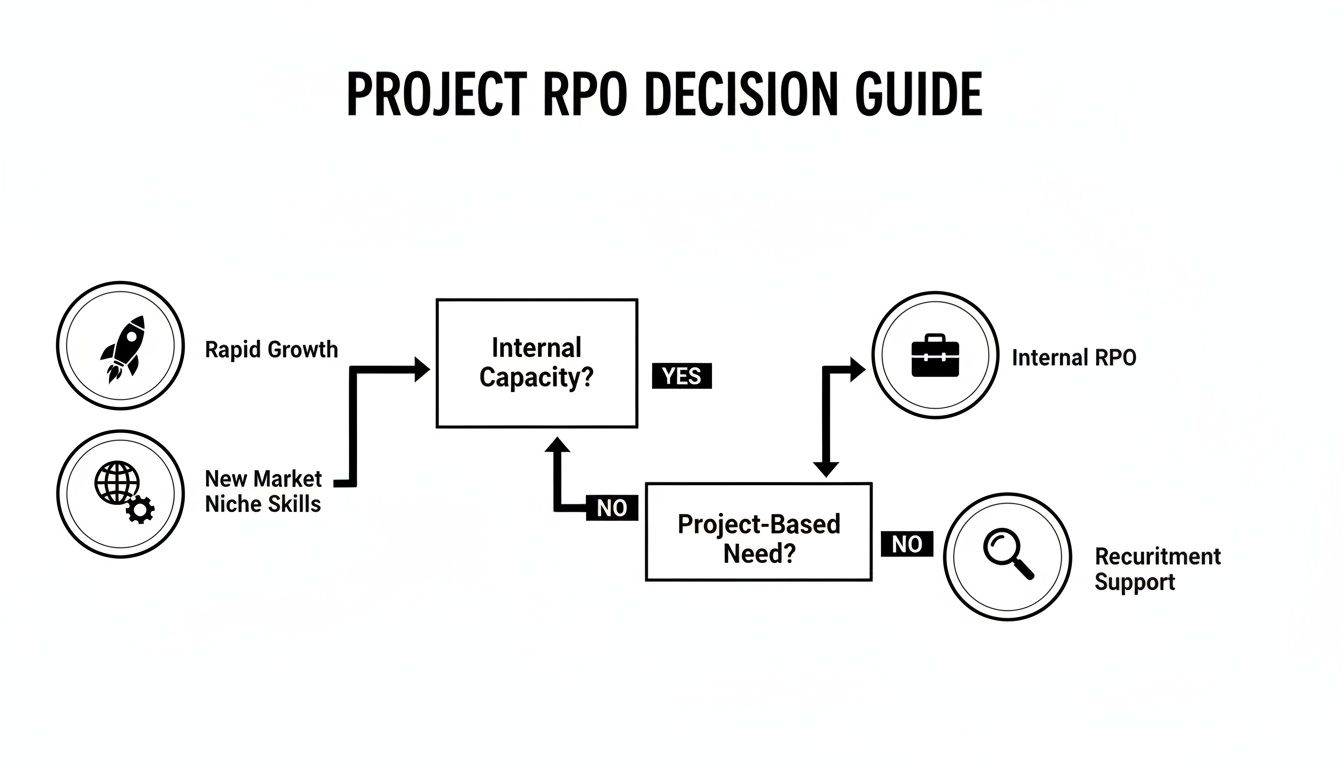
The key takeaway here is that Project RPO becomes the obvious choice when you’re facing a combination of scale, speed, and a gap in your internal team’s capacity to handle a hiring surge.
To make this even clearer, let’s put these models side-by-side. Think of this as your cheat sheet for deciding which talent solution fits your current challenge.
Choosing the Right Talent Solution: A Comparative Overview
| Model | Best For | Cost Structure | Engagement Duration | Strategic Control |
|---|---|---|---|---|
| Project RPO | Hiring multiple roles for a specific, time-bound project (e.g., new product launch, geographical expansion). | Management fee + cost-per-hire or fixed project fee. | Short to medium-term (typically 3-12 months). | High. Acts as an extension of your TA team, aligning with your brand and process. |
| Contingent Staffing | Filling individual, non-critical roles quickly when speed is the top priority. | High percentage of first-year salary, paid upon successful placement. | Transactional, per-role basis. | Low. Manages multiple agencies, less control over candidate experience. |
| Enterprise RPO | Long-term, complete outsourcing of the entire talent acquisition function for ongoing hiring needs. | Management fees, often with performance-based incentives. | Long-term (multi-year contract). | Very High. A deep, strategic partnership that transforms the entire TA function. |
| Retained Search | Filling a single, high-stakes senior leadership or executive role (C-suite, VP). | Upfront retainer fee, often paid in instalments throughout the search. | 3-6 months for a single search. | High. A consultative, in-depth partnership for a critical hire. |
This table provides a high-level view, but the real devil is in the details. Understanding the operational differences between these models will help you justify your decision and set the right expectations internally.
Project RPO vs. Contingent Staffing Agencies
On the surface, Project RPO and contingent staffing might seem similar, but their strategic value and how they operate are worlds apart. A contingent agency works on a “no win, no fee” basis, focusing on filling individual roles as fast as possible. It’s a transactional game where they often race against other agencies to get a CV in front of you first.
Project RPO, on the other hand, is a true partnership. It’s an exclusive, end-to-end solution where the provider becomes an extension of your own team for a specific project. They own the entire lifecycle—from sourcing and screening to offer management—ensuring every candidate experience is consistent with your employer brand.
Here are the key differentiators:
- Focus: Contingent agencies are built for speed on single roles. Project RPO is designed to build an entire team with consistent quality and cultural fit.
- Process Control: With agencies, you’re often juggling multiple contacts and candidate streams. With Project RPO, you have one accountable partner managing the entire campaign.
- Cost Structure: Contingent fees are typically a high percentage of the first-year salary for each hire. Project RPO often uses a management fee or a lower cost-per-hire model, which is far more economical for volume hiring.
For a deeper dive, our strategic hiring guide on RPO vs staffing agencies breaks down which model aligns better with different business goals.
Project RPO vs. Enterprise RPO
The main difference here boils down to two things: duration and scope. Enterprise RPO (or end-to-end RPO) is a long-term, ongoing partnership where an external provider manages all, or a huge chunk, of your company’s permanent hiring function. It’s essentially a complete outsourcing of your talent acquisition department.
Project RPO is the agile, short-term version of this. It has a defined start and finish line tied directly to a specific business goal.
Think of it like this: Enterprise RPO is like hiring a permanent catering company to run your company’s canteen every single day. Project RPO is like bringing in a specialised event caterer for a single, important company gala.
The choice depends entirely on your needs. If your organisation consistently has high-volume hiring demands and wants to fundamentally overhaul its talent function for the long haul, Enterprise RPO is the answer. But if you have a specific, time-sensitive hiring surge, knowing when to use Project RPO is your key to success.
Project RPO vs. Retained Search
Retained search firms are the specialists you call for filling high-level executive positions—the C-suite, VPs, and other senior leadership roles. You pay them an upfront retainer to conduct a meticulous, often confidential, search for one critical hire. Their process is deep, consultative, and laser-focused on a tiny pool of elite candidates.
Project RPO operates at a completely different scale. It’s designed to hire entire teams, not just one person. While it can certainly handle senior roles as part of a larger project, its strength is in building out entire departments or functions. A retained search is a scalpel; Project RPO is a full surgical team.
How Project RPO Delivers Results in the Real World
Frameworks and charts are one thing, but the real test of any recruitment strategy is how it performs under pressure. The question of when to use Project RPO gets a lot clearer when you see it solving actual business problems—not just filling roles, but powering growth, launching new products, and hitting critical deadlines.
Let’s ditch the theory and look at some concrete examples. These snapshots show how different organisations, facing unique, high-stakes challenges, used Project RPO to get the job done. Each story pinpoints a specific business trigger and shows the direct impact of bringing in a focused, project-based recruitment team.
These aren’t just hypotheticals; they’re common situations where speed, scale, and specialised skills are everything.
Scenario 1: The FinTech Platform Launch
A fast-growing fintech firm in Mumbai was on the verge of its biggest launch ever: a new trading platform built on blockchain. The entire project’s success depended on one thing: hiring a team of 50 elite blockchain developers and security engineers within a nail-biting four-month window.
The Challenge: Their in-house HR team was fantastic at hiring for the core business, but they just didn’t have the network or deep tech knowledge to find top-tier blockchain talent that quickly. In a fiercely competitive market, every week of delay meant lost revenue and giving competitors a chance to catch up.
The Project RPO Solution: The firm brought in a Project RPO partner with a dedicated tech recruitment practice. This partner didn’t just post jobs; they deployed a specialist team that immediately mapped the talent landscape, built a targeted pipeline of candidates, and ran the entire show from technical screening to negotiating offers. They became a true extension of the company’s brand.
The Tangible Outcomes:
- They hit their hiring goals ahead of schedule, filling 98% of the roles in just three and a half months.
- The time-to-hire dropped by 35% compared to what the company usually saw for similar senior tech positions.
- The platform launched on time, securing that all-important first-mover advantage.
Scenario 2: The Healthcare Clinic Expansion
A major healthcare provider had an ambitious goal: open five new diagnostic clinics across tier-2 cities in northern India in just one quarter. This meant hiring over 80 qualified professionals, from clinic managers and radiologists to phlebotomists and front-desk staff.
The Challenge: The central HR team, based in Delhi, had little to no insight into the local talent pools in these smaller cities. They were facing a logistical mountain—sourcing, screening, and coordinating interviews across multiple locations at once, all while trying to navigate different regional hiring norms.
The Project RPO Solution: They partnered with a Project RPO provider that had a strong footprint across the region. The provider set up on-the-ground recruitment teams in each city, tapping into local networks to find the right healthcare professionals. The solution covered everything from running local hiring events to ensuring compliance with regional rules.
This is a classic case for using Project RPO for geographic expansion. The provider’s local expertise instantly turns a logistical nightmare into a smooth, efficient process.
The Tangible Outcomes:
- All five clinics were fully staffed and ready to go by the target launch date.
- The provider successfully filled 95% of the required positions within the 12-week project timeline.
- The cost-per-hire was 15% lower than if the company had tried to juggle multiple local staffing agencies for each location.
Scenario 3: The Manufacturing Shift Ramp-Up
After landing a huge new contract, a large automotive parts manufacturer near Chennai needed to add a third production shift. To meet the client’s tight schedule, they had to hire 120 skilled machine operators, quality inspectors, and logistics coordinators in just 60 days.
The Challenge: The sheer volume was overwhelming. The existing HR department couldn’t possibly handle that many hires in such a short time without putting all other recruitment on hold. Plus, the roles required specific certifications and experience, making the screening process a massive undertaking.
The Project RPO Solution: The manufacturer turned to Project RPO to manage this high-volume hiring sprint. The provider rolled out a powerful sourcing plan, including referral drives and community outreach, and created a streamlined assessment process to quickly vet candidates’ technical skills.
The Tangible Outcomes:
- Over 100 new employees were hired and onboarded within the 60-day deadline, allowing the new shift to start without a hitch.
- The project achieved an impressive candidate-to-hire ratio of 4:1, proving the screening process was both fast and accurate.
- The internal HR team was free to concentrate on strategic, white-collar hiring, ensuring the rest of the business kept moving forward.
Your Practical Checklist for a Successful Engagement

Once you’ve decided that Project RPO is the right move, your focus has to pivot from if to how. A successful engagement doesn’t just happen—it’s built on a bedrock of careful planning, transparent communication, and a true partnership. This diligence is what separates a chaotic hiring scramble from a strategic talent victory.
Think of this checklist as your roadmap. It’s designed to guide you through the make-or-break stages, ensuring your Project RPO engagement delivers the speed, quality, and results your business needs. Let’s get started.
Stage 1: Laying the Foundation
Before you even think about talking to a provider, the most critical work happens internally. Getting your own house in order prevents scope creep down the line, aligns all your stakeholders, and sets your future RPO partner up for success. Without this internal alignment, even the best provider will be fighting an uphill battle.
Start with these fundamentals:
- Define Project Scope with Precision: Don’t just stop at a headcount. You need to get granular. Detail the specific roles, seniority levels, essential skills, and locations. Is this for a new tech hub needing 50 developers or a regional sales team of 30? The more detail you provide, the better.
- Establish Crystal-Clear KPIs: How will you actually measure success? Key Performance Indicators (KPIs) need to be agreed upon from the very beginning. Move beyond just “time-to-fill.” Consider metrics like quality of hire (maybe tracked by first-year performance ratings), cost-per-hire, and, crucially, hiring manager satisfaction scores.
- Secure Internal Stakeholder Buy-In: This one is a classic project-killer if overlooked. Make sure every hiring manager and department head involved understands the process, what’s expected of them, and why this project matters. A lack of cooperation internally is one of the most common reasons for costly delays.
Stage 2: Selecting the Right Partner
Choosing a Project RPO provider isn’t just about outsourcing recruitment; you’re selecting a temporary extension of your brand and your team. The right fit comes down to proven expertise, cultural alignment, and a solid track record of delivering on projects just like yours.
Your vetting process should be robust:
- Verify Industry and Functional Expertise: Have they actually done this before in your sector? Ask for specific case studies from projects of a similar scale and complexity. A partner who already speaks your industry’s language will find better candidates, faster.
- Assess Cultural and Brand Alignment: Remember, the provider’s recruiters will be the first human contact for potential hires. You need to be confident they can understand and genuinely represent your employer value proposition (EVP). This is vital for attracting people who will actually thrive in your organisation.
- Evaluate Technology and Reporting Capabilities: Any modern provider should have a solid tech stack for sourcing, tracking, and reporting. Ask for a demo. You want to see transparent, real-time dashboards that show you exactly how progress is being monitored.
The right partnership is a two-way street. A top-tier provider will ask you as many questions as you ask them, demonstrating a genuine interest in understanding your business goals, not just filling roles.
Stage 3: Managing the Engagement
Once your partner is chosen and the project kicks off, proactive management is key. This is how you ensure the project stays on track and delivers continuous value. Think of communication and feedback as the lifeblood of the engagement—they stop small issues from snowballing into major roadblocks.
Keep the momentum going with these practices:
- Establish Robust Communication Channels: Set up a steady rhythm of communication. Weekly or bi-weekly check-in meetings are perfect for reviewing progress against KPIs, tackling challenges head-on, and tweaking the strategy as needed. A clear communication cadence keeps everyone aligned and accountable.
- Conduct a Final ROI Analysis: When the dust settles, it’s time to measure the real impact. Perform a thorough review comparing the final KPIs against your initial goals. Did you hit your target of reducing time-to-hire by 30%? Was the project completed on budget? This analysis gives you the hard data needed to justify the investment to your leadership and prove the project’s success.
Frequently Asked Questions About Project RPO
Even after you’ve identified the signs that you need a Project RPO partner, some practical questions always come up. It’s only natural. Making a shift in your hiring strategy is a big decision, and the details matter.
Let’s tackle the most common queries we hear from CHROs and talent leaders. We’ll get straight to the point on cost, implementation speed, cultural fit, and handling those tricky specialised roles to give you the clarity you need.
What Is the Typical Cost Structure for a Project RPO Engagement?
There are generally three ways Project RPO costs are handled: a fixed management fee, a cost-per-hire model, or a mix of both.
Think of a management fee as your predictable option. It’s great for straightforward budget planning and gives you a clear monthly cost. On the other hand, the cost-per-hire model is purely results-driven – you only pay when a position is successfully filled.
Which one is right for you? It really boils down to your project’s scope and how predictable your hiring numbers are. The most important thing is to get total transparency upfront. Make sure you clarify all potential costs, like technology or advertising fees, before signing on the dotted line.
How Long Does It Take to Implement a Project RPO Solution?
You can expect to be up and running in about two to six weeks. This isn’t just a flick of a switch; this initial phase is crucial. It involves deep-dive discovery sessions, mapping out the recruitment process, setting up any tech, and getting both your internal team and the RPO provider’s recruiters on the same page.
For those “we needed them yesterday” hiring surges, some providers have a rapid deployment option that can cut this down to just a week or two. The secret to a fast, smooth launch? Having crystal-clear hiring goals from day one and ensuring your internal stakeholders are ready to dive in and collaborate with your new partner.
A swift implementation is a hallmark of an experienced Project RPO provider. Their ability to quickly understand your needs and integrate with your processes is a strong indicator of their effectiveness and a key differentiator from less agile solutions.
How Do We Ensure the RPO Provider Understands Our Company Culture?
This is a big one, and it starts way before the project kicks off – right back in the vendor selection process. Look for a partner who genuinely wants to spend time understanding your unique employer value proposition (EVP). A proper immersion phase, where the RPO team meets your key leaders and hiring managers, is non-negotiable.
You can help them by sharing your internal branding guides and even inviting them to sit in on relevant team meetings. From there, it’s all about communication. Set up regular feedback loops to discuss not just the quality of candidates, but how well they align with your culture. This keeps everyone calibrated and ensures the project delivers people who don’t just have the right skills, but who will truly thrive in your environment.
Can Project RPO Be Used for Highly Specialised Roles?
Absolutely. In fact, this is where Project RPO really shines. The best providers have dedicated recruitment teams with deep roots in specific sectors like technology, healthcare, or finance. They live and breathe your industry.
When you need to build out a team of specialists, a Project RPO partner gives you immediate access to their established talent networks and advanced sourcing tools. Their recruiters speak the language of your niche field and know exactly where to find the people you’re looking for. It’s a level of speed and access that an internal team, no matter how good, often struggles to match.
Ready to tackle your next big hiring challenge with precision and speed? Taggd delivers expert Project RPO solutions designed to meet your specific business goals. Learn how we can build your winning team.