
Decoding the Attendance Cycle for Peak Efficiency
At its heart, an effective attendance cycle is the complete, structured journey of capturing, checking, and processing your employees’ work hours. Think of it as the engine driving your workforce management, turning raw clock-in data into the fuel for accurate payroll, compliance, and smart business decisions.
Understanding the Foundations of the Attendance Cycle
Imagine your company’s total workforce hours are a critical budget you have to manage perfectly every single month. The attendance cycle is the system that makes sure you do exactly that.
This is far more than just a simple timekeeping chore. A well-oiled attendance cycle is the very backbone of your operational integrity, legal compliance, and the trust you build with your employees. It’s what guarantees everyone gets paid correctly for their time—a fundamental part of maintaining a fair and positive workplace.
When this process falls apart, the problems ripple through the entire organisation. Inaccurate data quickly leads to payroll errors, which can seriously damage employee morale and even land you in costly legal hot water. On the flip side, a smooth, transparent process builds confidence and frees up your administrative teams to focus on more strategic work.
The Three Pillars of Attendance Management
When you boil it down, the entire process stands on three fundamental pillars. They all work in sync to create a system you can rely on. This diagram shows the high-level flow, from the moment an employee clocks in to the final reports that land on your desk.
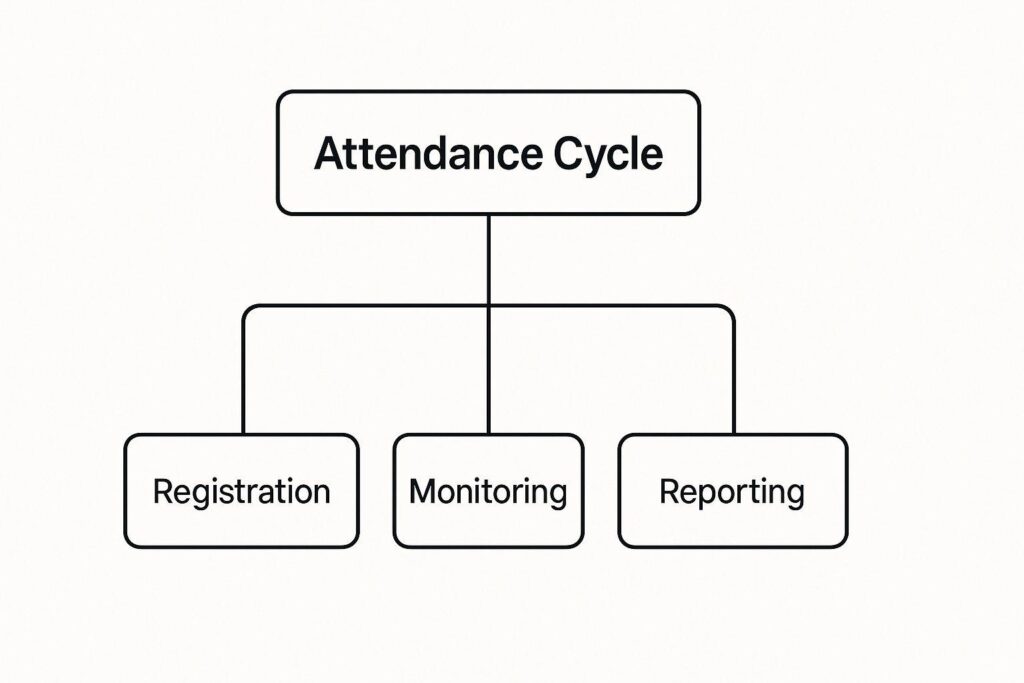
As you can see, a successful attendance cycle always starts with accurate registration, depends on consistent monitoring, and ultimately delivers value through insightful reporting. Each stage builds on the one before it, forming a workflow that’s both cohesive and dependable.
A Glimpse into the Core Phases
To really get a feel for how the attendance cycle works, it helps to break it down into four distinct phases. Each one has a specific job to do, transforming raw clock-in data into verified records ready for payroll and analysis. This step-by-step approach is key to minimising errors and boosting efficiency from start to finish.
A truly optimised attendance cycle does more than just track hours; it gives you a clear, data-backed view of your workforce’s productivity, engagement, and operational needs. It’s the first step toward making informed decisions about staffing and how you allocate resources.
To make this crystal clear, the table below provides a high-level overview of these four core phases and what they’re responsible for. Think of this as a roadmap for the journey from an employee clocking in to their data driving key business decisions.
The Four Core Phases of the Attendance Cycle
| Phase | Core Function |
|---|---|
| Time Capture | The initial recording of employee work hours, whether that’s through biometric scanners, mobile apps, or web-based portals. |
| Data Validation | The review and approval stage where managers fix errors, apply overtime rules, and sign off on leave requests. |
| Reporting & Analytics | The analysis of attendance data to spot trends in things like absenteeism, labour costs, and overall productivity. |
| System Integration | The final step, where verified attendance data is seamlessly transferred to payroll and other HR systems for processing. |
Understanding this structure is the key to seeing how a simple punch-in can power so much of your organisation’s operational and strategic planning.
Phase 1: Capturing Accurate Time Data

The entire attendance cycle rests on the quality of its very first step: capturing time data. This is where it all begins, and getting it right is non-negotiable. If your initial data is shaky, everything that follows—from validation to payroll—will be built on a weak foundation.
Think of it like building a house. A small crack in the foundation can lead to massive structural problems down the road. In the same way, a single missed punch, a wrong entry, or the age-old problem of ‘buddy punching’ creates a ripple effect that turns into payroll nightmares and compliance headaches.
The real challenge isn’t just about recording time; it’s about guaranteeing the integrity of that record from the get-go. Thankfully, modern businesses have moved well beyond outdated punch cards, embracing a whole range of tools built for today’s diverse workforces.
Choosing the Right Tools for the Job
Picking the right technology is the key to building a trustworthy attendance system. The best method for you will depend entirely on your company’s structure and how your teams work. There’s simply no one-size-fits-all solution here.
For instance, a company with a sales team spread across different cities would find GPS-enabled mobile apps a game-changer. These tools don’t just log time; they verify location using geofencing, making sure your team is exactly where they need to be. On the other hand, a manufacturing plant with hundreds of employees clocking in at one location would lean on fixed biometric systems to completely eliminate buddy punching.
Common time capture methods include:
- Biometric Scanners: Using fingerprints or facial recognition, these offer the highest level of accuracy and are perfect for on-site workforces.
- Mobile Apps with Geofencing: Ideal for remote or field-based teams, these apps track both time and location, giving managers real-time visibility.
- Web-Based Portals: A flexible option for office-based or remote employees who can log in from their computers to start and stop their day.
- Automated Software Integrations: These tools link directly with project management or scheduling software to automatically log hours based on activity.
Each method brings its own advantages to the table, designed to solve specific business challenges, whether it’s security, flexibility, or both.
The goal is to make clocking in both easy for the employee and foolproof for the employer. When the process is seamless and secure, you establish a culture of trust and accountability from day one.
The Impact of Inaccurate Data Capture
The fallout from poor data capture goes far beyond a bit of admin frustration. Inaccurate records have a direct and serious impact on your labour costs, productivity insights, and legal compliance. Studies across various sectors consistently show how much attendance issues can drag down an organisation’s effectiveness.
Even tiny, recurring mistakes in timekeeping can snowball into huge financial losses over the course of a year. What’s more, inconsistent data makes it impossible to get a reliable picture of labour allocation or overtime trends. You can’t manage what you can’t measure accurately. This is especially true in industries that demand strict record-keeping, a point we explored in detail in our comprehensive sectoral analysis on the BFSI sector.
By investing in the right data capture tools, you aren’t just tracking hours; you’re protecting your bottom line and arming your business with data you can actually trust.
Phase 2: Validating and Processing Attendance Records
Raw time data, captured in the first phase, is just the starting point. Think of it like unrefined ore—full of potential but pretty much useless until it’s processed. The validation phase is that crucial quality control check where this raw data gets transformed into reliable, accurate records ready for payroll.
This is where managers and HR professionals step in to refine the information. They’re the ones correcting missed punches, handling leave requests, and applying complex pay rules. If you skip this step, the entire attendance cycle would be built on a foundation of guesswork, and that leads to nothing but costly errors and frustrated employees.
From Raw Data to Reliable Records
The validation process involves several key actions that make sure every single minute is accounted for correctly. It’s less about a simple tick of approval and more about applying business logic and compliance rules to the initial time entries. This careful review stops small inaccuracies from snowballing into major payroll disasters.
Some of the most common validation tasks include:
- Correcting Exceptions: This means addressing flagged issues like missed clock-ins, late arrivals, or early departures.
- Applying Pay Rules: This is where you calculate overtime, shift differentials, and holiday pay according to your company policy and local labour laws.
- Managing Leave: Approving and logging paid time off, sick leave, and other absences to ensure they are correctly reflected is a must.
These steps turn a simple list of timestamps into a verified record of work performed, forming the foundation for fair and accurate compensation.
The Role of Automation in Validation
Manually checking every single timesheet is an administrative nightmare, and it’s wide open to human error and inconsistency. Modern attendance systems act as a powerful safety net here, automating a huge chunk of this workload. They can automatically flag exceptions, calculate tricky overtime scenarios, and send approval requests straight to the right managers.
This automation doesn’t just save time; it enforces consistency. The system applies the exact same rules to every employee, every single time, which is absolutely essential for maintaining fairness and staying compliant. This frees up managers to focus their attention only on the exceptions that truly need a human touch.
By making approvals smoother and cutting down on manual checks, automation turns validation from a tedious chore into a strategic checkpoint. It protects the business, ensures legal compliance, and builds employee trust in the process.
The importance of a structured attendance cycle isn’t just a corporate issue; it’s a critical component in many sectors. For instance, chronic absenteeism in schools highlights just how challenging it can be to manage complex attendance cycles. In some Indian states like Rajasthan and Madhya Pradesh, chronic absenteeism rates for primary students have hovered between 15% to 25%, often tied to local socio-economic factors. You can discover more insights about attendance rate indicators from official data analyses on Indikit.net.
Ultimately, this phase is where the integrity of your entire system is either confirmed or compromised. A solid validation process ensures the final data is not only accurate but also fully compliant with all relevant regulations, protecting your organisation and ensuring fairness for everyone involved.
Phase 3: Turning Attendance Data into Business Insights

Once your attendance data is clean and validated, its real job begins. This is where the attendance cycle stops being an administrative chore and starts becoming a strategic powerhouse for your business. Think of it less as just logging hours for payroll and more as uncovering a goldmine of intelligence.
This phase is all about interpretation. Modern systems move way beyond simple clock-in/clock-out reports, offering powerful visual analytics that turn raw numbers into a clear story about your workforce. You start to see patterns and trends that would be completely invisible on a paper timesheet, giving you a solid, data-driven foundation for much smarter decisions.
From Numbers to Narratives
Imagine your attendance data as a detailed map of your company’s day-to-day operations. Every clock-in, every bit of overtime, every sick day—these are all landmarks. When you look at them together on an analytics dashboard, these landmarks reveal the busiest routes, the biggest roadblocks, and the hidden shortcuts to better performance.
For instance, a sudden spike in overtime in one department isn’t just a number to adjust in payroll. It’s a flare, a signal that something needs attention. It might point to a team being understaffed, a bottleneck in your process causing delays, or even a skills gap that needs closing with some targeted training. Without the right reporting, you’re just guessing. With it, you can act with confidence.
The real value of the attendance cycle emerges when you stop seeing data as a record of the past and start using it as a guide for the future. It empowers managers to manage proactively, not reactively.
Key Reports for Strategic Decision-Making
Good reporting is like a health check for your operations, letting you diagnose issues and make informed adjustments. A few of the most impactful reports and analytics include:
- Absenteeism Trend Analysis: This helps you spot patterns. Are Mondays always the quietest day? Does one team have a much higher rate of unplanned leave? The answers can shine a light on problems with morale, workload, or even management style.
- Overtime Hotspot Identification: By seeing which departments or individuals consistently clock extra hours, you can get ahead of potential burnout, re-evaluate project staffing, and get a better handle on your labour costs.
- Labour Cost Allocation: This is an absolute must for project-based businesses. Accurate data lets you tie labour costs directly to specific projects or clients, giving you a crystal-clear view of profitability and where your resources are really going.
These insights aren’t just for internal operations. Evidence from the Indian education sector shows that attendance cycles often follow seasonal and demographic patterns. A 2023 report, for example, noted that school attendance often drops during monsoon months because of transport problems and illness, showing how external factors can have a real impact. You can learn more about similar analyses in these case studies on attendance journeys.
By digging into these insights, leaders can make smarter, data-backed decisions on everything from budgeting and staffing to employee well-being and operational efficiency. This is what makes this phase a true cornerstone of strategic workforce management.
Phase 4: Integrating Data with Payroll and HR Systems
This final phase is where everything clicks into place. It’s the point where all the validated attendance data you’ve carefully gathered flows from your tracking system straight into the financial and administrative heart of your business—your payroll and HR platforms. Think of it as the crucial last mile that ensures all your hard work actually pays off.
Without this connection, you’re stuck with the risky and painfully slow process of manual data entry. That old way of doing things flings the door wide open for human error, which can lead to expensive payroll mistakes, delayed paycheques, and a serious dent in employee trust. A smooth, automated integration is the only real way to prevent these headaches and make sure everyone gets paid accurately and on time.
Creating a Single Source of Truth
The real power of this phase goes far beyond just getting payroll right. When your attendance system is in constant communication with your wider Human Resource Information System (HRIS), you create a unified, reliable source for all things employee-related.
This seamless connection unlocks several huge advantages:
- Real-Time Leave Balances: Employee leave requests and approvals sync up instantly. No more guesswork—everyone has an up-to-the-minute view of their available paid time off.
- Informed Performance Reviews: Managers can pull accurate attendance and punctuality data, giving them a much clearer, fact-based picture during performance evaluations.
- Streamlined Onboarding: New hire information flows effortlessly between systems from day one, slashing the administrative time needed to get them set up.
By linking these core systems, you break down the data silos that cause so much confusion and create a single, cohesive ecosystem. This automation frees your HR team from monotonous admin, letting them focus on the strategic work that truly drives the business forward.
The consistency that integration brings is vital. Managing attendance can get complicated fast, especially when you consider external factors. For example, the attendance cycle in Indian schools highlights how things outside your control can affect presence. The Net Attendance Ratio for children aged 6-14 years averages around 80-85%, but daily numbers often dip due to economic or cultural pressures. You can explore more of these attendance data findings on ies.ed.gov.
Ultimately, this final integration is what solidifies the integrity of your entire attendance cycle. It transforms a series of separate tasks into a powerful, automated workflow that champions accuracy, ensures compliance, and supports strategic HR management.
Optimising Your Attendance Management Process

A truly efficient attendance cycle doesn’t just happen on its own. It’s the product of careful planning, smart design, and a commitment to getting it right over time. Moving your process from simply ‘good enough’ to genuinely great involves a structured approach that hinges on clarity, technology, and trust.
The bedrock of any solid attendance system is a clear and fair attendance policy. This isn’t just a document that sits in a folder; it should be easy for everyone to find and understand, leaving no grey areas. It needs to clearly spell out what’s expected for punctuality, the proper steps for reporting an absence, and the consequences if policies aren’t followed. When everyone is on the same page, the whole system just works better.
This level of transparency is what builds trust—and you can’t have employee buy-in without it. A good policy helps create a positive work environment, which naturally influences the kind of people you attract to your team. You can dive deeper into this by exploring these best practices for hiring a culture fit candidate.
Key Pillars for a Stronger Process
To really strengthen your attendance cycle, it pays to focus on a few core areas. Each of these recommendations is a practical step you can take right now to cut down on errors and improve how you manage your workforce.
- Choose User-Friendly Technology: If your system is a pain to use, people will inevitably find workarounds. It’s crucial to select software that’s intuitive. Clocking in and requesting leave should be simple for employees, and reviewing timesheets should be a straightforward task for managers.
- Train Managers Effectively: Consistency is everything. Make sure every manager is trained to handle exceptions, apply policies the same way for everyone, and tackle issues before they escalate. When enforcement is inconsistent, it chips away at trust and opens the door to compliance risks.
- Conduct Regular Audits: Don’t just set up your system and walk away. You need to periodically review your attendance data. Look for patterns, double-check for any inaccuracies, and confirm you’re staying compliant with labour laws. Audits help you spot small problems before they snowball into big ones.
Fostering transparency is more than just having a policy written down; it’s about communicating openly and consistently. When employees trust that the system is fair and accurate, they are far more likely to engage with it positively, which in turn strengthens every single phase of the attendance cycle.
Frequently Asked Questions
When you’re trying to get a modern attendance cycle right, questions are bound to pop up, especially with different work models and ever-changing rules. Getting straight answers is the first step toward building a system that’s both solid and fair.
One of the big ones we hear all the time is how to handle attendance for remote and hybrid teams. The secret isn’t about watching the clock; it’s about shifting focus to output. Modern tools that track time against projects, use automated check-ins, or monitor activity can give you the visibility you need without being intrusive. This way, everyone is held to the same standard of accountability, no matter where they log in from.
Choosing the Right System
Another common hurdle is just picking the right software. The best way to start is by looking at what your team actually needs. Do you have people in the field who need mobile access with geofencing? Or are you mainly office-based, where a biometric system could finally put an end to buddy punching?
The goal is to find a user-friendly platform that integrates seamlessly with your existing payroll and HR systems. A system that is difficult for employees to use or creates data silos for HR is not a solution—it’s just another problem.
And finally, there’s the big concern: staying compliant with labour laws. A well-configured attendance management system is your best defence. It should automatically handle overtime calculations, manage leave, and keep the detailed records the law demands. Regularly auditing your process and touching base with legal experts will ensure your attendance cycle stays on the right side of the law.
For any organisation, getting internal processes like this right is crucial, especially when facing wider workforce challenges. In fact, many find that a streamlined attendance cycle is a key part of the puzzle when trying to overcome global labour shortages with RPO services. It means you’re managing your current team as efficiently as possible while you strategically build for the future.
Ready to build an attendance cycle that drives efficiency and growth? Taggd specialises in optimising workforce management through expert Recruitment Process Outsourcing. Learn how we can help.