
Recruitment Managed Services: Transform Your Hiring Strategy
At its heart, Recruitment Managed Services (RMS) is a strategic partnership where you hand over the reins of your entire talent acquisition process to an external expert. It’s about moving away from frantic, reactive hiring and building a proactive, predictable talent pipeline guided by clear service level agreements.
What Are Recruitment Managed Services, Really?
Think of your talent acquisition function as a complex orchestra. You have various instruments playing at once—job boards, staffing agencies, sourcing tools, and your internal team. An RMS provider steps in as the master conductor, making sure every section works in perfect harmony to produce a seamless performance. This isn’t just about farming out tasks; it’s about outsourcing the entire outcome.
An RMS partner takes charge of the whole recruitment lifecycle. We’re talking about everything from initial workforce planning and candidate sourcing to screening, interviewing, hiring, and even onboarding. By bringing all these moving parts under a single, accountable partner, you gain a level of visibility and control over your hiring world that’s simply not possible otherwise.
Beyond Traditional Recruiting
Unlike juggling multiple staffing agencies for different roles, an RMS solution gives you one central point of management. This immediately cuts down on vendor overlap, standardises your processes, and leads to serious cost savings. The real goal is to build a talent function that’s both scalable and agile—one that can adapt to changing business demands without the hefty fixed costs of a large in-house team. This is a crucial piece of any modern talent acquisition and recruitment strategy.
The strategic payoff of this model is becoming undeniable, especially in fast-paced markets. For example, the managed services market in India, where RMS is a key driver, was valued at around INR 43,857.4 Crore in 2024. Market forecasts suggest this figure will nearly double by 2033, a surge fuelled by the growing need for specialised skills and more efficient hiring. You can dig deeper into the growth of India’s managed services market on IMARC Group.
The Core Components of an RMS Solution
A solid RMS partnership is built on a few key pillars. These are the elements that truly set it apart from simpler, more tactical recruitment support.
- Centralised Governance: One provider manages all your suppliers, contracts, and performance metrics. Everything becomes one unified, easy-to-manage system.
- Technology Integration: The provider usually brings their own technology stack, like a Vendor Management System (VMS) or Applicant Tracking System (ATS), to automate and streamline workflows.
- Data and Analytics: You get continuous reporting on crucial KPIs—think time-to-fill, cost-per-hire, and quality-of-hire. This gives you the hard data needed to make smart, strategic decisions.
- Scalability: The model is built for flexibility. You can ramp up your recruitment capacity for big projects or seasonal peaks and scale back down just as easily, all without long-term commitments.
This structure transforms recruiting from what is often a chaotic cost centre into a strategic, data-driven function built for lasting success.
Choosing Your Talent Model: RMS vs RPO vs Staffing
Picking the right talent acquisition strategy can feel like navigating a maze of acronyms—RMS, RPO, traditional staffing. Each model serves a very different purpose, and knowing the difference is what separates a reactive hiring function from a truly strategic one. The goal is to move beyond just filling seats and start building a forward-thinking talent engine.
Let’s start with the most familiar model. Imagine you have an urgent, short-term project and need a few skilled people to jump in right away. You’d probably call a contingent staffing agency. Think of them as a specialist on-demand service. They find you qualified individuals for specific, temporary roles and usually work on a success-fee basis. It’s a fast, practical solution for plugging immediate gaps.
This infographic lays out a simple decision tree, helping you see if a reactive or proactive hiring approach makes more sense for where your business is today.
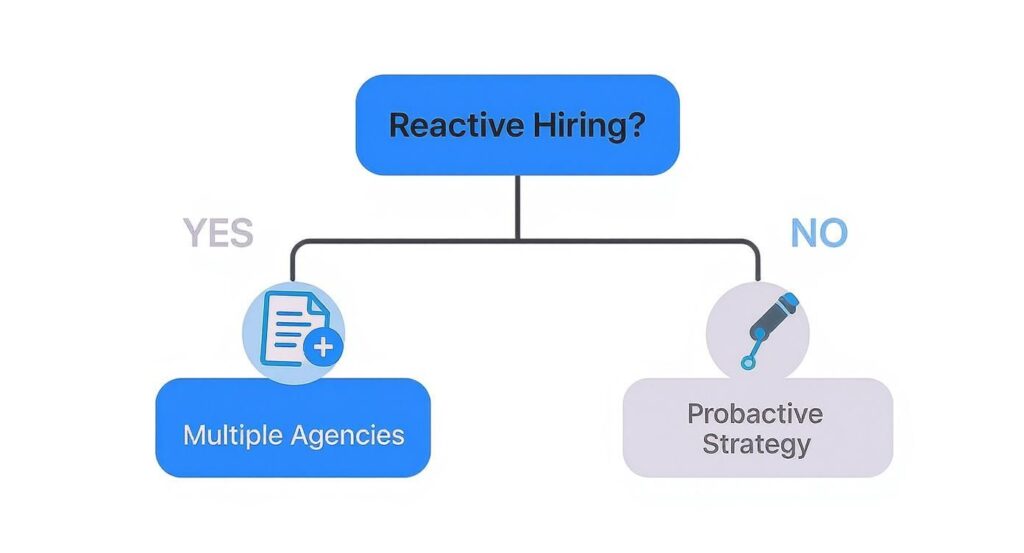
As you can see, a reactive strategy often means juggling multiple agencies and constantly putting out fires. A proactive approach, however, points you towards a managed service model that acts as a central conductor for your entire talent orchestra.
Distinguishing RPO from the Broader RMS Scope
Now, let’s look at a more strategic challenge, like overhauling your entire permanent hiring process. This is where Recruitment Process Outsourcing (RPO) enters the picture. An RPO provider essentially becomes an embedded part of your HR team, taking ownership of sourcing, screening, and hiring your full-time staff. They operate under your employer brand to streamline and improve that specific piece of your recruitment puzzle.
But what if you need more? Recruitment Managed Services (RMS) takes this a massive step further. An RMS solution is the most comprehensive of the three, giving you a single point of control over your entire talent ecosystem. This umbrella covers not just permanent hires (like RPO) but also the complete management of all your contingent workers, freelancers, and staffing agency relationships.
An RMS provider doesn’t just manage a single process; it takes control of the whole supplier landscape, the technology stack, and the talent outcomes. It centralises command, boosts efficiency across all worker types, and delivers unified analytics for a complete view of your workforce.
This all-encompassing approach is the true game-changer with RMS. It’s not just about filling jobs; it’s about strategically orchestrating your entire talent supply chain. To get a better feel for these distinctions, it’s worth exploring the key differences between an RPO and a staffing agency in more detail.
A Head-to-Head Comparison
To make the choice crystal clear, let’s compare these three powerful models side-by-side. Each has its place, but only one offers a complete, 360-degree view.
This table highlights the fundamental differences between Recruitment Managed Services, Recruitment Process Outsourcing, and Contingent Staffing across key operational and strategic dimensions.
| Attribute | Recruitment Managed Services (RMS) | Recruitment Process Outsourcing (RPO) | Contingent Staffing |
|---|---|---|---|
| Primary Scope | Manages the entire talent ecosystem, including permanent, contingent, and SOW workers. | Manages the end-to-end process for permanent hiring only. | Fills individual temporary or contract positions on a role-by-role basis. |
| Strategic Value | High. Provides total workforce visibility, supplier consolidation, and strategic planning. | Medium. Optimises a specific part of the recruitment function (permanent roles). | Low. Purely tactical and reactive for immediate, short-term needs. |
| Supplier Mgt. | Centralises and manages all staffing agencies and third-party suppliers. | Typically does not manage other staffing vendors. | Acts as one of many suppliers in a decentralised system. |
| Technology | Often includes a Vendor Management System (VMS) for total programme oversight. | Utilises an Applicant Tracking System (ATS) to manage permanent candidates. | Uses its own internal systems; no client-facing technology provided. |
| Pricing Model | Typically a management fee based on spend, plus performance-based incentives. | Management fees, cost-per-hire, or a hybrid model. | Percentage-based fee upon successful placement of a candidate. |
At the end of the day, the right choice really comes down to your company’s maturity and its long-term goals. If you just need to fill a few temporary desks, staffing agencies are perfect. If your permanent hiring engine is broken and needs a dedicated fix, RPO is a brilliant solution.
But if you’re ready to take full command and orchestrate your entire talent acquisition strategy from a single, strategic viewpoint, then recruitment managed services is unequivocally the way to go.
The Real-World Benefits of an RMS Partnership

When you bring in a recruitment managed services provider, you’re doing more than just outsourcing a few tasks. You’re elevating your entire talent function from a cost centre into a strategic business driver. For any CHRO, the true win isn’t just about handing off work; it’s about seeing a tangible, measurable impact on the bottom line. This kind of partnership delivers clear benefits in efficiency, cost, quality, and agility.
The first thing you’ll likely notice is the financial gain. By bringing all your contingent hiring under one umbrella, an RMS partner cuts out redundant spending and negotiates far better rates with a curated list of top-performing suppliers. This central oversight brings much-needed discipline to what can often be a chaotic, unmanaged expense.
Ultimately, this strategic approach drives down your overall cost-per-hire. Instead of fragmented teams using different tools and processes, you get a single, optimised system. This push for efficiency is a huge reason why the broader managed services market is exploding across India.
Driving Efficiency and Accelerating Hiring
Beyond the immediate cost savings, an RMS partnership acts as a powerful engine for operational efficiency. Think about it: standardised processes for everything from raising a job requisition to processing an invoice. This slashes the administrative delays and errors that bog down the entire hiring lifecycle, which means your hiring managers get the talent they need, faster.
With a dedicated provider managing the whole show, your time-to-fill metrics can improve dramatically. A well-run RMS programme can realistically shorten hiring cycles by 20-30% or even more. In a competitive market, that speed is a massive advantage, helping you secure top candidates before your rivals even get a chance.
This impact is especially noticeable in high-growth sectors. The India managed services market, which includes RMS, brought in around USD 14.9 billion in 2023 and is on track to hit USD 41.3 billion by 2030. This boom is fuelled by companies needing scalable workforce solutions to keep up with their own expansion—a core strength of the RMS model. To get a better sense of this trend, you can explore more insights about the booming managed services market on Technavio.
Enhancing Talent Quality and Strategic Focus
Perhaps the most important benefit of recruitment managed services is the undeniable lift in the quality of hires. Your RMS partner opens the door to broader and more diverse talent pools, reaching candidates your internal team might never find. They use sophisticated sourcing tech and data-driven methods to identify the best-fit people, not just the ones who are available right now.
An RMS partnership frees your internal HR team from the administrative grind of tactical recruitment. This allows them to pivot their focus to high-value strategic initiatives like leadership development, succession planning, and strengthening organisational culture.
By handing over the operational side of hiring, you empower your core team to become true strategic partners to the business. This shift is fundamental for long-term growth and employee retention. Many of these ideas about focusing on quality talent are also central to understanding the advantages of an RPO partner.
Building an Agile and Scalable Workforce
Market demands can turn on a sixpence. A sudden project win, a new product launch, or even seasonal peaks can create an urgent need for skilled people. An RMS partnership gives your organisation the workforce agility to respond to these shifts without missing a beat.
Here’s how an RMS provider builds that critical flexibility:
- Rapid Scaling: Need to staff up for a large-scale project? You can do it quickly, without the fixed overhead of hiring more internal recruiters.
- Market Responsiveness: Just as easily, your provider can scale things down during slower periods. This turns your recruitment costs from a fixed expense into a variable one.
- Access to Niche Skills: For highly specialised roles, your RMS partner can tap into their extensive networks to find experts on demand—a task that can be incredibly difficult and time-consuming for an in-house team.
This ability to scale your workforce up or down in direct response to business needs gives you a level of agility that is simply out of reach with a traditional, static in-house recruitment model.
Your Step-by-Step RMS Implementation Roadmap
Getting a recruitment managed services program off the ground isn’t as simple as flipping a switch. It’s a carefully planned journey of change that needs a solid plan, clear communication, and dedicated oversight to move from your old hiring methods to a fully managed solution. This roadmap breaks the whole process down into clear, manageable phases, guiding you from the first conversation to long-term success.
Think of it like building a house. You wouldn’t just show up and start laying bricks. First, you’d get the land surveyed, draw up detailed blueprints, and manage the construction carefully, making sure everyone is on the same page before you finally move in.
Phase 1: Discovery and Assessment
The journey starts with a deep, honest look at your current recruitment world. This first phase is all about understanding where you are right now so your RMS partner can build a solution that actually solves your problems and helps you hit your goals. It’s essentially an audit of your processes, costs, and headaches.
During this stage, the main job is to gather the right data and insights. Your potential RMS partner will work alongside you to analyse key figures like your current cost-per-hire, time-to-fill roles, how your suppliers are performing, and how happy your hiring managers are. The aim is to build a rock-solid business case that shows exactly why moving to a managed service makes sense.
Key activities in this phase include:
- Stakeholder Workshops: Sitting down with HR, procurement, and key business leaders to really understand what they need and what’s frustrating them about the current hiring process.
- Process Mapping: Laying out your existing hiring workflows from start to finish to spot the bottlenecks and find opportunities for improvement.
- Cost Analysis: Adding up every penny you spend on temporary staff and permanent hires to set a clear baseline for measuring future savings.
Phase 2: Solution Design and Vendor Selection
Once you have a crystal-clear picture of your starting point, it’s time to design where you want to go—and pick the right partner to get you there. The solution design phase is a true collaboration, where you and your chosen provider co-create the entire framework for your new recruitment managed services programme.
This is where you nail down the details of the partnership. Together, you’ll define the scope of the services, set realistic service level agreements (SLAs), and map out the technology and processes that will run the whole show. A well-designed solution means no nasty surprises after the contract is signed.
The success of an RMS implementation hinges on a meticulously designed solution that aligns perfectly with your business objectives. This is not about fitting your needs into a one-size-fits-all model; it’s about building a bespoke program from the ground up.
Phase 3: Implementation and Change Management
This is where the rubber meets the road. The implementation stage is all about bringing the designed solution to life. It involves the technical setup, re-engineering processes, and—most importantly—getting your organisation ready for the change. Proactive, transparent communication is everything here.
A dedicated implementation team from your RMS provider will take the lead, managing everything from integrating technology to getting your suppliers onboard. Their experience is crucial for a smooth, orderly rollout that causes as little disruption as possible to your daily business.
Your implementation plan should include:
- Technology Configuration: Setting up the Vendor Management System (VMS) or other platforms that will manage your workflows and data.
- Supplier Transition: Moving your existing staffing agencies into the new programme and clearly communicating the new rules of engagement.
- Stakeholder Training: Running hands-on training sessions for hiring managers and other users so they feel confident with the new processes and tools.
- Communication Plan: Keeping the entire organisation in the loop with regular updates on progress, the benefits, and what to expect on launch day.
Phase 4: Go-Live and Continuous Improvement
The “go-live” date is the official launch of your new RMS programme, but the work is far from over. This final phase is about stabilising the new model and shifting the focus to constant improvement and optimisation. The goal is to make sure the programme doesn’t just meet its promises, but smashes them.
Your RMS partner will keep a close eye on performance against the agreed-upon KPIs, providing you with regular dashboards and holding quarterly business reviews (QBRs). These reviews are vital for talking about what’s working, tackling any challenges, and finding new ways to add value. This data-driven approach ensures your recruitment managed services programme grows with your business, delivering a solid return for years to come.
How to Select the Right RMS Partner
Picking a partner for your recruitment managed services programme is one of the most important decisions you’ll make. This isn’t just about choosing a vendor; it’s about forging a strategic alliance that will define your talent pool—and your competitive advantage—for years to come. The right partnership can be a game-changer, while the wrong one can lead to nothing but wasted money, frustration, and a major hit to your strategic goals.
You have to look past the slick sales pitches and glossy brochures. What you really need is a partner who acts like an extension of your own team. They need to genuinely understand your industry’s quirks, fit in with your company culture, and have a proven track record of actually delivering on their promises.
Evaluating Industry and Functional Expertise
The first thing to look at is their industry experience. Sure, a generalist provider knows how to recruit, but do they know the specific skills, compliance headaches, and market realities of your sector? A partner with deep roots in your industry already has a network of quality talent and a real grasp of what it takes to succeed in the roles you need to fill.
This is absolutely critical in highly specialised fields. Take India’s application management services (AMS) market, for example. It’s set to hit USD 10.52 billion by 2031, a boom driven by companies modernising their tech stacks. This has created a massive demand for niche skills. An RMS provider without solid experience in the BFSI or tech sectors would be completely out of their depth. You can find more details on the growth of India’s AMS market at TechSci Research.
You need to ask some tough questions:
- Show me case studies from companies our size and in our industry.
- How do you keep up with the specific talent trends and salary benchmarks in our sector?
- Tell me about a time you had to find someone for a highly specialised, hard-to-fill role for a client like us. What happened?
Assessing Technological and Analytical Capabilities
The platform needs to do more than just track candidates. Look for powerful reporting dashboards that give you a live view of your key performance indicators (KPIs). The ability to pull custom reports and analyse trends in hiring speed, cost per hire, and quality of hire is non-negotiable.
A great RMS partner doesn’t just manage processes; they provide the data-driven insights that empower you to make smarter, more strategic workforce decisions. Their technology should illuminate opportunities, not just report on past performance.
Verifying Track Record and Cultural Alignment
Last, but certainly not least, you need to check their reputation and make sure they’re a good cultural fit. A partnership can look perfect on paper but completely fall apart if your working styles and core values don’t align. This is where you have to do your homework.
Ask for client references—and actually check them. Don’t just ask if they were happy. Dig in with specific questions to get a real feel for what it’s like to work with them day-to-day.
Key Questions for Client References
- Problem-Solving: How did they handle unexpected problems or urgent issues?
- Communication: What was the communication like with their account team? Was it regular? Was it clear?
- Strategic Input: Did they bring new ideas and strategic advice to the table, or did they just react to your requests?
- Overall Value: Besides saving money, what was the biggest benefit they brought to your company?
A strong cultural fit means your RMS partner works with the same urgency, quality standards, and collaborative spirit as your own people. That alignment is what turns a simple vendor relationship into a long-term, successful recruitment managed services partnership that delivers real business impact.
Measuring the Success of Your RMS Programme

So, how do you actually know if your investment in recruitment managed services is delivering? The proof isn’t just a gut feeling; it’s a clear, data-driven story told through key performance indicators (KPIs) that make sense to the C-suite. A good RMS partner will help you get past the surface-level numbers to measure what really drives the business forward.
This means we need to look beyond basics like time-to-fill or cost-per-hire. While those numbers have their place, they don’t tell the whole story. The real litmus test for an RMS programme is how it directly supports the company’s strategic goals, making your talent acquisition a predictable and powerful engine for growth.
Moving Beyond Traditional Recruitment Metrics
To really understand the impact of your RMS programme, you need to track KPIs that show strategic value, not just how busy the recruitment team is. These are the metrics that offer real insight into how your hiring strategy is affecting the company’s long-term health.
Here are the strategic KPIs that should be on your dashboard:
- Quality of Hire: This is the big one. You can get a handle on this by tracking things like first-year attrition rates, performance review scores of new employees, and satisfaction surveys from hiring managers. A high-quality hire adds more value and is less likely to leave.
- Diversity and Inclusion Progress: Your RMS partner should be able to deliver detailed reports on the diversity of your candidate pools and final hires. This isn’t just about optics; it’s about proving your commitment to building a workforce that reflects your customers and your core values.
- Supplier Performance: A key part of recruitment managed services is getting the most out of your network of staffing agencies. Tracking metrics like supplier fill ratios, cost-effectiveness, and compliance helps you see who your best partners are and ensures you’re getting great value.
Establishing a Robust Governance Framework
Of course, tracking metrics is pointless without a solid structure for accountability and regular check-ins. A well-defined governance framework creates transparency, encourages constant improvement, and ensures the partnership stays aligned with your business needs, which are always changing. The whole idea is to build a rhythm of structured communication and data analysis.
The cornerstone of this framework is the Quarterly Business Review (QBR). This isn’t just another meeting on the calendar. It’s a strategic work session where you and your RMS partner dive deep into performance against your agreed SLAs, spot trends, and map out the next quarter.
A well-governed RMS programme gives you the visibility and control to make talent acquisition a data-driven, strategic part of the business. It shifts hiring from a reactive fire-drill into a proactive competitive advantage.
The QBR is where you bring the data from your performance dashboards to life. These dashboards should give you a real-time, easy-to-read view of all your most important KPIs. This steady stream of information means you can make quick adjustments and back up your decisions with hard numbers, keeping the programme on track.
When you combine these advanced KPIs with a strict governance schedule, you get undeniable proof of your return on investment. It allows you to show stakeholders exactly how the recruitment managed services partnership is delivering on its promise: cutting costs, reducing risks, and, most importantly, bringing in the top-tier talent your organisation needs to innovate and win.
Answering Your Top RMS Questions
Making the leap to recruitment managed services is a big move, and it’s perfectly normal to have a few questions before you dive in. Over the years, I’ve noticed that HR leaders tend to bring up the same handful of concerns when they first consider an RMS partnership. Let’s tackle those questions head-on so you can feel confident about your next steps.
One of the first things people ask is about control. There’s a common fear that outsourcing recruitment means losing your grip on a vital part of the business. But here’s the reality: a well-designed RMS program actually gives you more control, not less. With detailed service level agreements (SLAs), regular performance reviews, and insightful data dashboards, you gain a panoramic view of your hiring that’s often impossible to get with a scattered, internal setup.
Addressing Cost and Integration Concerns
Then, of course, comes the question of money. How much does an RMS program cost, and is it really going to save us anything? Most providers charge a management fee, usually calculated as a percentage of your total contingent worker spend. While that’s an upfront investment, the real return on investment (ROI) comes from a few key areas: getting consistent rates from all your suppliers, slashing administrative busywork, and stopping uncontrolled “rogue” spending in its tracks. The focus shifts from just cutting costs to getting the absolute best value for your entire talent budget.
What about our existing tech? You’ve probably already put time and money into an HRIS or other platforms. A good RMS provider isn’t going to show up and demand you scrap everything.
A crucial part of the setup is integrating the provider’s Vendor Management System (VMS) with the technology you already use. This creates a smooth, connected experience for your hiring managers and ensures data flows where it needs to.
Finally, there’s the people side of things. How do you get your hiring managers to embrace a new way of working? Your RMS partner should also be a change management guide. They’ll work with you to create a clear communication plan, provide proper training, and show managers exactly what’s in it for them—like getting better candidates faster with way less hassle. This hands-on approach is key to getting everyone on board and making the transition a success.
At Taggd, we specialise in creating recruitment solutions that deliver strategic value. Discover how our expert-led RPO and managed services can transform your talent acquisition function by visiting us at Taggd