
Master Self Managed Teams: Proven Strategies for Success
Understanding Self-Managed Teams Beyond The Corporate Hype
 To truly understand self-managed teams, we need to look past the surface-level buzzwords. Picture a traditional organisation as a finely tuned orchestra. Each musician, an expert in their field, waits for the conductor’s signal before playing their note. The conductor controls the pace, volume, and rhythm, holding the complete musical score.
Now, contrast this with a self-managed team, which functions more like a professional jazz ensemble. Each member is a master of their instrument, but they improvise together, listening closely to one another. They share a common purpose—to create exceptional music—but they get there through fluid collaboration and mutual adjustments, not through top-down directives.
This difference is fundamental. It isn’t just about “empowering” staff or flattening an organisational chart. It represents a deep shift in ownership and decision-making. In this model, teams are given not just the responsibility for a task, but the authority to manage the entire process. This includes everything from planning and scheduling to problem-solving and even peer evaluations. The focus shifts from individual task completion managed by a supervisor to collective outcome achievement driven by the team itself.
The Core Principles in Action
So, what separates a successful self-managed team from a failed experiment? It all boils down to a few core principles. The first is shared responsibility. When a project succeeds or fails, the entire team owns that outcome. This creates a strong sense of collective accountability that is often missing in siloed, hierarchical setups.
Another key principle is defined autonomy. Autonomy without clear boundaries can lead to confusion. Effective self-managed teams work within a framework of clear goals, budgets, and strategic objectives set by the wider organisation. Within these guardrails, they have the freedom to innovate and execute as they see fit. This method has produced real business results. In India, for example, some companies that have adopted self-management on a large scale have reported revenue increases of up to 50%. By removing rigid managerial layers and connecting performance to profit-sharing models, they enable teams to take complete ownership of their work.
A New Organisational Blueprint
Adopting this model requires a profound cultural change, moving from a culture of seeking permission to one of informed action. To better understand the practical differences, the table below compares the key characteristics of traditional and self-managed teams.
Traditional vs Self-Managed Team Characteristics
A detailed comparison showing the fundamental differences in structure, decision-making, accountability, and outcomes between traditional hierarchical teams and self-managed teams.
| Aspect | Traditional Teams | Self-Managed Teams | Impact on Performance |
|---|---|---|---|
| Decision-Making | Manager-led and top-down. The manager makes key decisions. | Team-led and collaborative. Decisions are made by the group. | Faster, more informed decisions as they are made by those closest to the work. |
| Leadership | Fixed and formal. A designated manager holds the leadership role. | Distributed and fluid. Leadership can shift based on the task or expertise required. | Encourages skill development and allows for more flexible problem-solving. |
| Accountability | Individual-focused. Each member is accountable to the manager. | Collective. The entire team is accountable for the outcomes. | Fosters a strong sense of team ownership and shared commitment to goals. |
| Work Design | Tasks are assigned by the manager to individual team members. | The team collectively plans, schedules, and allocates work among themselves. | Increases engagement and allows for better alignment of tasks with individual strengths. |
| Communication | Hierarchical. Information typically flows up to and down from the manager. | Open and peer-to-peer. Direct communication among all team members is the norm. | Improves transparency, speeds up information sharing, and builds stronger team cohesion. |
Understanding these distinctions is the first step for any CHRO considering this path. It is not an easier way to manage; it’s a more mature and potentially far more effective way to organise work. It shifts the focus from managing people to creating an environment where talented people can manage themselves toward outstanding results.
The Business Case That Wins Over Sceptical Executives

Proposing a new way of working to a board of executives can feel like pushing a boulder uphill, particularly when it goes against decades of management tradition. For many CHROs, just saying the words self-managed teams can make sceptical CFOs and COOs imagine chaos and a complete loss of control. The truth is, the business case for this model isn’t based on ideals; it’s built on hard, measurable results that directly improve the bottom line. The goal is to translate the human benefits of autonomy into the language of performance.
The strongest argument begins by tackling a major problem in many workplaces: disengagement. When people are just following orders, they have little personal investment in the results. They’ll do what’s asked, but rarely anything more. Self-managed teams flip this script by giving people true ownership of their work. Think of it as the difference between renting a house and owning one. A renter follows the landlord’s rules, but an owner will invest their own time and money into improvements because they have a real stake in the property’s value. This feeling of ownership is a huge motivation for engagement.
Turning Engagement Into Tangible Returns
Better engagement isn’t just a nice-to-have metric; it directly leads to major business improvements. Teams that are engaged are more creative, more productive, and produce higher-quality work. They solve problems quicker because they don’t have to wait for a manager’s permission to act. This is especially important in knowledge-based fields where quick thinking and creative solutions are what set a company apart.
Another key benefit that gets executives’ attention is the reduction in management overhead. In a typical company structure, managers spend a lot of their time supervising tasks, assigning work, and checking on progress. When teams handle these tasks themselves, managers can become strategic coaches. Their new role is to remove roadblocks and help people grow, not to micromanage every detail. This leaner structure not only cuts costs but also makes the entire organisation more nimble and responsive.
Presenting a Bulletproof Case
When you build your business case, concentrate on the numbers that leadership cares about most. Here’s a way to structure your argument:
- Productivity and Efficiency: Show how self-managed teams can shorten project timelines, boost output per employee, and cut down on errors. You can frame this as optimising your most important resource—your people.
- Talent Retention: Present this model as a strong method for keeping your best employees. High-performing individuals want autonomy and the chance to make an impact. Offering this makes your company a more appealing place to build a long-term career.
- Innovation and Agility: Explain how giving decision-making power to frontline staff allows the company to react faster to market shifts. The teams closest to the customer can spot new opportunities and potential threats long before they show up on an executive’s report.
The engagement crisis is a real and growing threat. For example, a recent study of India’s workforce showed a worrying drop in engagement to just 19% in 2025, a significant fall from the previous year. This disengagement problem can’t be fixed with small perks. It demands a fundamental change in how work is organised, which is exactly what self-managed teams provide. You can find more details in the 2025 ‘People at Work’ report. By clearly linking autonomy to solving this engagement issue, you create a powerful, people-focused case that even the most data-driven executive will find hard to ignore.
Learning From Implementation Champions Who Got It Right

While the idea of self managed teams is attractive, what really gets leadership on board is seeing it work in the real world. The shift to team autonomy isn’t a simple, clean process. It’s often a messy journey, full of unexpected hurdles that demand creative thinking. By looking at organisations that have successfully made this change, we can find practical lessons that go beyond what you’d read in a book. Their stories highlight not just the successes, but the critical challenges they overcame and the tangible results that made it all worthwhile.
From nimble tech startups where autonomy is baked into the culture to established manufacturers overhauling decades of top-down management, the principles of self-management have proven effective across different sectors. The secret isn’t to just copy-paste a model, but to adapt the core ideas to your own company’s unique environment.
Manufacturing a Culture of Ownership
In most factories, a rigid, top-down structure is standard. Yet, some companies have broken from this tradition with impressive results. Take Yash, an Indian paper company that started putting self-management into practice over 20 years ago. Instead of managers dictating every move on the factory floor, they handed decision-making power directly to the teams. This created a culture where employees took charge of their own work, worked together to fix production problems, and shared the responsibility for hitting quality and output goals. You can explore more about their two-decade journey to understand this approach in detail.
This change didn’t happen overnight. It took a serious commitment to training, rethinking job roles, and, most importantly, building trust. The lessons from these pioneers provide a valuable guide:
- Start with Clear Guardrails: Autonomy works best within a well-defined framework. Teams were given clear goals and performance standards but were trusted to figure out the best ways to achieve them on their own.
- Invest in Cross-Skilling: For a team to truly manage itself, its members need to understand the entire process. Investing in training ensures people can fill different roles when needed, which makes the team more adaptable and robust.
- Redefine Leadership: Managers had to shift from being directors to being coaches. Their main job became clearing roadblocks and helping their team grow, not just watching over tasks.
Lessons From Diverse Industries
The success of self managed teams isn’t limited to one type of business. Across technology, professional services, and even retail, organisations are showing that trusting your people leads to better outcomes. For anyone wanting to see how these ideas work in different settings, looking at specific examples is incredibly helpful. You might find it useful to review these case studies to see how other companies have met their objectives.
These champions of change teach us a critical lesson: success is less about a flawless plan and more about nurturing a culture of trial and error and constant improvement. It’s about having faith in your team, giving them the right support, and being brave enough to let go of old-fashioned control. The outcomes—from better productivity to more engaged employees—speak for themselves.
Your Implementation Playbook: Getting Started Without Chaos
Moving to self-managed teams is a profound cultural shift, not just a project you can manage with a checklist. Think of it less like installing new software and more like nurturing a garden; it demands preparation, patience, and the right environment to grow. Launching without a clear plan can breed confusion and resistance, defeating the very autonomy you want to encourage. The secret is to begin small, create a supportive setting, and build momentum with early successes.
Assessing Readiness and Selecting a Pilot Team
Before you jump in, it’s crucial to gauge if your organisation is truly prepared. This goes beyond getting executive approval; it’s about taking the pulse of your existing culture. Are employees used to taking initiative, or do they operate in an environment where they constantly seek permission? A company culture rooted in rigid hierarchy will need more foundational work to adapt to the self-management mindset.
Once you have a feel for your organisational climate, the next step is to pick the right pilot team. This choice is critical because their success—or failure—will strongly influence the rest of the company. Look for a team that fits this profile:
- A Defined Area of Work: Select a team with a clear, self-contained mission and measurable results. This makes it simpler to track their performance and show their value.
- A Willing Guide: The current team lead or manager must be a champion for this change. Their role will shift from being a director to a coach, and their backing is essential.
- Volunteer Spirit: The team members themselves should be enthusiastic about the experiment. Forcing autonomy on a hesitant group is a formula for failure. Self-managed teams do best when individuals are keen to take on more ownership.
Starting with a single, carefully chosen pilot team lets you learn and adjust in a controlled environment. It becomes a small-scale laboratory for testing new processes, spotting potential hurdles, and building a success story for a broader rollout.
Creating the Essential Support Structures
Autonomy isn’t the same as anarchy. For a self-managed team to succeed, it needs a clear support framework. Picture this as the guardrails on a bridge; they don’t dictate how you drive, but they do keep you from veering off course. One of the biggest errors organisations make is granting freedom without providing the structure needed for that freedom to be productive.
This infographic shows the core stages for building these structures.
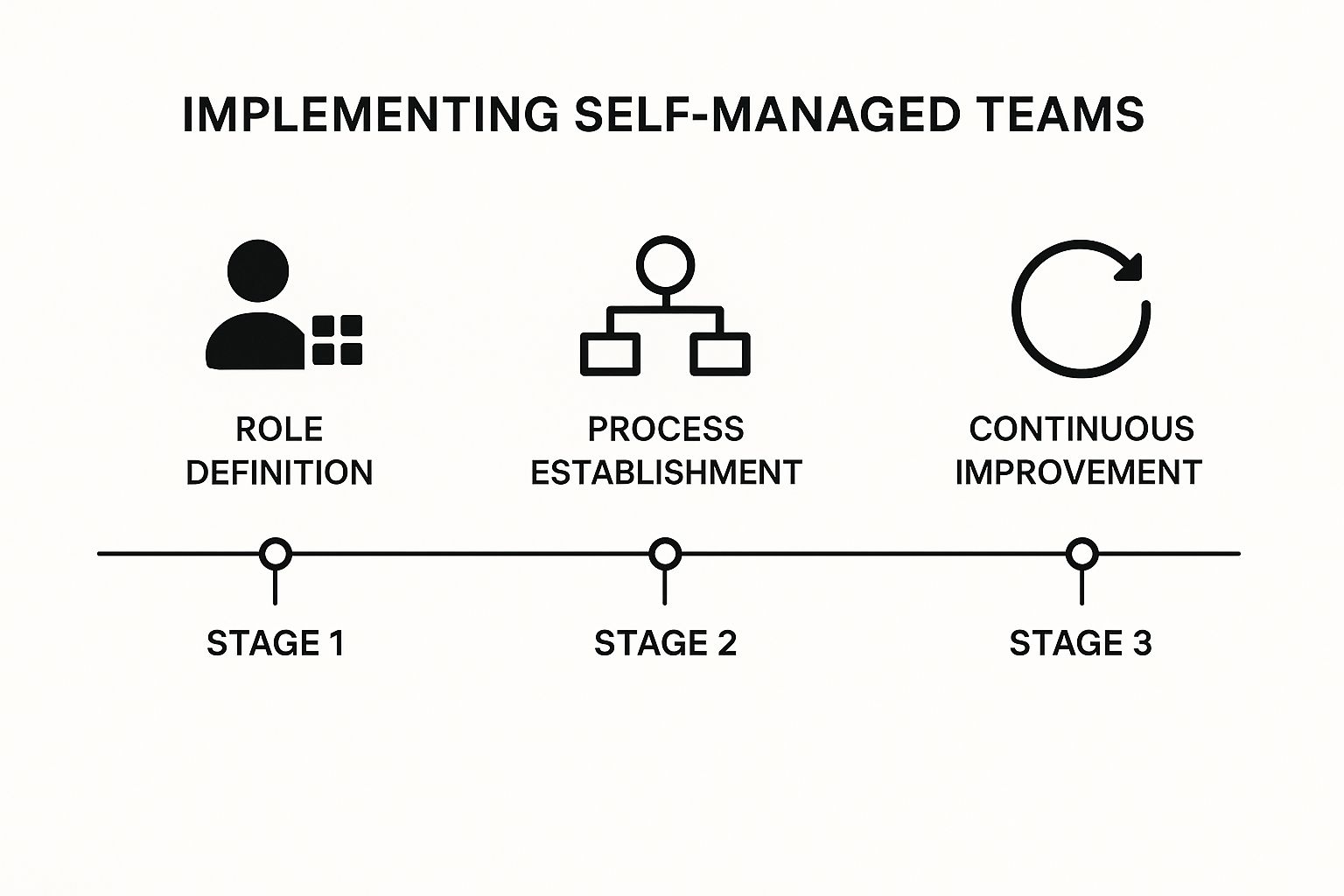
This visual guide shows that implementation is a step-by-step process, beginning with clear roles, moving to established processes, and leading to a culture of constant improvement. Genuine self-management is built systematically, not declared overnight.
Essential support structures include:
- Clear Mandates and Boundaries: The team needs to know exactly what they are responsible for, which decisions they can make, and what their budget is. This clarity prevents the “laptop decision dilemma,” where employees, unsure of their authority, waste time seeking approval for small choices.
- Access to Information: To make sound decisions, teams require the same information that managers traditionally had. This covers performance data, customer feedback, and financial metrics. Transparency is the foundation of trust.
- Conflict Resolution Processes: Disagreements will happen. Providing a clear, team-driven process for resolving conflicts ensures that minor “pebbles” of irritation don’t become major “boulders” of resentment that disrupt teamwork.
- Skills Training: Don’t assume your team already has all the necessary skills for self-management. They will likely need training in areas like project management, financial literacy, communication, and collaborative decision-making. This investment is vital for empowering them to confidently take on their new duties.
Before diving into a full-scale rollout, it’s helpful to map out the journey. The following table provides a practical timeline for the first year, detailing the key phases and what to expect along the way.
Self-Managed Team Implementation Timeline
A practical month-by-month breakdown of key activities, milestones, and expected challenges during the first year of self-managed team implementation.
| Phase | Duration | Key Activities | Success Metrics | Common Challenges |
|---|---|---|---|---|
| Phase 1: Foundation & Planning | Months 1-2 | Secure leadership buy-in. Define success criteria. Select and train a cross-functional pilot team. Develop initial team charter and boundaries. | Pilot team selected and trained. Leadership commitment is documented. Initial performance baseline is established. | Resistance from middle management. Unclear initial goals. Difficulty in choosing the right pilot team. |
| Phase 2: Pilot Launch & Coaching | Months 3-6 | Pilot team begins operating under the new model. The former manager transitions to a full-time coach role. Establish regular feedback loops and check-ins. Provide just-in-time skills training (e.g., conflict resolution, financial literacy). | Team consistently meets operational targets without direct supervision. Measurable improvement in a key metric (e.g., cycle time, quality). Team members actively participate in decision-making. | Team struggles with decision-making paralysis. Interpersonal conflicts arise. Over-reliance on the coach for answers. |
| Phase 3: Stabilisation & Refinement | Months 7-9 | Refine team processes based on learnings. Codify conflict resolution and communication protocols. The team takes on more complex responsibilities (e.g., peer reviews, budget input). | The team independently resolves most operational issues. The coach’s role becomes less intensive, more advisory. The team proposes and implements process improvements. | Burnout from increased responsibility. Difficulty in giving and receiving constructive peer feedback. “Us vs. Them” mentality with other teams. |
| Phase 4: Scaling & Expansion | Months 10-12 | Document the pilot’s success and lessons learned. Create a playbook for scaling. Identify and prepare the next wave of teams for transition. Pilot team members become mentors for new teams. | Successful pilot outcomes are communicated organisation-wide. A clear, repeatable implementation plan is developed. 2-3 new teams identified for transition. | Maintaining momentum and executive support. Inconsistent application of principles across new teams. Cultural resistance from the wider organisation. |
This timeline highlights that the transition is a gradual process of learning and adaptation. Each phase builds upon the last, turning initial uncertainties into established practices.
By starting with a committed pilot team and carefully building these essential support structures, you create an environment where self-managed teams can not only function but also excel. This deliberate, phased approach minimises disruption and paves the way for a successful, organisation-wide adoption.
Avoiding The Pitfalls That Derail Good Intentions
Transitioning to self-managed teams is an exciting prospect, but good intentions alone don’t guarantee success. The path is often lined with potential pitfalls that can turn a well-meaning initiative into a source of frustration and chaos. Understanding these common failure points is the first step for any CHRO aiming to guide their organisation through this complex change. Being prepared for what lies ahead can make the difference between a successful transformation and a spectacular failure.
One of the most frequent mistakes is confusing autonomy with a complete absence of structure. This often leads to a phenomenon known as the “tyranny of structurelessness,” where the lack of clear guidelines creates more confusion, not less. Without defined roles, decision-making boundaries, and conflict resolution processes, teams can become paralysed. A simple choice, like ordering a new laptop, can become a drawn-out ordeal of seeking consensus, as employees fear overstepping invisible lines of authority.
The Human Element of Resistance
Beyond structural issues, the psychological and cultural barriers are often the most difficult to clear. Middle managers, in particular, can become a significant source of resistance. Seeing their traditional responsibilities of assigning tasks and overseeing work distributed among teams, they may fear becoming irrelevant. Their resistance isn’t necessarily malicious; it’s a natural reaction to a perceived loss of status and purpose. If their role isn’t actively redefined from a director to a coach, their apprehension can quietly sabotage the entire effort.
Similarly, team members themselves can struggle. After years of being told what to do, the sudden expectation to lead, make decisions, and hold peers accountable can be overwhelming. This is where the “pebble in the shoe” concept becomes relevant. Small, unresolved annoyances between colleagues—like someone consistently dominating meetings or missing deadlines—can grow into major resentments if the team lacks the skills or a safe process to address them. These unaddressed “pebbles” can build into “boulders” of distrust that destroy team cohesion.
Common Failure Modes and Early Warnings
To navigate this journey successfully, it’s vital to recognise the early warning signs that your implementation is heading off track.
- Decision-Making Paralysis: Teams endlessly debate minor issues or consistently escalate decisions that fall within their mandate. This signals a lack of clarity or confidence in their autonomy.
- Declining Productivity: A temporary dip in productivity is normal during the transition. However, a prolonged slump often indicates that teams are struggling with new processes or that support structures are inadequate.
- A Blame Culture Emerges: When things go wrong, if the team defaults to pointing fingers rather than collectively solving the problem, it’s a clear sign that a sense of shared ownership has not been established.
- Withdrawal of Key Individuals: Both former managers and team members may disengage. Managers might adopt a hands-off approach out of frustration, while team members who are uncomfortable with the new model may become silent.
A crucial part of avoiding these pitfalls is hiring people who are naturally suited to this collaborative environment. To learn more, you might be interested in our guide on assessing and hiring for culture fit. Ultimately, building successful self-managed teams isn’t about eliminating structure; it’s about replacing the rigid, hierarchical structure with a more dynamic, enabling one that empowers people to do their best work.
Measuring What Matters: KPIs That Tell The Real Story
To demonstrate the real value of self-managed teams, CHROs must look beyond traditional, manager-focused reports. Relying only on standard HR metrics is like using a city map to navigate the open sea; the tools are familiar, but they are completely wrong for the new environment. Sceptical executives want to see data that tells a story of tangible results, not just a vague tale of happier employees. The right Key Performance Indicators (KPIs) can build this story, turning cultural shifts into measurable business outcomes.
Adapting Metrics for Autonomous Environments
The first step is to adjust your existing metrics. Instead of tracking who completed which task, the focus needs to shift to what the team achieved together. Think beyond individual output and start measuring team velocity—the actual speed at which a team delivers value from the beginning of a project to its completion. Another vital metric is decision-making speed. How long does it take for a team to identify a problem, decide on a course of action, and implement a solution? A shorter timeframe is powerful proof that removing layers of bureaucracy is paying off.
Presenting this data effectively is just as important as gathering it. Don’t just flash charts and graphs; connect the dots for the C-suite. Clearly explain how faster decision-making by the team led to a 15% drop in customer complaint resolution time, or how improved team velocity helped launch a new product a full month ahead of schedule.
Uncovering the Story with New KPIs
Beyond tweaking old metrics, CHROs should introduce new ones that capture the unique benefits of autonomous work. These KPIs typically fall into two main categories: leading and lagging indicators.
Leading Indicators (Predictive of Future Success):
- Psychological Safety Score: Use simple, regular pulse surveys with questions like, “How comfortable do you feel taking a risk on this team?” A high score is a strong predictor of future innovation and collaboration.
- Peer Feedback Frequency: Track how often team members give each other constructive feedback. This shows a growing sense of shared responsibility for performance and development.
- Skill Acquisition Rate: Upskilling is a critical factor in India’s fast-moving economy. As the India Skills Report points out, continuous learning is essential for workforce readiness. Monitor how many new skills a team learns and applies, proving their ability to adapt without management direction.
Lagging Indicators (Reflecting Past Performance):
- Team-Driven Innovation Rate: Measure the number of process improvements or fresh ideas that come directly from the team and are put into action by them.
- Reduced Management Escalations: A noticeable decrease in the number of problems escalated to senior leaders is a clear sign that self-management is working effectively.
- Employee Retention within the Team: Teams that feel a high sense of ownership often have much lower turnover rates—a powerful metric for any CHRO to share.
By combining these different types of metrics, you create a complete picture. It shows not only that the model is working today (lagging indicators) but also that the team is building the cultural foundation for long-term success tomorrow (leading indicators). This data-driven approach moves the conversation from theory to proof, showing that investing in self-managed teams isn’t a gamble—it’s a sound business strategy.
Your Next Steps: Building Self-Managed Team Success
The path to creating self-managed teams is less like reaching a destination and more like tending a garden; it requires ongoing care, adaptation, and improvement. For CHROs, the way forward needs a clear map, whether you’re just exploring the concept or ready to expand successful pilots throughout the company. These steps offer a practical guide to help you check your readiness, create a strong business case, and find the right support.
Assess Your Organisational Readiness
Before you take a single step, you need to honestly look at your company’s current environment. This goes beyond getting a simple approval from senior leadership; it’s about digging into your cultural DNA.
- Start with Critical Questions: Do your teams usually wait for detailed instructions, or do they take the initiative to solve problems on their own? Is failure seen as a chance to learn or as an error that needs to be punished? The answers will show you how much groundwork is needed.
- Identify Your Champions: Find managers and teams who are already showing signs of autonomy. These people can be your first supporters and prove that self-management can work within your company’s unique culture.
Build Your Business Case for Leadership
Once you understand how ready your organisation is, the next task is to get your leadership on board. This means you need to translate the cultural advantages of self-managed teams into the language of business outcomes. Concentrate on tangible results that matter to executives. Frame your proposal around:
- Improved Agility: Explain how giving teams the power to make their own decisions can shorten project timelines and help the organisation react faster to market shifts.
- Talent Magnetism: Present self-management as a compelling benefit to attract and keep top performers who want ownership and fulfilling work.
- Sustainable Performance: Demonstrate how shared responsibility leads to better quality work and a more dedicated workforce, which directly affects the bottom line. Research suggests that organisations using this model have seen revenue increases of up to 50%.
Nurture and Evolve Continuously
Putting this model into practice isn’t a one-and-done project. It’s an ongoing dedication to growth and refinement. A key goal for any organisation shifting to self-management is to foster a culture where everyone feels they can lead in their own area of expertise. This requires leaders to actively listen more and speak less, trusting the team to handle challenges and come up with creative solutions.
Success with self-managed teams is built on a foundation of trust, clear guidelines, and continuous learning. It’s about swapping a rigid hierarchy for a structure that empowers people to do their best work, together. By starting with a careful assessment, building a data-supported business case, and committing to ongoing support, you can steer your organisation towards a more agile, engaged, and successful future.
Ready to build high-performing teams that drive business success? Taggd provides expert Recruitment Process Outsourcing to help you find and onboard the right people who will thrive in an autonomous culture. Learn more about how we can support your journey.