Executive Summary
NASSCOM estimates that India will need to reskill 60-65% of its workforce by 2030, with AI adoption creating 38 million new jobs across sectors by 2030. India’s IT-BPM sector alone employs 5.4 million professionals, with generative AI expected to impact 70-80% of IT roles in the next 3-5 years.
India’s Unique Position in AI Workforce Transformation
India stands at a critical juncture with its demographic dividend, 65% of the population under 35 years and one of the world’s largest pools of STEM graduates. However, only over 50% of Indian graduates are immediately employable according to the India Skills Report 2025. Global Capability Centers (GCCs) in India will be more than 2,100 according to Vestian. The GCC sector is projected to reach 2,400 centers by 2030, employing 3 million professionals. India hosts 55% of the world’s GCCs, with Bengaluru (450+), Hyderabad (380+), and Pune (320+) leading as GCC hubs. These centers contribute approximately $64.6 billion to India’s economy, with 70% of Fortune 500 companies will expand reach to India by 2030.
Introduction: The CHRO at the Inflection Point
“What the data makes clear is that the future CHRO isn’t just a culture steward or operational leader; they are now a transformation driver at the center of business strategy.” — Kathi Enderes, SVP Research, Josh Bersin Company
The workplace landscape faces major changes as we approach 2026. The automation revolution already reshapes how organizations operate, compete, and create value.
India’s Skills Transformation: The 2026-2030 Window
In January 2026, India partnered with the World Economic Forum to join the Reskilling Revolution initiative, which aims to equip over 850 million people worldwide with future-ready skills by 2030. While India adds 2.9 lakh AI jobs in 2025, 32% rise seen in 2026.
The upcoming workforce transformation has no precedent. McKinsey’s analysis shows current AI and related technologies could automate tasks that take up to 70% of employees’ time. This rapid transformation in workplace dynamics needs immediate action.
India’s IT sector, contributing 7.4% to GDP, will see the most dramatic transformation, with automation potentially impacting 40% of current IT service jobs while simultaneously creating new roles in AI development, prompt engineering, and AI ethics.
Tomorrow’s workers will spend more time on tasks machines can’t easily copy:
- Managing people effectively
- Applying specialized expertise
- Communicating and negotiating with others
- Exercising creativity and logical reasoning
Tasks where machines outperform humans like predictable physical activities and data processing will become less important.
India’s Priority Sectors for AI Workforce Growth:
According to NITI Aayog’s National Strategy for AI, India’s focus areas include:
- IT & ITeS: Expected to create 1 million AI-related jobs by 2027
- BFSI: Indian banks investing $2.1 billion in AI by 2025, requiring 200,000+ AI-skilled professionals
- Healthcare: Telemedicine and AI diagnostics creating 50,000+ specialized roles
- Manufacturing: Industry 4.0 adoption requiring 300,000 AI-enabled engineers
- Agriculture: AI-driven agritech needing 100,000 specialists for precision farming
- India’s Ministry of Skill Development and Entrepreneurship projects demand for 109 million skilled workers across 24 high-growth sectors by 2026, with technology, healthcare, and renewable energy leading growth. 65% of Indian students consider AI skills critical for future jobs
Why CHROs Are Now Strategic Business Drivers
The CHRO role has transformed completely. Modern CHROs work as core strategic partners with CEOs and CFOs. They shape decisions about digital transformation, global workforce strategies, and organizational agility.
CEOs now recognize CHROs’ importance, with 89% saying they should drive long-term profitable growth. This marks a big change from HR’s traditional administrative role.
Several factors drive this elevation:
The need for workforce agility and closing skills gaps puts CHROs in leadership positions. They must encourage flexibility while addressing quick reskilling needs as global competition for specialized talent grows.
Cloud solutions give CHROs access to data that helps them find powerful insights for organizational change. Visier’s 2026 Trends Report states that “AI is transforming the workplace at lightning speed, but humans remain the catalyst for innovation, creativity, and connection”.
Smart companies see CHROs as perfect leaders for AI integration. They connect technology implementation with human capability development- crucial for successful workforce transformation. Some experts say “CHROs are the new CTOs, the next CEOs,” similar to how technology leaders grew from back-office roles to strategy drivers.
Organizations that strengthen their “High-Res CHROs” gain major advantages. These leaders excel at connecting data, technology, and people while building collaboration across the enterprise. They find new value streams
throughout the organization.
The CHRO’s role now extends beyond workforce management. They architect their organization’s future- where AI and human capabilities work together instead of competing.
Chapter 1: Redefining Workforce Transformation Strategy with AI
Organizations cannot adapt to the rise of workforce capabilities fast enough. Today’s business environment demands workforce transformation as a strategic necessity for survival and competitive advantage, not just an HR initiative.
What is Workforce Transformation in the AI Era?
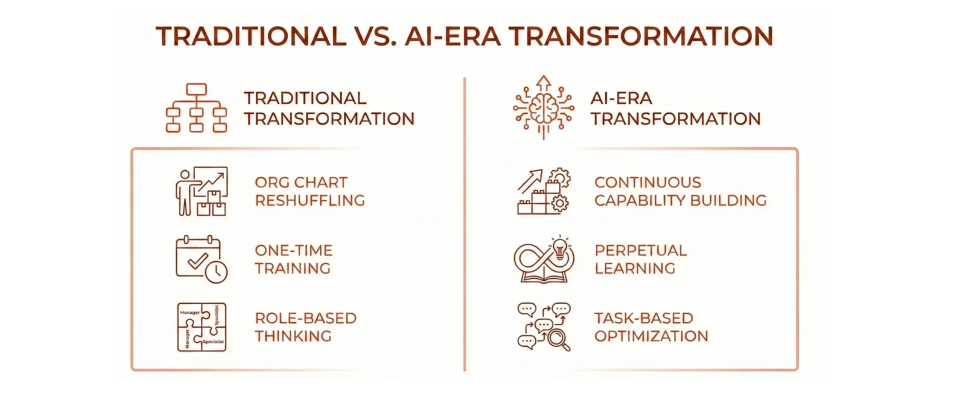
Workforce transformation in the AI era represents a complete process to arrange an organization’s employee base. The goal ensures their skills match current and future strategic needs. This goes beyond simple upskilling or restructuring initiatives. Modern workforce transformation requires a fundamental rethink of work performance, value delivery, and career development in response to AI integration.
Organizations need to reshape their structure, culture, and skills to meet business goals amid technological advancement. Strategic initiatives help modernize the workforce by integrating new technologies, developing emerging competencies, and driving cultural changes necessary for future success.
Organizations must assess existing skills and identify capabilities needed for future goals. They need to address skills gaps through targeted development initiatives. This approach has become vital as technological changes accelerated during global disruptions. Certain workplace skills now become obsolete 70% faster than predicted.
The focus lies on redefining role performance rather than workforce reduction. AI frees teams to concentrate on strategy, state-of-the-art ideas, creativity, and complex problem-solving when used responsibly. These areas showcase human excellence that machines cannot easily replicate.
From Cost Center to Value Creator: HR’s New Role
HR traditionally operated as a back-office function handling paperwork and compliance. Executives often labeled it as a “cost center” or “overhead”. Yes, it is true that this perception limited HR’s meaningful contribution to organizational missions.
This perception changes faster now. Companies that transform their HR function from cost centers to value creators see measurable improvements in employee engagement, retention, and profitability. Progressive companies recognize that HR professionals can create solutions directly affecting revenue and growth when
they understand business strategy and market dynamics.
Research shows 60% of executives now view HR as a potential partner in increasing business profitability and value. Only 20% maintain the outdated view of HR’s primarily transactional function.
HR departments must arrange their mission with organizational objectives to achieve this transition. To name just one example, see an organization that wants to provide first-class service and attractive shareholder returns. HR should focus on ensuring “the right people are in the right jobs at the right time their skills are needed” to meet customer and shareholder expectations.
Strategic Workforce Transformation vs. Traditional HR Models
Most HR functions still organize along the traditional HR model (often called the Ulrich model). This model divides HR into business partnering, shared services, and centers of excellence. This approach typically optimizes for uniformity, bureaucracy, and control—elements that clash with today’s business needs.
Strategic workforce transformation needs an AI-infused operating model that prioritizes flexibility, adaptability, and state-of-the-art ideas. This model focuses on:
- Creating customized employee experiences rather than standardized processes
- Designing human-AI collaboration instead of simply automating tasks
- Continuously measuring organizational health to proactively solve issues
- Freeing managers to provide more individualized attention, guidance, and coaching
The strategic approach requires HR to progress from a reactive administrative function into a forward-looking business driver. Organizations with strong capabilities in specific HR practices achieve higher total shareholder returns over three to five years. Executives at high-performing companies consistently report that workforce issues drive strategy.
Forward-thinking CHROs must change from disruption response to structured transformation as AI becomes embedded across service lines and workflows. This progress enables HR to transition from cost center to value-creation leader through a strategic triumvirate of coaches, subject matter experts, and technologists who reimagine traditional HR functions.
Chapter 2: The Four Pillars of AI Workforce Transformation
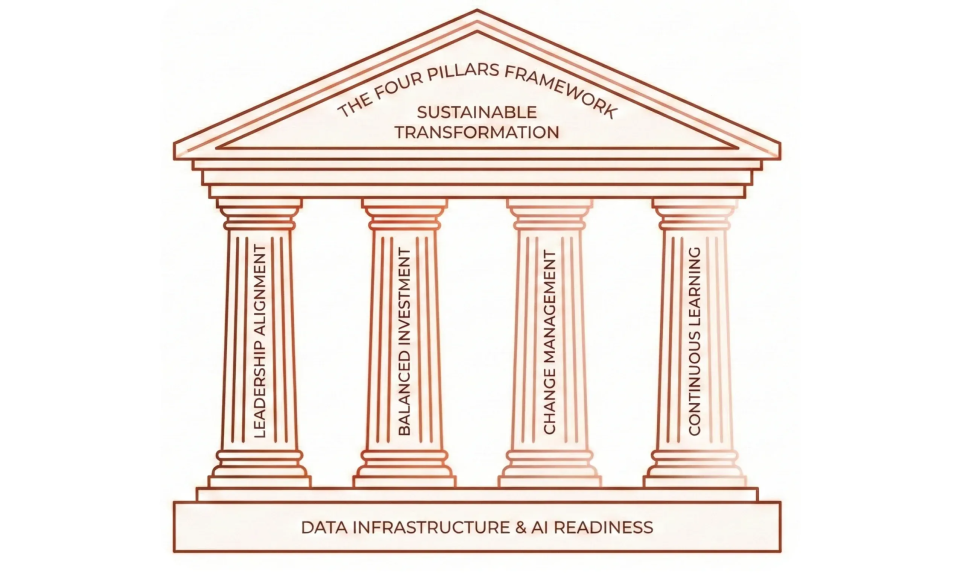
Companies need more than new technologies to succeed with AI adoption in their workforce. They need a detailed framework built on four core elements. These elements help companies direct the complexities of AI-powered workforce changes and create the structure needed for lasting transformation.
Leadership Arrangement Across C-Suite
Senior executive buy-in has become crucial as AI strategy has grown from an IT project into a boardroom priority. Senior executives now make most decisions, with CEO involvement in AI strategy increasing from 26% to 55%. COO participation jumped from 2% to 41%, while Chief Financial Officer participation grew from 1% to 38%. This sharp increase shows how AI has become vital to business strategy.
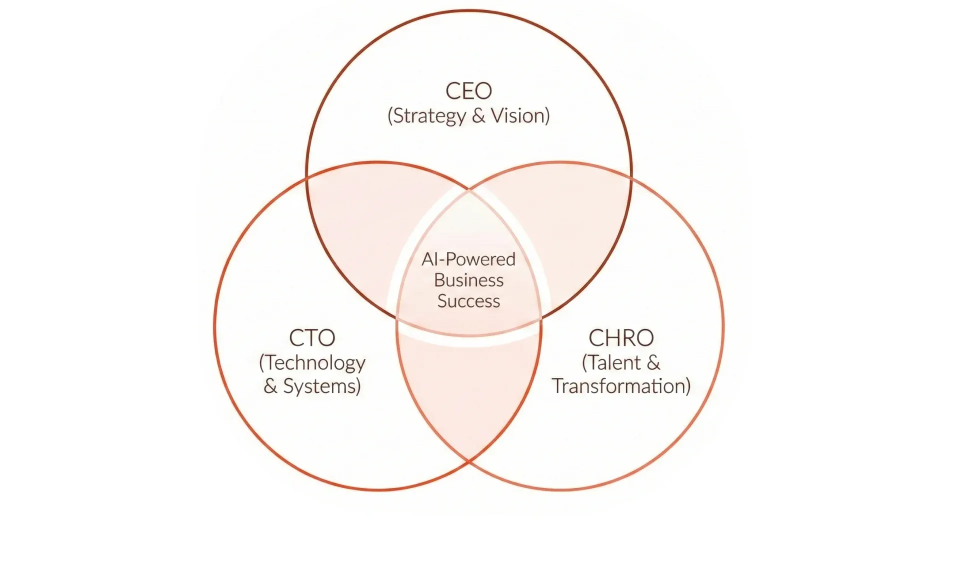
The best approach creates a shared leadership vision. The CEO charts the course, the CTO builds adaptable systems, and the CHRO prepares the workforce and manages changes. This three-way partnership balances technology rollout with employee development which is a crucial factor for successful workforce transformation.
Balanced Investment in Tech and Talent
Technology and talent strategies must work together now. Human and technological elements form the heart of effective business strategy. Companies that use AI to boost productivity see roles evolve. This creates ongoing needs for specialists in security, machine learning, and software architecture.
A balanced approach identifies crucial roles and predicts talent gaps based on business goals. The World Economic Forum projects 170 million new jobs by 2030, with India expected to capture 15-20% of these due to its talent pool and cost advantage. However, out of an estimated 18,000–20,000 professionals in the country with some exposure to AI, only about 4,000–5,000 qualify as “true AI specialists,” according to Xpheno, with AI specialist salaries ranging from ₹12-40 lakhs annually, representing a 45-60% premium over non-AI roles in the same functions.
Companies face a tough balance. They must manage costs during economic changes while attracting technical talent crucial for breakthroughs and staying competitive. This challenge requires smart, future-focused talent management that matches technological capabilities with human potential.
Proactive Change Management Programs
The best AI systems fail without proper change management. Traditional methods must evolve to handle unique AI integration concerns. Companies with strong executive support see better AI adoption results. Yet 43% of projects failed because leaders didn’t provide enough support.
Successful AI-focused change management works in four key areas:
- Trust: Building employee confidence in both the technology and organizational objectives
- Balanced Investment in Tech and Talent Proactive Change Management Programs
- Transparency: Helping workers understand AI’s purpose and effects
- Skills: Supporting continuous learning and AI literacy
- Agility: Building adaptability to meet new challenges and opportunities
This method helps companies handle complex AI integration issues and reduce resistance to change, especially fears about job losses.
Continuous Learning and Upskilling Culture
Companies that excel in the AI era know that learning skills once for an entire career doesn’t work anymore. Companies with strong learning cultures are 92% more likely to invent, 37% more productive, and 58% better prepared for future needs.
Three key elements drive this strategy: matching skills to jobs, evaluating people’s abilities, and updating this information regularly. Companies that focus on these areas help employees meet changing job needs while keeping their skills fresh.
Creating continuous learning does more than develop skills—94% of employees would stay with companies that invest in their training. Companies that build this culture of ongoing growth stand at the vanguard of workforce transformation. They stay ready to adapt as technology advances and new opportunities arise.
Chapter 3: Building an AI-Ready Workforce: Skills, Roles, and Readiness
CHROs are now in the hot seat. All CEOs want a more rapid adoption of the AI agenda, yet CHROs are responsible for the problem of skills development, organization redesign, and finding key talent. The precipitous drop in CHRO tenure tells me just how challenging a role this has become, and some CHROs are struggling to keep up.” — Kathi Enderes, SVP Research, Josh Bersin Company
Building a capable workforce takes more than just implementing technology. Organizations need to help their teams develop specific skills to work well with AI systems.
AI Fluency and Prompt Engineering as Core Competencies
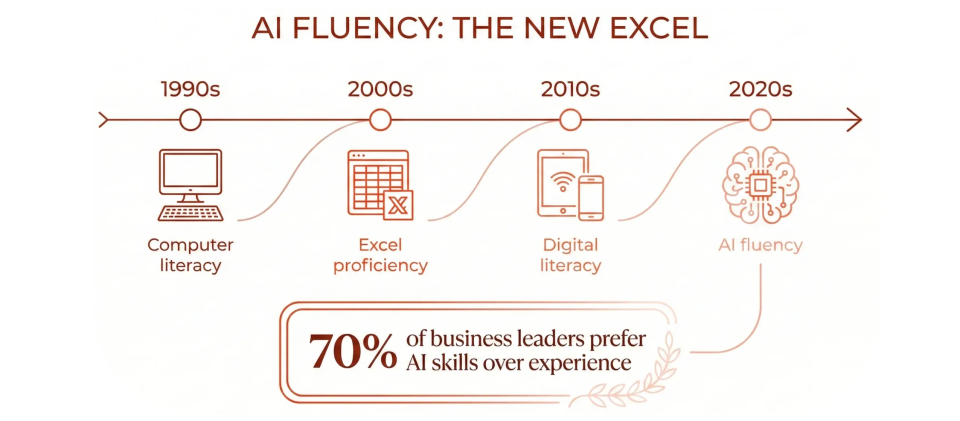
AI literacy has shifted from a niche expertise to an essential workplace baseline. In India, this shift stands out sharply. 92% of knowledge workers now use AI daily, with 75% of tech leaders prioritizing AI skills in hiring over experience. AI-proficient candidates see 142x higher profile updates on platforms like LinkedIn, yet only 20% of youth have AI exposure, fueling a stark supply-demand mismatch.
This evolution echoes Excel’s rise as a workplace staple—AI fluency now underpins career advancement across fields.
Prompt engineering sits at the heart of this fluency which simply put means knowing how to create clear, well-laid-out inputs that guide AI models toward useful outputs. This skill helps employees get the most value from tools like ChatGPT or Claude, whatever their technical background. Global studies show that employees with strong critical evaluation skills have 64% higher productivity than casual AI users.
Organizations need new ways to check these skills. They now use:
- Personality work style assessments
- Situational judgment questions
- Scenario-based evaluations
These methods give a better picture of how people show good judgment and adapt when working with AI systems.
India’s AI Fluency Challenge: The Multilingual Dimension
India’s linguistic diversity presents unique AI adoption challenges and opportunities:
- India has 22 official languages and over 19,500 dialects, requiring multilingual AI competency
- Only 10-12% of Indians are fluent in English, yet most AI tools default to
- English interfaces Bhashini initiative by MeitY aims to democratize AI in Indian languages, creating demand for vernacular AI specialists
- Organizations must train employees on both English-language AI tools AND emerging Indic LLMs like AI4Bharat’s models
Reimagining Entry-Level Roles in an AI-Augmented Workplace
Entry-level jobs are changing as AI takes over routine tasks. Capgemini research shows generative AI could save entry-level workers up to 18% of their time. This time isn’t wasted—it moves to more valuable work that needs critical thinking and problem-solving.
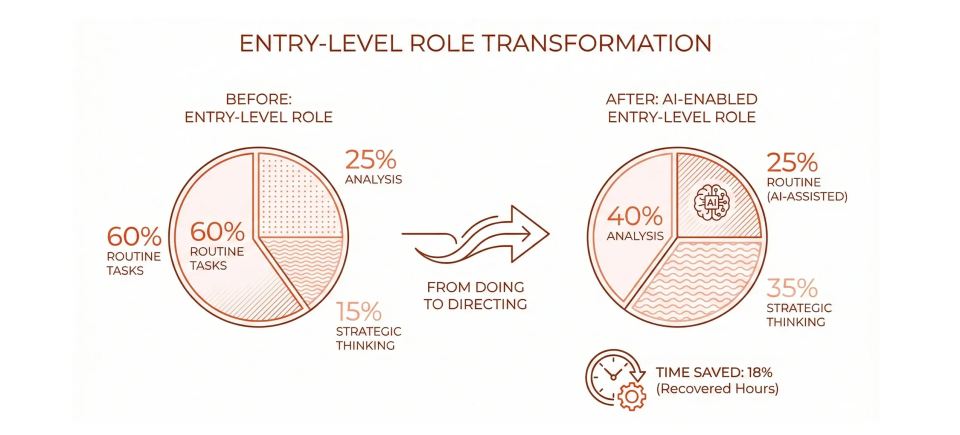
The new entry-level job focuses less on “doing” and more on “directing” AI output. Success depends on building skills in prompt engineering, data interpretation, and AI-assisted strategic thinking. One executive put it this way: “Don’t think about replacing jobs—think over what net-new jobs we’ll create for junior staff”.
Organizations should create well-planned AI fluency programs and safe spaces for dialog. Regular “AI roundtables” let employees share concerns and experiences, which helps curb misconceptions about job displacement.
The Build vs. Buy Talent Strategy for Digital Workforce Transformation
Financial analysis for Indian CHROs presents compelling arguments for internal development:
- Training cost: ₹15,000-₹25,000 per employee annually for digital upskilling programs
- Time to Hire: 45-60 days for mid-level tech roles, 90+ days for AI specialists
- Onboarding costs: First-year productivity loss estimated at 30-50% of annual CTC
Indian AI Talent Market Realities:
- AI job postings grew 320% YoY in India, outpacing talent supply by 4:1
- Machine Learning Engineers earn ₹8-25 lakhs for 0-5 years’ experience, ₹25-50 lakhs for senior roles
- Data Scientists command ₹6-18 lakhs (junior) to ₹25-60 lakhs (senior)
- AI Research Scientists at top Indian labs: ₹30-80 lakhs
- Tier 2/3 cities offer 25-40% cost arbitrage while accessing untapped AI talent pools
Government Incentives for “Build” Strategy:
- Skill India Digital platform offers free/subsidized AI courses
- NSDC partnerships provide 50-75% training cost reimbursement for recognized programs
- CSR mandates (2% of profits) can fund employee upskilling
- PLI schemes offer training subsidies for manufacturing and electronics sectors
- Apprenticeship Act incentives provide ₹1,500/month/apprentice government contribution
Chapter 4: Operationalizing AI: From Strategy to Execution
Breaking down traditional job structures into core components helps organizations move from AI strategy to real-life execution. Success depends on a deep understanding of work at its most basic level.
Mapping Work at the Task Level for Automation
A groundbreaking way to achieve AI workforce transformation focuses on analyzing tasks rather than entire roles. Smart leaders break down roles into specific tasks and assess each one’s automation potential. They don’t just wonder if jobs will vanish. This fundamental change from looking at whole jobs to individual tasks reveals new ways humans and AI can work together. Traditional approaches often miss these opportunities.
Here’s how to start:
- Pick your most critical roles
- Break each position into 20-30 specific tasks
- Check what current AI can and cannot do
- Spot quick wins and future possibilities
Companies that excel at task-level workforce planning gain a competitive edge. Those stuck with old job structures don’t handle AI integration well and lose talent.
Redesigning Workflows for Human-AI Collaboration
Creating clear handoffs between humans and AI agents matters more than just identifying tasks. IBM’s research reveals that employees prefer AI systems that predict their needs, share their workload, and switch control naturally when human judgment becomes necessary. The best workflow designs make it clear when humans should guide AI and when AI should help humans.
Trust in AI changes based on how workflows are set up. Research shows people understand their role better when they work alongside algorithms on different tasks. However, trust drops when humans work in sequence doing similar tasks but make final decisions. This trust-reducing setup appears often in real-life applications.
AI Literacy as a Corporate Benefit: Training and Access
AI literacy has become essential for success at work. It works much like reading comprehension in the corporate world. Almost half of all employees want proper training. They believe it helps them use AI better.
McKinsey’s research shows employees use AI more than their leaders think. Millennial managers report the highest AI experience, making them natural leaders for strategic workforce transformation. Organizations should work with these existing champions while creating systematic training programs that cover both technical skills and ethical awareness.
Making AI literacy a core benefit similar to healthcare or retirement plans creates a foundation for successful digital workforce transformation that balances tech advancement with human potential.
Indian Case Studies: Task-Level AI Transformation
TCS (Tata Consultancy Services): TCS’s ignio™ platform automated 60% of routine IT operations tasks, redeploying 15,000+ employees to higher-value client engagement and innovation roles.
HDFC Bank: Deployed AI assistant ‘EVA’ handling 5+ million customer queries, freeing 3,000+ customer service representatives for complex financial advisory roles. 80% query resolution rate, 30% improvement in customer satisfaction scores.
Infosys: Nia platform automated 16,000+ business processes, achieving $737 million in operational savings. Reskilled 2.2 lakh employees in digital technologies.
Flipkart: AI-powered warehouse optimization reduced order processing time by 50%, redeploying logistics staff to last-mile delivery innovation and customer experience roles.
Designing Human-AI Collaboration for Indian Workplaces
Indian organizations face unique workflow design considerations:
Hierarchical Structures: Indian workplaces traditionally have higher power distance (77 on Hofstede scale), requiring AI systems that respect decision-making hierarchies while empowering frontline workers.
Jugaad Innovation: India’s frugal innovation mindset demands cost-effective AI solutions, Indian AI implementations cost 40-60% less than Western counterparts.
Hybrid Work Models: 48% of Indian IT workers now in hybrid arrangements, requiring AI tools that work across connectivity constraints.
Diversity Considerations: Gender diversity in Indian AI roles remains low, requiring inclusive AI workflow design and targeted reskilling for women
Chapter 5: Measuring ROI and Business Impact of Workforce Transformation
Calculating how AI projects affect business remains a tough challenge for CHROs leading workforce changes. Traditional HR metrics fall short here. We need a broader view that looks at both quick wins and long-term value.
Talent ROI: Quality-of-Hire
Companies that create great employee experiences tend to beat their competitors. Indian businesses reporting an average ROI of 15% from AI initiatives in 2025, projected to reach 31% within two years.
Productivity Gains: Time-to-Productivity and Task Automation
Indian organizations report sector-specific AI productivity improvements:
- IT Services: 35-45% reduction in code development time
- BFSI: 50-60% faster loan processing, 70% reduction in fraud detection time
- Manufacturing: 25-35% improvement in predictive maintenance
- Healthcare: 40% faster diagnostic image analysis
- E-commerce: 30% improvement in demand forecasting accuracy
Risk Mitigation: Indian Regulatory Compliance
Indian CHROs must navigate evolving AI governance frameworks:
Data Protection Compliance:
- DPDPA 2023 penalties up to ₹250 crores for violations
- Employee data consent requirements impact 87% of HR AI use cases
- Data localization requirements affect cross-border AI training
Sector-Specific Regulations:
- RBI’s AI/ML framework for BFSI requires explainable AI for credit decisions
- IRDAI guidelines for insurance mandate human oversight in AI-driven underwriting
- SEBI regulations for fintech require algorithmic trading disclosures
Data Infrastructure Barriers:
- 54% of Indian organizations cite poor data quality as a key barrier to AI adoption. The highest rate across the Asia-Pacific region.
- Only 52% of data leaders say their organizations have formal data governance framework, indicating significant gaps in governance maturity.
- 62% of Indian organizations identify a lack of internal AI skills and governance frameworks as a major challenge.
Conclusion: The CHRO as Architect of India’s AI-Powered Future
AI-driven workforce transformation marks a turning point for organizations worldwide. CHROs now create business value instead of just supporting it as they work at the crossroads of technology and talent strategy. This new reality gives HR leaders a rare chance to reshape their organizations’ capabilities and market position.
AI-driven workforce transformation marks a turning point for organizations worldwide. CHROs now create business value instead of just supporting it as they work at the crossroads of technology and talent strategy. This new reality gives HR leaders a rare chance to reshape their organizations’ capabilities and market position.
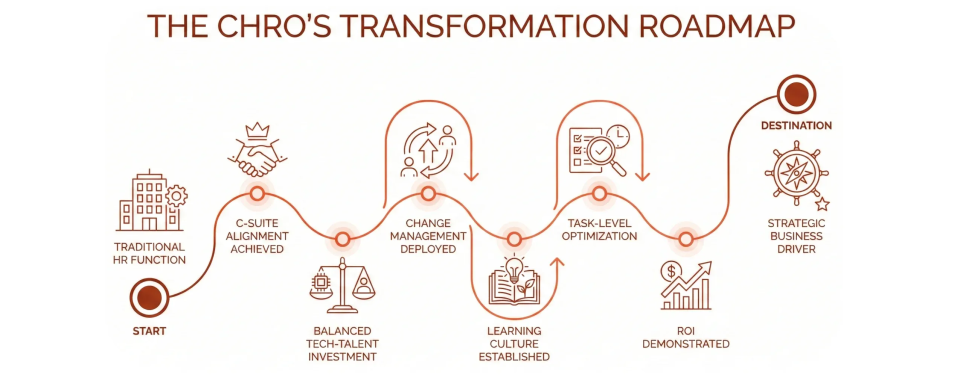
A successful workforce transformation needs action on many fronts. CHROs must work with C-suite colleagues to build a shared vision for AI implementation. On top of that, they need to match tech investments with talent development plans that ready workers for new roles. Even the best AI systems will fail without proper change management and a culture that values learning.
AI literacy has become as basic as digital literacy was 10 years ago. Smart organizations now offer this skill as a core benefit. They know that employees who become skilled at human-AI teamwork show increased efficiency and create breakthroughs. Looking at tasks rather than entire jobs helps realize AI’s full potential by creating meaningful partnerships between humans and machines.
The numbers tell a clear story about successful workforce transformation. Companies that use AI-powered workforce strategies effectively see better hiring quality, more internal movement, big productivity gains, and stronger risk management. These results give them an edge in fast-changing markets.
CHROs who welcome this chance for transformation will shape change rather than react to it. Their organizations will build workforces that adapt as technology evolves. Those who wait too long might struggle to stay relevant as skills become outdated faster.
India’s Moment: From Talent Pool to AI Powerhouse
India’s unique advantages position it to lead global AI workforce transformation:
- World’s largest youth population with 808 million under age 35
- 3.5 million STEM graduates annually, the highest globally
- Cost advantage of 40-60% over Western markets
- 1,600+ GCCs employing 1.66 million, making India the global GCC hub
- Projected $500 billion AI opportunity for India by 2030
However, realizing this potential requires immediate action. India ranks 72nd globally in AI readiness, behind peers like China (20th) and Brazil (49th). The skills gap affects 54% of Indian enterprises, threatening to convert
demographic dividend into demographic disaster.
The CHRO’s Role in India’s AI Transformation
Indian CHROs must champion:
- Vernacular AI adoption – ensuring AI benefits reach 90% of workforce in non-English roles
- Inclusive reskilling – bridging the gender gap where only 26% of AI roles go to women
- Academia partnerships – leveraging National Education Policy 2020 for industry-aligned curricula
- Government scheme utilization – maximizing Skill India, PLI, and CSR funding estimated at ₹2.5 lakh crores
- Tier 2/3 talent activation – tapping 250+ cities with untapped STEM talent
AI-driven work transformation brings both challenges and possibilities. Yet one truth stays clear – human skills cannot be replaced. The winners will be organizations that make use of AI to magnify what humans do best while freeing them from routine work. CHROs can guide their organizations into the AI-powered future confidently by following the strategies in this playbook.