Hiring an effective operations manager starts with a sharp, strategic definition of the role itself. You need to move beyond generic templates and really pinpoint the specific skills and business outcomes your organisation needs to thrive. It’s about creating a detailed profile that speaks directly to your company’s unique challenges and future ambitions, ensuring you attract candidates who can make an impact from day one.
Part 1: Defining the Modern Operations Manager Role
Before you even think about posting a job description, the most important work happens internally. This is the foundational step: defining what “great” actually looks like for your business, right now.
A laundry list of responsibilities won’t catch the eye of the high-calibre talent you need to drive real efficiency and growth. What you need is a precise, future-focused role profile. The best way to do this is to shift your thinking from task-based descriptions to competency-based profiles. Instead of just listing duties, focus on the core skills and behaviours that genuinely lead to success.
Pinpointing Core Competencies
For any modern operations manager, these competencies usually fall into three key areas. The trick is to tailor each one to your specific industry and organisational context.
- Strategic Planning: This is about more than just managing today’s workflow. It’s the ability to see the bigger picture and align daily operations with long-term company objectives. You’re looking for someone who can build scalable processes for tomorrow.
- Financial Acumen: A deep understanding of budgeting, forecasting, and P&L management is non-negotiable. A top-tier candidate can dig into financial data to spot cost-saving opportunities and build a strong case for operational investments.
- People Leadership: Great operations managers are great leaders. They have the skill to motivate, mentor, and manage a diverse team, handling everything from performance management to fostering a culture of continuous improvement.
The demand for leaders with this blend of skills is climbing. In India’s buzzing job market, overall hiring activity has seen a 23% year-on-year increase, with senior management roles experiencing a massive 39% YoY surge. This directly impacts the hunt for operations leaders, who are essential for efficiency in booming sectors like logistics and manufacturing.
To build a truly effective job description, it helps to break these competencies down and connect them to real business results.
Core Competencies for a High-Impact Operations Manager
| Competency | Description & Key Behaviours | Business Impact |
|---|---|---|
| Process Optimisation | Identifies bottlenecks, implements lean principles, and leverages technology to streamline workflows. Continuously seeks out efficiency gains. | Reduces operational costs, improves production speed, and increases overall output quality. |
| Data-Driven Decision Making | Uses KPIs and analytics to monitor performance, forecast needs, and make informed strategic choices. Comfortable turning raw data into actionable insights. | Enhances forecasting accuracy, lowers operational risks, and drives evidence-based improvements. |
| Change Management | Effectively communicates the ‘why’ behind new initiatives, manages resistance, and guides the team through operational transitions smoothly. | Ensures successful adoption of new systems and processes, minimising disruption and maximising ROI. |
| Vendor & Supply Chain Management | Builds strong relationships with suppliers, negotiates favourable terms, and ensures a resilient and cost-effective supply chain. | Mitigates supply chain risks, secures better pricing, and improves inventory management. |
| Problem-Solving & Crisis Management | Remains calm under pressure, quickly assesses complex situations, and implements decisive, effective solutions to unexpected challenges. | Minimises downtime and financial losses during disruptions, maintaining business continuity. |
By outlining competencies in this way, you create a much clearer picture of the ideal candidate, both for your hiring team and for potential applicants.

From Skills to a Scorecard
Connecting these competencies to tangible business outcomes is where a role scorecard becomes an absolute game-changer. This simple document translates your job description into a set of measurable objectives and key performance indicators (KPIs).
A role scorecard is your North Star for the hiring process. It forces you to define success before you start interviewing, ensuring every assessment is tied to what a candidate must achieve in their first year.
For instance, a competency in “Process Optimisation” could be directly linked to a KPI like, “Reduce production cycle time by 15% within the first six months.” This clarity is powerful. It sharpens your evaluation criteria during interviews and sets crystal-clear expectations for the new hire from their very first day.
Separating Must-Haves from Nice-to-Haves
Finally, a realistic profile acknowledges the difference between what’s essential and what’s simply a bonus. While it’s good to be ambitious, searching for a unicorn who ticks every single box can stall your search indefinitely.
The practical approach? Create two distinct lists.
- Must-Haves: These are the non-negotiables. For an e-commerce operations manager, this might be proven experience with warehouse management systems (WMS) and last-mile delivery logistics.
- Nice-to-Haves: These are skills that add value but could be developed on the job. Think experience with a specific project management tool like Asana or a certification in Lean Six Sigma.
This framework helps you craft a profile that is both ambitious and achievable, attracting top-tier talent without narrowing your pool too much. When you invest time in this defining stage, you build a solid foundation for the entire hiring process. Having a clear grasp of the roles and responsibilities of an operations manager is the critical first step to getting this right.
Crafting a Multi-Channel Sourcing Strategy
Let’s be honest: just posting a job ad on a portal and waiting for the perfect Operations Manager to apply is a strategy from a bygone era. In today’s market, that’s not a strategy—it’s a lottery ticket. To land top-tier talent, you need to go hunting. This means a proactive, multi-channel approach that targets not just active job seekers, but the high-performers who are currently delivering results for someone else.
A modern sourcing plan is all about building a healthy, diverse pipeline of candidates. It’s about ditching the “post and pray” mindset and actively engaging the kind of leaders who can genuinely drive your business forward. This is where a smart mix of digital outreach, networking, and internal programmes really makes a difference.
Expanding Beyond the Job Board
The best candidates are often happily employed. They aren’t scrolling through job sites. To get on their radar, your sourcing has to be both diverse and intentional. Think of it as creating multiple pathways for great talent to find their way to you.
Your strategy should blend several key channels:
- Professional Networks: Use platforms like LinkedIn for more than just posting jobs. It’s a goldmine for identifying and directly engaging potential candidates. This requires personalised outreach that actually speaks to their expertise and career ambitions, not a generic copy-paste message.
- Employee Referrals: Your own team is one of your most powerful—and often overlooked—recruiting tools. A well-structured referral programme gives them a real incentive to recommend skilled people from their networks. These candidates often come pre-vetted and are a much stronger cultural fit from the get-go.
- Industry-Specific Forums: Operations pros hang out in online communities and forums to trade stories and solve problems. Being present in these spaces lets you spot the real experts and subtly build your employer brand where it counts.
By diversifying your approach, you’re not just casting a wider net; you’re casting a smarter one. This dramatically increases your chances of finding someone with the exact blend of skills and experience you need.
Tapping into Hidden Talent Pools
While major hubs like Bengaluru and Mumbai are the obvious places to look, some of the most exciting growth is happening elsewhere. In fact, data shows that Tier-2 and Tier-3 cities are seeing a 21% year-on-year hiring growth, blowing past the 14% in metros. Cities like Bhubaneshwar (41%) and Udaipur (44%) are quickly becoming hotspots for skilled professionals.
Focusing on these high-growth smaller cities can be a huge strategic advantage. You often face less competition for top talent and can find highly skilled individuals who are eager for leadership opportunities without having to relocate.
This isn’t about just posting your job ad in a new location. It requires a targeted approach where your team understands the local market dynamics, from salary benchmarks to what truly motivates professionals in these regions. It’s a shift from waiting for talent to come to you, to going where the talent actually is.
This is exactly where a Recruitment Process Outsourcing (RPO) partner can provide incredible value. An RPO partner can amplify your reach with advanced sourcing tech and deep market mapping, identifying ideal candidates in overlooked locations—even if they aren’t looking for a new role. There are many modern recruitment sourcing methods you can explore to build a more robust pipeline.
The Art of Compelling Outreach
Once you’ve identified potential candidates, your first message has to cut through the noise. Generic, templated outreach is the fastest way to get ignored. The key is personalisation and showing them what’s in it for them.
Your outreach messages should:
- Show You’ve Done Your Homework: Reference a specific project on their profile or a recent company win. It shows you see them as an individual, not just another name on a list.
- Highlight the Opportunity, Not Just the Job: Don’t just list responsibilities. Frame the role in terms of impact. What challenges will they get to solve? How can they make a real difference?
- Let Your Employer Brand Shine: Your first message is a direct reflection of your company culture. Use a tone that’s professional but human. Briefly touch on what makes your organisation a great place to build a career.
Effective outreach is what turns a cold contact into a warm conversation. It’s the first step in building a genuine relationship and making top professionals want to join your team.
Getting Assessments Right: A Framework for Hiring Top Operations Talent
To make a truly great hire, you need to go beyond just looking at a candidate’s CV. Your process has to predict how they’ll actually perform in your unique operational environment. This is where a structured assessment framework comes in. It’s about replacing gut feelings and guesswork with a consistent, data-driven approach that hones in on the competencies that really matter.
Let’s be honest, moving away from those free-flowing, conversational interviews can feel unnatural at first. Building rapport is important, of course. But a structured process ensures every single candidate is measured against the same objective yardstick. This isn’t just about making better hires; it’s about creating a fair and defensible process that strengthens your employer brand.
The best frameworks use a multi-stage approach, designed to test different skills at each step, giving you a complete, 360-degree view of what each person brings to the table.
Designing a Multi-Stage Assessment Process
A solid process for an operations manager role usually involves a few distinct stages, each with a specific job to do. Think of it as a funnel—this layered approach lets you screen candidates efficiently while digging progressively deeper into the skills of your most promising prospects.
A typical flow might look something like this:
- The Initial Screen: A quick call to confirm the basics—foundational experience, salary expectations, and a general feel for cultural alignment. This is a fast filter to make sure you’re only investing real time in viable candidates.
- The Behavioural Interview: This is where you dig into past performance using a structured method to see their core competencies in action.
- The Practical Case Study: A work-sample test that mirrors a real-world challenge they’d actually face in the role.
- The Final Panel Interview: A meeting with a cross-functional group of senior leaders to gauge strategic thinking and leadership fit.
This assessment framework is fed by a strong sourcing strategy, which is all about getting the right people into the funnel in the first place.
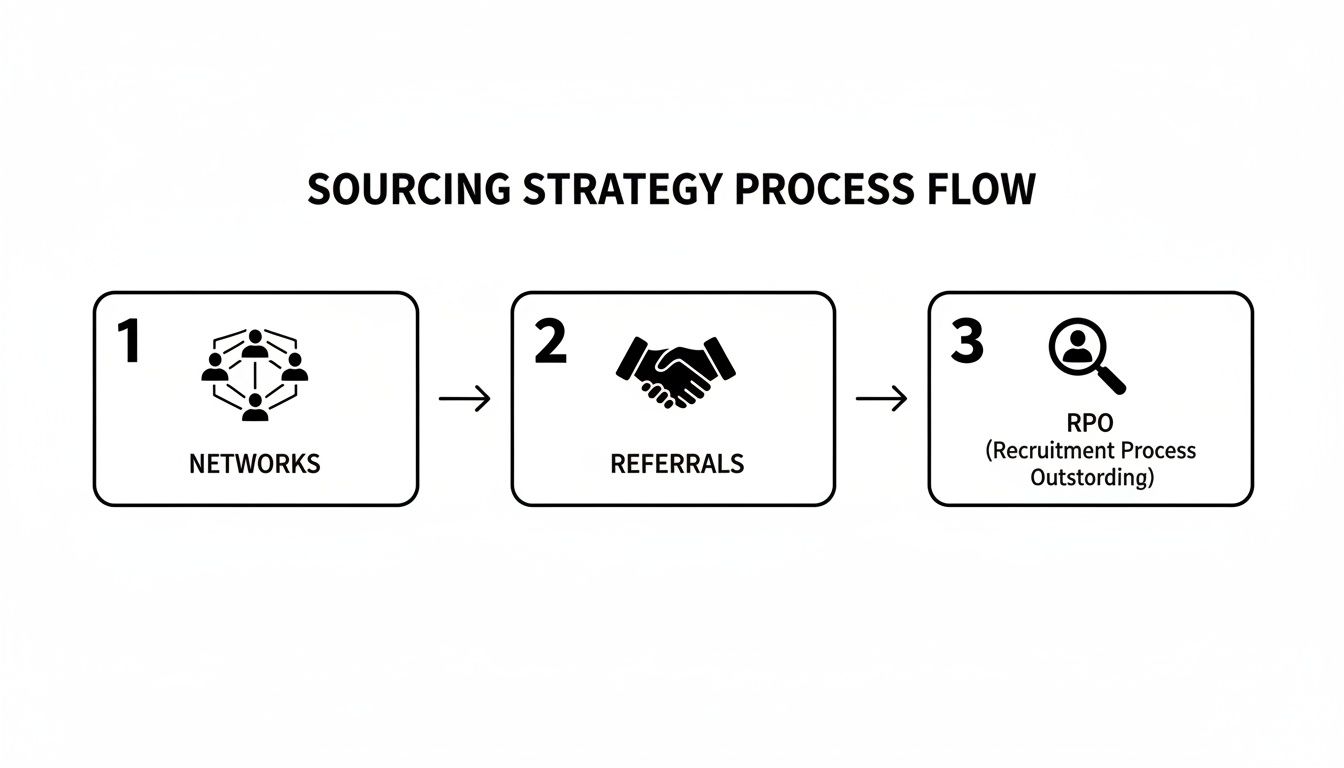
As the diagram shows, channels like personal networks, employee referrals, and RPO partnerships all work together to build a strong talent pipeline that flows directly into these assessment stages.
Mastering the Behavioural Interview
The real heart of the assessment process is the behavioural interview. The idea behind it is simple: past behaviour is the best predictor of future performance. To get at that, the STAR method (Situation, Task, Action, Result) is your most valuable tool. It forces candidates to move beyond generic, hypothetical answers and provide concrete, evidence-based examples.
Your questions should tie directly back to the core competencies you mapped out in the role scorecard.
- For Problem-Solving: “Tell me about a time you uncovered a major operational bottleneck. What was your process for getting to the root cause, and what was the outcome of the fix you put in place?”
- For Change Management: “Walk me through a situation where you had to guide your team through a significant process change. How did you handle resistance, and what was the key to getting everyone on board?”
- For People Leadership: “Describe a time you had to manage an underperforming team member. What steps did you take, and what was the end result for that person and for the team?”
Questions like these don’t let candidates hide behind theory. They have to show you how they actually apply their skills when it counts.
The Power of Practical Case Studies
Behavioural questions are fantastic, but nothing predicts on-the-job success quite like a well-designed work sample. For an operations manager, this usually means a case study.
A practical case study is your chance to see a candidate’s thought process live and in action. It’s not about them finding the one ‘right’ answer. It’s about you evaluating their analytical chops, strategic thinking, and ability to communicate a complex solution with clarity.
You could, for instance, present a candidate with anonymised data showing a recent dip in production efficiency or a spike in customer complaints. Their job would be to analyse the data, pinpoint potential causes, and propose a detailed, actionable plan to fix it. In one exercise, you’re testing their financial acumen, data analysis skills, and strategic planning abilities all at once.
Ensuring Consistency with a Scoring Rubric
The final, critical piece of the framework is a standardised scoring rubric. This simple tool ensures that every interviewer—whether they’re from finance, sales, or your own team—is evaluating candidates on the exact same scale. A simple 1-5 rating for each competency, with clear descriptions for what a 1 or a 5 actually looks like, works wonders.
Bringing in a cross-functional interview panel is a great way to get diverse perspectives. When everyone is armed with the same shared rubric, the panel can make a truly collective and data-backed decision. This one change alone can dramatically improve the quality and consistency of your operations manager hires.
Making the Offer They Can’t Refuse
You’ve put in the hard work, navigated through dozens of candidates, and run a rigorous assessment process. Now you have your top choice. But don’t pop the champagne just yet—the final stage is often where great hires are lost. Extending a compelling offer is so much more than just throwing a number on the table.
It’s about crafting a narrative that sells the opportunity, reinforces your employer brand, and makes the candidate feel like this is the only logical next step in their career. Getting this right is a delicate dance between hard data and genuine human connection.
Getting the Compensation Right
Let’s be blunt: the foundation of any great offer is a competitive salary. Guesswork won’t cut it here. You need to ground your offer in solid, up-to-the-minute market data.
The Indian market for operations talent is hot. Right now, the national average salary for an operations manager is around ₹18.5 LPA, but we see the top 10% of professionals commanding salaries north of ₹30 LPA. This isn’t just trivia; it’s a clear signal that you need a well-researched strategy. You can dig deeper into the latest salary insights for operations managers on collegesearch.in to get a feel for the landscape.
Of course, location is everything. A senior manager in Bengaluru will have very different expectations from someone in a Tier-2 hub like Jaipur or Chandigarh.
To help you benchmark effectively, here’s a look at how salaries stack up across major Indian cities and experience levels. Use this as a starting point to ensure your offer is not just competitive but compelling for your specific location.
Operations Manager Salary Benchmarks by Experience and City
| Experience Level | Bengaluru Range (LPA) | Mumbai Range (LPA) | Delhi NCR Range (LPA) | Tier-2 Average (LPA) |
|---|---|---|---|---|
| Entry-Level (0-3 Yrs) | ₹8 – 15 | ₹8 – 14 | ₹7 – 13 | ₹6 – 10 |
| Mid-Level (3-8 Yrs) | ₹15 – 28 | ₹14 – 26 | ₹13 – 25 | ₹10 – 18 |
| Senior-Level (8+ Yrs) | ₹28 – 45+ | ₹26 – 40+ | ₹25 – 38+ | ₹18 – 30+ |
This data gives you a solid anchor, but a truly irresistible offer is about the total rewards, not just the base salary.
While the paycheck is the headline act, the supporting cast is what often closes the deal. Think about the complete package:
- Performance Bonuses: Tie bonuses directly to the KPIs from the role scorecard. When a candidate sees a clear path from their performance to their pocket, it shows you’re serious about rewarding results.
- Real Growth Opportunities: Don’t just talk about growth; budget for it. Mention specific funds for certifications, industry conferences, or an executive education programme. This proves you’re investing in their future, not just filling a seat.
- The Human Element: In a post-pandemic world, flexibility and balance are non-negotiable for top talent. Highlighting flexible hours, generous leave policies, or wellness stipends can often be the tipping point.
Making Reference Checks Actually Mean Something
Too often, reference checks are just a final, procedural box-ticking exercise. This is a massive missed opportunity. When done right, they are your final layer of due diligence and a rich source of genuine insight.
Forget the generic, “Did they work there from X to Y?” questions. Use this time to validate the competencies you saw—or had questions about—during the interviews.
A great reference check goes beyond confirming dates of employment. It’s your chance to ask a candidate’s former manager specific, behaviour-based questions that give you a real sense of their on-the-job impact.
Try asking something like this: “We were impressed with [Candidate’s Name]’s experience in process optimisation. Could you share a specific example of a time they had to lead their team through a difficult operational change? How did they manage the pushback and get everyone on board?”
This kind of question gives you a story, not a “yes” or “no.” It provides concrete evidence of how they perform under pressure and how they’ll likely fit into your culture.
A Masterclass in Negotiation and Communication
Once you extend the offer, the conversation has just begun. Be prepared to negotiate. Any A-player worth their salt knows their market value and will likely come back with questions or a counter.
See this as a collaborative discussion, not an adversarial battle. Your goal is to understand their core motivations. Is it really just about the base salary, or are they looking for more scope, a better title, or specific benefits? A respectful, flexible approach to negotiation doesn’t just get the deal done; it starts your relationship with your new hire on a foundation of trust.
Finally, let’s talk about the candidates you didn’t choose. How you handle this is just as important. Ghosting unsuccessful candidates is not just bad form; it’s bad for business.
Providing timely, professional, and personalised feedback protects your employer brand. A candidate who has a positive experience—even in rejection—is far more likely to apply again, refer others from their network, or simply speak well of your organisation. Every interaction is a brand-building opportunity, ensuring your talent pipeline stays healthy for the next crucial operations manager hiring cycle.
Designing an Impactful Onboarding Plan
Getting your top candidate to sign the offer letter is a huge win, but let’s be honest, the real work starts on day one. A fantastic hire can fizzle out fast without a thoughtful, structured onboarding experience. This is especially true for an operations manager, who needs to get up to speed on complex processes and build relationships across the business almost immediately. For them, a solid onboarding plan isn’t just a nice-to-have; it’s critical for their long-term success.
The goal here is to go way beyond the standard HR orientation filled with paperwork and a welcome lunch. You need a strategic 90-day plan that truly immerses your new leader in the company culture, gives them the tools they need, and empowers them to score some early, meaningful wins. This proactive approach makes your new manager feel supported and puts them on a clear path to making a real impact.

The First 30 Days: Immersion and Learning
The first month should be all about soaking things in and building relationships. Resist the urge to throw them into the deep end with complex, high-pressure projects right away. The main objective is to help them understand the operational landscape—the people, the processes, and the unwritten rules.
Here’s what this phase should look like:
- Structured Introductions: Don’t just introduce them to their direct reports. Set up one-on-one meetings with key players in finance, sales, IT, and other departments they’ll be working with. Give them context on who does what and how the departments mesh.
- Process Deep Dives: Arrange for team leads to walk them through crucial workflows, from supply chain logistics to customer service protocols. Actually seeing it in action is far more powerful than just reading a manual.
- Role Scorecard Review: Pull out that role scorecard you built during the hiring process. Walk through it again, discuss the KPIs, and set clear, achievable expectations for their first quarter.
This entire period is about listening and learning. Encourage them to be a sponge—ask questions, sit in on meetings, and really get to the “why” behind how things are done before they even think about making changes.
The Next 30 Days: Contribution and Initial Wins
In month two, the gear shifts from passive learning to active contribution. Now’s the time to assign a small, well-defined project that lets them flex their skills and get a tangible result. The trick is to pick something with a high chance of success. This builds their confidence and, just as importantly, their credibility with the team.
For instance, you could task them with analysing a specific, nagging bottleneck in the production line and presenting a detailed improvement plan by the end of the month. This kind of project forces collaboration, shows off their analytical chops, and delivers a clear, measurable outcome.
An early win, no matter how small, is a powerful catalyst. It builds momentum, validates the hiring decision in the eyes of the team, and gives the new manager a crucial sense of accomplishment and belonging.
Regular check-ins are absolutely vital during this phase. A weekly sync-up with their direct manager can help clear roadblocks, offer guidance, and make sure they feel supported as they tackle their first big task. For a deeper dive, you can explore our detailed guide on creating a comprehensive new employee onboarding checklist and template.
The Final 30 Days: Ownership and Initiative
By the third month, your new operations manager should be moving from guided tasks to proactive ownership. They should have a firm grasp of the business and be starting to spot opportunities for improvement on their own.
This is where you empower them to take the lead:
- Develop a 90-Day Plan Review: Have them present their observations from the first two months, along with a strategic plan for the next quarter. This plan should tie their proposed initiatives directly back to the KPIs on their role scorecard.
- Delegate Broader Responsibilities: Start handing over full ownership of key operational areas, like vendor management or inventory control.
- Establish Feedback Loops: Schedule a formal 90-day review to discuss their progress. Celebrate the early wins and provide constructive feedback to fuel their continued growth.
This structured 90-day plan does more than just get a new employee up to speed; it lays the foundation for a successful, high-impact leader. By connecting their onboarding directly to the performance metrics defined at the very start of the operations manager hiring process, you create a seamless journey from candidate to indispensable team member.
FAQs
Even with a detailed playbook in hand, hiring for a role as critical as an operations manager always throws up a few questions. As a CHRO, you’re constantly juggling market shifts, evolving candidate expectations, and keeping internal stakeholders aligned. Here, we tackle some of the most common queries we hear, with clear answers to help you move forward with confidence.
These questions usually get to the heart of the matter—the real challenges in sourcing, assessing, and attracting top-tier talent in such a competitive space. Getting these answers right is often what separates a good hire from a truly great one.
What Are the Most Critical Skills for an Operations Manager Today?
The role has moved far beyond the traditional pillars of logistics and process management. Of course, expertise in supply chain and workflow optimisation is still the foundation, but the candidates who truly make an impact bring a much more dynamic mix of strategic and soft skills to the table.
Keep an eye out for individuals who are exceptional in these three specific areas:
- Advanced Data Analysis: It’s one thing to read a dashboard; it’s another thing entirely to translate complex operational data into actionable business strategy. This skill is a genuine game-changer.
- Financial Acumen: A deep, practical understanding of P&L statements, budgeting, and forecasting is no longer just a “nice-to-have.” The best candidates can draw a straight line from operational efficiencies to bottom-line financial performance.
- Empathetic Leadership and Change Management: Great operators are also brilliant people leaders. They can steer their teams through major technological shifts or process overhauls with clarity and empathy, winning buy-in instead of creating resistance.
The biggest mistake we see is companies undervaluing these “softer” skills. An operations manager who can master a spreadsheet but can’t inspire their team will always hit a ceiling on their impact. Today’s leaders have to manage systems and motivate people with equal flair.
How Can We Attract Top Operations Talent Outside of Major Metro Cities?
The talent pool in Tier-2 and Tier-3 cities is growing—and fast. But attracting them requires a completely different playbook than what works in Bengaluru or Mumbai. You can’t just rely on your big-city brand name; you have to build a compelling local story.
A winning strategy focuses on what actually matters to professionals in these areas. Start by building a strong employer brand that highlights specific, tangible advantages. This could mean showcasing a better work-life balance, spelling out clear pathways for career growth, or emphasising the unique opportunity to make a massive impact in a growing market.
Your outreach has to be more targeted, too. Get involved with local industry networks and use platforms like LinkedIn for geo-targeted searches. And this is critical: make sure your compensation packages are competitive for that specific region, not just a scaled-down version of a metro salary. Show that you value the role and the local talent, and the best candidates will take notice.
What Is the Biggest Mistake Companies Make When Hiring an Operations Manager?
Without a doubt, the single most common pitfall is falling back on a generic job description and an unstructured interview process. This approach is fundamentally broken because it treats the operations manager role like a commodity. It completely fails to account for your company’s unique operational challenges, its culture, or its long-term strategic goals. This almost always results in a hire who looks great on paper but turns out to be a poor fit in practice.
A vague job description just invites a flood of irrelevant applications, which is a massive waste of time. Worse, an unstructured interview process—where every interviewer asks different, off-the-cuff questions—makes it impossible to compare candidates objectively. You open the door to hiring based on “gut feel” or unconscious bias, rather than on solid evidence of who can actually do the job.
The only way to avoid this is to invest the time upfront. Create a tailored role profile and a structured assessment framework. This ensures every single step of your operations manager hiring process is purpose-built to find the exact leader your organisation needs to thrive.
Navigating the complexities of sourcing, assessing, and onboarding a high-impact operations manager is a huge undertaking that requires a strategic partner. At Taggd, we specialise in RPO solutions that help you build the leadership teams that drive real business growth. Learn how our expertise can refine your hiring process.