To really get ahead in EdTech today, companies need to build teams with a smart mix of talent, focusing on four crucial areas. It’s no longer just about hiring coders; it’s about finding people with deep technical expertise in AI/ML, the pedagogical know-how of learning engineers, a solid grasp of AI in Edtech ethics, and essential organisational skills like collaboration and adaptability.
The New EdTech Reality Is Powered by AI
Artificial Intelligence isn’t some far-off concept in education anymore. It’s here, right now, fundamentally changing how we learn. From primary school classrooms to corporate training modules, AI tools are making learning more personal, adaptive, and genuinely effective.
This breakneck speed of innovation is creating a real headache for Chief Human Resources Officers (CHROs) and talent leaders. There’s a growing chasm between how fast EdTech is evolving and the number of skilled people available who can actually build, manage, and ethically use these sophisticated systems.
The Growing Demand for Specialised Talent
The educational technology sector is expanding at a blistering pace, with AI sitting squarely in the driver’s seat. Just look at the numbers: India’s EdTech market is currently valued at USD 4.28 billion and is expected to rocket forward at a compound annual growth rate of 28.91% through 2035. This boom is powered by widespread internet access and affordable smartphones, completely reshaping learning for millions.
This growth is creating an urgent, almost frantic, demand for talent that can live at the intersection of technology and education. Companies aren’t just looking for software developers anymore. They need people who get the subtleties of learning science and the critical ethical questions that come with AI. This hunt for new skills is a major theme in the latest EdTech hiring trends.
The real challenge isn’t just finding tech experts. It’s about putting together teams that can create tools that are not only smart but also educationally sound, fair, and truly helpful for the learner.
Mapping the Essential Skill Clusters
To build a team that can lead in this new world, CHROs need to think in terms of connected skill clusters. Simply hiring a machine learning engineer won’t cut it. That engineer needs to work hand-in-glove with someone who understands how students absorb information, and both of them need to operate under clear ethical guidelines.
We can break down the most vital capabilities into four distinct but deeply interconnected groups:
- Technical Skills: This is the bedrock of any AI project. Think machine learning, data science, and top-tier software engineering.
- Pedagogical Skills: This is the expertise in learning science, instructional design, and curriculum development that makes sure the tech actually serves educational goals.
- Ethical and Governance Skills: This is the ability to spot and fix bias, protect student data, and build AI systems that are fair and transparent.
- Organisational Skills: These are the soft skills, collaboration, communication, and adaptability—that allow diverse teams to click and work together seamlessly.
Before diving deep into talent strategies, it’s helpful to see these clusters in a clear, high-level view.
Essential Skill Clusters for the AI-Driven EdTech Sector
The table below provides a quick snapshot for CHROs, summarising the core talent competencies needed to innovate and scale AI in education.
| Skill Cluster | Core Competencies | Impact on EdTech |
|---|---|---|
| Technical Skills | AI/ML, Data Science, Cloud Computing, Software Engineering | Builds the functional backbone of AI-powered learning platforms and tools. |
| Pedagogical Skills | Learning Engineering, Instructional Design, Curriculum Development | Ensures technology enhances learning outcomes and is educationally effective. |
| Ethical & Governance Skills | AI Ethics, Data Privacy, Bias Mitigation, Regulatory Compliance | Establishes trust and ensures responsible, fair, and safe use of AI in education. |
| Organisational Skills | Collaboration, Adaptability, Strategic Thinking, Communication | Enables diverse teams to work cohesively and drive innovation forward. |
Understanding these clusters is the first real step for any CHRO looking to build a future-proof workforce. It’s the roadmap for finding, assessing, and nurturing the talent you need to not just compete in the AI-driven EdTech market, but to lead it. We’ll explore each of these areas in more detail next.
Mastering the Technical and Domain-Specific Skills
Building successful AI-powered EdTech isn’t just about a great idea; it’s about having the right craftspeople to bring that idea to life. These technical and domain-specific skills are the raw materials and specialised tools needed to construct learning experiences that are both intelligent and effective. For CHROs, understanding these roles is about more than just job titles, it’s about appreciating what each person contributes to the final product.
Think of it like building a smart, self-adjusting bridge. You need architects, engineers, material scientists, and safety inspectors, all working in sync. In EdTech, these roles have different names, but their collaborative importance is exactly the same.
Architects of Personalised Learning: AI and ML Engineers
At the very core of any AI EdTech platform, you’ll find the Artificial Intelligence (AI) and Machine Learning (ML) Engineers. These are the architects designing the “brain” of the system. They don’t just write code; they create the algorithms that allow software to learn from student interactions, identify knowledge gaps, and serve up the perfect piece of content at just the right moment.
For instance, an ML engineer might build the engine for an adaptive quiz platform. This engine doesn’t just score answers as right or wrong. It analyses patterns in a student’s mistakes to understand why they’re struggling with a concept and then dynamically adjusts the difficulty and focus of the next questions. They are essential for turning a one-size-fits-all lesson plan into a one-to-one tutoring experience, at scale.
The Compass for Educational Journeys: Data Literacy and Analysis
If AI/ML engineers build the engine, then data literacy is the compass that steers it. Every click, every answer, every second a student spends on a platform generates a data point. Professionals skilled in data analysis and interpretation transform this raw information into actionable insights. They are the navigators who map out the student’s learning journey.
A data analyst can tell you that 70% of students are dropping off at a specific module, but someone with true data literacy digs deeper to ask why. Are the questions too hard? Is the content unengaging? By answering these questions, they provide the critical feedback loop that allows the product team to refine and improve the educational experience, ensuring the AI is genuinely helping, not just collecting data.
This visual breaks down the hierarchy of essential talent, showing how technical, pedagogical, and ethical skills all come together.
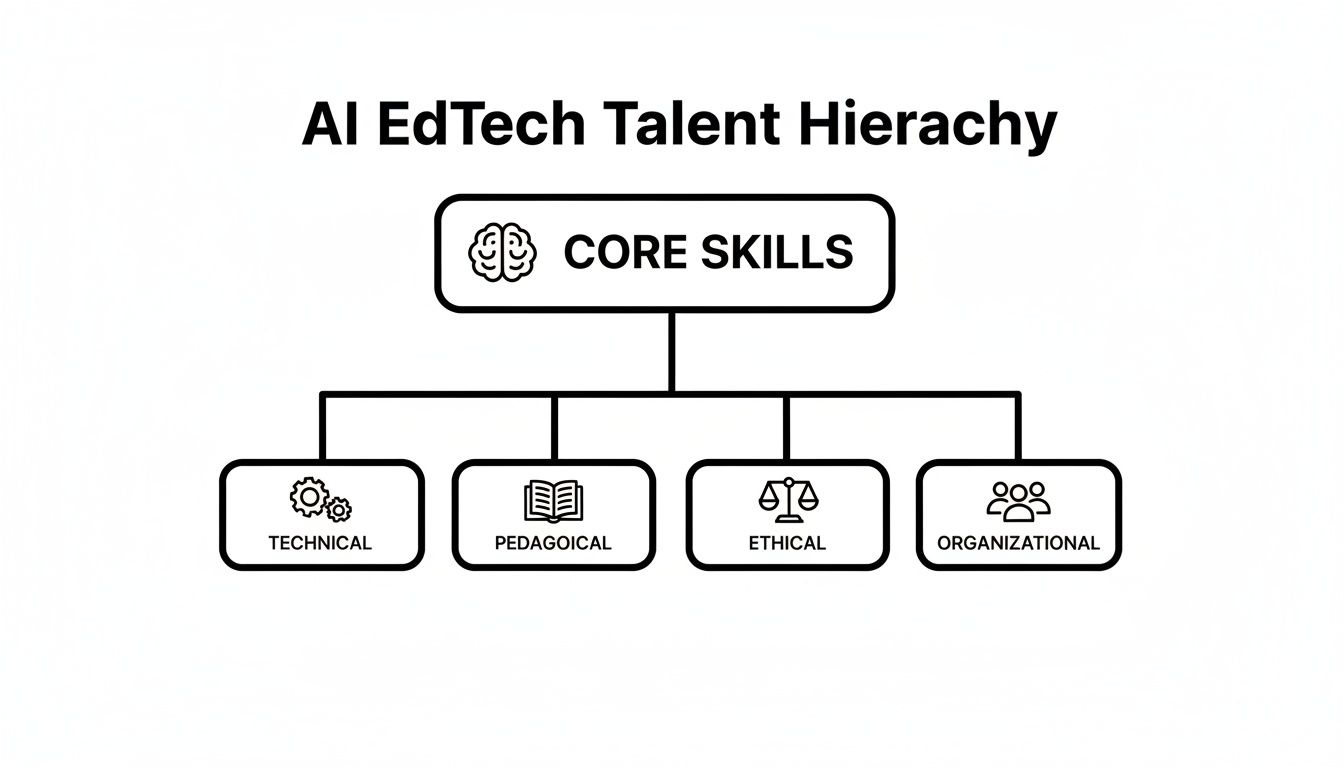
The diagram clearly shows that core skills are supported by interconnected pillars, highlighting that technical prowess alone is never enough without a strong pedagogical and ethical foundation.
The Bridge Between Pedagogy and Technology: Learning Engineers
One of the most critical and often overlooked roles in AI EdTech is the Learning Engineer. This is a hybrid role, a true bridge builder who stands firmly between the world of educational science (pedagogy) and the world of software development. They’re fluent in both languages and make sure nothing gets lost in translation.
A Learning Engineer takes established principles of how people learn, like cognitive load theory or spaced repetition, and works with AI engineers to embed them directly into the technology’s design. They ensure the platform’s “smart” features are not just technologically impressive but also educationally sound.
A platform might use AI to create a beautiful, interactive simulation. But a Learning Engineer asks the crucial question: “Does this simulation actually lead to better comprehension and retention, or is it just a gimmick?” They are the guardians of educational effectiveness.
Creating Intuitive Learning Environments: UX and UI Designers
Even the most intelligent AI tutor is useless if students and teachers find it confusing or frustrating to use. This is where User Experience (UX) and User Interface (UI) Designers become indispensable. Their expertise ensures that the technology is not only powerful but also accessible, intuitive, and engaging.
- UI Designers focus on the visual aspects, the layout, colours, and typography. They create a clean, inviting digital classroom that feels easy to navigate.
- UX Designers focus on the overall feel of the journey. They map out how a user interacts with the platform to make sure the process is logical, seamless, and free of friction.
In an EdTech context, their work is even more critical. They design for a wide range of users, from young children who need playful interfaces to adult learners who require professional, efficient tools. A strong UX/UI team ensures the technology gets out of the way, allowing the learning to take centre stage. As you look to hire, you can find more insights on the broader spectrum of AI skills in demand that complement these specific EdTech roles.
The Moral Foundation: AI Ethics and Governance Specialists
Finally, building trust is paramount in education. Parents and educators need to know that AI tools are fair, unbiased, and safe. AI Ethics and Governance Specialists provide this crucial moral foundation. Think of them as the quality control inspectors for fairness and responsibility.
These professionals proactively examine algorithms for hidden biases that might disadvantage certain student populations. They also develop robust data privacy policies to protect sensitive student information. In a world where an algorithm could influence a student’s educational path, the role of an ethicist is not a luxury; it is an absolute necessity for building a sustainable and reputable EdTech product.
Developing the Soft Skills That Drive Success
Brilliant technology is only half the story. An AI-powered educational tool, no matter how clever its code, can fall completely flat if the team behind it lacks the crucial, human-centric skills needed to guide its journey from concept to classroom. This is where we pivot from raw technical ability to the organisational and soft skills that truly separate a good project from a great one.
These aren’t just “nice-to-have” additions to a CV; they are fundamental for navigating the complex, deeply human challenges of using AI in education. Without them, even the most promising tech initiatives can stall, miss the mark with users, or create serious ethical headaches.
Fostering Collaborative Innovation
In the world of AI EdTech, innovation is rarely a solo act. The most impactful products are born from a dynamic fusion of different experts. A data scientist, a learning engineer, a UX designer, and a classroom teacher each bring a unique and vital perspective to the table. Collaborative innovation is the magic that allows these diverse viewpoints to merge into a single, effective solution.
Picture two teams building an AI maths tutor. Team A works in silos. The engineers code the algorithm from a spec sheet, and the pedagogy experts only see it at the end. The result? A tool that’s technically sound but totally out of sync with how teachers actually run their classrooms.
Team B, on the other hand, lives and breathes collaborative innovation. Engineers and educators are in the trenches together from day one, co-designing features and constantly swapping feedback. This synergy creates a far superior product, one that not only helps students learn but also fits seamlessly into a teacher’s daily workflow. This is why teams that master collaboration consistently outperform those that don’t.
The most successful AI EdTech teams operate less like an assembly line and more like a jazz ensemble. Each member is a master of their instrument, but the real magic happens when they listen to each other and improvise together to create something new.
This collaborative spirit is the best defence against creating products that are technologically impressive but practically useless in a real school.
The Importance of Adaptability and Agility
The field of AI is moving at lightning speed. A breakthrough algorithm announced today could be standard practice in six months. This constant state of flux means that adaptability and agility aren’t just skills; they’re essential for survival. It’s the ability to pivot quickly based on new research, user feedback, or a sudden shift in the market.
An adaptable team doesn’t blindly follow a two-year product roadmap. Instead, they embrace an agile way of working—operating in short cycles, testing ideas, gathering data, and refining their approach on the fly. This lets them respond swiftly when, for example, a pilot programme reveals their AI writing assistant works better for high-schoolers than the middle-schoolers they originally targeted.
This skillset includes:
- Learning Agility: A genuine hunger to continuously learn new technologies and teaching methods.
- Resilience: The strength to see setbacks not as failures, but as priceless learning opportunities.
- Open-mindedness: A willingness to ditch an old idea for a better one, no matter whose it is.
Championing Ethical Judgment and Critical Thinking
While an AI ethics specialist plays a formal role, a true culture of responsibility demands that ethical judgment is a skill baked into the entire team. Every single engineer, designer, and product manager must feel empowered to ask the hard questions. Is this feature equitable? Could this algorithm reinforce existing biases? What are the long-term privacy implications for students?
Critical thinking is the engine that powers this ethical awareness. It’s the ability to look at a problem from every angle and anticipate what could go wrong. For instance, a team with strong critical thinking skills would immediately question a plan to use facial recognition to monitor student engagement. They would proactively flag the huge privacy and consent issues long before a single line of code is ever written.
These skills ensure the team builds products that are not just effective but also trustworthy and safe for their most vulnerable users: students. Let’s take a look at how these hard and soft skills must work in tandem.
Here’s a quick comparison of how technical abilities and interpersonal skills must complement each other to create a high-performing EdTech team.
Comparing Hard Skills vs Soft Skills in AI EdTech Roles
| Role | Essential Hard Skill | Essential Soft Skill | Why Both Are Needed |
|---|---|---|---|
| ML Engineer | Algorithm Development | Ethical Judgment | To build an effective algorithm that is also fair and doesn’t perpetuate societal biases. |
| UX Designer | Prototyping & Wireframing | Collaborative Innovation | To design an intuitive interface that incorporates direct feedback from educators and learning scientists. |
| Learning Engineer | Instructional Design | Adaptability | To modify learning pathways based on real-world student data and evolving pedagogical research. |
Ultimately, a team’s technical expertise determines what it can build. But it’s their collective soft skills that determine what it should build and how successfully they bring that vision to life.
Your CHRO Action Plan for Building an AI EdTech Team

Knowing what skills you need is the first step. The real challenge is building a team that actually has them, and that demands a solid, strategic plan. For CHROs, this is a signal to move past the old recruiting playbook and architect a complete talent system designed for the unique world of AI in education.
This isn’t just about filling seats. It’s about designing a workforce that can pioneer real innovation in a field that changes by the month. Your action plan should be built on three core pillars: attracting the right hybrid talent, assessing for real-world skills, and upskilling the people you already have.
Attracting Hybrid Talent with Precision
The most valuable players in AI EdTech are what we call “hybrid” professionals. These are the people who can talk machine learning in one meeting and learning science in the next. Your standard job descriptions for a pure software engineer just won’t cut it, they’ll fly right past these unique candidates.
To get their attention, you have to rewrite your job postings to reflect this blended reality.
- Focus on Impact, Not Just Tasks: Instead of just listing coding languages, talk about the problems they will solve. Think: “Develop adaptive learning algorithms to personalise maths instruction for students with diverse learning needs.”
- Use Inclusive Language: Make it clear that collaboration with educators, curriculum designers, and ethicists is central to the role. This shows you value the “Ed” side of EdTech and are building a truly integrated team.
- Highlight Your Mission: The best people in this space are often driven by a sense of purpose. Make sure your commitment to improving learning outcomes and creating equitable education is front and centre.
This approach acts as a powerful filter, attracting candidates who are not just technically brilliant but also genuinely passionate about the mission.
Assessing Skills Beyond the Resume
Let’s be honest: traditional interviews that rely on brain teasers or abstract coding problems are poor predictors of success in AI EdTech. The real test is whether a candidate can apply their knowledge to solve the messy, complex problems found in actual learning environments. This means shifting towards practical, project-based assessments.
These tasks should look and feel like the actual work they’ll be doing. For example, give a Learning Engineer candidate a real (anonymised) dataset from a learning platform and ask them to propose AI-driven ways to boost student engagement. For an AI ethicist, hand them a case study about a biased algorithm and ask them to map out a plan to fix it.
Your goal is to move beyond what a candidate says they can do and see what they actually do when faced with a relevant challenge. This method reveals their problem-solving process, collaborative instincts, and ethical reasoning in action.
Upskilling Your Existing Workforce
While bringing in new talent is crucial, ignoring the potential of your current employees is a massive missed opportunity. One of the smartest moves you can make is to build an internal upskilling programme. It fosters a culture of continuous learning and helps your organisation stay agile.
The need for this is obvious when you see how quickly new tech is being adopted. Generative AI, for example, has exploded into Indian classrooms. A recent survey revealed that 35% of EdTech users in schools are already using GenAI tools. This breakneck pace is exactly why you need an adaptable workforce. You can learn more about the impact of GenAI in Indian schools.
To get started, identify the knowledge gaps in your current teams and create clear development pathways. This could involve:
- Cross-Functional Workshops: Get your tech teams and education specialists in the same room. Have them teach each other about pedagogical principles and AI capabilities.
- Micro-Learning Modules: Offer easy access to short, focused online courses on topics like AI ethics, data literacy, and the latest machine learning frameworks.
- Mentorship Programmes: Pair a senior AI engineer with an instructional designer. This is one of the best ways to foster knowledge sharing and build those critical hybrid skills from within.
When you invest in your people, you’re not just preparing for the future; you’re boosting employee retention and engagement right now. You’re creating a sustainable talent pipeline that can grow and change right alongside the technology itself.
Accelerating Your Talent Strategy with RPO
In a market where the battle for specialised AI and EdTech skills is fierce, finding and attracting the right people can feel like a full-time job in itself. The demand for candidates who understand both machine learning and pedagogy far outstrips the available supply, leaving many internal HR teams stretched incredibly thin.
This is exactly where a strategic partnership with a Recruitment Process Outsourcing (RPO) provider can give you a serious advantage.
An RPO partner isn’t just another external recruiter. Think of them as a dedicated extension of your own talent team, one that arrives with a deep, pre-existing network in the niche you’re trying to crack. They live and breathe the AI EdTech space, so they already know who the key players are, what they’re working on, and where to find them. This immediate access to a pre-vetted talent pool can dramatically slash the time it takes to fill your most critical roles.
Gaining a Strategic Edge with Specialised Expertise
A specialised RPO brings much more than a list of candidates; they bring vital market intelligence. They understand the compensation benchmarks for a Learning Engineer versus a Data Scientist and know what it really takes to lure top talent away from competitors. This is the kind of deep industry knowledge most in-house teams, who often have to be generalists, simply don’t have the bandwidth to develop.
By handling the heavy lifting of sourcing, screening, and initial interviewing, an RPO partner frees up your internal team. This allows your CHRO and HR leaders to shift their focus from the tactical grind of day-to-day recruitment to more strategic activities. They can finally concentrate on workforce planning, developing internal talent, and strengthening the company culture, all essential for long-term success. For those considering this model, it’s useful to understand how RPO can improve hiring results.
The real value of a specialised RPO isn’t just filling roles faster. It’s about gaining a partner who understands your unique talent challenges and provides the strategic insight to solve them, letting you focus on the bigger picture.
Measuring the Tangible Returns of an RPO Partnership
The effectiveness of an RPO partnership isn’t just a feeling; it can be measured through clear, tangible metrics that demonstrate a solid return on your investment. These go far beyond just filling open positions.
- Time-to-Hire: A key indicator of efficiency. A specialised RPO can reduce this metric by 30-50% for niche roles, getting critical talent into your organisation and contributing much faster.
- Quality-of-Hire: This is arguably the most important metric of all. You can track it through performance reviews, manager satisfaction surveys, and the retention rates of new hires. A great RPO partner will consistently deliver candidates who not only meet but exceed your expectations.
- Scalability: RPO providers offer the flexibility to scale your recruitment efforts up or down in response to project demands or market changes, all without the overhead of maintaining a large internal team.
Ultimately, partnering with an RPO is a strategic decision. It’s about leveraging external expertise to build the highly specialised team you need to win in the competitive AI EdTech landscape, ensuring your talent strategy is as advanced as your technology.
Future-Proofing Your Workforce for What Comes Next
The only constant in AI is change. Skills that are hot today might just be the baseline expectation tomorrow. To get ahead—and stay there—CHROs need a talent strategy that’s less about reacting and more about anticipating what’s around the corner. We have to think beyond this quarter’s hiring targets and start building a team that’s ready for the next big shift.
The real magic happens when you bring together teams that combine deep technical skill with genuine pedagogical insight and a firm ethical backbone. If there’s one thing to take away, it’s this: your competitive edge is found in the interplay between machine learning engineers, learning scientists, and ethical governance experts. The companies that get this mix right are the ones that will define the future of EdTech.
Fostering a Culture of Proactive Upskilling
The demand for this new kind of professional is already here, especially as India’s focus on AI in Education intensifies. The market for AI-specific applications in the sector is valued at USD 270.38 million, a number that screams for more talent in machine learning and ethical AI. These are the people needed to build the next wave of adaptive learning platforms for our K-12 students. You can get a deeper sense of this shift from the India Skills Report 2026, which explores how AI is raising the bar across industries.
The only way to keep up is by embedding a culture of continuous learning into your organisation’s DNA. This means creating an environment where people are genuinely excited to grow and adapt.
- Champion Learning Agility: Foster a sense of curiosity. Give your people the tools and time to explore emerging AI technologies and new educational theories on their own terms.
- Promote Cross-Disciplinary Projects: Get your tech, product, and education teams out of their silos. Have them work on projects together. This is how you build mutual respect and create that hybrid expertise you need.
- Invest in Continuous Development: Make it easy for your team to stay sharp. Support them with certifications, workshops, and mentorship programmes that keep their skills fresh and relevant.
By building the right human capital, CHROs move from being support functions to indispensable strategic partners. You become the leaders who are not just reacting to change, but actively guiding your organisation through the AI-driven EdTech revolution.
When you take this proactive approach, you’re not just filling roles. You’re building a resilient, capable workforce that’s ready for whatever comes next in the dynamic world of AI and education.
Frequently Asked Questions
As AI continues to reshape EdTech, it’s natural for some practical questions to come up, especially around talent. We get it. Here are some straightforward answers to the common queries we hear from CHROs, designed to cut through the noise and help you build your team.
Think of this as a quick-reference guide for the most pressing talent challenges you’re likely facing.
What Is the Single Most Important Skill to Hire for in AI EdTech Right Now?
It’s tempting to say machine learning engineering, but the real game-changer is Learning Engineering. This isn’t just one skill; it’s a hybrid capability that sits right at the intersection of educational theory (pedagogy) and hardcore AI development.
Why is it so crucial? A great Learning Engineer is the person who ensures the technology actually improves learning outcomes. They translate educational goals into technical specs, making sure the final product is an effective and engaging tool, not just a piece of clever tech. For a CHRO, prioritising this role is the best way to guarantee your tech investments deliver a real educational return.
A Learning Engineer is your translator and quality control expert, all rolled into one. They stop you from building technologically impressive tools that don’t actually teach anyone anything, protecting both your investment and your core mission.
How Can We Assess for AI Ethics During the Hiring Process?
You can’t just ask, “Are you ethical?” You have to see their principles in action. The best way to do this is by moving beyond standard questions and using realistic, scenario-based assessments. This is where you’ll see a candidate’s true ethical framework and practical reasoning shine through.
Give them a hypothetical dilemma. For instance: “An algorithm you’ve deployed is showing a consistent bias against students from a particular region. What’s your process for diagnosing and fixing this?”
Their answer will be far more revealing than a simple Q&A. You’re not just looking for a technical fix. You want to see candidates who talk about:
- Transparency and accountability in how they would investigate the problem.
- The guiding principles of fairness and equity for every single learner.
- A deeper understanding of unintended consequences, not just a surface-level solution.
This approach helps you filter for professionals who bring a profound sense of responsibility to their work.
Should We Focus on Hiring New Talent or Upskilling Our Existing Employees?
The smartest move is almost always a combination of both. You can’t rely on just one strategy. For highly specialised roles, like a senior AI researcher, bringing in new talent from outside is often essential. You’re buying expertise that simply doesn’t exist in your company right now.
At the same time, upskilling your current team is an incredibly powerful and efficient play. These employees already live and breathe your company culture and educational mission. Giving them targeted training in data analytics, the fundamentals of AI, and ethical guidelines can build a more agile, loyal, and capable team from the inside out.
Ultimately, a balanced strategy that pairs strategic external hires with strong internal development programmes will deliver the best long-term results. This is how you build a workforce that’s not just skilled, but resilient.
Building a future-ready team with the right blend of AI and EdTech skills is a challenge that requires a specialised partner. Taggd is an expert in Recruitment Process Outsourcing, connecting you with the niche talent you need to drive innovation forward. Find out how we can speed up your hiring process at https://taggd.in.