Relying on AI for executive search isn’t some far-off concept anymore; it’s a present-day reality for finding and securing top-tier leadership talent. It gives hiring managers the power of predictive insights and data-driven accuracy, pushing well beyond the old, traditional methods. This shift is turning the hunt for C-suite candidates from a reactive chore into a powerful strategic advantage.
Why AI in Executive Search Is No Longer Optional?
In today’s hyper-competitive world, the heat is on for CHROs to find leaders who can genuinely transform the business. The old ways of executive search, once the gold standard, are now visibly struggling to keep up.
Imagine you’re trying to navigate a bustling city with a paper map while everyone else is using a real-time GPS. That’s the difference we’re talking about. Artificial intelligence has become that indispensable GPS for leadership hiring, offering speed, precision, and insights that manual processes simply can’t deliver. It elevates recruitment from a back-office function to a strategic driver, handing organisations a serious competitive edge.
The Urgency for a Smarter Approach
This push towards AI isn’t just about following a trend; it’s a direct response to immense market pressure. Businesses are transforming at an incredible pace, demanding leaders who can steer through constant disruption and spark innovation.
Leaving a critical C-suite role empty for weeks, let alone months, creates a leadership vacuum that can slam the brakes on growth and leave a business vulnerable. Relying solely on personal networks and sifting through CVs manually just doesn’t cut it anymore when you’re fishing in a global talent pool for the absolute best fit.
This urgency is felt even more acutely in rapidly digitalising economies. A recent Microsoft Work Trend Index paints a vivid picture in India, where a staggering 90% of business leaders see 2025 as the make-or-break year for weaving AI into their core operations, including how they hire leaders. With 93% of these leaders already planning to use AI agents to support their teams, it’s crystal clear the war for proven CXOs is now being fought on a technological battlefield. You can get the full story on how India’s workforce is becoming AI-first on news.microsoft.com.
Moving from Intuition to Intelligence
For decades, executive search has been more of an art, leaning heavily on a recruiter’s gut feeling, years of experience, and their little black book of contacts. While that human touch is still absolutely vital, AI brings a much-needed scientific edge to the process. It doesn’t replace human judgement; it strengthens it with hard data, ensuring decisions are rooted in evidence, not just instinct.
AI doesn’t replace the human touch in executive search; it enhances it. By automating data analysis and candidate sourcing, AI frees up recruiters to focus on what they do best: building relationships, assessing cultural fit, and providing strategic counsel.
This fusion of human insight and machine intelligence is at the heart of the future of hiring in a tech-driven world. AI lays the data-driven groundwork that empowers more informed, confident, and ultimately more successful leadership placements.
How AI Transforms the Executive Search Lifecycle
To really get a feel for how AI is changing executive search, we need to look past the buzzwords and see how it works at each step of the hiring journey. It’s not one single magic bullet; it’s a series of smart tools that upgrade the entire process. This turns the old, manual slog of finding a leader into a dynamic, data-driven mission.
Think of it as the difference between navigating with a paper map and using a real-time GPS. The old way gets you there, eventually. The new way anticipates traffic, finds the best route, and is geared towards hitting your strategic goals with precision.
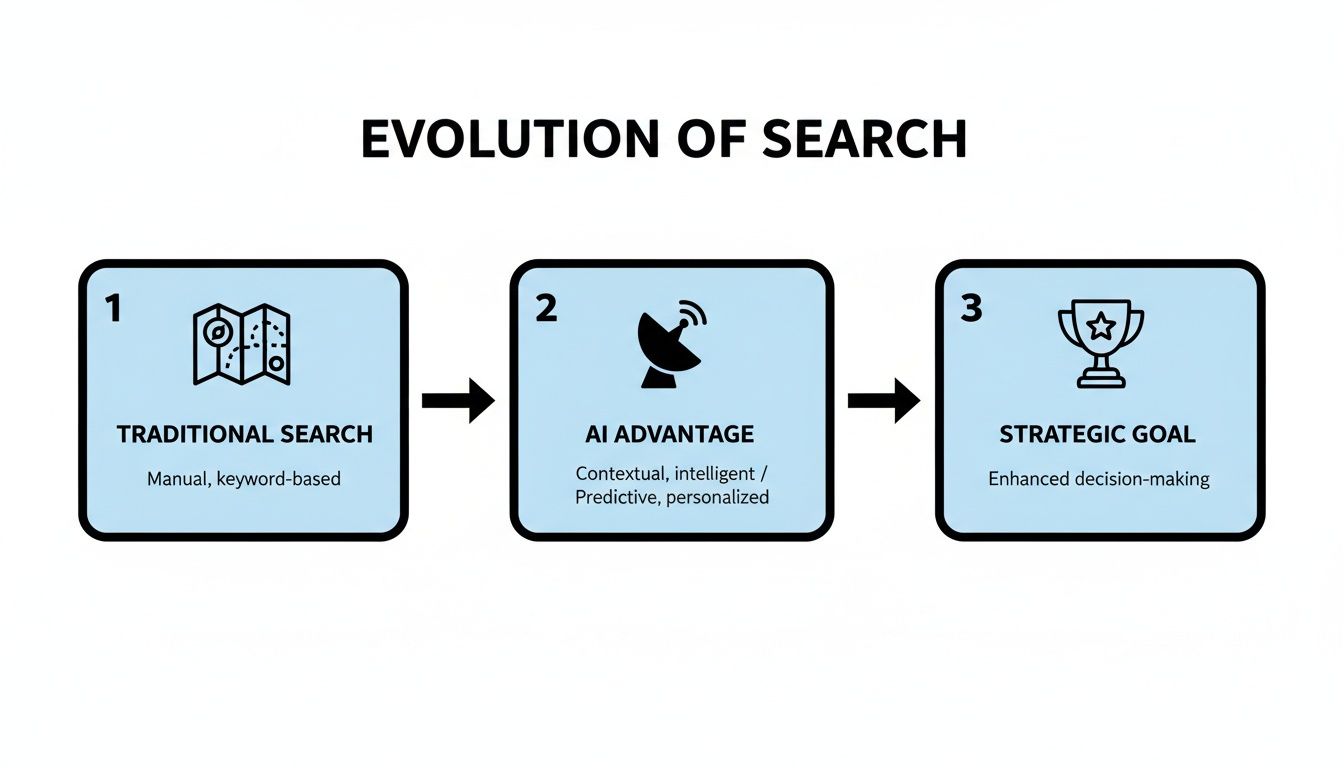
This shift is fundamental. AI gives you the live data and predictive insights needed to navigate the crowded, complex talent market with speed and confidence.
Let’s break down how this works stage-by-stage. The following table gives a quick overview of how the traditional, manual way of doing things stacks up against a smarter, AI-enhanced approach.
AI Integration in the Executive Search Process
| Search Stage | Traditional Method (The Manual Way) | AI-Enhanced Method (The Smart Way) | Benefit for CHRO |
|---|---|---|---|
| Proactive Sourcing | Reactive search begins only when a vacancy arises. Recruiters manually scour their existing networks and databases, a process that can take weeks to generate an initial longlist. | Continuous market mapping where AI constantly scans public data, professional networks, and industry news. It builds dynamic talent pipelines of high-potential leaders before a role is even open. | When a critical role opens up, a pre-vetted list of qualified candidates is ready almost instantly. This dramatically cuts down time-to-hire and gives the organisation a huge competitive edge. |
| Candidate Profiling & Matching | Keyword-based screening of CVs and LinkedIn profiles. This approach is often superficial and can easily miss high-potential candidates who don’t use the exact right jargon or phrasing. | Intelligent, contextual analysis using Natural Language Processing (NLP). The AI looks beyond keywords to understand the impact of a candidate’s experience, matching their proven accomplishments to the role’s strategic needs. | The quality of the initial candidate slate is far higher. You’re not just getting people who look good on paper; you’re getting leaders whose career trajectory and proven results align with your company’s goals. |
| Assessment & Evaluation | Subjective interviews and manual note-taking. This stage is highly susceptible to unconscious bias, where interviewers might favour candidates from similar backgrounds or universities, regardless of actual competence. | Unbiased, data-driven scorecards are created based on predefined competencies. AI tools can summarise interview transcripts, removing subjective interpretation and focusing on the substance of a candidate’s answers. | This leads to fairer, more defensible, and diverse hiring decisions. By standardising the evaluation criteria, you level the playing field and ensure you’re judging every candidate on merit, not connections. |
| Predictive Analytics | “Gut feel” and intuition play a major role in the final decision. The board and CEO rely heavily on their experience and personal judgment to predict a candidate’s long-term success. | Predictive models analyse historical data on successful leaders to forecast a candidate’s likelihood of long-term success and retention. It considers dozens of variables to provide an extra layer of data for validation. | The final decision is backed by evidence, not just instinct. This provides the board with greater confidence and significantly increases the probability of a successful, long-lasting placement that delivers real business impact. |
As you can see, AI isn’t about replacing human judgment but about augmenting it at every single step. It provides the data and insights to make smarter, faster, and more objective decisions when the stakes are highest.
Stage 1: Proactive Sourcing and Market Mapping
Typically, an executive search kicks off when someone resigns. With AI, the work begins long before that. AI platforms are always on, constantly scanning the market and pulling data from press releases, patent filings, professional networks, and public records to build living, breathing talent pipelines.
Instead of just reacting to a vacancy, CHROs can now have an up-to-the-minute database of high-potential leaders. For example, an AI agent could alert you the moment an executive you’re tracking at a rival firm speaks at a major conference or gets a promotion—signalling the perfect moment for a quiet, strategic conversation.
This proactive stance means that when a key role does open up, that first list of qualified, warm candidates is on your desk in hours, not weeks. This is a massive leap forward and a cornerstone of what modern AI in recruitment makes possible.
Stage 2: Intelligent Candidate Profiling and Matching
Once the search is live, AI goes way beyond just matching keywords on a CV. It uses sophisticated natural language processing (NLP) to grasp the context and subtlety of a candidate’s career, spotting skills and achievements a human might easily overlook.
Let’s say you need a Chief Financial Officer who has taken a company public. A traditional search would simply scan for “IPO” on a résumé. A smart AI tool, on the other hand, can analyse a leader’s entire career path and identify patterns that point to pre-IPO financial restructuring, even if the acronym “IPO” is nowhere to be found.
AI helps us answer the most important question that a CV never can: “What was the actual impact this person had in their previous roles?” It digs through the data to connect their time at a company with real business results, like market share growth or successful global expansion.
This level of deep analysis means your initial longlist is packed with much higher-quality candidates. These are people who don’t just have the right credentials; they have a proven history of delivering the exact kind of results you need.
Stage 3: Unbiased Assessment and Evaluation
We all have unconscious biases, and in executive hiring, they’re a huge risk. Decisions can easily be swayed by things that have no bearing on performance, like where someone went to university or if they move in the same social circles. AI-powered assessment tools help create a more level playing field by bringing objectivity to the evaluation process.
These tools can generate objective scorecards based on competencies you define for the role. They can also take messy interview transcripts and turn them into structured notes, stripping out subjective chatter and focusing everyone on the core substance of a candidate’s answers.
- Standardised Criteria: Every single candidate is measured against the exact same yardstick.
- Data-Driven Insights: The focus shifts to skills and past performance, not demographic details.
- Bias Auditing: The best AI platforms can be audited to find and fix any algorithmic biases, ensuring fairer outcomes for everyone.
This doesn’t take the human element out of judging cultural fit, but it gives you a solid, data-backed foundation for those critical conversations. The result? More diverse and defensible hiring decisions.
Stage 4: Predictive Analytics for Long-Term Success
This is where AI gives you a real glimpse into the future. By crunching historical data on successful leadership hires—both within your company and across the industry—predictive models can actually forecast how likely a candidate is to succeed and stay with you for the long haul.
These models weigh dozens of variables, from a leader’s adaptability in volatile markets to their track record of scaling teams. This gives the CEO and the board an extra layer of data to back up their final choice, moving the decision from a “gut feeling” to an evidence-based conclusion. It’s the final piece of the puzzle, making the entire search lifecycle smarter, faster, and far more effective.
The Real Business Impact of AI-Powered Recruitment
Beyond the tech specs and algorithms, the question every CHRO really wants an answer to is: “What will this do for my business?” Bringing AI into executive search isn’t just about modernising a process; it’s a strategic pivot that delivers real, measurable value. It all boils down to three pillars that the C-suite genuinely cares about: Speed, Quality, and Strategic Insight. This is how recruitment stops being a cost centre and starts becoming a proactive, value-driving partner.

This shift isn’t just about hitting HR targets. It’s about making smarter, faster, and more impactful leadership decisions that ripple across the entire organisation’s performance.
Accelerating Time to Hire for Critical Roles
Every single day a C-suite role sits empty, it creates a leadership vacuum. Projects stall, team morale dips, and the company bleeds potential revenue. AI hits this problem head-on by drastically cutting down the time-to-hire, arguably the most critical metric in the world of executive recruitment.
Think about the traditional slog: market mapping, sourcing, initial screening. It takes weeks. AI automates these laborious early stages, serving up a high-calibre shortlist in a fraction of the time. You could have pre-vetted, high-potential leaders ready for a conversation in days, not weeks.
This speed is more than a convenience. As many leaders are fast realising, time to hire is the new business risk metric. The faster you can close that leadership gap, the faster you can get back to seizing market opportunities instead of watching your competitors pass you by.
Enhancing the Quality of Executive Hires
Getting someone in the door quickly is great, but it’s worthless if they’re the wrong person. The real prize is finding the right leader. This is where AI truly shines, moving beyond just matching keywords on a CV to analysing a candidate’s actual impact and potential fit.
AI algorithms use data-driven matching to pinpoint executives who have a proven history of success in environments just like yours. It surfaces people who don’t just have the right skills on paper, but also demonstrate the leadership styles and behaviours that will actually thrive within your company culture.
This leads to some powerful outcomes:
- Better Fit: Candidates are matched based on a deep, contextual analysis of their career journey, massively increasing the odds of a successful placement.
- Higher Retention: Leaders who are a genuine cultural and strategic fit are far more likely to stick around, slashing the painful cost of executive turnover.
- Improved Performance: When you place the right leader in a critical role, you see a direct, positive ripple effect on their team’s performance and the company’s bottom line.
AI provides the evidence needed to back up intuition. It validates a candidate’s potential by connecting their past experiences to your future needs, ensuring every hire is a strategic investment.
This data-backed approach takes a lot of the guesswork—and risk—out of the equation. A bad hire at the top can be devastating, and AI provides a level of assurance that gut feeling alone just can’t compete with.
Gaining Strategic and Predictive Talent Insights
Perhaps the biggest game-changer is AI in executive search’s ability to offer a glimpse into the future. Instead of just reacting to an open position, CHROs can now make proactive, data-informed decisions about their leadership pipeline.
AI platforms can analyse market trends, flag potential talent shortages on the horizon, and identify the emerging leadership skills your company will need to compete a year or two down the line. Suddenly, the executive search function transforms from a reactive service into a strategic advisory board.
This is especially true in India, where AI adoption in the workplace is soaring. Research shows that 62% of Indian employees are already using Generative AI at work—a figure that leaves global averages in the dust. With 90% of employers and 86% of employees reporting a positive impact on productivity, it’s clear the technology is sharpening decision-making, which is exactly what you need when vetting top leaders. You can find more on this in EY’s survey covered on storyboard18.com.
Building the Business Case for AI in Executive Search
To get any new technology signed off at the board level, you have to speak their language: numbers, impact, and a clear return on investment. Bringing AI into executive search is no different. You need a solid, data-driven business case that goes beyond buzzwords to show real financial and strategic wins.
This isn’t about jumping on the latest tech bandwagon. It’s a calculated move to sharpen your competitive edge in the relentless war for top leadership talent. To build this case, you need to translate the potential of AI into concrete Key Performance Indicators (KPIs) that the C-suite will actually care about.
Identifying Your Core KPIs
Before you can show success, you have to define what it looks like. Vague goals like “improving our hiring” simply won’t cut it. You need to focus on specific metrics that draw a straight line between AI adoption and the company’s bottom line.
Here are the essential KPIs you should be tracking:
- Time-to-Fill for Senior Roles: This is the metric that gets noticed first. Track the average number of days it takes from opening a C-suite role to getting a signed offer. Compare your AI-powered searches against your traditional baseline to show the speed advantage.
- Quality of Hire: This one is a long game, but it’s arguably the most important. How do you measure it? Look at the performance ratings of new executives after their first year, and track their retention over the next 24-36 months. Better performance and lower churn are undeniable signs of a superior match.
- Cost-per-Hire: Tally up every expense tied to an executive search—agency fees, the hours your internal team puts in, advertising spend. AI chips away at the manual grunt work and can reduce how much you lean on expensive retained search firms, leading to direct cost savings.
- Leadership Pipeline Diversity: Use AI to meticulously track and report on the diversity of your candidate slates at every single stage. Being able to show a quantifiable lift in representation within your leadership pipeline is a massive strategic victory.
When you focus on these metrics, you change the conversation from “how much will this cost?” to “what will this investment deliver?”. You’re showing exactly how AI drives efficiency, quality, and strategic alignment.
Quantifying the Return on Investment
With your KPIs in place, you can start building your financial model. The maths is pretty straightforward: compare the gains you get from AI against the cost of implementing it. The gains, of course, are the improvements you see in your core metrics.
Think about it this way: shaving 60 days off the time-to-fill for a Chief Revenue Officer role has a direct, and often huge, financial impact. You can calculate the opportunity cost of that empty seat in lost revenue to put a hard number on the savings. Similarly, a 5% reduction in executive turnover over three years means avoiding massive replacement and onboarding costs.
This graphic from Hager Executive Search perfectly captures the current shift towards ‘strategic selectivity’, where data-driven tools are becoming essential for finding leaders with very specific, high-impact skills.
The data points to a clear pivot towards roles that fuel digital innovation and business transformation. It’s a stark reminder of why you need precise, AI-powered tools to find these specialised leaders before your competitors do.
The heart of your business case is this: AI moves executive search from a high-cost, high-risk art form into a predictable, data-backed science. It gives you the evidence to justify your decisions and proves its worth through results you can actually measure.
Ultimately, taking this numbers-driven approach allows you to tell a powerful story. It not only justifies the initial investment but also clearly illustrates the strategic and financial impact of modernising how you find your next generation of leaders. It’s how you get everyone, from the CFO to the CEO, to see the incredible value you’re bringing to the table.
A Practical Roadmap for AI Implementation
Bringing AI into your executive search process isn’t like flipping a switch. It’s a journey that demands careful planning. For CHROs looking to weave AI in executive search, taking it one step at a time is the only way to guarantee a smooth transition, prove the value, and lock in success for the long haul. Think of it like building a house—you pour a solid foundation long before you even think about the walls and roof.
This roadmap breaks the whole thing down into four clear stages. Each one builds on the last, taking you from initial exploration all the way to continuous, data-backed improvement. Following this structure helps manage risk and ensures you get the most out of your investment.

Stage 1: Discovery and Goal Alignment
Before you even glance at a vendor demo, you need to look inward. What does your executive search process look like right now? Get honest about it. Where are the delays? What causes the most headaches? Is time-to-hire dragging on, or are your candidate slates lacking genuine diversity?
Once you’ve got a handle on the problems, you can start to picture what success looks like. This means setting tangible, measurable goals.
- Define Clear Objectives: Do you want to slash the time-to-fill for C-suite roles by 30%? Or maybe boost the diversity of your leadership pipeline by 25% within the next 18 months? Be specific.
- Identify Key Stakeholders: Get your CEO, CFO, and other senior leaders in the room from day one. You’ll need their buy-in to get this off the ground and make sure it aligns with the company’s bigger picture.
- Map Existing Workflows: Chart out your current process from the first conversation to the final offer. This map will show you exactly where AI can step in and make a real difference.
This first stage is all about asking the tough questions and setting a clear direction before you spend a single rupee.
Stage 2: The Pilot Programme
With your goals locked in, it’s time to test the waters with a pilot programme. This is your low-risk way to prove the concept works and show the rest of the business what AI can really do. Pick one important executive search to be your test case.
The aim here is to gather hard data and build a story you can’t ignore. You’ll work closely with your chosen tech partner to set up the AI tools for this specific search. Then, you track everything against the KPIs you set in stage one, comparing the AI-assisted search to your old, traditional methods.
A successful pilot does more than just fill a role. It creates internal champions for the technology and provides the hard data needed to justify a wider, more ambitious rollout.
This controlled experiment gives you the space to learn and tweak your approach before you go all-in.
Stage 3: Scaled Integration and Change Management
Once your pilot has delivered the goods, you’re ready to scale. This means rolling out the AI solution across your entire executive search function. But remember, this is as much about people as it is about platforms. Smart change management is what makes the new process stick.
Give your recruitment team proper training. Don’t just show them which buttons to click; explain how AI makes their jobs better. Show them how it takes away the tedious tasks, freeing them up to focus on what they do best: building relationships and assessing top-tier candidates.
This stage also throws a spotlight on the growing need for tech-savvy leaders. The demand for executives who get digital innovation is exploding. In India’s 2025 leadership hiring market, vacancies for these kinds of roles have shot up by 38% year-over-year. This has led to a huge spike in searches for Chief AI Officers and Chief Digital Officers. You can find more on these executive hiring trends on hagerexecutivesearch.com.
Stage 4: Continuous Optimisation
Getting AI up and running isn’t a “one and done” project. The real magic of these systems is their ability to learn and get better over time. This final stage is a continuous loop of fine-tuning, where you use data to sharpen the algorithms and improve your results.
Schedule regular check-ins with your tech partner to go over the performance data. Dig into which sourcing channels are bringing in the best people. Refine your assessment criteria based on how your new hires perform in the long run. This constant feedback loop ensures your AI in executive search capability gets smarter and more effective with every placement you make.
Navigating the Ethical Landscape of AI in Hiring
Let’s be honest: adopting powerful technology like AI isn’t just about flipping a switch. It demands a serious commitment to using it responsibly. When you bring AI into executive search, building a strong ethical foundation isn’t some box-ticking exercise for the compliance department—it’s how you earn and keep the trust of high-calibre candidates and your own stakeholders.
With the right governance, you can innovate confidently while holding yourself to the highest standards. This really boils down to three core areas: handling candidate data with extreme care, actively fighting algorithmic bias, and always, always keeping a human in charge of the final call.
Ensuring Data Privacy and Security
In the world of executive search, you’re the custodian of incredibly sensitive personal and professional data. AI systems need to process huge volumes of this information, which puts privacy and security front and centre. A data breach doesn’t just tarnish your reputation; it can land you in serious legal trouble.
Because of this, any AI partner you work with must be fully compliant with data protection laws like GDPR and other local regulations. This means having crystal-clear policies on how data is collected, stored, and anonymised. Candidates need to know exactly how their information is being used, which is vital for building the trust required in such a high-touch recruitment process.
Mitigating Algorithmic Bias
One of the loudest alarm bells with AI is its potential for bias. If an AI model is trained on historical hiring data that reflects past prejudices—conscious or not—it will simply learn and amplify those same patterns. This can lead to qualified candidates from underrepresented groups being unfairly filtered out, completely undermining the goal of building diverse leadership teams.
Getting ahead of this requires a proactive stance:
- Regular Audits: Your AI models can’t be a “set it and forget it” tool. They need regular check-ups to find and fix any biases that creep into their decision-making.
- Diverse Training Data: Garbage in, garbage out. Ensure the data used to train the AI is as diverse and representative as possible to prevent skewed, unfair results.
- Focus on Skills: Configure the AI to zero in on what actually matters—skills, experience, and performance metrics—rather than demographic data like gender, ethnicity, or even the name of their university.
When you deliberately design an AI for fairness, it can flip the script and become a powerful tool for reducing human bias. It forces a focus on objective qualifications, levelling the playing field and helping you build a more diverse and capable slate of candidates for top roles.
Championing the Human in the Loop
This might be the most critical principle of all: AI is a co-pilot, not the pilot. It’s a tool to assist human judgment, never to replace it. The nuanced, high-stakes decisions that define executive hiring demand the empathy, intuition, and strategic thinking that only a seasoned recruiter brings to the table. This is what we call the human-in-the-loop approach.
Let the AI do the heavy lifting—the data analysis, the initial sourcing, the first-pass screening. This frees up your human experts to focus on the irreplaceable parts of the job. They’re the ones building relationships, assessing cultural fit, conducting deep-dive interviews, and handling delicate negotiations. The final decision must always rest with a person. This ensures that while your process is powered by data, it’s ultimately guided by human wisdom.
Answering Your Questions About AI in Executive Search
As CHROs start to look seriously at bringing AI into executive search, it’s natural for some practical questions to come up. Making the switch from traditional gut-feel methods to a more data-informed approach is a big change, and it’s smart to be curious. Let’s tackle some of the most common concerns head-on.
Will AI Replace the Human Touch in Executive Hiring?
This is the big one, isn’t it? The short answer is a firm no. AI isn’t here to replace the critical human elements of executive search. Instead, think of it as a powerful co-pilot for your best recruiters.
AI takes on the heavy lifting—the time-consuming, data-heavy tasks like mapping the market, sourcing candidates, and doing the initial screenings. This frees up your team to do what people do best: build real relationships, gauge the subtleties of cultural fit, and handle delicate negotiations. The tech handles the science, so your team can master the art.
Isn’t Implementing AI for Executive Search Overly Complex and Expensive?
If you were trying to build your own AI platform from scratch, then yes, it absolutely would be. But that’s not how smart companies are doing it today. The most effective route is to partner with a specialised firm that has already invested the time and money to build and perfect the technology.
This approach gives you a few major wins:
No Heavy Investment: You skip the enormous upfront cost of developing a platform and hiring a team of data scientists.
Immediate Access: You get to use cutting-edge tools and tap into vast pools of market data from day one.
Scalable and Cost-Effective: It becomes a manageable operational expense that scales with your needs, not a massive capital investment.
By partnering with an expert, you’re essentially leasing their technology and expertise. It makes getting started straightforward and financially viable, letting you access powerful tools without the headache of building them yourself.
The goal isn’t to become a tech company; it’s to use technology to get better at finding brilliant leaders. A partnership makes this possible, delivering a strong ROI without the implementation nightmare.
Can AI Really Help Improve Leadership Diversity?
Yes, and this is one of its most compelling uses. We all know that unconscious bias is a stubborn problem in hiring, often resulting in leadership teams that all look and think the same. A well-designed AI system can be a powerful antidote.
The system is built to focus purely on objective, merit-based criteria: skills, proven achievements, career progression, and specific leadership qualities. It can be programmed to completely ignore demographic details like gender, ethnicity, or even which university someone attended during the early screening phases.
This immediately widens the talent pool, bringing forward outstanding candidates who might have been missed otherwise. By presenting a more diverse slate of equally qualified leaders, AI empowers you to build a C-suite that truly reflects the world you do business in.
Ready to build a faster, smarter, and more diverse leadership pipeline? Taggd combines deep human expertise with powerful AI to find the transformative leaders your organisation needs. Learn how our Recruitment Process Outsourcing solutions can give you a competitive edge at https://taggd.in.