India’s automotive talent landscape is at a tipping point. If you’re leading talent strategy for an automotive organization in India today, you’re likely navigating two very different worlds simultaneously.
On one side, there’s the traditional automotive manufacturing ecosystem. It is predictable, process-driven, and built on decades of mechanical engineering excellence.
On the other, there’s the electric vehicle revolution. It is fast-moving, software-heavy, and desperately competing for a highly specialized EV and software talent that barely existed five years ago.
The shift isn’t gradual anymore. Taggd’s India Decoding Jobs Report 2026 highlights the Indian government’s policy initiatives (PLI scheme, growing ESG commitments, and the rapid establishment of automotive GCCs in India) have accelerated EV adoption beyond what most talent teams were prepared for. R&D centers are scaling up. Battery plants are coming online. Charging infrastructure projects are multiplying.
And here’s what keeps CHROs up at night: how to build automotive and EV-ready teams at scale.
The good news? India has always been an engineering powerhouse. The hard truth? The rules of automotive recruitment in India have fundamentally changed, and traditional automotive hiring playbooks aren’t enough anymore.
Traditional Automotive Manufacturing Talent
For decades, automotive manufacturing talent in India operated within a largely predictable ecosystem. Hiring cycles were closely tied to production schedules, plant expansions, and long-term capacity planning.
For CHROs, workforce planning was structured, sequential, and most importantly forecastable. Teams could be planned quarters in advance, with a clear understanding of what each plant and function would require.
Characteristics of Core Talent Foundation
At the heart of traditional automotive manufacturing were roles built on deep mechanical and operational expertise. This included:
- Mechanical and production engineers who formed the backbone of shop-floor operations
- Quality and compliance specialists with strong command over ISO standards and regulatory frameworks
- Vendor and supply chain professionals skilled in managing complex, multi-tier logistics networks
- Location-bound talent concentrated around established manufacturing hubs such as Chennai, Pune, Gurugram, and Sanand
Typical Roles That Defined the Automotive Industry
The industry was shaped by well-established roles-
- Production Engineers optimizing assembly lines
- Quality Managers driving zero-defect manufacturing
- Plant Heads running large-scale operations with precision
- Maintenance and Tooling Experts ensuring uninterrupted output.
These roles demanded deep domain knowledge, but the talent pipeline was mature and dependable. Engineering institutions consistently produced graduates aligned to these career paths.
Attrition levels were manageable, and employer brands were built on stability, operational excellence, and long-term career progression within a familiar framework.
For CHROs, automotive hiring was undoubtedly complex, but it was structured. With the right processes, timelines, and partners, talent acquisition remained a challenge that could be planned, managed, and delivered with confidence.
EV Talent in India
Now, let’s talk about what’s keeping recruitment teams scrambling.
EV talent in India doesn’t fit the traditional automotive mold. These professionals operate at a complex intersection- automotive systems, electronics, software engineering, and energy management. It’s a rare, hybrid skill set, and demand far outstrips supply.
Every OEM, EV startup, global mobility player, and energy company is chasing the same profiles.
The New Skill Mix
The EV jobs landscape in India demands capabilities that many traditional automotive roles were never designed to cover, including:
- Battery chemistry, cell optimization, and thermal management
- Power electronics, inverter design, and motor control systems
- Embedded software development and ADAS (Advanced Driver Assistance Systems)
- Charging infrastructure, grid integration, and energy systems
- Digital manufacturing, data-led operations, and Industry 4.0 technologies
Emerging EV Roles You’re Hiring For
If you’re building or scaling an EV team today, you’re likely hiring for roles such as:
- Battery Management System (BMS) Engineers who can optimize cell performance and lifecycle
- Power Electronics Engineers designing converters and inverters
- Embedded Software Developers working on automotive-grade, safety-critical code
- EV Thermal and Safety Engineers ensuring battery reliability
- Charging Infrastructure Specialists who understand both hardware and software ecosystems
- Digital Manufacturing experts driving smart factory implementations.
What Makes This Talent Different
What we’re consistently seeing across EV recruitment challenges in India is that this talent looks and behaves very differently. Many professionals come from startups, electronics firms, or adjacent industries rather than legacy automotive backgrounds. They seek innovation-led cultures, rapid experimentation, and visible impact- not incremental change.
They also learn fast, but they move fast. Attrition risk is higher because competition is intense and options are plentiful. And unlike plant-centric roles, electric vehicle engineering jobs are increasingly location-agnostic, clustered around tech hubs like Bengaluru and Hyderabad rather than traditional automotive belts.
For recruitment teams, this shift has transformed EV hiring from a predictable exercise into a high-stakes race for scarce, future-critical skills.
Automotive vs EV Talent: A Side-by-Side View for CHROs
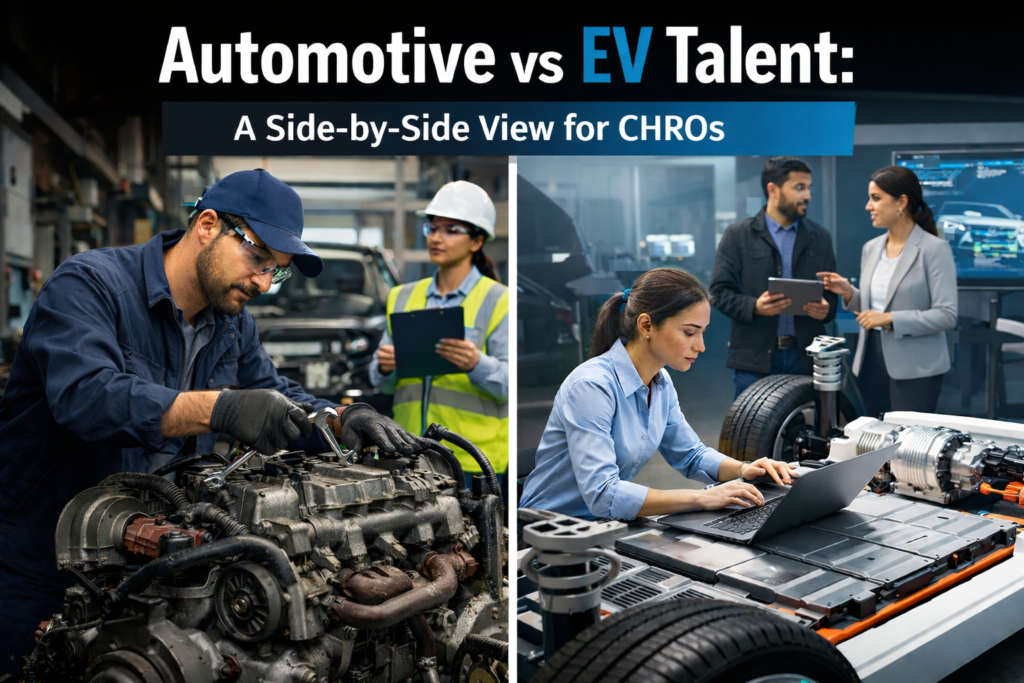
To understand why hiring strategies are under pressure, comparing automotive and EV talent helps to look at how fundamentally different these two talent segments have become.
When you compare traditional automotive roles with emerging EV talent requirements, the contrast is stark.
Let’s make this concrete. Here’s what the talent landscape looks like when you compare traditional automobile industry hiring trends with EV requirements:
| Dimension | Automotive Manufacturing | EV Talent |
| Core Skills | Mechanical & Process Engineering | Software, Electronics, Energy Systems |
| Hiring Speed | Planned & cyclical | Urgent & highly competitive |
| Talent Availability | Moderate to high | Scarce & fragmented |
| Attrition Risk | Low to medium | High |
| Hiring Locations | Plant clusters (Chennai, Pune, Gurugram) | Tech + innovation hubs (Bangalore, Hyderabad, Pune) |
| Global GCC Demand | Limited | Rapidly growing |
| Compensation Expectations | Structured & predictable | Premium & negotiable |
| Assessment Approach | Domain + experience focused | Skill adjacency + learning agility |
CHRO Insight: You can’t use the same sourcing engines, assessment frameworks, or employer value propositions for both talent segments. EV hiring strategy in India requires fundamentally different recruitment infrastructure.
Why CHROs Struggle to Hire EV Talent at Scale?
Let’s be honest about the pain points. We hear this from CHROs and talent leaders every week.
Hiring EV talent in India is difficult not because of intent or investment, but because the market itself is still forming. The pace of EV adoption has outstripped the pace at which talent ecosystems can mature. For CHROs, this has turned EV hiring into one of the most complex talent challenges they face today.
The Talent Shortage Is Structural, Not Temporary
There is a genuine shortage of professionals with EV-specific skills in India. While universities and training institutions are beginning to respond, the gap between demand and supply remains significant.
Most EV-ready talent has been built through on-the-job learning rather than formal education, which means every EV-focused organization and every recruitment partner is competing for the same limited pool.
Cross-Industry Talent Wars Are Intensifying
The competition extends far beyond the automotive sector. CHROs are now competing with technology companies launching mobility platforms, energy firms investing in charging infrastructure, and EV startups offering equity, faster growth, and purpose-led cultures.
The battle for EV and adjacent talent has become cross-industry and relentless, fundamentally reshaping automotive versus EV hiring dynamics in India.
The Job Description Problem
One of the most underestimated challenges is role definition. Many EV roles simply didn’t exist a few years ago.
Organizations are still clarifying what success looks like for positions such as Battery Thermal Engineers or BMS Specialists and which skills from traditional automotive engineering can be reskilled or redeployed. This ambiguity slows hiring and leads to misaligned expectations on both sides.
Global HQ Expectations vs Local Realities
If you’re setting up or scaling an automotive GCC in India, the pressure is twofold: scale quickly while maintaining global quality benchmarks.
However, hiring mandates designed for mature global markets don’t always align with India’s evolving EV talent landscape. Bridging this gap requires local market insight, not just global hiring targets.
The Employer Branding Gap
Legacy automotive brands carry significant credibility in manufacturing ecosystems, but that recognition doesn’t always extend to software engineers or electronics specialists.
Many EV candidates see themselves as technologists first, not automotive professionals. Without a compelling EV-focused employer narrative, even strong brands struggle to attract the right talent.
Speed vs Quality Trade-offs
The market is moving so fast that CHROs are forced into impossible choices- hire quickly and risk bad fits, or maintain rigorous standards and lose candidates to faster-moving competitors.
These are the talent challenges in EV industry cannot be solved with conventional recruitment processes alone. They demand a more strategic, insight-led approach- one that combines market intelligence, skill adjacency, and scalable hiring infrastructure.
To get detailed industry-wise recruitment challenges, download the India Decoding Jobs Report 2026.
GCCs in India: Why EV & Automotive Leaders Are Doubling Down
One trend is impossible to ignore. Global automotive and EV organizations are rapidly expanding their footprint in India- not just for manufacturing, but for high-value engineering, R&D, and digital capabilities that sit at the core of future mobility.
Why India Is Emerging as a GCC Hub for Automotive and EV
The case for India is compelling. It offers a rare combination of scale, capability, and cost efficiency. Each year, India produces over 1.5 million engineering graduates, creating one of the world’s deepest technical talent pools.
At the same time, the domestic EV ecosystem is maturing rapidly- battery manufacturing, charging infrastructure, and component suppliers are increasingly establishing local operations.
This momentum is further accelerated by strong policy support, including the PLI scheme and production-linked incentives, making India a strategic choice for automotive and EV GCC expansion rather than just an execution hub.
What GCC Hiring Demands
For CHROs, however, GCC hiring is where complexity intensifies. Scaling an automotive or EV GCC in India is very different from expanding a manufacturing plant.
Hiring often needs to happen at speed- ramping up teams of 50, 100, or even 200 engineers within a single quarter. Organizations must balance senior leadership hires who can build teams and processes from the ground up with highly specialized technical talent that can deliver immediate impact.
Diversity expectations aligned to global standards add another layer of complexity, as do governance, compliance, and reporting requirements typical of captive centers.
CHRO Reality: GCC hiring in India consistently struggles without a localized, insight-led recruitment partner- one that understands both global mandates and the nuances of India’s evolving automotive and EV talent market. Global hiring playbooks cannot simply be transplanted and expected to work. Success depends on tailoring recruitment strategy, assessment frameworks, and employer narratives to local realities while delivering against global expectations.
How RPO Models Are Evolving for Automotive & EV Hiring
Traditional contingency hiring and even legacy RPO models used by automotive companies were never designed for the complexity CHROs are managing today. The current talent challenge isn’t about filling roles one by one; it’s about orchestrating hiring at scale across skills, locations, and seniority levels simultaneously.
Consider what modern automotive and EV hiring actually looks like. You may be building a battery engineering team in Bengaluru, scaling digital manufacturing capabilities in Pune, and hiring production specialists in Chennai- all at the same time.
You’re expected to deliver volume hiring, such as dozens of production engineers, alongside critical leadership appointments like a VP of Battery Technology, with equal speed and rigor.
At the same time, the talent simply doesn’t exist in neat, ready-made pools. CHROs must identify skill adjacencies- understanding which mechanical engineers can be reskilled into EV thermal management roles, or which software professionals from adjacent industries can transition into embedded automotive systems. This requires insight, not just sourcing capacity.
What Modern RPO Must Deliver
Next-generation RPO models for the automotive and EV industry must move beyond requisition fulfilment to become strategic workforce enablers. This starts with workforce planning and talent intelligence- helping CHROs understand where critical skills are available, what they cost, and how long it will realistically take to hire them.
Skill adjacency and reskilling insights are equally critical, because the “perfect” EV candidate often doesn’t exist. The real value lies in identifying talent that can be developed fastest and most effectively. Speed remains non-negotiable, but it must be balanced with strong governance, as mis-hires in EV-critical roles are costly and difficult to correct.
Finally, modern RPO must deliver a technology-enabled candidate experience. Top EV talent expects seamless, consumer-grade interactions throughout the hiring journey. Employer branding support is also essential, as EV hiring requires an EVP that resonates with both legacy automotive professionals and a new generation of software- and innovation-driven talent.
How Taggd Enables Future-Ready Automotive & EV Hiring?
This is where we come in, not with generic recruitment services, but with deep understanding of what automotive vs EV talent strategies actually require.
Automotive and EV hiring today is about managing scale and scarcity at the same time. It requires precision, speed, leadership alignment, and market intelligence- all delivered within strong governance frameworks. That’s the gap Taggd is designed to fill.
Taggd’s Differentiated Value for CHROs
We’ve built industry-specialized RPO teams for automotive and EV hiring because these roles are not interchangeable.
Hiring a BMS engineer is fundamentally different from hiring a battery test engineer. At the same time, attracting talent to a legacy automotive brand requires a very different narrative than hiring for an EV business backed by innovation and OEM scale.
Generic recruitment models simply don’t account for these nuances.
Our AI-powered talent intelligence platform allows CHROs to move beyond job boards and reactive sourcing. We map where EV and adjacent talent actually exists- identifying embedded engineers within tech companies who can transition into automotive systems, supplier-side professionals ready to move into OEM roles, and underleveraged geographies with strong talent density that competitors often overlook.
This insight-led approach has delivered measurable outcomes.
For an iconic commercial vehicle manufacturer, Taggd re-engineered the recruitment process by centralizing hiring into a unified RPO model. The result was-
- 6x surge in hiring volume managed within just 60 days
- 41% reduction in time-to-fill (from 51 to 30 days), and
- 72% first-time-right delivery
demonstrating that scale does not have to come at the cost of quality. Notably, 70% of hires were fulfilled from Taggd’s proprietary talent database, and diversity hiring in corporate roles improved by 15%, reinforcing long-term workforce strength.
Leadership and Critical Role Hiring at Scale
EV transformation also brings leadership complexity. Roles such as VP of Electrification or Head of Charging Infrastructure cannot be sourced through traditional postings.
These leadership roles are relationship-driven, high-impact hires that require executive search rigor combined with RPO scalability. Taggd integrates both, ensuring leadership hiring progresses in parallel with volume and niche talent acquisition.
This integrated approach proved critical when Taggd ramped up EV hiring for one of India’s largest automotive manufacturers. By combining market intelligence, niche skill expertise, and a value-driven candidate engagement model, Taggd enabled-
- 100% target achievement
- 2x increase in average hiring volumes, and
- 25% dropout rate, significantly lower than market benchmarks for EV roles.
Explore more Case Studies.
So, whether you’re scaling a manufacturing plant, building an EV GCC in India, or launching a new electrification-led product line, Taggd manages bulk hiring and precision hiring together– not as separate tracks, but as one integrated talent strategy.
We also design DEI-aligned hiring frameworks, ensuring global diversity mandates are delivered through localized execution. And we bring India-specific compliance and workforce intelligence that directly impact candidate conversion and retention.
We are a strategic RPO partner managing your talent future, aligned to where mobility, electrification, and global capability centers are headed next.
What Forward-Looking CHROs Are Doing Differently
The CHROs who are winning the EV talent hiring India battle are making some fundamental shifts:
They’re moving from “role-based” to “skill-based” hiring. Instead of waiting for someone with the exact job title, they’re identifying adjacent skills and building internal reskilling programs. A mechanical engineer with strong analytical skills and software aptitude can become a thermal management specialist with the right training pathway.
They’re investing seriously in employer branding specifically for EV talent. They’re showcasing innovation projects, highlighting sustainability missions, and making their EV culture visible to candidates who care about those things.
They’re partnering early with specialized RPOs for workforce planning– not waiting until requisitions are open but involving recruitment partners in talent strategy conversations six months before hiring needs hit.
And most importantly, they’re treating EV hiring as a strategic capability, not just a recruitment task. They’re building dedicated talent teams, investing in recruitment technology, and measuring success not just by time-to-fill but by quality of hire and retention rates.
The Future of Automotive Hiring Is Hybrid and Strategic
Here’s the truth: automotive manufacturing isn’t disappearing. India will continue to produce millions of internal combustion vehicles for years to come. But the future is hybrid—both literally in terms of powertrains and figuratively in terms of talent strategy.
EV talent is redefining what “automotive workforce” means. It’s expanding the industry’s boundaries, pulling in expertise from software, electronics, and energy sectors, and creating entirely new career paths.
For CHROs, this means you need partners who understand both worlds. Partners who can hire production engineers for your existing plants while simultaneously building your EV engineering team. Partners who bring strategic workforce planning, not just recruitment execution.
This is complex, high-stakes work. The companies that get talent strategy right will lead India’s automotive transformation. Those that treat it as business-as-usual recruitment will struggle to keep pace.
Strategic RPOs like Taggd enable the speed, scale, and sustainability you need- across automotive recruitment in India, EV hiring, GCC expansion, and leadership searches.
FAQs
What is the key difference between automotive and EV talent hiring in India?
Automotive hiring in India focuses on mechanical and process engineering with predictable talent pipelines, while EV talent hiring requires software, electronics, and energy system expertise. EV talent is scarcer, more mobile, and highly competitive, forcing CHROs to adopt faster, skill-based, and insight-led hiring strategies.
Why is EV talent so difficult to hire at scale in India?
EV talent is hard to hire at scale because demand has outpaced supply. Most EV professionals are cross-industry hires built through on-the-job learning rather than formal education. This creates intense competition across automotive, tech, energy, and startup ecosystems, increasing attrition risk and time-to-hire for CHROs.
How should CHROs rethink hiring strategies for EV roles?
CHROs must move from role-based to skill-adjacent hiring. Instead of waiting for perfect EV profiles, leading organizations identify transferable skills, invest in reskilling pathways, and assess learning agility. This approach enables faster hiring while building long-term EV-ready talent pipelines.
Why are GCCs in India central to automotive and EV talent strategy?
India has become a strategic hub for automotive and EV GCCs due to its deep engineering talent pool, cost efficiency, and growing EV ecosystem. However, GCC hiring requires rapid ramp-ups, leadership hiring, global governance, and localized recruitment insight- making traditional hiring models insufficient.
How can an RPO partner help CHROs solve EV hiring challenges?
A specialized RPO partner provides talent intelligence, skill adjacency mapping, faster hiring infrastructure, and governance at scale. Unlike traditional recruitment, strategic RPOs help CHROs plan workforce needs, reduce dropouts, improve quality of hire, and support automotive, EV, and GCC hiring simultaneously.
Ready to Transform Your Automotive Talent Strategy?
Explore how Taggd supports automotive and EV leaders with end-to-end RPO solutions- from bulk hiring and project-based recruitment to executive search and CXO placement.
Let’s build your future-ready workforce together.