To build a BFSI digital-first workforce, you can’t just hire a few tech specialists and call it a day. It demands a deliberate strategy built on three core pillars: strategic talent architecture, continuous capability building, and a culture of agility. This is a fundamental shift that involves redesigning roles, seriously upskilling your existing teams, and creating an environment where real innovation can actually happen.
The Digital Mandate for Banking’s Future Workforce
The gap between a bank’s digital ambitions and its team’s actual skills isn’t just a hurdle, it’s a critical business vulnerability. Fintech disruptors are built with digital-native DNA from the ground up. Meanwhile, many established banks are caught trying to bolt new technology onto legacy structures and old ways of thinking.
This isn’t about launching a slick new mobile app. It’s about weaving digital fluency into the very fabric of the bank, from risk management and compliance to frontline customer service.
The urgency is impossible to ignore, especially when you look at the data coming out of India’s banking and financial services (BFSI) sector. A staggering 83% of financial institutions have named digital transformation a top priority. Yet, a recent report shows that only 31% believe their workforce has the skills to actually deliver on that promise. This chasm is the central dilemma facing CHROs today: aspiration is massively outpacing capability.
The real work isn’t just about acquiring digital talent. It’s about building an organisation that can attract, develop, and most importantly retain that talent for the long haul. A digital-first workforce is the outcome of a digital-first culture, not just a recruitment target.
To close this critical gap, CHROs need to champion a multi-pronged approach. Thinking about this transformation through three distinct but interconnected pillars provides a clear and actionable roadmap.
Three Pillars of a Digital-First Workforce Strategy
To effectively structure your transformation efforts, it helps to break down the challenge into three strategic pillars. Each one addresses a unique part of the workforce puzzle, ensuring a holistic and sustainable approach to building digital capabilities.
| Pillar | Core Focus | Key CHRO Actions |
|---|---|---|
| Strategic Talent Architecture | Redesigning the organisation and roles for the future of banking. | – Move from rigid hierarchies to agile, cross-functional teams. – Analyse future skill needs driven by AI and data. – Decide whether to build skills internally, buy talent externally, or borrow expertise via partners. |
| Continuous Capability Building | Creating a culture of perpetual learning and skill development. | – Establish personalised learning journeys, not one-off training events. – Integrate upskilling and reskilling into the daily workflow. – Link new skills directly to clear career progression paths. |
| A Culture of Agility | Fostering an environment where digital talent and technology can thrive. | – Empower teams to experiment and take calculated risks. – Ensure leadership actively models the desired digital behaviours. – Create psychological safety to encourage innovation and learning from failure. |
By focusing on these three areas, you move beyond simply hiring for new skills and start building an entire ecosystem that fosters digital excellence from within.
Here’s a closer look at what each pillar entails:
Strategic Talent Architecture: This is about moving away from the rigid, traditional hierarchies that slow banks down. The goal is to create agile, cross-functional teams that can pivot quickly. It means doing a deep analysis of the future skills your bank will need, driven by AI, automation, and data analytics and then making smart decisions on whether to build those skills internally, buy talent from the market, or borrow expertise through specialised partners like RPO firms.
Continuous Capability Building: A one-time training session on a new platform is a waste of money. This pillar is about creating personalised learning journeys that make upskilling and reskilling a part of the daily workflow. It’s about cultivating a genuine desire for growth, where employees see acquiring new skills as a direct and visible path to career advancement within the bank.
A Culture of Agility: The best technology and the brightest talent are useless in a risk-averse, bureaucratic culture. Fostering agility means empowering your teams to experiment, rewarding calculated risks, and ensuring that leadership is out in front, actively modelling the digital behaviours you want to see. This cultural shift is absolutely essential for making any changes stick and for fully understanding the talent shifts required for building a resilient BFSI workforce.
Architecting Your Talent Strategy for Digital Demands
Building a digital-first workforce is about so much more than just hiring a few more coders or data scientists. It demands a fundamental redesign of your talent structure. Frankly, the traditional, siloed model that banking has relied on for decades is just too slow and rigid for today’s pace of change. To win, banks have to be willing to architect a new talent blueprint from the ground up.
This journey starts with a clear-eyed, honest look at where you stand today. You need to map the digital skills you already have against the capabilities you’ll absolutely need tomorrow, especially those driven by AI and advanced data analytics. This isn’t just an HR exercise; it’s a strategic business imperative.
We can think of this transformation as a continuous cycle, as shown below. It’s about architecting the right talent structure, building the necessary capabilities, and forging a culture that supports it all.
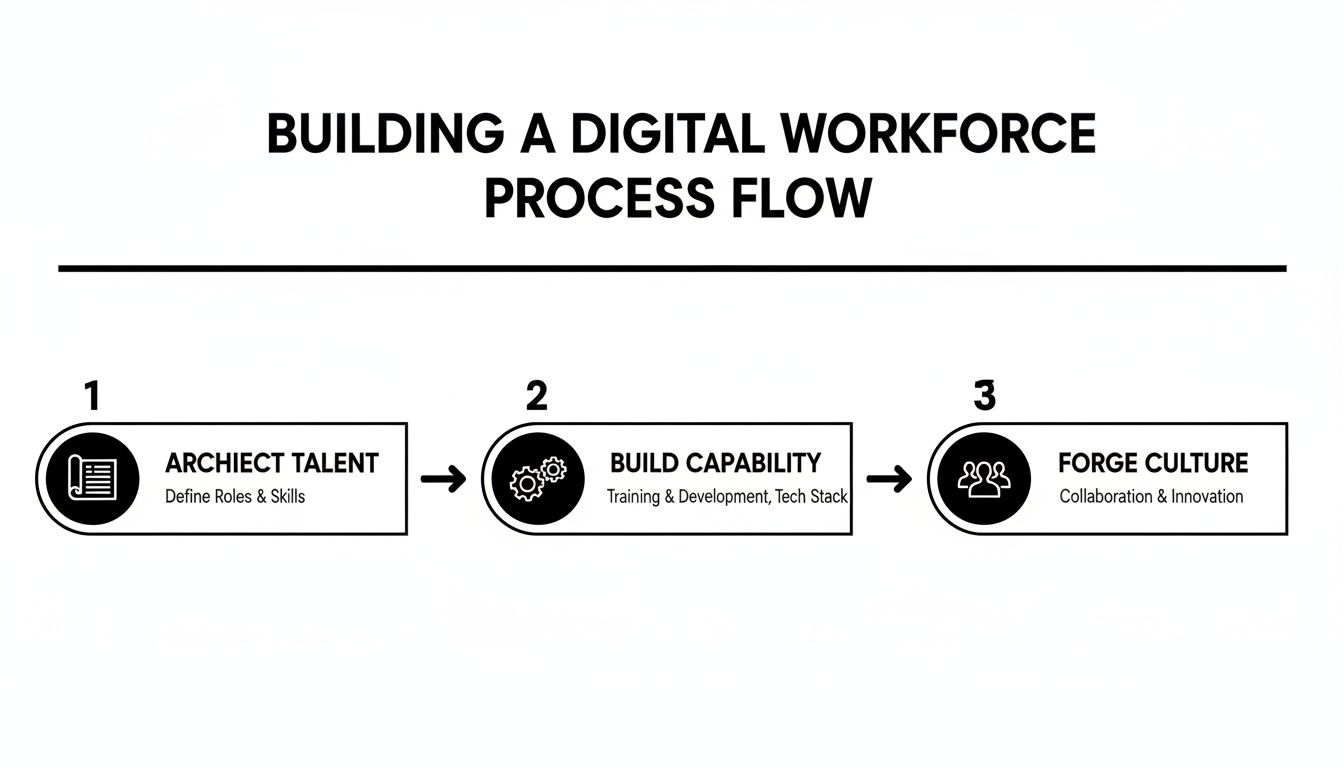
It’s a flywheel, once you get it spinning, each part reinforces the others.
Moving from Hierarchies to Agile Teams
The single biggest shift is moving away from rigid, functional hierarchies and embracing dynamic, cross-functional teams. Think less about departments and more about missions.
For instance, instead of a siloed ‘Loan Officer’ role, picture a ‘Customer Journey Squad’ dedicated to streamlining the entire lending experience from first click to final signature.
This squad wouldn’t be a collection of lone wolves. It would bring together experts from across the bank to work in concert:
- Product Owners obsessed with customer needs and the product vision.
- Technology Specialists who build and maintain the digital platform.
- Data Analysts who find insights to personalise offers and smooth out friction points.
- Marketing Experts who craft the right messaging to engage customers.
- Compliance Professionals embedded from the start to ensure everything adheres to regulations.
This agile structure smashes communication barriers and dramatically speeds up decision-making. More importantly, it puts the customer at the heart of every action, directly connecting your talent structure to business outcomes.
The real goal here is to organise your people around the work to be done, not around outdated job titles. An agile, team-based structure lets you assemble the right skills for a specific problem and then reconfigure as priorities inevitably shift.
Confronting the Build, Buy, or Borrow Dilemma
Once you’ve defined these new team structures and the skills they require, you’ll inevitably hit a critical crossroads for each capability gap: do you build, buy, or borrow the talent?
- Build: Upskill and reskill your current employees. This is your best bet for skills that are core to your long-term strategy and where you have a willing internal talent pool.
- Buy: Hire new talent with the required skills directly from the market. This is often necessary for specialised, high-demand roles where you simply don’t have the expertise in-house.
- Borrow: Engage external partners, freelancers, or consultants for specific projects or highly niche skills. This gives you incredible flexibility without the long-term overhead of a full-time hire.
There’s no silver bullet here; a winning strategy will always be a smart blend of all three. For foundational digital literacy, building from within is the most sustainable path. But for something as specialised as AI ethics or quantum computing, borrowing expertise might be your only practical starting point.
Tapping Into India’s Tech Talent Pool
When the decision is to ‘buy’ talent, you have to look at global hubs. India, in particular, has become an absolute powerhouse for digital and tech skills. The country boasts the world’s second-largest IT talent pool with over 5.8 million tech professionals, making it a critical source for everything from software development to cybersecurity and AI.
In the banking sector alone, over 50 banking Global Capability Centers (GCCs) operate more than 90 centres across India, employing over 180,000 professionals.
But accessing this talent requires a sophisticated game plan. This is where Recruitment Process Outsourcing (RPO) can be a real game-changer. A specialised RPO partner brings deep market intelligence and an established network that your internal HR team, as good as they are, might not possess.
Imagine you need to hire a team of 20 cybersecurity analysts with specific experience in threat hunting for financial systems. A strong RPO partner can immediately:
- Map the talent landscape to pinpoint where these professionals are.
- Craft an employer value proposition that truly resonates with tech talent.
- Run a targeted sourcing campaign across channels your bank may not even know about.
- Handle the initial technical screenings, freeing up your hiring managers to focus on the best candidates.
Using an RPO partner strategically allows you to surgically acquire the niche skills you need to buy without overwhelming your internal talent acquisition team. This lets your team focus on the equally critical tasks of internal mobility and cultural integration the glue that makes your new talent architecture hold together and succeed.
Building Continuous Capability and Future-Ready Skills
Architecting a new talent structure is only half the battle. Bringing in skilled digital professionals gives you an immediate shot in the arm, but it’s a short-term fix for a long-term challenge.
The real win in building a digital-first workforce comes from turning your current team into a perpetual learning powerhouse. One-off training days are a thing of the past; the future belongs to continuous, embedded skill development.
This means moving well beyond generic e-learning catalogues. The goal is to create deeply personalised learning pathways directly tied to an employee’s role, their career goals, and the bank’s most critical needs. It’s about cultivating a culture where people are genuinely hungry to learn because they see a clear, tangible link between new skills and their own growth.

Designing Personalised Learning Pathways
Generic training programmes get you generic results. Simple as that. To build real, durable capability, learning must be contextual and role-specific. Instead of offering a broad course on “Big Data,” think about creating a targeted “Data Literacy for Relationship Managers” certification.
This focused approach makes the learning immediately useful. A relationship manager might not need to build machine learning models, but they absolutely need to understand how data-driven insights can help them spot new cross-selling opportunities or flag at-risk clients. It connects the dots for them.
Let’s look at a few more practical examples of how this could work:
- For Risk and Compliance Teams: An “AI in Fraud Detection” module that simulates new cyber threats and teaches analysts how to use AI tools to spot anomalies in real-time.
- For Branch Operations Staff: A “Digital Customer Onboarding” course focusing on user experience principles and troubleshooting common issues with the mobile app.
- For Wealth Management Advisors: A “Robo-Advisory Integration” workshop that teaches them how to blend automated portfolio advice with high-touch, personalised financial planning.
By creating these specific pathways, you answer the employee’s unspoken question: “What’s in it for me?” Learning is no longer an abstract corporate mandate; it’s a practical tool for becoming better at their job tomorrow. This method is a core principle of fostering continuous learning in the workplace and is absolutely vital for retaining your best people.
To get started, you can map out clear upskilling journeys for your most critical traditional roles.
Upskilling Pathways from Traditional to Digital Roles
This table illustrates how some familiar banking jobs can be evolved into digital-first positions through targeted training.
| Traditional Role | Core Digital Skills to Add | Evolved Digital-First Role | Example Training Module |
|---|---|---|---|
| Loan Officer | Data Analytics, CRM Platforms, Digital Sales Funnels | Digital Lending Specialist | “Leveraging Salesforce Financial Services Cloud for Proactive Client Engagement” |
| Branch Teller | User Experience (UX) Basics, Digital Product Support, Video Banking Etiquette | Digital Banking Ambassador | “Guiding Customers Through the Mobile App: A UX-Focused Approach” |
| Compliance Analyst | AI/ML Fundamentals, Regulatory Technology (RegTech) Tools, Process Automation | AI-Powered Compliance Officer | “Introduction to Machine Learning for Fraud Pattern Recognition” |
| Financial Advisor | Robo-Advisory Platforms, Social Media Engagement, Personalised Video Content Creation | Hybrid Wealth Manager | “Integrating Automated Portfolios with High-Touch Client Advisory” |
These pathways aren’t just about training; they’re about redefining what’s possible for your existing talent and showing them a clear route forward.
Blending Diverse Learning Methodologies
How people learn is just as important as what they learn. A digital-first workforce thrives on a blended learning diet that combines different formats to keep engagement high and cater to various learning styles. The days of relying only on classroom lectures are well and truly over.
A modern learning ecosystem should be a rich mix of:
- Micro-learning Platforms: Delivering bite-sized content (5-10 minute videos, quizzes, articles) directly to an employee’s device, perfect for learning on the go.
- Immersive Simulations: Using Virtual Reality (VR) to train customer service staff on handling difficult conversations or teaching investment bankers complex trade scenarios in a risk-free environment.
- Project-Based Learning: Assigning cross-functional teams to solve real business problems, letting them apply new skills in a hands-on way.
- Ed-Tech Partnerships: Collaborating with specialised platforms like Coursera or edX to provide deep-tech certifications in areas like cloud computing or blockchain where you might lack internal expertise.
The key is to integrate these opportunities directly into the flow of work. An employee shouldn’t have to “go to training”; the training should come to them, just-in-time and in the right format.
The most effective learning happens when it’s part of the job, not an interruption from it. The goal is to make skill development a daily habit, as routine as checking email.
Fostering a Culture of Skill-Based Growth
Ultimately, the most powerful driver for building continuous capability is a culture that visibly and tangibly rewards it. If your people see no link between learning new skills and progressing in their careers, even the best-designed programmes will fall flat.
This demands a fundamental shift away from a tenure-based system and towards a skill-based one.
Here’s how to start making that happen:
- Map Skills to Career Ladders: Clearly define the digital skills required for promotion to the next level in every job family. Most importantly, make this completely transparent to all employees.
- Reward Skill Acquisition: Tie bonuses, pay rises, and coveted project assignments directly to the successful completion of key certifications and the demonstrated application of new skills.
- Celebrate Learning Champions: Publicly recognise employees who are actively upskilling themselves and crucially helping their colleagues learn. This creates positive peer pressure and builds a network of internal role models.
When an employee at your bank knows that earning a “Python for Finance” certificate is a concrete step towards becoming a Senior Analyst, their motivation transforms. It’s no longer about compliance; it’s about ambition. By doing this, you’re not just offering training, you’re building a clear and compelling path to a better future within your organisation.
You’ve got the perfect talent strategy and a cutting-edge tech stack. But if you try to deploy them in a risk-averse, siloed culture, you’re going to hit a brick wall. This is exactly where many ambitious workforce transformations grind to a halt.
For CHROs, however, this cultural roadblock is a genuine opportunity to lead and drive meaningful, lasting change.
Ultimately, building a digital-first workforce is a cultural exercise. It’s about dismantling the outdated mindsets that prioritise process over progress. We need to replace them with a shared mindset of smart experimentation and deep collaboration. This shift doesn’t happen by memo; it’s forged through deliberate, visible, and sustained actions.
From Fear of Failure to Smart Experimentation
For generations, banking has been built on minimising risk. While that’s essential for financial stability, this ethos has often bled into operations, creating a culture where employees fear making any mistake. An innovative, agile culture doesn’t abandon risk management; it redefines it by encouraging calculated risk-taking.
One of the most effective ways I’ve seen to jumpstart this shift is by launching internal “hackathons.” And no, these aren’t just for coders. A bank could host one focused on a real, nagging business problem, like reducing customer onboarding time by 20%.
Imagine bringing together teams of branch staff, marketers, IT specialists, and compliance officers for 48 hours to prototype and pitch solutions. This creates a safe space for radical ideas and rapid iteration. Even if the winning idea isn’t perfect, the process itself teaches teams to collaborate, think creatively under pressure, and build a business case for their innovation.
A digital culture is one where “What if we tried…?” is a more common phrase than “That’s not how we do things here.” It’s about creating psychological safety, where failure is treated as a data point for learning, not a reason for punishment.
Dismantling Silos with Innovation Hubs
Another powerful tactic is to establish cross-departmental “innovation hubs” or “digital centres of excellence.” These are not ivory towers. Think of them as small, agile teams tasked with exploring new technologies and business models.
Let’s say you set up a pilot hub focused on generative AI in wealth management. This team could be composed of:
- An experienced financial advisor who understands client needs.
- A data scientist to experiment with AI models.
- A UX designer to map out potential advisor and client interfaces.
- A legal expert to navigate the regulatory implications from day one.
This group’s mandate wouldn’t be to launch a massive, bank-wide product immediately. Instead, their job is to build small proofs-of-concept, test hypotheses with real advisors and clients, and report their findings, both successes and failures back to the broader organisation. This structure breaks down departmental walls and accelerates learning across the entire bank.
Redesigning Rewards and Recognition
Your performance management system is one of the most powerful levers you have for shaping culture. If your reviews only reward hitting existing targets and following established procedures, you’re implicitly telling people not to innovate.
To truly foster agility, you have to redesign performance metrics and rewards. You need to introduce criteria that explicitly value and incentivise behaviours like:
- Calculated Risk-Taking: Did the employee propose and test a new approach, even if it didn’t fully succeed? Let’s document the learnings.
- Cross-Functional Collaboration: How effectively did the individual work with teams outside their immediate department to solve a problem?
- Skill Acquisition and Application: Did the employee complete a relevant upskilling course and then apply that new skill to a project?
When an employee sees a colleague receive a bonus for a pilot project that generated valuable insights despite not hitting its initial ROI target, the message is loud and clear: experimentation is valued here.
Securing Executive Buy-In and Visible Leadership
Let’s be clear: no cultural transformation can succeed without buy-in from the very top. Senior executives must do more than just approve the budget; they must become active, visible champions of the new digital culture. Their actions speak far louder than any internal communication campaign.
This means senior leaders must actively model the desired behaviours. They should be seen using the new collaboration platforms, publicly celebrating teams that experiment, and transparently discussing their own learning journeys. When the Head of Retail Banking starts their weekly meeting by sharing an insight they gained from an AI-powered analytics dashboard, it sends a powerful signal to their entire division.
As CHRO, your role is to coach this leadership team, helping them understand the “why” behind the change so they can communicate it authentically. This is how you ensure that everyone, from a newly hired teller to the C-suite, grasps the vision and feels empowered to be a part of building your bank’s digital-first future.
Choosing the Right Tech Stack for Your People
To build a digital-first workforce, you first need to provide a digital-first work environment. This isn’t about just buying a new Human Resources Information System (HRIS) and ticking a box. It’s about thoughtfully designing a seamless, integrated technology ecosystem that truly empowers your people and gets out of their way.
The goal here is to create an internal employee experience that mirrors the frictionless, intuitive digital service you want to offer your customers. If your teams are stuck fighting with clunky, disconnected internal systems, how can you expect them to build world-class digital experiences for your clients? It’s nearly impossible.
Enabling Collaboration and Connection
The foundation of any modern tech stack is communication. In an agile, team-based structure, the ability for people to connect instantly, share information, and collaborate on projects is completely non-negotiable.
Platforms like Microsoft Teams or Slack have become more than just chat applications; they’re the new digital headquarters. They act as central hubs where conversations happen, documents are shared, and decisions are made in real-time. This dynamic instantly breaks down the communication silos that have plagued traditional banks for decades and dramatically speeds up the pace of work.
Just think about a typical loan approval process. Instead of a long, confusing email chain with attachments getting lost, a dedicated channel can bring together the relationship manager, credit analyst, and compliance officer to resolve queries in minutes, not days. This is the kind of operational velocity that a modern tech stack unlocks.
The right technology doesn’t just make work faster; it makes it more transparent. When conversations and documents live in a central, searchable place, it creates a shared context that builds alignment and cuts down on misunderstandings across the entire organisation.
Powering Continuous Learning and Development
A digital-first workforce is, by its very nature, a learning workforce. Your tech stack has to support this with platforms that make skill development an accessible, engaging part of the daily routine. This means going far beyond a traditional Learning Management System (LMS) that’s mainly used for mandatory compliance tracking.
You need to invest in a Learning Experience Platform (LXP). An LXP works more like a “Netflix for learning.” It uses AI to recommend personalised content, from articles and videos to full courses and podcasts based on an employee’s role, skills, and career aspirations. This simple shift puts the employee firmly in the driver’s seat of their own development.
Imagine a branch manager getting a recommendation for a five-minute video on coaching for digital adoption, right after their team struggles with a new app feature. That’s the kind of just-in-time learning that makes a real, tangible impact.
Leveraging AI for Smarter Talent Decisions
Artificial Intelligence is a powerful ally for any CHRO building a digital-first banking team. When you integrate AI-powered tools into your talent processes, you can make them faster, fairer, and far more effective. If you’re building a new team from the ground up, you can explore our detailed guide on creating an effective recruitment tech stack to support your goals.
AI can dramatically improve talent acquisition in a few key ways:
- Screening candidates more effectively: AI algorithms can analyse thousands of applications to pinpoint candidates whose skills and experience are the best match for complex digital roles. This not only saves countless hours but also helps reduce unconscious bias.
- Identifying internal talent: An internal talent marketplace powered by AI can map your current employees’ skills against open roles. It can even suggest upskilling pathways, making internal mobility a genuine, practical reality.
- Providing workforce analytics: AI tools can analyse workforce data to reveal trends, predict future skills gaps, and help you make much smarter strategic decisions about where to invest in talent.
This data-driven approach is absolutely essential in a market undergoing such rapid change. Just look at the explosion of digital payments in India. Projections show digital transactions are set to grow from 206 billion in FY25 to 617 billion in FY30, a nearly threefold increase in just five years. This massive shift, exemplified by the UPI ecosystem that now includes 688 banks and 491 million users, creates immense opportunities for talent leaders to build teams that can support this growth.
Your tech stack should provide the analytics to help you understand precisely which skills from cybersecurity to data analytics, you need to hire or develop to capitalise on this trend. By choosing the right platforms, you’re not just buying software; you’re building the essential technological foundation for a modern, connected, and intelligent banking workforce.
Of course. Here is the rewritten section, crafted to sound completely human-written, following your specified style and requirements.
Answering Your Key Questions on Workforce Transformation
Driving change on this scale will naturally stir up some tough questions. As you shift from planning to actually building your digital-first workforce, you’re going to hit some roadblocks. It’s unavoidable.
This section tackles the most common and challenging questions we hear from CHROs and talent leaders, with straightforward, experience-based answers to help you navigate this complex journey with confidence.
How Do We Get Buy-In from Leaders Resistant to This Scale of Change?
Resistance from leadership is often the first, and biggest, hurdle you’ll face. The secret is to stop talking about “transformation” and start speaking their language: business outcomes.
You need to build a rock-solid, data-driven business case that draws a straight line from enhanced workforce skills to critical banking KPIs. Show them exactly how upskilling your risk team in AI can cut fraud losses by a projected percentage. Demonstrate how equipping relationship managers with data analytics skills can lift cross-sell revenue.
Don’t just present a plan; create a sense of urgency. Use competitor analysis to highlight how nimble fintechs or rival banks are stealing market share precisely because of their digital talent. Lay out a phased roadmap with clear, measurable ROI projections for each stage. Crucially, find a powerful executive sponsor, ideally the CEO or a highly respected business unit head, to champion the vision from the top.
Your most persuasive tool isn’t a PowerPoint deck; it’s a small, successful pilot project. Pick one department, like digital marketing or a specific lending vertical, and run a focused upskilling initiative. The success stories, hard data, and internal champions that come out of that pilot will convince sceptics more effectively than any presentation ever could.
What Is the Real Role of an RPO Partner in This Transformation?
If you’re thinking of a Recruitment Process Outsourcing (RPO) partner as just an external recruiter, you’re missing a huge opportunity. In a digital workforce transformation, a strategic RPO partner becomes a vital extension of your talent strategy team. They bring capabilities you likely don’t have in-house.
For a bank building its digital muscle, a specialised RPO partner brings three critical functions to the table, far beyond just filling roles:
- Market Intelligence: They have real-time data on where to find niche skills like AI ethics, blockchain development, or cloud security. They know what these roles command in salary and what kind of employer brand will actually lure top tech talent away from startups and Big Tech.
- Scalable Assessment: They can design and run sophisticated, scalable assessment processes built specifically for digital roles. This ensures you’re evaluating candidates for the right technical and cultural fit, not just matching keywords on a CV.
- Strategic Consultation: A true partner doesn’t just take orders; they consult on your workforce plan. They can help you model different talent scenarios, advise on the crucial “build vs. buy” decision for specific skills, and help structure your teams for genuine agility.
This frees up your internal HR team to focus on the high-value work you can’t outsource: cultivating your culture, steering employee development, and crafting retention strategies for the critical talent you’ve just brought on board.
Our Budget Is Limited. Where Should We Invest First for the Biggest Impact?
When your resources are tight, you have to be precise. Don’t try to boil the ocean. Your best bet is to focus your investment on a few high-leverage areas that will create the most momentum.
First, invest in a precise skills gap analysis. Don’t guess where your weaknesses lie; use data to know exactly which capabilities are missing and where they’re most critical. This is how you avoid wasting money on generic training that has little real impact.
Second, kick things off with a highly targeted upskilling programme for a small group of high-potential employees in a single, vital business area. Think about creating a “Data Analytics for Risk Management” certification for your top ten risk analysts. This creates internal champions and delivers a quick, measurable win you can shout about.
Third, instead of a massive tech overhaul, pick one or two enabling platforms with the broadest impact, like a modern collaboration tool (Slack or Microsoft Teams). This simple step can improve communication and agility across the entire organisation at a relatively low cost.
Finally, dedicate a small but meaningful slice of your budget to training your leaders on a digital mindset. Their ability to lead agile teams, foster psychological safety, and champion innovation has a ripple effect that costs very little but delivers an enormous cultural return.
How Do We Actually Measure the Success of This Transformation?
Measuring success has to go far beyond tracking things like training course completion rates. To get a true picture of your ROI, you need a balanced scorecard that connects your talent initiatives directly to business results.
We recommend organising your metrics into three key areas:
| Metric Category | Key Performance Indicators (KPIs) to Track |
|---|---|
| Talent & Capability Metrics | – Percentage of workforce with certified digital skills. – Time-to-fill for critical digital roles. – Internal mobility rate into digital-focused jobs. |
| Business Impact Metrics | – Reduction in customer query resolution time. – Increase in digital product adoption rates. – Improvement in operational efficiency (e.g., loan processing time). |
| Culture & Engagement Metrics | – Employee engagement scores on “innovation” and “empowerment.” – Number of new ideas submitted/prototyped from hackathons. – Employee retention rates for staff in digital roles. |
When you track these interconnected metrics, you can tell a powerful story. You can show how investing in upskilling your customer service team (a talent metric) led to a 15% reduction in call times (a business metric) and a higher employee net promoter score (a culture metric). This is how you prove that building a digital-first workforce isn’t an HR expense, it’s a core business investment.
Ready to architect your digital-first banking workforce with precision and speed? Taggd provides strategic RPO solutions that go beyond recruitment, helping you find and integrate the niche digital talent you need to win. Learn how our expertise can accelerate your transformation.