If you feel like you’re constantly fighting a losing battle to hire cloud engineers, you’re not wrong. The traditional playbook, posting a job and waiting for the right people to apply, is fundamentally broken. In today’s market, that’s a reactive approach, and it’s failing fast.
Why Your Cloud Engineer Hiring Strategy Is Broken
Let’s be blunt: the old hiring methods just don’t cut it anymore. The demand for skilled cloud engineers is rocketing past the available supply, leaving far too many organisations in the lurch. This isn’t just a passing phase; it’s the new reality for CHROs trying to build teams that are ready for the future.
The heart of the issue is a massive talent gap, and it’s being squeezed by two powerful market forces.
The Rise of Global Capability Centres
First off, the explosion of Global Capability Centres (GCCs) in India has completely reshaped the hiring landscape. These hubs, set up by huge multinational corporations, are soaking up top-tier cloud talent at an astonishing rate. They come to the table with premium salaries and complex, global-scale projects that are tough for most other companies to compete with.
Suddenly, you’re not just up against local firms. You’re in a bidding war with global tech giants for the very same small pool of experts.
The sheer scale of this talent war is undeniable. Traditional sourcing and attraction methods simply can’t keep up with the aggressive hiring engines of modern GCCs. A fundamental shift in strategy is no longer optional.
Skyrocketing Salary Expectations
This intense demand has, unsurprisingly, sent salary expectations through the roof. Cloud engineers with real expertise in platforms like AWS, Azure, and Google Cloud Platform know exactly what they’re worth. It’s common for them to juggle multiple offers, each one promising a significant pay bump.
If you aren’t armed with competitive, data-backed compensation packages from the start, you’ll consistently lose your best candidates at the final hurdle.
The cloud engineering market is a challenging one to navigate. Before we dive into the playbook, let’s quickly summarise the key dynamics every CHRO must grapple with today.
Cloud Engineer Hiring At A Glance
| Market Driver | Impact on Hiring | Strategic Consideration |
|---|---|---|
| Global Capability Centres (GCCs) | Increased competition from global tech giants for a limited talent pool. | Develop a strong Employer Value Proposition (EVP) that highlights unique culture, growth, and learning opportunities. |
| High Salary Expectations | Candidates often receive multiple, competing offers, driving up compensation costs. | Conduct regular compensation benchmarking to ensure offers are competitive and data-driven. |
| Severe Talent Shortage | The demand for skilled cloud professionals far exceeds the available supply. | Move from reactive to proactive sourcing; build talent pipelines before roles even open. |
| Rapid Tech Evolution | New cloud services and tools emerge constantly, requiring continuous skill updates. | Prioritise candidates with a proven ability to learn quickly and adapt to new technologies. |
This perfect storm of high demand and short supply means a passive approach to cloud engineer hiring is a guaranteed recipe for failure. This is especially true in India’s booming tech scene, where projections for 2026 show a massive demand-supply gap.
It’s estimated that nearly 14 million cloud-related jobs will be created by the end of the year alone, all fuelled by enterprises racing to the cloud. You can explore more data-backed insights on the cloud computing job market on Taggd.in.
A proactive, data-driven hiring strategy isn’t just a “nice-to-have” anymore. It’s the only way to build the teams that will secure your company’s future.
Defining the Cloud Engineer You Actually Need
Posting a generic job description for a “Cloud Engineer” is like fishing with an empty hook. You might get a few nibbles, but you certainly won’t attract the specific, high-value talent your organisation needs to really move the needle.
Success in cloud engineer hiring begins long before you even think about posting a job ad. It starts with getting crystal clear on the exact role that will directly support your business objectives.
Too often, hiring managers cobble together a wish list of every cloud technology they’ve ever heard of. This doesn’t just intimidate qualified candidates; it attracts jacks-of-all-trades who are masters of none. It’s time to shift from a sprawling, unrealistic list to a precise, outcome-driven role profile.
The flowchart below shows just how easily a hiring process can break down, starting with poorly defined needs and ending with a reactive, ineffective strategy.
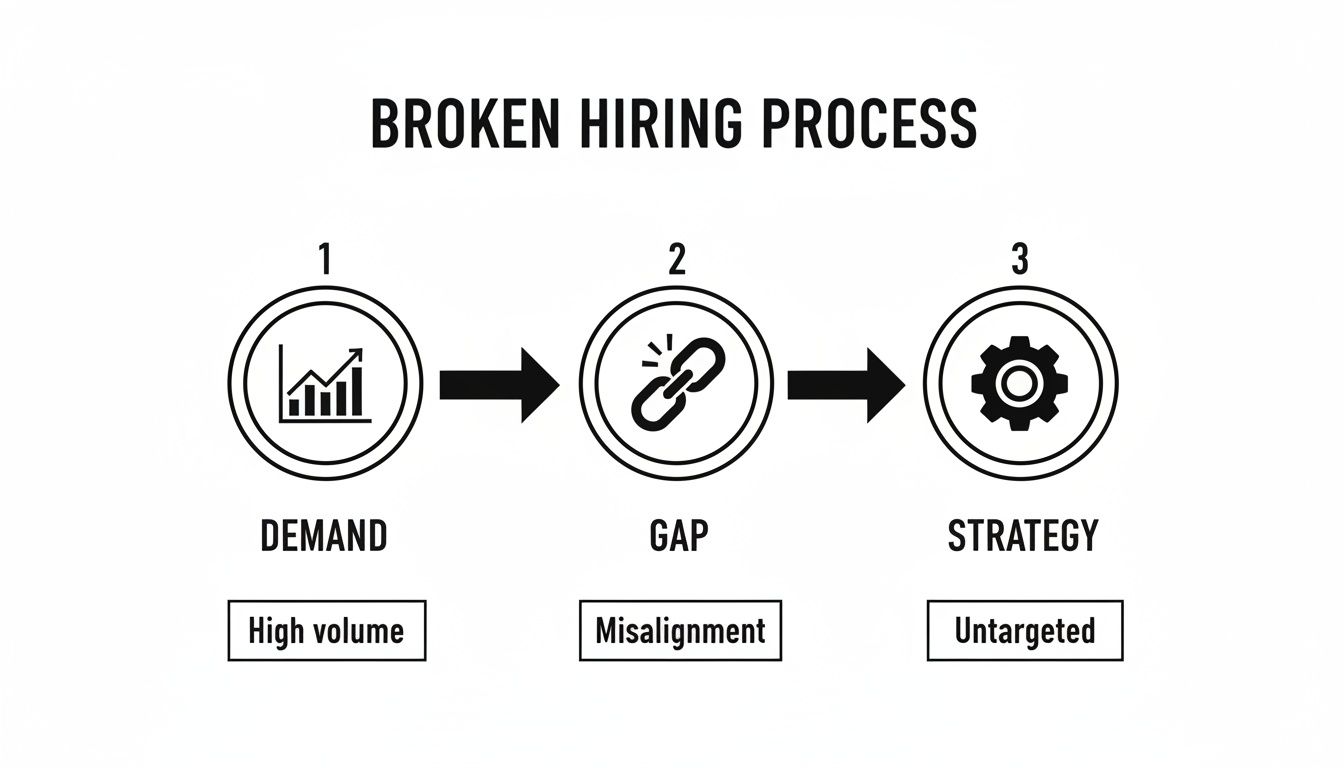
This diagram highlights a critical breakdown: when the understanding of what’s needed is vague, a significant talent gap emerges. This forces the team into a reactive scramble, which rarely ends well. Let’s fix that by focusing on clarity right from the very beginning.
Pinpointing Your True North
Before you write a single line of a job description, stop and answer this fundamental question: What business problem are we hiring this person to solve?
Your answer to that question will dictate everything, the specialisation, the skills, and even the seniority level you need. Are you migrating legacy systems to the cloud? Trying to get your cloud spend under control? Or are you building a brand-new cloud-native application from scratch? Each of these goals requires a completely different type of engineer.
For example, a company undertaking a massive migration from on-premise data centres needs an engineer with deep experience in lift-and-shift strategies, data replication, and hybrid cloud architectures. On the other hand, a startup building a new SaaS product needs a Cloud Native specialist who lives and breathes serverless, containers, and microservices.
From Vague Roles to Clear Specialisations
“Cloud Engineer” is just an umbrella term. It covers several distinct specialisations. By identifying the right one from the start, you can focus your search and attract professionals who are genuinely excited by the specific challenges you’re offering.
Here are three common profiles to consider:
- Cloud Infrastructure and Operations: Think of this as the traditional “keeper of the cloud.” These engineers focus on provisioning, managing, and monitoring core infrastructure on platforms like AWS, Azure, or GCP. Their world revolves around networking, virtual machines, and ensuring rock-solid reliability and uptime.
- DevOps and Site Reliability Engineering (SRE): This role is where development and operations meet. The focus is heavily on automation, building CI/CD pipelines, and managing infrastructure as code (IaC) with tools like Terraform or Ansible. You can get a deeper look into this critical function in our guide on DevOps engineer roles and responsibilities.
- Cloud Security Engineer: This is a specialist laser-focused on securing your cloud environments. They’re the ones implementing identity and access management (IAM) policies, configuring firewalls and security groups, and managing threat detection systems. For any company handling sensitive data, this role is absolutely non-negotiable.
Differentiating Must-Haves from Nice-to-Haves
Once you’ve nailed down the specialisation, the next critical step is to separate the mandatory skills from the desirable ones. This simple act prevents you from creating a “unicorn” job description that no real human can actually fulfil. It also gives your recruiters a clear roadmap for screening candidates and keeps your interview process focused on what truly matters.
A common mistake is listing every possible tool under the sun. Instead, focus on the core concepts. An engineer who truly understands Kubernetes can adapt to different orchestration platforms; one who masters IaC with Terraform can quickly pick up CloudFormation.
Let’s look at a practical example for a DevOps role:
Mandatory Skills (Must-Haves):
- Deep expertise in Kubernetes: Essential for managing our containerised applications at scale.
- Proficiency with Terraform: The backbone of our automated infrastructure provisioning.
- Strong scripting ability: In Python or Go for creating custom automation and tooling.
Desirable Skills (Nice-to-Haves):
- Experience with a specific cloud provider: Like AWS or Azure.
- Familiarity with monitoring tools: Such as Prometheus or Grafana.
- Exposure to service mesh technology: Like Istio.
This structured approach makes your job description both realistic and highly targeted. It sends a clear signal to candidates that you have a well-defined vision for the role and genuinely understand what it takes to succeed. In a competitive market, that clarity is your most powerful tool for attracting engineers who not only have the right technical chops but also align perfectly with your strategic goals.
Finding Talent in a Candidate-Driven Market
Let’s be honest: the most talented cloud engineers aren’t polishing their CVs or scrolling through job boards. They’re already employed, neck-deep in complex projects, and probably batting away recruiter messages every single day. If your strategy is to wait for them to come to you, you’re going to be waiting a long time. The only way to win is to build a proactive, multi-channel sourcing engine.
This means looking beyond the usual suspects like LinkedIn. While it’s still part of the toolkit, the real gold is in the places where these engineers gather, learn, and collaborate on their own terms. That’s where you can connect with passive candidates in a way that feels genuine and actually makes an impact.

Go Where the Engineers Are
Top-tier talent gravitates towards communities built around shared technical passions. By becoming a valued member of these spaces, your sourcing team can spot the standout contributors and build relationships long before a job opening even exists.
Here are a few high-value channels to get into:
- GitHub and GitLab: Look for engineers contributing to open-source projects that are relevant to your tech stack. An engineer who actively maintains a popular Terraform module or contributes to a Kubernetes project has already put their skills on public display.
- Niche Slack and Discord Communities: Channels dedicated to specific tech (think the “Kubernetes” or “HashiCorp Users” Slack workspaces) are absolute goldmines. Your recruiters can pick up the lingo, understand the current pain points, and identify the people everyone turns to for answers.
- Specialised Tech Forums: Platforms like Stack Overflow or even specific subreddits are where engineers go to solve real-world problems. Pay attention to who provides the most insightful, well-reasoned answers, you’re looking at an expert.
The goal in these communities isn’t to blast out job ads. It’s to listen, learn, and engage. A thoughtful comment on a technical discussion will get you much further than a generic “I have a great opportunity for you” message ever will.
Crafting Outreach That Actually Gets a Reply
When you do find someone promising, that first message is your one shot to make an impression. Top engineers can spot a lazy, copy-pasted template from a mile away, and it’s the fastest way to get ignored.
To cut through the noise, your outreach has to be hyper-personalised. This is more than just using their first name; it’s about proving you’ve actually done your homework.
A weak outreach message looks like this: “Hi [Name], I saw your profile and was very impressed. We are hiring for a Cloud Engineer role that I think you’d be a great fit for. Are you open to a chat?”
A strong, personalised message is completely different: “Hi [Name], I came across your contributions to the [Specific Open-Source Project] on GitHub, particularly your work on optimising the CI/CD pipeline. That kind of hands-on expertise with Terraform is exactly what we need for our platform team as we look to scale our infrastructure. We’re tackling some interesting challenges around multi-cloud orchestration. Would you be open to a brief chat about it?”
See the difference? The second example works because it shows you’ve paid attention. It references their specific work and connects it directly to a compelling challenge. For more on this, dive into our guide on the best candidate sourcing practices for tech hiring.
Building a Magnet for Talent
Sourcing is just one piece of the puzzle. For long-term success, you need to build an employer brand that engineers actually respect. This isn’t about flashy marketing, it’s about showing a real commitment to technical excellence and a culture where engineers can do their best work.
How do you do that?
- Encourage Open Source Contributions: Give your current engineers the time and support to contribute to open-source projects.
- Host Tech Talks and Meetups: Position your company as a place where technical knowledge is shared and celebrated.
- Publish Engineering Blogs: Let your engineers write about the cool, tough problems they’re solving.
This approach creates a pull, drawing passive talent to you because they admire the work your team is doing. It shifts your hiring from a constant hunt to a system that attracts the right people.
This is more important than ever as the market gets tighter. India’s tech sector, for instance, is facing a major skills gap. By 2026, the talent deficit in cloud, AI, and cyber skills could hit 25%, a big jump from 18% in 2023. This skills crunch is fuelling fierce competition for talent, and a strong employer brand is your best defence.
Designing an Assessment That Identifies True Skill
A poorly designed technical interview is worse than just a waste of time, it actively pushes away top talent. The best cloud engineers can spot a textbook trivia quiz from a mile away and will lose interest fast. They want to solve real-world problems, not just spit back definitions they could look up in the documentation.
That’s why your assessment process has to mirror the actual challenges the role will tackle day-to-day. You need to shift away from theoretical questions and lean into practical, hands-on evaluations that truly show off a candidate’s problem-solving chops. This approach not only gives you a more accurate read on their skills but also gives the candidate a taste of the interesting work you’re doing, turning the interview into a powerful selling point.

Beyond Whiteboards: The Practical Take-Home Assignment
One of the most effective ways I’ve seen to gauge real-world ability is a carefully crafted take-home assignment. Let’s be clear: this isn’t about asking for free work or dropping a massive project in their lap. It’s about creating a small, self-contained challenge that reflects a typical task.
For instance, instead of asking, “What is Kubernetes?”, hand them a broken microservices application and a brief. Their task? Containerise it, write the necessary Kubernetes manifests to get it deployed, and document the process. This single task tests a whole range of skills: their grasp of containers, their fluency with Kubernetes, their documentation habits, and their overall problem-solving workflow.
A great take-home assignment should be:
- Time-boxed: Clearly state it should take no more than 2-4 hours. This shows you respect the candidate’s time.
- Relevant: It must be directly related to the core responsibilities of the job.
- Open-ended: Allow for more than one correct solution. This gives creative engineers room to impress you.
- A discussion starter: The submitted project should become the centrepiece of the next technical interview.
Structuring a Technical Deep Dive
The conversation that follows the take-home assignment is the technical deep dive. This is your chance to evaluate not just what the candidate built, but why they made the choices they did. It’s a critical moment for assessing their architectural thinking and true depth of knowledge.
Forget a rapid-fire Q&A. Structure this as a collaborative code review or an architectural discussion. Ask probing questions that peel back the layers of their thought process.
“I noticed you chose a Load Balancer service type here. Could you walk me through the trade-offs you considered? What might be the implications for cost and security if we pushed this to a production environment?”
This style of questioning moves the conversation from rote memorisation to strategic thinking. It tells you if the candidate understands the second- and third-order effects of their technical decisions, a clear sign of a senior-level engineer.
Assessing the All-Important Soft Skills
A brilliant engineer who can’t collaborate is a net negative for the team. For cloud roles, which are inherently cross-functional, skills like communication, ownership, and adaptability are just as vital as technical expertise. Behavioural interview questions are your best tool for uncovering these traits.
But generic questions like “Tell me about a time you faced a challenge” won’t get you very far. You have to tailor them to the specific realities of a cloud engineering role.
Examples of Role-Specific Behavioural Questions
- For Ownership: “Tell me about a time you were on-call and a critical production system went down. How did you handle the incident and what was your communication strategy with stakeholders?”
- For Adaptability: “Describe a project where the underlying cloud service you were using was deprecated. How did you plan and execute the migration to a new service?”
- For Collaboration: “Walk me through a time you had a strong disagreement with a software developer about an infrastructure design. How did you work to find a resolution?”
These questions compel candidates to draw on real experiences, giving you concrete evidence of how they operate under pressure and as part of a team.
Finally, none of this works without a well-trained interview panel. Every interviewer must understand which specific competencies are being evaluated at each stage. Arm them with a structured scorecard to mitigate unconscious bias and standardise the feedback. This not only improves the quality of your cloud engineer hiring decisions but also guarantees every candidate walks away with a positive, professional impression of your company, no matter the outcome.
Structuring Offers That Win Top Talent
You’ve navigated the tricky waters of sourcing and assessment. Now comes the final, make-or-break moment in the cloud engineer hiring process: the offer. In today’s hyper-competitive market, a well-structured offer is far more than a formality. It’s a powerful statement about how much you actually value top-tier talent.
Losing your best candidate at this stage isn’t just a letdown; it’s a costly failure that throws you right back to the beginning of a long, expensive search.
To craft an offer that gets an enthusiastic “yes,” you have to ditch the generic compensation models. It’s all about a data-driven approach that truly reflects what’s happening on the ground, especially with the salary wars defining the tech scene in India.
Benchmarking in a High-Stakes Market
Guesswork is your worst enemy here. Before you even think about putting a number on paper, you must benchmark against real-time market data. The Indian tech market moves incredibly fast, and salaries for cloud professionals are climbing year after year. What was a competitive offer six months ago might look completely underwhelming today.
This is especially true when you consider different levels of experience. A junior engineer just starting out has vastly different salary expectations than a principal architect who will be steering your enterprise-wide cloud strategy. You absolutely need clear, tiered salary bands that account for this.
For instance, the salary landscape for cloud professionals in India for 2026 is seeing intense competition. Cloud architects command an average of ₹8-25 lakhs per annum. Entry-level roles might start around ₹3-8 lakhs, while senior positions can easily shoot past ₹16-25 lakhs.
It doesn’t stop there. Adjacent roles like DevOps engineers are just as sought-after, averaging ₹5-12 lakhs and climbing to ₹10-22 lakhs for seasoned professionals. If you’re hiring for niche specialisations like cloud security, be prepared to pay a premium of 40-60% over standard roles.
Moving Beyond the Base Salary
A competitive base salary is the foundation, no doubt. But top-tier engineers, the ones who can really move the needle for your business, are almost always looking for more. They want a piece of the success story they’re helping to build. This is where equity and performance bonuses become your secret weapons.
- Meaningful Equity: For many senior engineers, especially in startups or high-growth companies, equity is a massive draw. Whether it’s stock options or RSUs (Restricted Stock Units), it offers a tangible stake in the company’s future.
- Performance-Based Bonuses: A clear bonus structure tied to measurable outcomes, like hitting uptime goals or bringing down cloud spend, shows that you genuinely reward high performance. It’s a great way to align individual contributions with the company’s bottom line.
- Sign-On Bonuses: When you’re in a fierce hiring battle for a niche skill set, a sign-on bonus can be the final nudge that convinces a candidate to choose your offer over a competitor’s.
An offer isn’t just a number; it’s a narrative. It should tell a compelling story about growth, impact, and shared success. Frame the total compensation, base, bonus, and equity, to highlight the long-term value of joining your organisation.
Mastering the Art of Negotiation
Once you’ve sent the offer, get ready to talk. The best candidates almost always negotiate, and how you handle this conversation says a lot about your company culture. Don’t see it as a battle. Think of it as the final stage of building a great working relationship.
Come prepared. Know your absolute maximum on base salary, but also have other levers you can pull. Maybe you can’t budge on salary, but you might be able to offer a bigger sign-on bonus, a little more equity, or a guaranteed professional development budget.
The goal is simple: close the deal without leaving a bad taste in anyone’s mouth. A positive, transparent negotiation process reinforces the candidate’s decision that your company is the right place for them. It ensures they join the team feeling valued, motivated, and ready to hit the ground running from day one.
When to Partner with a Recruitment Specialist
There comes a tipping point in every fast-growing company where the sheer volume of hiring outstrips what your internal team can handle. Even the most switched-on, efficient in-house team will eventually hit a wall, especially when they’re suddenly tasked with aggressive targets for highly specialised roles like cloud engineers. This is the moment a strategic partnership becomes your most powerful asset.
Bringing in a specialist recruitment partner, often through a Recruitment Process Outsourcing (RPO) model, isn’t an admission of defeat. Far from it. It’s a savvy, strategic move to pour fuel on your cloud engineer hiring engine precisely when you need it most. This allows your core HR team to stay focused on culture, strategy, and employee development while the RPO partner handles the heavy lifting of high-volume recruiting.
Key Triggers for Seeking External Help
Knowing when to call for backup is half the battle. You’ll likely need an RPO partner when your organisation starts facing some very specific growing pains.
Look out for these common scenarios:
- Aggressive Hiring Targets: The board wants you to hire 20-30 cloud engineers in a single quarter. For most in-house teams, that volume is enough to bring everything else to a grinding halt.
- Entering New Markets: You’re expanding into a new city or country where your team has zero network, no on-the-ground knowledge, and no brand recognition.
- Lack of Niche Expertise: Your recruiters are fantastic generalists, but now you need someone with a black book of contacts and deep sourcing expertise to find engineers with rare skills in multi-cloud or cloud security.
- Inconsistent Candidate Experience: The pressure of rapid hiring has led to a chaotic, disjointed process. Your employer brand is taking a hit, and you’re losing great candidates to the competition because of it.
An RPO partner should operate as a true extension of your team. They don’t just find candidates; they integrate into your workflows, adopt your branding, and use your systems to deliver a completely seamless experience from the first outreach call right through to offer management.
This kind of partnership is much more than a temporary fix. For many organisations, it becomes a long-term strategic lever for growth. If you’re seeing signs that your internal capabilities are stretched to their limit, it might be time to explore if you’ve outgrown in-house hiring in our detailed article. An RPO gives you the power to build world-class cloud teams with the speed and expertise the market demands.
Your Cloud Engineer Hiring Questions, Answered
Hiring top-tier cloud engineers can feel like a maze. As a CHRO, you’re likely grappling with some tough questions. Here, I’ll tackle some of the most common ones I hear from leaders, offering straightforward advice to sharpen your hiring strategy.
How Do We Assess Soft Skills in Technical Roles?
This is a big one. It’s easy to get fixated on technical chops, but a brilliant engineer who can’t collaborate is a bottleneck waiting to happen. The trick is to stop thinking about soft skills as a separate checkbox. Instead, weave behavioural assessments right into your technical interviews.
For example, when a candidate is whiteboarding a system design, see how they react to a little pushback or an unexpected change in requirements. Do they get defensive, or do they adapt? I love asking, “Okay, now walk me through how you’d explain this complex architecture to a non-technical project manager.” Their answer tells you everything you need to know about their communication and empathy skills.
The best signal for soft skills isn’t a list of questions about teamwork. It’s observing collaboration, ownership, and adaptability in the wild, while they’re solving a real technical problem. That’s how you get an authentic read on how they’ll perform on your team.
Are Cloud Certifications Really That Important?
In short, they’re a nice-to-have, not a must-have. A certification like the AWS Certified Solutions Architect shows that someone has a foundational grasp of a platform and is committed to learning. That’s definitely a plus.
But, and this is a big but, a certificate is no substitute for hands-on, battle-tested experience. I’d take a candidate with a rich GitHub portfolio and a track record of wrestling with complex infrastructure challenges over someone with a dozen certs but little real-world application, any day of the week.
Think of certifications as a helpful filter at the very top of the funnel. But when it’s time to assess, always, always prioritise proven, practical skills.
How Can We Compete with FAANG Compensation Packages?
Let’s be realistic: going head-to-head with FAANG (Facebook, Amazon, Apple, Netflix, Google) on salary is a losing battle for most companies. The smart move is to shift the conversation from pure compensation to the total value proposition.
Here’s where you can really shine:
- Impact and Ownership: In a smaller, nimbler organisation, you can offer engineers the chance to truly own a project from start to finish. That kind of autonomy is a huge draw and often hard to come by in a massive corporation.
- Work-Life Balance: A culture that respects personal time and avoids burnout is an incredibly powerful recruiting tool, especially when contrasted with the high-pressure environments at some tech giants.
- A Clear Growth Path: Show them a clear, accelerated route to a senior technical role or a leadership position. Make it tangible.
Your offer needs to tell a compelling story, one about meaningful work, genuine impact, and a career that’s going somewhere fast. That’s how you win.
Struggling to scale your cloud engineering team without burning out your internal recruiters? Taggd offers expert Recruitment Process Outsourcing to help you find and hire the top-tier cloud talent you need to drive your business forward. Let’s talk about building your team, faster.