The real story behind the core engineering vs new-age engineering talent shift is a classic tale of market demand and skill relevance. We’re seeing a fundamental split. On one side, you have roles in AI/ML and Data Science, where employability and salaries are high thanks to rapid tech adoption. On the other, traditional core disciplines like Mechanical and Civil engineering are struggling with a growing skills mismatch and softer immediate demand.
The Great Engineering Divide: Understanding the Talent Shift
For any Chief Human Resources Officer (CHRO), getting to grips with the widening gap between traditional and digital engineering talent has become a central challenge. Today’s business world runs on data and automation, creating a sharp contrast in the value and availability of different engineering skills. This isn’t just a passing trend; it’s a structural realignment of the entire engineering talent market.
This shift is changing everything about how organisations plan their workforce, recruit new talent, and invest in development. While foundational engineering principles are still important, the skills that give you a competitive edge today are almost entirely digital. Companies across every sector, not just IT, are prioritising candidates who can build intelligent systems, analyse complex data, and work in cloud-native environments. We’ve seen this firsthand, especially in how the demand for tech talent is shifting across industries like automotive manufacturing.
A Tale of Two Talent Pools
The data doesn’t lie, it paints a very clear picture of this divide. In India’s evolving job market, the overall employability for B.E./B.Tech graduates hit a five-year high of 71.5% in 2025. That sounds great on the surface, but the growth is almost entirely driven by new-age fields.
Computer Science, for example, boasts an 80% employability rate. Meanwhile, Mechanical Engineering lags far behind at just 63%. This disparity creates a twofold problem for CHROs. They must compete aggressively for a small, expensive pool of new-age talent while also figuring out how to reskill and redeploy their existing core engineering workforce to stay relevant.
The chart below really drives home the stark difference in employability.
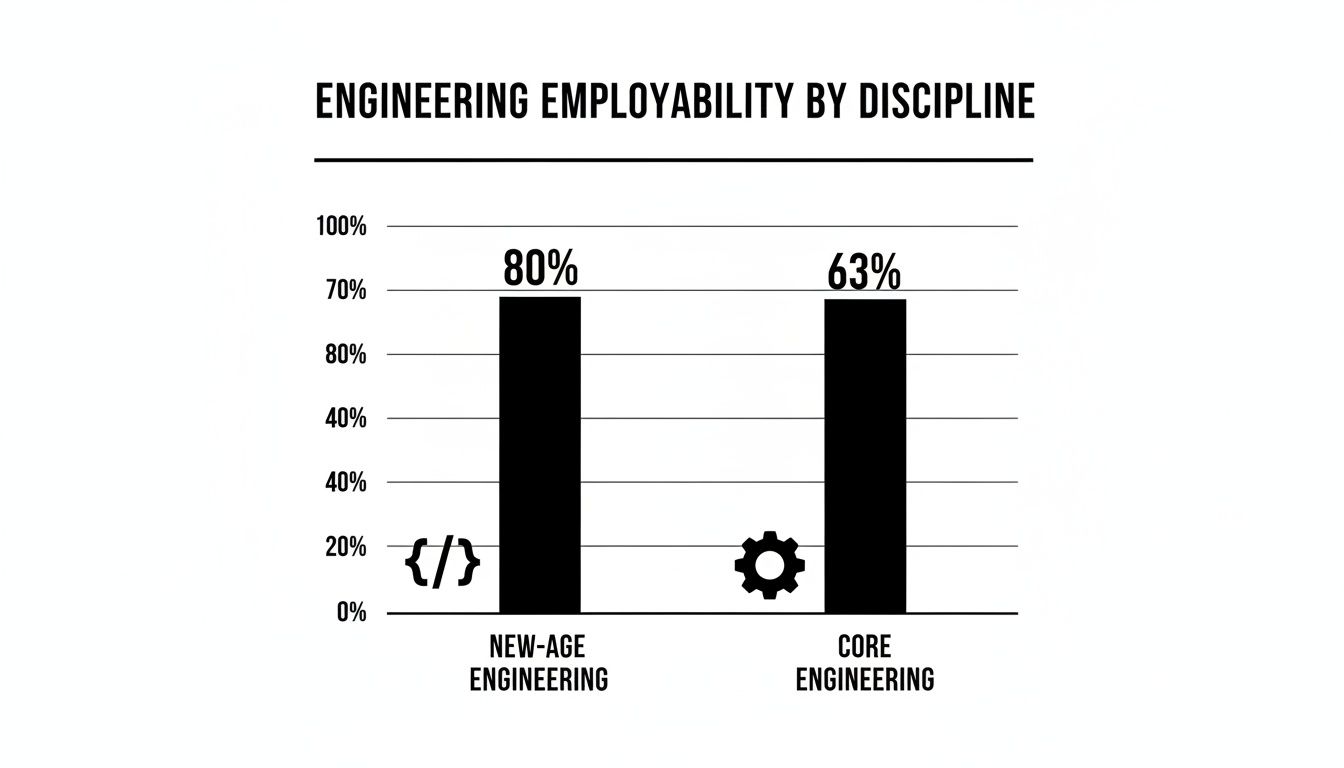
That 17-percentage-point gap isn’t just a number. It represents an urgent call for smarter talent strategies to bridge this growing divide.
Quick Look: Core vs New-Age Engineering Employability in 2026
To give you a clearer picture, the table below breaks down the key metrics. It’s a snapshot of the current talent gap between traditional core engineering and the emerging new-age fields in India, offering a glimpse into the hiring and retention landscape CHROs have to navigate.
| Metric | Core Engineering (e.g., Mechanical, Civil) | New-Age Engineering (e.g., AI/ML, Data Science) |
|---|---|---|
| Employability Rate | Lower (approx. 63%) | Higher (approx. 80%) |
| Skill Focus | Physical systems, process integrity, project execution | Algorithmic logic, data fluency, cloud-native development |
| Market Demand | Stable to declining in some sectors | Rapidly growing across all industries |
| Salary Expectations | Moderate, with incremental growth | High, with significant premiums for niche skills |
| Talent Availability | Relatively abundant but with skill gaps | Scarce and highly competitive |
Looking at this, it’s easy to think it’s a simple case of replacement, but that would be a mistake. The real challenge and opportunity lies in finding a way to integrate both talent pools.
The most resilient organisations won’t be the ones that just replace old with new. They will be the ones that successfully blend the deep domain knowledge of their core engineers with the digital capabilities of new-age talent.
Comparing Core Skills and New-Age Capabilities
To really get a handle on the shift from core to new-age engineering talent, CHROs need to look past the job titles. It’s not about which type of engineer is “better,” but which one is right for the job at hand. The real difference is in how they think and the kind of business value they’re wired to create.
Core engineers are the master builders of our physical world. Their entire expertise is built on a solid foundation of scientific principles, sticking to processes, and getting projects done right. They think in terms of reliability, safety, and results you can touch and see. Their world is dictated by physics, material science, and trusted methods that have been fine-tuned over decades.
New-age engineers, on the other hand, are the architects of our digital world. Their skills are all about algorithmic logic, fluency with data, and thinking about entire systems. They thrive on abstraction, playing with cloud-native development, machine learning models, and massive datasets to build smart systems that can scale.
A Deeper Dive into Foundational Competencies
The difference in mindset is massive. A core mechanical engineer might design a factory floor layout to make sure materials flow smoothly, equipment is safe, and production is efficient, all based on proven industrial engineering principles. Success for them is measured by uptime, physical output, and meeting safety rules.
Now, give that same factory to a new-age engineer. Their first thought would be to build its digital twin. They’d want to stick IoT sensors on the machinery, stream all that data to a cloud platform, and create algorithms that predict when a machine is about to break down. Their success is measured by how accurate their predictive models are, the drop in unplanned downtime, and whether the system can learn to optimise itself.
This deep divide is showing up in the talent market. A recent Confederation of Indian Industry (CII) survey highlighted a major skills gap, finding that only 27% of graduates are actually employable in core engineering jobs because they lack practical problem-solving skills. At the same time, the demand for AI/ML specialists is jumping by 51% as companies start moving their generative AI projects from a pilot phase to full-scale production. You can get a better sense of these market dynamics by reading the full analysis on the engineering employability surge.
Contrasting Value Creation Models
The most important point of difference is how each group tackles problems and creates value. A core engineer is trained to deliver reliability and safety within very specific, defined limits. A new-age engineer is trained to build systems that grow and automate intelligently.
Core Engineer Focus: “How can we build this bridge to be structurally sound, last for a century, and keep the public safe under all foreseeable conditions?”
New-Age Engineer Focus: “How can we build a traffic management system that uses real-time data to predict congestion, reroute cars automatically, and slash commute times by 30%?”
Both are absolutely essential, but they are solving different parts of a business problem. The core engineer makes sure the physical infrastructure won’t fail; the new-age engineer makes sure the system running on that infrastructure is smart and efficient.
Let’s break down their competencies side-by-side.
| Competency Area | Core Engineering Talent | New-Age Engineering Talent |
|---|---|---|
| Problem-Solving | Focused on physical constraints, process optimisation, and established scientific principles. | Focused on data-driven insights, algorithmic solutions, and system-level thinking. |
| Key Skills | Mechanical/Electrical Design, Project Management, Quality Assurance, Process Safety. | Python/Java, Cloud Architecture (AWS/Azure), Machine Learning, Data Analytics. |
| Mindset | Emphasis on reliability, durability, and safety. | Emphasis on scalability, agility, and intelligent automation. |
| Value Proposition | Delivers robust, predictable, and physically sound products and infrastructure. | Delivers scalable, data-driven, and automated systems that enhance efficiency and create new capabilities. |
At the end of the day, a CHRO’s job isn’t to pick one over the other. The real magic happens when you build a talent ecosystem where these two groups can work together. The core engineer’s deep domain knowledge of physical systems gives the new-age engineer the crucial context they need to build digital solutions that actually work in the real world.
Decoding Workforce Trends and Hiring Implications
Knowing the difference between core and new-age skills is one thing. But for Chief Human Resources Officers (CHROs), the real test is turning that insight into a hiring strategy that works in today’s chaotic market. The shift from core to new-age engineering isn’t just a skills gap, it’s changing the entire workforce, making the hiring game more complex and competitive than ever.
The talent shortage in India is hitting a critical point. By 2026, a staggering 82% of employers report struggling to find the skilled professionals they need. This crisis is overwhelmingly fuelled by the demand for new-age skills, with AI capabilities quickly becoming the top priority for most organisations.

The Dual Challenge of Talent Scarcity and Surplus
This intense demand for specialised new-age talent has created a hyper-competitive market. We’re seeing a huge spike in competition from Global Capability Centres (GCCs), who often have deep pockets and can offer premium pay packages. As a result, salaries for new-age roles have shot up by as much as 18%, putting a massive strain on talent acquisition budgets.
But this fierce competition is creating a strange paradox. As companies and universities pivot their focus towards these new skills, the applicant-to-job ratio has more than doubled since early 2022. This points to a surplus of candidates in the general market, but a critical shortage of the specific, high-demand skills that businesses actually need. Even campus hiring has changed, showing a 12% increase in recruitment for tech-focused roles over traditional engineering disciplines.
This leaves CHROs wrestling with two problems at once:
- Battling for Scarcity: Fighting an expensive and exhausting war for a tiny pool of highly specialised, expensive new-age engineering talent.
- Managing a Surplus: Figuring out what to do with a growing pool of traditional core engineers who risk underemployment or redundancy without a clear plan.
The core operational reality for CHROs is a talent market defined by extremes. Success hinges on navigating the intense competition for new-age skills while unlocking the hidden potential within the existing core engineering workforce through strategic reskilling, not simple replacement.
This complex situation demands a more sophisticated strategy than just traditional recruitment. For a deeper look at these evolving market dynamics, you can also explore our comprehensive analysis in the India Decoding Jobs 2026 report.
Translating Trends into Talent Acquisition Realities
So, what does this look like on the ground? Your recruitment teams are probably seeing longer time-to-fill for roles in AI, data science, and cloud architecture. The cost-per-hire is climbing, and offer acceptance rates are likely dropping as top candidates field multiple, aggressive counter-offers.
Think about it. A typical search for a Senior Machine Learning Engineer today might mean sifting through hundreds of applications, only to find a handful who have the right mix of technical skill and business sense. Those few candidates are almost certainly talking to several other companies, pushing you into bidding wars that stretch your salary bands and create difficult pay equity issues internally.
At the same time, you might have brilliant, experienced mechanical or electrical engineers on your team. Their domain knowledge is irreplaceable, but their current skillset might not line up with future projects. Just letting this talent walk out the door is a huge waste of institutional knowledge and a major blow to morale. The smarter play is to build structured pathways for these core engineers to upskill into hybrid roles, where their foundational expertise is boosted with new-age capabilities. This approach creates a far more sustainable and cost-effective talent pipeline for the long run.
Alright, let’s move from understanding the problem to actually doing something about it. The massive shift from core to new-age engineering talent isn’t a gap you can fill with a few new hires. It calls for a complete overhaul of how you think about, build, and nurture your talent. To build a truly future-ready engineering workforce, you need a smart mix of growing your own people, bringing in outside specialists, and always keeping an eye on what’s next.
This means we have to stop hiring the way we always have. The old model of looking for a specific degree is no longer enough. We need to get much more practical and focus on competencies. The real question isn’t, “What degree is on their CV?” but “What real-world problems can this person solve for us?” This mindset shift is the key to creating clear career paths that turn your high-potential core engineers into the hybrid talent you desperately need.
Shifting from Credentials to Competencies
For decades, a specific engineering degree was a reliable shortcut for gauging a candidate’s skills. Let’s be honest, that shortcut doesn’t work anymore. Technology is moving so fast that practical, applicable skills have become the real currency, not the diploma on the wall. A competency-based approach is all about figuring out what a person can actually do, no matter where they learned it.
This pivot helps you tap into the incredible talent you already have. Think about it: your seasoned mechanical engineers have domain knowledge that is simply impossible to hire off the street. When you layer new-age skills onto that solid foundation, you’re creating an asset far more powerful than a fresh graduate. You get an expert who truly understands both the physical and digital sides of your business. This is where grasping the power of combination skills for upskilling and growth gives you a serious competitive edge.
Here are a few practical ways to make this shift happen:
- Rethink your interview scorecards. Stop asking about old university projects. Instead, give candidates practical, real-world problems that test their algorithmic thinking, data fluency, and ability to integrate systems.
- Use proper skills validation tools. Don’t just take their word for it. Use technical assessments and project simulations to see if they’re actually proficient in Python, cloud platforms, or specific machine learning frameworks.
- Launch internal academies. Build structured, in-house training programmes that offer clear certification paths, giving your core engineers a direct route to gaining new-age qualifications.
Following this path naturally builds a more diverse and resilient talent pool. It’s about realising that a civil engineer with a knack for data analytics could be your next smart infrastructure lead, or that a chemical engineer might be the perfect person to optimise your production lines using IoT and predictive models.
The companies that win tomorrow will be the ones that build their own talent, blending deep institutional knowledge with modern skills. This ‘grow-your-own’ approach is far more sustainable, cost-effective, and better for your culture than constantly being on the hunt for the ‘perfect’ external candidate who probably doesn’t exist.
The Strategic Role of Recruitment Process Outsourcing
While growing talent from within is the best long-term play, the immediate demand for new-age skills is intense and often outpaces your ability to upskill. This is precisely where a strategic Recruitment Process Outsourcing (RPO) partner comes in. An RPO partner isn’t just another recruiter; they act as an extension of your own HR team, bringing the market intelligence, scale, and laser focus you need to compete for top talent right now.
This partnership is becoming more critical by the day. Recent data shows that employer hiring intent for FY 2026-27 has skyrocketed to 40%, up from 29% the previous year, with a heavy emphasis on flexible, AI-ready roles. The pressure is on, especially when 84% of professionals admit they feel unprepared for the job market of 2026, citing AI and fierce competition as major concerns.
Bringing in an RPO specialist frees up your internal HR team to concentrate on what they do best: fostering your company culture, improving retention, and managing internal career progression. Meanwhile, the RPO partner handles the tough, time-consuming work of finding and securing top-tier external talent.
Strategic Approaches to Bridging the Engineering Talent Gap
So, how does this dual approach work in the real world? The table below breaks down how you can blend your team’s internal strengths with the specialised contributions of an RPO partner to cover all your bases effectively.
| Strategic Initiative | In-House Focus | RPO Partner Contribution (e.g., Talent Hired) |
|---|---|---|
| Talent Sourcing | Managing internal mobility, employee referrals, and leadership development programmes. | Building and nurturing external talent pipelines for niche skills (e.g., AI/ML, Cybersecurity, Cloud), executing large-scale tech hiring campaigns. |
| Market Intelligence | Understanding internal skills gaps, employee engagement, and retention drivers. | Providing real-time data on salary benchmarks, competitor hiring strategies, and emerging skill trends to inform offers and strategy. |
| Assessment & Selection | Defining role competencies, conducting final-round cultural fit interviews, and managing hiring manager relationships. | Designing and administering technical assessments, conducting initial screening, and presenting a curated shortlist of validated candidates. |
| Employer Branding | Developing and communicating the overall Employee Value Proposition (EVP). | Executing targeted branding campaigns to the tech community, showcasing the company as an employer of choice for new-age engineers. |
By dividing the labour this way, you ensure that your long-term cultural and developmental goals are being met internally, while your immediate, critical hiring needs are being handled by experts who live and breathe the tech talent market. This balanced strategy is your best bet for building a truly resilient engineering function.
Integrating Core and New-Age Talent in Practice
The strategies for blending engineering talent sound great in theory, but what does it actually look like on the ground? The most forward-thinking organisations aren’t just replacing their core engineers. Instead, they’re augmenting their skills, proving that the most powerful workforce is an integrated one. These real-world scenarios offer a practical blueprint for any CHRO trying to manage the core vs new-age engineering talent shift.

This blended team approach is only becoming more important as technology changes how we work. With more than 9 in 10 employees already using GenAI, jobs are being reshaped, not just replaced. This gives CHROs a massive opportunity to combine the deep-seated reliability of core engineers with the fresh innovation of new-age specialists. The result? Sustainable talent pipelines that are truly future-ready.
Case Study 1: The Predictive Maintenance Team
A large manufacturing firm was constantly battling unscheduled operational downtime. Their team of mechanical engineers was top-notch at fixing problems as they happened, but the business needed to get ahead of the curve with a predictive model to stay competitive.
The answer wasn’t to hire a brand-new data science team from scratch. Instead, the company launched a targeted upskilling programme for its most experienced mechanical engineers, training them on the Internet of Things (IoT) sensors and data analytics.
By combining their deep, hands-on knowledge of the machinery with these new digital skills, the team evolved into a formidable predictive maintenance unit. They knew exactly where to place sensors and, more importantly, how to interpret the data in the context of how the machines actually behaved.
The results spoke for themselves:
- Operational Downtime: Slashed by 35% within the first year.
- Maintenance Costs: Dropped by 22% thanks to fewer emergency fixes.
- Employee Retention: Saw a significant lift among the upskilled engineers, who now had a modernised and clear career path.
Case Study 2: The Smart Infrastructure Project
An established infrastructure company was finding it hard to boost safety and efficiency across its large-scale construction projects. Their civil engineers were masters of structural integrity and project management, but they didn’t have the tools to use modern data for better planning and risk assessment.
The core insight was that the firm’s most valuable asset was not its equipment, but the decades of experience held by its civil engineers. The challenge was to unlock that knowledge with new technology.
The company took a novel approach by creating integrated project teams. They paired seasoned civil engineers with a small, specialist group of external hires: drone operators and data scientists. This hybrid team immediately put drones to work for site surveying, progress tracking, and safety inspections.
The drone pilots captured high-resolution imagery, which the data scientists turned into actionable 3D models and risk reports. The civil engineers then provided the indispensable context, flagging potential structural weaknesses or logistical jams that only a trained, experienced eye would ever spot.
This fusion of talent delivered a clear business impact:
- Project Planning Cycles: Shortened by 20%, allowing projects to get off the ground faster.
- On-Site Safety Incidents: Fell by a remarkable 40% due to proactive hazard spotting.
- Material Wastage: Reduced by 15% because of more precise site modelling and planning.
These examples reveal a clear and repeatable pattern. The most effective way to handle the talent shift is to invest in your current people, strategically augment their skills, and build a culture where core and new-age professionals work together seamlessly.
Your CHRO Action Plan: Building an Engineering Powerhouse for 2026 and Beyond
Shifting from core engineering to a new-age talent model isn’t something you can do overnight. It demands a clear, step-by-step plan. For any CHRO looking to stay ahead of the curve, it’s time to move from thinking to doing, building an engineering workforce that is both resilient and balanced.
Think of this not as a radical overhaul, but as a steady, intentional evolution of your talent strategy. The aim is to create a talent ecosystem where deep institutional knowledge and cutting-edge digital skills can thrive side-by-side. This ensures your organisation has the engineering firepower it needs to maintain its competitive edge for years to come.
Short-Term Actions (The First 90 Days)
Your immediate focus should be on two things: assessment and experimentation. You need to get a quick, accurate picture of where you stand today and test new ideas on a small scale before you even think about a company-wide rollout. These first steps will give you the hard data you need to build your entire strategy on.
Your 90-day objectives should be simple and direct:
- Conduct a real skills audit: Forget job titles. Map the specific competencies of your current engineering teams. You need to know your strengths in core disciplines and uncover any hidden talents for new-age skills that might already exist in-house.
- Launch targeted upskilling pilots: Pick a small group of high-potential core engineers for a pilot programme. Focus it on a single, high-demand skill like data analytics or IoT integration. This is your low-risk way to see what training works and measure early results.
- Analyse your recruitment metrics: Really dig into your time-to-fill, cost-per-hire, and offer-acceptance rates. Compare the numbers for new-age roles versus your traditional core roles. This data is what you’ll use to build the business case for a smarter approach to talent acquisition.
Mid-Term Goals (The Next 6–12 Months)
With a solid baseline from your first 90 days, it’s time to make these changes stick. This phase is all about formalising your processes and bringing in the right partners to make your talent strategy more robust and scalable.
The mid-term is where your strategy becomes operational reality. It’s about building the formal structures and partnerships needed to systematically close the talent gap, moving from isolated pilots to scalable, organisation-wide initiatives.
Key initiatives for this period include:
- Redesign recruitment scorecards: It’s time to completely overhaul your interview and assessment criteria. You need to start prioritising competency over credentials, especially for new-age roles. Focus on problem-solving, data fluency, and systems thinking.
- Formalise an RPO partnership: Engage a specialist Recruitment Process Outsourcing partner like Talent Hired to handle the heavy lifting of sourcing and acquiring hard-to-find new-age talent. This frees up your internal team to focus on culture and development while you get the benefit of external market expertise.
- Establish internal career pathways: Create clear, well-defined career ladders for your core engineers to transition into hybrid or new-age roles. This isn’t just a wish list; it needs to be a formal path complete with training, mentorship, and real project-based experience.
Long-Term Vision (2–3 Years and Onward)
Looking further ahead, your strategy should focus on creating a talent ecosystem that can sustain itself. This is about more than just filling roles; it’s about embedding a culture of continuous learning and proactively shaping the future talent pipeline instead of just reacting to it.
- Build a culture of perpetual learning: Make professional development a core part of your engineering culture. This means actively incentivising and rewarding employees who take the initiative to learn new skills, making it a natural part of their career at your company.
- Forge academic partnerships: Start collaborating with universities and technical institutes to influence their curricula. By giving them direct input on what the industry actually needs, you help ensure that the next generation of engineers graduates with the right skills, bridging the gap between core and new-age education right at the source.
Frequently Asked Questions
As a CHRO, tackling the shift from core to new-age engineering talent is bound to bring up some tough questions. It’s a complex transition, and there are no simple answers. Here, we’ll break down some of the most common queries we hear and offer some practical advice to help shape your talent strategy.
What Is the First Step to Address This Talent Gap?
Before you even think about hiring or training, you need to know exactly what you’re working with. The best place to start is with a thorough skills audit. This isn’t just about listing job titles; it’s about getting a granular, honest look at the actual competencies on your teams.
Think of it as a three-step process:
- Map what you have: Catalogue the skills your current engineering teams possess. This includes their deep domain knowledge and any emerging new-age skills they might already be using.
- Forecast what you’ll need: Look at your company’s strategic goals for the next few years. Which new-age skills, like data analytics or AI integration, are going to be absolutely critical to get you there?
- Find the gaps: Now, compare the two. This data-driven analysis will show you precisely where your talent gaps are, giving you a solid foundation to build your entire strategy on.
Should We Upskill Core Engineers or Hire New Talent?
This is the big question, isn’t it? The truth is, it’s not an “either/or” choice. The most effective strategies we’ve seen involve a hybrid model. You have to do both, simultaneously.
It’s not about building versus buying talent; it’s about blending the two. Use targeted external hiring to plug immediate, specialised gaps, but invest in long-term upskilling to build a sustainable, loyal pipeline from within.
A smart way to handle this is to bring in a Recruitment Process Outsourcing (RPO) partner for those high-demand, new-age roles. This frees up your internal HR team to do what they do best: focus on creating fantastic upskilling programmes that turn your high-potential core engineers into the versatile talent you need for tomorrow.
How Can We Measure the ROI of Blending These Teams?
Measuring the return on blending these teams means looking past typical HR metrics. The real proof is in the business outcomes and operational wins.
Look for tangible results like:
- Reduced operational costs: Think lower maintenance bills because your newly upskilled mechanical engineers have built a predictive analytics team.
- Faster time-to-market: Are your product development cycles getting shorter? That’s what happens when teams integrate digital and physical design from day one.
- Higher employee retention: You should see a clear uptick in retention, especially among your core engineers who now see a real, valuable career path forward with your organisation.
At Taggd, we specialise in building the agile, blended engineering teams you need to thrive. Our RPO solutions deliver the new-age talent required to compete today, while giving you the space to develop your workforce for tomorrow. Discover how we can help you bridge the talent gap.