Customer Support Outsourcing in India isn’t just a line item on a budget sheet. It’s a strategic pivot. By partnering with a specialised provider, companies can delegate the complex operational tasks and free up their internal teams to focus on what they do best: driving core business innovation.
The CHRO’s Strategic Shift to Outsourcing in India

At the end of the day, outsourcing customer support to India delivers a powerful one-two punch:
- Operational Efficiency: You get immediate access to a scalable, expert workforce ready to manage customer interactions 24/7.
- Strategic Focus: You gain the freedom to redirect your best internal talent and resources toward the big-picture initiatives that truly drive your business forward.
Of all the global shifts we’ve seen in business, one thing has remained remarkably constant: India’s spot as the undisputed leader in customer support outsourcing. This isn’t just a happy accident. It’s the direct result of a powerful mix of incredible talent, robust infrastructure, and decades of proven experience. For a CHRO, looking to India isn’t a gamble; it’s a calculated, low-risk strategic move.

Think of India’s talent market as a vast, continuously replenished reservoir. Every year, millions of STEM graduates flood the workforce, creating a deep pool of candidates who are not just educated but also technically sharp and analytical. That kind of scale is simply unmatched anywhere else in the world.
This massive talent pipeline is a direct answer to a core challenge every large enterprise faces: finding qualified people, and finding them fast. For companies that need to scale their customer support teams, customer support outsourcing to India gives you immediate access to a ready-made, English-proficient workforce, which is key for maintaining service continuity and quality.
An Unbeatable Combination of Talent and Technology
But India’s dominance is built on more than just its people. It’s about the incredibly mature ecosystem that supports them. The country’s BPO industry has spent decades evolving from simple call handling to managing complex, technology-driven customer experiences.
This maturity means you’re partnering with service providers who have refined talent acquisition, training, and quality assurance into a science. They have deep, hands-on expertise in running large-scale, multinational support operations across dozens of industries. This established framework takes a huge operational burden off your shoulders.
On top of that, government initiatives like ‘Digital India’ have poured fuel on the fire, helping build out world-class technology infrastructure. We’re talking about high-speed internet connectivity, robust data centres, and a secure digital backbone, all critical for delivering reliable, 24/7 customer support. For a CHRO, this all adds up to peace of mind, knowing the operational foundation is rock-solid.
Market Dominance Backed by Data
The numbers don’t lie. India holds a commanding 17.58% share of the global outsourcing market, cementing its position as the top destination for customer support services. The entire Asia-Pacific region is growing at a 9.16% CAGR, easily outpacing the worldwide rate. For CHROs, this data signals stability and a well-trodden path to success.
You can explore further trends and projections to see how India’s IT services revenue is forecasted to hit USD 130 billion in 2025, with a huge chunk of that growth coming from high-value digital projects.
India is not just a location; it’s a strategic ecosystem. For a CHRO, outsourcing customer support here is like plugging into a national grid of service excellence, powered by a massive talent pool and a world-class technological framework.
This long-standing dominance ensures that when you choose a partner in India, you are not working with a newcomer. You are engaging with an industry that has set global standards.
Ultimately, it all comes together to build a compelling business case:
- Massive Talent Pool: Immediate access to millions of skilled, English-speaking graduates.
- Mature Service Providers: Decades of experience managing complex, large-scale support operations.
- Advanced Infrastructure: A reliable technological foundation built for global service delivery.
- Proven Track Record: A long history of success that minimises risk for new partnerships.
For any enterprise looking to achieve operational excellence in customer support, India presents a solution that is both strategically sound and operationally reliable. The decision to outsource here is backed by a legacy of performance and a future of continued growth.
Balancing Strategic Benefits with Operational Risks

Exploring customer support outsourcing in India feels a bit like harnessing a powerful river. It can propel your organisation forward with incredible speed and efficiency, but you have to be smart about the undercurrents. For a CHRO, putting together a solid business case means presenting a clear-eyed view of both the game-changing upsides and the very real risks.
The benefits are often what get the conversation started. They’re tangible, they resonate with the C-suite, and they speak directly to the bottom line. These are the tailwinds that push companies toward this model in the first place.
The Clear Advantages Driving the Decision
Let’s be direct: the most talked-about benefit is the dramatic cost saving. Shifting your customer support to India can slash operational costs by 30-60% compared to running the same team in-house in most Western countries. This isn’t just about salaries. It’s the whole package, less spend on infrastructure, recruitment, training, and employee benefits.
But the real strategic value goes far beyond just the cost column.
- 24/7 Operational Capability: India’s time zone creates a natural “follow-the-sun” model. This lets you offer genuine round-the-clock support without the headache and high cost of managing multiple overnight shifts internally.
- Rapid Scalability: Need to suddenly triple your support team for a big product launch or seasonal rush? Indian BPO partners have the recruitment engines to scale your team up or down with an agility that’s almost impossible to match in-house.
- Access to Specialised Talent: The BPO ecosystem in India is mature. This means you’re not just hiring agents; you’re tapping into a deep pool of people and managers with serious experience in specific industries and support channels, from complex technical troubleshooting to e-commerce support.
Put together, these benefits make a powerful case for outsourcing, one that promises better efficiency, global reach, and smart financial management. But a forward-thinking CHRO knows that what separates a good strategy from a great one is acknowledging the risks head-on.
Proactively Managing Operational Risks
While the upside is massive, long-term success really hinges on how well you manage the risks that come with any outsourcing partnership. Tackling these concerns from the get-go shows foresight and builds confidence across the leadership team.
The goal is not to avoid risk entirely, that’s impossible in any business venture. The goal is to identify, understand, and build robust mitigation strategies that turn potential liabilities into manageable operational processes.
For HR leaders, three areas of concern pop up time and again:
- Cultural and Communication Nuances: Misunderstandings happen. They can be small things, rooted in different communication styles, local idioms, or cultural context. But a minor misinterpretation can easily spiral into customer frustration and chip away at the brand experience you’ve worked so hard to build.
- Data Security and Compliance: Handing over customer data to a third party is a huge responsibility, especially with tough regulations like GDPR and CCPA watching your every move. Making sure your partner lives and breathes the highest security standards is completely non-negotiable. A breach here can lead to massive fines and reputational damage.
- Vendor Performance and Quality Control: How do you guarantee service quality when your team is thousands of miles away? Without a strong governance framework, you risk watching service levels drop, first-call resolution rates suffer, and a growing disconnect from your company’s core values.
For every one of these risks, you need a clear, practical mitigation plan. For cultural nuances, you mandate comprehensive brand and cultural immersion training for the outsourced team. To lock down data, you insist on partners with key certifications like ISO 27001 and bake strict data protection clauses right into your contract.
And to manage vendor performance? You establish crystal-clear SLAs, a shared KPI dashboard, and a regular rhythm of governance meetings to keep everyone aligned and focused on continuous improvement. By anticipating these challenges, you turn them from potential roadblocks into guideposts for building a resilient, long-term partnership.
Choosing Your Partnership and Pricing Models
Deciding to outsource your customer support to India is just the first step. The next, and arguably more critical, decision is how you’ll structure that partnership. It’s a two-part puzzle you have to solve. First, you need to define the operational model, how much control you want to keep versus how much you hand over. Second, you have to land on a pricing structure that aligns with your budget and actually rewards the performance you care about.
Think of it like deciding how to build a new house. You could hire a turnkey builder who handles everything from the foundation to the final coat of paint (a third-party model). Or, you could act as your own general contractor, managing every detail yourself (a captive centre). The right choice depends on your budget, your timeline, and how much you want to be involved in the day-to-day.
Aligning Your Operational Model with Your Strategy
Your choice of operational model is the blueprint for your entire outsourced team. It sets the rules for who owns the office space, who hires and manages the talent, and who directs the daily work. There are three main paths, each built for a different strategic goal.
- Third-Party Outsourcing: This is the most popular route. You partner with a specialised BPO company that manages your entire customer support function. They take care of everything, recruitment, training, technology, and facilities, delivering a ready-to-go solution.
- Captive Centre (GCC): A Global Capability Centre is a facility that you, the parent company, build, own, and run in India. This gives you absolute control over your brand, culture, and processes. However, it also demands a serious upfront investment in real estate, tech infrastructure, and local leadership.
- Hybrid Model: This approach offers a blend of both worlds. A common strategy is the “build-operate-transfer” model, where you partner with a vendor to build and run your centre initially, with a plan to take it over as a captive centre down the line. This lets you minimise the initial risk while still aiming for long-term control.
There’s no single “best” choice here. The right model comes down to your company’s appetite for investment, your desire for control, and what you want to achieve in India in the long run.
Demystifying Common Pricing Structures
Once you have an operational model in mind, the conversation turns to money. In the early days of outsourcing, pricing was all about inputs, like paying for an agent’s time. Today, the smartest partnerships are shifting focus towards outputs and real business outcomes, directly linking what you pay to the value you receive.
A pricing model isn’t just a financial agreement; it’s a statement of priorities. By choosing a model that rewards outcomes like customer satisfaction or first-call resolution, you ensure your partner’s goals are perfectly aligned with your own.
Getting your head around these models is the key to building a partnership that is both cost-effective and performance-driven. Let’s break down the most common structures you’ll encounter.
Comparing Outsourcing Pricing Models
Choosing the right pricing structure is critical. This table breaks down the most common models to help you decide which one best fits your organisation’s goals and budget.
| Pricing Model | Best For | Key Consideration |
|---|---|---|
| Fixed Price | Organisations that need predictable, stable monthly costs for easy budgeting. | This can sometimes be more expensive, as vendors build in a risk premium to cover any unexpected spikes in call volume or issue complexity. |
| Per-Agent / Per-Hour | Companies with very consistent, predictable support volumes and straightforward, repeatable tasks. | You’re paying for an agent’s time, not the results they produce. This can lead to paying for idle agents during quiet periods. |
| Per-Resolution | Businesses laser-focused on efficiency and results, especially those dealing with complex customer issues. | You and your partner must have a crystal-clear, mutually agreed-upon definition of what actually counts as a “resolution.” |
| Outcome-Based | Strategically-minded companies that want to tie payments directly to core business KPIs (e.g., CSAT, NPS, retention rates). | This requires a mature data and reporting framework on both sides to accurately track and validate performance against your targets. |
Each of these models encourages different behaviours from your partner. A per-hour model, where agents in India might cost $6 – $10 per hour, incentivises logging more hours. In stark contrast, an outcome-based model that ties a bonus to hitting a 95% CSAT score incentivises quality work and true customer focus. Your choice sends a powerful message to your partner about what success really means for your business.
Your Checklist for Selecting the Right Partner
Choosing a partner for customer support outsourcing in India is easily the most critical decision you’ll make in this entire journey. This isn’t about finding a vendor; it’s about bringing a strategic extension of your brand into the fold. A misstep here can wipe out all the potential cost savings and efficiency gains, so doing your homework isn’t just recommended, it’s non-negotiable.
For a CHRO, this evaluation has to go way beyond a simple price sheet. Your focus should be on finding a true strategic fit, someone with stable talent and mature technology. Think of this checklist as your guide to spotting a partner who can genuinely grow with you and protect your brand’s reputation.
Talent Acquisition and Retention Strategies
A BPO partner’s biggest asset is its people, and its greatest risk is high attrition. When agents are constantly coming and going, service quality plummets, institutional knowledge walks out the door, and your customer experience ultimately suffers. You need a partner who sees talent management as a core business function, not just an HR checkbox.
It’s time to drill down into their HR practices. Ask them directly:
- Recruitment Engine: How do you actually find and vet candidates? What’s your typical time-to-hire when scaling a team of our size?
- Employee Retention: What is your annual agent attrition rate? In the Indian BPO industry, a rate below 30-40% is considered healthy. Anything higher is a massive red flag.
- Career Pathing: What real opportunities for growth and development do you offer your agents? A clear career ladder is one of the most powerful tools for keeping good people.
A partner that invests in its employees is a partner that can deliver consistent, high-quality service. Their talent strategy has a direct impact on your operational stability. You can get a better handle on the key aspects of a support role by reviewing the roles and responsibilities of a customer support executive.
Technology and Security Posture
In today’s service world, technology isn’t just a background tool, it’s the very engine of efficiency and security. Your chosen partner must show a serious commitment to both automation and data protection. This is where you’ll separate the real leaders from the laggards.
A provider’s tech stack is a direct reflection of their forward-thinking capabilities. Any partner still leaning on outdated, legacy systems is completely unprepared for modern customer expectations or security threats.
Your evaluation has to cover these points:
- AI and Automation: Ask for concrete examples. How do they use AI for smart ticket routing, chatbots for simple queries, or analytics for quality assurance? This shows they’re serious about efficiency.
- Data Security Certifications: At a bare minimum, they must hold an ISO 27001 certification. This is the global standard for information security management and is non-negotiable for protecting your customer data.
- Compliance Expertise: Probe their experience with regulations that matter to your business, like GDPR, CCPA, or HIPAA. They should be able to clearly explain their compliance protocols.
The booming India outsourcing services market, valued at USD 137.66 million in 2025 and projected to hit USD 347.27 million by 2034, is pouring serious money into these areas. This growth proves just how sophisticated partners in the region are becoming, a trend CHROs can find more details about on the IMARC Group website.
Vetting Testimonials and Case Studies
Finally, never take a provider’s claims at face value. Client testimonials and case studies are useful, but you have to know how to read between the lines. Look for proof that aligns with your specific business needs.
Ask for references from companies similar to yours in size, industry, and complexity. When you get them on the phone, go beyond the generic questions. Ask about the initial transition, how the partner handled a crisis, and how they work together on continuous improvement. This is where you’ll find out what it’s really like to work with them.
Managing Your Outsourced Team for Long-Term Success
Getting your outsourced team up and running is a huge milestone, but it’s just the starting line. The real payoff from customer support outsourcing in India comes from what happens next: smart, continuous management that turns a simple contract into a genuine partnership.
Think about it, you wouldn’t hire a top executive and just hope for the best. The same logic applies here. You can’t just “set and forget” your outsourced team and expect world-class results. Long-term success is all about having a smart plan for the transition and a solid system for managing the relationship day-to-day. It starts with a phased rollout that won’t give your customers or your internal teams whiplash.
Crafting a Phased Implementation Plan
A thoughtful, structured implementation is your best defence against risk. Instead of flipping a switch and hoping for the best, you want to move in stages. This gives both your company and your new partner time to get in sync and iron out any wrinkles.
A typical phased rollout looks something like this:
- Knowledge Transfer: This is where it all begins. Your internal experts need to do a deep dive, documenting everything from processes and product quirks to your brand’s unique voice. Your partner team in India should be soaking in your company culture, not just memorising scripts.
- Pilot Programme: Before going all-in, start with a small, dedicated group of agents. A pilot programme lets you test everything, workflows, tech integrations, communication, in a safe, controlled setting. It’s your chance to catch issues before they ever reach your broader customer base.
- Gradual Ramp-Up: Once the pilot is running smoothly, you can start to scale. This might mean moving over one support channel at a time or focusing on a specific customer segment. The key is to make sure quality stays rock-solid as the volume grows.
This step-by-step approach builds a much stronger foundation, ensuring the outsourced team is ready to be a true extension of your brand from day one.
The Pillars of Strong Governance
Once the team is live, your focus shifts to governance. A strong governance framework is the steering wheel for your partnership, keeping everyone pointed in the same direction and focused on the same goals. It all comes down to clear metrics and open, consistent communication.
A partnership without governance is just a transaction. True governance transforms a vendor relationship into a strategic alliance, where both parties are mutually invested in achieving outstanding customer outcomes.
Your governance model should stand on two legs: a detailed Service Level Agreement (SLA) and a shared Key Performance Indicator (KPI) dashboard. The SLA is the contract, it lays out the black-and-white expectations for things like response times and availability. The KPI dashboard is what brings that contract to life.
For a deeper dive into optimising your support operations, you can learn more about building an effective customer support function in our complete guide.
Fostering a True Partnership
At the end of the day, the best outsourcing relationships don’t feel like a client-vendor dynamic. They feel like one team working towards a shared goal. This doesn’t happen by accident; you have to actively build that connection and move beyond just managing a contract.
The best way to do this is to set up a regular rhythm for communication. Schedule weekly operational check-ins to go over performance metrics and tackle any immediate issues. Then, hold monthly and quarterly business reviews to zoom out. Use that time to discuss bigger strategic goals, review trends in KPIs like First Call Resolution (FCR) and Net Promoter Score (NPS), and plan for what’s next.
By investing in a careful transition, setting up clear governance, and actively building a sense of shared purpose, you turn outsourcing from a simple cost-cutting move into a powerful, long-term strategic advantage.
FAQs
Even with a solid strategy in your pocket, big operational shifts always bring up practical questions. This is where the rubber meets the road. Let’s tackle the common, hands-on concerns CHROs have when they start looking into customer support outsourcing in India, giving you clear answers so you can move forward with confidence.
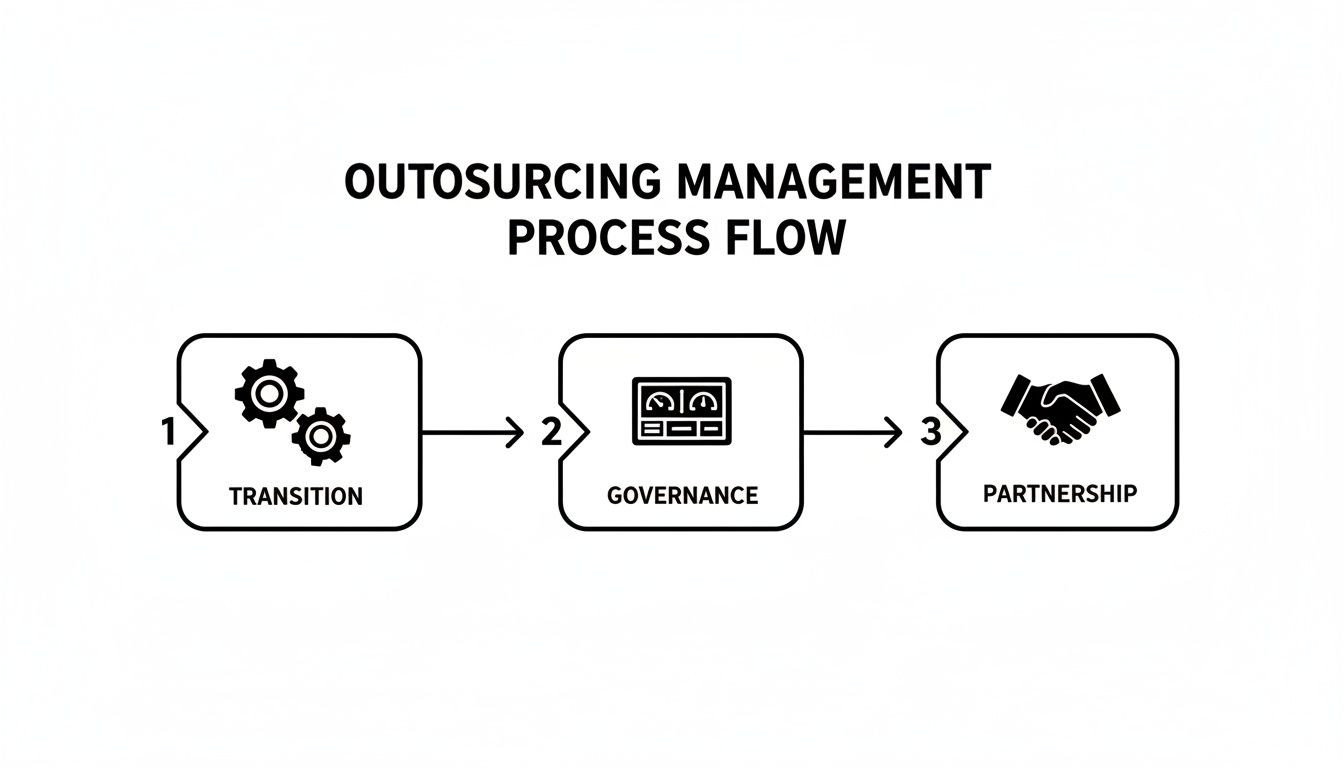
The journey, as the diagram above shows, really boils down to three core stages: a smooth transition, solid governance, and a true partnership. It’s a great reminder that success isn’t a one-time event but a continuous, carefully managed process.
How Do We Protect Our Intellectual Property?
This is a big one, and rightly so. Protecting your IP is non-negotiable, and it all starts with the contract. Your Master Service Agreement (MSA) needs iron-clad clauses that leave no doubt about who owns all proprietary information, processes, and customer data. We’re talking everything from training manuals to the exact call scripts your agents use.
Beyond the legal paperwork, you need to be sure your partner has tough physical and digital security measures in place. This means restricted access to sensitive work areas, secure networks, and robust employee confidentiality agreements. Regular audits and an absolute insistence on certifications like ISO 27001 are your best lines of defence here.
What Are the First Practical Steps to Take?
The journey doesn’t start with vendor calls; it starts with deep internal alignment. Before you even think about talking to a potential partner, you need to get your own house in order and define exactly what you want to achieve.
- Define Your Scope and Objectives: Get crystal clear on which support functions you plan to outsource. Is it just Level 1 email support, or are you handing over more complex technical voice support? Pin it down.
- Establish Your Success Metrics: What does a “win” look like for you? Is it about cutting costs by 25%? Pushing CSAT scores up to 90%? Or is the main goal to finally achieve 24/7 coverage?
- Build a Cross-Functional Team: Pull together a project team with people from HR, IT, Legal, and Operations. This ensures every part of the organisation has a voice from the very beginning.
Only once you’ve nailed these internal steps should you even start the process of vetting potential partners.
How Much Does It Realistically Cost?
Pricing for customer support outsourcing in India can vary depending on the model you go for, but a common range for agent-based pricing is somewhere between $6 to $10 per hour. That’s a significant saving compared to typical Western rates. However, looking only at the hourly rate is a rookie mistake.
A truly effective partnership isn’t measured by the cost it reduces, but by the value it creates. Focus on pricing models that tie back to business outcomes, like per-resolution or incentive-based structures, to make sure your partner is just as motivated by quality and efficiency as you are.
For instance, a “per-resolution” model means you only pay for issues that are successfully solved. This directly aligns your vendor’s financial incentives with your customer satisfaction goals. Always push potential partners to break down their pricing so you can see exactly what’s included and sidestep any hidden costs down the line. That kind of financial transparency is the bedrock of a sustainable, long-term relationship.
As experts in building scalable talent solutions, Taggd understands the complexities of creating high-performing teams, whether in-house or outsourced. We help enterprises build the strategic hiring frameworks needed for growth. Learn more about our AI-powered RPO solutions at Taggd.