For any Chief Human Resources Officer, getting data engineer hiring right isn’t just another recruitment task—it’s a core business strategy. Let’s be honest, the old ways of hiring just aren’t cutting it in this specialised field. The result? Critical roles sit empty, and innovation grinds to a halt. This guide is your new playbook, designed specifically for the realities of India’s competitive tech market.
Rethinking Your Data Engineer Hiring Strategy

The struggle to hire great data engineers has moved far beyond a simple recruitment challenge. Today, it’s a direct measure of your company’s ability to compete and innovate. Data engineers are the architects of your entire data stack, the ones building the infrastructure that lets data scientists and analysts uncover game-changing insights. Without them, all that valuable data you’re collecting is just sitting there, locked away and useless.
So many organisations get this wrong because they treat it like any other hire. They throw up generic job ads, rely on outdated technical tests, and take forever to make a decision in a market that moves at lightning speed. This approach doesn’t just fail to attract top talent; it actively pushes them away. A skilled engineer can spot a clunky, inefficient hiring process from a mile off.
The Current Market Dynamics in India
First, you have to understand the ground reality of the Indian tech landscape. It’s a battlefield out there, with fierce competition for a very small pool of truly skilled professionals. This means you have to shift from a passive, reactive mindset to a proactive one. You can no longer afford to wait for the perfect candidate to find your job posting; you need to go out and engage them where they live and work online.
The demand is being driven by explosive growth. India’s data science market is set to skyrocket from $204.23 million in 2023 to an incredible $1.391 billion by 2028. That’s a staggering 57.5% CAGR. This boom directly fuels the urgent need for data engineers who can manage big data and AI integrations, cementing their role as one of the most in-demand IT jobs for years to come. You can explore more on these data science career trends to get a feel for the competitive pressure.
The biggest mistake I see is companies treating data engineer hiring as a transaction. To win, you have to see it as building a long-term relationship with a community of technical experts, starting long before you even have an open role.
Why a Strategic Approach Is Essential
A thoughtful, multi-pronged strategy isn’t a “nice-to-have” anymore. It’s the only way you’ll secure the talent you need to become a truly data-driven organisation. This requires a few key shifts in how you think about hiring:
- Focus on Foundations, Not Just Tools: Don’t get hung up on finding someone with experience in one specific, niche tool. Prioritise candidates with rock-solid fundamentals in computer science, SQL, and data modelling. A great engineer can pick up a new platform quickly, but you can’t easily teach those core concepts.
- Build an Employer Brand That Speaks to Engineers: The best engineers aren’t just looking for a paycheque; they want to solve interesting, complex problems and be part of a culture that values technical excellence. Your employer brand needs to scream this from the rooftops.
- Create an Exceptional Candidate Experience: Every single touchpoint matters. From your first outreach message to the final offer letter, every interaction must show respect for the candidate’s time and expertise. A smooth, efficient process is a massive green flag that signals a well-run, organised company.
By embracing this modern playbook, you shift from just filling a vacant seat to building a genuine strategic advantage for your company. It demands a much deeper partnership between HR and your technology leaders to precisely define what you need, find the right people, and build an environment where top data engineers can do their best work.
Building a Realistic Ideal Candidate Profile

Before you even think about writing a job description, your first and most critical task is to pin down exactly who you’re looking for. A vague or unrealistic profile is the fastest route to a mountain of mismatched applications, and that’s a waste of everyone’s time. In the world of data engineer hiring, precision is everything.
This whole process has to start with an honest, practical conversation between HR and your CTO or Head of Engineering. The goal here isn’t to build a generic wish list; it’s to create a grounded profile that plugs directly into your current business goals and data maturity.
Are you building a data platform from the ground up? Then you’ll need a seasoned engineer with serious architectural chops. Or are you focused on optimising existing pipelines for cost and efficiency? In that case, a mid-level engineer who knows a specific cloud platform inside and out might be a much better fit. Get this right first, and you’ll avoid chasing a mythical “unicorn” candidate who simply doesn’t exist.
Differentiating Between Seniority Levels
Not all data engineers are created equal. Their impact on your business varies dramatically with their experience, and a common misstep is writing a senior-level job description but only offering junior-level compensation. This misalignment screams disconnect to the market.
Here’s a practical way to think about the different tiers:
- Junior Data Engineer (1-3 years): These are your executors. They’re great at building and maintaining specific ETL jobs, writing SQL queries, and troubleshooting pipeline failures with guidance. Their value is in their ability to get well-defined tasks done and their eagerness to learn your tech stack.
- Mid-Level Data Engineer (3-6 years): They’re starting to take ownership. A mid-level engineer can independently design, build, and deploy moderately complex data pipelines or small projects. They should be proficient in at least one major cloud platform (like AWS, GCP, or Azure) and have a solid grasp of data modelling.
- Senior/Principal Data Engineer (6+ years): Now you’re talking systems and architecture. Seniors don’t just build pipelines; they design the entire data ecosystem. They’re mentoring junior engineers, setting technical standards, and making critical tech choices that will impact the entire organisation for years to come.
Understanding these distinctions is fundamental. If you need to drill down into their day-to-day, you can learn more about data engineer roles and responsibilities to make sure your profile is scoped accurately.
Prioritising Technical and Soft Skills
Once you’ve settled on the seniority level, it’s time to zero in on the skills. It’s incredibly tempting to create a laundry list of every tool and technology under the sun. Please don’t. This is a massive red flag for experienced engineers.
Instead, sit down with your CTO and ruthlessly separate the absolute “must-haves” from the “nice-to-haves.”
Core Technical Must-Haves:
- Strong SQL Proficiency: This is completely non-negotiable. They must be able to write complex, performant queries to manipulate and analyse data.
- Programming Language: You need solid experience in a language like Python or Scala for building data pipelines and automation.
- ETL/ELT Process Knowledge: They need a deep, practical understanding of how to move data around efficiently and reliably.
- Cloud Platform Experience: In today’s world, familiarity with at least one major cloud provider (AWS, GCP, Azure) is a baseline expectation.
Don’t fall into the trap of hiring for a specific, niche tool. A great engineer with strong fundamentals in SQL, Python, and cloud architecture can pick up a new framework in weeks. Prioritise those foundational skills over trendy tool experience every single time.
Beyond the technical checklist, remember that the best data engineers have soft skills that amplify their impact. You need pragmatic problem-solvers who can explain complex technical ideas to non-technical folks in sales or marketing. Their ability to collaborate with data scientists, analysts, and business leaders is just as crucial as their coding ability. This is what turns a good engineer into a great one.
Where to Find and Engage Top Data Engineers
Let’s be honest: the best data engineers aren’t scrolling through job boards. They’re heads-down, deep in complex problems, and busy building the next big thing in data. This simple truth means the old “post and pray” method of recruiting is a surefire way to miss out on the top 10% of talent. You have to go where they are.
Sourcing elite technical talent requires a proactive, almost investigative approach. Forget the usual suspects for a moment and start thinking about where these engineers actually spend their time, show off their skills, and connect with their peers. This is your new hunting ground.
Your talent acquisition team needs to get comfortable navigating the platforms that are the lifeblood of an engineer’s world. These aren’t just websites; they are communities where credibility is earned through contribution and technical skill is on full public display.
Tapping into Technical Communities
The real work of finding a great data engineer begins where they live and breathe code. This is where you can see their skills in action, long before a CV ever lands in your inbox.
- GitHub: Think of it less as a code repository and more as a living, breathing portfolio. Look for engineers contributing to open-source data projects (like Apache Spark or Airflow), maintaining their own well-documented projects, or offering sharp, insightful code reviews to others. An active GitHub profile speaks volumes about passion and technical ability.
- Kaggle: While it’s known as a hub for data scientists, you’ll find plenty of data engineers here sharpening their skills. Keep an eye out for those who build incredibly efficient data processing pipelines for the competitions. How they handle massive datasets under pressure reveals a lot about their engineering mind.
- Stack Overflow: Don’t just look for people asking questions—find the ones providing the high-quality answers. An engineer who consistently helps others solve tricky problems with data warehousing, ETL frameworks, or cloud platforms is a subject matter expert and a potential leader for your team.
By focusing on these platforms, you shift from simply reviewing CVs to evaluating actual work, which is a far more reliable way to gauge real skill. For a deeper look, check out these additional best candidate sourcing practices for tech hiring to round out your strategy.
Crafting Outreach That Actually Works
Once you’ve spotted someone promising, the next move is absolutely critical. A generic, copy-pasted message will get you ignored or, worse, blocked. Your outreach has to be personal, respectful of their time, and about them, not just your open role.
A great first message shows you’ve done your homework. Reference a specific project on their GitHub or a particularly brilliant answer they gave on Stack Overflow. Show you genuinely appreciate their work.
“Hi [Candidate Name], I was incredibly impressed with your Python script for optimising Parquet file writes on GitHub. The way you handled memory management was brilliant. We’re tackling similar data performance challenges at [Your Company] and I thought you might be interested in a brief chat.”
This approach does a few things perfectly:
- It proves you aren’t a bot or a recruiter spamming inboxes.
- It shows you value their specific skills and contributions.
- It frames the conversation around an interesting technical challenge, not just a job vacancy.
Building a Sustainable Talent Pipeline
Finding top-tier talent isn’t a task you just turn on and off when a position opens up. It’s about building relationships and nurturing a pipeline so that you’re always connected to a pool of qualified engineers.
This is especially vital in a market like India’s, where competition for skilled engineers is incredibly fierce, even with a high volume of applicants. The data engineering job market is tough; junior roles can attract hundreds of applications, and even senior positions are saturated with graduates from bootcamps and universities. By mastering in-demand skills and using a strategic sourcing partner, organisations can cut through the noise to find the real experts. You can learn more about the realities of India’s data engineering job market to get a better sense of the landscape.
Think about hosting targeted virtual hiring events or technical webinars. These aren’t just recruitment tools. They’re opportunities to showcase your company’s tech culture, introduce your senior engineers, and talk about the cool problems your team is solving. This strategy builds your employer brand naturally and attracts engineers who are genuinely interested in your work, giving you a lasting advantage in your data engineer hiring efforts.
Designing a Modern Technical Assessment Framework
A poorly designed interview process doesn’t just filter out bad candidates—it actively repels great ones. Top data engineers have options, and a clunky, irrelevant, or disrespectful assessment is a glaring red flag that your organisation doesn’t value their time or expertise. Crafting an effective framework for your data engineer hiring is all about striking the right balance between rigour and respect.
The aim is to get far away from abstract whiteboard puzzles and build a multi-stage process that actually simulates the challenges an engineer will face in the role. This approach gives you a much more accurate signal of their true capabilities. It also gives the candidate a genuine taste of the work, making the role that much more attractive.
This flowchart shows how you can evaluate the real-world work of data engineers on key platforms before they even hit the ‘apply’ button.
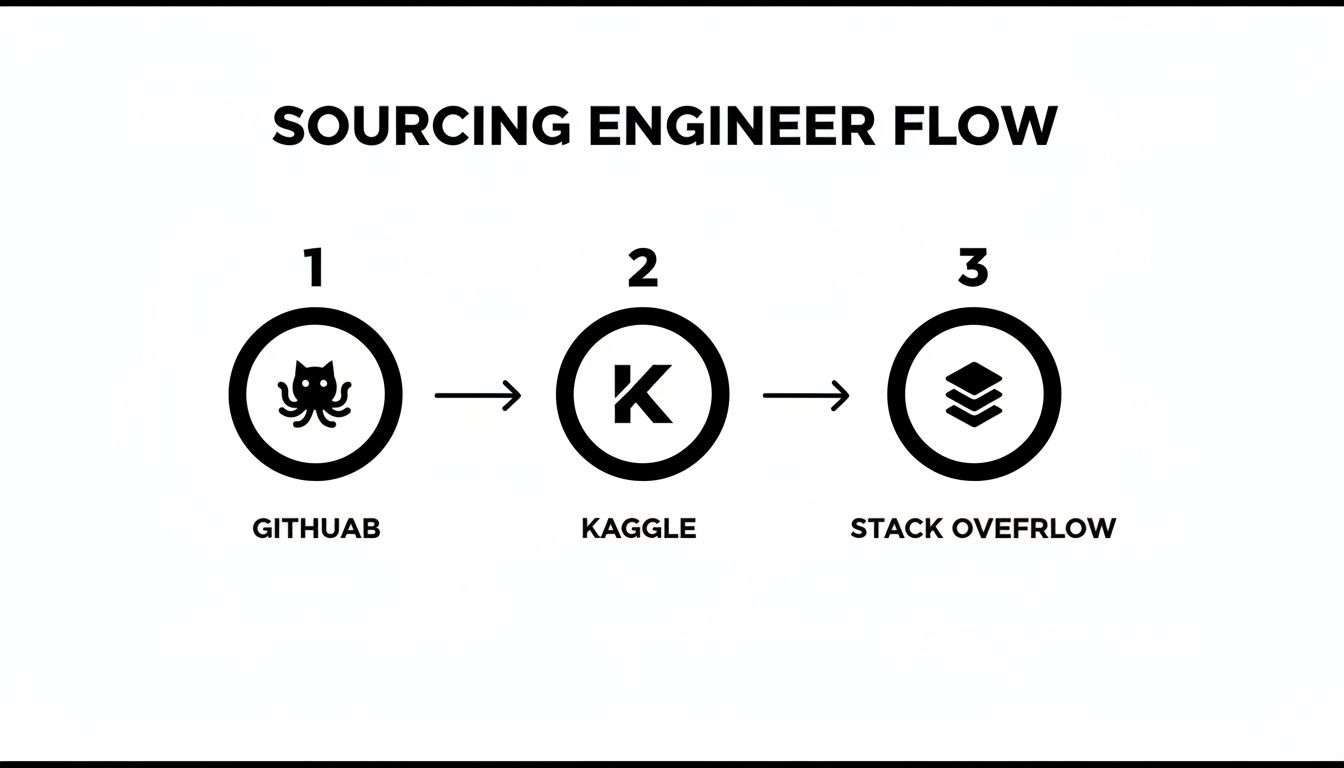
By looking at an engineer’s public contributions on platforms like GitHub, Kaggle, and Stack Overflow, you get a window into their practical skills and passion for the craft long before the first interview.
The Interview Stages: A Structured Approach
A well-structured process should have three to four distinct stages, each with a clear objective. This prevents interview fatigue for everyone involved and ensures every conversation adds new, valuable information to the final decision.
Here’s a breakdown of what that process looks like in practice.
Data Engineer Interview Stages and Objectives
This table outlines a multi-stage interview process designed to progressively evaluate a candidate’s skills, from foundational knowledge to deep technical expertise and team alignment.
| Interview Stage | Primary Focus | Key Evaluation Criteria | Who Is Involved |
|---|---|---|---|
| Initial Screen (30-45 mins) | Foundational knowledge & culture alignment | Past project experience, high-level problem-solving, technical interests. | Senior Engineer or Hiring Manager |
| Technical Challenge (2-4 hours) | Core practical skills | Code quality, problem decomposition, solution design, documentation. | Candidate (Take-home or live coding) |
| Deep Technical Dive (60-90 mins) | Technical depth & communication | Articulation of design choices, trade-off analysis, collaboration skills. | 2-3 Senior/Lead Engineers |
| Team Fit & Values (45-60 mins) | Behavioural skills & career goals | Handling workplace scenarios, alignment with company values, motivation. | Head of Engineering, Key Stakeholders |
Following a structured flow like this ensures a consistent and fair evaluation for every candidate, giving you a comprehensive view of their abilities.
The most effective technical assessments feel less like a test and more like the first day on the job. Present a problem that mirrors a real business challenge your team has faced. It’s the single best way to see how a candidate truly thinks and operates.
Creating Fair and Practical Challenges
The “gotcha” style of technical interviews is outdated and counterproductive. Your assessment should be a practical problem that can be solved within a reasonable timeframe, showing respect for the candidate’s personal time.
For a take-home assignment, try a task like this:
- The Scenario: Provide a sample dataset, like messy JSON log files, and ask the candidate to build a simple ETL pipeline.
- The Goal: The pipeline should clean the data, transform it into a structured format (like Parquet), and load it into a schema of their own design.
- The Deliverable: They should submit their code, a README file explaining their approach, and a few SQL queries to prove the data is analysis-ready.
This kind of challenge is brilliant because it effectively tests core competencies—Python, SQL, data modelling, and documentation—without demanding an entire weekend of their time.
Using an Evaluation Scorecard for Consistency
To remove bias and keep the process consistent, you need a structured evaluation scorecard for every interview stage. This simple tool forces interviewers to assess candidates against the same predefined criteria, moving beyond just “gut feelings.”
Your scorecard should cover key areas with a simple rating scale, maybe 1-5.
- Problem-Solving: Did they break down the problem logically? Did they consider the trade-offs?
- SQL Proficiency: Was their SQL clean, efficient, and correct?
- Coding Best Practices: Is their code well-structured, readable, and maintainable for the next person?
- System Design Intuition: Did they make sensible architectural choices for the task at hand?
- Communication: Could they clearly articulate their thought process and technical decisions?
By designing an assessment framework that is challenging yet relevant and respectful, you build a powerful employer brand. Candidates leave the process feeling valued, even if they don’t get an offer. And the ones who do join? They’re the ones truly equipped to help your business win.
Crafting an Offer They Can’t Refuse
You’ve spent weeks sifting through profiles, conducting intense interviews, and running assessments. Finally, you’ve found the one—your ideal data engineer. But hold on, the hardest part might still be ahead. In today’s market, landing top tech talent isn’t just about identifying them; it’s about getting them to sign on the dotted line.
The best candidates are almost always juggling multiple offers. This is where your offer letter transforms from a simple document into your final, most powerful sales pitch. It needs to be more than just a number; it has to tell a story about your company’s culture, vision, and the unique growth path you can provide.
Getting a Read on the Indian Salary Landscape
To even be in the running, your offer needs to be competitive. That starts with knowing the market inside and out. In India, data engineer salaries can swing wildly depending on experience, specific skills, and, of course, location. Tech hubs like Bengaluru and Hyderabad will always command a premium. You simply have to keep your finger on the pulse of these trends.
The numbers tell a compelling story. Projections show Big Data Engineer as one of the top jobs for 2026 as India’s IT demands evolve. Right now, entry-level roles typically land in the ₹6-9 lakhs per annum range, while mid-career professionals are looking at around ₹12 lakhs. For seasoned Big Data Engineers, the bracket widens to anywhere from ₹11-22 lakhs, with top-tier talent often pushing past the ₹25 lakhs mark.
This isn’t just about rising salaries; it’s about a market that’s rapidly expanding. Companies need professionals who can turn raw data into a strategic advantage, and they’re willing to pay for it. You can get a deeper dive into these figures by exploring the latest research on in-demand IT jobs in India and their salary trends.
Thinking Beyond the Paycheque
A competitive salary gets you in the door, but it’s the total rewards package that seals the deal. A great engineer isn’t just thinking about their next paycheque; they’re looking at the whole picture—professional development, work-life balance, and long-term wealth creation.
Here are a few components that can make your offer irresistible:
- Performance Bonuses: A clearly defined annual or semi-annual bonus plan is a huge motivator. Tie it to specific, measurable goals—both for the company and the individual—so it feels tangible and achievable.
- Equity and Stock Options: For senior talent, in particular, equity is a game-changer. It’s not just money; it’s ownership. Giving them a real stake in the company’s success aligns their goals with yours in a powerful way.
- Professional Development Stipend: This is a big one. Offering a dedicated budget for certifications, tech conferences, or new courses shows you’re invested in their career, not just what they can do for you today.
- Flexible Work Policies: Let’s be clear: this is no longer a perk. It’s an expectation. Whether it’s fully remote, hybrid, or just flexible hours, your commitment to work-life balance can be the deciding factor.
The best offers feel like a conversation, not a transaction. Don’t just email a PDF. Get on a call, walk the candidate through every part of the offer, and explain why you’ve included each element. Connect it back to their career ambitions. That personal touch can make all the difference.
How You Present the Offer Matters
The delivery is just as crucial as the offer itself. A cold, impersonal email can kill all the momentum you’ve built.
Instead, have the hiring manager schedule a call to present the offer verbally. This is your chance to convey genuine excitement and answer any questions on the spot. Frame the discussion around their future with the company. Remind them of the complex, interesting problems they’ll get to solve and the direct impact their work will have.
By building a thoughtful, competitive package and presenting it with genuine enthusiasm, you dramatically increase your odds of turning your top candidate into your next great hire.
Onboarding and Retaining Your New Hire
Getting a top data engineer to sign the offer is a massive win, but don’t pop the champagne just yet. The real challenge starts on day one. A successful hire isn’t just about closing the deal; it’s about plugging them into an environment where they can add value fast and want to build their career with you.
Those first ninety days? They’re absolutely critical. They set the tone for everything that follows.
A messy, disorganised onboarding experience is a huge red flag for any technical professional. It screams chaos and frankly, a lack of respect for their time. Forget the generic HR induction. What a data engineer really needs is a structured, technical ramp-up that gets them hands-on with your data stack, architecture, and current projects.
Designing a 30-60-90 Day Plan
A clear, well-thought-out plan eliminates guesswork and empowers your new hire right out of the gate. It provides clear expectations and tangible milestones, helping them feel productive and part of the team from the very beginning.
- First 30 Days: Learn and Integrate. The goal here is total immersion. Get them set up with all their system access, introduce them to key people across different teams, and give them a comprehensive tour of your data infrastructure. Assigning them a buddy or a mentor is a must. Start them with small, low-risk tasks—maybe fixing a minor bug or documenting a small part of a pipeline. This is their time to soak up your culture and understand how things get done.
- Days 31-60: Start Contributing. Now, we shift the focus to contribution. Your new engineer should be ready to take ownership of their first small project or a significant feature within a larger initiative. This is the perfect time for them to start participating in code reviews and getting more involved in team planning sessions.
- Days 61-90: Build Independence. By this point, your new hire should be operating with a lot more autonomy. The aim is for them to be a fully integrated, contributing member of the team who can tackle moderately complex tasks with minimal hand-holding. They should also feel comfortable enough to offer feedback on existing processes.
A world-class onboarding experience isn’t about checklists; it’s about connection and contribution. Give your new data engineer a clear path to making an impact in their first month, and you’ll build the foundation for long-term loyalty.
The finish line for your data engineer hiring process isn’t the offer letter. To help structure this crucial period, our comprehensive onboarding checklist template can ensure a smooth and effective transition.
Ultimately, keeping top tech talent comes down to a few core pillars: giving them challenging and meaningful work, fostering a culture of continuous learning, showing them a clear path for career progression, and making sure they have modern, effective tools to do their job. Get these right, and you won’t just hire great people—you’ll keep them.
Got Questions About Hiring Data Engineers? We’ve Got Answers.
When it comes to hiring data engineers, we see the same questions pop up time and again from CHROs and hiring managers. Getting these fundamentals right can be the difference between a quick, successful hire and a costly, drawn-out search. Let’s tackle some of the most common queries we hear.
What’s the Single Biggest Mistake Companies Make?
Hands down, the most common blunder is creating a vague, unrealistic job description. We often see roles that try to mash a data scientist, a data analyst, and a data engineer into one “unicorn” candidate. This approach just doesn’t work; it confuses the real experts and attracts a flood of people who aren’t the right fit.
A successful search starts with a laser-focused profile. You need to be crystal clear that you’re looking for someone who builds and maintains the data highways—the pipelines and infrastructure—not someone who analyses the traffic on them.
How Long Should the Hiring Process Really Take?
In this market, you have to move fast. A well-oiled hiring process for a data engineer should take no more than three to four weeks, from the day they apply to the day you make an offer.
If your process drags on longer than that, you’re almost guaranteed to lose your best candidates to companies that can make a decision faster. This kind of speed requires tight coordination between HR, the hiring manager, and your technical panel. It’s exactly where an RPO partner can step in to get everyone aligned and moving quickly.
The best candidates are off the market in 10 days. If your process takes a month, you are only interviewing candidates who were rejected by others. Speed isn’t just a goal; it’s a necessity.
How Can We Actually Assess Soft Skills?
The trick is to stop treating soft skills as a separate checklist. Instead, weave behavioural questions directly into your technical interviews. This gives you a much more authentic look at how a candidate thinks and communicates in a real-world context.
For example, right after they finish a coding challenge, try asking:
- “How would you explain this solution to someone on the marketing team who isn’t technical?”
- “Tell me about a time you disagreed with a technical decision from your team lead. How did you navigate that?”
These types of questions reveal far more about their communication, collaboration, and problem-solving skills than any abstract hypothetical scenario ever could.
Should We Hire for Specific Tools or Foundational Skills?
Always, always prioritise strong foundational skills over experience with one specific tool. A great engineer can pick up a new cloud platform or framework without much trouble.
What you can’t easily teach is a deep, intuitive grasp of computer science fundamentals, SQL, and data modelling. A solid understanding of data structures, algorithms, and system design is infinitely more valuable in the long run. Make sure your hiring process is built to test these core competencies above all else.
Ready to build a world-class data engineering team without the friction? Taggd specialises in connecting you with the technical experts who will drive your data strategy forward. Let us help you find the right talent, faster.