Digital manufacturing hiring in India has become a CHRO priority.
Today, manufacturing in India is about smart factories, automation, data, and AI. The shop floors that once ran on mechanical precision and human oversight are now powered by sensors, analytics, and autonomous systems. This shift has fundamentally changed what it means to build a manufacturing workforce.
Digital manufacturing hiring in India is accelerating across multiple sectors:
- Automotive & EV: As India positions itself as a global EV hub, companies are racing to hire talent who can navigate battery systems, connected vehicles, and digital assembly lines
- Industrial manufacturing: Traditional plants are retrofitting with IoT, robotics, and predictive maintenance tools
- Electronics & semiconductors: With PLI schemes fueling growth, the demand for automation and precision manufacturing talent has surged
- Global Capability Centres (GCCs): MNCs are setting up engineering and R&D hubs in India to drive digital transformation across their global operations
CHROs are now expected to hire hybrid talent- professionals who understand manufacturing and digital systems at speed and scale. They’re being asked to deliver on quarterly ramp-ups, reduce time-to-productivity, and build teams that can operate in both legacy and smart environments.
But the talent landscape for digital manufacturing looks very different from traditional manufacturing hiring.
What Digital Manufacturing Really Means for Indian Organizations?
Digital manufacturing is the use of digital technologies, data, and software-driven systems into manufacturing processes to design, produce, monitor, and continuously improve production systems making factories smarter, faster, and more adaptive.
It combines Operational Technology (OT) and Information Technology (IT) like industrial IoT, automation and robotics, cloud and edge computing, cyber-systems, advanced analytics and AI, etc.
It’s where machines, data, and decision-making systems come together to create intelligent, self-optimizing production environments.
In practice, digital manufacturing includes:
- Smart factories with real-time monitoring and adaptive production lines
- Industry 4.0 frameworks that integrate automation, cloud computing, and machine learning
- Connected supply chains that respond dynamically to demand signals
- AI-driven production planning that reduces waste and optimizes throughput
Core Digital Manufacturing Capabilities
Organizations transitioning to digital manufacturing need teams skilled in:
- Industrial IoT (IIoT): Connecting devices, sensors, and systems across the factory floor
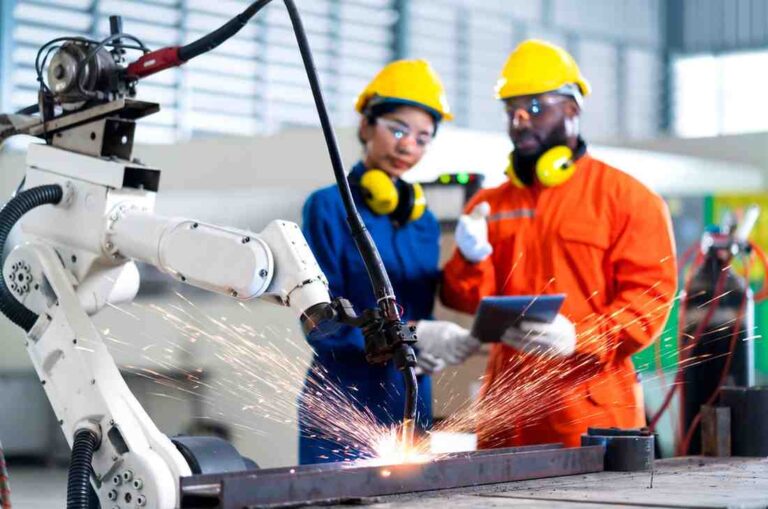
- Automation & robotics: Deploying collaborative robots (cobots), AGVs, and automated assembly systems
- MES, PLM, ERP integration: Ensuring seamless data flow between manufacturing execution, product lifecycle, and enterprise resource planning systems
- Data analytics & AI/ML: Using historical and real-time data to predict failures, optimize schedules, and improve quality
- Digital twins & simulation: Creating virtual replicas of physical assets to test scenarios and improve designs
- Cybersecurity for industrial systems: Protecting OT environments from cyber threats while maintaining operational continuity
These capabilities are redefining digital manufacturing hiring in India, especially for organizations transitioning from legacy plants to smart operations. The roles being created today didn’t exist in most Indian manufacturing org charts just five years ago.
Why CHROs Are Struggling with Digital Manufacturing Hiring in India?
CHROs are struggling with digital manufacturing hiring in India because talent with hybrid IT–OT skills is scarce, demand from GCCs and EV firms is intense, roles are poorly defined, employer branding doesn’t appeal to digital talent, and hiring speed often compromises quality in mission-critical roles.
Let’s explore the recruitment challenges for digital manufacturing roles.
The Talent Doesn’t Fit Traditional Manufacturing Profiles
Mechanical-only profiles are no longer enough. A production engineer who excels at process optimization may not understand PLC programming or industrial analytics. A software engineer with cloud experience may lack the domain knowledge to deploy solutions on a factory floor.
What organizations need are hybrid engineers who can bridge these worlds:
- Mechatronics specialists who combine mechanical, electrical, and software skills
- Controls + software engineers who can program automation systems and integrate them with IT infrastructure
- Manufacturing + data analysts who understand production workflows and can build predictive models
Talent Supply Is Fragmented and Highly Competitive
Digital manufacturing talent in India is spread across:
- OEMs like Mahindra, Tata Motors, and Maruti Suzuki
- Tier-1 suppliers investing in automation and quality systems
- IT services firms offering Industry 4.0 consulting and implementation
- Startups & SaaS firms building manufacturing software and IoT platforms
Everyone is hiring the same profiles. A manufacturing data scientist is being courted by automotive companies, GCCs, and tech startups all at the same time.
GCC Pressure: Scale Fast, Hire Right
Global Capability Centres (GCCs) have added a powerful new layer of complexity to digital manufacturing hiring in India. For CHROs, GCC hiring is no longer about scaling local teams. It’s about delivering global-grade capability at India speed.
When a global manufacturing leader sets up a GCC in India, expectations are unforgiving:
- Global HQ benchmarks: Talent quality must match or exceed engineering standards in Europe, the US, and East Asia
- Quarter-based ramp-ups: GCC hiring often requires filling 50–100 digital manufacturing roles within 60–90 days
- Zero tolerance for mis-hires: In GCC environments, even one poor-quality hire can delay global product roadmaps and critical transformation programs
But GCC hiring in digital manufacturing isn’t about filling seats. These centers demand engineers who can contribute meaningfully to global product development, collaborate seamlessly across time zones, and operate with minimal hand-holding from day one.
For CHROs, this makes digital manufacturing GCC hiringa high-stakes exercise where speed, precision, and talent readiness must coexist without compromise.
Compensation & Attrition Volatility
Digital manufacturing roles command premium salaries. A seasoned MES specialist or robotics engineer can see compensation packages 30–50% higher than traditional manufacturing roles.
Counteroffers arrive within days of resignation. High early attrition is common when role expectations don’t align with ground realities.
These realities make digital manufacturing hiring in India fundamentally different from traditional manufacturing recruitment. The old playbooks don’t work anymore.
Here’s a quick difference between traditional manufacturing recruitment and digital manufacturing hiring in India-
| Dimension | Traditional Manufacturing Recruitment | Digital Manufacturing Hiring in India |
| Core Skill Focus | Mechanical engineering, production, maintenance, quality | Software, data, automation, AI, IIoT, cyber-physical systems |
| Hiring Predictability | Planned, cyclical, capacity-driven | Dynamic, project-led, transformation-driven |
| Talent Availability | Established and stable talent pools | Scarce, fragmented, highly competitive |
| Candidate Backgrounds | Core manufacturing & automotive companies | Tech firms, startups, GCCs, IT/OT integrators |
| Hiring Locations | Plant-based clusters (Pune, Chennai, Sanand) | Tech hubs + hybrid GCC locations (Bengaluru, Hyderabad, Pune) |
| Assessment Criteria | Domain experience + years of service | Skill adjacency, learning agility, problem-solving |
| Time-to-Fill Expectations | Flexible timelines | Business-critical, compressed timelines |
| Attrition Risk | Low to medium | High, especially for niche digital roles |
| Employer Value Proposition | Stability, long-term careers | Innovation, impact, global exposure |
| Recruitment Model Fit | Transactional hiring or basic RPO | Insight-led RPO with talent intelligence |
Critical Digital Manufacturing Roles CHROs Are Hiring for in India
As Indian manufacturers and GCCs accelerate digital transformation, digital manufacturing hiring in India is focused on a new set of high-impact roles.
CHROs are actively hiring digital manufacturing engineers, industrial automation & controls engineers, IIoT specialists, manufacturing data & analytics engineers, MES architects, digital twin & simulation engineers, OT cybersecurity specialists, and smart factory program managers.
Most of these roles didn’t exist in Indian manufacturing org charts five years ago- making digital manufacturing hiring in India a skills-definition challenge as much as a sourcing challenge.
For CHROs and HR leaders, success now depends on understanding what each role truly owns, how it creates business impact, and what “hire-ready” actually looks like.
Below is a practical breakdown of the critical digital manufacturing roles Indian organizations and GCCs are hiring for today.
Digital Manufacturing Engineers
Digital Manufacturing Engineers drive the implementation of smart factory solutions by integrating digital technologies with shop-floor operations to improve productivity, quality, and efficiency.
Roles & Responsibilities:
- Design and deploy digital manufacturing solutions across production lines
- Integrate MES, automation systems, sensors, and analytics platforms
- Translate operational requirements into digital workflows
- Optimize manufacturing processes using real-time data and insights
- Collaborate with IT, OT, and plant leadership teams
Industrial Automation & Controls Engineers
Industrial Automation & Controls Engineers design, program, and maintain automation and control systems that enable efficient, safe, and scalable manufacturing operations.
Roles & Responsibilities:
- Develop and maintain PLC, SCADA, DCS, and robotics systems
- Implement advanced control strategies for manufacturing processes
- Ensure system reliability, safety, and compliance with standards
- Integrate legacy equipment with modern automation platforms
- Support automation scalability across plants and GCCs
IIoT (Industrial Internet of Things) Specialists
IIoT Specialists enable connectivity across machines, systems, and platforms to deliver real-time visibility and data-driven decision-making in manufacturing environments.
Roles & Responsibilities:
- Design IIoT architectures using sensors, edge devices, and cloud platforms
- Enable real-time machine data collection and monitoring
- Support predictive maintenance and remote operations initiatives
- Integrate OT data with enterprise and analytics systems
- Ensure data reliability, security, and scalability
Manufacturing Data & Analytics Engineers
Manufacturing Data & Analytics Engineers transform production and operational data into insights that improve efficiency, quality, and cost performance.
Roles & Responsibilities:
- Build data pipelines for manufacturing and shop-floor data
- Develop analytics models for predictive maintenance and yield optimization
- Analyze production, quality, and downtime data
- Work with operations teams to translate insights into action
- Support data-driven continuous improvement initiatives
MES (Manufacturing Execution Systems) Architects
MES Architects design and scale MES platforms that connect ERP systems with shop-floor operations, enabling end-to-end manufacturing visibility and control.
Roles & Responsibilities:
- Define MES architecture, data models, and integration frameworks
- Lead MES implementation and rollout across plants or GCCs
- Integrate MES with ERP, automation, and analytics systems
- Ensure standardization while enabling local plant flexibility
- Govern MES performance, scalability, and compliance
Digital Twin & Simulation Engineers
Digital Twin & Simulation Engineers create virtual replicas of manufacturing systems to simulate, test, and optimize processes before physical deployment.
Roles & Responsibilities:
- Build digital twin models of manufacturing lines and assets
- Simulate production scenarios to identify bottlenecks and risks
- Support process optimization and capacity planning
- Collaborate with engineering and operations teams
- Reduce downtime and improve time-to-market through simulation
OT Cybersecurity Specialists
OT Cybersecurity Specialists protect industrial systems and manufacturing networks from cyber threats while ensuring operational continuity and compliance.
Roles & Responsibilities:
- Design and implement OT security frameworks
- Secure industrial networks, control systems, and connected assets
- Monitor and respond to OT cybersecurity threats
- Ensure compliance with global security and safety standards
- Collaborate with IT and operations teams on risk mitigation
Smart Factory Program Managers
Smart Factory Program Managers lead end-to-end digital manufacturing transformation programs, aligning technology, operations, and global stakeholders.
Roles & Responsibilities:
- Manage smart factory and digital transformation initiatives
- Coordinate cross-functional IT, OT, and operations teams
- Define program roadmaps, milestones, and success metrics
- Drive change management and stakeholder alignment
- Ensure timely delivery of digital manufacturing outcomes
Taggd helps CHROs fulfil digital manufacturing hiring mandates by bringing role clarity, skill adjacency insights, and industry-specialized RPO execution. Whether you’re hiring niche specialists or scaling digital manufacturing teams across India and GCCs, Taggd enables faster, higher-quality, future-ready hiring.
Skills that Define Successful Digital Manufacturing Teams
Successful digital manufacturing teams in India are defined by a hybrid skill mix- not pure mechanical engineering, and not pure software talent.
CHROs must build teams that combine manufacturing domain expertise, automation and controls, software and data skills, and strong change-management capability. This blended talent model is what enables smart factories, scalable GCCs, and sustainable digital transformation.
Check out the digital manufacturing skill set Indian CHROs need to look for to build high-impact teams-
CHROs leading digital manufacturing hiring in India must prioritize learning agility over perfect skill matches. The technologies and tools will evolve. What matters is hiring people who can adapt, upskill, and think critically about manufacturing problems.
Core Technical & Manufacturing Skills
These skills ensure digital initiatives remain grounded in real-world manufacturing realities.
- Strong understanding of manufacturing processes and shop-floor operations
- Mechanical, electrical, or mechatronics engineering fundamentals
- Knowledge of quality systems, safety standards, and compliance frameworks
- Experience with production planning, maintenance, and operations
Automation & OT Skills
These capabilities enable the transition from manual or semi-automated plants to smart factories.
- PLC, SCADA, DCS, and robotics programming
- Industrial automation and control systems integration
- OT network architecture and protocols
- Equipment reliability and industrial safety systems
Software, Data & Digital Skills
This skill layer differentiates traditional manufacturing from digital manufacturing hiring in India.
- Embedded systems and industrial software development
- Data engineering, analytics, and visualization for manufacturing data
- IIoT platforms, sensors, and edge computing
- MES, digital twin, and simulation technologies
- Cybersecurity for OT and cyber-physical systems
Systems Thinking & Integration Capability
Digital manufacturing fails without engineers who can connect systems—not just build them.
- ERP–MES–automation system integration
- Cross-platform data flow and architecture design
- Ability to work across IT, OT, and business functions
- Understanding of global manufacturing system landscapes
Leadership, Collaboration & Change Skills
These skills determine whether transformation actually sticks.
- Program and stakeholder management across plants and GCCs
- Collaboration with global engineering and product teams
- Change management and adoption leadership on the shop floor
- Problem-solving, learning agility, and decision-making under ambiguity
For deeper insights into evolving hiring priorities, explore manufacturing hiring trends shaping the Indian industrial landscape.
Digital Manufacturing Hiring Models in India: What Works for GCCs and Enterprises
Digital manufacturing has fundamentally changed how hiring must be done in India. Roles are hybrid, ramp-ups are aggressive, and talent pools are fragmented.
As a result, traditional hiring models are no longer equipped to support digital manufacturing transformation- whether for GCCs or Indian enterprises.
Why Traditional Hiring Models Fall Short
Conventional manufacturing recruitment was built for stability. Roles were standardized, hiring was linear, and talent supply was relatively predictable. That model worked when manufacturing change was incremental.
In digital manufacturing hiring in India, those assumptions no longer hold.
Linear, role-by-role recruitment struggles to keep pace with quarter-based ramp-ups and transformation-led hiring cycles. Hiring teams often assess roles in isolation, missing the interdependencies between automation, software, data, and operations.
Most critically, limited access to talent intelligence leaves CHROs making decisions without visibility into where digital manufacturing talent exists, how scarce it is, or what compensation benchmarks truly look like across regions.
The result is slower hiring, higher drop-offs, and misaligned talent that struggles to deliver impact at scale.
What Modern Digital Manufacturing Hiring Models Look Like?
Organizations that are succeeding in digital manufacturing are shifting from static recruitment processes to adaptive workforce models.
Instead of waiting for “perfect-fit” candidates, they adopt skill adjacency hiring– bringing in professionals with strong foundational skills and accelerating their readiness through structured upskilling and learning pathways.
They also follow build–buy–borrow strategies. Core capabilities are built internally through reskilling initiatives and academies. Critical, business-impact roles are hired externally. Specialized expertise is borrowed through consultants or short-term specialists where speed matters more than long-term headcount.
Geographically, leading CHROs run parallel hiring programs across multiple locations. Digital manufacturing talent is no longer confined to one hub. Strong capabilities exist across Pune, Chennai, Bengaluru, Gurugram, and emerging ecosystems such as Coimbatore and Ahmedabad.
Finally, successful models integrate volume and niche hiring into a single orchestration layer. High-volume plant roles and niche digital specialists are hired in parallel- aligned to one workforce plan, one employer narrative, and one delivery model.
GCC vs Indian Enterprise Hiring: What Actually Works
While GCCs and Indian enterprises share the same talent market, their hiring priorities differ in meaningful ways.
GCC hiring for digital manufacturing in India is driven by speed, governance, and global alignment. These organizations need talent that can integrate into global systems, tools, and processes from day one- often under compressed timelines and strict quality benchmarks.
Indian enterprises, on the other hand, focus heavily on reskilling existing workforces, managing retention in high-attrition environments, and optimizing costs while still delivering digital capability at scale.
The hiring models that work best are those that are context-aware– adapting assessment frameworks, ramp-up strategies, and workforce planning based on whether the mandate is global delivery or domestic transformation.
How Taggd Enables Scalable Digital Manufacturing Hiring in India?
Industry-Specialized RPO for Manufacturing & EV
Taggd’s approach to manufacturing recruitment is built on deep industry expertise. The team includes dedicated recruiters who have worked in automotive, industrial manufacturing, and EV ecosystems. They understand the difference between a Manufacturing Execution System (MES) and an Enterprise Resource Planning (ERP) system. They know why a robotics engineer from automotive may not be the right fit for electronics manufacturing.
This specialization matters when hiring for digital manufacturing roles, where technical nuance separates good hires from great ones.
AI-Powered Talent Intelligence
Taggd uses AI-driven talent intelligence platforms to:
- Map where digital manufacturing talent exists: Which companies, geographies, and functions have the profiles you need
- Identify cross-industry transitions: Find software engineers ready to move into manufacturing, or mechanical engineers with an appetite for automation
- Benchmark location and cost: Understand compensation trends across Chennai, Pune, Bengaluru, and NCR to make informed offers
This intelligence layer transforms hiring from reactive sourcing to proactive talent strategy.
Integrated Hiring: Volume + Critical Roles
Most RPOs specialize in either high-volume hiring or niche leadership roles. Taggd does both, simultaneously.
For a manufacturing transformation program, this means:
- Plant ramp-ups: Hiring 200+ operators, technicians, and supervisors in 90 days
- GCC engineering teams: Building 50-member digital manufacturing and R&D teams across Bengaluru and Pune
- Leadership & niche specialists: Placing Industry 4.0 heads, OT cybersecurity leads, and smart factory program managers
This integrated approach ensures hiring velocity and quality across the entire talent spectrum.
Proven Outcomes
Taggd has delivered measurable results for organizations scaling digital manufacturing teams:
- 6x hiring surge delivered in 60 days for a leading EV manufacturer ramping up production
- 41% faster time-to-fill for critical automation and IoT roles compared to internal hiring teams
- 25% lower dropouts in EV and digital manufacturing roles through better candidate engagement and expectation alignment
Explore the case study in detail on howTaggd re-engineered recruitment process for an iconic vehicle manufacturerdelivering 6x surge, 21-day faster time-to-fill.
Taggd helps organizations move from reactive recruitment to future-ready digital manufacturing hiring in India. The difference lies in treating hiring as a strategic enabler of business transformation, not just a support function.
What CHROs Must Get Right Before Scaling Digital Manufacturing Teams
Before launching a hiring blitz, CHROs need to set the foundation. Here’s what matters most:
- Redefine job architectures: Move away from rigid, traditional role definitions. Create flexible job families that allow for skill adjacency and internal mobility. Digital manufacturing roles often require T-shaped skills—depth in one area and breadth across others.
- Invest in employer branding for digital talent: The engineers you’re competing for are being courted by tech startups, GCCs, and global OEMs. Your employer brand needs to communicate why your organization is the best place to do meaningful work in digital manufacturing. Highlight real projects, impact, and growth opportunities.
- Use skill-based assessments: Resumes and interviews only tell part of the story. Use technical assessments, case studies, and simulations to evaluate how candidates think and solve problems. For roles like industrial data scientists or automation engineers, a skills test can be more predictive than years of experience.
- Partner with RPOs who understand manufacturing transformation: Not all recruitment partners are created equal. Choose partners who understand the nuances of OT + IT convergence, have a proven track record in manufacturing, and can operate at the speed your business requires.
For more context on how hiring strategies are evolving across industries, download the India Decoding Jobs Report 2026 – a comprehensive analysis of talent trends, skill shifts, and workforce models shaping India’s industrial future.
Wrapping Up
The transformation is irreversible. Indian manufacturing is going digital—whether it’s a legacy plant retrofitting with IoT sensors or a greenfield EV factory designed from the ground up as a smart facility. The question is no longer if organizations will adopt digital manufacturing, but how fast and how well they can build the teams to make it happen.
Talent is the biggest differentiator. Technology is available. Capital is flowing. But the organizations that win will be those that can attract, hire, and retain the hybrid talent needed to bridge OT and IT, engineering and data, manufacturing and digital.
CHROs who get digital manufacturing hiring in India right will define the next decade of industrial growth. They’ll build organizations that don’t just respond to change—they lead it.
FAQs
What is digital manufacturing hiring in India?
Digital manufacturing hiring in India refers to recruiting talent with combined manufacturing and digital skills, such as automation, IIoT, data analytics, MES, and robotics. It focuses on building hybrid IT–OT teams that enable smart factories, Industry 4.0 adoption, and data-driven manufacturing transformation across enterprises and GCCs.
Why is digital manufacturing hiring difficult in India?
Digital manufacturing hiring is challenging in India due to a shortage of hybrid IT–OT talent, intense competition from GCCs and EV firms, unclear role definitions, high compensation volatility, and fast ramp-up expectations. Traditional manufacturing recruitment models are not designed to support these transformation-led hiring needs.
What skills are most in demand for digital manufacturing roles in India?
The most in-demand digital manufacturing skills in India include industrial automation and controls, IIoT architecture, MES–ERP integration, data analytics and AI, robotics, digital twins, and OT cybersecurity. Employers increasingly prioritize learning agility and system-integration capability over narrow, role-specific expertise.
How is digital manufacturing hiring different from traditional manufacturing recruitment?
Unlike traditional manufacturing recruitment, digital manufacturing hiring in India is project-driven, skill-adjacent, and time-critical. It emphasizes software, data, automation, and system integration skills rather than only mechanical expertise, and requires faster hiring cycles, broader talent pools, and stronger employer branding.
How do GCCs approach digital manufacturing hiring in India?
GCCs focus on speed, global-quality benchmarks, and readiness from day one. Digital manufacturing hiring for GCCs in India requires engineers who can integrate into global systems, collaborate across time zones, and deliver immediate impact- often under aggressive 60–90 day ramp-up timelines.
What hiring models work best for digital manufacturing in India?
The most effective digital manufacturing hiring models in India include skill adjacency hiring, build–buy–borrow workforce strategies, multi-location sourcing, and integrated volume plus niche hiring. These models allow organizations to scale quickly while maintaining quality in both plant and GCC environments.
How can CHROs improve digital manufacturing hiring outcomes?
CHROs can improve digital manufacturing hiring outcomes by redefining role architectures, using skill-based assessments, investing in digital employer branding, leveraging talent intelligence, and partnering with RPOs that specialize in manufacturing transformation and IT–OT convergence.
How can RPOs support digital manufacturing hiring in India?
Specialized RPOs like Taggd support digital manufacturing hiring by providing role clarity, access to hybrid talent pools, compensation benchmarking, and faster time-to-fill across plants and GCCs. Insight-led RPO models help CHROs scale transformation programs without compromising on talent quality.
Ready to Scale Your Digital Manufacturing Teams?
If you’re planning to scale digital manufacturing teams in India- whether through a GCC, a plant expansion, or an enterprise-wide transformation- partnering with a recruitment expert who understands both manufacturing and digital talent is no longer optional.
Taggd combines industry specialization, AI-powered intelligence, and proven hiring velocity to help CHROs build future-ready manufacturing workforces.
Let’s talk about how we can support your transformation.