To win at digital marketing hiring, you have to throw out the old rulebook. The goal isn’t just to fill seats; it’s to build a team that actively drives business growth. This means adopting a specialised approach that understands modern marketers are a unique mix—part creative, part analyst, and part tech guru. CHROs who get this will inevitably win the war for talent.
Why Traditional Hiring Fails in Digital Marketing
The game has completely changed. Using generic job descriptions and outdated interview questions for digital marketing roles is like bringing a knife to a laser fight. The pace of change—fuelled by AI, a constant stream of new platforms, and ever-shifting consumer behaviour—makes old hiring playbooks obsolete. What worked five years ago, or even last year, simply won’t cut it anymore.
For CHROs, the real problem is a major disconnect between legacy HR processes and what a modern marketing function actually needs. You’re not just looking for a “marketer.” You’re hunting for an SEO strategist who understands Python scripts, a paid media specialist fluent in programmatic advertising, or a content lead who knows how to use generative AI to scale operations.
The Widening Skills Gap
The gap isn’t just about finding people who know how to use the latest software. It’s about finding professionals who have a hybrid set of skills:
- Analytical Acumen: The ability to look at complex data from dozens of sources and pull out insights that actually mean something for the business.
- Creative Problem-Solving: Coming up with fresh, innovative campaign ideas that can actually break through the incredible amount of digital noise.
- Technical Proficiency: A solid grasp of the marketing technology (MarTech) stack, from CRM and automation platforms to complex analytics tools.
This kind of talent is rare, and the competition to hire them is fierce. In 2025, India Inc. is seeing a huge 23% year-on-year jump in hiring, with digital marketing roles leading the charge in almost every industry. This trend is particularly strong for mid-to-senior talent skilled in digital strategy, AI integration, and data-driven campaigns, making the hiring challenge even tougher. Discover more insights about India Inc’s hiring trends and what they mean for your business.
The core issue is that traditional hiring methods are built to screen for experience listed on a CV, not for the fluid, problem-solving skills that are essential for modern marketing. This leads to mis-hires—people who can follow a checklist but can’t adapt or innovate when things change.
Ultimately, taking a specialised approach to digital marketing hiring isn’t a “nice-to-have”; it’s a business necessity. It’s about building a talent acquisition engine designed specifically to attract, assess, and onboard the multifaceted professionals who will define your company’s future growth. Without this shift, organisations are practically guaranteed to fall behind competitors who have already figured this out.
Designing a High-Impact Marketing Team
The days of hunting for that one “digital marketing manager” who can magically master SEO, paid media, content, and automation are long gone. That approach is a recipe for failure. Modern marketing isn’t about finding a unicorn; it’s about building a specialised, collaborative team that functions like a well-oiled machine.
Your first move in hiring for digital marketing should be to architect a team structure that directly supports your business goals. Forget just filling a vacant seat with a generic title.
Instead of a generalist, think about the specific functions you need to win. You might need a Performance Marketer obsessed with ROI, an SEO Strategist laser-focused on organic growth, and a Marketing Automation Expert to build and nurture your lead funnels. Each of these roles demands a very distinct skillset.
Sticking to old, generalised hiring methods in today’s market just creates bigger problems.
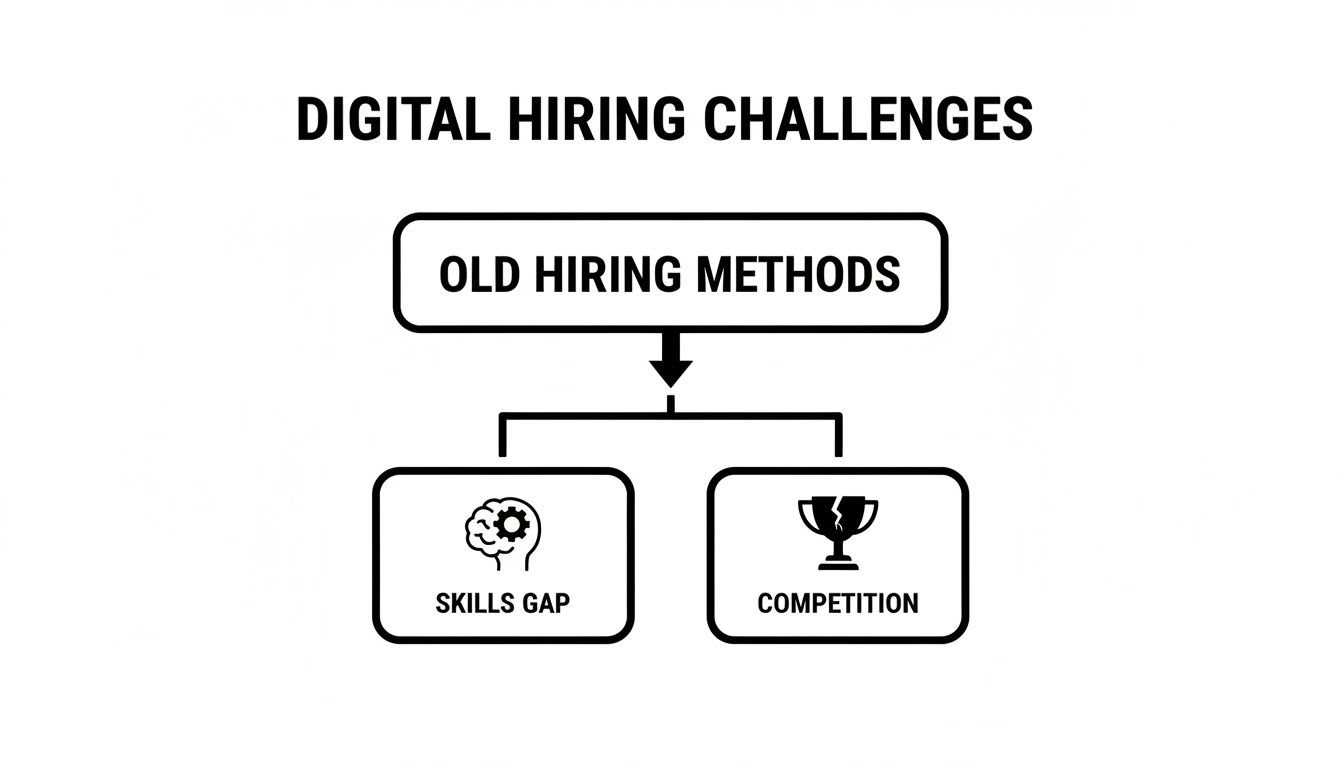
As you can see, relying on traditional hiring directly contributes to a widening skills gap and only intensifies the competition for genuinely qualified candidates.
Mapping Core Competencies
To build a team that delivers, you need a crystal-clear skills matrix. This isn’t just a shopping list of software. It’s a blueprint mapping out the technical, strategic, and soft skills required for someone to truly succeed in each role. A well-defined matrix standardises your evaluation process and ensures you’re hiring for actual capabilities, not just keywords on a resume.
Let’s break it down. Your Performance Marketer needs technical fluency in platforms like Google Ads and Meta Ads Manager. Strategically, they must be a pro at budget allocation and A/B testing. And their most crucial soft skill? Adaptability, because ad platforms are in a constant state of flux.
On the other hand, an SEO Strategist lives in tools like SEMrush and Ahrefs. Their strategic mind is wired for technical audits and long-term content strategy. The key soft skill here is persistence—SEO is a marathon, not a sprint.
To help you get started, here’s a sample matrix outlining the core competencies for a few key roles.
Core Competencies for Key Digital Marketing Roles
| Role Title | Core Technical Skills | Strategic Competencies | Key Soft Skills |
|---|---|---|---|
| Performance Marketer | Google Ads, Meta Ads, Google Analytics, Conversion Rate Optimisation (CRO) Tools | Budget allocation, A/B testing frameworks, Campaign optimisation, Funnel analysis | Adaptability, Analytical thinking, Results-driven |
| SEO Strategist | SEMrush, Ahrefs, Screaming Frog, Google Search Console, Technical SEO audits | Keyword research, Content strategy, Link building strategy, Competitor analysis | Persistence, Curiosity, Communication |
| Content Marketing Manager | Content Management Systems (e.g., WordPress), Basic HTML/CSS, SEO best practices | Content calendar planning, Brand storytelling, Audience segmentation, Distribution strategy | Creativity, Empathy, Project management |
| Marketing Automation Expert | HubSpot, Marketo, or Salesforce Marketing Cloud; CRM integration | Lead nurturing workflows, Email marketing strategy, Database management, Lead scoring models | Detail-oriented, Problem-solving, Logical thinking |
This matrix is just a starting point, of course. You’ll want to tailor it to the specific nuances and goals of your own organisation.
The shift towards these specialised, data-centric roles is only accelerating. We’re seeing a huge spike in demand for leaders who can integrate data and AI strategies into the marketing function, but legacy hiring pipelines are completely misaligned. With 44% AI adoption across Indian firms, this skills shortage is driving up the cost-per-hire by a staggering 25-35% for these critical profiles. You can discover more insights into India’s hiring outlook to see the full picture.
Structuring for Collaboration and Growth
How your team is structured has a massive impact on its effectiveness and, just as importantly, its retention. The way people collaborate and see their own future in the company is as crucial as the skills they bring to the table. Two proven models really stand out here:
- Agile Pods: Think small, cross-functional teams organised around a specific mission, like customer acquisition or brand awareness. This structure demolishes silos, promoting incredible speed and collaboration between different specialists.
- Centre of Excellence (CoE): This involves creating a centralised team of deep experts (an SEO CoE, for instance) that provides strategic guidance and hands-on support to various business units. This model is fantastic for ensuring consistency and nurturing world-class expertise across the organisation.
Choosing the right structure really depends on your company’s size, maturity, and goals. The bottom line is to create an environment that not only attracts top talent but also gives them clear career paths to keep them engaged and growing with you for the long haul.
Finding and Attracting Elite Digital Marketers
Let’s be honest. The digital marketers you really want to hire aren’t spending their days polishing their CVs or scrolling through job boards. They’re head-down, in the trenches, driving real results. So, how do you get their attention?
Relying on LinkedIn alone just won’t cut it anymore. Winning in digital marketing hiring today means you have to be proactive and strategic, meeting top talent where they already are.
Think about it from their perspective. The best in the business are active in niche communities, sharing knowledge and building their personal brands. You’ll find them in industry-specific Slack channels, private marketing forums, and even on platforms like GitHub if you’re looking for someone with deep technical SEO or data science chops.
The key is to engage authentically. Don’t just drop a job link and run. Ask thoughtful questions, share valuable content, and become a trusted voice in their world. That’s how you position your company as an employer of choice before a role even opens up.
Crafting a Magnetic Employer Brand
Your employer brand has become your single most powerful recruitment tool. For marketers, it isn’t about the free lunches or the flashy office perks; it’s about the work. They want to know what challenges you’re tackling, what your big wins look like, and what tools they’ll get their hands on.
A strong brand story is everything. To dive deeper, check out how to build an effective employer branding strategy that speaks directly to top-tier marketing talent.
To really build a magnetic brand, you need to showcase what marketers genuinely care about:
- Highlight Your Tech Stack: Are you running on best-in-class tools like HubSpot, SEMrush, or sophisticated analytics platforms? Make sure candidates know it.
- Showcase Your Coolest Projects: Talk about that ambitious campaign that knocked its targets out of the park or a complex problem your team solved in a clever way.
- Position Your Team as Thought Leaders: Get your current marketers out there. Encourage them to speak at conferences, publish blog posts, or host webinars. Their expertise instantly becomes your company’s expertise.
The most compelling employer brands don’t just list job duties; they tell a story about the impact that role has. It’s the difference between saying “manage social media” and “lead our brand’s conversation with a million followers.”
Writing Job Descriptions That Cut Through the Noise
Think of your job description as a piece of marketing copy, not an internal HR document. It’s often your very first conversation with a potential hire, so it has to grab their attention.
Ditch the corporate jargon and tell a story. What is the mission of this role? What does success look like in the first 90 days? Paint a vivid picture that gets them excited about the possibilities.
This is absolutely critical in fast-growing specialisations. For example, India’s influencer marketing industry is projected to hit ₹28 billion by 2026, creating an explosion in demand for specialists. A generic “Influencer Marketing Manager” post won’t attract someone who understands AI-driven discovery or privacy-first campaigns. Your job description has to speak their language and reflect the true sophistication of the opportunity.
How to Accurately Assess Marketing Skills
A polished resume can hide a multitude of skill gaps. In digital marketing, what a candidate says they can do is far less important than what they can actually accomplish. Your assessment process has to be sharp enough to cut through the noise and evaluate true, on-the-ground capability.
The first move is to get past the resume and into tangible results. Instead of just noting a candidate managed a ₹1 crore ad budget, ask for their portfolio. Better yet, have them do a brief screen-share walkthrough of a campaign they’re proud of. You’re looking for their ability to articulate the why behind their strategy, not just the what.
Going Beyond the Portfolio Review
While a strong portfolio is a great starting point, it only shows you past successes in a different environment. To really understand if a candidate can solve your unique challenges, you need to see their skills in action with a real-world assessment.
This is a central pillar of effective evaluation. To explore this approach in more detail, check out our complete guide to skills-based hiring, which lays out a deeper framework.
These assessments shouldn’t be generic brain teasers. They must mirror the actual day-to-day work the role involves.
- For an SEO Role: Ask them to run a brief technical audit on one of your key landing pages. Give them 48 hours and ask for a 5-slide presentation on their top three findings and recommended fixes. This tests their technical chops, prioritisation skills, and ability to explain complex issues simply.
- For a Paid Media Role: Give them a mock business scenario. Something like, “We’re launching a new product with a ₹5 lakh budget for the first month. Create a high-level paid media plan outlining your proposed channel mix, target audience, and key performance indicators.” This quickly reveals their strategic thinking and budget management skills.
- For a Content Role: Don’t just ask for writing samples. Give them a creative brief to write a 500-word blog post on a relevant topic, optimised for a specific keyword. This assesses their research, writing, and basic SEO skills all at once.
A well-designed case study is the single best predictor of on-the-job performance. It shifts the conversation from hypothetical claims to demonstrated ability, which is the foundation of a successful digital marketing hiring process.
Implementing Structured Evaluation Frameworks
To root out bias and ensure everyone is on the same page, every interview and assessment needs a structured framework. Gut feelings are notoriously unreliable when it comes to hiring. A simple scorecard, customised for each role, can make your evaluation process far more objective and effective.
Create a scorecard that rates candidates on a 1-5 scale across the key competencies you identified in your skills matrix.
| Competency | Weighting | Score (1-5) | Interviewer Notes |
|---|---|---|---|
| Strategic Thinking | 30% | Candidate connected marketing tasks to larger business goals. | |
| Technical Proficiency | 40% | Showed deep expertise in Google Analytics and campaign setup. | |
| Problem-Solving Ability | 20% | Articulated a clear process for troubleshooting a drop in leads. | |
| Communication Skills | 10% | Clearly explained complex concepts to a non-technical audience. |
This method forces interviewers to justify their ratings with specific evidence from the conversation and case study. It helps ensure that you’re comparing candidates on the same criteria, leading to a much more defensible and accurate hiring decision. Honestly, this structured approach is what separates good hiring from great hiring.
Mastering the Final Interview and Onboarding
Getting a “yes” from your top candidate feels like a victory, but let’s be honest—it’s not the finish line. The real test of your digital marketing hiring process is what comes next. A sharp final interview and a solid onboarding plan are what turn a promising new hire into a high-impact team member.
By this stage, the final interview shouldn’t be about grilling them on technical skills; your earlier assessments should have already covered that ground. Now, it’s about digging into their cultural fit and seeing how they handle real-world business challenges. This is your chance to observe their thinking process when things get messy.
Probing for Real-World Agility
It’s time to move past tired questions like, “Tell me about a time you failed.” Instead, throw them scenarios that reflect the day-to-day chaos of a modern marketing team.
Think about using behavioural and situational questions that are tailored to your business:
- Situational Question: “Imagine our organic traffic suddenly drops by 20%, and the initial data is inconclusive. Walk me through your first 48 hours. What do you do?”
- Behavioural Question: “Describe a time you had to convince a senior leader to invest in a marketing channel they were sceptical about. What data did you present, and how did it turn out?”
These questions don’t have a single correct answer. What you’re really looking for is how they structure their thoughts, communicate under pressure, and connect their marketing actions back to the bigger business picture.
A great candidate won’t just list steps; they’ll ask clarifying questions. Their response reveals how they collaborate, handle uncertainty, and take ownership of a problem from start to finish.
Designing a 90-Day Onboarding Roadmap
For a digital marketer, the standard HR orientation just won’t cut it. They need a strategic roadmap—one designed to get them up to speed and integrated into the team as quickly as possible. A well-thought-out 90-day plan is absolutely critical for retention and makes your new hire feel like they’re making a real impact from day one.

This isn’t about drowning them in paperwork; it’s about empowering them to succeed. This plan should be a living document that clearly outlines expectations and gives them all the tools they need.
A Sample 90-Day Onboarding Framework:
| Phase | Duration | Key Focus Areas |
|---|---|---|
| Foundation | Days 1-30 | Deep Dives: Get them trained on your MarTech stack (think CRM, analytics tools, and automation platforms). Meet the Team: Set up one-on-ones with key people in sales, product, and data. |
| Integration | Days 31-60 | Ownership: Give them their first small-scale project or campaign to own from start to finish. Mentorship: Pair them with a senior team member for regular check-ins to help them navigate internal politics and processes. |
| Acceleration | Days 61-90 | Performance Metrics: Set clear goals for their first quarter (e.g., improve the lead conversion rate by 5%). Strategic Contribution: Pull them into Q2 planning meetings. This fosters a sense of long-term ownership. |
This kind of structured approach shifts onboarding from a passive experience to an active, engaging one. It builds their confidence, makes expectations crystal clear, and proves that your meticulous digital marketing hiring process has set them up for long-term success.
When to Partner with a Recruiting Specialist
Even the sharpest in-house talent acquisition teams can hit a wall when it comes to the unique beast that is digital marketing hiring. Knowing when to call for backup isn’t a sign of failure; it’s a strategic move. The signals are usually pretty clear and almost always tied to business pressure.
Are you finding it nearly impossible to fill roles that require niche skills, like MarTech integration or sophisticated data analytics? That’s a classic trigger. When your team spends months hunting for a single candidate, the opportunity cost starts to add up—fast. The same goes for when you suddenly need to scale your marketing team for a new product launch or market expansion. Your internal capacity can get overwhelmed in a heartbeat.
Recognising the Triggers for External Support
While a traditional recruiting agency might fill a single role, sometimes you need a more embedded, strategic approach. Watch out for these red flags:
- Speed to Hire is Lagging: Your average time-to-fill for marketing roles is creeping past 90 days, putting critical projects and revenue goals at risk.
- Cost-per-Hire is Climbing: Sourcing specialised talent is getting ridiculously expensive because you’re leaning too heavily on high-fee agencies or massive ad spends.
- Lack of Passive Talent Access: Your team is mostly talking to active job seekers, completely missing out on the 70% of the talent pool who are passive but might be open to the right opportunity.
An RPO partnership embeds specialised recruiters directly into your process, making them feel like an extension of your own team. This isn’t just about transactional hiring; it’s about building a sustainable talent pipeline, tapping into the passive candidate market, and genuinely improving your hiring outcomes for the long haul.
Having this kind of dedicated support can be a real game-changer. By exploring the advantages of an RPO partner, you’ll see how this model delivers the focused expertise you need to build a world-class marketing function without pulling your internal team away from their core responsibilities.
Common Questions About Digital Marketing Hiring
As a CHRO, you’re likely navigating the same tricky questions we hear from leadership all the time when it comes to building a digital marketing team. Getting straight, practical answers is key to moving forward with confidence and building a team that actually delivers.
Let’s cut through the noise and tackle some of the most common queries we see.
What Are the Most Critical Roles to Hire First?
This is the big one. For most businesses, the first couple of hires need to make an immediate impact. Your best bet is to start with a “T-shaped” Digital Marketing Manager. Think of this person as your versatile utility player—they have a broad understanding across all channels, but they’ve gone deep in one or two critical areas, usually performance marketing (like PPC or Paid Social) or SEO. This lets you tap into existing customer demand right out of the gate.
Once that person is in place, your second hire should be their perfect complement. If your first hire is a whiz at SEO, your next move should be bringing in a skilled Content Creator or a Paid Media Specialist. This creates a powerful synergy, where one role amplifies the efforts of the other, and you start seeing compounded results.
How Can We Test for Strategic Thinking?
Forget the standard, tool-based tests. Anyone can learn to click the right buttons in a platform. True strategic thinking is about connecting marketing activity to business goals. The best way to test for this is to move beyond simple tasks and present them with a real-world business problem.
Instead of asking something tactical like, “Set up a Google Ads campaign,” frame it as a business challenge: “Our lead volume has dropped by 30% in the last quarter. With a budget of ₹50,000, map out a 30-day plan to turn this around.”
What you’re looking for isn’t just a list of actions. A great candidate will analyse the potential root causes, weigh the pros and cons of different channels, define what success looks like with clear metrics, and walk you through the why behind their plan. This shows you they can think beyond the campaign and focus on outcomes.
Should We Prioritise Specialists or Generalists?
Honestly, there’s no single right answer here—it all comes down to where your company is in its journey. If you’re an early-stage company, versatile generalists are worth their weight in gold. You need people who can wear multiple hats and keep several plates spinning without dropping them.
As your company scales and your marketing function matures, that’s when you bring in the specialists—the deep-divers in SEO, Marketing Automation, or Conversion Rate Optimisation. These are the experts who can take a channel from “good” to “great” through focused optimisation. The ideal setup for a mature team is a healthy blend of both: a strategic generalist leading a team of dedicated specialists, each owning their domain.
Building a world-class digital marketing team isn’t about just filling seats; it’s about finding the right talent with the niche skills to accelerate growth. Taggd specialises in RPO solutions that connect you with these hard-to-find experts. Learn how we can build your high-impact marketing function.