Think of enterprise RPO for digital transformation as bringing in a specialist strike team. It’s a strategic partnership where an external expert takes over your entire tech talent acquisition, from sourcing to onboarding. The goal? To land those hard-to-find specialists in fields like AI and cloud engineering at a scale and speed your in-house team simply can’t match. This isn’t just about filling seats; it’s about building the specialised workforce you need to actually win at innovation.
Why Digital Transformation Demands a New Hiring Playbook

Let’s be clear: digital transformation is a people game. New software and systems are just tools. The real magic comes from the people who can build, manage, and innovate with them. Right now, companies are in an all-out sprint to hire elite talent in artificial intelligence, data science, cybersecurity, and cloud engineering.
This creates a massive bottleneck. The demand for these niche skills has exploded, far outpacing the available supply. Traditional, generalist in-house recruitment teams often find themselves completely out of their depth. They might not have the right networks, sourcing tools, or even the technical know-how to engage top-tier tech professionals. The sheer volume and breakneck pace of hiring required for a company-wide transformation can quickly lead to burnout and lost opportunities.
The Limits of Traditional Recruitment
Let’s face it, standard hiring methods were never built for today’s hyper-competitive tech talent market. An internal HR team, already juggling everything from payroll to employee relations, just can’t dedicate the focused resources needed. Their processes are often too slow, their reach is limited, and their ability to properly vet highly technical candidates can be a hit-or-miss affair.
This problem is only getting bigger as the digital economy grows. Just look at the numbers: the digital transformation market in India is projected to rocket from around USD 26.7 billion to an estimated USD 126.8 billion by 2033, growing at an incredible 17.5% CAGR. This boom is fuelled by the very technologies—AI, IoT, and cloud computing—that demand this specialised talent.
The core issue is simple: you cannot build the future of your company using the recruitment playbook of the past. The specificity, scale, and urgency of digital transformation hiring require a purpose-built solution.
Traditional Recruitment vs Enterprise RPO for Digital Hiring
To truly grasp the shift, it helps to see the two approaches side-by-side. The old way of doing things just doesn’t hold up when you’re trying to hire for the future.
| Attribute | Traditional In-House Recruitment | Enterprise RPO Partnership |
|---|---|---|
| Expertise | Generalist HR team with broad duties | Dedicated team of specialised tech recruiters |
| Speed & Scale | Slow to scale; often reactive to needs | Agile and scalable; can ramp up or down on demand |
| Talent Access | Limited to standard job boards and networks | Deep access to niche tech communities and passive talent pools |
| Technology | Basic Applicant Tracking System (ATS) | Advanced AI-powered sourcing and analytics platforms |
| Focus | Tactical and transactional (filling open roles) | Strategic and proactive (building long-term talent pipelines) |
| Cost Model | Fixed overhead, regardless of hiring volume | Flexible and variable, tied directly to hiring outcomes |
The comparison makes it clear that for the unique challenges of digital hiring, a specialised partnership offers a far more strategic and effective path forward.
A Strategic Shift to Enterprise RPO
This is where enterprise Recruitment Process Outsourcing (RPO) comes in, not as a simple cost-saving tactic, but as a strategic necessity. A true RPO partner becomes an extension of your own organisation. They embed a team of specialised tech recruiters who live and breathe your company culture and hiring goals.
This partnership is all about building a sustainable, high-performance talent engine. Instead of just reactively filling jobs, an enterprise RPO for digital transformation focuses on proactively building talent pipelines, amplifying your employer brand in the right tech circles, and using sophisticated sourcing tech. It directly tackles the core weaknesses of traditional recruitment by delivering:
- Specialised Expertise: You get immediate access to recruiters who are deeply networked in niche tech communities. They speak the language and know where the real talent is.
- Scalability: The ability to ramp hiring up for a major project or scale it down afterwards without the headache of managing a large internal team. It’s agility personified.
- Advanced Technology: RPO partners bring their own best-in-class tech stack, including AI-driven sourcing tools and powerful analytics platforms that most in-house teams don’t have.
- Strategic Focus: This frees up your internal HR team to concentrate on the bigger picture of talent management, culture, and employee development. To see how this fits together, explore our insights on the role of HR in digital transformation.
What Enterprise RPO for Tech Hiring Actually Means

Let’s cut through the jargon. At its heart, Enterprise Recruitment Process Outsourcing (RPO) is a strategic partnership where an outside firm takes the reins of your entire talent acquisition function. Think of it less like handing off a task and more like embedding a specialist unit right into your company’s operational command centre.
This is a world away from just calling a recruiter to fill a few open roles. A standard agency relationship is transactional; they find a candidate, fill a seat, and the job is done. An enterprise RPO provider, on the other hand, signs up for a long-term relationship, taking complete ownership of your hiring outcomes. They become responsible for everything, from sourcing elite talent to ensuring a world-class onboarding experience.
For digital transformation, that difference is everything. The mission isn’t just to hire a few developers. It’s about methodically building the specialised engineering, data science, and cybersecurity teams that will define your company’s future. An RPO partner is engineered to build this sustainable talent engine, not just staff a project.
The Core Components of an RPO Partnership
So, what does this integrated talent engine actually look like in practice? An enterprise RPO for digital transformation hiring is built on several key pillars that work in concert to deliver high-quality talent consistently and at scale.
This partnership becomes a true extension of your team, deeply woven into your company culture and fully aligned with your strategic business goals.
- Dedicated Sourcing Teams: You get immediate access to recruiters who live and breathe the tech world. They know the difference between Java and JavaScript and, more importantly, they know where to find top-tier passive candidates who aren’t scrolling through job boards.
- Seamless Technology Integration: A good RPO provider’s tech stack slots perfectly into your existing systems, like your Applicant Tracking System (ATS). This creates a single source of truth for all candidate data and ensures a smooth, consistent journey for everyone involved.
- Employer Brand Amplification: Your RPO partner becomes a powerful brand ambassador, carrying your company’s flag into niche tech communities and professional networks to attract the very best talent.
- Data-Driven Analytics and Reporting: You get detailed, actionable insights into every stage of the recruitment process. Metrics like time-to-fill and cost-per-hire are tracked meticulously, allowing for constant fine-tuning and optimisation.
More Than a Vendor—An Embedded Partner
The biggest mental shift is moving from a “vendor” to a “partner” mindset. A vendor provides a service. A partner shares your vision and is invested in your success. The RPO team immerses itself in your company’s mission, its values, and its long-term objectives.
A true RPO partner doesn’t just work for you; they work as you. They adopt your brand voice, champion your culture, and become indistinguishable from your internal team in the eyes of a candidate.
This deep level of integration is what ensures every single candidate interaction reflects your company’s values, creating a positive experience that ultimately strengthens your employer brand. It’s a holistic approach that draws a direct line between talent acquisition and real business results.
Building a Proactive Talent Pipeline
Finally, one of the most powerful benefits of enterprise RPO is the shift from reactive to proactive recruitment. Instead of scrambling when a new role opens up, your RPO partner is always mapping the market. They are constantly building pipelines of qualified, pre-vetted candidates for your most critical roles.
This forward-thinking strategy is absolutely vital for digital transformation, where talent needs can pivot on a dime. By cultivating relationships with top tech professionals before you even have a job opening, your partner makes sure you can hire faster and more effectively than your competitors. For a deeper look at how RPO solutions can revolutionise your company’s hiring strategy, you can find valuable perspectives on optimising IT workforce planning with RPO. This strategic foresight is what turns recruitment from a cost centre into a genuine competitive advantage.
Finding the Right RPO Model for Your Transformation Goals
Deciding to bring in a Recruitment Process Outsourcing (RPO) partner is a big move. But here’s the thing: not all RPO solutions are the same. The real trick is picking a model that clicks perfectly with the speed, scale, and specific needs of your digital transformation hiring goals.
Think of it like building a house. You wouldn’t use the same blueprint for a cosy cabin as you would for a sprawling corporate campus. In the same way, the structure of your RPO partnership has to match the unique architecture of your talent needs. Choosing the right model means you get exactly the support you need, without paying for extras you don’t.
End-to-End RPO for Comprehensive Transformation
The most immersive option you can go for is End-to-End RPO, often called full-lifecycle RPO. With this model, you’re essentially outsourcing your entire digital and tech recruitment function. The RPO partner becomes a deeply embedded part of your HR team, handling everything from sourcing and screening candidates to managing offers and onboarding.
This approach is perfect for large-scale, long-haul digital transformations. Think building whole new departments from scratch or needing a steady stream of dozens of specialised hires year after year. It gives you a sustainable, long-term talent engine that keeps your growth and innovation humming.
By taking complete ownership, an end-to-end RPO partner delivers a consistent candidate experience, strengthens your employer brand in niche tech communities, and provides a goldmine of data to shape your future workforce strategy.
Project-Based RPO for Targeted Initiatives
But what if your hiring needs are more specific and have a deadline? That’s where Project-Based RPO really shines. This model is tailor-made for specific, high-stakes projects with a clear beginning and end. You get a dedicated team of specialist recruiters for the duration of the project, and once it’s done, the engagement wraps up.
This is the perfect fit for situations like:
- Launching a New Division: You need to quickly hire a 20-person data science team to get a new analytics centre of excellence off the ground.
- Product Development Sprint: You have three months to bring on 15 specialised cloud engineers to fast-track a critical product launch.
- Geographic Expansion: You’re opening a new tech hub in another city and need local experts to build your founding team.
Project-Based RPO gives you a burst of specialised recruiting firepower exactly when you need it, without the long-term commitment of a full outsourcing deal.
Hybrid RPO for Strategic Flexibility
The Hybrid RPO model gives you the best of both worlds, blending the strengths of your internal team with the specialised muscle of an RPO partner. In this setup, your in-house team might handle the high-volume or more generalist roles, while the RPO provider zeroes in on the toughest, most niche positions.
For instance, your internal recruiters could be managing front-end developer hiring, but you bring in the RPO partner to hunt down those rare cybersecurity architects or AI research scientists. It’s a surgical approach that lets you strategically boost your team’s capacity and expertise. This is an incredibly smart way to tackle your most critical talent gaps while keeping direct control over other recruitment areas.
This move towards more specialised RPO models isn’t just a hunch; it’s a major trend. The Indian RPO market is on track to hit USD 420 million by 2027, growing at a 15.5% CAGR. This explosion shows that companies are no longer seeing RPO as just a cost-saving measure, but as a crucial lever for hitting complex business goals like digital transformation. You can read more about the evolving RPO landscape in India.
Making Your RPO Partner an Extension of Your Team
Getting an enterprise RPO partnership right isn’t about outsourcing a task; it’s about insourcing a capability. To really get ahead in digital transformation hiring, your RPO provider needs to become a true part of your company. This fusion isn’t just wishful thinking—it’s built on two solid pillars: seamless technology and a shared culture.
Without this deep-seated connection, your partner is just another vendor. They might be effective, sure, but they’ll never operate with the instinct and understanding of an internal team. The real goal is to weave them so tightly into your organisation’s fabric that candidates, and even your own managers, see one cohesive talent acquisition function.
Weaving Technology into a Single, Unified System
In today’s world, technology is the central nervous system of recruitment. For an enterprise RPO partnership to work, data has to flow effortlessly and instantly between your systems and your partner’s. The most critical connection point is your Applicant Tracking System (ATS) and Human Resource Information System (HRIS).
A smooth integration means every candidate interaction, every status update, and every piece of feedback lands in one single source of truth. This simple step eliminates data silos and confusion, creating a polished, professional experience for both candidates and hiring managers.
But it’s more than just shuffling data around. This tech alignment allows your partner to bring their advanced sourcing tools and analytics platforms to the table, feeding crucial insights straight back into your ecosystem. What you get is a powerful, unified data environment that helps you make smarter hiring decisions, faster.
A disconnected tech stack creates friction. A fully integrated one builds momentum, ensuring every part of the hiring journey—from the first hello to the final offer—is smooth, on-brand, and incredibly efficient.
Aligning on Culture for an Authentic Voice
If technology is the ‘how’, then culture is the ‘why’. For any RPO provider to genuinely represent your brand, they have to live and breathe your company’s mission, vision, and values. This goes way beyond just memorising a few taglines from your website.
This kind of cultural immersion is what turns recruiters into true brand ambassadors. They need to get the subtle nuances of your work environment, feel the passion behind your products, and understand what makes your company a place someone would want to build a career.
How do you make this happen? Organise deep-dive sessions where the RPO team can:
- Meet with key leaders to hear the company’s strategic vision straight from the source.
- Chat with hiring managers to grasp team dynamics and what makes a candidate truly great, beyond a list of skills on a resume.
- Actually experience your products or services to build genuine excitement and knowledge they can share.
This alignment ensures every conversation the RPO team has with a potential hire feels real. When they talk about your company’s culture, they’re speaking from a place of genuine understanding, not just reading from a script.
Building the Framework for True Collaboration
With your tech and culture in sync, the final piece is to build a solid operational framework. This governance model is what ensures your enterprise RPO for digital transformation hiring operates as an extension of your team, not as a separate silo.
Key parts of this framework should include:
- Shared KPIs and Scorecards: Don’t just track time-to-fill. Work together to create a balanced scorecard that includes quality of hire, candidate satisfaction scores, and hiring manager feedback. This makes sure you’re all aligned on what success actually looks like.
- A Regular Communication Rhythm: Set up a steady cadence of communication. Think daily check-ins for quick updates, weekly strategic reviews with key stakeholders, and quarterly business reviews (QBRs) with leadership to track progress against the big-picture goals.
- Clear Governance and Escalation Paths: Clearly define who does what and establish straightforward channels for making decisions and solving problems. This nips bottlenecks in the bud and empowers both teams to move forward confidently.
By thoughtfully integrating your RPO partner across technology, culture, and governance, you’re not just outsourcing recruitment. You’re building a powerful, unified talent engine that’s ready for the unique challenges of digital transformation.
Your Step-by-Step RPO Implementation Roadmap
Bringing an enterprise RPO for digital transformation hiring on board isn’t a flip-of-the-switch event; it’s a carefully planned journey. A clear roadmap is what turns this complex process into a series of manageable, logical steps. It’s about building your partnership on a solid foundation of clear goals, aligned expectations, and smooth execution right from the start.
Think of it like building a high-performance engine for your talent acquisition. You wouldn’t just toss a bunch of parts together and hope for the best. You’d follow a precise blueprint. This phased approach helps you get ahead of challenges, reduce friction, and get you the specialised digital talent you need, much faster.
Phase 1: Discovery and Scoping
The journey always begins with a deep dive into what makes your organisation tick. This first phase is all about defining the “what” and “why” of the partnership. It’s a truly collaborative effort, where your team and the potential RPO partner sit down together to map out where you are today and where you need to be tomorrow.
Key activities here usually involve:
- Defining Hiring Needs: Getting crystal clear on the specific digital roles you need to fill—from data scientists to cloud architects—and figuring out the hiring volume you’re projecting.
- Auditing Current Processes: Taking an honest look at your existing recruitment workflows to pinpoint the bottlenecks, weaknesses, and golden opportunities for improvement.
- Setting Success Metrics: Establishing the key performance indicators (KPIs) that will tell you if you’re winning. This could be time-to-fill for critical roles, the quality of new hires, or even candidate satisfaction scores. To get this right, you need a solid grasp of which recruitment KPIs matter most and how RPO providers improve them.
Phase 2: Vendor Selection and Design
Once you have a clear scope, it’s time to choose the right partner. You’re looking for someone with proven expertise in the tech talent market. This isn’t just about comparing price tags; it’s about digging into their tech capabilities, seeing if their culture fits with yours, and checking their track record in sourcing those hard-to-find digital skills.
After you’ve picked your partner, the design phase kicks in. This is where you tailor the RPO solution to fit your organisation perfectly. Together, you’ll design bespoke recruitment workflows, set up communication protocols, and build reporting dashboards. This stage ensures the RPO solution isn’t some off-the-shelf product but a custom-built service designed around your specific transformation goals.
The design phase is absolutely critical. It turns a simple RPO contract into a shared operational playbook, making sure both teams are working from the same page and chasing the same objectives.
Phase 3: Change Management and Go-Live
Kicking off a successful RPO partnership is about more than just a formal launch. It demands thoughtful change management to get everyone in your organisation ready and on board. This means clear, consistent communication with your hiring managers and other key stakeholders is non-negotiable.
You need to walk them through how the new process will work, what their role in it is, and the benefits they can expect to see. This kind of proactive communication builds trust and paves the way for a smooth transition. The “Go-Live” is the official launch, where the RPO team takes the reins of the agreed-upon recruitment processes, fully integrated and ready to start bringing in top talent.
Phase 4: Continuous Improvement and Optimisation
A great enterprise RPO partnership is a living, breathing thing that evolves right alongside your business. This final phase is an ongoing cycle of performance reviews and optimisation. It’s here that the true strategic value of the partnership really shines through.
This phase is fuelled by data and collaboration:
- Regular Performance Reviews: Think weekly or bi-weekly check-ins to review progress against KPIs and tackle any immediate hurdles.
- Quarterly Business Reviews (QBRs): These are deeper strategic sessions to analyse hiring trends, review market intelligence from your partner, and adjust the overall talent acquisition strategy as needed.
- Process Refinement: Using data and feedback to constantly fine-tune everything—from workflows and sourcing strategies to how you engage with candidates—for better and better results.
This commitment to always getting better ensures your talent acquisition function stays agile, effective, and perfectly aligned with the fast-moving demands of your digital transformation journey.
How to Choose the Right RPO Partner for Your Digital Future
Picking a partner for your enterprise RPO for digital transformation hiring is one of the most consequential decisions you’ll make. This isn’t just about finding someone to fill jobs; it’s about choosing a strategic ally who will help build the very foundation of your company’s future.
The right partner becomes an engine for innovation. The wrong one can stall your progress entirely.
You have to look far beyond standard metrics like cost-per-hire. The real value is in finding a firm with deep, proven expertise in sourcing the kind of specialised talent that fuels digital initiatives. Think AI/ML engineers, cloud solution architects, and cybersecurity specialists. A generic RPO provider simply doesn’t have the networks or the technical fluency to play in this league.
Vetting for True Digital Expertise
To find a partner who can genuinely accelerate your transformation, you need to dig into their specific capabilities in the tech talent market. Their recruiters need to be more than just sourcers; they must be tech-savvy consultants who truly understand the nuances of the roles they are trying to fill.
Here are the critical areas to investigate:
- Proven Tech Talent Pipelines: Don’t settle for general success stories. Ask for specific case studies where they’ve successfully built teams in areas like data science or cloud infrastructure. You need hard evidence they can deliver in your exact areas of need.
- A Modern Technology Stack: A top-tier RPO partner brings their own advanced tools, including AI-powered sourcing platforms and analytics dashboards. This technology should plug seamlessly into your own systems, creating a unified, data-rich environment.
- Deep Understanding of Employer Branding: The best tech talent is won over by culture and mission, not just a paycheque. Your partner must show a sophisticated grasp of how to position your employer brand to attract and engage top professionals in fiercely competitive tech communities.
Critical Questions to Ask Potential Partners
When you get into discussions, you have to move past the sales pitch. The right questions will cut to the core of their capabilities and reveal whether they are a true strategic fit or just another vendor.
Your evaluation process should feel less like a procurement exercise and more like you’re interviewing a candidate for a senior leadership position. You are looking for a partner who shares your vision and has the specialised skills to help you execute it.
This process flow shows the typical journey from identifying your need to launching a successful RPO partnership.
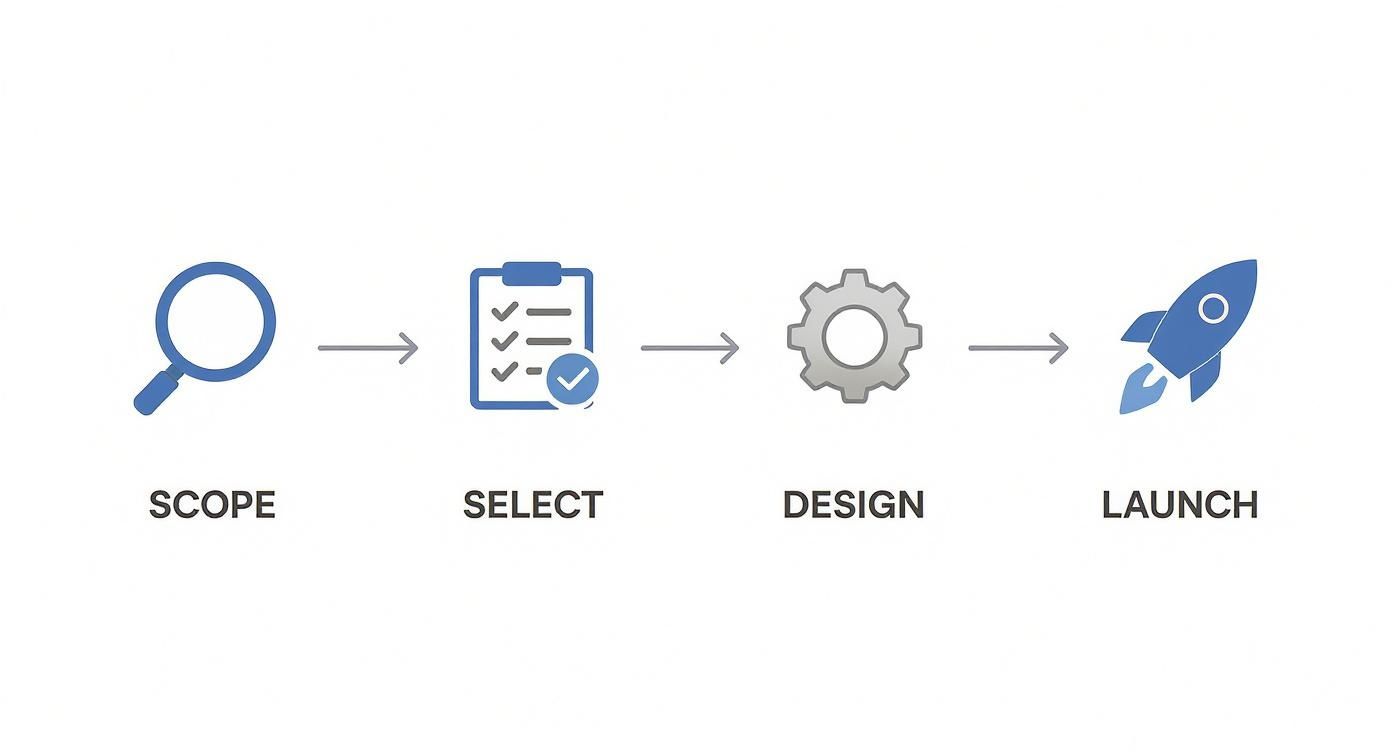
This visual roadmap underscores the importance of a structured approach. It ensures each phase—from scoping your needs to selecting and designing the solution—is thoughtfully executed before you hit “go.”
Arm yourself with these targeted questions to guide your conversations:
- How do you source passive candidates for highly technical roles like Machine Learning Engineers? This tests their proactive sourcing strategies beyond just posting on job boards.
- Can you describe your process for training recruiters on our company culture and specific value proposition? This reveals their commitment to becoming genuine ambassadors for your brand.
- What specific analytics and reporting will you provide to demonstrate ROI and inform our workforce strategy? This pushes for a data-driven approach, not just activity metrics.
- How do you ensure a seamless and positive candidate experience when representing our brand? This focuses on their ability to protect and enhance your reputation in the talent market.
Choosing the right partner for your enterprise RPO for digital transformation hiring is a strategic imperative. By prioritising deep digital expertise, a sophisticated tech stack, and a true partnership mindset, you can secure a collaborator who won’t just fill roles, but actively help build your company’s digital future.
Answering Your Questions About Enterprise RPO
Even when the benefits seem clear, it’s only natural for leaders to have a few practical questions before committing to an enterprise RPO for digital transformation hiring. Getting these points ironed out helps you move forward with confidence, making sure the model you choose is the right fit for your long-term goals.
Let’s tackle some of the most common queries we hear.
How Is Enterprise RPO Different from Using a Staffing Agency?
This is a big one. Think of a staffing agency as tactical. Their job is to fill a single role—it’s a transaction. They find a candidate for an open seat, and the engagement is over. It’s a short-term fix for an immediate problem.
An enterprise RPO provider, on the other hand, is playing a completely different game. They are a long-term strategic partner who takes full ownership of your recruitment process. When it comes to digital transformation, this means they don’t just fill seats. They build sustainable tech talent pipelines, polish your specific tech employer brand, manage the entire candidate experience, and deliver data-driven insights that shape your future workforce strategy. It’s about building a lasting capability, not just making a single placement.
Will We Lose Control Over Our Hiring Process?
This is a perfectly valid concern we hear all the time. But a well-designed RPO partnership actually gives you more control, not less. The RPO provider works as a seamless extension of your company, operating under a strict Service Level Agreement (SLA) with clear KPIs that you define.
You stay in the driver’s seat, retaining full strategic command over your brand, culture, and hiring standards. The RPO partner simply brings the specialised resources, technology, and scale to execute your vision far more effectively than an already stretched internal team ever could. It’s all about delegating the operational heavy lifting while you maintain complete strategic ownership.
Is RPO Only for High-Volume Hiring?
Not at all. While RPO is brilliant for managing large-scale hiring, its real magic in the digital world is often in securing those low-volume, high-impact roles that are incredibly tough to fill. Imagine you need to build a new 15-person AI team from the ground up or find three senior cloud architects with a very specific, rare mix of skills.
This is where flexible models like Project-Based or Hybrid RPO shine. The partner brings in a focused, specialised sourcing capability that a generalist in-house team just can’t replicate. They make sure you land the niche talent needed to push your most critical innovation projects across the finish line.
Ready to build the specialised tech team your digital transformation demands? At Talent Hired – The Job Store Private Limited, we deliver the strategic RPO solutions that connect you with the talent of tomorrow. Discover how we can accelerate your hiring goals today.