Deciding between enterprise RPO and an in-house recruitment team really boils down to one thing: partnership versus ownership. An in-house team is woven into the fabric of your company culture, offering direct control. On the other hand, an RPO partner brings external expertise, advanced technology, and scalable resources to the table, driving efficiency and expanding your reach. The right choice depends entirely on whether your enterprise values strategic flexibility or deep internal integration more for its talent acquisition.

Defining Your Talent Acquisition Strategy: RPO vs In-House
For any Chief Human Resources Officer, choosing a talent acquisition model is one of those cornerstone strategic decisions. It’s far more than just an operational choice between internal staff and an external vendor; it’s a decision that fundamentally shapes your company’s ability to attract, hire, and keep top talent. This choice has a direct ripple effect on your cost structures, organisational agility, and the quality of every single person who joins the team.
An in-house recruitment team is a known quantity. They live and breathe your company’s culture and processes. This model gives you unmatched control over the hiring narrative and ensures direct alignment with business leaders. The trade-off, however, often involves fixed overheads, limited ability to scale during hiring surges, and potential gaps in specialised recruitment tech or market knowledge.
Then there’s Recruitment Process Outsourcing (RPO). An RPO partner acts as a true extension of your HR department. They introduce a variable cost model, provide immediate access to a wider talent pool, and bring a sophisticated technology stack that most companies couldn’t justify building themselves.
For a CHRO, the core dilemma is balancing the deep-seated desire for direct control and cultural ownership against the urgent need for the speed, scalability, and specialised capabilities an RPO provider delivers.
To help you weigh these trade-offs, let’s look at a high-level comparison of how each model stacks up across critical business criteria.
Quick Comparison: RPO vs In-House at a Glance
The table below offers a snapshot of the fundamental differences, helping you see where each model shines.
| Criterion | Enterprise RPO | In-House Recruitment Team |
|---|---|---|
| Cost Structure | Primarily variable, based on hiring volume or project scope. | Primarily fixed, including salaries, benefits, and overheads. |
| Scalability | High; easily scales up or down to meet demand. | Low; scaling requires new hires, a slow and costly process. |
| Technology Access | Access to advanced ATS, AI sourcing tools, and analytics. | Limited to the organisation’s existing or budgeted tech stack. |
| Speed & Reach | Often faster time-to-fill due to larger talent pools and dedicated sourcers. | Dependent on the existing network and brand recognition. |
| Strategic Control | Governed by SLAs and partnership agreements. | Direct, hands-on management and process control. |
Ultimately, the choice hinges on your specific business context, but the market is showing a clear preference.
The trend toward RPO is picking up speed, especially in competitive markets. Here in India, for example, growing talent scarcity is pushing more and more businesses toward outsourced solutions. It’s now estimated that 60% of businesses will use RPO for high-volume recruitment by 2025, a significant jump from 45% in 2023.
This shift isn’t just a fad; it’s driven by real efficiency gains. RPO providers frequently slash time-to-hire to just 20–30 days, a stark contrast to the 40–60 day average for many traditional teams. This data paints a clear picture: businesses are increasingly favouring models that offer greater agility and a serious technological edge.
Comparing the Financial Models: Cost, ROI, and Business Impact
As a CHRO, looking at the RPO versus in-house debate means going far beyond a simple cost comparison. A truly strategic financial analysis gets into the weeds of the Total Cost of Ownership (TCO) and measures the real, long-term business impact of each model. This is about shifting the mindset from recruitment as a cost centre to seeing it as a function that actively drives revenue and growth.
The financial model for an in-house team is pretty straightforward, built on fixed, predictable costs. You have recruiter salaries, benefits, bonuses, and the overheads for office space and equipment. Then there are the significant capital investments in your tech stack—an Applicant Tracking System (ATS), sourcing tools, and assessment platforms—all with recurring license and maintenance fees.
In contrast, an RPO partnership works on a more flexible, operational expenditure model. Costs are often variable and tied directly to hiring volume or specific project outcomes. This structure gives you incredible financial agility, letting you scale your recruitment spend up or down with market demand, all without the dead weight of fixed headcount costs.
Deconstructing the Total Cost of Ownership
To really compare apples with apples, CHROs need to look beyond the obvious line items and uncover the hidden costs tied to each model.
In-House TCO Factors:
- Direct Costs: Recruiter salaries, benefits, and performance bonuses.
- Technology Stack: Annual licenses for your ATS, CRM, and sourcing platforms.
- Overhead: Office space, IT support, and other administrative costs.
- Training & Development: Constant upskilling is needed to keep recruiters on top of their game.
- Third-Party Agency Fees: These often pop up for niche or senior roles, adding unpredictable expenses to the budget.
An RPO model neatly consolidates many of these variable and hidden expenses into a single, predictable partnership fee. Thanks to their economies of scale, RPO providers can absorb technology and specialised sourcing costs, often leading to a much lower overall TCO for you.
Modelling the Return on Investment
The real story of an RPO partnership emerges when you start analysing its Return on Investment (ROI). This goes way beyond just a lower cost-per-hire. It’s about process efficiencies, a step-up in talent quality, and ultimately, faster business growth. A good starting point is to understand how to track and analyse the ROI of your recruiting efforts, which lays the groundwork for this kind of comparison.
For instance, Indian enterprises that have made the switch to RPO are seeing tangible results. Market analysis shows companies working with RPO providers have achieved up to a 34% reduction in hiring costs, a 40% faster time-to-hire, and an impressive 68% increase in their candidate pipelines.
The core financial benefit of RPO isn’t just cost savings; it’s value creation. By filling critical revenue-generating roles faster and reducing dependency on expensive third-party agencies, RPO directly contributes to the bottom line.
Quantifying the Business Impact
This is where the strategic value really shines. An empty seat, especially in a sales or product development role, is more than just a vacancy—it’s lost revenue and delayed innovation.
Think about these scenarios:
- Rapid Market Expansion: An in-house team would likely struggle to staff a new regional office quickly, pushing back your market entry. An RPO partner, however, can deploy a dedicated team almost immediately, shrinking your time-to-revenue.
- Niche Skill Requirements: Trying to hire for specialised tech roles can force an in-house team to lean on costly external agencies. An RPO provider comes with pre-existing talent pools and sourcing expertise for these exact roles, cutting down both cost and time.
By shifting recruitment from a fixed overhead to a variable investment, an RPO partnership aligns your talent acquisition spend directly with your strategic business goals. This financial flexibility and sharp focus on creating value make it an incredibly compelling model for any dynamic, growth-focused enterprise.
Analysing Key Performance Metrics: Speed vs Quality
When it comes down to comparing an enterprise RPO with an in-house recruitment team, the conversation always lands on two core metrics: the speed of hiring (time-to-fill) and the long-term value of the new hire (quality of hire). For any CHRO, mastering the delicate balance between these two is the bedrock of building a high-performing workforce.
In-house teams bring a deep, almost instinctual understanding of the company’s culture. But RPO providers walk in with process rigour, specialised tech stacks, and vast talent networks that can seriously move the needle on both speed and quality.
An in-house team’s speed is often capped by its existing network and the competing priorities pulling recruiters in multiple directions. They might be fantastic at filling familiar roles, but throw high-volume demands or niche skill sets at them, and things can slow down. Those prolonged vacancies aren’t just frustrating; they have a real impact on business outcomes.
An RPO partner, on the other hand, is built for speed. Their entire operating model revolves around dedicated sourcing professionals who leverage advanced technology and expansive talent pools to build candidate pipelines before you even need them. This singular focus allows them to slash hiring cycles without cutting corners on vetting.
Breaking Down Time-to-Fill and Time-to-Hire
It’s crucial to separate time-to-fill (from the moment a job requisition is approved to when an offer is accepted) from time-to-hire (the time from a candidate’s first application to offer acceptance). An RPO’s edge is clear in both.
- Proactive Sourcing: RPO firms don’t start from scratch. They cultivate active talent communities, meaning they often have qualified, pre-vetted candidates lined up before a role is officially open. This shaves huge amounts of time off the initial sourcing phase.
- Process Efficiency: RPO providers live and breathe optimised workflows for screening, interviewing, and scheduling. This operational discipline irons out the common administrative wrinkles and bottlenecks that can easily overwhelm an already busy in-house team.
This efficiency is a game-changer, especially in competitive industries. For example, data from Indian enterprises clearly shows how RPO services can transform recruitment outcomes. One of our BFSI clients saw their time-to-hire fall by 45% while their offer acceptance rates climbed by 20% after engaging an RPO firm. These wins weren’t just luck; they were the direct result of an integrated approach that included employer branding and candidate experience strategies—things that often fall outside the scope of a traditional TA team.
Measuring the Elusive Quality of Hire
Speed is easy to track, but the quality of hire is far more nuanced—and arguably, far more critical for long-term business success. This metric shifts the focus from just filling a seat to measuring the actual value a new employee contributes to the organisation.
The ultimate test of any recruitment model is not how quickly it can fill a role, but whether it consistently delivers talent that performs, stays, and drives the company’s strategic goals forward.
Here, an in-house team’s strength is its cultural immersion. Recruiters instinctively know the unspoken traits that make someone a great fit. The flip side is that this can lead to subjective, inconsistent evaluation criteria, making it tough to measure quality of hire systematically across the enterprise.
RPO providers tackle this challenge by introducing a structured, data-driven methodology. They sit down with stakeholders to define what ‘quality’ actually looks like for specific roles and then track objective metrics to measure it. To see how this works in practice, explore our detailed guide on how RPO providers track, report, and improve recruitment KPIs.
Performance Metric Impact Analysis
The table below breaks down how RPO and in-house models typically measure up on key performance indicators, based on real-world data and industry observations.
| Performance Metric | Typical RPO Impact | Typical In-House Baseline |
|---|---|---|
| New-Hire Performance | Uses structured 30-60-90 day performance reviews benchmarked against predefined role competencies. | Often relies on informal hiring manager feedback, which can be inconsistent across departments. |
| Retention Rates | Tracks 90-day, 6-month, and 1-year retention rates for all new hires, identifying trends and root causes. | May track overall company turnover but often lacks cohort-specific data for new hires. |
| Hiring Manager Satisfaction | Deploys formal satisfaction surveys (NPS style) to gather structured, actionable feedback on candidate quality and process. | Feedback is typically anecdotal and collected informally during one-on-one meetings or casual conversations. |
| Offer Acceptance Rate | Continuously analyses data and optimises the candidate journey to maintain and improve high acceptance rates. | Acceptance rates are tracked but may not be systematically analysed for strategic improvement opportunities. |
Ultimately, the choice between RPO and an in-house team isn’t just about filling roles. An in-house team offers deep cultural alignment, while an RPO provides the structure, technology, and scale needed to consistently deliver both speed and measurable quality. This transforms talent acquisition from a reactive function into a predictable, strategic advantage for the business.
Evaluating Scalability, Technology, and Strategic Control
Beyond the balance sheets and performance metrics, the debate between enterprise RPO and an in-house team really comes down to three operational pillars: scalability, technology, and strategic control. For a CHRO, getting these right determines whether your talent acquisition function can fuel business growth or becomes a major bottleneck. Each model offers a completely different philosophy for managing these critical areas.
An in-house team, by its very nature, operates with a fixed capacity. While this feels stable during predictable hiring periods, it creates serious strain when the business needs to make a sharp turn. A sudden market opportunity, a new project launch, or geographic expansion can completely overwhelm an internal team, leading to delayed hires and missed revenue goals.
An RPO partnership, on the other hand, is built for elasticity. It allows an organisation to scale its recruitment engine up or down almost on demand. This ability to rapidly bring in resources for a hiring surge and then scale back without the pain of layoffs is a massive strategic advantage. It transforms recruitment from a rigid cost centre into a flexible, responsive business partner.
The Recruitment Technology Divide
Let’s be honest: modern talent acquisition is a technology-driven function. An in-house team is often stuck with the organisation’s overall IT budget and priorities, which can mean an outdated or limited HR tech stack. They might have a decent Applicant Tracking System (ATS), but they often lack the specialised, AI-powered tools needed for sophisticated sourcing and analytics.
RPO providers, however, see technology as a core investment, not an overhead. They bring a sophisticated, pre-integrated suite of tools to the table, which usually includes:
- Advanced Sourcing Platforms: Think AI-driven tools that can scan millions of profiles to find passive candidates with those hard-to-find niche skills.
- Predictive Analytics: Data models that can forecast hiring trends, identify high-potential candidates, and sharpen your decision-making.
- Candidate Relationship Management (CRM): Specialised systems for nurturing long-term talent pipelines, ensuring you have a ready supply of qualified candidates when you need them.
This immediate access to a superior tech stack lets an organisation leapfrog years of internal development and investment, giving them a real competitive edge in the war for talent.
Maintaining Strategic Control and Governance
One of the biggest worries for CHROs considering RPO is the fear of losing control. The thinking goes that outsourcing recruitment means giving up influence over a vital business function. While an in-house team certainly offers direct, hands-on oversight, a well-structured RPO partnership maintains strategic control through a strong governance framework.
This isn’t about handing over the keys; it’s about co-creating a strategic partnership. This collaborative approach is built on a few key components that ensure the RPO provider operates as a true extension of your brand and culture.
The myth is that outsourcing means a loss of control. The reality is that a modern RPO partnership replaces direct operational management with strategic governance, ensuring alignment through clear metrics, transparent reporting, and shared objectives.
An effective RPO partnership doesn’t achieve control through micromanagement, but through clear and mutually agreed-upon terms.
Framework for RPO Governance:
- Service Level Agreements (SLAs): These aren’t just contractual fine print; they are the operational rulebook. SLAs define precise targets for key metrics like time-to-fill, quality of hire, and hiring manager satisfaction.
- Transparent Reporting: RPO partners provide detailed, real-time dashboards and hold regular business reviews. This data-driven transparency gives CHROs a clear, unfiltered view of performance, challenges, and opportunities for improvement.
- Collaborative Strategy Sessions: Regular meetings between RPO leadership and your internal stakeholders ensure the recruitment strategy stays perfectly aligned with ever-changing business priorities.
Ultimately, this structure allows the CHRO to focus on high-level talent strategy while the RPO partner handles the day-to-day operational execution. This division of labour doesn’t diminish control; it refines it, making it more strategic and impactful.
Choosing the Right Model for Your Business Context
The strategic debate over enterprise RPO versus an in-house recruitment team doesn’t have a one-size-fits-all answer. The best model is tangled up in your organisation’s unique DNA—its growth plans, market standing, and what you prioritise operationally. A generic pros-and-cons list just won’t cut it; a CHRO has to dig into specific business scenarios to make a call that actually sticks.
This means you have to move beyond a simple feature list and start asking some tough, targeted questions about what your business truly needs. Your answers will light the path forward, whether that means doubling down on your internal team or bringing a strategic RPO partner into the fold.
To help you navigate this, think of it as a decision tree. The key branches to consider are your hiring volume, technology gaps, and just how much strategic control you need to keep in-house.
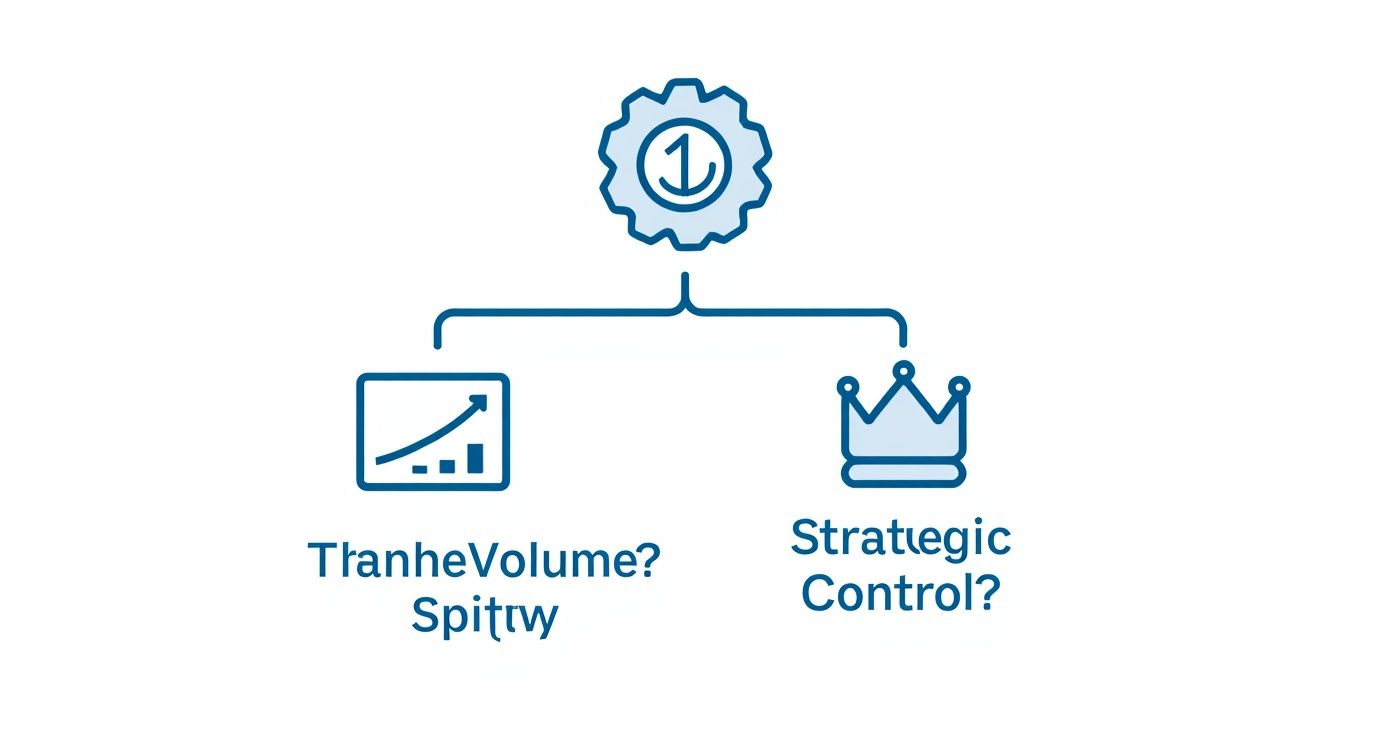
As the visual suggests, organisations facing big, unpredictable hiring swings and needing advanced recruitment tech often get the most out of an RPO partnership. On the flip side, those who prize direct control and have stable, predictable hiring patterns are usually better served by their own in-house team.
High-Growth Tech Company Scaling Its Sales Team
Picture a fast-moving tech company, fresh off a new funding round. Their number one goal is to double the sales force in six months to grab market share. This scenario is all about high volume, intense urgency, and finding candidates with very specific industry chops.
An in-house team, even a great one, would likely get swamped. The sheer volume would stretch their resources to the breaking point, pushing out time-to-fill and potentially forcing them to compromise on quality as the pressure cooker heats up. Their fixed capacity becomes a serious bottleneck to growth.
In high-stakes growth scenarios, speed and scalability are everything. The ability to deploy a specialised recruitment engine almost overnight is a competitive advantage that an internal team struggles to match.
For this situation, an enterprise RPO model is the clear winner. A partner can parachute in a dedicated team of recruiters who already know the sales hiring landscape. They come equipped with ready-made talent pools and a powerful tech stack to source, screen, and deliver qualified candidates at a pace the internal team simply couldn’t sustain. This lets the company hit its aggressive growth targets without the long delay of hiring and training new internal recruiters first.
Stable Manufacturing Firm with Predictable Hiring
Now, let’s look at a well-established manufacturing firm. They have a strong employer brand and low employee turnover. Their hiring needs are steady and predictable, mostly focused on backfilling for retirees or adding roles on established production lines. Here, the biggest priorities are cultural fit and keeping their brand messaging consistent.
For an organisation like this, an in-house recruitment team is the ideal choice. The team’s deep, intuitive understanding of the company culture and their long-term relationships with hiring managers ensure that every new hire fits perfectly with the company’s values. Because hiring volumes are predictable, there’s no need for the elastic scalability an RPO offers.
The investment in an internal team pays dividends through stronger cultural alignment and absolute control over the candidate experience, reinforcing their powerful employer brand with every single interaction.
Multinational Corporation Entering a New Market
Finally, let’s analyse a multinational corporation expanding into a completely new country. This scenario is a minefield of unique challenges: zero local market knowledge, no existing talent network, and a maze of unfamiliar compliance and cultural norms to navigate.
An in-house team, no matter how big, would face a steep and costly learning curve. Trying to build a recruitment function from the ground up in a new country is slow, expensive, and loaded with risk.
Here, a hybrid RPO or project-based RPO model offers the perfect solution. The RPO partner provides immediate access to local expertise, established talent networks, and a deep understanding of regional hiring practices. This de-risks the entire market entry and dramatically speeds up the process of building a foundational local team. The RPO can handle the initial high-volume hiring surge, giving the corporation the breathing room to build a smaller, permanent in-house team over time.
Implementing Your Decision: A Roadmap to Success
You’ve weighed the pros and cons of an enterprise RPO versus an in-house recruitment team. Now comes the critical part: putting that decision into action. Whether you’re gearing up for a new partnership or doubling down on your internal capabilities, a clear roadmap is what turns a strategic choice into real business impact. The success of either path hangs on a smart, well-managed execution plan.
For companies moving toward an RPO partnership, the journey kicks off with rigorous vendor selection. This is much more than a price comparison; it’s about finding a true partner who gets your company culture, understands the nitty-gritty of your industry, and has the tech to give you an edge.
A rushed or superficial selection process is a recipe for mismatched expectations and lacklustre results, defeating the very purpose of bringing in a partner.
Selecting the Right RPO Partner
Choosing an RPO provider is a major strategic commitment. Your checklist needs to go deep, looking for solid proof that they can integrate smoothly and deliver results you can actually measure.
- Proven Industry Expertise: Look for partners who have a strong track record in your specific sector, be it BFSI, technology, or manufacturing. They need to speak your language and have a real pulse on your talent market.
- Technological Capabilities: Get under the hood of their tech stack. Do they have advanced AI-sourcing tools, predictive analytics, and a powerful ATS that can plug into your existing HR systems without a fuss?
- Cultural Alignment and Integration: Remember, the RPO team becomes the face of your brand to candidates. You need to assess their plan for embedding themselves into your company culture to guarantee a seamless and positive candidate experience.
- Performance Metrics and Reporting: Insist on total transparency. A top-tier partner won’t shy away from providing detailed, real-time dashboards on key metrics like time-to-fill, quality of hire, and hiring manager satisfaction.
A great RPO relationship is a strategic alliance, not just a service agreement. It’s built on a foundation of shared goals and mutual trust, moving beyond transactions to focus on hitting long-term talent objectives together.
After you’ve picked a partner, the implementation usually rolls out in phases. It starts with a deep-dive discovery to map out all your processes, followed by a carefully managed deployment, and then shifts to continuous improvement driven by performance data.
Building a Modern In-House Talent Function
If your analysis points to building up your internal team, the mission is to create a modern, data-driven talent acquisition machine that operates with the agility and insight of an external specialist. This means making strategic investments in three key areas: technology, talent, and process.
First, give your team the right gear. This isn’t just about having a basic ATS anymore. You need to invest in a full talent acquisition suite, including a Candidate Relationship Management (CRM) system to build and nurture talent pipelines and powerful sourcing tools to uncover those hard-to-find passive candidates. The right tech transforms recruiters from reactive admins into proactive talent advisors.
Second, commit to upskilling your recruiters. The modern recruiter is part marketer, part data analyst, and part strategic consultant. Invest in training that builds their skills in digital sourcing, employer branding, and data analytics.
Finally, overhaul your recruitment processes to be more agile. Cut out the bureaucratic bottlenecks, empower your hiring managers with better tools and training, and foster a culture of continuous improvement. A modern in-house team uses agile methods to pivot quickly with business needs, delivering a top-notch candidate experience that becomes a powerful competitive advantage for your organisation.
Your Top Questions Answered
When you’re weighing up a major strategic decision like bringing in an RPO partner versus sticking with your in-house team, a few critical questions always come to the surface. Let’s tackle the big ones head-on.
Can an RPO Partner Really Get Our Company Culture?
This is probably the most common—and most valid—concern we hear from CHROs. And the answer is, a top-tier RPO partner makes it their first priority. It’s not just about filling roles; it’s about finding people who will belong.
They should kick things off with a deep-dive immersion phase. This means workshops with your leadership, frank conversations with key stakeholders, and a thorough analysis of your employer brand. A true RPO partner operates as a cultural ambassador, weaving your unique values into every single touchpoint, from the way a job description is written to how they speak with candidates.
What Happens to Our Data Security with an Outside Provider?
Handing over sensitive candidate and company data is a big deal, and it should be treated as such. Any reputable RPO provider will operate under iron-clad data protection protocols, often compliant with global standards like GDPR.
Your vetting process must include a rigorous review of their security infrastructure—think data encryption, access controls, and their specific policies on handling and retaining candidate information.
A strong RPO agreement will spell out, in no uncertain terms, who owns the data, what the security responsibilities are, and the exact compliance protocols in place. This ensures your data is protected with the same rigour as if it never left your own servers.
How Flexible are RPO Contracts, Really?
The last thing you want is to be locked into a rigid, long-term contract that doesn’t move with the business. Modern RPO agreements are built to be agile.
Most contracts will have specific clauses that let you scale services up or down based on real-time hiring needs. Need to hit the brakes for a quarter? Or maybe you’re launching a surprise expansion into a new market? A well-structured agreement gives you the elasticity to adapt the scope, ensuring the partnership always aligns with your business strategy, not the other way around.
Taggd can help you build the agile, high-performing talent function your enterprise needs. Explore our tailored RPO solutions to see how we drive strategic growth.