So, what’s the real reason FMCG needs to get serious about its employer brand for Gen Z? It all boils down to a massive perception gap. While these companies are masters of consumer branding, their employer brands are often stuck in the past, projecting an image of stability without much purpose. That message just doesn’t land with a generation that craves impact, flexibility, and a digital-first culture.
The Growing Disconnect Between FMCG Brands and Gen Z Talent
For decades, the big FMCG players were the go-to destination for top graduates. The deal was simple and attractive: a stable job, a prestigious name on your CV, and a clear, linear career path. This traditional value proposition was a perfect match for a workforce that valued predictability and long-term loyalty.
But the ground has shifted. Gen Z operates on a completely different wavelength.
This new wave of talent isn’t just looking for a job; they’re looking for an experience. They want a role that aligns with their personal values and gives them a platform for constant growth and learning. To them, the old promise of a long, steady career sounds less like security and more like stagnation. They’re wired for dynamic challenges and want to see the tangible impact of their work.
The Perception Problem in Plain Sight
This isn’t just a feeling; the data tells a clear story. In India’s hyper-competitive talent market, FMCG companies are finding it tough to get on Gen Z’s radar, a group that now makes up over 25% of the workforce. When you look at research on India’s most attractive employer brands, it’s the tech and conglomerate giants that dominate the charts. You won’t find a single pure-play FMCG company in the top 10.
This tells us something crucial: the appeal of an FMCG product on a shelf isn’t translating into an appealing place to work for the next generation. This growing chasm is precisely what we need to address.
This concept map breaks down the widening gap between what traditional FMCG brands typically offer and what Gen Z talent is actually looking for.
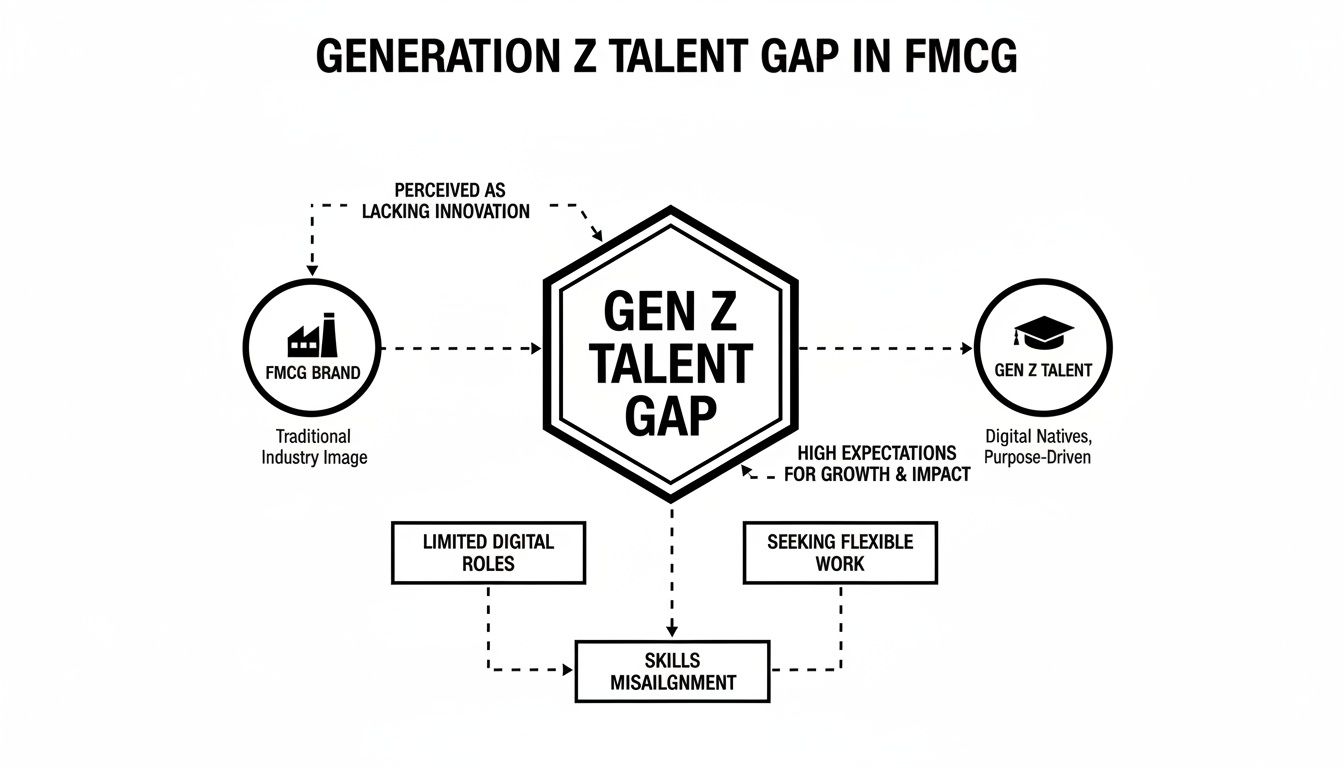
As you can see, the historic emphasis on stability and rigid hierarchy is in direct conflict with Gen Z’s demand for purpose-driven work and agility.
Outdated Attributes vs. Modern Expectations
To start bridging this gap, CHROs need to take an honest look at where their current employer brand is falling short. The real challenge is shifting from a brand built on a legacy of “how things have always been done” to one that speaks to modern relevance and future ambition.
This often means a complete rethink of how the company talks about its culture, its opportunities, and its purpose. It’s about looking beyond the factory floor and the product shelves to showcase a workplace that’s vibrant, innovative, and genuinely impactful. You can get a deeper view of the competitive landscape by exploring current FMCG hiring trends and challenges.
To put it in perspective, here’s a look at the old-school perceptions holding FMCG back versus the modern attributes that Gen Z actively seeks out.
FMCG Employer Brand Traditional vs. Modern Attributes
| Attribute | Traditional FMCG Perception | Modern Gen Z Expectation |
|---|---|---|
| Career Path | Linear, predictable, slow-moving hierarchy | Dynamic, project-based, rapid skill development |
| Culture | Formal, bureaucratic, top-down | Collaborative, transparent, agile, flat structure |
| Work Model | 9-to-5, office-centric, rigid | Flexible hours, hybrid/remote options, outcome-focused |
| Purpose | Brand prestige, market share, stability | Social impact, sustainability, ethical practices |
| Technology | Legacy systems, slow to adopt new tech | Digital-first tools, data-driven decisions, innovation |
| Learning | Formal training programmes, structured learning | On-demand learning, mentorship, hands-on experience |
This table isn’t just a comparison; it’s a roadmap. Moving from the left column to the right is the strategic pivot FMCG companies must make to win over the next generation of leaders. It’s about evolving the employee experience to match the expectations of today’s talent.
The core challenge for FMCG is that its brand story is often written for consumers, not candidates. To attract Gen Z, the narrative must pivot from “what we sell” to “why you should work with us,” focusing on purpose, growth, and culture.
Decoding the Values That Drive Gen Z in the Workplace
To really connect with the next wave of talent, FMCG leaders have to look past the usual stereotypes. For Gen Z, a job isn’t just a transaction for a monthly paycheque; it’s a huge part of their personal identity and what they stand for. Getting to grips with what truly motivates them is the first step to building an employer brand that actually clicks.
This generation stepped into the workforce during a time of massive global shifts, which has given them a very specific set of expectations. They aren’t just looking for a stable career path. They’re looking for a partnership where their work feels important and their personal well-being is taken seriously.
The Non-Negotiable Demand for Purposeful Work
More than any generation before them, Gen Z needs to see a clear link between their daily to-do list and a bigger, positive impact on the world. They’re naturally drawn to companies that can explain their purpose beyond just making a profit.
For an FMCG company, this means showing how a supply chain role helps cut down on food waste, or how a marketing campaign is driving sustainable choices. It’s about taking those corporate social responsibility points from a glossy annual report and making them a real, tangible part of the job.
Gen Z doesn’t just want to know what they’ll be doing. They need to understand why it matters. A modern employer brand has to answer that “why” with total clarity and honesty to even get on their radar.
This calls for a complete rethink of how roles are advertised. Instead of a dry list of responsibilities, job descriptions need to be framed around the problems they solve and the impact they create.
Radical Transparency and Continuous Growth
The days of vague promises about moving up the ladder are long gone. Gen Z expects total transparency about their growth path, how their performance is measured, and the overall health of the company. They grew up with information at their fingertips and expect that same openness from an employer.
This means laying out clear roadmaps for advancement and building a culture of constant feedback. They are also hyper-aware that skills are the new currency and will prioritise employers who invest in their development.
- Continuous Skill Development: They see upskilling and reskilling as part of the job itself, not some extra-curricular activity.
- Transparent Career Paths: They want to see exactly how they can get promoted and what skills they need to learn to get there.
- Honest Communication: They respect leaders who are open about the company’s challenges just as much as its successes.
This mindset is make-or-break for keeping them around. Data shows Gen Z has a 15-20% higher intent to switch jobs, driven by a hunt for better work-life balance (their top priority at 72%), fairness, and better benefits. The old FMCG image of slow, opaque career ladders is a massive turn-off. You can dig deeper into what this generation is looking for by exploring what Millennials and Gen Z expect from employers in India.
A Focus on Wellbeing and Work-Life Integration
Perhaps the most defining trait of Gen Z at work is how much they value mental health and overall well-being. They’ve watched older generations burn out, and they’re determined to find employers who support a healthier way of working.
This is about so much more than a gym membership. It’s about creating a culture where it’s okay to talk about mental health, where flexible working is standard practice, and where managers actually lead by example when it comes to work-life boundaries.
For many FMCG companies, this can be a tough cultural shift from a traditional, office-first mentality. But showing a real commitment to work-life integration isn’t just a nice-to-have anymore—it’s a basic requirement to attract and keep this crucial talent pool. Your employer brand has to prove that your policies and culture genuinely support employees’ lives, both inside and outside the office.
Where Traditional FMCG Employer Brands Are Falling Short
For decades, the Fast-Moving Consumer Goods (FMCG) sector’s employer brand was rock-solid, built on a promise of unshakeable stability and legacy. The deal was simple: join a reputable company and you’d have a long, predictable career. This narrative used to be a powerful magnet for talent, but today, it’s clashing head-on with what Gen Z values, creating a major roadblock in the talent pipeline.
What was once a strength is now often seen as a weakness. The very language that used to pull people in—stability, loyalty, hierarchy—can now push the next generation away. It’s a classic case of the message getting lost in translation between generations.
To really get why FMCG needs a modern employer brand to click with Gen Z, we have to look at these specific points of friction. These aren’t just minor misalignments; they’re fundamental disconnects in culture, career philosophy, and corporate values.
The Problem with Slow Career Ladders
The classic FMCG career path is often sold as a ladder—a slow, steady climb up a rigid hierarchy. Every rung represents years of service, with the top reserved for those who’ve shown decades of loyalty. For previous generations, this model offered reassuring structure and predictability.
But for Gen Z, this ladder looks more like a cage. They’ve grown up in an agile, project-based world where your skills, not your years on the job, are what move you forward. They’re hungry for dynamic experiences, cross-functional projects, and the chance to make a real impact—fast. The thought of waiting five years for a promotion feels painfully outdated.
To a generation that values rapid skill acquisition and tangible results, the FMCG narrative of ‘stability’ and ‘loyalty’ can easily sound like ‘stagnation’ and ‘bureaucracy’. They are looking for a jungle gym of opportunities, not a single ladder.
This mismatch is critical. When a Gen Z candidate hears about a ten-year path to a management role, they don’t see a secure future. They see a decade of missed opportunities to learn, grow, and pivot in a world that’s changing by the minute.
The Perception of a Tech Lag
Let’s be honest: behind the scenes, many FMCG giants are masters of data analytics and supply chain technology. Yet, you’d never know it from their employer brand. From the outside, the sector often comes across as less digitally savvy than fields like tech, e-commerce, or even modern banking.
This perception is a huge red flag for a generation of digital natives. Gen Z candidates expect to walk into a workplace with modern tools, data-driven strategies, and a culture that isn’t afraid to experiment. When an FMCG company’s careers page or application process feels clunky and old-fashioned, it just confirms their suspicion that the internal operations are just as sluggish.
They aren’t just looking for a job that uses technology; they want to be part of an organisation that is shaped by technology. This means your employer brand needs to scream innovation, showcasing how you’re using tech in every corner of the business, from marketing to logistics.
When Purpose Gets Lost in Product Marketing
Many of the big FMCG players have impressive sustainability initiatives and corporate social responsibility (CSR) programmes. The problem? These efforts are almost always framed as part of their consumer brand—a way to sell more products—instead of being a core part of their employer brand.
This is a massive missed opportunity. Gen Z overwhelmingly wants to work for companies that align with their personal values. In fact, research shows that 73% of Gen Z workers say a company’s values are a top priority when choosing an employer. They are actively looking for a clear, authentic commitment to ethical sourcing, environmental protection, and community impact.
Think about the difference between these two messages:
- Consumer Message: “Buy our product because it’s made sustainably.”
- Employer Brand Message: “Join our team and help us build a more sustainable supply chain.”
The first message sells a product; the second sells a purpose-driven career. By failing to connect their sustainability work to the employee experience, FMCG companies are leaving one of their most powerful recruitment tools on the table. They aren’t showing Gen Z how they can be part of the solution—which is exactly what this generation is looking for.
Building a Magnetic Employer Value Proposition for Gen Z
Once you’ve figured out where the old employer brand playbook is failing, the next move is to build a new one. This means fundamentally rethinking and redefining your Employer Value Proposition (EVP) to be something Gen Z talent can’t ignore. Think of your EVP as the heart of your employer brand—it’s the core promise you make to your people in return for their skills and dedication.
For FMCG companies, this isn’t about adding a few flashy perks or a game room. It’s a foundational redesign of the employee experience, aligning it with what today’s workforce actually wants. You have to move beyond corporate buzzwords and build an EVP that genuinely reflects a forward-thinking, human-centric, and appealing place to work. This is the strategic heavy lifting that turns a legacy brand into a talent magnet.
The Four Pillars of a Modern FMCG EVP
A compelling EVP for Gen Z stands on four solid pillars. These pillars directly address the values and expectations this generation carries, shifting the focus from old-school stability to modern drivers like impact, growth, wellbeing, and honesty.
- Purpose and Impact: Gen Z wants to see a clear connection between their daily tasks and a bigger, positive outcome. They need to feel their work matters beyond just hitting sales targets.
- Hyper-Personalised Career Growth: The traditional, one-size-fits-all career ladder is dead. This generation expects dynamic, tailored opportunities to develop skills and grow their careers on their own terms.
- A Culture of Wellbeing and Flexibility: Mental health and work-life integration aren’t just nice-to-haves; they’re non-negotiable. Gen Z seeks an environment that supports them as whole people, not just employees.
- Radical Authenticity and Transparency: This generation has a finely-tuned radar for corporate fluff. They expect honest, straightforward communication about the company’s culture, its challenges, and its future direction.
These four pillars give you the framework to build a new employer brand story—a narrative that speaks directly to what motivates today’s most sought-after talent.
Activating the Pillars with Actionable Tactics
An EVP is just a concept on paper until it’s a visible, tangible part of daily life at your company. The fact that major FMCG brands are absent from India’s top employer rankings highlights just how urgent this work is. While the dairy sector, for example, is forecasting 11-13% growth for FY26, the industry’s ‘stable but boring’ reputation is a massive roadblock.
This perception gap is expensive. Gen Z’s intent to switch jobs is up by 20%, driven by a hunger for better work-life balance and equity.
An EVP isn’t a marketing slogan written by HR; it’s the lived, daily experience of your employees. To attract Gen Z, you must ensure the promise you make in your recruitment marketing is the reality they find on day one.
So, how do you bring these pillars to life? It’s about moving from abstract ideas to concrete actions that build a magnetic employer brand.
The framework below breaks down how to activate each pillar with practical tactics that show you’re serious.
Modern FMCG EVP Pillar and Activation Tactics
| EVP Pillar | Core Message to Gen Z | Activation Tactic Example |
|---|---|---|
| Purpose and Impact | “Your work here contributes to a better, more sustainable world. We’ll show you how.” | Create ‘Impact Dashboards’ for teams, visually tracking how their projects contribute to sustainability goals or community initiatives. |
| Hyper-Personalised Career Growth | “Your career path is your own. We provide the tools, projects, and mentorship for you to grow in any direction.” | Launch a reverse mentoring programme where Gen Z employees mentor senior leaders on digital trends, fostering two-way learning. |
| Wellbeing and Flexibility | “We trust you to do great work, wherever and whenever you work best. Your health comes first.” | Implement ‘Focus Fridays’ with no internal meetings, giving employees dedicated time for deep work and preventing weekend spillover. |
| Radical Authenticity | “We are open about our successes and our challenges. You will always know where we stand.” | Host quarterly “Ask Me Anything” sessions with senior leadership where no topic is off-limits, and share the unedited recordings internally. |
By putting tactics like these into play, FMCG companies can start to close the gap between perception and reality. This isn’t just about attracting new talent; it’s about building a culture that keeps and inspires them. For more inspiration, check out our guide on effective Employer Value Proposition examples.
Ultimately, the goal is to create an employee experience so compelling that your own people become your most powerful recruitment channel.
Activating Your New Brand Where Gen Z Is Actually Listening

A powerful Employer Value Proposition (EVP) is useless if it’s just a slide in an HR deck. The real test is whether it actually connects with Gen Z where they already are, speaking a language they understand and trust. Activating your brand isn’t about telling candidates you have a great culture; it’s about actively showing them.
This isn’t about just posting more jobs online. It’s about weaving a rich, authentic story across the digital platforms where Gen Z lives and breathes. The mission is simple: give candidates a real peek behind the curtain, turning your EVP from a corporate statement into a living, breathing reality.
Go Beyond the LinkedIn Post
LinkedIn is still a vital piece of the professional puzzle, but for Gen Z, it’s just one stop. Their world is far more visual, informal, and dominated by video. To truly grab their attention, FMCG brands have to get comfortable on platforms built for authenticity and user-generated content.
Think about the raw power of short-form video. Platforms like Instagram Reels and TikTok are tailor-made for showcasing your culture in a way that feels unscripted and genuine.
- “Day-in-the-Life” Takeovers: Let a young marketing associate or a supply chain analyst run your company’s Instagram Stories for a day. It’s an honest, behind-the-scenes look that a polished corporate video could never replicate.
- Team Spotlights: Create quick, punchy videos introducing different teams. Show them brainstorming a new product launch or even just grabbing lunch together. This puts a human face to the company name.
- Micro-Influencer Partnerships: Team up with nano or micro-influencers in spaces like food tech or sustainable packaging. An endorsement from them feels more like a trusted recommendation to their followers than a standard ad.
Suddenly, recruitment marketing stops being a one-way broadcast and becomes an engaging, two-way conversation.
Empower Your People to Be Your Storytellers
Here’s a secret: the most believable voice for your employer brand isn’t your CEO or your marketing team. It’s your current employees. Gen Z has a built-in scepticism for polished corporate messaging, but they’re incredibly open to what their peers have to say. In fact, research shows that 58% of people trust what employees say about their workplace far more than any traditional advertising.
Your existing Gen Z team members are your single greatest asset here. Putting a simple employee advocacy programme in place gives them the tools to become authentic brand ambassadors.
Think of your employees as the true influencers of your employer brand. An authentic post from a team member about a project they’re genuinely excited about is infinitely more powerful than any recruitment ad you could ever buy.
This doesn’t have to be complex. Start by making it incredibly easy for them to share their experiences. Offer up some branded templates or hashtags, but always—always—encourage them to add their own personal perspective. Authenticity is the whole point.
Optimise Your Digital Front Door
Every fantastic social media post or video needs to lead somewhere. For interested candidates, that destination is your careers page. This is your digital headquarters, and if it provides a poor mobile experience, it’s an instant deal-breaker for Gen Z. A clunky, slow-loading site that’s a nightmare to use on a phone screams one thing: “we’re behind the times.”
Your careers site absolutely must be built for a seamless, mobile-first experience. That means:
- Fast Load Times: Pages need to pop up instantly on a phone. No excuses.
- Simple Navigation: Candidates should find what they’re looking for—roles, information, company values—in just a few taps.
- Easy Application Process: Let them apply with one click using their social profiles. Don’t make them fight through a dozen pages of forms.
But it’s not just about function. Pack your careers page with engaging content, like video testimonials from your team. Hearing directly from peers about their growth journey or the real impact of their work is far more compelling than a dry, static job description. The message across all your efforts has to be consistent: show, don’t just tell.
How an RPO Partner Amplifies Your Employer Brand

Turning a legacy FMCG employer brand into a Gen Z talent magnet is a huge task. It demands a specific mix of marketing flair, recruiting know-how, and deep market intelligence that most in-house HR teams just aren’t set up for. This is where a strategic Recruitment Process Outsourcing (RPO) partner becomes more than just a supplier—they become your brand architect.
Think of an RPO partner as a dedicated marketing agency, but for your employer brand. While your internal team is rightly focused on employee relations and core HR duties, an RPO brings the specialised skills needed to diagnose, build, and launch a compelling brand story into the talent market.
Moving from Tactical Hiring to Strategic Brand Building
An RPO provider does a lot more than just fill open positions. Their real value is in providing the outside perspective and operational muscle to drive a complete brand transformation. Internal teams are often too close to the day-to-day grind to see their own brand with the fresh, objective eyes of a candidate.
An RPO partner brings a data-driven viewpoint. They start by doing a full brand audit, digging into how Gen Z candidates actually see your company versus how you think they see it.
A strategic RPO partner doesn’t just manage recruitment; they become the custodian of your employer brand. They provide the outside-in perspective needed to bridge the gap between your internal culture and your external reputation, ensuring your brand story is both authentic and compelling.
This audit shines a light on the critical perception gaps that are holding you back. From there, they help you build a multi-channel content strategy designed to tell your story where Gen Z is actually paying attention.
The Specialist Skillset an RPO Delivers
Partnering with an RPO gives a CHRO access to a team of specialists who live and breathe talent attraction. This expertise is what makes a modern employer brand strategy work.
- Market Intelligence: RPOs have real-time data on what competitors are up to, which messages are connecting with Gen Z, and which channels are actually delivering results.
- Content and Creative: They have the in-house skills to produce authentic content—from social media campaigns to employee testimonial videos—that truly captures your unique culture.
- Hiring Manager Training: A key, often overlooked, role is training your hiring managers to be effective brand ambassadors. This ensures every single candidate interaction reinforces your EVP.
The modern talent war, especially in fast-growing FMCG sectors like value-added dairy and pet food, requires this level of specialisation. For instance, strong brands can cut hiring costs by up to 50% and see a 2x boost in employee engagement. An RPO partner like Talent Hired can transform a CHRO’s strategy, with initial EVP audits often revealing opportunities for a 30% uplift in talent attraction. To see how industry leaders are using their brands, you can find more insights about India’s most attractive employers on TataSteel.com.
Ultimately, this kind of partnership frees up your internal HR leaders to focus on high-level strategy and culture, knowing that the day-to-day work of your employer brand is being driven by experts. It provides the structure and accountability needed to turn brand development from a one-off project into a continuous, measurable business function that delivers a clear return on investment.
Frequently Asked Questions
When it’s time for an employer brand overhaul, HR leaders often grapple with the same set of valid questions. Getting these answers right from the start is key to clarifying the strategy and getting everyone on board to build a brand that truly clicks with Gen Z.
How Can We Measure the ROI of Investing in Our Employer Brand?
This is the big one, and the good news is, you absolutely can measure it. A strong employer brand isn’t just about looking good; it’s a performance driver with clear, trackable KPIs that hit the bottom line.
Start by watching your time-to-hire and cost-per-hire metrics—you should see them both drop. At the same time, look for a healthy increase in qualified inbound applicants and a stronger offer acceptance rate. Don’t forget to track internal numbers, too, like employee engagement scores and turnover rates for new hires.
A successful employer brand isn’t a “nice-to-have” marketing asset. It’s a measurable business function that directly impacts recruitment efficiency, talent quality, and long-term retention.
Our Company Has Strong Consumer Brands. Can’t We Just Leverage That?
Having a beloved consumer brand is a massive head start, but it won’t get you all the way to the finish line. Gen Z is incredibly skilled at seeing the difference between what a company sells and what it’s actually like to work there. They’ve grown up with an internet that exposes everything.
They want to know about your internal culture, the real day-to-day work, and where their career can go with you. Simply leaning on your product’s reputation leaves their most critical questions unanswered—a gap your competitors will be more than happy to fill with their own employer brand stories.
Is Focusing on Gen Z Risky for Our Multigenerational Workforce?
Not at all. In fact, it’s quite the opposite. When you look at what Gen Z is asking for—things like transparency, purpose, flexibility, and a genuine focus on wellbeing—you’ll find these are values that resonate with everyone in your workforce.
Building a modern employer brand is fundamentally about creating a more human-centric workplace for everyone. By updating your EVP to attract the next generation, you’re not just future-proofing your talent strategy; you’re also making your company a better place to work for the valued employees you already have, no matter their age.
Ready to turn your employer brand into a genuine talent magnet? Taggd is an RPO specialist that builds powerful employer branding right into your talent strategy.
Discover how we help you attract and keep the very best people at https://taggd.in.