The whole conversation around what skills GCCs need for the future has completely shifted. It’s a different game now.
Not long ago, the focus was all on operational efficiency. Today, the dialogue is about building serious, high-impact capabilities in cutting-edge fields like generative AI, cloud infrastructure, and advanced analytics. This isn’t just a minor tweak; it reflects a massive change in identity. Global Capability Centres are no longer seen as back offices. They’ve become strategic hubs that actively drive global business outcomes.
The Evolution from Cost Centres to Innovation Hubs

Global Capability Centres (GCCs) in India have gone through a profound transformation. What started as a smart play for cost arbitrage and standardising processes has grown into a powerful engine for global innovation and business leadership. This evolution is a seismic shift, completely redefining the purpose and potential of a GCC.
For CHROs and talent leaders, getting a grip on this context is non-negotiable. The talent conversation isn’t about filling seats at a lower cost anymore. It’s now about finding and nurturing the sophisticated skills needed to pioneer new technologies and own strategic projects from start to finish.
From Process Execution to Strategic Ownership
In the early days, GCCs were all about executing routine tasks dictated by corporate headquarters. Fast forward to today, and these centres are increasingly taking full ownership of complex, end-to-end business functions. They aren’t just supporting global operations; they’re leading them.
A perfect example is the development of proprietary technology. Where a GCC might have once just maintained a legacy system, it now builds and deploys advanced platforms from the ground up. We see this happening everywhere GCCs are developing AI-powered risk assessment models for global banks and engineering cloud-native trading platforms used across continents. This demands a workforce with both deep technical expertise and a real strategic mindset.
The New Mandate for Talent
This shift places new and urgent demands on talent strategy. The skills that guaranteed success a decade ago are now just the basic price of entry. The future skills for GCCs are the ones that enable innovation, drive digital-first solutions, and manage complex global projects.
This has created an intense demand for specialised roles in a few key areas:
- Artificial Intelligence and Machine Learning: Specialists who can build, deploy, and govern AI models are in high demand to automate processes and uncover new business insights.
- Cloud Architecture and Engineering: As companies move critical applications to the cloud, professionals who can design and manage scalable, secure infrastructure are absolutely essential.
- Full-Stack Development: Engineers with expertise across the entire technology stack are needed to build the sophisticated applications that power global business.
This transition from an operational outpost to a strategic partner means talent is now the single most important competitive advantage. The ability to attract, develop, and retain individuals with these future-focused skills will determine which GCCs lead and which fall behind.
Ultimately, the journey from cost centre to innovation hub changes everything about how we approach talent. It demands a forward-looking strategy focused on building a workforce that can not only meet today’s demands but also anticipate and shape the needs of tomorrow. For a deeper dive into this transformation, you can explore our detailed analysis of the major GCC growth trends and talent insights shaping the industry.
Pinpointing Critical Competencies for GCC Leadership
To build a team that can navigate the future, you first need a clear blueprint of the skills that actually matter. It’s no longer enough to hire for broad roles; success now demands pinpoint accuracy in identifying the specific competencies that drive real business value. For Global Capability Centres, these competencies are clustering in three critical, high-impact domains.
Moving beyond generic job titles allows you to map your talent strategy directly to organisational goals. The focus has to shift from simply filling seats to acquiring capabilities. This means understanding not just what a role is called, but what it achieves for the business.
AI and Generative AI Mastery
Artificial intelligence, and generative AI in particular, is arguably the most significant force reshaping GCC operations today. The demand isn’t just for data scientists who can build models, but for a wider spectrum of specialists who can weave AI into the business responsibly and effectively. To put it simply, having deep AI talent is the new table stakes for innovation.
The roles emerging here are highly specialised, reflecting a more mature understanding of what it takes to deploy AI at scale.
- AI Governance Specialists: These professionals are absolutely vital for navigating the complex ethical and regulatory landscape. They establish frameworks to ensure AI models are fair, transparent, and compliant, which helps mitigate enormous business risk.
- Prompt Engineers: A role that didn’t even exist a few years back, prompt engineers are experts in talking to large language models (LLMs). They design and refine prompts to pull the most accurate and valuable outputs, directly impacting the efficiency of your GenAI tools.
- Machine Learning Operations (MLOps) Engineers: MLOps engineers are the ones who bridge the gap between building a cool model and actually deploying it reliably in a production environment. They ensure AI systems are scalable, monitored, and maintained essential for seeing any long-term value.
Fortifying the Digital Fortress with Cybersecurity
As GCCs take on more critical global functions, their exposure to cyber threats grows exponentially. Cybersecurity has evolved far beyond a purely technical IT function; it’s now a strategic business imperative. A security breach in a GCC can have devastating global consequences, making top-tier talent in this area completely non-negotiable.
The need for a proactive defence has created a huge demand for sophisticated security professionals who can think like an attacker and build resilient systems from the ground up.
A robust cybersecurity posture is no longer just about defence; it’s a competitive differentiator. Clients and partners need assurance that their data and operations are secure, making cybersecurity talent a core component of a GCC’s value proposition.
New roles are focused on proactive and specialised threat management. An Offensive Security Engineer, for example, actively tests your systems for vulnerabilities by simulating attacks to find weaknesses before malicious actors can. This proactive stance is a world away from the reactive security models of the past.
Harnessing the Power of Cloud Computing
Cloud infrastructure is the foundation on which most modern digital capabilities are built. For GCCs, proficiency in cloud computing is essential for agility, scalability, and cost-efficiency. Deep expertise here enables GCCs to manage vast global operations, deploy applications quickly, and leverage data more effectively than ever before.
But “cloud skills” is far too broad a term. The real value is in specialists who can architect and manage complex, multi-cloud environments securely and efficiently. For instance, a Cloud Security Architect focuses exclusively on designing secure cloud frameworks, integrating threat detection, and ensuring compliance across platforms like AWS, Azure, and GCP. Their work is vital for protecting critical assets housed in the cloud.
To bring this all together, the table below summarises these pivotal domains, the new roles emerging within them, and why they are so critical for your strategic growth.
Top 3 Critical Skill Domains for GCCs
| Skill Domain | Emerging Roles | Strategic Importance |
|---|---|---|
| AI and Generative AI | AI Governance Specialist, Prompt Engineer, MLOps Engineer | Drives innovation, automates complex processes, and creates new revenue streams while managing ethical and operational risks. |
| Cybersecurity | Offensive Security Engineer, Digital Risk Analyst | Protects critical business assets, ensures regulatory compliance, and builds trust with global clients and stakeholders. |
| Cloud Computing | Cloud Security Architect, FinOps Specialist | Enables operational agility, supports scalable global applications, and optimises infrastructure costs for long-term efficiency. |
Ultimately, mapping these specific competencies to your business objectives is a crucial first step. Building robust leadership competency models can provide a structured framework for this entire process, ensuring your talent strategy becomes a powerful driver of organisational goals, not just a hiring checklist.
How to Conduct an Actionable Skills Gap Analysis
Once you’ve got a clear picture of the future skills for GCCs, the next move is to size up your current team’s capabilities. Knowing where you want to go is only half the battle; you need an accurate map of where you are right now. An actionable skills gap analysis is that map a data-backed snapshot of your talent landscape.
This isn’t about just ticking boxes. It’s a deep dive into both technical chops and those crucial soft skills, like strategic thinking and adaptability, that will truly define success in the coming years. A well-executed analysis is the bedrock for every strategic talent decision you’ll make, from targeted reskilling drives to precise external hiring.
Moving Beyond Surface-Level Assessments
A classic mistake is to rely only on manager feedback or employee self-assessments. While these have their place, they can be subjective and often paint an incomplete picture. A manager might not see an employee’s budding potential in a new tech area, and let’s be honest, most of us struggle to rate our own skills accurately.
To get a real measure, you need a multi-faceted approach that pulls together different data points. This creates a much more balanced and reliable view of your workforce’s current skill set, helping you sidestep expensive missteps in your talent strategy.
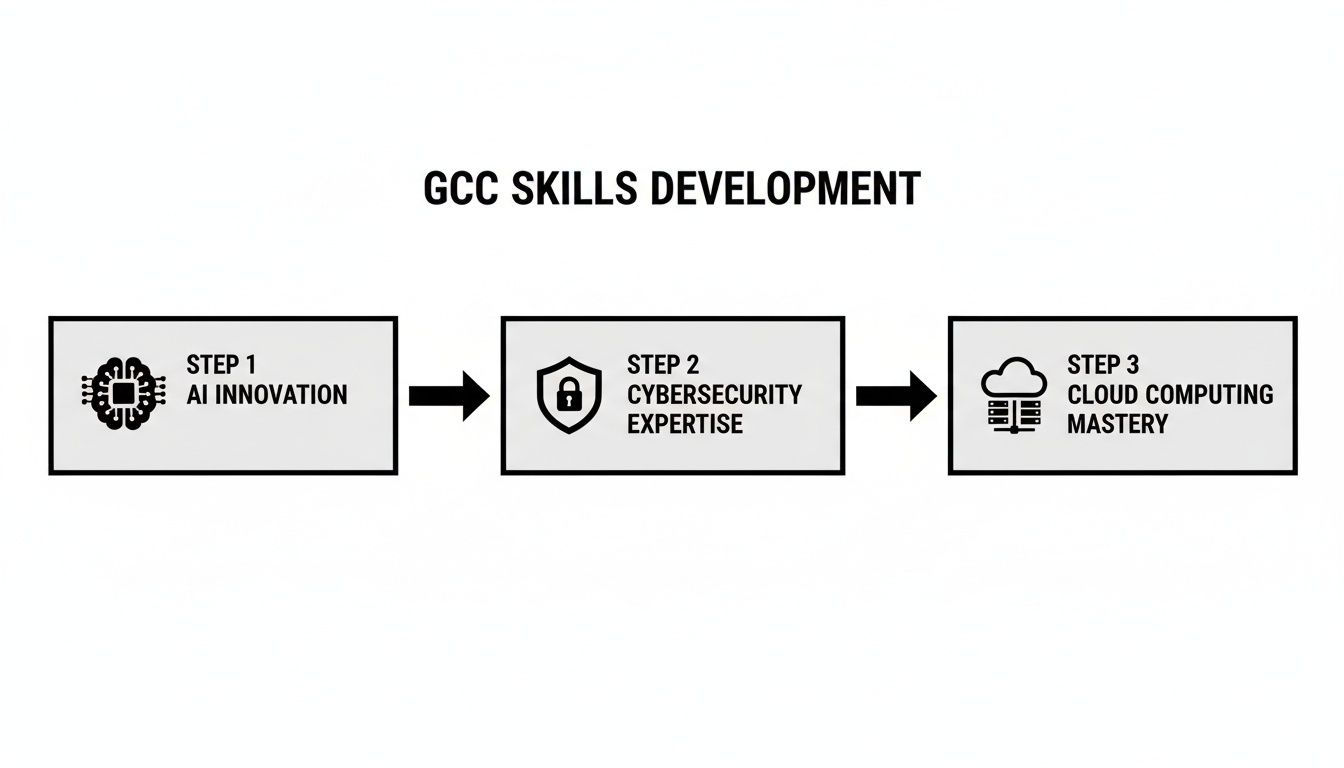
This flowchart lays out the core competencies AI, Cybersecurity, and Cloud that are absolutely central to a modern GCC’s success.
To build out this talent base, you need practical tools. A great place to start is with a skills matrix, a powerful framework for visualising capabilities across your teams and departments. It lets you see, at a glance, where your strengths and vulnerabilities lie. Check out our detailed guide on how to build and use a skills matrix for your organisation.
Then, follow up with structured methods to get objective data:
- Targeted Surveys: Ditch the generic questions. Instead of asking, “Are you proficient in Python?”, try asking, “Have you built and deployed a production-level application using Python in the last 12 months?”. This pushes for concrete evidence, not just self-perception.
- Technical Assessments: For hard skills like coding or cloud architecture, nothing beats practical assessments or simulated projects. They provide undeniable proof of an individual’s current capability level.
- 360-Degree Feedback: Gather input from peers, direct reports, and managers. This gives you a well-rounded view of an employee’s soft skills think collaboration, problem-solving, and leadership potential.
Gathering and Interpreting the Data
Once all the information is in, the real work begins: turning raw data into strategic insights. You’re looking for patterns to quantify the gaps. You might find, for instance, that your team has strong foundational knowledge in data analysis but is completely missing specific expertise in MLOps.
This level of detail is critical. It allows you to design interventions that are surgical, not general. A broad “AI training” programme is far less effective than a targeted workshop on deploying machine learning models at scale, delivered specifically to the team that needs it.
The point of a skills gap analysis isn’t just to find weaknesses. It’s to uncover hidden strengths and spot employees with high potential for upskilling into those critical future roles.
The urgency here is real. A recent report from our parent company, Quess Corp, flagged a significant 41% skills gap in AI, data, and analytics within the Indian market. This deficit is directly causing a 40% surge in project-based hiring, as companies scramble to find flexible, skilled talent to bridge immediate gaps while they work on building long-term capabilities.
By systematically running this analysis, you arm yourself with the data to make confident decisions. You’ll know exactly where to invest in reskilling, which roles demand external hires, and how to structure your teams for maximum impact. This transforms talent management from a reactive function into a proactive, strategic driver of business growth.
Crafting Your Build vs Buy Talent Strategy
So, you’ve done the hard work of a thorough skills gap analysis. You know exactly where your team stands and, more importantly, where the gaps are. Now comes the big question: how do you close them?
The answer isn’t a simple choice between training your existing people (‘build’) or hiring new talent (‘buy’). The most successful and resilient GCCs have mastered the art of doing both. This is about creating a smart, balanced strategy that blends internal development with strategic external hiring.
Deciding when to build and when to buy really boils down to a few key factors: urgency, cost, and the long-term impact on your business. Building talent by reskilling your current team is fantastic for morale and keeps valuable institutional knowledge in-house, but let’s be honest, it takes time. On the other hand, buying talent by hiring externally can parachute in fresh perspectives and specialised skills almost overnight. But it comes with a higher price tag and can sometimes disrupt your internal culture if you don’t manage the integration carefully.
Ultimately, the right mix is unique to your GCC’s specific goals.
Designing Impactful Internal Reskilling Programs
Investing in your current workforce sends a powerful message. It shows you’re committed to their growth, which is a huge driver for both engagement and retention. When it comes to the most critical future skills for GCCs, especially something like generative AI, this is simply non-negotiable. The aim here is to move beyond generic online courses and create structured learning pathways that deliver real, job-ready skills.
A good place to start is by setting a clear benchmark. For your highest-priority skills, aim for a minimum of 40 hours of dedicated GenAI training annually for every employee in a relevant role. And this isn’t just about watching videos; we’re talking about hands-on, project-based learning that sticks.
Here are a few practical ways to build a reskilling engine that actually works:
- Technology Bootcamps: Think intensive, cohort-based programmes focused on specific, high-demand areas like cloud security or MLOps. These immersive sprints can get a team’s proficiency up to speed incredibly quickly.
- Applied Learning Projects: This is crucial. Don’t let those newly acquired skills go to waste. As soon as someone is upskilled, get them onto a real-world project where they can apply what they’ve learned. This solidifies their knowledge and delivers immediate value back to the business.
- Internal Certifications: Create your own certification programmes for key skill sets. This not only gives employees a tangible validation of their new expertise but also establishes a clear, consistent standard of capability across the entire organisation.
One of the best ways I’ve seen to make learning stick is to build an environment where people teach each other. Setting up internal ‘Communities of Practice’ for disciplines like AI or cybersecurity allows employees to share what they know, swap best practices, and tackle problems together.
These communities turn learning from a top-down exercise into something organic and peer-driven. They quickly become your innovation hubs, where your most passionate experts can mentor others and accelerate skill development across the whole GCC.
Modernising Your External Hiring Tactics
While building up your internal team is essential for long-term health, some skills gaps are just too urgent or too specialised to fill from within. This is where a sharp ‘buy’ strategy comes into play. But in today’s competitive market, traditional recruiting methods just won’t cut it, especially when you’re hunting for niche talent.
The demand for certain skills is incredibly focused. For instance, recent data shows that cloud computing and digital infrastructure skills now make up 50% of all GCC hires in India. This has become the foundational skill set as these centres evolve into critical decision-making hubs. The same report flagged a massive 41% skills gap in AI and data often overlapping with cloud needs which is driving fierce competition for mid-to-senior level experts.
To win this war for talent, you need more than just a single line of attack.
Partnering with a Recruitment Process Outsourcing Provider
For many GCCs, bringing on a Recruitment Process Outsourcing (RPO) provider is a total game-changer. A modern RPO isn’t just another vendor; they act as a strategic extension of your own talent team. They bring deep market intelligence, established talent pipelines, and the sheer scale required to handle complex, high-volume hiring.
A great RPO partner can help you:
- Access Niche Talent Pools: They have teams of specialists who live and breathe sourcing for those hard-to-fill roles, like AI Governance Specialists or Offensive Security Engineers.
- Build a Flexible Talent Ecosystem: An RPO can help you construct a blended workforce of permanent hires, project-based contractors, and contract-to-hire professionals. This gives you the agility to scale capabilities up or down as your business demands.
- Enhance Your Employer Brand: They’ll work alongside you to craft and amplify a compelling employer value proposition that truly speaks to the top-tier technical talent you’re trying to attract.
In the end, crafting your build-versus-buy strategy is about creating a dynamic talent ecosystem. By investing in meaningful reskilling, you cultivate a loyal and highly capable internal workforce. At the same time, by using modern hiring tactics and strategic partners like an RPO, you can inject critical new skills into your organisation exactly when and where you need them most. It’s this dual approach that will ensure your GCC has the resilience and capability to lead, not just follow.
Weaving Continuous Learning into Your GCC Culture

Let’s be honest: one-off training programmes don’t work. No matter how well-designed, they rarely create lasting change. Real capability building happens when learning is woven into the very fabric of your GCC’s daily operations. To truly master the future skills for GCCs, you have to shift from isolated training events to a self-sustaining ecosystem of constant development.
This isn’t about big budgets; it’s about mindset and infrastructure. It means creating an environment where curiosity is rewarded, sharing knowledge is easy, and skill development is part of everyone’s job, not an occasional interruption. Get this right, and learning becomes a powerful, self-perpetuating engine for growth.
Leaders Must Champion Learning
A learning culture starts at the top. When senior leaders visibly and consistently champion continuous development, it sends a clear signal that this is a strategic priority, not just another HR initiative. This means more than just signing off on training budgets it requires active participation and advocacy.
Think about the impact when a GCC head regularly shares articles or key takeaways from a tech webinar with their team. This simple act shows that learning is for everyone, regardless of their role.
Leaders can actively nurture this environment by:
- Celebrating learning wins: Publicly recognise employees who earn a new certification or apply a new skill to solve a real business problem.
- Making time for learning: Formally block out time for learning activities, protecting it from the crush of daily deadlines.
- Leading by example: Join training sessions alongside their teams. It shows vulnerability and a genuine commitment to their own growth.
Make Learning Accessible and Relevant
Technology is your greatest ally here. The goal is to make it effortless for employees to access relevant, bite-sized content exactly when they need it. Think of it as creating an internal “Netflix” for skills, where learning is on-demand and personalised.
Building a learning culture is about changing behaviour, not just buying a platform. The best technology is useless if skill development isn’t tied directly to career progression, rewards, and opportunities for high-impact work.
This means going beyond a simple library of courses to create a connected learning ecosystem. For example, you could integrate your learning platform with project management tools. When a team member gets assigned a task involving a new technology, the system could automatically suggest relevant micro-learning modules. This kind of contextual learning is far more effective than generic training.
Connect Learning with Performance and Governance
For learning to stick, it has to have real consequences. Employees are far more motivated to engage when skill development is directly tied to performance reviews, promotions, and access to exciting new projects. This closes the loop between effort and reward, turning learning from a nice-to-have into a must-do.
This also applies to governance and ethics, which are becoming critical skills. India’s GCC landscape is facing a massive skills shortage in cybersecurity, pushing CHROs to enforce new upskilling mandates. A standard of 40+ hours of annual GenAI training is now common, but this is expanding to include cyber ethics. In fact, a projected 60% of GCCs will establish dedicated compliance teams by 2026.
Tying critical training modules like these to performance goals ensures the organisation builds the necessary muscle not just in technical areas, but in responsible and secure operations.
When you embed learning into your cultural DNA championed by leaders, enabled by tech, and linked to tangible outcomes you create a resilient GCC that’s ready for any future challenge.
Your Burning Questions on GCC Talent Answered
As a CHRO or a talent leader steering a Global Capability Centre (GCC), you’re probably grappling with a few tough questions. How do you hold onto talent after you’ve invested so much in them? What’s the real role of a partner in this new landscape? And how on earth do you prove the investment was worth it?
These are the exact conversations we’re having with leaders on the ground. Let’s get straight to the answers.
How Can We Retain Top Talent After Upskilling Them?
This is the big one, isn’t it? It’s the question that keeps leaders up at night. You spend a small fortune training a star employee in a hot-ticket skill like AI or cloud security, only to see their LinkedIn profile light up with recruiter messages.
The secret to retention post-upskilling isn’t complicated: it’s opportunity.
There is nothing more frustrating for an employee than learning a game-changing new skill and then being sent back to their old desk to do the same old work. They need to be able to use what they’ve learned immediately, on projects that matter, where they can see the impact of their new capabilities.
This has to be backed by clear career paths. The message should be simple: new skills lead directly to promotions, more responsibility, and of course, better pay.
Retention is less about locking the doors and more about building a place people don’t want to leave. It’s a proactive game of creating growth, impact, and genuine recognition.
Here are a couple of practical ways to make this happen:
- Launch ‘Communities of Practice’. These are internal groups where your newly skilled experts can connect, share what they’ve learned, and mentor others coming up the ranks. It builds a sense of belonging and keeps the learning alive.
- Benchmark salaries relentlessly. For these high-demand roles, you have to stay competitive. Don’t lose your best people over a preventable pay gap.
What Is the Role of an RPO Partner in This New Era?
Forget the old idea of a transactional recruiter. A modern Recruitment Process Outsourcing (RPO) partner is your strategic talent advisor. For GCCs trying to hunt down scarce future skills for GCCs, a great RPO acts as your intelligence unit in the talent market.
They are your eyes and ears, feeding you real-time data on who has the skills you need, what they expect to be paid, and what your competitors are up to.
But their value goes much deeper. They build targeted talent pipelines for those hyper-niche roles you can’t find on job boards, like AI Governance Architects or Cloud FinOps Specialists. This gives you a direct line to passive candidates the ones who aren’t even looking.
An RPO also brings agility. Need to scale up a team for a six-month project? They can source contract or contract-to-hire professionals, giving you world-class capability without the long-term overhead. This partnership frees your internal HR team to focus on what they do best: developing your people, planning for the future, and strengthening your company culture.
How Do We Measure the ROI of Our Skills Programmes?
Proving the return on your skills investment isn’t about just one metric. It requires a multi-layered approach that clearly connects the training room to the balance sheet. Forget simple completion rates; we need to track real business impact.
First, look at your direct talent metrics.
- What’s your internal fill rate for senior tech roles now?
- How has the promotion rate for upskilled employees changed?
- Are you seeing a reduction in time-to-hire for key positions because you have a ready-made internal talent pool?
Second, draw a straight line from the training to business performance. Start correlating project success rates, innovation output (like new patents filed or product features launched), and efficiency gains directly to the teams that completed the upskilling. For example, you can measure the drop in operational costs in your Digital Risk Analytics team after they went through a targeted AI programme.
Finally, keep a close eye on employee engagement and attrition rates among those who participated in the training. Better retention isn’t just a “nice to have” it’s a massive financial win. It proves that investing in your own people is one of the smartest business decisions you can make.
At Taggd, we’re in the business of helping GCCs build resilient, future-ready teams. Our RPO solutions are designed to find and secure the critical talent that will drive your innovation and growth. Learn how we can build your strategic talent pipeline.