When we talk about gig workforce models for automotive, we’re describing a fundamental move away from only using traditional, full-time hiring. Instead, it’s about strategically bringing in flexible, on-demand talent. It’s a way for companies to tap into specialised skills right when they’re needed, especially as the market races towards EVs and autonomous technology. This approach is what keeps automakers and their suppliers agile and competitive.
Why the Automotive Industry Needs a More Agile Workforce
Think of your company’s workforce as a high-performance engine. For decades, that engine ran just fine on a single type of fuel: permanent, full-time employees. This model gave the industry stability and predictability, powering it through generations of slow-and-steady product cycles.
But today’s automotive world is completely different. The frantic race towards electric vehicles (EVs), autonomous driving, and software-defined cars demands a more dynamic, hybrid system. The old, rigid hiring engine is just struggling to keep up.
This old engine starts to sputter when it has to deal with:
- Rapidly Evolving Skill Demands: The industry now needs experts in battery chemistry, AI/ML, and infotainment UX. These aren’t skills you typically find in a pool of mechanical engineers.
- Project-Based Innovation: Building a new battery management system or an ADAS feature is a project with a clear start and end. It doesn’t always make sense to create a permanent role for it.
- Market Volatility: Sudden shifts in what customers want or major supply chain disruptions mean you need to scale teams up or down fast, without the heavy burden of permanent payroll costs.
Sticking with the old way of hiring just creates innovation bottlenecks and makes skill gaps even wider. Spending a whole year searching for one niche expert means you’ve lost an entire year of development. This is exactly why integrating gig workforce models for automotive is no longer just a trend it’s a critical survival strategy.
The Indian Automotive Boom Demands Flexibility
This need for a more agile workforce is incredibly apparent in high-growth markets like India. In FY25 alone, the country’s vehicle production shot past 3.1 crore units, and EV sales jumped by a massive 45% year-on-year in the first quarter.
With India aiming for 30% EV penetration by 2030, the demand for specialised talent in EV manufacturing, battery tech, and autonomous systems is exploding. For CHROs, these numbers make it clear that traditional hiring alone simply cannot keep up with the demand for scaling the automotive workforce effectively.
Adopting a more flexible talent strategy isn’t just about plugging temporary holes. It’s about building a resilient, future-ready organisation that’s capable of leading the next wave of automotive innovation.
Understanding Different Gig Workforce Models
To really tap into the power of flexible talent, you have to see the different gig workforce models as specialised tools in a strategic toolbox. Each model is built for a specific job, giving you a unique way to bring in skills and manage projects. Just saying you’ll hire “gig workers” isn’t a strategy; the real win comes from picking the right model for the task at hand.
Your choice will hinge entirely on the work itself, how much control you need, and the business outcome you’re chasing. Let’s break down the main options you have as an automotive leader.
The Freelancer Model
Think of the Freelancer Model like hiring a top-tier surgeon for a single, complex procedure. This is where you directly engage an independent professional for a specific, often niche, project with a very clear scope. These folks are experts in their field, bringing deep knowledge you might not need on your permanent payroll.
A perfect automotive example? Hiring an independent infotainment UX designer on a six-month contract to completely overhaul the user interface for a new EV. You get elite expertise right when you need it, without the long-term overhead of a full-time hire. This direct engagement is ideal for snapping up high-demand, specialised skills in a hurry.
The diagram below really drives home the pressures pushing the industry toward these kinds of agile talent solutions.
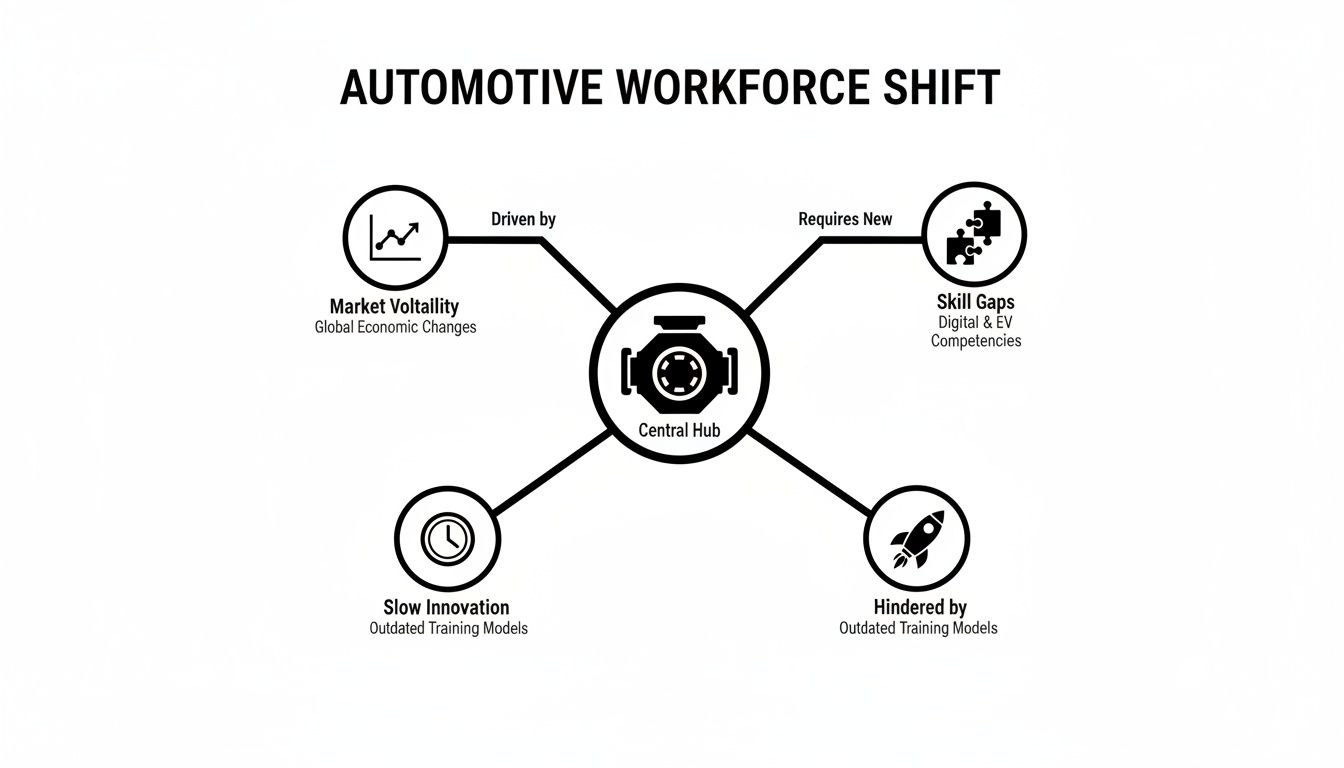
As you can see, the combination of market volatility, widening skill gaps, and the constant need to innovate faster all point to one thing: the need for a more flexible workforce.
The On-Demand Platform Model
Now, what if you need to quickly scale up a team for a repeatable task that requires a lot of hands on deck? The On-Demand Platform Model is like a dial you can turn up or down as your needs change. These platforms connect you to a large, pre-vetted pool of workers for short-term gigs, all managed through an app or web portal.
For example, a manufacturer could use an on-demand platform to find 100 certified vehicle inspectors for two weeks to handle a surge in post-production quality checks during a new model launch. The platform takes care of the sourcing, vetting, and payments, offering incredible scalability and efficiency. It’s the perfect fit for roles that see massive swings in demand.
The Statement of Work (SOW) Model
Finally, let’s look at the most project-focused approach: the Statement of Work (SOW) Model. This isn’t so much about hiring individuals as it is about outsourcing an entire project outcome. You define the “what” the deliverables, timeline, and budget and the vendor takes care of the “how” by managing their own team, processes, and execution.
This model shifts your focus from managing people to managing results. For a complex, multi-faceted project, an SOW provides crystal-clear accountability and transfers the execution risk to a vendor who brings their own team of specialists to the table.
A classic automotive use case is engaging a specialised engineering firm through an SOW to develop a new battery management system module. The agreement nails down the performance targets, integration requirements, and delivery date. This frees up your core team to focus on their own priorities, all while knowing the project is in expert hands.
Comparing Gig Workforce Models in an Automotive Context
To make the choice clearer, this table breaks down the key characteristics, ideal use cases, and management considerations for each gig model within an automotive setting.
| Model Type | Ideal Automotive Use Case | Pros | Cons |
|---|---|---|---|
| Freelancer Model | Hiring a niche expert like a cybersecurity analyst for vehicle software or an EV battery chemist for R&D. | Fast access to specialised, high-demand skills. Direct relationship with the expert. | High hourly/project rates. Requires internal management and project oversight. |
| On-Demand Platform Model | Scaling up for vehicle delivery drivers, event staff for auto shows, or quality control inspectors during a production spike. | Extreme scalability and flexibility. Platform handles admin tasks like payments and vetting. | Best for standardised, repeatable tasks. Less control over individual worker selection. |
| Statement of Work (SOW) Model | Outsourcing the development of a new mobile app, a full marketing campaign for a model launch, or a supply chain audit. | Focus on outcomes, not headcount. Transfers project execution risk to the vendor. Clear budget and timeline. | Less direct control over the day-to-day process. Requires a well-defined scope from the start. |
Each of these models offers a distinct advantage. The key is to match the model to the specific business need, ensuring you have the right kind of talent, with the right level of oversight, to get the job done effectively.
The Strategic Benefits of a Flexible Workforce
For a CHRO in the automotive world, a flexible workforce isn’t just a modern HR tactic; it’s a strategic lever that pulls on the entire business. Embracing different gig models delivers measurable results that speak directly to the bottom line, giving your organisation tangible wins in three critical areas: speed, cost, and innovation. These aren’t just buzzwords; they are direct solutions to the most pressing challenges in the auto sector today.
The most immediate payoff is lightning-fast access to highly specialised, niche skills. Picture this: your team is engineering a new EV and suddenly hits a wall with battery thermal management. Going the traditional route to hire a full-time expert could easily burn the better part of a year. By tapping into a freelancer or SOW model, you can bring a world-class thermal management specialist on board for a six-month project and have them start within weeks.
Gain a Competitive Edge with Speed and Innovation
That kind of speed is a game-changer. In an industry where time-to-market can make or break a product’s success, slashing development timelines gives you a massive competitive advantage. Instead of a long, drawn-out search, you get the exact expertise you need, right when you need it, keeping your projects on schedule and leaving competitors in the rear-view mirror.
Beyond just speed, a flexible workforce gives you incredible cost agility. Think about the organised chaos of a new vehicle launch. It demands a huge, but temporary, army of quality control inspectors, vehicle delivery drivers, and event staff. Hiring these roles permanently would saddle the business with immense, unnecessary overhead once the launch window closes.
By using on-demand platforms, you can scale your quality control team by 200% for a three-month peak period and then seamlessly scale back down without carrying the long-term burden of salaries and benefits. A huge fixed cost is transformed into a variable, on-demand expense.
Finally, integrating external experts sparks a culture of genuine innovation. Your in-house teams are brilliant, no doubt. But they can sometimes get boxed in by institutional knowledge and the “way things have always been done.” Bringing in an outside expert who has already tackled similar engineering problems for other manufacturers introduces fresh eyes and new ways of thinking.
This cross-pollination of ideas is often the key to cracking stubborn engineering challenges, whether in software-defined vehicle architecture or advanced materials science. This infusion of outside expertise doesn’t just solve an immediate problem; it upskills your existing team, leaving a lasting impact long after the gig worker’s project is complete. This strategic use of gig workforce models for automotive ultimately shortens your innovation cycles and accelerates your organisation’s ability to deliver the next big thing.
Navigating Compliance and Co-Employment Risks in India

For many CHROs I talk to, the biggest hurdle to embracing gig workforce models for automotive isn’t about finding quality talent; it’s the fear of legal headaches. That line between a true independent contractor and a misclassified employee can feel incredibly blurry, sparking worries about co-employment risks, hefty fines, and drawn-out legal battles. And in India, with labour laws racing to keep pace with the on-demand economy, those concerns are completely valid.
The heart of the risk lies in misclassification. This is what happens when a gig worker is treated like a full-time employee in practice, but denied the statutory benefits that come with it, like Provident Fund (PF), gratuity, and insurance. The deciding factor almost always comes down to one thing: control. The more you dictate how the work gets done, not just what the final result should be, the more that relationship looks like traditional employment to the authorities.
Think of it this way: you commission an artist to paint a specific car model. You set the canvas size, the subject, and the deadline. But you don’t stand over their shoulder telling them which brush to use or insisting they work from 9 AM to 5 PM in your office. That’s the fundamental difference you need to maintain.
The Indian Labour Code Context
India’s new labour codes are finally starting to formally recognise “gig workers” and “platform workers,” which is a huge step forward. While this gives them a legal definition, it also places new responsibilities on companies. The main goal is to bring this growing workforce into the social security net without taking away the flexibility they signed up for.
For an automotive company, this means you can’t just slap a “freelancer” label on someone and wash your hands of all obligations. It requires a mental shift from supervising employees to managing vendors. Instead of micromanaging tasks, your focus must be on defining clear, project-based outcomes. The government’s direction is clear: create a safety net for these workers. Companies that get ahead of this will be in a much stronger position to avoid compliance nightmares. To see where things are headed, you can read about industry suggestions on the Rajasthan gig workers’ law, which provides a great preview of future national policies.
Key Takeaway: The legal landscape is shifting towards a model where companies share responsibility for the social security of their gig workers. Ignoring this trend isn’t just risky; it’s a potential liability. Proactive compliance is your best strategy.
A Practical Checklist for Engaging Gig Workers
To build a compliant and successful flexible workforce in India, your primary job is to maintain that clear boundary between independent contractors and employees. Use this straightforward ‘dos and don’ts’ checklist to guide your contracts and daily management practices.
Do This:
- Focus contracts on deliverables: Your agreements should be crystal clear about the project scope, the specific outcomes you expect, and the deadlines.
- Allow worker flexibility: Gig workers need to control their own work hours and location, unless a project absolutely requires them to be on-site (like a factory audit).
- Permit them to work for others: A true freelancer can, and often does work for multiple clients, sometimes even your competitors. Your contract shouldn’t prevent this.
- Pay per project or deliverable: Structure payments around key milestones or the final project completion, not by the hour.
Don’t Do This:
- Dictate daily work hours: Stay away from setting fixed schedules or requiring them to join daily team huddles designed for your permanent staff.
- Provide extensive training: Gig workers are hired for the skills they already have. Forcing them into mandatory, company-specific procedural training muddies the waters.
- Supply primary tools and equipment: Contractors are expected to bring their own tools to the job, whether it’s a laptop, specific software, or other equipment.
- Include them in employee performance reviews: Their performance should be judged against the contract’s deliverables, not your internal employee evaluation system.
Building Your Automotive Gig Workforce Strategy
Shifting to a more flexible workforce model doesn’t mean you have to tear down your existing talent structure and start from scratch. The smartest way forward is a phased, manageable roadmap that kicks off with a small, contained project and builds on its wins. Think of it less like a factory demolition and more like adding a new, high-performance wing onto your current facility.
The journey starts by designing a low-risk pilot project. The real goal here is to prove the concept in a controlled setting, gather hard data, and build confidence within your teams. By starting this way, you create a powerful internal case study that makes it much easier to get buy-in for wider adoption.

Designing Your Low-Risk Pilot Project
First things first: find a single department with a clear, project-based need. Your R&D or software development teams are often perfect candidates for this. You’re looking for a challenge that is well-defined, has measurable outcomes, and can be wrapped up within a 3-6 month timeframe.
A few ideal pilot projects could be:
- Developing a specific software module: For instance, hiring a freelance cybersecurity expert to run a penetration test on a new infotainment system.
- Conducting market research: Engaging a small team on an SOW to analyse competitor strategies for a new EV model launch in a specific region.
- Creating technical documentation: Contracting a specialist technical writer to develop user manuals for a newly designed powertrain component.
Once you’ve picked your project, define what success looks like right from the get-go. This could be hitting project milestones on time, staying within budget, or the quality of the final deliverable. This sharp focus on outcomes is fundamental to successfully managing gig workforce models for automotive.
The timing for this shift couldn’t be better. India’s gig workforce is seeing explosive growth, projected to swell from 7.7 million workers in FY21 to 12 million by FY25. This surge is fuelled by widespread smartphone penetration among over 800 million users and mature digital payment systems, creating a deep and accessible talent pool. For talent leaders, this expansion confirms that flexible engagement models are becoming an essential part of the modern talent playbook.
Selecting the Right Technology and Process
With a pilot project scoped out, the next step is to choose the right tools and set up clear processes. Trying to manage freelance talent through traditional HR systems built for full-time employees is a recipe for friction, inefficiency, and compliance headaches.
A dedicated Freelancer Management System (FMS) is your central command centre. It streamlines everything from sourcing and vetting talent to contract management, payments, and performance tracking, ensuring a consistent and compliant process.
Finally, you need to create a seamless onboarding experience. While it should be different from your employee onboarding, it must effectively integrate gig workers into your core teams and workflows. This process should cover:
- Project-Specific Briefing: Clearly communicate the project goals, key deliverables, who to contact for what, and the project timeline.
- Systems Access: Provide the necessary access to project management tools, communication channels (like Slack or Microsoft Teams), and any relevant data.
- Team Introduction: Run a kickoff meeting to introduce the gig worker to key internal stakeholders. This establishes clear lines of communication and a sense of team from day one.
This structured, step-by-step approach takes the guesswork out of the equation, giving you the confidence to start building your agile workforce with minimal disruption.
Measuring the ROI of Your Gig Talent Program
If you want to get and keep executive buy-in for your gig talent program, you have to talk their language. That means moving past familiar recruiting metrics like cost-per-hire. The C-suite isn’t just interested in what you spend; they want to see a clear return on investment (ROI) that ties directly into the company’s biggest goals.
You need to show them precisely how using gig workforce models for automotive is making the business faster, more cost-effective, and more innovative. Think of it as building a new kind of business case, backed by numbers that truly matter to leadership.
Strategic KPIs for C-Suite Impact
To really show the value of a flexible workforce, you need a mix of operational and strategic metrics. These key performance indicators (KPIs) tell a powerful story about the agility and performance your program delivers.
Here are the metrics that will get their attention:
- Time-to-Fill for Specialised Roles: This is a huge one. Contrast the weeks it takes to bring on a gig expert say, an ADAS software engineer with the months it can take to find and onboard a permanent hire. This is a direct measure of how you’re accelerating critical projects.
- Project Milestone Achievement Rate: Are projects staffed with gig talent hitting their deadlines? Track the percentage that meet or even beat their targets. This proves your on-demand workforce isn’t just a backup plan; it’s a reliable engine for getting things done.
- Cost of Agility: This metric hits right at the bottom line. Calculate the direct savings from not having to cover fixed salaries, benefits, and other long-term overheads for roles that are purely project-based. It’s the tangible financial upside of being able to scale your teams on demand.
By focusing on these outcomes, you completely change the conversation. It’s no longer about, “How much did we spend on contractors?” but rather, “How much faster and more efficiently did we hit our targets because we had this agile talent?”
Don’t forget to track the impact on innovation, either. You can put a number on this by monitoring how many new features are developed or how many complex engineering problems are solved by your gig specialists. For a closer look at the nuts and bolts of measurement, you can learn more about how to track and analyse the ROI of your recruiting efforts in our detailed guide.
Put together, these numbers build an undeniable business case for a more modern, flexible workforce.
Frequently Asked Questions
Let’s tackle some of the common questions we hear from CHROs and RPO buyers when they start looking at gig workforce models for the automotive sector. Here are some quick, practical answers to clear things up.
How Do We Ensure Knowledge Transfer from Gig Workers?
This is a big one. You can’t just let a contract end and watch valuable insights walk out the door. Effective knowledge transfer needs a structured offboarding process to capture the value your gig worker created.
A great first step is making comprehensive documentation a final, non-negotiable deliverable for the project. This document should lay out their processes, key findings, and any solid recommendations for what comes next.
Organise formal ‘debriefing sessions’ where the gig worker presents their project outcomes to your core team. This is a golden opportunity for direct Q&A and makes sure that institutional knowledge stays right where it belongs, with you.
On top of that, you can also:
- Create a Central Hub: Use a shared knowledge base or a project management tool. This becomes the single source of truth where all project-related assets live for anyone who needs them in the future.
- Appoint a Liaison: Pair one of your full-time employees with the gig expert. This person acts as a ‘project liaison’ and can absorb knowledge naturally throughout the entire engagement.
Can Gig Models Work for Core Manufacturing Roles?
Absolutely, though maybe not in the way you’re thinking. While gig work is more common for specialised, white-collar roles, it’s gaining traction for specific tasks right on the shop floor. It’s less about replacing your core assembly line workforce and more about adding flexible muscle where you need it most.
Think about using it for temporary roles during production ramp-ups, or hiring a specialised machine operator for a limited product run. You might even bring in a dedicated team for a short-term quality inspection project. The real win here is using on-demand talent to handle fluctuating production demands without bumping up your fixed overheads. Just remember, in these situations, rock-solid safety and compliance training are non-negotiable.
What Is the Best First Step to Explore a Gig Workforce Model?
Start small. The best way to dip your toes in the water is with a low-risk pilot project. Find a single, clearly defined business problem that an outside specialist could solve. This approach lets your team learn the ropes of sourcing, onboarding, and managing a gig worker without causing any major disruption.
Pick a project with crystal-clear deliverables and a timeline of about 3-6 months. For example, you could hire a freelancer to develop a new software feature or conduct targeted market research for an upcoming model. The success of this small-scale pilot will give you the hard data and confidence you need to roll it out more widely.
Ready to build a more agile and competitive automotive workforce? Taggd specialises in Recruitment Process Outsourcing that connects you with the right talent, right when you need it. Discover how our tailored solutions can drive your talent strategy forward