If you’re still using the same old hiring playbook to find sales executives in 2026, it’s time for a serious rethink. Let’s be frank: the old methods are broken. The current market isn’t just competitive; it’s grappling with a severe talent mismatch that’s leaving critical revenue-driving roles wide open and putting the brakes on growth.
To win today, you need to ditch the reactive, post-and-pray approach. Success now demands a proactive, data-informed strategy that focuses on what truly matters: objective competencies and real-world performance.
The Urgent Need to Rethink Sales Hiring
For CHROs and talent leaders across India, the pressure to land top-tier sales talent has never been more intense. The challenge isn’t just about competition; it’s a fundamental misalignment between what companies need and the skills candidates bring to the table. This isn’t just a minor recruiting headache, it’s a strategic crisis threatening your revenue targets and expansion plans.
Relying on the traditional cycle of posting a job, sifting through résumés, and getting swayed by interview charisma is a recipe for failure. The best sales reps aren’t always actively looking, and a polished CV is no guarantee they can actually hit their quota. This outdated model leads to painfully slow hiring cycles, costly mis-hires, and mounting frustration for everyone from the hiring manager to the C-suite.
The Great Indian Talent Mismatch
At the heart of the problem is a gaping chasm between corporate needs and the available talent pool. As Indian companies push for aggressive expansion, sales executives are at the forefront of this hiring boom, accounting for a staggering 42% of all new roles.
Yet, while job openings have surged, employers are finding it incredibly difficult to connect with candidates who have the practical, on-the-ground skills to succeed. For a deeper look at this trend, you can explore the full report on 2026 job trends from India Today.
The table below paints a clear picture of the market forces at play, highlighting why a strategic shift is no longer optional for CHROs.
Key Sales Hiring Statistics in India for 2026
| Metric | Statistic | Implication for CHROs |
|---|---|---|
| Share of New Roles | 42% of all new job openings are for sales executives. | Your recruiting team is likely overwhelmed. Prioritising and optimising sales hiring is critical. |
| Talent Scarcity | 68% of employers report difficulty finding skilled candidates. | The right talent won’t just apply. A proactive sourcing strategy is non-negotiable. |
| Cost of a Bad Hire | Can cost up to 2.5x the employee’s annual salary. | The risk of getting it wrong is too high. A robust assessment framework is essential. |
| Time to Fill | Average time to fill a sales role is now 45 days. | Every day a role is open, revenue is lost. You need a more efficient hiring process. |
This data confirms what many talent leaders are already feeling: the old way of hiring simply can’t keep up with the demands of today’s market.
Moving from Reactive to Proactive Hiring
This disparity is forcing a much-needed change in perspective. Leaders can no longer afford to be reactive, waiting for candidates to come to them. The modern playbook for hiring sales executives demands a fundamental shift towards a proactive and strategic talent acquisition function. It’s about building a continuous pipeline of great talent, even when you don’t have an immediate opening.
A proactive approach means truly understanding the market, pinpointing the specific competencies that drive success in your organisation, and building a machine that consistently attracts and assesses top performers. It involves looking beyond traditional talent pools and exploring new, often unconventional, sourcing channels.
The goal is to transform your hiring process from a transactional function that simply fills empty seats into a strategic weapon that fuels predictable revenue growth. This playbook is your guide to making that transition.
This guide will walk you through a clear framework for building a high-performance sales team. We’ll cover everything from defining the role and building a solid competency model to crafting a multi-channel sourcing strategy that actually works. By the end, you will have an actionable plan to hire sales executives who not only meet but smash expectations, ensuring your company can capture the immense growth opportunities ahead.
Defining Your Next Great Sales Hire
Before you even think about writing a job description, stop. The single biggest mistake in hiring sales executives is rushing this first step. You have to define what a top performer actually looks like for your specific business, right now. Simply downloading a generic template is a surefire path to mediocrity. In today’s market, success demands a precise, modern competency model that reflects the realities of selling in 2026.
This initial definition is the bedrock of your entire hiring process. Get it wrong, and your hiring team will operate on subjective biases and gut feelings, leading to inconsistent interviews and, ultimately, costly mis-hires. Getting this right from the start aligns everyone and sharpens every subsequent step.
This is exactly how companies end up with a revolving door in their sales department. They rely on outdated playbooks to find talent and wonder why it’s not working.
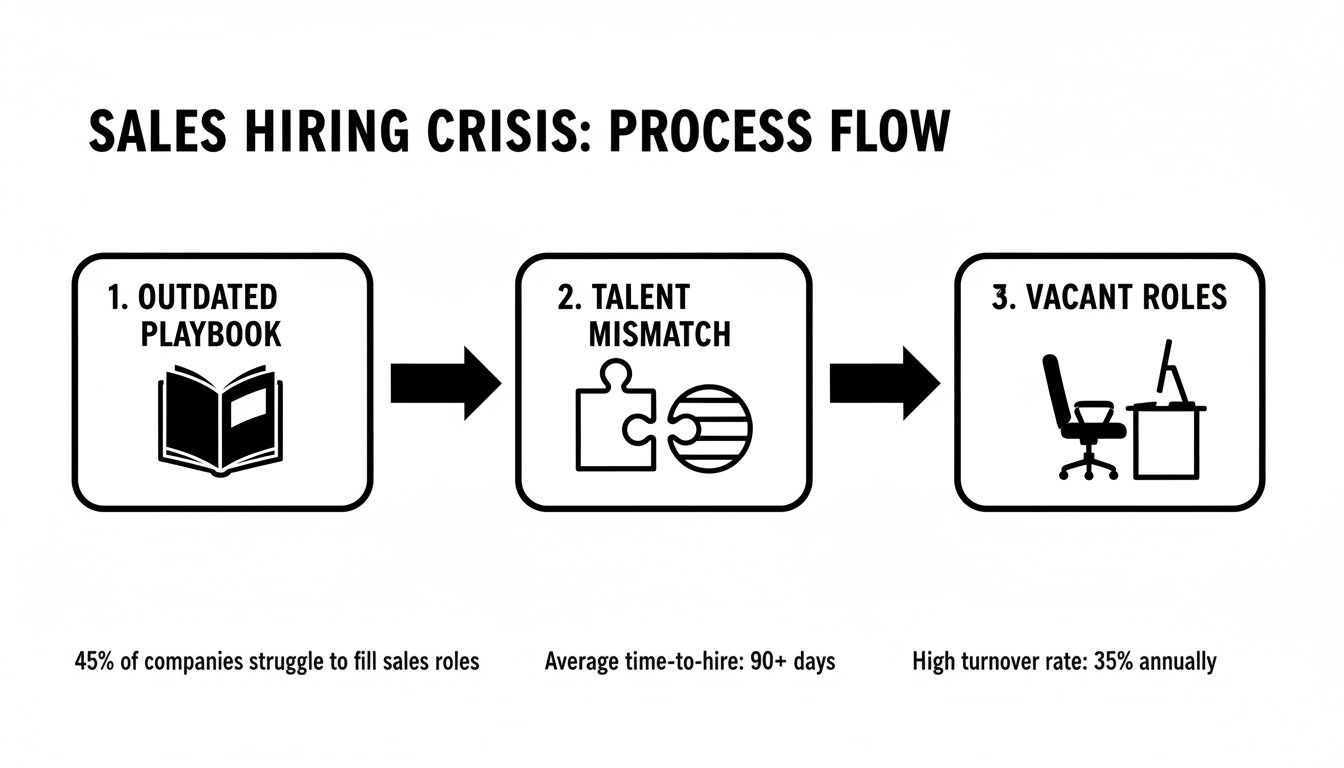
As you can see, starting with a fuzzy or outdated strategy inevitably creates a talent mismatch. That mismatch is what leaves critical, revenue-driving roles sitting vacant for months on end.
Moving Beyond the Generic Job Description
A great sales executive profile is much more than a simple list of duties. It’s a detailed scorecard that breaks down the role into its core components. This ensures everyone from HR to the sales director is assessing candidates against the same objective criteria.
Your goal here is to build a profile that answers one key question: “What do our top 10% of reps do that the rest don’t?”
To get started, ditch the vague, unhelpful traits like “go-getter” or “people person.” Instead, zero in on observable behaviours and measurable skills. The very best sales profiles I’ve seen are always built on three pillars.
- Core Competencies: These are the fundamental, non-negotiable skills required to even do the job.
- Performance Outcomes: These are the tangible, measurable results the person absolutely must achieve.
- Behavioural Traits: These are the soft skills and attitudes that predict cultural fit and long-term success on your team.
Identifying Must-Have Versus Nice-to-Have Traits
One of the most critical exercises in this whole process is separating the non-negotiable requirements from the desirable extras. This simple step prevents you from accidentally disqualifying high-potential candidates who just happen to lack a minor, teachable skill.
A simple way to do this is to create a tiered list. For instance, if you’re trying to hire sales executives for a fast-growing SaaS company, your list might look something like this:
Must-Haves (Non-Negotiable)
- CRM Fluency: They must have proven experience managing a pipeline, tracking activities, and reporting on metrics within a modern CRM like Salesforce or HubSpot. No exceptions.
- Quota Attainment: We need to see a verifiable track record of meeting or exceeding sales targets in a similar B2B role for at least two consecutive years.
- Consultative Selling: They have to demonstrate experience using a question-based sales methodology to uncover customer pain points and build value.
Nice-to-Haves (Teachable or Desirable)
- Experience in our specific vertical (e.g., FinTech, EdTech).
- Familiarity with advanced sales tools like Gong or SalesLoft.
- A large, pre-existing network of contacts in our target market.
This distinction is absolutely vital. A candidate with an incredible record of quota attainment can learn your industry quickly, but a candidate with industry experience who has never consistently hit their number is a much, much bigger risk. For more guidance on this, our in-depth article on understanding sales executive roles and responsibilities is a great resource.
A role scorecard is not a wish list; it’s an objective blueprint. It forces you to prioritise what truly drives revenue and prevents the hiring process from being derailed by personal preferences or unconscious bias.
Ultimately, building a detailed role profile is the most strategic move you can make before you hire sales executives. It transforms hiring from a subjective guessing game into a predictable process designed to find individuals who will not just fit in, but excel. By investing the time upfront to define success with this level of clarity, you create a powerful filter that dramatically increases your odds of making a fantastic hire.
Finding and Engaging Top Sales Talent
Let’s be honest: the best sales professionals are rarely browsing job boards. They’re too busy hitting their quotas and delivering results for their current employers. If you want to hire true top-performers, you can’t just post a job and wait for the magic to happen. You have to become a hunter.
This means building a multi-channel sourcing strategy that actively seeks out and engages the best talent, whether they’re looking for a new role or not. It’s about creating a robust, consistent pipeline of high-quality candidates, giving you a massive strategic advantage the moment a role opens up.
Think Beyond the Job Posting
Relying on job portals mainly attracts active candidates, people who are either unemployed or unhappy in their current role. While you might find good people there, the absolute elite performers are almost always passive candidates. They need to be convinced that your opportunity is better than the one they already have.
A modern sourcing strategy means running several channels at once.
- AI-Powered Talent Intelligence: These platforms are game-changers. They use AI to scan millions of professional profiles, identifying candidates who fit your competency model with incredible precision. They go way beyond simple keywords, analysing career progression, skills, and performance indicators to surface people you’d otherwise never find.
- Professional Networks: LinkedIn is still a powerhouse, but just sending generic InMails won’t cut it. Success here means building a genuine presence. You need to engage with industry content, build relationships, and use tools like Sales Navigator to create highly targeted lists of prospects.
- Employee Referral Programmes: Your best reps know other great reps. A well-structured, properly incentivised referral programme is consistently one of the most effective ways to hire sales talent. These candidates often come pre-vetted, are a stronger cultural fit, and tend to have much higher retention rates.
Crafting Outreach That Actually Gets Read
Top sales reps get hammered with generic recruiting messages every single week. To get their attention, your outreach has to be different. It needs to be personal, add value, and focus on them, not you.
Ditch the lazy “I came across your profile” opening. Instead, lead with an insight that proves you’ve actually done your homework.
Here’s an example that works:
Subject: Your work at [Candidate’s Current Company] & our team at [Your Company]
Hi [Candidate Name],
I was impressed by your recent post on [Topic] and noticed your experience scaling the enterprise segment at [Candidate’s Current Company]. We’re tackling a similar challenge here at [Your Company] as we expand our footprint in the [Industry] market.
Our top reps value the career growth and direct impact they have here. Given your background, I believe a confidential conversation about our direction could be very interesting for you.
Would you be open to a brief chat next week?
This approach works because it’s specific and respects their expertise. It frames the opportunity as a peer-level conversation about their career, not just another job application. This is absolutely critical when sourcing passive candidates, a skill that demands a delicate, strategic touch. For a deeper look, check out our guide on the art of passive candidate sourcing.
Tapping into Hidden Talent Pools
When you’re trying to hire sales executives, the competition in major hubs like Mumbai or Bengaluru can be brutal, driving salaries through the roof. One of the smartest, most underutilised strategies is to look beyond these tier-1 cities.
Tier-2 and tier-3 cities have become goldmines for exceptional, untapped talent. These locations often have a lower cost of living, which can lead to more competitive hiring, and a workforce that is loyal and incredibly motivated. Recruitment Process Outsourcing (RPO) partners are particularly valuable here, as they often have deep networks in these emerging markets, giving you access to pre-vetted candidates you’d never find on your own.
In today’s market, your ability to hire sales executives depends on your willingness to look where your competitors are not. Exploring tier-2 cities isn’t a compromise; it’s a strategic advantage that unlocks a rich pool of overlooked talent.
This broader geographical approach diversifies your talent pipeline and builds resilience into your hiring strategy. And you’ll need it, because the competitive landscape is heating up fast. India’s hiring outlook for 2026 shows a powerful 11% overall hiring intent the highest in recent memory driving aggressive recruitment in sectors like BFSI and automotive. This surge is fuelled by strong sector-led momentum and average salary hikes of 10.1%, with tech and e-commerce companies leading the charge. You can explore the full hiring outlook from Taggd’s India Decoding Jobs Report to get a handle on these crucial market dynamics.
Let’s be real, a compelling personality and a polished résumé are great, but they don’t close deals. When you hire sales executives, relying on interview charm is one of the fastest routes to a costly mis-hire.
True top performers have a specific set of skills and behaviours that you can, and should, rigorously assess. To predict on-the-job performance with any real accuracy, you have to move beyond surface-level chats and put a structured, multi-stage assessment framework in place.
This means looking past the CV and digging into concrete evidence of past results and future potential. The goal is to build a complete picture of the candidate, using a mix of methods to evaluate everything from their problem-solving skills to their cultural alignment. A strong assessment process replaces gut feelings with objective data, giving you the confidence that you’re hiring a genuine sales hunter, not just a good talker.

Go Beyond Standard Interview Questions
The traditional interview, where you ask candidates to “walk me through your résumé,” is fundamentally flawed. It just invites rehearsed answers and gives you very little insight into what they can actually do. A modern assessment process uses different types of interviews at various stages to probe deeper.
Behavioural Interviews are built on a simple premise: past performance is the best predictor of future success. Instead of asking hypothetical questions, you ask for specific examples of past experiences.
- “Tell me about a time you inherited a challenging territory. What were the first three steps you took to turn it around?”
- “Walk me through a complex deal you lost. What was your analysis of why it fell through, and what did you learn from it?”
- “Describe a situation where you had to sell a price increase to a long-standing client. How did you handle their objections?”
These questions force candidates to provide solid evidence, not just abstract opinions.
Simulate Real-World Sales Challenges
While behavioural questions look backward, situational exercises look forward. They simulate the real-world scenarios your sales executives will face every single day. This is your chance to see how they think on their feet and apply their skills in a practical setting.
A role-play is one of the most effective tools here. For instance, give the candidate a one-page brief on a fictional prospect and a product sheet. Then, give them 15 minutes to prepare for a “discovery call” where you or a sales manager plays the role of the prospect.
During a role-play, you are assessing their ability to ask insightful questions, listen actively, handle objections, and establish next steps. It gives you a direct glimpse into their sales acumen in a way no conversation ever could.
This hands-on approach provides powerful data. If a candidate struggles to formulate good questions or defaults to a hard pitch, it’s a major red flag, no matter what their résumé says. These insights become even more powerful when combined with modern evaluation tools. To see how this fits into a broader talent strategy, you can learn more about how predictive talent analytics transforms hiring outcomes.
Use Objective Assessments and Work Samples
Interviews, even well-structured ones, can still be influenced by unconscious bias. To add a layer of objectivity, you should bring practical work samples and psychometric tests into your process. These tools give you standardised data points that help you compare candidates more fairly.
A practical work sample is a task that mirrors a key responsibility of the role. For example, you could ask final-stage candidates to prepare a mock 30-60-90 day territory plan for a specific region. This shows their strategic thinking, research skills, and ability to turn goals into an actionable plan.
Psychometric assessments can also offer valuable insights, especially around behavioural traits and cultural fit. These tests can help you evaluate:
- Resilience: How do they handle rejection and bounce back from setbacks?
- Coachability: Are they open to feedback and willing to adapt their approach?
- Motivation: Are they driven by internal factors like achievement or external ones like money?
It’s crucial to remember that these tests aren’t a pass/fail mechanism. They are just one piece of a much larger puzzle. A candidate’s test results should be used to inform the final interview conversation, letting you probe areas of potential concern or strength.
By combining these different assessment methods, you create a robust, multi-faceted evaluation process. This significantly improves your ability to accurately predict sales performance and hire executives who will truly drive revenue.
You’ve made it through the gruelling assessment process and pinpointed your ideal candidate. Now for the final, and most critical, sales pitch of the entire hiring journey: the job offer itself.
In today’s cut-throat market for sales talent, a weak or badly constructed offer can undo all your hard work in a heartbeat. It can send your top choice straight into the arms of a competitor who was better prepared.
To win, your offer has to be more than just a number. It needs to be a compelling package that speaks directly to the candidate’s professional ambitions and financial goals. This is your last chance to prove that your opportunity is the best one on the table.
Benchmarking Your Compensation
Before you even think about putting an offer together, you need to know exactly what “competitive” looks like. Compensation benchmarking is non-negotiable. Without accurate, up-to-date market data, you’re flying blind. This can lead to offers that are either too low to be taken seriously or unnecessarily high, straining your budget for no good reason.
Use industry salary reports, tap into your network of other leaders, and look at data from recruitment partners. You need to understand the going rate for sales executives with the specific skills and experience you’re after. This isn’t just about base salary; you must benchmark the entire package, including typical commission structures and on-target earnings (OTE).
Building a Motivational Compensation Package
A great offer goes far beyond a solid base salary. Top-performing sales executives are wired for incentives and opportunity. Your goal is to build a package that balances security with explosive earning potential.
A well-rounded offer should be a thoughtful mix of these elements:
- Competitive Base Salary: This provides stability and covers the candidate’s essentials. It has to align with the market benchmarks you’ve already established.
- Performance-Based Incentives: For a salesperson, this is everything. Commission plans should be simple, directly tied to key business goals (like new logo acquisition), and, crucially, uncapped to reward over-performance.
- Signing Bonus: A signing bonus is a powerful tool. It can offset money the candidate might be leaving on the table (like an upcoming bonus) or simply sweeten the deal, making them feel highly valued from day one.
- Non-Monetary Perks: Never underestimate perks like flexible working hours, a generous leave policy, comprehensive health insurance, and professional development budgets. For many candidates, these can be just as influential as direct compensation.
Handling Negotiations and Counter-Offers
Expect your top candidates to negotiate. A good salesperson will almost always try to improve the offer, it’s in their DNA. The key is to be ready for it. Know your budget limits beforehand and decide which parts of the offer have some wiggle room.
When a candidate comes back with a counter-offer from their current employer, it’s a critical moment. Don’t get dragged into a bidding war. Instead, tactfully remind them of the reasons they started looking for a move in the first place, the career growth, the culture, the leadership and reinforce how your opportunity solves for those things in a way that more money at their old job simply cannot.
The current market is incredibly dynamic. With sales roles now claiming 42% of new positions and a massive skills gap to contend with, companies are sweetening the pot. Salary boosts are averaging 10.1% across key sectors like automotive and BFSI.
This intense competition makes a well-crafted offer even more critical. For enterprises facing high-volume hiring demands, partnering with an RPO solution that has ready-to-hire talent databases can drastically cut down the time it takes to get to this offer stage. You can discover more about these hiring trends and solutions to stay ahead of the curve.
Ultimately, a winning offer is one that’s fair, competitive, and aligns with what truly motivates the candidate. By doing your homework and structuring the package strategically, you can confidently close your top choice and finally secure the sales executive who will drive your business forward.
Your New Hire’s First 90 Days to Success
When you hire a new sales executive, the real work begins the moment they accept the offer. Let’s be clear: the finish line isn’t the signed contract. It’s a fully productive team member who is consistently hitting their quota. A structured onboarding plan is the single most critical factor in slashing their ramp-up time and securing their long-term success.
A weak or non-existent onboarding process is a recipe for disaster. It leaves your new hire feeling lost, encourages bad habits, and massively delays their time-to-revenue. Instead, a well-designed 30-60-90 day plan gives them a clear roadmap, builds their confidence, and plugs them right into your company’s sales culture from day one.
The First 30 Days: Immersion and Learning
The first month is all about total immersion. The main goal here isn’t to close deals, it’s for them to become a sponge, absorbing as much information as they possibly can. Your new executive should be laser-focused on understanding your products, your customers, your processes, and your company culture.
This foundational knowledge is the bedrock of their long-term effectiveness. Key activities during this period have to include:
- Intensive Product Training: They need to get the product inside and out. Not just its features, but the specific problems it solves for your customers.
- Process and Systems Onboarding: This means mastering your CRM, understanding the lead routing rules, and learning your established sales methodology cold.
- Shadowing Top Performers: Get them to listen in on discovery calls, demos, and negotiation meetings led by your absolute best sales reps.
This first month is a sprint of learning, not selling. Rushing them into carrying a quota before they understand the fundamentals is the fastest way to demotivate a new hire and set them up for failure.
The Next 30 Days: Application and Early Wins
During the 30-to-60-day window, the focus shifts from just learning to practical application. The new hire should start actively taking part in the sales process, with strong support from their manager and mentor. It’s time to start building their pipeline and aiming for small, achievable victories that create real momentum.
Set clear, manageable goals for this period. Instead of a full sales quota, focus on the leading indicators of success.
Key Goals for Days 30-60:
- Conducting Independent Discovery Calls: They should be able to confidently lead initial prospect conversations on their own.
- Generating a Specific Number of Qualified Leads: Task them with building their own pipeline through targeted, intelligent prospecting.
- Securing a First Small Win: This could be a small deal or even just moving a significant opportunity to a late stage.
These early wins are absolutely vital for building confidence and proving to them and the rest of the team that their training is paying off and they’re on the right track.
The Final 30 Days: Execution and Ownership
By the 60-to-90-day mark, your new executive should be operating with more and more autonomy. They are now expected to manage their territory, drive their own pipeline, and take full ownership of their results. This is the point where they transition to a full quota and are measured against the same KPIs as the rest of the team.
This final phase is all about refining their approach, optimising their process, and consistently hitting their numbers. Regular one-on-one coaching sessions with their manager are essential during this period to fine-tune their performance and tackle any lingering challenges. A successful 90-day plan doesn’t just happen, it strategically turns a promising candidate into a productive, revenue-generating member of your sales force.
FAQs
Even with a rock-solid playbook, a few tough questions always seem to pop up when you’re hiring for a critical sales executive role. The market is always shifting, and the stakes are high. Let’s tackle the ones I hear most often from CHROs and talent leaders.
What Is the Biggest Hiring Mistake?
Hands down, the most common and costly mistake is getting dazzled by charisma instead of focusing on verifiable performance. A great talker isn’t always a great seller, and a résumé packed with big-name companies doesn’t automatically mean they can hit quota.
Relying on “gut feel” over a structured assessment process is the fastest way to a mis-hire. You absolutely have to build your process around objective evidence.
The strongest signal of future success is past performance. Use behavioural questions and role-play scenarios to see how a candidate actually performs under pressure, rather than just taking their word for it.
How Can We Compete Without the Highest Salary?
While compensation is always a factor, the best sales executives are rarely driven by money alone. If you can’t offer the top-of-the-market base salary, you need to get creative and lean into what elite performers truly value.
- A Clear Career Path: Show them a tangible, exciting path for growth within the organisation. Where can they be in two, three, or five years?
- Real Impact and Autonomy: Give them the chance to genuinely own their territory, build something, and see the direct impact of their work on the business.
- Strong Leadership and Culture: A supportive, high-performance culture led by leaders they can respect and learn from is a massive draw for A-players.
Often, a compelling mission, excellent training, and a flexible work environment can easily tip the scales against an offer with a slightly higher base salary somewhere else.
How Long Should the Hiring Process Take?
In India’s current market, an in-house team should brace for a 45 to 75-day hiring cycle, from opening the role to getting an offer accepted. The problem? That long timeline means lost revenue and, even worse, losing your best candidates to competitors who move faster.
This doesn’t have to be the norm. You can cut that time down drastically. For instance, partnering with an RPO that has a pre-vetted talent database and uses AI-powered sourcing can shrink the time-to-hire to under 30 days. This happens by compressing every stage, from the first outreach to the final negotiation, ensuring you lock in top talent before anyone else gets a chance.
Ready to build your high-performance sales team without the long delays? Taggd leverages AI-powered talent intelligence and a vast ready-to-hire database to help you hire elite sales executives in record time. Discover how our RPO solutions can accelerate your growth.