Building a top-tier EdTech team in India isn’t just challenging; it’s like navigating a perfect storm. You’ve got explosive market growth on one side and a real scarcity of specialised, hybrid talent on the other. This collision is forcing Chief Human Resources Officers (CHROs) to throw out the old rulebook. Why? Because the demand for people who are fluent in both education and technology is completely outstripping the available supply.
Why EdTech Hiring Is a Perfect Storm for Talent Leaders

For a CHRO, trying to staff an EdTech firm feels less like standard recruitment and more like trying to unblock a critical business bottleneck. The industry isn’t just growing it’s expanding at breakneck speed. This creates an almost insatiable hunger for professionals who can seamlessly connect pedagogy with programming.
This rapid expansion has turned hiring into a fierce battle over a very small pool of candidates. India’s EdTech sector is on a trajectory to rocket from USD 3.63 billion in 2025 to an incredible USD 33.31 billion by 2034. To support this boom, the country needs nearly 20 lakh special education professionals by 2030, a glaring talent gap that current strategies simply can’t fill.
To better understand the hurdles CHROs are facing, let’s break them down.
The Core Hiring Challenges in Indian EdTech at a Glance
| Hiring Challenge | Primary Driver | Impact on Business Goals |
|---|---|---|
| Skills Gap | Lack of professionals with blended pedagogical & tech expertise. | Slower product innovation; inferior user learning experiences. |
| Talent Scarcity | High demand for niche roles (e.g., instructional designers). | Intense competition; prolonged hiring cycles; inflated salary demands. |
| Cultural Fit | Clash between fast-paced tech culture and traditional education values. | High employee turnover; poor team collaboration and morale. |
| Compensation | Start-ups competing with established tech giants for top talent. | Inability to attract or retain experienced professionals. |
These challenges aren’t just isolated HR problems; they directly hamstring a company’s ability to innovate, scale, and achieve its mission.
The Rise of the Hybrid Professional
At the heart of the problem is the very unique blend of skills needed. An EdTech team needs more than just brilliant software developers or seasoned educators. It needs people who are both. These “hybrid” professionals are the real unicorns of the industry.
Think about it:
- Instructional Designers who also get UX principles and can read data analytics.
- Data Scientists who have a background in learning sciences to actually understand student behaviour.
- Product Managers who can juggle curriculum goals with the demands of agile development cycles.
Finding one person with this mix of expertise is tough. Building an entire team of them? That’s one of the biggest hiring challenges in building EdTech teams today.
The search for EdTech talent isn’t about finding a developer who can code or a teacher who can write a lesson plan. It’s about finding that rare professional who can translate educational theory into functional, engaging, and effective technology.
A New Strategic Imperative
This talent drought means that conventional hiring playbooks are basically obsolete. Simply posting on job boards and conducting standard interviews won’t cut it anymore. The competition is just too fierce, and the skills required are too specific.
As a result, talent leaders have to adopt a whole new framework. It means thinking much more strategically about talent acquisition, which often involves partnering with specialists who have deep networks in this very niche space. A proactive approach, frequently supported by Recruitment Process Outsourcing (RPO), becomes essential not just for growth, but for survival.
Without the right people, product roadmaps stall, learner engagement plummets, and business goals remain frustratingly out of reach. The challenge is crystal clear: win the war for talent, or risk being left behind.
The Seven Hurdles Slowing Down EdTech Innovation

Building a successful EdTech company is like assembling a high-performance vehicle while it’s already on the racetrack. The pressure is immense, and every component has to be perfect. For talent leaders, finding the right components, the people is a complex job, filled with specific, recurring obstacles that can stall even the most promising ventures.
These hiring challenges in building EdTech teams aren’t just minor bumps in the road. They are significant hurdles that directly hit your product quality, your ability to scale, and ultimately, the learning outcomes you promise.
To get ahead, you have to understand these seven core obstacles from a CHRO’s perspective. Each one is a unique puzzle that needs more than just a standard recruitment playbook to solve.
1. The Hybrid Skills Gap
The single biggest challenge is finding a new breed of professional: someone who is fluent in both pedagogy and technology. It’s simply not enough to hire a brilliant software developer or a seasoned educator. You need people who can translate complex learning theories into intuitive, functional software.
This creates a massive skills gap. Imagine searching for a translator who is an expert in both ancient Sanskrit and modern Python-the talent pool is incredibly small. This gap means product roadmaps get pushed back because the tech team doesn’t get the pedagogical nuances, or the curriculum team dreams up features that are a technical nightmare to build.
2. Extreme Talent Scarcity in Niche Fields
Beyond that general hybrid skillset, EdTech depends on hyper-specialised experts who are in ridiculously short supply. Fields like learning science, educational psychology, and AI in education are still new, and the demand for people with proven experience far outstrips the supply.
This scarcity creates a hyper-competitive market where companies find themselves in a bidding war for a handful of candidates. The impact is immediate:
- Long-drawn-out Vacancies: Critical roles can stay open for months, putting a serious drag on innovation.
- Inflated Compensation: High demand drives salary expectations to levels that can strain a startup’s budget.
- Compromised Quality: In desperation, teams might hire someone who is only a partial fit, leading to performance problems down the line.
Finding an experienced learning scientist isn’t recruitment; it’s a treasure hunt. You’re looking for someone who understands cognitive development and can interpret data models to improve a platform. It’s a truly rare combination.
3. Cultural Misalignment
EdTech companies have a foot in two different worlds: the fast-paced, agile environment of a tech startup and the more measured, mission-driven world of education. This duality often leads to a culture clash. A developer used to shipping code fast might get frustrated with the need for evidence-based pedagogical validation, which takes time.
On the flip side, an educator might feel out of place in a culture that prioritises a “minimum viable product” over perfectly polished educational content. This misalignment can cause high turnover, poor team chemistry, and a constant tug-of-war between business goals and educational integrity.
4. Uncompetitive Compensation Structures
EdTech is a booming industry, but many firms, especially early-stage startups, just can’t compete on salary with the tech giants in Bengaluru or Hyderabad. Top-tier software engineers, data scientists, and product managers are often lured away by significantly bigger pay packets from large MNCs.
This forces EdTech companies to build a compelling value proposition that goes beyond just money. You have to sell the mission, the opportunity for social impact, and a collaborative culture to attract talent motivated by more than just the bottom line.
5. Ineffective Talent Assessment
How do you accurately test a candidate’s ability to blend educational theory with technical skill? Traditional interviews and coding tests often miss the mark completely. A candidate might crush a technical challenge but lack the empathy to design for young learners.
Without specialised assessment methods, like practical case studies where a candidate has to design a learning module or critique an existing educational app – companies risk making bad hires. These mistakes are expensive, leading to wasted resources, project delays, and a hit to team morale. Nailing this is a pivotal part of overcoming the hiring challenges in building EdTech teams.
6. The Complexities of Remote Work
While remote and hybrid models have definitely widened the talent pool, they’ve also brought new headaches. Managing a distributed team of educators, content creators, and developers requires a solid operational backbone.
Ensuring smooth collaboration, maintaining a strong culture, and providing fair support for all employees, no matter where they are, is an ongoing leadership challenge.
7. Navigating Regulatory Grey Areas
Finally, the EdTech sector operates in a complex and constantly changing regulatory landscape. Issues around student data privacy, content standards, and accreditation are critical.
You need leaders who not only understand technology but are also well-versed in educational policy and compliance. Hiring them is essential for long-term sustainability and managing risk.
The Growing Gap Between EdTech Needs and Available Skills
One of the biggest headaches for anyone hiring in EdTech today is a fundamental mismatch. The skills you desperately need to build a great product are often nowhere to be found in the available talent pool. This isn’t just a minor snag; it’s a structural chasm that throttles innovation and puts your entire talent strategy under immense pressure.
It wasn’t always this complicated. In the past, hiring for an EdTech role felt more straightforward: you’d find a great teacher for the content side and a sharp developer for the platform side. That clear-cut approach is now completely obsolete. Today’s market demands professionals who are fluent in both education and technology, giving rise to a new breed of ‘hybrid’ talent.
The Rise of the Hybrid Professional
Think about building a high-performance race car. You wouldn’t hire a brilliant engine specialist who knows nothing about aerodynamics, would you? Of course not. Success hinges on experts who get how different systems have to work together perfectly to win. EdTech is exactly the same.
A winning team is built with people who blend multiple disciplines into one cohesive role. For instance:
- A Product Manager who not only lives and breathes agile development but can also talk curriculum design and learning objectives with ease.
- A UX Designer who uses principles of cognitive psychology and instructional design to build learning journeys that are actually intuitive and effective for students.
- A Data Analyst who can look at engagement metrics through the lens of pedagogy, figuring out why students are struggling, not just flagging where they drop off.
These roles demand a rare mix of hard and soft skills. You might find a candidate with a stellar tech background who just doesn’t have the empathy to design for young learners. Or you’ll meet an experienced educator who can’t quite grasp the technical realities and constraints of building a software platform. This creates a constant lag between what your teams need and who you can actually find.
The challenge is no longer just finding a developer or an educator. It’s about finding the translator a professional who can convert deep pedagogical knowledge into functional, engaging, and scalable technology.
The Build vs. Buy Dilemma
This skills gap shoves companies into a tough “build versus buy” talent dilemma. Do you pour time and money into training your existing people, hoping to “build” the hybrid skills you need from within? Or do you jump into the fiercely competitive market to “buy” this scarce talent, usually at a hefty premium?
Both paths are risky. Building talent from scratch takes time and resources that a fast-moving startup might not be able to spare. Buying talent means you’re fighting against every other tech and EdTech company for the exact same small group of qualified people.
This dynamic creates a relentless war for talent, especially in major innovation hubs. While research shows that nearly 81% of Indian professionals have been upskilling in the past year, it hasn’t solved the specialised talent shortage in EdTech. The market is also incredibly concentrated, with Delhi, Noida, and Mumbai driving over 80% of EdTech adoption in Tier 1 cities. This makes the competition for local talent even more intense. You can find out more about the latest hiring trends in EdTech to see how this is playing out.
The chart below shows just how significant this upskilling trend is across India’s professional landscape.
This data reveals a workforce that’s eager to learn, yet the specialised, blended skills needed for core EdTech roles remain hard to find. It points to a clear disconnect between general upskilling and specific industry needs. For a CHRO, this means that even a market buzzing with newly skilled professionals may not hold the answer to filling your most critical roles.
Navigating India’s Diverse Talent Geography
When you’re hiring for an EdTech company in India, you quickly realise it’s not a single challenge but a mosaic of regional puzzles. The idea that all top talent resides in the big Tier 1 cities is becoming an outdated and expensive strategy. It puts a huge strain on operations and throws you into a fierce bidding war for a very small pool of experts.
For a CHRO, this means you can’t just be a recruiter; you have to be a portfolio manager for your company’s human capital. The real win lies in balancing the mature, albeit costly, talent pools in hubs like Bengaluru and Mumbai with the fresh, untapped potential simmering in India’s smaller cities. A location-aware approach isn’t just a “nice-to-have” anymore it’s absolutely critical for sustainable growth.
The Tier 1 Hub Conundrum
For years, the heart of EdTech innovation has beaten strongest in a handful of major metropolitan areas. This is where the money flows, the infrastructure is solid, and talent has traditionally gathered. But that very concentration has created a hiring pressure cooker.
The reality is that hiring challenges in building EdTech teams are spread across the map, with unique bottlenecks in Tier 1, Tier 2, and Tier 3 cities. Regions like Karnataka, Maharashtra, and Delhi NCR are still the epicentres for EdTech registrations and innovation. Naturally, this pulls talent demand into these areas, making recruitment incredibly competitive.
This intense competition in Tier 1 cities creates a few predictable headaches:
- Inflated Salary Expectations: Bidding wars for top people drive compensation costs through the roof, which can cripple the budgets of startups and growing companies.
- High Attrition Rates: With so many options available, it’s easy for talent to jump ship for a slightly better salary or shinier perks.
- Saturated Talent Pools: There might be a high volume of people, but finding someone with that perfect mix of niche, hybrid skills is still like finding a needle in a haystack.
Trying to build an entire EdTech team exclusively from Tier 1 cities is like trying to fish in a small, crowded pond. Yes, there are some big fish, but everyone is casting their line in the exact same spot. It’s an expensive and often frustrating game.
The Untapped Potential of Tier 2 and Tier 3 Cities
The real opportunity for forward-thinking EdTech companies lies beyond the usual metropolitan suspects. The rise of remote work, coupled with better digital infrastructure across the country, has unlocked massive talent pools in India’s emerging cities. These regions offer a compelling way out of the hyper-competitive Tier 1 landscape.
Sourcing talent from these areas gives you a few powerful strategic advantages. First, you get access to a fresh, motivated workforce that is often completely overlooked. Second, compensation expectations are usually far more reasonable, which makes scaling your team much more sustainable. Finally, we often see that employees in these cities show greater loyalty and have lower attrition rates, bringing some much-needed stability to a growing organisation.
Of course, this strategy demands a different playbook. You have to invest in rock-solid remote onboarding, build a strong digital-first culture, and create clear frameworks for your distributed teams to collaborate effectively. This isn’t just about finding cheaper talent; it’s about building a workforce that is geographically diverse and far more resilient. If you want to dive deeper into this trend, check out our article on how smaller cities are becoming India’s most promising talent pool.
By taking a portfolio approach to talent geography, CHROs can hedge against the risks of putting all their eggs in one regional basket. This balanced strategy lets you tap into the best of both worlds: the seasoned specialists in Tier 1 hubs and the eager, high-potential professionals emerging from smaller cities. It’s a vital step in overcoming the broader hiring challenges in building EdTech teams and creating a talent pipeline that can actually scale with your business.
A Strategic Playbook for Winning the EdTech Talent War
Alright, we’ve diagnosed the hiring pains. Now, let’s get into the practical steps CHROs can take to actually win the battle for niche EdTech talent.
This isn’t about just handing off tasks to a vendor. Think of Recruitment Process Outsourcing (RPO) as a strategic partner one that brings the scale, deep-seated expertise, and market intelligence you need to get ahead.
Every tactic in this playbook is designed to directly tackle the core hiring challenges in building EdTech teams, ultimately improving both your speed and quality of hire. It’s about being smarter, not just faster. We’ll focus on four key areas:
- Developing sophisticated talent personas for those tricky hybrid roles.
- Using data-driven sourcing to find incredible passive candidates.
- Designing competency-based assessments that blend tech and pedagogy perfectly.
- Crafting competitive, non-monetary value propositions for mission-driven talent.
Develop Hybrid Talent Personas
Think of creating a talent persona like writing a character profile for a story. It needs to be detailed, specific, and believable. You’re not just listing job duties; you’re painting a picture of your ideal hire.
These personas map out the perfect blend of pedagogical insight, technical skills, and the cultural traits essential for each hybrid role. Getting this right brings incredible clarity to your search, guiding your outreach and eliminating wasted effort on candidates who just aren’t the right fit.
A strong persona should cover:
- Educational background, including specific degrees and certifications.
- Technical stack familiarity and relevant project experience.
- Teaching style preferences and methods for learner engagement.
- Cultural values like a genuine knack for collaboration and adaptability.
An experienced RPO partner can build these personas with you and, more importantly, refine them over time using real-world market data.
Use Data-Driven Sourcing
Finding the best passive candidates those brilliant people who aren’t even looking for a job is a bit like panning for gold. You need the right tools and a map.
Data-driven sourcing is that map. It uses analytics to pinpoint professionals who perfectly match your talent personas but are flying under the radar. This strategy takes you far beyond the usual job boards and into the niche online communities and social networks where top talent actually congregates.
We’re talking about places like:
- University research forums where learning scientists discuss new findings.
- Specialised professional groups for instructional designers on platforms like LinkedIn.
- Open-source project communities for developers building education software.
Here, recruitment metrics like source effectiveness and time to engagement become your most important KPIs.
Once you find these gems, the next step is to validate their skills. How do you confirm they truly fit the multi-faceted needs of an EdTech role? Through smarter assessments.
Talent Geography Insights
Where is this talent actually located? The map below shows a clear trend: as you move from Tier 1 to Tier 3 cities, the talent pool shrinks considerably.
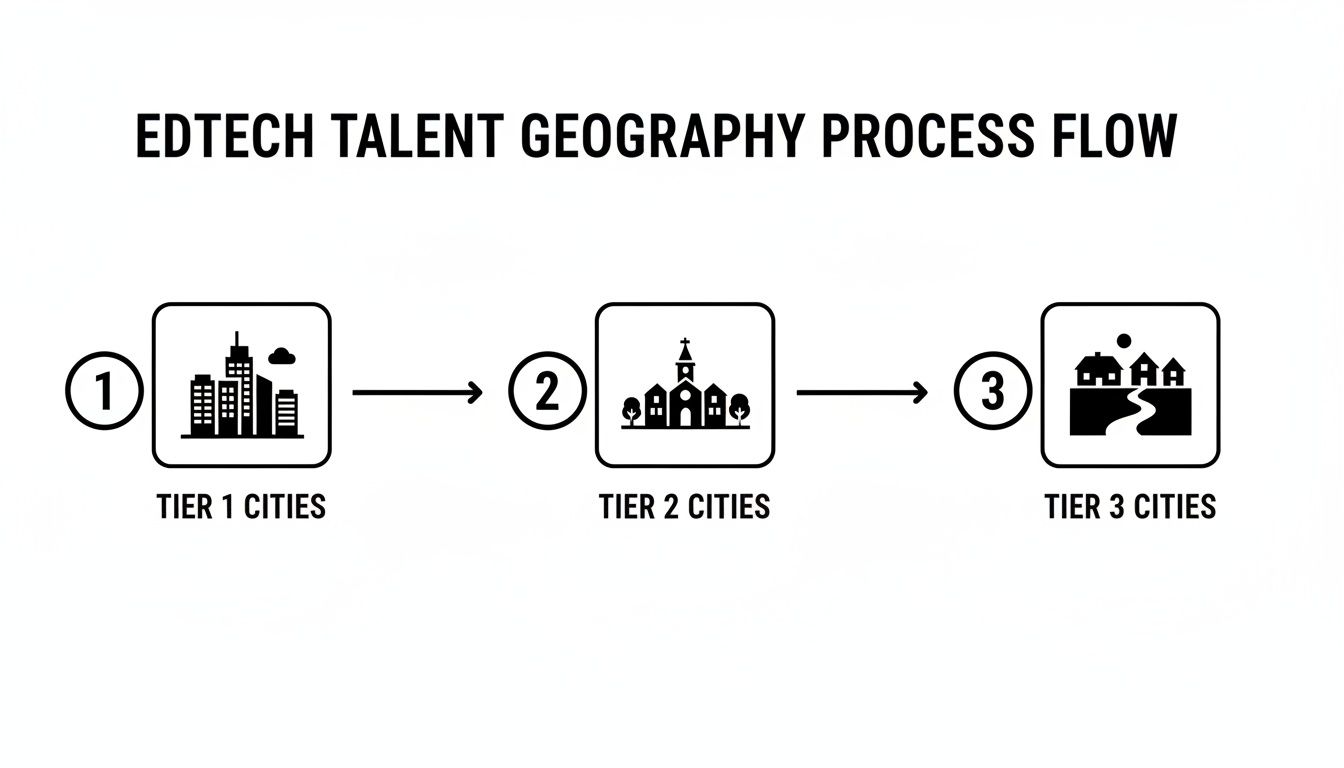
This visual underscores just how critical it is to have a hiring strategy that diversifies your locations. Relying solely on the major hubs is a recipe for high costs and fierce competition.
Design Competency-Based Assessments
Let’s be honest: traditional interviews and generic skills tests often fail to capture the unique blend of tech and teaching skills needed in EdTech.
A specialised RPO partner moves beyond this. They design practical, real-world case studies and simulations. Imagine asking a candidate to build a short lesson module from scratch or debug a faulty adaptive learning algorithm.
These assessments are brilliant because they reveal not just raw problem-solving ability but also a candidate’s learner-centric thinking. You see how they really work.
Craft Non-Monetary Value Propositions
With compensation wars driving salaries sky-high, you need other ways to stand out. The good news is that many EdTech professionals are driven by more than just money they want to make an impact.
This is where your non-monetary value proposition becomes your secret weapon. Highlight the mission. Talk about the change you’re creating. Then, back it up with tangible benefits that appeal to their desire for growth and purpose.
Offer things like dedicated professional development budgets, access to industry conferences, and opportunities to publish research on learning outcomes. These are powerful levers that resonate deeply with professionals who are motivated by purpose.
Internal HR vs RPO Partnership for EdTech Hiring
So, how does partnering with a specialised RPO change the game compared to keeping everything in-house? The difference is often in the depth of expertise and the proactive nature of the approach. An internal team is often juggling dozens of priorities, while an RPO partner brings a singular focus to your most critical hiring needs.
The table below breaks down how these two approaches stack up.
| Recruitment Function | Typical Internal HR Approach | Strategic RPO Partner Approach |
|---|---|---|
| Talent Persona Development | Ad-hoc profiles based on past hires and manager input. | Data-enriched personas constantly refined with live market insights. |
| Sourcing Passive Candidates | Mostly limited to active channels like job boards and referrals. | Advanced sourcing across niche communities, forums, and passive networks. |
| Assessment Design | Standard interviews and generic, off-the-shelf tests. | Custom-built scenarios and simulations that blend tech and pedagogy. |
| Value Proposition Creation | Primarily focused on salary, standard benefits, and company perks. | Highlights mission-driven projects, growth paths, and development opportunities. |
| Speed to Fill | Vacancies can sit open for an average of 3–6 months. | Proactive pipelines can reduce time-to-fill to 4–8 weeks. |
As the table shows, a strategic partnership shifts recruitment from a reactive function to a proactive, data-informed powerhouse. It’s about building a sustainable talent engine, not just filling empty seats.
You can learn more about the strategic advantages of this model by exploring our detailed guide on Recruitment Process Outsourcing solutions.
Monitor KPIs And Iterate
A playbook is useless if you don’t keep score. Establishing clear KPIs turns your strategy into a set of measurable actions you can track and improve.
Key metrics to watch include time to hire, source effectiveness, diversity ratios, and, crucially, first-year retention rates.
Regularly reviewing this data allows you to make smart course corrections. Is one sourcing channel underperforming? Are candidates dropping out at a specific stage? This ensures your playbook evolves and stays sharp as market conditions shift.
Partnering with the right RPO makes the difference between simply filling roles and building a truly best-in-class EdTech team.
Scale Geographically With RPO
An experienced RPO partner immediately expands your talent search beyond the usual-suspect cities. They have the on-the-ground networks and local knowledge to tap into talent pools in underserved Tier 2 and Tier 3 hubs.
This geographic agility is a game-changer. It allows you to uncover hidden gems and scale your team sustainably without getting caught in the high-cost bidding wars of major tech centres.
Build A Continuous Talent Pipeline
The most effective hiring functions are always hiring even when there are no open roles. A proactive talent pipeline avoids the last-minute scramble by maintaining a warm list of qualified, pre-vetted candidates.
RPO partners excel at this. They use modern CRM tools and consistent candidate nurturing to keep potential hires engaged and interested in your company over the long term.
This steady stream of pre-assessed talent dramatically slashes your time to fill and improves the quality of your hires when a position does open up. By putting this playbook into action, CHROs can move from fighting fires to building a resilient EdTech team that is a true driver of long-term, sustainable growth.
Frequently Asked Questions About EdTech Hiring
Digging into EdTech recruitment often feels like opening a can of worms it seems to raise more questions than it answers. For CHROs and talent leaders, the constant juggling of technology, pedagogy, and explosive market growth throws up some very specific, recurring headaches.
Here, we’ll tackle some of the most common questions head-on with clear, practical advice to help shape your hiring strategy and clear up the confusion.
How Do We Effectively Assess Hybrid Skills?
This is a classic stumbling block. How do you properly vet candidates who need to be fluent in both the language of education and the logic of technology? Standard interviews often miss the mark because they test these skills separately. You might find a developer who smashes a coding challenge but has zero empathy for designing a learning tool for a six-year-old.
The key is to ditch the theoretical and get practical with scenario-based assessments. Stop just asking questions and start creating real-world challenges that look and feel like the actual job.
For instance:
- For an Instructional Designer: Give them an existing learning module to critique. Ask for specific improvements and make them justify their choices using both solid pedagogical principles and UX best practices.
- For a Product Manager: Present a case study about a platform’s dropping student engagement. Ask them to map out a data-driven plan to figure out why it’s happening and how they’d fix it.
Tasks like these do more than just show you what a candidate knows; they reveal how they think and solve problems right at that crucial intersection of education and tech.
Can We Realistically Compete With Tech Giants for Talent?
Let’s be honest: trying to outbid the tech behemoths on salary is a game most EdTech firms will lose. They can throw around compensation packages that startups and scale-ups simply can’t match.
But you have an ace up your sleeve, a powerful asset they often can’t offer: a compelling mission. Top talent isn’t always just chasing the biggest paycheck; many are driven by a genuine desire to make a real difference in education. Your recruitment strategy has to lead with this.
Don’t just advertise jobs. Frame your roles as opportunities to solve deeply meaningful problems in education. Show them the direct line between the code they write or the content they create and a student’s lightbulb moment.
Build your entire employer brand around this purpose. Think about offering unique benefits that resonate with this mindset, like paid time off for volunteering in schools, dedicated budgets for professional development in learning sciences, or chances to work directly with educators. It completely changes the conversation from a bidding war to a decision based on shared values.
When Does an RPO Partnership Make Sense?
Many leaders wonder about the right time to bring in a Recruitment Process Outsourcing (RPO) partner. An RPO stops being just an option and becomes a strategic necessity when you find yourself in one of these classic scenarios:
- You need to scale, fast: You’ve just landed a major funding round and need to hire 30 specialised roles yesterday. An RPO brings the immediate horsepower and expertise your internal team probably lacks.
- Your key roles are gathering dust: That “Learning Scientist” or “Senior Instructional Designer” position has been open for months. A specialised EdTech RPO has an existing network of passive candidates you can’t reach.
- You’re fighting for talent in hyper-competitive hubs: Trying to hire in saturated markets like Bengaluru or Delhi NCR is a constant battle. A good RPO can broaden your search and tap into talent pools in emerging Tier 2 and Tier 3 cities.
- Your internal team is drowning: If your HR team is so buried in paperwork and scheduling that they have no time for proactive sourcing, an RPO can manage the entire recruitment lifecycle. This frees up your people to focus on the things that matter most culture and retention.
At the end of the day, bringing on an RPO isn’t just about handing off tasks. It’s about embedding deep market intelligence and serious recruitment muscle directly into your talent strategy to finally crack those persistent hiring challenges.
Ready to build a world-class EdTech team without the hiring headaches? Taggd offers specialised RPO solutions designed to navigate the unique challenges of the EdTech sector. We connect you with the hybrid talent you need to innovate and scale.
Discover how we can transform your hiring outcomes at Taggd.