Hiring for Electric Vehicle (EV) roles is more than just filling seats; it’s about a strategic hunt for highly specialised talent in one of the world’s fastest-growing markets. To get it right, you need a deep understanding of the unique skills required, a compelling employer brand, and a playbook for navigating the intense competition for pros in battery engineering, powertrain systems, and autonomous software development.
Navigating the EV Talent Surge
The EV industry isn’t just growing; it’s accelerating at a breakneck pace, igniting a fierce battle for specialised talent. For Chief Human Resources Officers (CHROs), this is much more than a recruitment challenge—it’s a core strategic imperative that will define their organisation’s place in the future of mobility. The skills gap between the demand for EV expertise and the available talent pool is widening, creating a real opportunity for companies that think ahead.
This surge is being massively fuelled by significant government initiatives and huge private sector investments aimed at electrifying transport. These drivers aren’t just encouraging people to buy EVs; they’re actively creating thousands of new, highly technical jobs.
Understanding the Scale of Demand
To win this talent war, you first have to grasp the sheer scale of the need. We’re not talking about filling a few engineering spots. We’re talking about building entire ecosystems of talent capable of designing, manufacturing, and servicing the next generation of vehicles. The numbers tell a story of explosive growth.
Take India’s EV sector, for instance. It’s seeing a massive expansion that directly translates to a greater need for specialised professionals. EV sales surged 45% year-over-year in the first quarter of 2025 alone, with the government aiming for 30% EV penetration by 2030. This ambitious target requires immense investment—an estimated $180 billion for vehicle production and charging infrastructure.
As a result, projections point to a demand for 100,000 to 200,000 EV professionals by 2030, spanning everyone from battery technologists to software developers. To get a deeper dive into these automobile hiring trends, you can explore the full analysis.
The real challenge isn’t just finding candidates; it’s finding professionals with that rare blend of mechanical engineering, software development, and electrical systems knowledge. Traditional automotive recruitment playbooks are quickly becoming obsolete.
A Strategic Imperative for CHROs
This market dynamic elevates EV hiring from a tactical function to a truly strategic one. Success demands a proactive, data-driven approach. Your organisation needs to be seen not just as an employer, but as a hub for innovation where top minds can solve complex, meaningful problems.
This means you need to be:
- Anticipating Skill Needs: Look beyond your current vacancies to predict the roles that will be critical in two to five years.
- Building a Talent Pipeline: Cultivate relationships with universities, industry forums, and niche online communities long before a role ever opens up.
- Crafting a Compelling Brand: Showcase your company’s commitment to R&D and sustainability. This is what attracts mission-driven talent.
Ultimately, turning the talent shortage into your competitive advantage comes down to building the engineering and technical teams that will drive the future of mobility. Understanding the state of EV jobs and their evolution is the crucial first step.
Laying the Foundation: Your EV Talent Blueprint
Smart hiring in the Electric Vehicle (EV) world doesn’t start with a job description. It starts way earlier, with a precise, forward-looking talent blueprint. If you skip this step, you’ll find yourself chasing vague skill sets, which almost always leads to costly mis-hires and painful project delays. The goal here is to get past generic job titles and actually map out the specific skills that will power your company’s growth in this fast-moving sector.
Think of this blueprint as your strategic guide. It defines the roles you need today, sure, but it also forces you to think about the skills you’ll need for tomorrow’s tech. It makes you get granular about the unique blend of hardware engineering, software development, and systems integration that defines the EV industry. A generic “Electrical Engineer” just won’t cut it; you need to be specific, asking for expertise in high-voltage battery systems or powertrain controls.
Deconstructing the Critical EV Domains
The EV ecosystem is a complex beast, full of interconnected specialisations. A solid talent blueprint breaks this down into core domains, each with its own set of critical roles and necessary skills. This detailed approach is the only way to do workforce planning and targeted recruitment properly.
It’s less a list of jobs and more a map of capabilities. For instance, the Battery Technology domain isn’t a single role but a whole cluster of them.
- Battery Management System (BMS) Engineers: These folks are the brains behind battery safety and performance. They need a sharp mix of embedded systems knowledge, control theory, and a solid grasp of battery chemistry.
- Cell & Pack Engineers: Their world is all about the physical design and thermal management of battery packs. This demands strong mechanical and thermal engineering chops.
- Testing & Validation Engineers: They’re the ones ensuring batteries meet brutal safety and durability standards, a job that mixes electrical engineering with heavy data analysis.
It’s the same story for the Powertrain and Drivetrain domain. This isn’t just about motor design. It includes specialists in power electronics, transmission systems, and vehicle dynamics—all of whom have to work in perfect sync. Getting this level of detail right from the start makes your sourcing efforts laser-focused.
Mapping Skills to Future-Proof Your Roles
Once you’ve broken down the key domains, the next job is to map the specific hard and soft skills needed for each role. This is where your blueprint turns from a plan into a powerful, actionable tool. It’s a critical step, especially when you consider that around 31% of traditional automotive jobs could be impacted by the EV transition, with a hefty 17% needing significant reskilling. Your blueprint needs to plan for this shift.
Don’t just list programming languages; explain why they’re needed. An EV Software Architect obviously needs C++, but their real value comes from experience with real-time operating systems (RTOS) and AUTOSAR architecture for vehicle control units.
The most valuable EV professionals are what we call “T-shaped” experts. They have deep expertise in one core area, like battery chemistry, but also a broad understanding of related fields like software integration and thermal dynamics. This is what allows for real, effective collaboration across teams.
This mapping exercise also helps you nail your budgeting and compensation. When you understand the scarcity and demand for specific skill combinations, you can build a competitive salary structure that attracts top talent without breaking the bank.
To get you started, here’s a foundational look at how you can structure your own talent blueprint, mapping key domains to roles, essential skills, and typical salary benchmarks in the Indian market.
Essential EV Role Taxonomy and Skill Mapping
This table breaks down some of the most critical EV roles, the core competencies they demand, and what you can expect to invest in talent within the Indian market. It’s a starting point for building a much more detailed plan tailored to your specific needs.
| EV Domain | Key Roles | Essential Skills (Hard & Soft) | Average Salary Range (INR) |
|---|---|---|---|
| Battery Technology | BMS Engineer, Cell Engineer, Validation Engineer | Embedded C, CAN protocol, MATLAB/Simulink, Thermal Analysis, Problem-Solving | ₹12 Lakhs – ₹30 Lakhs |
| Powertrain Systems | Motor Design Engineer, Power Electronics Engineer | Ansys Maxwell, AC/DC converters, Inverter Design, Systems Thinking, Collaboration | ₹15 Lakhs – ₹35 Lakhs |
| EV Software & AI | Software Architect, ADAS Engineer, V2X Specialist | C++, Python, ROS, AUTOSAR, Machine Learning, Adaptability, Communication | ₹18 Lakhs – ₹50 Lakhs+ |
| Charging Infrastructure | Charging Systems Engineer, Network Planner | OCPP, Smart Grid Tech, High-Voltage Systems, Project Management, Vendor Relations | ₹10 Lakhs – ₹25 Lakhs |
| Vehicle Integration | Systems Integration Engineer, Homologation Expert | Vehicle Dynamics, CAN/LIN, EMI/EMC Testing, Attention to Detail, Resilience | ₹14 Lakhs – ₹32 Lakhs |
Just remember, this blueprint isn’t a “set it and forget it” document. The EV industry changes in the blink of an eye, and your understanding of the talent it needs must keep pace. Make a habit of regularly reviewing and updating your blueprint based on new tech and market trends. It’s the only way to ensure your hiring for Electric Vehicle (EV) roles stays locked in with your long-term goals.
Building a Brand That Attracts EV Innovators
Let’s be clear: the top professionals in the electric vehicle space aren’t just looking for another job. They’re on a mission to solve incredibly complex problems and redefine the future of mobility. When you’re hiring for Electric Vehicle (EV) roles, your standard corporate careers page simply won’t cut it. You’re in a race for innovators who are pulled in by purpose, tough technical challenges, and a culture that actually fosters progress.
This means your employer brand can’t just be a slick marketing exercise. It has to be a genuine reflection of your commitment to pioneering the next wave of transport tech. These candidates are sharp; they’ll see right through generic mission statements. They need to see the proof.
Crafting a Compelling Employer Value Proposition
Your Employer Value Proposition (EVP) is the heart of your brand. It must answer one critical question: “Why should a highly sought-after battery engineer or AI specialist work here instead of anywhere else?” For EV talent, the answer is rarely just about the salary. It’s about impact.
To build an EVP that truly connects, you need to focus on a few key pillars:
- Mission and Sustainability: Get specific about how your work contributes to a cleaner future. Don’t just use corporate buzzwords; showcase real projects and their environmental impact.
- Technological Leadership: Be vocal about the cutting-edge challenges your teams are wrestling with. Are you developing solid-state batteries? Pushing the limits of Vehicle-to-Grid (V2G) technology? The details matter.
- Culture of Innovation: You have to show, not just tell, that your organisation gives engineers the autonomy and resources to experiment, fail, and ultimately, break new ground. This is a massive draw for talent sick of corporate red tape.
The most powerful EVPs don’t just promise innovation; they prove it. They put the complex problems your teams are solving today front and centre and invite candidates to come and be part of the solution.
This narrative needs to be woven into every single touchpoint, from your job descriptions to your social media feed, creating a consistent and magnetic pull for the right people.
Taking Your Story to Where the Talent Lives
Having a great story is only half the battle. You have to tell it in the right places. The best EV innovators are often passive candidates who are deeply plugged into their professional communities, not actively scrolling through job boards. This demands a proactive, content-driven approach to your branding.
A great first step is to turn your senior technical leaders into industry evangelists. Get them speaking at conferences, publishing white papers, or jumping into specialised online forums. When your Head of Powertrain Engineering is on a popular engineering podcast discussing the finer points of inverter design, you gain instant credibility with the exact audience you need to reach.
Think about developing a content series that offers a genuine, unfiltered look inside your R&D efforts. This isn’t about glossy corporate videos; it’s about being authentic and technically deep.
Actionable Content Ideas:
- “A Day in the Life” Videos: Feature a lead BMS engineer walking through their problem-solving process on a real challenge. This offers an authentic peek into the day-to-day work and the company culture.
- Deep-Dive Tech Talks: Host webinars or record sessions where your R&D leaders discuss a specific technological hurdle they’ve overcome. This positions your company as a thought leader and a place where the tough problems get solved.
- Project Spotlights on LinkedIn: Instead of just posting jobs, share detailed updates on key project milestones. Celebrate the team’s technical wins and be sure to tag the engineers who made it happen.
By consistently sharing valuable, authentic content, you stop being just another company hiring for Electric Vehicle (EV) roles. You become a destination where innovators know their skills will be valued and their work will actually matter.
How to Source and Engage Niche EV Professionals
Let’s be honest: the kind of talent that truly pushes the electric vehicle industry forward isn’t scrolling through job boards. The battery thermal management gurus, powertrain control engineers, and ADAS specialists you really want are heads-down, solving incredibly complex problems at their current jobs. They’re classic passive candidates.
To get their attention, you can’t just post a vacancy and hope for the best. You need a proactive, multi-channel playbook designed to find and engage these experts where they live and breathe technology. This isn’t about selling a job; it’s about starting a compelling technical conversation.
Go Beyond the Usual Sourcing Channels
Relying solely on LinkedIn is a recipe for getting stuck in a bidding war with every other recruiter for the same handful of candidates. To get an edge, you have to diversify your sourcing and build a real presence in the communities where genuine EV innovation is actually being discussed.
Think about dedicating real resources to these specialised channels:
- Niche Engineering Forums: Platforms like ResearchGate, IEEE Xplore, or even hyper-specific subreddits focused on electrical engineering are goldmines. Your technical leaders—not just recruiters—should be in these conversations, building credibility and spotting talent.
- University Partnerships and Alumni Networks: Forge deep, meaningful relationships with universities known for their killer engineering programmes. Go beyond the career fair; sponsor final-year projects, have your senior engineers host guest lectures, and actively engage with alumni networks. This is how you spot rising stars and seasoned pros.
- EV-Focused Symposiums and Conferences: These events are concentrated hubs of top-tier talent. Don’t just send someone to man a booth. Your team should be there to network, understand emerging research, and identify the key speakers and contributors who are shaping the future of the industry.
When you build a presence in these spaces, sourcing stops being a reactive task and becomes a continuous, strategic talent pipeline. This is just one of many advanced recruitment sourcing methods that can dramatically improve your quality of hire.
Crafting Outreach That Cuts Through the Noise
Generic outreach messages are dead on arrival. Top EV professionals are spammed constantly, so your approach has to be radically different. It needs to speak their language, focusing on meaty technical challenges and real-world impact, not corporate fluff.
Treat your outreach templates as a starting point for deep personalisation, not a rigid script.
The best outreach doesn’t ask, “Are you looking for a job?” It asks, “Here’s a fascinating thermal propagation challenge we’re trying to solve. Does this sound like something you’d be interested in tackling?” This reframes the conversation from a job offer to a peer-to-peer technical discussion.
For instance, when trying to connect with a rare Battery Thermal Management expert, ditch the generic pitch and try something targeted.
Example Outreach for a Battery Thermal Management Expert
Subject: Challenging Thermal Propagation in High-Density Packs
Hi [Candidate Name],
I came across your research paper on advanced liquid cooling systems for Li-ion batteries and was seriously impressed by your approach to mitigating thermal runaway. Here at [Your Company], our R&D team is actually tackling a similar challenge with our next-gen high-density battery packs for heavy commercial vehicles.
We’re exploring innovative phase-change materials and predictive modelling to hit a 15% improvement in thermal efficiency. Given your deep expertise in this exact area, I thought the problem itself might intrigue you.
Would you be open to a quick, informal chat with our Head of Battery Engineering to geek out on the technical specifics?
This approach immediately shows you’ve done your homework. More importantly, it presents an interesting puzzle, which is far more engaging to a true expert than a bland job description.
Tapping into Regional Talent Hotspots
Strategic sourcing also means knowing where the talent is. Government policies and major private investments are creating super-concentrated EV job markets in specific regions, giving you a roadmap for targeted hiring.
Take India, for example. Government initiatives are absolutely supercharging job creation in the EV sector. Tamil Nadu has become a major hub, attracting an incredible Rs. 50,000 crore (US$5.84 billion) in EV investments targeted by 2025.
This flood of capital is projected to create 150,000 direct jobs in manufacturing, R&D, and supply chain management. For CHROs planning their hiring strategies, understanding these regional dynamics isn’t just helpful—it’s a massive competitive advantage. You can find more insights on India’s growing EV industry and its opportunities to inform your strategy.
By weaving together a multi-channel sourcing plan, highly personalised outreach, and a sharp awareness of these regional talent clusters, you can finally start engaging the passive candidates who will drive your company’s innovation for years to come.
Designing an Assessment Process That Actually Works
When you’re hiring for highly specialised Electric Vehicle (EV) roles, your standard interview process just won’t cut it. It will almost certainly fail you. The technical depth needed in areas like battery management, powertrain controls, and vehicle systems integration is just too immense.
You have to move beyond conversational questions and design an assessment that actively tests a candidate’s practical, on-the-spot problem-solving skills. This isn’t about throwing trick questions at them. It’s about simulating the real, complex challenges your engineers wrestle with every single day. The goal is to see how they think, troubleshoot, and collaborate—not just what’s written on their CV.
Building a Multi-Stage Evaluation Framework
A truly effective assessment process for technical EV roles needs distinct stages. Each stage should be designed to evaluate a different facet of a candidate’s capabilities, from raw technical knowledge to practical application and cultural fit. This layered approach is the only way to get a comprehensive view of their skills while also respecting their time.
A solid framework usually looks something like this:
- Initial Technical Screening: This is a focused chat with a senior engineer or a team lead. Think of it as a crucial first filter to validate core technical knowledge and quickly weed out candidates who don’t have the foundational skills.
- The Practical Case Study: This is the heart of the assessment. It’s where you see their problem-solving ability in action. More on this in a bit.
- Behavioural and Cross-Functional Interviews: The final stage focuses on soft skills, their collaborative spirit, and whether they’ll genuinely fit with the team and the wider company culture.
By structuring it this way, you ensure that by the final interview, you’re already confident in their technical abilities. The last conversation can then be all about whether they’re the right long-term addition to your team.
The Power of the Practical Case Study
Let’s be clear: the most critical part of hiring for any deep-tech EV role is the practical assessment. This is where candidates have to prove they can apply their knowledge to solve the kind of complex, nuanced problems they’ll face on the job. Forget generic brain teasers—your case studies must be highly specific to the work your team is actually doing.
For instance, if you’re hiring a Battery Management System (BMS) Engineer, don’t just ask them to describe cell balancing algorithms. That’s theory. Instead, give them a real-world scenario.
Present the candidate with a dataset showing erratic voltage readings from a specific cell block in a battery pack. Ask them to walk you through their diagnostic process right then and there. What are their initial hypotheses? What other data would they request? How would they figure out if it’s a faulty sensor, a software glitch, or a genuine cell degradation issue?
This approach forces them to demonstrate their systematic troubleshooting process, a skill infinitely more valuable than reciting something from a textbook. For a Powertrain Controls Engineer, you could give them a simulation model of an inverter and ask them to optimise its switching frequency to cut energy loss while hitting performance targets. That’s how you separate the talkers from the doers.
Assembling a Balanced Interview Panel
The decision to hire should never fall on one person’s shoulders, especially in a field as collaborative as EV development. Putting together a balanced interview panel is absolutely crucial for a well-rounded evaluation. The ideal panel brings together different perspectives to assess not just technical brilliance, but also teamwork and cultural alignment.
Your panel should always include:
- The Hiring Manager: To assess role-specific skills and how they’ll fit into the immediate team.
- A Technical Peer: A future teammate who can evaluate their practical skills from a hands-on, day-to-day perspective.
- A Cross-Functional Lead: Someone from a connected department (like software or mechanical engineering) to gauge their ability to think about the entire system and collaborate effectively.
- An HR Partner: To dig into behavioural competencies, cultural fit, and what drives them in their career.
By bringing these different viewpoints into the room, you build a much more complete and reliable picture of the candidate. This cross-functional approach significantly lowers the risk of making a hire who is technically brilliant but can’t work effectively within the broader organisation—a recipe for disaster in the complex, interconnected world of EV engineering.
How to Secure and Retain Your EV Talent
Getting a ‘yes’ from a top candidate is a huge win, but it’s definitely not the finish line. When you’re hiring for EV roles, this is where the real work starts. The game shifts from attracting talent to keeping them. How you handle compensation, onboarding, and long-term engagement will decide if your new hire becomes a long-term asset or just another statistic.
A competitive offer is just table stakes in this market. This means you need to be doing rigorous, real-time compensation benchmarking. Don’t make the mistake of relying on general automotive salary data; EV roles, especially in hot areas like battery systems and software, demand a serious premium. You have to dig into data specific to the EV sector, looking at skill scarcity, where the role is located, and even what tech companies are paying—not just the traditional OEMs. The offer has to be compelling enough to get them in the door, but also sustainable for the company down the road.
Your 90-Day Onboarding Blueprint
Once they’ve accepted, a specialised onboarding plan is non-negotiable. A generic HR orientation just won’t cut it for the technical complexity of EV projects. We’ve found a structured 90-day plan is the best way to get new hires integrated and productive quickly, making sure they feel capable and connected from day one.
A solid plan should look something like this:
- Weeks 1-2: Deep dives into project roadmaps, key technical documentation, and introductions to all the cross-functional teams they’ll be working with.
- Weeks 3-4: Give them a small, manageable starter project. This is huge for building confidence and lets them score an early win.
- Days 30-90: Gradually bring them into core project responsibilities. Pair them with a dedicated mentor who can help with both technical questions and navigating the company culture.
This kind of structured approach turns what could be an overwhelming first three months into a focused period of learning and real contribution. If you want to dive deeper into this phase, you can explore more detailed employee retention strategies to keep your talent.
True retention isn’t about stopping people from leaving; it’s about building an environment they don’t want to leave. For EV engineers, that means seeing a clear path to mastering their craft and solving bigger, more complex problems.
Long-term retention has to be part of your company’s DNA. The best EV professionals are driven by innovation and the chance to grow. This means you need transparent career ladders that show a clear path from an individual contributor all the way up to a technical fellow or an engineering leader. It’s also vital to foster a culture of continuous learning by sponsoring certifications, sending people to conferences, and holding internal tech talks.
This flowchart shows the critical assessment stages—screening, case study, and interview—that we use to land a successful hire.
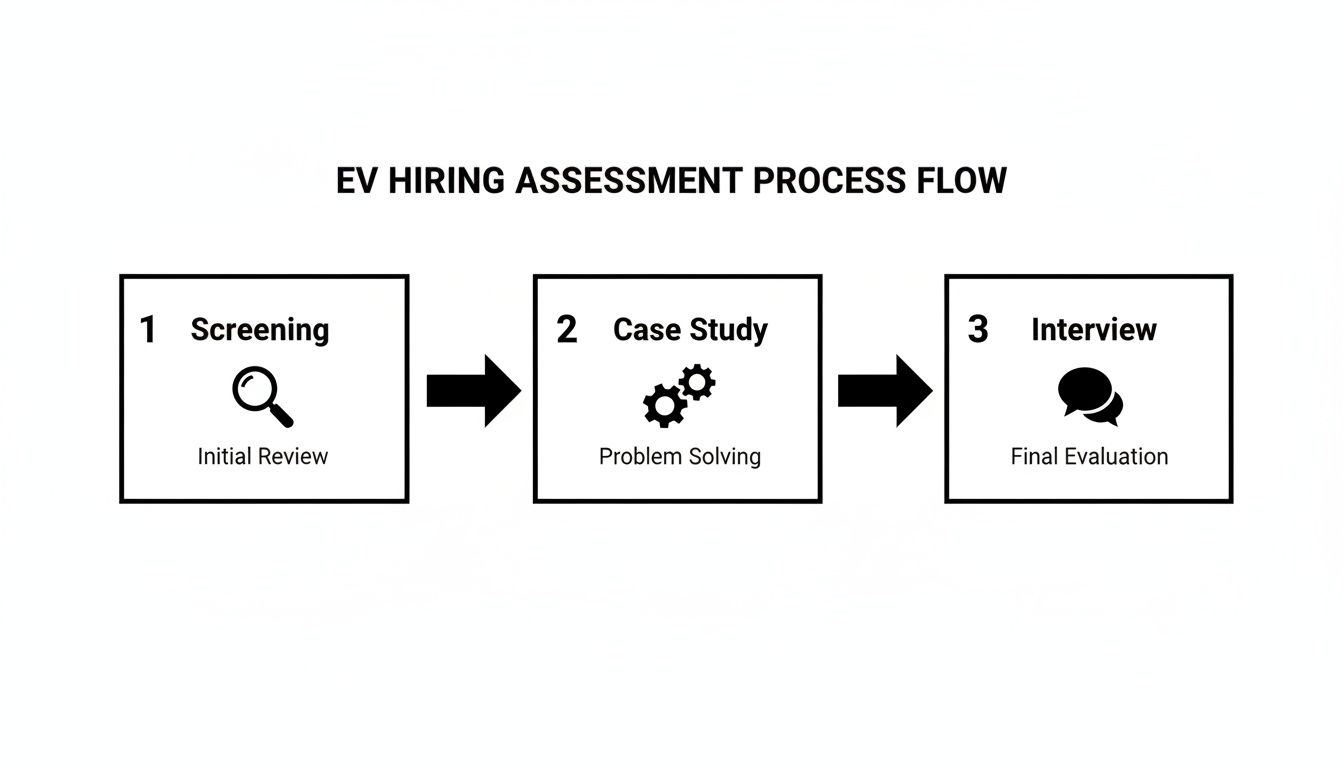
Each step is designed to evaluate both technical depth and cultural fit, making sure only the most qualified candidates move forward.
Measuring What Truly Matters
Finally, to know if your EV talent strategy is actually working, you have to track the right metrics. It’s time to move beyond the vanity numbers.
- Time-to-Fill: This is important, but it has to be balanced with the quality of the hire. A fast hire isn’t a good hire if they don’t perform.
- Quality of Hire: How do you measure this? Look at performance ratings at the 6 and 12-month marks.
- 12-Month Retention Rate: This is the ultimate test. It tells you if you made a successful match and if your onboarding is effective.
These metrics give you a clear, data-backed picture of how effective your hiring really is. It allows you to tweak your process and build a resilient, innovative EV team that’s in it for the long haul.
Frequently Asked Questions
Hiring for the Electric Vehicle (EV) space is a different beast, and it naturally brings up some tough, strategic questions. Let’s tackle a few of the most common challenges CHROs are facing right now with some straight, actionable advice.
What Are the Most Challenging EV Roles to Hire For?
Right now, the roles giving hiring managers the biggest headaches are the ones demanding a rare mix of deep, interdisciplinary skills.
We’re talking about Battery Management System (BMS) Engineers, EV Powertrain Control Engineers, and the real unicorns—experts in Vehicle-to-Grid (V2G) technology. The simple reason they’re so hard to find? The technology is evolving much faster than the talent pool. Experienced professionals in these niche areas are exceptionally rare and highly sought after.
How Can We Compete with Established Automotive Giants?
This is a classic David vs. Goliath scenario, but smaller, more agile companies have a secret weapon. You can win by offering what the giants often can’t: genuine impact, more autonomy, and a culture that truly puts innovation first.
Make sure your pitch highlights the opportunity for talent to lead brand-new, pioneering projects. Show off your agile work environment and, if you can, consider offering equity. It’s about selling the vision.
Emphasise your unique mission within the EV ecosystem. This will attract the kind of passionate people who want to build something from the ground up, not just maintain a legacy system. This is your key differentiator when hiring for Electric Vehicle (EV) roles.
Should We Upskill Internally or Hire Externally?
The smartest strategy is almost always a bit of both. It’s not an either/or question.
For roles where deep institutional knowledge is a huge plus, upskilling your existing mechanical or electrical engineers through specialised EV training is incredibly effective. It’s a great way to build loyalty and leverage the talent you already have.
However, for those bleeding-edge specialisations—think AI in autonomous driving or advanced battery chemistry—you’ll likely need to hire externally. This injects fresh expertise into your team and can seriously accelerate your innovation timeline. The key is to strike a balance, creating a hybrid approach that fits your specific project needs and long-term ambitions.
At Taggd, we specialise in building the high-impact teams that are driving the EV revolution forward. Let us help you build your expert EV workforce.