Think of hiring velocity as the speedometer for your recruitment engine. It’s the metric that tells you just how quickly and efficiently you’re moving a great candidate from their initial application right through to a signed offer. A high velocity means you have a well-oiled, effective hiring machine. A low one? That’s a sign of expensive friction somewhere in the system.
What Is Hiring Velocity and Why Does It Matter?
Let’s imagine your company’s big growth plan is a high-performance car, poised for a major race. Your products are the slick, aerodynamic design, but the engine that actually propels you forward is your ability to hire the right people. In this scenario, hiring velocity is your speedometer. It doesn’t just show you that you’re moving; it tells you exactly how fast you’re accelerating towards your business goals.
This isn’t just another way to say “time-to-fill”. While time-to-fill measures the total number of days a role stays open, hiring velocity zeroes in on the momentum of qualified candidates as they move through your pipeline. It’s the difference between knowing a road trip took ten hours, and knowing you were consistently cruising at 100 km/h on the motorway, making steady progress.
The True Cost of a Slow Hiring Process
A sluggish hiring process is far more than a headache for your HR team—it’s a real business liability. When your hiring velocity drops, the consequences ripple out across the entire organisation, often in ways that aren’t immediately obvious but are deeply damaging.
The fallout is significant:
- Lost Revenue and Missed Opportunities: Every single day a crucial role, like a sales leader or a lead engineer, sits empty, your company is actively leaving money on the table. Projects stall, sales targets are missed, and you’re giving your competitors a chance to pull ahead.
- Increased Team Burnout: When a position goes unfilled, who picks up the slack? Your current team. This extra workload leads directly to lower morale, higher stress, and can eventually push your best people to start looking for the exit.
- Damaged Employer Brand: In a tight talent market, the best candidates always have other options. A slow, confusing, or unresponsive hiring process sends a clear message: your company might be just as inefficient internally. That negative candidate experience can tarnish your reputation for years to come.
At its core, slow hiring is like driving with the handbrake on. It burns through resources, wears down your team, and makes it impossible to scale at the pace your business demands. Getting a handle on your hiring velocity isn’t just an HR task; it’s a strategic necessity for winning.
Moving Beyond a Buzzword
Ultimately, hiring velocity is more than just the latest industry jargon. It’s a vital sign of your organisation’s ability to adapt, compete, and attract the very best talent. By truly understanding this metric, you can shift your talent acquisition function from being a reactive cost centre to a proactive, strategic advantage. It gives you the power to anticipate hiring needs, smooth out the friction, and build the teams you need to dominate your market. This guide will show you exactly how to measure, analyse, and accelerate this critical business function.
How to Accurately Calculate Your Hiring Velocity
If you want to speed up your hiring, you first have to know how fast you’re going. But measuring hiring velocity isn’t about grabbing a single number and calling it a day. It’s about digging into your recruitment data to understand the story it’s telling you. By breaking down the calculation, you can move from guesswork to a data-driven strategy that shows you exactly where your hiring engine needs a tune-up.
It all starts with tracking the right metrics. Too many teams just look at the total time a job is open, but a much sharper approach focuses on the candidate’s journey. This is where getting to grips with two key metrics becomes absolutely essential.
Differentiating Time-to-Fill from Time-to-Hire
These two terms are often thrown around interchangeably, but they measure completely different parts of the recruitment lifecycle. Nailing this distinction is the first real step to understanding your hiring momentum.
- Time-to-Fill: This is the big-picture number. It measures the total days from the moment a job requisition is opened until a candidate accepts the offer. It covers the entire process, including getting approvals and the initial sourcing slog.
- Time-to-Hire: This one is all about the candidate. It tracks the number of days from when a qualified person applies (or you find them) to the day they say “yes” to your offer. This is the true heart of hiring velocity because it zeroes in on the speed of your active recruitment pipeline.
Think of it this way: a role might have a Time-to-Fill of 60 days, but the person who got the job had a Time-to-Hire of only 21 days. What does that tell you? It says that while the position was open for two months, once you found the right candidate, your team moved pretty quickly. This distinction helps you figure out if the problem is your active process or if you’re getting bogged down in the pre-sourcing stages.
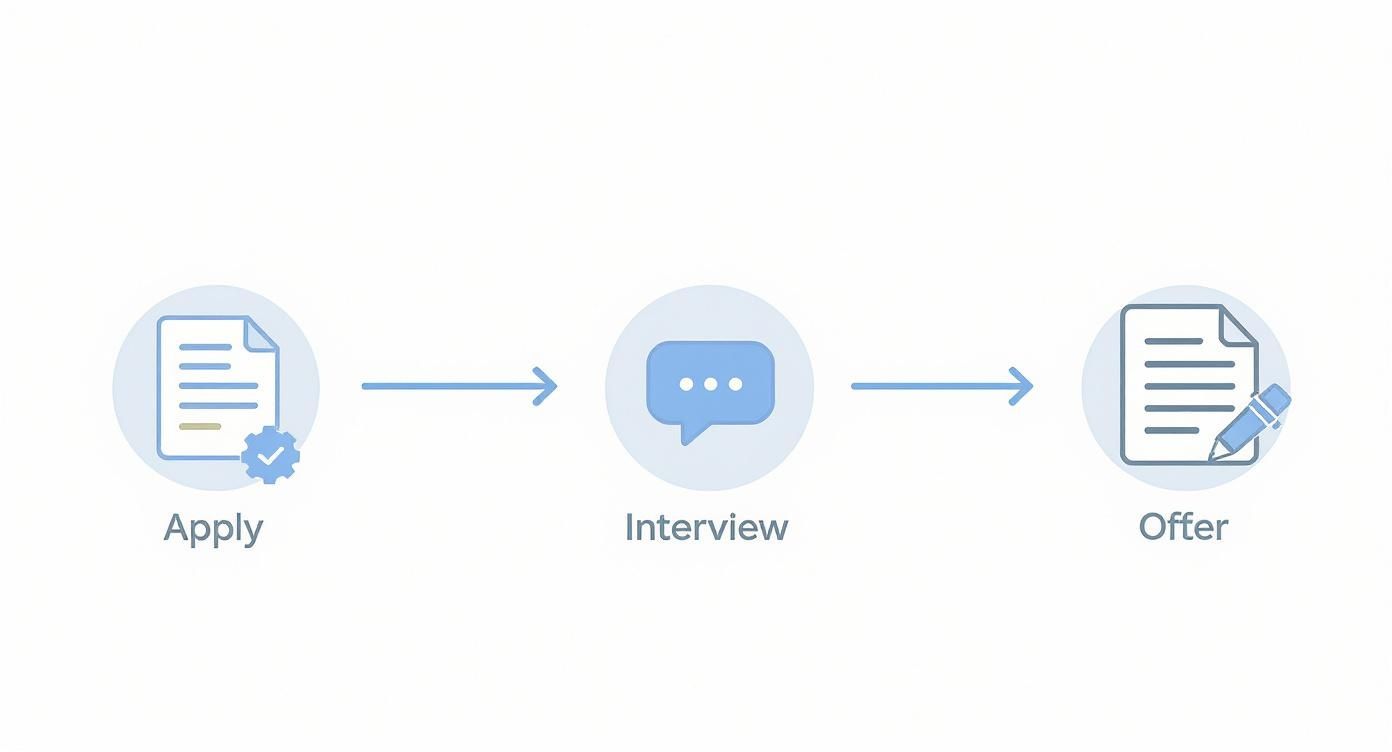
This simple flow shows what really matters: how fast you can move someone from “Apply” to “Offer Accepted”. That’s your hiring momentum in action.
The Basic Hiring Velocity Formula
Once you’re clear on Time-to-Hire, calculating your baseline velocity is simple. It’s just the average Time-to-Hire across all the roles you filled in a certain period.
The formula is pretty straightforward:
Hiring Velocity = Total Sum of Time-to-Hire for All Roles / Total Number of Roles Filled
Let’s run a quick example. You filled three roles last quarter. The Time-to-Hire for each was 25 days, 35 days, and 45 days. The calculation is just (25 + 35 + 45) / 3. That gives you an average hiring velocity of 35 days. Now you have a baseline.
Building a Hiring Velocity Dashboard
A single, company-wide average is a decent starting point, but the real magic happens when you start slicing up the data. A powerful hiring velocity dashboard does more than just display one number; it breaks it down to reveal the hidden patterns and bottlenecks holding you back.
To get a complete picture of your performance, your dashboard needs to track several key KPIs.
Here’s a breakdown of the essentials for a dashboard that actually gives you actionable insights.
Key Metrics for Your Hiring Velocity Dashboard
| Metric | What It Measures | Why It’s Important for Velocity |
|---|---|---|
| Time-to-Hire by Department | The average hiring speed for specific teams like Engineering, Sales, or Marketing. | Instantly shows which departments are running smoothly and which might need process adjustments or more support. |
| Time-to-Hire by Seniority | The hiring speed for different job levels, from entry-level and mid-senior to executive roles. | Reveals if complexity, extra interview stages, or scheduling headaches are slowing down your senior hires. |
| Time-in-Stage | The number of days candidates spend in each step of the pipeline (e.g., screening, technical interview, final review). | Pinpoints the exact stages where candidates are getting stuck, allowing you to make targeted improvements. |
| Offer Acceptance Rate | The percentage of candidates who accept a job offer after it has been extended. | A low rate is a huge red flag. It can point to issues with compensation, culture fit, or a slow offer process, all of which kill your velocity. |
By tracking these KPIs, your dashboard becomes less of a report and more of a diagnostic tool. You might discover that your overall hiring velocity is a healthy 30 days, but your engineering team is crawling along at 55 days because of a brutal technical assessment stage.
That’s the kind of specific insight that turns raw data into a clear roadmap for putting your foot on the accelerator.
Finding the Bottlenecks in Your Hiring Process

Once you have a clear dashboard showing your numbers, you can stop just tracking data and start actively diagnosing your hiring process. Think of your hiring velocity metrics as the vital signs for your recruitment engine. A low number is a symptom, and your job is to play detective and find the root cause of the slowdown.
Some organisations just seem to hire faster. These companies usually have powerful drivers that accelerate their process right from the start. A magnetic employer brand, for instance, pulls in a steady stream of high-quality, inbound applicants, cutting down the time spent on sourcing.
Likewise, a well-tended talent pipeline is like having a reserve of pre-vetted candidates ready to go. When a new role opens up, the recruitment team isn’t starting from a blank slate; they’re re-engaging with warm leads who are already familiar with the company. These are your accelerators. But the real work often involves finding and fixing the brakes—the bottlenecks that create friction and drag down your momentum.
Identifying Common Hiring Blockers
Most hiring delays aren’t caused by a single, catastrophic failure. They’re usually the result of a series of small, cumulative frictions. These seemingly minor issues can tack on days, or even weeks, to your Time-to-Hire, frustrating candidates and hiring managers alike. By learning to spot these common blockers, you can start targeting your improvement efforts where they’ll have the most impact.
Here are the usual suspects that stall hiring velocity:
- Vague or Unrealistic Job Descriptions: A poorly defined role is the first domino to fall. It leads to a flood of unqualified applicants, forcing recruiters to waste precious time on screening calls that lead nowhere. This slows the whole process down from the very beginning.
- Prolonged Interview Rounds: While being thorough is important, a process with five, six, or more interview stages often just signals internal indecision. Each extra step adds scheduling headaches and increases the risk of your top candidate taking another offer.
- Delayed Hiring Manager Feedback: This is one of the most common—and damaging—bottlenecks out there. When feedback on candidates is slow to arrive, the entire pipeline grinds to a halt. Candidates are left in limbo, and your employer brand takes a hit.
A hiring process is only as fast as its slowest step. A single hiring manager who consistently takes a week to provide feedback can single-handedly double the Time-to-Hire for their entire department, no matter how efficient the recruitment team is.
Analysing the Ripple Effects of Delays
It’s critical to understand that these bottlenecks don’t exist in a vacuum. A delay in one stage creates a domino effect of negative consequences that ripples through the entire system, impacting everything from the candidate experience to internal team morale.
Think about a real-world scenario of a slow feedback loop. A recruiter screens ten candidates and sends the top three to the hiring manager. If that manager takes five business days to review the CVs, several things happen at once.
The three qualified candidates, who were initially keen, start to lose interest. They might even assume they’ve been rejected. Meanwhile, the recruiter’s time is tied up chasing feedback instead of sourcing for other open roles. This small delay directly hurts your ability to land top talent in a competitive market.
This dynamic is reflected in wider economic trends. For instance, India’s hiring momentum has shown a significant recovery, with the jobs component of the HSBC India PMI reaching 53.8 during January–October, an increase from 52.5 in the previous year. This improved hiring velocity was largely driven by bigger enterprises, which often have more refined processes to eliminate these very bottlenecks. You can explore more about India’s recruitment trends and see how leading companies are optimising their hiring.
Pinpointing these specific problem areas is the most important step toward getting better. It moves your team from making generic complaints like “hiring is too slow” to creating targeted, actionable solutions like “we need to implement a 48-hour feedback SLA for all hiring managers.” This analytical approach turns your data into a powerful tool for change, allowing you to systematically dismantle the barriers holding your hiring velocity back.
Actionable Strategies to Accelerate Your Hiring
Pinpointing the friction in your hiring process is a great start, but a diagnosis alone won’t get the engine running smoothly. To really ramp up your hiring velocity, you need to attack the problem from multiple angles—refining processes, embracing smart tech, and building a talent pipeline that’s always ready.
This isn’t about pushing your team to simply work harder. It’s about giving them the tools and frameworks to work smarter, shifting recruitment from a reactive fire-drill to a proactive, high-speed advantage. We’ll dive into three core areas that deliver the biggest impact: process optimisation, technology adoption, and building a proactive talent community.
Pillar 1: Streamline Your Recruitment Process
The quickest win for faster hiring is often found by cutting out unnecessary steps and standardising the crucial ones. Clunky, inconsistent processes are the number one cause of delays, leading to great candidates dropping out and hiring managers getting frustrated.
A great place to start is with structured interviews. This simply means every candidate for the same role gets asked the same set of questions and is scored against the same clear criteria. It not only helps reduce bias but makes comparing candidates far more objective and quick, slicing through indecision.
Next, get serious about standardised feedback templates and Service Level Agreements (SLAs).
- Feedback Templates: Design simple, mandatory forms for hiring managers. This forces feedback to be specific and relevant, and most importantly, it gets captured right away.
- Feedback SLAs: Set a firm rule, like a 24-48 hour turnaround for interview feedback. This one change can literally shave days of dead time off your hiring cycle.
A slow ‘no’ is almost as damaging to your employer brand as a slow ‘yes’. Standardising feedback ensures every candidate, successful or not, has a respectful and timely experience, which is crucial for maintaining a positive reputation in the market.
Pillar 2: Adopt the Right Technology
Manual, repetitive tasks are a huge drag on your team’s momentum. Modern recruitment tech can automate these low-value activities, freeing up your recruiters to do what they do best: build relationships with fantastic candidates.
Your Applicant Tracking System (ATS) should be more than a digital filing cabinet. A properly configured ATS can automate communications, help with scheduling, and spit out the very analytics you need for your hiring velocity dashboard. If your current system is clunky and creates more work than it saves, it’s a bottleneck itself.
Beyond the ATS, look into AI-powered sourcing tools. These platforms can scan millions of profiles in minutes to find passive candidates who fit your ideal profile, drastically cutting down the time spent on initial sourcing. This lets your team engage with a pre-qualified pool of talent from day one. Using these tools is a central part of any modern talent acquisition and recruitment strategy on Taggd.in and can dramatically boost efficiency.
Pillar 3: Build a Proactive Talent Pipeline
The ultimate play for high hiring velocity is to find your candidates before you even have an open role. Proactive talent pipelining means building and nurturing a community of qualified people who are interested in your company, even when there isn’t a perfect job for them today.
This approach completely changes the recruitment game. Instead of starting from zero with a cold outreach campaign, your team gets a head start by engaging a warm, pre-vetted talent pool. This can slash the initial sourcing and screening phases from weeks down to just days.
Here’s how to start building that pipeline:
- Identify Evergreen Roles: Pinpoint the jobs you’re always hiring for, like software engineers or sales executives.
- Create Talent Communities: Use social media, newsletters, and exclusive online events to engage professionals in these fields. Share valuable content and company updates, not just job ads.
- Nurture Relationships: Encourage your recruiters to be career advisors, building genuine, long-term connections. When a role finally opens up, they aren’t just filling a vacancy; they’re reaching out to a known contact.
This proactive stance is becoming essential. For example, recent data shows India’s hiring activity saw a 3.4% year-on-year growth, with non-IT sectors showing real momentum. Companies with talent pipelines already in place are in the best position to take advantage of this growth. Learn more about the latest hiring trends in India to see how a ready talent pool provides a powerful competitive edge.
Setting Realistic Goals with Industry Benchmarks
After you’ve fine-tuned your process, the next question is always, “So, is our hiring velocity actually any good?” The answer isn’t a single magic number; it’s all about context. To set goals that are both effective and grounded in reality, you need to look beyond your own four walls and understand the competitive field you’re playing on.
Comparing your performance to industry benchmarks is a bit like a competitive runner checking their split times against the rest of the field. It’s the only way to know if you’re leading the pack, just keeping pace, or starting to fall behind. Simply put, what’s considered lightning-fast hiring in one industry could be dangerously slow in another.
Understanding Variations Across Industries and Roles
The race for top talent isn’t run on the same track for everyone. Hiring a software engineer in the hyper-competitive tech world is a completely different ball game than recruiting a healthcare professional or a manufacturing supervisor. Every industry has its own rhythm, its own talent supply, and its own set of candidate expectations.
For example, the average Time-to-Hire for a technical role might hover around 40-50 days thanks to complex coding assessments and stiff competition. Meanwhile, high-volume retail or logistics roles often need to be filled in 15-20 days just to keep stores and warehouses running smoothly.
Think about these general industry timelines:
- Technology: Often the longest hiring cycle, bogged down by multi-stage technical interviews and a fierce battle for specialised skills.
- Healthcare: Can be slowed by necessary credentialing and extensive background checks, even as the demand for roles like nurses is sky-high.
- Manufacturing and Logistics: Speed is everything for operational roles, which usually means faster, more direct hiring processes.
- Financial Services: Tends to have rigorous interview loops and compliance hurdles, stretching out the timelines.
Trying to hire engineers in 25 days might sound ambitious, but it could just lead to a burnt-out recruitment team. On the flip side, taking 50 days to hire a customer service representative means you’re almost certainly losing your best candidates to competitors who move faster.
This context is crucial for setting achievable targets that actually motivate your team instead of discouraging them. The wider economic climate matters, too. For instance, India has held a strong global position in employment, ranking second among 42 countries in hiring intent. The energy and utilities sector has been a major player here, reporting an 18% jump in its hiring outlook.
The Power of Internal Benchmarking
While industry data gives you the big picture, one of your most powerful tools for improvement is right under your own roof: internal benchmarking. This just means comparing your current hiring velocity against your own past performance. It’s the clearest way to measure progress and prove that your strategic changes are actually working.
Start by tracking your performance quarter-over-quarter and year-over-year. Did your Time-to-Hire for sales roles drop after you introduced a new interview format? Did the offer acceptance rate for your tech team climb after you simplified the final stage? These internal numbers tell a powerful story of your team’s evolution.
This approach builds a culture of continuous improvement. By focusing on beating your own personal best, you can:
- Celebrate Incremental Wins: Showing off even small improvements keeps your talent acquisition team energised and focused.
- Identify Internal Champions: You can pinpoint which departments or hiring managers are nailing it and then share their successful strategies across the organisation.
- Build a Stronger Business Case: When you can show tangible progress with hard data, it’s much easier to get leadership to sign off on new tools, headcount, or resources.
By blending external industry awareness with a sharp focus on your own data, you move goal-setting from a guessing game to a strategic exercise. You can also get a deeper look at employment statistics and learn more about the jobs landscape in our 2023 report to refine your strategy even further. This balanced approach is how you set hiring velocity goals that are both ambitious and, more importantly, achievable.
Proving the ROI of Faster Hiring to Leadership

To get the resources you need to ramp up your hiring velocity, you have to start speaking the language of business impact. Leadership teams listen when recruitment performance is tied directly to the company’s bottom line. It’s time to shift the perception of your talent function from a cost centre to a strategic revenue driver.
This all starts with a clear framework for showing the Return on Investment (ROI) of a faster, more efficient hiring process. You need to translate your team’s speed into the tangible results that matter most to the C-suite.
Calculating the True Cost of Vacancy
The single most powerful tool in your arsenal is the Cost of Vacancy (COV). This metric isn’t just jargon; it quantifies the actual financial loss the company faces every single day a crucial role sits empty. It turns a theoretical problem into a hard financial number that no one can ignore.
A straightforward way to calculate it is with this formula:
Daily COV = (Role’s Annual Salary / 260 Working Days) x Impact Multiplier
The Impact Multiplier is a key variable reflecting the role’s strategic importance. For instance, you might use 1x for support roles but 3x for critical revenue-generating positions. A role with a ₹15,00,000 salary could be costing the company over ₹17,000 for every day it remains vacant. Suddenly, speed feels a lot more urgent.
Translating Speed into Business Outcomes
Once you’ve calculated the COV, you can start connecting your hiring velocity directly to financial wins. The key is to frame your metrics around core business objectives, demonstrating how a faster hiring engine pumps real value back into the organisation.
When you make your case, focus on these kinds of outcomes:
- Reduced Cost-Per-Hire: A quicker process naturally means fewer recruiter hours and less ad spend burned on each role.
- Accelerated Project Delivery: Imagine filling key engineering or product roles 30% faster. That can directly shorten project timelines and get your products to market ahead of the competition.
- Increased Revenue Capture: Show your leadership how hiring a salesperson just 20 days sooner translates into nearly an entire extra month of quota-bearing activity. That’s revenue left on the table.
This data-driven approach completely changes the conversation. The most forward-thinking companies already know that optimising recruitment isn’t just an HR goal—it’s a core business strategy. For a real-world example, you can see how OYO Rooms experienced a big lift in hiring metrics by strategically refining its process.
By building a compelling, data-backed business case, you’ll secure the executive buy-in you need to transform your talent function into a true strategic powerhouse.
Frequently Asked Questions About Hiring Velocity
As you start digging into hiring velocity, you’re bound to have some questions. It’s a powerful concept, but it has its nuances. Let’s clear up some of the most common queries to help you get started on the right foot.
How Is Hiring Velocity Different From Time to Hire?
It’s easy to mix these two up, but they measure different things. Think of it this way:
Time-to-Hire is like a single lap time in a race. It’s a specific KPI that tells you the number of days it takes to fill one role, from the moment a candidate applies to when they accept your offer.
Hiring velocity, on the other hand, is your overall race performance. It’s the broader, strategic view of your entire recruitment engine’s momentum and efficiency. You use Time-to-Hire data, along with several other metrics, to understand and ultimately improve your hiring velocity.
What Is a Good Hiring Velocity Benchmark?
This is the million-dollar question, but the honest answer is: it depends. There’s no universal “good” number because a realistic benchmark is tied directly to your industry, the role’s seniority, and how specialised the required skills are.
For instance:
For high-volume roles like customer service, aiming for 15-25 days is a strong, competitive target.
For specialised technical roles, like a senior software engineer, a timeline of 40-60 days is often standard. The interview process is more complex, and you’re competing for a very small pool of talent.
The best place to start is by benchmarking against your own past performance. Once you have a handle on that, you can start looking at industry reports for comparison.
The real goal isn’t to hit some magic industry number. It’s to show consistent, quarter-over-quarter improvement in your own hiring velocity. That’s the true sign that your strategies are paying off.
Can We Speed Up Hiring Without Sacrificing Quality?
Absolutely. In fact, a faster hiring process often leads to better quality hires. Think about it: a slow, clunky, and disorganised recruitment process is one of the biggest reasons top-tier candidates drop out. They get other offers or simply lose interest. When they walk away, you’re left with a smaller, less qualified talent pool.
By structuring your interviews, standardising how you collect feedback, and creating a great candidate experience, you not only move faster but you keep your best applicants engaged right to the end. A quicker process shows you respect the candidate’s time, which does wonders for your employer brand and attracts even more high-calibre talent. It’s not about cutting corners; it’s about being more efficient.
Ready to turn your recruitment process from a cost centre into a real strategic advantage? Taggd provides expert Recruitment Process Outsourcing (RPO) solutions built to accelerate your hiring velocity and land you the best talent. Learn how we can build a high-speed hiring engine for your organisation.