If you’re still relying on reactive, hire-as-needed tactics to fill your blue- and grey-collar roles, you’re fighting a losing battle. The old playbook is broken. To build a truly skilled and reliable talent pipeline today, you have to shift your entire mindset, moving from frantic, last-minute hiring to proactive, long-term workforce planning.
This means getting serious about hyper-local sourcing, bringing your screening process into the 21st century with the right tech, and putting a massive focus on upskilling and retention. It’s the only way to create a sustainable, predictable flow of qualified people who actually want to stick around.
Why Your Old Hiring Model Is Broken
Let’s be blunt: the traditional approach is bleeding your company dry. When attrition rates are hitting as high as 55% annually in some sectors, you’re trapped in a constant, costly scramble for replacements. This isn’t just inefficient; it’s a strategic vulnerability that drains resources, tanks quality, and leaves your operations exposed every time there’s a labour crunch.
And if you’re still only looking for talent in the big metro cities, you’re missing the real story. A huge wave of young, ambitious workers is rising from non-metro areas, and they’re looking for careers, not just jobs.
This isn’t a simple talent shortage. It’s a fundamental mismatch between how you hire and what the modern workforce actually wants. Three big shifts are driving this change:
- The Rise of Hometown Talent: Gen Z and Millennials are increasingly choosing to build their careers closer to home. The great migration to major cities is reversing, and the real talent goldmines are now in Tier 2 and Tier 3 locations.
- Aspirations Beyond the Pay Cheque: Today’s workers want to see a future. They’re looking for clear career paths, opportunities to learn new skills, and a company that invests in their growth.
- The Crushing Cost of Churn: Constantly replacing workers inflates your hiring costs by 20-30% every year. More than that, it kills team morale and disrupts the operational stability you need to grow.
Moving from Reactive to Proactive
To build a workforce that can weather any storm, CHROs have to move from a short-term, transactional view to a long-term, strategic one. Stop thinking of your talent pool as a resource you just tap when needed. Instead, see it as a dynamic ecosystem you need to cultivate and nurture.
A modern talent pipeline is a living, breathing system. It anticipates your needs before they become emergencies.
This is what that flow looks like in practice, moving from smart sourcing through to robust assessment and ongoing development.
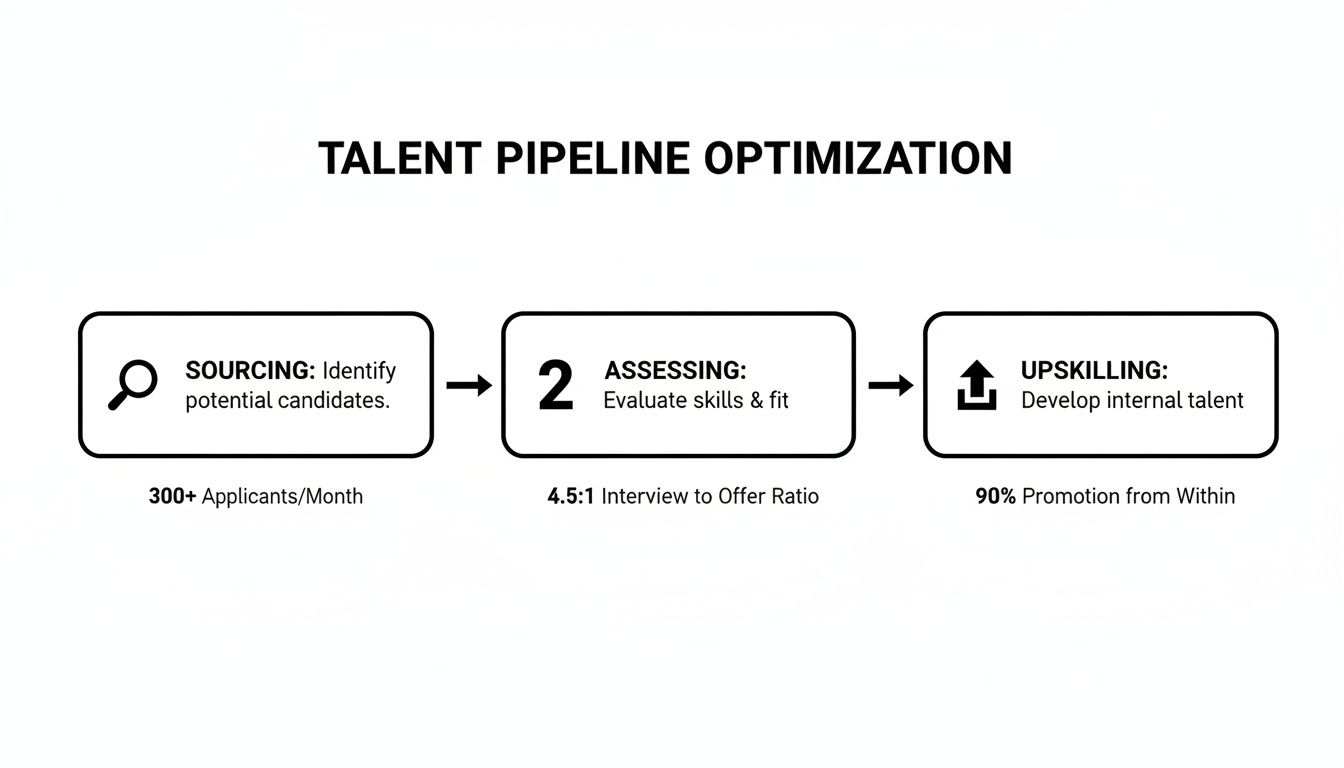
As you can see, success isn’t about acing one stage. It’s about optimising the entire journey to attract, develop, and, most importantly, keep skilled people.
To put it simply, here are the core components that make up a modern, resilient pipeline.
Core Components of a Modern Talent Pipeline
This table breaks down the strategic pillars that are absolutely essential for building a sustainable skilled workforce today.
| Pillar | Strategic Focus | Key Outcome |
|---|---|---|
| Workforce Planning | Shifting from reactive hiring to predictive, data-driven forecasting of talent needs. | Reduced hiring costs and improved operational readiness. |
| Hyper-Local Sourcing | Tapping into talent pools in non-metro areas through community and vocational partnerships. | Access to a larger, more stable, and engaged talent pool. |
| Tech-Enabled Screening | Using modern assessment tools to evaluate skills, fit, and potential at scale. | Faster, more accurate, and unbiased hiring decisions. |
| Retention & Upskilling | Creating clear career paths and continuous learning opportunities to foster loyalty. | Lower attrition rates and a highly skilled, adaptable workforce. |
| Employer Branding | Building a reputation as an employer of choice within local communities. | A strong inbound flow of qualified, organic candidates. |
Each of these pillars works together to create a system that feeds itself, turning a constant challenge into a powerful competitive advantage.
The core challenge is no longer just finding people. It’s about building a predictable system that consistently delivers skilled, engaged, and loyal talent right when and where you need it most.
When you get this right, your pipeline becomes your biggest asset. It guarantees business continuity, drives productivity, and builds an employer brand that makes you a magnet for the best local talent. By orchestrating hyper-local sourcing, tech-driven assessments, and retention-focused development, you transform your workforce from a recurring cost centre into the engine that fuels your growth. For many, a specialised RPO partner can be the key to designing and managing this end-to-end system effectively.
Unlock Talent with Hyper-Local Sourcing
If your talent strategy for blue- and grey-collar roles is still stuck on the major metro hubs, you’re missing the single biggest opportunity in the market today. The real goldmine isn’t in the big cities anymore; it’s in India’s Tier-II, III, and IV towns, where a massive, aspirational workforce is ready and waiting to build a career.
Tapping into this requires a fundamental shift in thinking. You have to move beyond passively posting jobs and start actively building a hyper-local sourcing engine. This isn’t just about finding people. It’s about becoming a pillar of the local community, forging genuine partnerships that create a predictable and cost-effective flow of skilled talent. It’s the difference between being a transactional hirer and a community employer of choice.
Go Beyond Job Boards to Build Community Partnerships
Your next great hire is probably studying at a local Industrial Training Institute (ITI) or vocational college as we speak. But you won’t connect with them by just sending a recruiter to a career fair once a year. That old model is broken.
True partnership means getting your hands dirty and engaging on a much deeper level. Here are a few things we’ve seen work wonders:
- Co-Develop Curriculum: Don’t just hope ITIs teach what you need. Work directly with them to align their training modules with your specific skill requirements. You could even offer to provide equipment or send your own experts as guest lecturers so students are learning on the technology they’ll use on the job.
- Sponsor Skill Competitions: Hosting or sponsoring local skill-based competitions is a brilliant way to spot top talent early. It also positions your brand as a community leader that actually invests in developing local expertise.
- Establish Apprenticeship Programmes: Create structured apprenticeship or internship programmes that offer a crystal-clear path from the classroom to a full-time job. This lets you assess skills and cultural fit firsthand while building loyalty from day one.
When you build these relationships, local institutes stop being just schools and start becoming a dedicated extension of your talent pipeline, feeding you a steady stream of pre-skilled, motivated candidates.
The most resilient talent pipelines are not bought; they are built. They grow from authentic relationships with local educational institutions, community leaders, and grassroots organisations that understand the aspirations of their people.
This strategy also has a huge cost advantage. Sourcing locally cuts down your reliance on expensive job boards and slashes relocation costs, making it a far more sustainable model for high-volume hiring.
Design Engaging and Mobile-First Recruitment Drives
When you do go to a campus for a recruitment drive, you have to make it count. A generic PowerPoint presentation in a stuffy auditorium just won’t cut it with a generation that values authentic experiences.
Think about designing an experience, not just a recruitment event. A manufacturing company, for example, could bring a virtual reality (VR) headset to campus and let students experience a day on the factory floor. It’s a simple, engaging tool that can demystify the work environment and attract candidates who might have otherwise overlooked the role.
And critically, your entire application process must be mobile-first. The vast majority of candidates in these regions will use their smartphones to look for and apply for jobs. A clunky, desktop-only process is a dead end. Make sure your application can be completed easily on a mobile device, ideally through platforms they already use every day, like WhatsApp.
Tap into the Ambitions of a Younger Workforce
The demographic shift in India’s workforce is your greatest asset. Recent data shows that Millennials and Gen Z now account for 65% of all blue-collar job applications. The 20-23 year age group, in particular, saw a massive 50.7% year-on-year surge in applications.
What’s really telling is that applications from Tier-IV cities jumped by 54.9%, showing a clear desire to build careers closer to home. You can dig deeper into these trends in this detailed report on the rise of a new talent generation.
This data is screaming one thing: the talent is not only there, it’s actively looking for good opportunities in smaller cities. To capture their attention, your messaging has to connect with their aspirations.
- Showcase Career Paths: Don’t just advertise a job; advertise a career. Use testimonials from current employees who started in entry-level roles and have grown with the company. Show them what’s possible.
- Highlight Stability and Growth: Emphasise the long-term stability and skill development you offer. For a generation seeking security and a chance to advance, this is a powerful motivator.
- Respect Local Culture: Take the time to understand and respect local customs and values. Your employer brand and all your communications should feel authentic and connected to the community you’re hiring from.
By tapping into the immense potential of India’s smaller cities, you’re not just building a talent pipeline that’s more cost-effective. You’re building one that’s more resilient and more loyal. For more on this, check out our insights on how smaller cities are becoming India’s most promising talent pool.
Modernise Your Screening and Onboarding

Once your hyper-local sourcing engine starts humming and delivering a steady stream of applicants, you’ll quickly run into the next major hurdle: how to accurately spot the right talent, fast. Let’s be honest, traditional interviews and CV reviews are terrible predictors of on-the-job success for most blue- and grey-collar roles. They’re slow, subjective, and rarely tell you if someone can actually do the job.
To build a talent pipeline that’s both scalable and effective, you have to bring your screening process into the 21st century. The mission is to get beyond just talking and start seeing skills in action. Technology is the key to making this happen, allowing for assessments that are quicker, far more objective, and frankly, more interesting for the candidates themselves. This isn’t just about shaving off time; it’s about making smarter, data-driven hiring decisions that stick.
Go Beyond the Interview with Tech-Enabled Assessments
Trying to gauge a welder’s precision or a forklift operator’s spatial awareness from a conversation alone is a recipe for a bad hire. The good news is that modern tools let you see those skills in action before an offer is ever made, which dramatically boosts the quality of your hires.
Imagine a logistics company hiring for its warehouse. Instead of asking candidates about their experience with inventory management, they could hand them a tablet with a gamified assessment. The game might challenge them to sort and categorise virtual packages against the clock, directly testing their speed, accuracy, and attention to detail. It feels like a challenge, not a test.
For more complex manufacturing roles, virtual reality (VR) simulations are a game-changer. A candidate can put on a VR headset and be instantly immersed in a digital twin of your factory floor. You can then ask them to operate a specific piece of machinery or follow a tricky assembly sequence. This gives you a wealth of data on their actual capabilities and safety awareness, all without any real-world risk.
These methods bring some powerful advantages to the table:
- Objectivity: Every single candidate is measured against the same standard criteria, slashing unconscious bias.
- Predictive Accuracy: They test the exact skills needed on the job, leading to better day-one performance and lower first-year attrition.
- Candidate Engagement: Let’s face it, interactive assessments are just more engaging than a stuffy interview. This improves the candidate experience and makes your brand look innovative.
Structure an Onboarding Experience That Retains Talent
Screening is only half the battle. That critical journey from “yes” to becoming a productive member of the team is where so many companies drop the ball. A sloppy, disorganised onboarding process is one of the biggest reasons for early turnover. The focus has to shift from a mountain of paperwork to creating a genuine sense of belonging and confidence from day one.
The first 90 days are make-or-break. A structured, welcoming onboarding experience can improve retention by over 80%. Yet for many organisations, it remains a bureaucratic afterthought.
For this workforce, onboarding needs to be practical, crystal clear, and culturally tuned-in. And it should start well before their first day.
Use Pre-Boarding to Maintain Momentum
That gap between offer acceptance and day one? It’s a high-risk zone. A counteroffer from a competitor or just a case of cold feet can mean your top choice never shows up. Pre-boarding is your strategy to keep them hooked and excited to join.
This is all about sending curated, bite-sized information through channels they actually use, like WhatsApp. Think a short welcome video from their future team leader, a digital guide to the first week’s schedule, or even a quick rundown of what to wear. To get a better sense of this journey, you can learn more about how to boost employee experience with the digital onboarding process.
A solid pre-boarding checklist might include:
- A Personal Welcome: A simple, personalised video message from their direct supervisor goes a long way.
- Logistical Clarity: Clear instructions on where to park, which entrance to use, and who to ask for when they arrive.
- Team Introduction: A quick ‘who’s who’ of the team they’ll be working alongside.
- Early Access: Give them a head start with links to essential safety modules or company culture videos.
This kind of proactive communication makes new hires feel valued and prepared. It cuts down on first-day jitters and reinforces that they made the right choice. It turns onboarding from a single, overwhelming day into a gradual, welcoming process that builds a foundation for long-term success.
Solve Retention with Upskilling and Engagement

Getting a skilled worker through the door is a victory. But it’s a short-lived one if they walk out again in six months. A robust talent pipeline isn’t just about efficient sourcing; its true strength is measured by how well it keeps the people it brings in.
High attrition is the silent killer of productivity. It turns your hiring efforts into a costly, revolving door.
The financial drain is staggering. With annual turnover potentially hitting 55% and monthly rates hovering between 8-24%, the costs add up fast. This constant churn can inflate your operational budget by 20-30% every single year. For CHROs, the only real solution is to ‘pipeline-proof’ the organisation by shifting focus from just filling jobs to actually building careers. You can dive deeper into the data behind this challenge in this insightful 2025 workforce report.
This means getting proactive with upskilling and genuine employee engagement, turning what someone might see as just a job into a long-term career destination.
Transform Jobs into Careers with Clear Pathways
For many blue- and grey-collar workers, the biggest reason for leaving isn’t the paycheque, it’s the feeling of being stuck in a dead-end role. If your people can’t see a future with your company, they’ll naturally start looking for one elsewhere.
Your most powerful retention tool, then, is creating visible and achievable career pathways.
This means going beyond vague promises of “growth opportunities” and actually mapping out a tangible progression. For instance, a warehouse associate should be able to see a clear, step-by-step journey to becoming a team lead, then a shift supervisor, and eventually a warehouse manager.
To make this a reality, you need to define:
- Skill Checkpoints: What specific skills or certifications does an employee need to master to move up?
- Training Programmes: What internal or external training will you provide to help them get there?
- Mentorship Opportunities: Who are the experienced leaders who can guide them along the way?
When you make these pathways transparent, you change the entire conversation. The job is no longer just about the daily grind; it’s about what’s next.
Invest in Practical Upskilling and Certifications
Upskilling isn’t just a nice-to-have perk; it’s a core retention strategy. Giving your team access to training that leads to recognised certifications has a direct impact on their loyalty and performance. It sends a clear message that you’re invested in their growth, which in turn makes them more invested in your company’s success.
Picture a manufacturing firm that needs more skilled CNC machine operators. Instead of immediately looking outside, they could launch an internal upskilling programme for their existing machine assistants.
- Phase 1 Foundational Training: Offer classroom and virtual training on CNC programming basics and safety protocols.
- Phase 2 Hands-On Apprenticeship: Pair trainees with senior operators for practical, on-the-job mentorship.
- Phase 3 Certification: Sponsor their final certification exam. They get a valuable, portable credential, and you fill a critical skills gap.
This approach doesn’t just build skills, it builds deep-seated loyalty and creates a culture of continuous improvement from the ground up.
Retention isn’t about grand gestures. It’s about the daily proof that you value your employees’ future as much as you value their present output. Clear career paths and skill development are the most powerful forms of that proof.
Drive Engagement Beyond the Pay Cheque
While competitive pay is table stakes, it’s rarely the only thing that keeps people around. Often, it’s the non-monetary parts of the daily work experience that have the biggest impact on morale and retention.
Fair and predictable shift management is huge. For workers juggling family and other commitments, a chaotic, last-minute schedule is a massive source of stress. Using modern workforce management tools to provide schedules in advance and offer flexibility can be a game-changer.
Meaningful recognition is another powerful, low-cost tool. This doesn’t have to be a formal “employee of the month” award. It can be as simple as a supervisor publicly acknowledging a team member for a great safety check or a peer-to-peer shout-out system for good teamwork.
Finally, a supportive and respectful work environment is non-negotiable. This means training your supervisors in soft skills, encouraging open communication, and having a zero-tolerance policy for bullying. When employees feel safe, respected, and heard, they are far more likely to stick with you for the long haul.
Build Your Employer Brand with RPO Partnerships
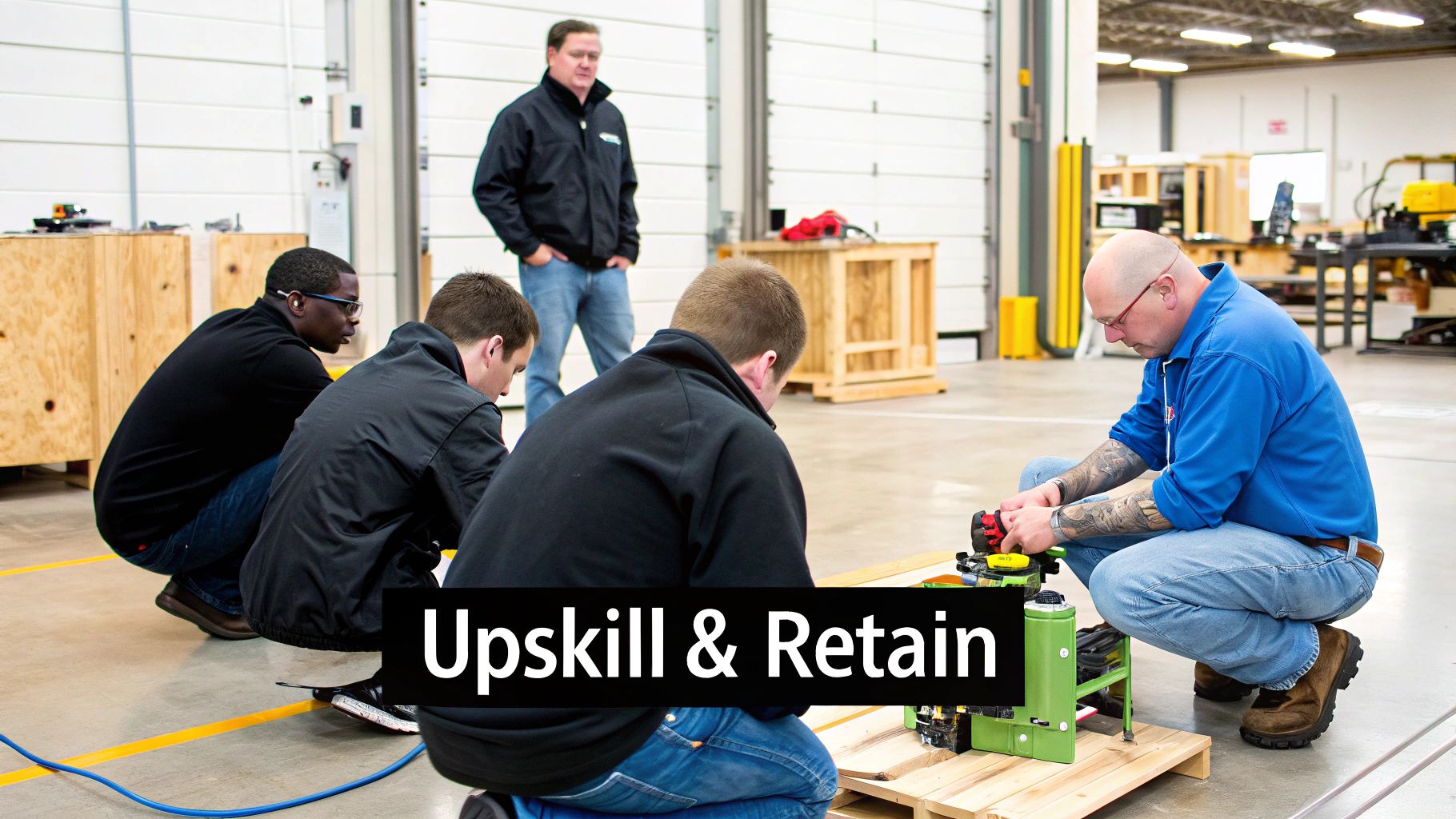
To win the war for talent, you can’t just be a company that hires. You have to be an employer people choose. A strong employer brand is the very foundation of a sustainable talent pipeline, especially when you’re hiring from tight-knit local communities.
This isn’t about glossy ad campaigns or slick corporate slogans. It’s about building a rock-solid, authentic reputation based on what blue- and grey-collar workers genuinely care about.
Your brand is built on the ground, through word-of-mouth, and on the digital channels they actually use. It’s about consistently showing your commitment to safety, demonstrating real career paths, and proving you value your people’s well-being. Get this right, and your brand becomes a magnet, pulling in qualified candidates without you having to spend a fortune on advertising.
But let’s be realistic. Managing this kind of hyper-local brand message across dozens of markets is a monumental task. That’s where a specialised Recruitment Process Outsourcing (RPO) partner can be a game-changer, acting as a strategic amplifier for your efforts.
Crafting a Message That Resonates
Your employer brand message has to connect with the core motivations of this workforce. Generic corporate speak about “innovation” or “global impact” is just noise. Your narrative needs to focus on the tangible, everyday benefits that truly matter.
We’ve found the most powerful brand stories are built on these pillars:
- Safety as a Priority: Don’t just talk about compliance. Show it. Showcase your clean, modern facilities, your investment in the best safety equipment, and a culture where anyone can flag a safety concern without fear.
- Visible Career Growth: Nothing is more powerful than a real story. Feature employees who started on the floor and are now supervisors or plant managers. Make career pathways clear and visible, and highlight every rupee you invest in training and certifications.
- Stability and Respect: In an uncertain world, the promise of a stable, long-term job is huge. Back this up with a message that reinforces a respectful, fair, and supportive work environment.
An employer brand isn’t what you say it is. It’s what your employees and the local community say it is when you’re not in the room. Authenticity is your most valuable currency.
These messages need to land where your audience will see them. This means looking beyond national job boards and doubling down on regional social media groups, local news outlets, and community events. A single positive story in a local newspaper can be worth more than a dozen national job postings.
How RPO Partners Amplify Your Brand
Trying to build and maintain this kind of local brand presence from a central HR team is next to impossible. A specialised RPO partner, however, acts as your dedicated brand ambassador on the ground, making sure your message is communicated consistently and effectively in every single one of your target regions.
Here’s what a good RPO partner brings to the table:
- Local Market Intelligence: They live and breathe these local markets. They know the influential community leaders, the best local job fairs, and the right channels to reach talent. They can tweak your brand message so it lands perfectly with local cultural values.
- A Consistent Candidate Experience: Every interaction a candidate has with you is a brand touchpoint. An RPO manages the entire hiring journey, ensuring every single applicant, even those not hired, gets timely communication and a professional experience. That’s how you protect your reputation.
- Data-Driven Brand Optimisation: RPOs are obsessed with metrics like source-of-hire and candidate feedback. This data gives you priceless insights into which messages are hitting the mark and which channels are delivering the best ROI, allowing for constant fine-tuning.
By integrating an RPO into your strategy, you’re not just outsourcing recruitment; you’re putting your employer brand on steroids. They become an extension of your team, dedicated to building a reputation that makes you the first-choice employer in every community you operate in. This creates a powerful, self-sustaining talent engine that will drive your success for years to come.
Measure Success with the Right KPIs
You can’t build a successful talent pipeline on gut feelings. It has to be engineered with data. Without the right metrics, you’re flying blind, unable to spot what’s working, what’s broken, and where your biggest opportunities are hiding. Measuring what matters is the only way to shift your hiring from a reactive cost centre to a predictable, strategic asset that actually fuels business growth.
This isn’t about tracking numbers for the sake of it. It’s about using data to tell a story. Does a low time-to-fill for a specific role mask a shockingly high first-year attrition rate? Is your cheapest sourcing channel also delivering the lowest-quality candidates? These are the critical questions that Key Performance Indicators (KPIs) help answer, allowing you to fine-tune your strategy and build a truly resilient blue- and grey-collar workforce.
Defining Your Core Pipeline Metrics
While you could track dozens of metrics, a few essential KPIs give you the clearest picture of your pipeline’s health. Focusing on these core four creates a powerful diagnostic toolkit without getting you lost in data overload. They tell you everything you need to know about efficiency, cost, retention, and overall effectiveness.
- Time-to-Fill: This is simply the number of days from when a job requisition is opened to when an offer is accepted. A consistently high time-to-fill can signal bottlenecks in your screening process or that your sourcing channels just aren’t cutting it. For instance, a 45-day average in one region versus 20 days in another points to a specific problem that needs digging into.
- Cost-per-Hire: This is the total cost of your recruitment efforts divided by the number of hires. It should include everything from job board fees and recruiter salaries to assessment tool subscriptions. Tracking this helps you see the financial efficiency of different sourcing channels and justify investments in strategies that deliver better, even if they aren’t the cheapest upfront.
- First-Year Attrition: This is arguably the most critical metric of them all. It tracks the percentage of new hires who leave within their first 12 months. A high rate (anything above 30%) is a massive red flag. It points to a mismatch in hiring, a poor onboarding experience, or deeper cultural issues that need to be addressed immediately.
- Quality of Hire: This one is a bit harder to quantify, but it measures the real value a new employee brings to the table. It’s often a composite score based on their 90-day performance review, productivity data, and feedback from their supervisor. This is the ultimate test of whether your pipeline is delivering people who don’t just fill a seat, but truly succeed in their roles. For an in-depth look, you might be interested in our guide on how RPO providers track and improve recruitment KPIs.
Turning Data into Actionable Insights
Collecting this data is just the starting line; the real value is in the analysis. When you start layering these KPIs on top of each other, you uncover powerful insights that can drive real strategic change.
Think about a manufacturing company that noticed a particular local job board had the lowest cost-per-hire. On the surface, it looked like a win. But when they dug deeper, they found that employees sourced from it had a 40% higher first-year attrition rate than those from their vocational institute partnerships. The data proved that the “cheaper” channel was actually costing them far more in the long run due to constant rehiring and training.
Data tells you where to look, but curiosity tells you what to find. Don’t just report on your KPIs; question them. Ask ‘why’ five times to get to the root cause of a problem in your talent pipeline.
This kind of analysis allows you to optimise your sourcing spend, refine your screening to better predict on-the-job performance, and improve your onboarding programme to tackle early turnover head-on. It transforms your HR function from an administrative department into a strategic partner that uses data to solve core business challenges and build a workforce that lasts.
Of course. Here is the rewritten section, crafted to sound completely human-written and natural, following all the specified requirements.
Your Top Questions Answered
When you’re deep in the trenches of building a skilled blue- and grey-collar talent pipeline, some very practical questions always bubble up. Here are a few I hear all the time from fellow CHROs, along with some straight-talking advice from my own experience.
How Can We Get Younger People Interested in Blue-Collar Jobs?
Let’s be honest, the old pitch of “a steady job with good pay” doesn’t cut it anymore for Millennials and Gen Z. If you want to grab their attention, you have to talk about what they genuinely care about: purpose, growth, and a decent work environment.
Start by showing them a real career path, not just a job. You need to visibly map out how an entry-level role today becomes a supervisor or manager role down the line. They need to see the ladder before they’ll even consider the first rung.
And forget the clunky, formal application process. Your entire recruitment has to be mobile-first and dead simple. Think less about desktops and more about meeting them where they are, like on WhatsApp. You also have to shout about your investments in a tech-forward, safe, and respectful workplace. This isn’t fluff; it’s a make-or-break factor for this generation.
What’s the Real Role of Technology in High-Volume Hiring?
In a high-volume world, tech isn’t a “nice-to-have.” It’s the engine that keeps the whole machine running with speed and sanity. It’s what frees up your team from drowning in repetitive tasks so they can actually focus on the human side of HR.
An Applicant Tracking System (ATS) is just the starting point, it’s table stakes for automating screening and making sure good candidates don’t get lost in the shuffle. But the real gains come from the next layer of tools.
- AI-powered matching tools are a game-changer. They can sift through thousands of applicants in seconds to find the best fits, something a human team could never do at scale.
- Digital onboarding platforms ensure every new hire gets a consistent, high-quality introduction, especially for critical safety training.
- Workforce management software isn’t just about scheduling; it’s about creating fair, predictable shifts, which is a massive driver of retention.
By plugging in the right tech, you empower your team to do what they do best: build relationships with community partners and mentor the people you’ve just hired.
How Do We Balance Full-Time Staff with Gig Workers?
Striking the right balance between permanent employees and gig workers is all about strategic flexibility. A blended model lets you dial your workforce up or down with market demand, without the fixed costs of a massive full-time payroll.
My advice is to use contract staff or gig workers to handle your peak seasons or one-off projects. This creates a pre-vetted bench of reliable talent you can activate on short notice, taking the pressure off your core team.
One of the smartest ways to de-risk hiring is a “temp-to-perm” model. It’s essentially a paid, working interview where you can see someone’s skills, attitude, and cultural fit in action before making a long-term offer.
This approach dramatically cuts down on hiring mistakes and means anyone who does transition to a permanent role is already up to speed. Just be transparent about the path to a full-time position and what they need to do to get there, it’s a powerful motivator.
Ready to build a resilient talent pipeline that powers your business growth? Taggd specialises in Recruitment Process Outsourcing designed for the unique challenges of blue- and grey-collar hiring. Let us help you build the skilled workforce you need to succeed. Learn more at https://taggd.in.