
Nailing your HRBP hiring starts with a fundamental mindset shift. You’re not just filling an HR role; you’re recruiting a strategic business driver who can turn your company’s goals into a tangible talent strategy. The right candidate won’t just follow orders—they’ll use data to challenge leadership and build a workforce ready for whatever comes next.
Defining the Modern High-Impact HRBP Role

Let’s be clear: the Human Resources Business Partner role has completely transformed. Gone are the days when an HRBP was simply a go-between for employees and managers, caught up in policy enforcement and operational tasks. Today’s high-impact HRBP is a strategic counsellor, an organisational architect, and a data-savvy decision-maker, all rolled into one.
For any CHRO navigating India’s fiercely competitive market, getting this distinction right is everything. The demand for truly strategic HRBPs is skyrocketing because companies finally realise their direct impact on the bottom line. It’s not about filling a seat. It’s about finding a partner who thinks like a CEO and speaks the language of the business unit they support.
This means your entire hiring process has to start with a modernised, crystal-clear role definition. Before you even think about a job description, you need to map the role’s responsibilities directly to your company’s core business objectives. For instance, if a key goal is market expansion, the HRBP’s job should be framed around talent acquisition, succession planning, and organisational design for that specific growth initiative.
Moving Beyond the Traditional HR Mandate
Getting your leadership team to understand this evolution is a crucial first step. The real value of a modern HRBP is their ability to get ahead of challenges, not just react to problems. They should be in key business discussions, offering insights backed by solid talent analytics and workforce trends.
A great HRBP doesn’t just manage employee relations; they dive into turnover data to uncover root causes and then design targeted retention strategies that protect your most critical business assets. This proactive, analytical mindset is what separates a true business partner from a traditional HR manager. You can dig deeper into the specific HRBP roles and responsibilities in our guide to help sharpen your definition.
The real measure of an HRBP’s success isn’t how well they administer HR processes, but how deeply they influence business strategy. They should be seen as essential to hitting commercial targets, not just maintaining compliance.
The Indian job market is already reflecting this shift. Projections show that hiring intent for seasoned HR Business Partners is expected to climb to 11% in 2026, a noticeable jump from 9.75% in 2025. This isn’t just replacement hiring; it’s a clear signal that India Inc. is actively expanding its strategic workforce. In fact, candidates with 6-15 years of experience are predicted to make up 55% of total hires in 2026, a massive increase from just 39% in 2025.
From Administrator to Strategist
To really bring this evolution to life for your stakeholders, it helps to spell out the differences in focus, mindset, and what success looks like. The table below clarifies what you’re really looking for in your HRBP hiring process and helps everyone understand the role’s strategic weight.
The Evolution from Traditional HR to Strategic HRBP
This comparison highlights the key differences between a traditional HR manager and a modern, strategic HR Business Partner across core functions.
| Area of Focus | Traditional HR Manager | Strategic HRBP |
|---|---|---|
| Primary Goal | Administer policies, ensure compliance | Drive business outcomes, improve performance |
| Perspective | Reactive, operational | Proactive, strategic |
| Key Metrics | Employee turnover, time-to-fill | Revenue per employee, talent pipeline strength |
| Decision Making | Based on policy and precedent | Based on data, analytics, and business needs |
| Relationship | Service provider to the business | Integrated partner in the business |
Seeing it laid out like this makes it obvious: you’re not hiring for the same old HR function. You’re hiring a strategic powerhouse who will be integral to your company’s growth.
How to Build Your Sourcing Strategy for Top HRBP Talent
Once you’ve nailed down a clear, modern definition of the HRBP role, the next big hurdle in your HRBP hiring journey is actually finding these strategic thinkers. Just posting a job ad on the usual portals isn’t going to cut it. Let’s be honest, the best candidates are often head-down, deeply engaged in their current roles, and not actively scrolling through job boards.
To find this hidden talent, you need a proactive, multi-channel sourcing strategy. This isn’t just about collecting applications; it’s about building a targeted pipeline of professionals who have that rare blend of sharp business sense and deep HR expertise. You have to go where they are.
Tapping into Passive Candidate Pools
The most impactful HRBPs are usually too busy driving results to be looking for a new job. This means active sourcing is your best bet. Professional networks like LinkedIn are a great starting point, but you need to be smarter than just firing off generic InMail messages.
A better approach? Identify companies you admire for their strong business performance or innovative cultures. Look for HR leaders in those organisations with titles that signal a strategic focus. Follow what they’re doing, engage with their content, and then reach out with a personalised message. Show them you’ve done your homework and understand the impact they’re making.
- Industry-Specific Forums: Get active in HR forums and online communities relevant to your industry. This is where real practitioners are talking about real-world challenges and solutions.
- Professional Networking Events: Both virtual and in-person HR conferences are goldmines for spotting rising stars and established leaders.
- Referral Programmes: Don’t forget your own business leaders. Ask them who the best HR partners they’ve ever worked with are. This simple question can lead to some incredibly high-quality referrals.
A well-rounded approach ensures you aren’t just waiting for candidates to come to you. For a deeper dive, it’s worth exploring the variety of modern recruitment sourcing methods to really broaden your reach.
Crafting a Compelling Employer Value Proposition
If you want to attract a strategic HRBP, you need to sell a strategic opportunity. Your employer value proposition (EVP) has to speak their language, highlighting the chance to make a genuine business impact, not just tick off HR tasks.
Top HRBP candidates are not looking for a job; they are looking for a business problem to solve. Your EVP is your pitch, proving that your organisation offers the challenge, autonomy, and influence they crave.
Your messaging should zero in on the strategic parts of the role. Talk about the opportunities to partner directly with senior leadership, influence business unit strategy, and use data to drive decisions. Showcase a culture that sees HR as a critical driver of growth, not just a support function.
EVP Messaging that Resonates with HRBPs:
| Avoid This Language | Use This Language Instead |
|---|---|
| “Manage employee relations” | “Coach leaders on building high-performing teams” |
| “Administer HR policies” | “Develop talent strategies to achieve P&L goals” |
| “Process HR transactions” | “Analyse workforce data to predict business risks” |
This deliberate framing completely shifts the perception from an administrative role to a true business partnership, which is exactly what attracts candidates with the right mindset.
Partnering with Specialised Recruitment Firms
For many CHROs, especially when timelines are tight or the requirements are niche, trying to source this talent alone can be slow and frustrating. This is where partnering with a specialised recruitment firm, particularly one offering a Recruitment Process Outsourcing (RPO) model, becomes a powerful strategic move.
These partners are more than just an extra pair of hands. They bring an extensive, pre-vetted network of passive HRBP talent that your internal team simply can’t access overnight. They have established relationships with top performers across industries and can quickly pinpoint candidates who are not only qualified but also a great cultural fit.
A specialised firm can dramatically speed up your hiring timeline. They handle the heavy lifting—sourcing, initial screening, and engagement—presenting you with a curated shortlist of high-calibre candidates. This frees you and your leadership team up to focus your energy on the final, most critical stages of assessment and selection, helping you fill this pivotal role faster and with much more confidence.
Designing an Assessment Process That Reveals True Potential
Once you have a shortlist of promising candidates, the real work in your HRBP hiring process begins. You need to figure out who can actually deliver a business-aligned talent strategy, and who just talks a good game. This means going way beyond the generic interview questions that barely scratch the surface.
Think of your assessment process as a diagnostic tool. It’s built to pinpoint genuine capabilities by throwing real-world HRBP dilemmas at them. So, forget asking, “Tell me about a time you influenced a leader.” Put them in a situation where they have no choice but to try.
Moving Beyond Standard Competency Questions
The classic interview often fails because it invites polished, rehearsed answers. Any decent candidate can explain the theory behind strategic partnership, but that tells you very little about how they’ll perform when the pressure is on. You need to see their thinking in action.
This is exactly why behavioural and situational interviews are so critical. These methods force candidates to get their hands dirty with practical, often messy, business problems—the kind that don’t have a textbook solution. You’re not just testing their HR knowledge anymore; you’re assessing their business acumen, problem-solving skills, and their knack for influencing outcomes.
Before you even get to this stage, of course, you need a strong pipeline. This is where a solid sourcing strategy comes in.
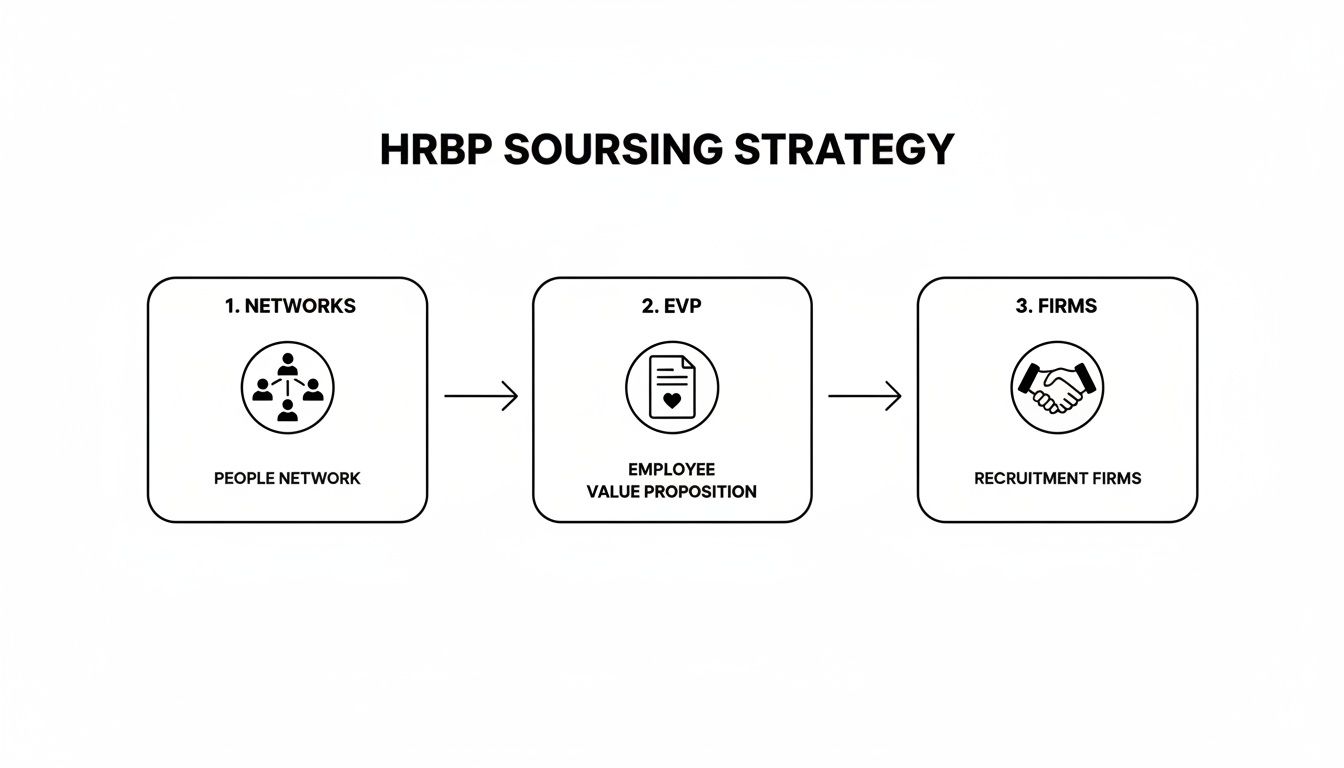
A multi-pronged approach that blends networking, a compelling employer brand, and partnerships with specialised firms ensures you attract the kind of high-calibre candidates who are worth putting through a rigorous assessment.
Using Case Studies to Test Strategic Thinking
One of the most powerful tools you have is the case study. This isn’t some abstract academic exercise; it’s a direct simulation of a complex business challenge they could walk into on their first day. A well-crafted case study can tell you more about a candidate in an hour than you’d learn in three standard interviews.
The scenario needs to be complex enough to demand real analysis but tight enough to be solved in a set time. Give them a mix of relevant data—and maybe some red herrings—to see how they cut through the noise to find what really matters.
Example Case Study Scenario:
- The Business Problem: “Our product engineering unit has a 25% attrition rate among mid-level engineers over the last six months, double the industry average. This is putting our new product launch, which is critical for Q4 revenue, at risk. Exit interviews just mention ‘better opportunities’ and ‘compensation’.”
- The Candidate’s Task: “As the new HRBP, you have 45 minutes to prepare a presentation for the Head of Engineering. Lay out your 30-day diagnostic plan, identify key stakeholders, list the specific data you’d analyse, and give your initial hypotheses on the root causes.”
This single scenario tests multiple competencies at once: data literacy, strategic thinking, influencing skills, and the ability to build a clear, actionable plan from ambiguity.
A great candidate won’t just jump to solutions like a salary review. They’ll start by asking deeper, more diagnostic questions. Are there issues with line management capability? Is our tech stack frustrating to work with? Are career paths a dead end? They’ll focus on the diagnosis before ever prescribing a cure.
Creating a Structured Interview Scorecard
Consistency is the key to a fair and effective assessment. To weed out bias and make sure every interviewer is measuring candidates against the same high bar, a structured interview scorecard is non-negotiable. It’s a simple tool that forces objectivity by defining exactly what “good” looks like for each critical competency.
Your scorecard should focus on observable behaviours, not vague traits. This keeps the feedback concrete and defensible, making the final debrief session with the hiring panel far more productive.
HRBP Competency Interview Scorecard Example
Here is a sample scorecard your interviewers can use to rate HRBP candidates across key competencies on a simple 1-5 scale.
| Competency | Key Behaviours to Look For | Candidate Rating (1-5) | Interviewer Notes |
|---|---|---|---|
| Business Acumen | Connects HR actions directly to P&L impact. Asks insightful questions about market trends and competitors. | ||
| Data Literacy | Demands data to support assumptions. Can interpret metrics and identify trends. Comfortable challenging anecdotal evidence with facts. | ||
| Strategic Thinking | Thinks beyond immediate problems to anticipate future talent needs. Proposes proactive, long-term solutions. | ||
| Consulting Skills | Listens more than they talk. Frames issues clearly for stakeholders. Builds a logical, persuasive business case for their recommendations. |
Using a rigorous framework like this—combining real-world case studies and a structured scorecard—gives your hiring team the confidence to make evidence-based decisions. It’s how you find an HRBP who can not only talk strategy but has the proven ability to execute it and deliver real business value.
Crafting an Offer and Onboarding for Immediate Impact

You’ve made it through the rigorous assessment process and pinpointed your top candidate. Now comes the real test: sealing the deal with a compelling offer and designing an onboarding experience that sets them up for immediate success.
This isn’t just about getting a signature on a contract. It’s about reinforcing the strategic importance of the role from day one and laying the groundwork for a long, impactful partnership.
Structuring a Competitive Compensation Package
When you’re hiring a strategic HRBP, your offer needs to reflect their potential business impact, not just fall in line with standard HR salary bands. The best candidates are analytical, they know their market value, and they will absolutely scrutinise your offer. You need to be ready with data.
In India, HRBP compensation clearly reflects the strategic value of the role, with average salaries hitting ₹19.6 lakhs annually. Data from over 700 real-world HRBP profiles shows a salary range from ₹15.5 lakhs to ₹49 lakhs, with the median hovering around ₹17.9 lakhs per year. This kind of package, often three to four times higher than entry-level HR roles, proves just how much of a premium companies place on experienced HR Business Partners. You can dive deeper into these benchmarks by reviewing verified HRBP profiles in India.
To craft an offer that truly stands out, you have to think beyond the base salary. Look at the total rewards package and how it speaks to the ambitions of a high-calibre professional.
- Performance-Based Incentives: Tie a significant part of their bonus directly to the business unit’s metrics—things like revenue growth, operational efficiency, or retention of key talent. This makes their success synonymous with the business’s success.
- Long-Term Incentives (LTIs): Offering stock options or other equity plans sends a powerful message. It shows you see them as a true long-term partner invested in the company’s future.
- Professional Development Budget: A dedicated budget for certifications, conferences, or executive coaching shows you’re committed to their ongoing growth as a leader.
This holistic approach demonstrates that you value their contribution not just as an employee, but as a critical driver of the business.
Building a 90-Day Strategic Onboarding Plan
A generic onboarding checklist filled with paperwork and system logins is a massive missed opportunity. For a strategic HRBP, the first 90 days need to be a deep, strategic immersion into the business, not an administrative marathon. Your goal is to fast-track their understanding, help them build crucial relationships, and empower them to start adding value right away.
Your onboarding plan is the first promise you deliver on. A strategic plan shows the new HRBP that you’re as serious about their success as you expect them to be about the business’s success.
Think of this plan as a structured roadmap with clear milestones for their first 30, 60, and 90 days, focusing on three core activities: learning, connecting, and delivering.
The First 30 Days: Focus on Immersion
Month one is all about deep listening and learning. The HRBP needs to become a sponge, absorbing everything they can about the business unit’s strategy, culture, challenges, and key players.
- Meet with Key Leaders: Set up one-on-one meetings not just with the head of the business unit, but with their direct reports and crucial leaders in finance, operations, and sales.
- Review Business Documents: Give them access to the essentials: strategic plans, financial reports, recent employee engagement surveys, and talent analytics dashboards.
- Shadowing and Listening Tours: Arrange for them to be a fly on the wall in team meetings, planning sessions, and operational reviews. This is where they’ll learn the real rhythm and pain points of the business.
The Next 60 Days: Shift to Diagnosis and Planning
Now that they have a solid understanding of the landscape, the HRBP transitions from learning to analysis. This is when they should start forming educated hypotheses about the key talent opportunities and challenges facing their business unit.
- Initial Diagnostic: Based on what they’ve learned, they should present an initial “State of the Talent” diagnosis to you and the business unit leader.
- Identify Quick Wins: Challenge them to pinpoint one or two high-impact, low-effort initiatives they can tackle quickly. This helps build immediate credibility and momentum.
- Draft a 6-Month Talent Roadmap: They should begin sketching out a longer-term talent strategy that is directly wired into the business unit’s primary objectives.
By structuring their entry this way, you’re not just hiring an HR professional; you’re launching a strategic partner who is primed to make a real impact from the get-go.
When to Partner with a Recruitment Process Outsourcing Firm
Even when you’ve perfectly defined the HRBP role and have a solid assessment plan, the reality of hiring can be a tough pill to swallow. Your internal talent acquisition team might be juggling too many roles, the unique blend of skills you need could be incredibly scarce, or you’re simply racing against the clock.
This is exactly where bringing in a strategic partner can make all the difference.
Engaging a Recruitment Process Outsourcing (RPO) firm is more than just offloading tasks. It’s a strategic move to infuse specialised hiring expertise directly into your organisation. Think of an RPO partner as an extension of your own team, one that’s completely dedicated to managing the entire recruitment cycle for these crucial HRBP roles.
This partnership frees up your internal team to focus on their core strategic duties while the RPO provider does the heavy lifting of sourcing, screening, and engaging top-tier talent. It’s about adding firepower and deep market insight right when you need it most.
Accelerating Time to Hire for Critical Roles
Here’s a situation I’ve seen play out many times: a fast-growing tech division urgently needs a seasoned HRBP. Their goal is to scale the engineering team and get a handle on rising attrition rates. But the internal TA team is already buried under a mountain of technical requisitions, and their network in the strategic HR space just isn’t there.
Every week that role stays open, the business risks losing key engineers and missing critical product deadlines. This is the classic trigger for bringing in an RPO.
A good RPO partner, especially one specialising in HR roles, already has a warm pipeline of passive candidates. These are the high-performers who aren’t actively job hunting but are open to the right conversation. They can tap into their network immediately, often presenting a curated shortlist in a fraction of the time it would take an internal team starting from square one.
An RPO partnership can slash the time-to-hire for a critical HRBP role by over 40%. This isn’t just about convenience; it’s a direct boost to business continuity and momentum.
By compressing the sourcing and screening stages, the RPO lets your hiring managers and leadership invest their valuable time where it matters most: in high-quality final interviews. This efficiency means you fill that capability gap much faster, preventing the negative ripple effects of a long-term vacancy.
Gaining Access to Specialised Talent Pools
Today’s HRBP often needs a very specific mix of skills. You might be looking for someone with deep experience in M&A integration, organisational design for the manufacturing sector, or advanced people analytics. Finding these individuals through standard job boards can feel like searching for a needle in a haystack.
This is where RPO providers shine. They are market specialists. Their entire day is spent mapping the talent landscape for specific functions.
- Deep Market Intelligence: They know which companies are known for developing the best HR talent and understand the subtle cultural and skill differences across industries.
- Established Networks: Their consultants have spent years building relationships with top HR professionals, giving them direct lines to candidates your job ads will never reach.
- Targeted Engagement: They know how to craft a compelling story that grabs the attention of a senior HRBP, positioning your role not just as a job, but as a strategic business opportunity.
For a CHRO, this translates to gaining access to a pre-vetted, high-calibre talent pool that was previously invisible. If you find your internal efforts are consistently hitting a wall, it might be one of the key signs you have outgrown in-house hiring for these highly specialised roles.
Choosing the Right RPO Partner
Be warned, not all RPO providers are the same. For this partnership to truly work, you need a firm that acts as a genuine collaborator, not just another vendor on the books.
When you’re evaluating potential partners, look for a consultative approach. A great partner will invest time upfront to really get under the skin of your business strategy, your company culture, and the specific problems this new HRBP needs to solve.
Ask for detailed case studies. Better yet, ask for references from companies who faced similar hiring challenges. A strong partner will be completely transparent about their process, their network, and how they define success. The goal is to find a firm that feels like an extension of your own leadership team—one that’s as invested in finding the right person for the long haul as you are.
Common Questions About Hiring an HRBP
Even with the best playbook in hand, hiring a strategic HRBP always throws up a few practical questions. As a CHRO, you’re looking for straightforward answers to cut through the noise and make the right call when adding such a vital partner to your team. Let’s get into some of the most common queries that come up.
How Long Should the HRBP Hiring Process Take?
Every search has its own rhythm, but a 60-to-90-day hiring cycle is a solid target for a strategic HRBP. This timeframe gives you enough breathing room for a thorough search and assessment, without letting things drag on and losing your best candidates to competitors.
Here’s a rough breakdown of how that timeline plays out:
- Days 1-21 (Sourcing and Screening): The first three weeks are all about building momentum. This is when you’re actively sourcing, reaching out to passive talent, and conducting those initial screening calls to build a healthy pipeline.
- Days 22-45 (Interviews and Assessments): This is where the real evaluation happens. You’ll be running multiple interview rounds, giving candidates case studies to tackle, and getting them in front of key business leaders for panel interviews.
- Days 46-60 (Final Selection and Offer): Time to narrow it down. This window is for final interviews, conducting reference checks, huddling with the leadership team, and finally, extending that all-important offer.
- Days 61-90 (Notice Period): Don’t forget to factor in the candidate’s notice period. For senior roles here in India, that’s typically anywhere from 30 to 60 days.
Trying to rush this process can backfire with a bad hire, but letting it stretch past 90 days almost always means your top candidates will have accepted other offers.
What Is the Ideal Background for a Strategic HRBP?
There’s no magic formula here, but the best HRBPs I’ve seen usually have what you’d call a T-shaped skill set. They have deep expertise in core HR functions, but they pair that with a genuinely broad understanding of how the business actually works.
Don’t just look at their HR experience. I always get interested when I see a candidate who has spent time outside of a pure HR role—maybe in a commercial, operations, or even a finance position. That kind of experience gives them a much richer business context. They get P&L statements, they understand market pressures, and they’ve seen operational challenges up close, which makes them infinitely more credible partners for your business leaders.
Forget just ticking the box on HR certifications. Look for the candidate who can clearly show you how they’ve used talent strategies to solve real business problems and deliver results you can measure.
How Do We Measure the Success of a New HRBP?
Gauging an HRBP’s success isn’t about tracking old-school HR metrics like time-to-fill. Their impact should be directly linked to the health and performance of the business unit they’re supporting.
Within their first year, you want to see tangible evidence of their influence in a few key areas:
- Improved Talent Metrics: Are the numbers moving in the right direction? Look for positive trends in things like the retention of high-performers, internal promotion rates, and employee engagement scores specifically within their business unit.
- Leader Capability: Is the HRBP actively coaching and developing the leaders they support? Getting direct feedback from those leaders is one of the most powerful ways to measure their effectiveness.
- Strategic Contribution: Are they a voice people want to hear in business planning meetings? Do leaders bring them into the fold proactively for advice on organisational and talent decisions?
At the end of the day, the ultimate test is simple: does the business unit leader see their HRBP as an indispensable partner in hitting their goals? That feedback, backed by the hard data, gives you the complete picture of your new hire’s true impact.
Ready to accelerate your search for a high-impact HRBP? Partner with a team that truly gets the nuances of strategic talent acquisition. Taggd specialises in connecting organisations with the kind of strategic HR leaders who drive genuine business growth. Discover how our Recruitment Process Outsourcing solutions can help you build your team faster and more effectively. Learn more about our approach at https://taggd.in.