Inside sales recruitment is all about strategically attracting, vetting, and hiring professionals who sell remotely. It’s not just about filling seats. It’s about finding people with a specific mix of technical savvy, genuine resilience, and sharp communication skills. These are the people who drive revenue through phone calls, emails, and virtual meetings, they’re the very backbone of today’s high-speed sales teams.
Why Inside Sales Recruitment Is Now Mission-Critical

The world of sales has completely changed. The old days of relying purely on field sales are long gone. For leaders in India’s most dynamic companies, mastering inside sales recruitment isn’t just a good idea, it’s non-negotiable.
This massive pivot is being driven by the explosion of digital-first business models and the aggressive growth we’re seeing in hot sectors like EdTech, FinTech, and SaaS. Companies are scrambling to build tech-powered, high-velocity sales teams that can connect with customers anywhere, breaking free from geographical chains. Roles like Sales Development Representatives (SDRs) and Account Executives (AEs) have been elevated from support functions to become the primary engines of revenue.
The Digital-First Sales Revolution
The shift to digital has made inside sales the new standard. Customers are now perfectly comfortable making major buying decisions over video calls and through digital chats. This demands a whole new kind of salesperson, someone who is just as comfortable navigating a CRM as they are building rapport over the phone.
Your recruitment strategy has to mirror this new reality. When you’re hiring for inside sales, you’re looking for a very specific skill set:
- Tech Acumen: They need to be fluent in CRM platforms, sales engagement software, and virtual meeting tools. This is non-negotiable.
- Resilience: The role involves facing a high volume of rejection. You need people who can take the hits and stay motivated.
- Coachability: The best reps are hungry to learn, adapt their pitch, and constantly refine their approach based on feedback.
A successful inside sales recruitment process isn’t just about filling seats. It’s about building a scalable system that consistently brings in talent capable of executing a high-velocity sales motion and contributing to predictable revenue growth.
A Powerhouse in the Indian Job Market
Let’s look at the numbers, because they tell a powerful story. Inside sales recruitment has become a true powerhouse in India’s job market, making up a massive 63% of all hiring activity in 2026.
To help you navigate this fast-changing environment, here’s a quick look at the major forces shaping inside sales hiring across India.
The Modern Inside Sales Recruitment Landscape at a Glance
| Market Driver | Key Industries | Essential Candidate Skills | Strategic Implication for CHROs |
|---|---|---|---|
| Digital Transformation & Remote Selling | SaaS, FinTech, EdTech | CRM fluency, video conferencing, resilience | Prioritise tech-enabled hiring processes to attract digitally native talent. |
| High-Velocity Sales Models | E-commerce, Online Services | High-volume outreach, coachability | Build scalable onboarding that quickly ramps up rep productivity. |
| Customer Self-Education | B2B Tech, Healthcare Tech | Consultative selling, active listening | Focus on hiring for emotional intelligence and problem-solving abilities. |
| Cost-Efficiency & Scalability | All sectors | Data analysis, automation tools | Invest in talent analytics to forecast hiring needs and optimise costs. |
This table provides a snapshot of the critical factors driving the demand for skilled inside sales professionals. As you can see, the talent you hire today will directly define your company’s growth trajectory for the next several years.
This incredible surge is especially obvious in booming sectors where speed and scale are everything. EdTech and online service companies, for example, are aggressively expanding their inside sales teams to handle a huge volume of calls and video meetings.
If you neglect the finer points of inside sales recruitment, you’re essentially handing a win to your competitors who are systematically building world-class teams. To get the full picture, you might also want to explore the broader 2026 hiring trends that are shaping the future of talent acquisition. This guide will give you the executive briefing on why this is so critical, right before we jump into the how.
Crafting Your Ideal Inside Sales Candidate Profile
Before you even think about posting a job opening, you have to know exactly who you’re looking for. A vague job description is a recipe for disaster. It guarantees a flood of mismatched applicants, and you’ll end up wasting everyone’s time – yours included.
Your goal isn’t just to write a job post. It’s to build a precise candidate profile that acts like a magnet for the right people and a filter for everyone else.
This goes way beyond generic job titles. It’s about doing a deep dive into the specific skills and traits needed for different roles on your team. The high-energy, resilient person who thrives as a Sales Development Representative (SDR) is a completely different hire from the strategic, relationship-focused Account Executive (AE) who closes the big, complex deals.
Getting these roles right from the start is the first real step toward building a team that actually performs. It ensures every new person you bring on board fits your culture, understands your sales cycle, and is wired to hit your revenue goals.
Differentiating Key Inside Sales Roles
Let’s be clear: not all inside sales roles are the same. Their day-to-day responsibilities are worlds apart, which means the ideal candidate is too. Let’s break down the two most common roles you’ll be hiring for.
- The Sales Development Representative (SDR): This person is the engine of your sales pipeline. An SDR’s entire world revolves around generating qualified opportunities for the closers. They spend their days making calls, sending emails, and connecting on social media, all with one goal: booking meetings. The perfect SDR is energetic, almost unbelievably resilient, and gets a buzz from hitting activity-based targets.
- The Account Executive (AE): This is your closer. The AE takes those qualified leads from the SDR and masterfully guides them through the entire sales process to a signed contract. They’re consultative, fantastic at discovery, and know how to demonstrate real value. Your ideal AE is a strategic thinker, an incredible listener, and has a proven track record of smashing revenue targets.
Understanding these differences is absolutely crucial. You’re not just hiring a “salesperson.” You’re strategically filling a specific, vital function within your revenue machine. We break down these nuances even further in our detailed guide on sales executive roles and responsibilities.
Balancing Hard Skills and Soft Skills
A truly successful inside sales professional is a mix of technical know-how and powerful people skills. Your candidate profile has to account for both. One of the most common hiring mistakes I see is focusing too much on one while completely ignoring the other.
Must-Have Technical Skills (Hard Skills)
These are the foundational, teachable abilities a candidate needs to get the job done efficiently from day one.
- CRM Fluency: They have to be comfortable in a CRM like Salesforce or HubSpot. Logging activities, managing their pipeline, and tracking progress shouldn’t feel like a chore.
- Sales Automation Tools: Experience with platforms like SalesLoft, Outreach, or Zoho is a huge plus. It shows they can handle high-volume outreach without getting overwhelmed.
- Virtual Communication: In today’s world, being a pro with video conferencing tools and professional written communication is completely non-negotiable.
The most critical mistake is overlooking soft skills. A candidate can learn your CRM, but it’s much harder to teach resilience, curiosity, or coachability. These traits are the true predictors of long-term success.
Critical Behavioural Traits (Soft Skills)
These are the intrinsic qualities that define how a person sells and how they’ll fit into your team. Honestly, these are often more important than hard skills.
- Resilience: The ability to handle rejection day in and day out without losing motivation is arguably the most important trait for an SDR.
- Coachability: The best reps are always looking for feedback. They don’t just listen; they actively adapt their process and put advice into practice, fast.
- Curiosity: A great salesperson asks brilliant questions that get to the heart of a prospect’s real pain points. They’re genuinely interested in solving problems, not just pushing a product.
- Grit: This is that special blend of perseverance and passion to stick with long-term goals, even when things get tough. It’s the inner drive that separates the good reps from the great ones.
Sourcing and Engaging Top-Tier Sales Talent

Here’s a hard truth: the best inside sales reps aren’t browsing job boards. They’re too busy hitting their quotas and closing deals for someone else. This means a passive, “post and pray” approach to hiring is a guaranteed way to build a mediocre team.
To attract elite performers, you have to become a hunter. You need a proactive, multi-channel sourcing engine that goes where the real talent is and grabs their attention with a message they can’t ignore. It’s all about active outreach, not just sifting through whoever happens to apply.
This mindset shift creates a sustainable pipeline of qualified candidates, cuts your reliance on the unpredictable flow of applicants, and keeps your hiring process well ahead of the competition.
Go Beyond Traditional Job Boards
Relying only on job portals means you’re just talking to the small fraction of candidates who are actively looking. To really win at inside sales recruitment, you’ve got to expand your hunting grounds.
Your best bet is professional networks. Platforms like LinkedIn are absolute goldmines for spotting passive candidates who fit your ideal profile. Get comfortable with advanced search filters to zero in on people with the right experience, at the companies you admire, and in the right locations.
Another powerful but often overlooked strategy is to tap into the talent pools of emerging cities. Tier-2 and Tier-3 cities across India are full of ambitious, skilled professionals. A localised sourcing strategy for these areas can uncover hidden gems who are hungry for a chance to grow.
Activate Your Employee Referral Program
Your current top performers are your single best source for finding more top performers. A strong employee referral program is one of the most powerful weapons in your recruitment arsenal. Why? Because referred candidates usually come pre-vetted for both skill and culture fit.
But for your program to work, it needs to be more than just a quick email announcement. Here’s how to make it a success:
- Generous Incentives: Offer a significant, timely bonus for successful hires. It’s a tiny cost compared to a bad hire or an empty seat.
- Clear Communication: Constantly promote the program. More importantly, make it dead simple for your team to submit referrals.
- Feedback Loop: Keep employees in the loop on their referral’s status. This simple step shows you value their effort and encourages them to do it again.
Think of your referral program as a natural extension of your recruitment team. Your best salespeople know exactly what it takes to succeed, and they can spot those same traits in their own professional networks.
This approach doesn’t just improve the quality of your hires, it dramatically slashes your time-to-hire.
Craft Outreach That Gets a Response
Once you’ve found potential candidates, the real challenge begins: getting them to actually talk to you. Top sales pros get dozens of generic recruiting messages every single week, and they ignore almost all of them. Your outreach has to cut through that noise.
The secret is to ditch the generic templates and embrace personalised, value-driven communication. Before you even think about hitting ‘send’, do your homework. Dig into their profile to understand their wins and career path.
A great outreach message does three things well:
- Shows you’ve done your research: Mention a specific achievement you noticed, a shared connection, or an article they wrote.
- Highlights the opportunity, not just the job: Frame the role in terms of its impact, potential for career growth, or a specific challenge they can solve.
- Includes a clear, low-friction call to action: Instead of a lazy “Are you open to a new role?”, try something like, “Would you be open to a brief, 15-minute chat to see if this aligns with your career goals?”.
By personalising your approach, you show you respect their time and expertise. This instantly separates you from the 90% of recruiters sending copy-paste messages and massively boosts your response rate. Honing your messaging is one of the most effective candidate engagement strategies you can deploy. It’s the difference between being ignored and starting a conversation with your next star hire.
How to Interview and Assess True Sales Potential
We’ve all felt the sting of a bad sales hire. It’s a costly mistake that goes way beyond a wasted salary. A bad hire can sink revenue, poison team morale, and even shatter the client relationships you’ve worked so hard to build.
This is why your interview and assessment stage is so critical. A polished presentation and a confident pitch can easily hide a complete lack of genuine sales grit. It happens all the time.
To find your future top performers, you have to dig deeper. You need a process that tests for the core competencies that actually drive sales success, not just the ability to talk a good game. It’s about mixing the right questions with practical challenges to see a candidate’s real potential unfold.
Moving Beyond the Standard Interview Questions
Let’s be honest, generic questions like “What are your greatest strengths?” are a complete waste of time. They just invite canned, meaningless answers. If you want to understand how someone will actually perform, you need to find evidence of how they’ve performed in the past.
The key is to use behavioural and situational questions that are laser-focused on uncovering specific sales competencies.
- To test resilience: “Tell me about a time you were on a long losing streak. What did you do to turn things around and get back on track?”
- To assess coachability: “Describe a piece of critical feedback you received from a manager that was tough to hear. How did you process it, and what did you actually change in your approach?”
- To gauge problem-solving: “Walk me through a complex deal you lost. What went wrong, and what would you do differently today?”
These kinds of questions force candidates to pull from real-world experiences. You get a raw, unfiltered look into how they think, how they handle pressure, and whether they learn from their mistakes. Their stories will tell you far more than any polished self-summary ever could.
Implement Practical Sales Assessments
Interviews alone will only get you so far. The absolute best way to know if someone can do the job is to see them do a version of it, right in front of you. Practical assessments simulate the day-to-day challenges of an inside sales role, giving you something tangible to evaluate.
The goal here isn’t to find someone who performs perfectly. It’s to see how they prepare, think on their feet, and handle feedback. A candidate’s response to a simulated challenge often reveals more about their potential than their entire resume.
Here are two incredibly effective assessments you can implement right away:
- The Mock Discovery Call: Give the candidate a short brief on a fictional company and have them run a 15-minute discovery call with one of your sales managers. You’re not looking for a perfect pitch. You’re assessing their ability to ask sharp questions, listen actively, and build rapport under pressure.
- The Follow-Up Email Exercise: Right after the mock call, ask them to draft a follow-up email that summarises the conversation and outlines the next steps. This is a quick but powerful test of their written communication, attention to detail, and ability to articulate value clearly.
These exercises give you concrete data points that are far more reliable than just “gut feelings.” They help you compare candidates fairly and make a decision based on evidence, not just personality.
Creating a Consistent Evaluation Framework
To make your hiring process fair and truly effective, you have to evaluate every single candidate against the same criteria. A structured scorecard is the perfect tool for this.
This scorecard standardises feedback from all your interviewers, forcing the conversation to centre on job-relevant skills rather than vague, subjective impressions. Make sure your scorecard aligns directly with the ideal candidate profile you built earlier.
Example Candidate Scorecard
| Competency | Rating (1-5) | Interviewer Notes & Evidence |
|---|---|---|
| Grit & Resilience | 4 | Described a specific instance of overcoming a sales slump by doubling down on cold calls and refining their script. Showed a positive mindset. |
| Coachability | 5 | Actively sought feedback after the mock call and incorporated suggestions immediately during the debrief. |
| Problem-Solving | 3 | Analysis of a lost deal was a bit superficial, but they correctly identified the key decision-maker they failed to engage. |
| Communication Skills | 5 | Articulate and clear during the call. The follow-up email was professional, personalised, and had a clear call to action. |
Using a scorecard like this for every candidate completely transforms your interview process. It shifts it from a series of casual chats into a strategic assessment. It forces you and your team to justify ratings with specific evidence, which leads to smarter hiring decisions and, ultimately, a much stronger inside sales team.
Onboarding, Retention, and Strategic Scaling
Getting that star candidate to sign the offer letter feels like a massive win, but let’s be honest, it’s the starting line, not the finish. The real success of your entire recruitment effort comes down to what you do next. Those first 90 days are completely make-or-break. It’s when a promising new hire either becomes a genuine revenue-generating asset or another disappointing statistic.
Throwing them in at the deep end with a haphazard welcome is a recipe for high early attrition and wasted recruitment budgets. A structured onboarding plan, on the other hand, dramatically shortens their ramp-up time, embeds your sales methodology, and genuinely integrates them into your company’s culture.
This flow chart outlines the core assessment process, moving from the initial interview to a final hiring decision.
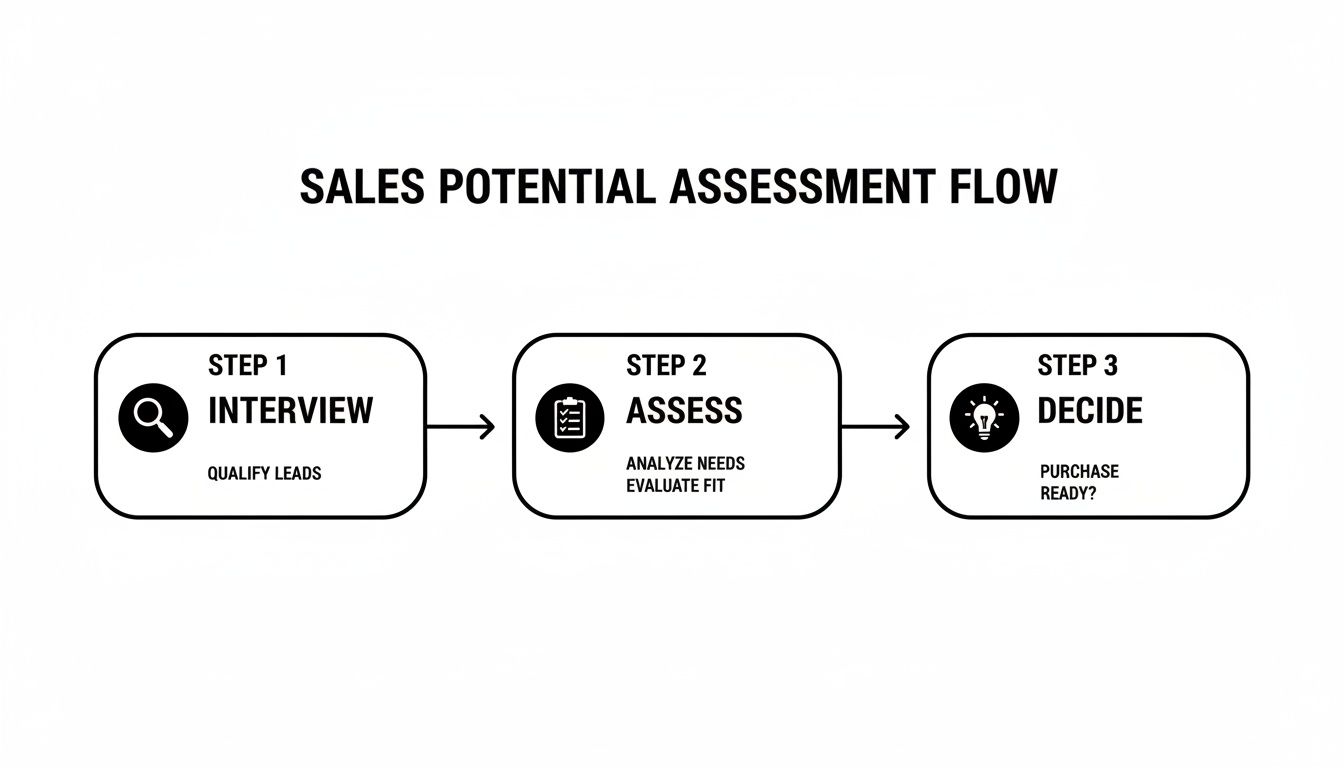
This visual just underscores a crucial point: hiring is a structured process, not a gut feeling. It takes distinct, deliberate stages to uncover real potential.
Building a 90-Day Onboarding Machine
An effective onboarding programme isn’t a week of PowerPoint slides on product features. It’s a carefully orchestrated journey designed to build three things: confidence, competence, and connection. You have to meticulously organise the plan to make sure new reps get all the critical info they need without feeling completely overwhelmed.
Here’s a practical framework that I’ve seen work wonders for the first three months:
- First 30 Days: Immersion and Foundation. This phase is all about soaking up knowledge. New reps should be diving deep into your product, getting to know your ideal customer profile inside and out, and shadowing your top performers on live calls. This is also the time to get them hands-on with your CRM and sales tools, but in a safe, sandboxed environment.
- Days 31-60: Application and Feedback. Now, it’s time to get on the field. Reps should begin making their first supervised calls and launching their initial outreach sequences. The real focus here is on non-stop coaching and feedback. Regular one-on-ones with their manager to review call recordings, tweak scripts, and build confidence are non-negotiable.
- Days 61-90: Autonomy and Performance. By the end of this period, your new hire should be starting to fly solo. They should be managing their own pipeline and hitting their initial, activity-based KPIs. This is the stage where you truly assess their trajectory and confirm they’re on the path to becoming a fully productive member of the team.
A well-executed onboarding process can improve new hire retention by 82% and productivity by over 70%. It’s the single most important investment you can make after extending an offer.
Strategies to Retain Your Top Sales Performers
Once your reps are ramped up and consistently hitting their numbers, the game shifts from onboarding to retention. Let me be clear: losing a top performer is devastating. It’s not just the lost revenue; it crushes team morale. Keeping your best people engaged requires a deliberate, continuous effort.
And it’s not always about throwing more money at them. While competitive compensation is table stakes, top reps are just as motivated by growth, recognition, and a clear sense of purpose.
Here are a few high-impact retention tactics that actually work:
- Clear Career Paths: Show your reps what’s next for them. A visible, achievable path from SDR to Account Executive or Team Lead is a powerful reason to stay and build a career with you.
- Continuous Coaching: The best performers are obsessed with getting better. Ongoing coaching, advanced sales training, and mentorship programmes show them you’re invested in their long-term professional development.
- Recognition and Celebration: Publicly celebrate every win, big or small. Recognising milestones like “First Deal Closed” or “Top Performer of the Quarter” builds a culture of achievement and makes people feel genuinely valued.
This kind of proactive engagement is what keeps your revenue engine humming and churn rates low.
Knowing When to Scale with an RPO Partner
As your company grows, so will your hiring targets. At some point, you’ll hit a fork in the road: do you keep trying to handle all inside sales recruitment in-house, or is it time to bring in a specialist? The answer usually comes down to three things: scale, speed, and strategic focus.
For any organisation planning a major expansion, a Recruitment Process Outsourcing (RPO) partner can be a complete game-changer. An RPO provider like Taggd doesn’t just fill a few open roles. They take ownership of the entire recruitment lifecycle, from sourcing and screening all the way to offer management. This frees up your internal HR team to step back from the tactical grind of high-volume hiring and focus on bigger strategic projects like leadership development and employer branding.
The 2026 hiring outlook for India shows a massive demand for inside sales roles as more businesses pivot to digital-first models. With 12.8 million new jobs on the horizon, a huge slice of that will be for mid-level sales talent in tech-enabled industries. In such a competitive landscape, an RPO partnership gives you the agility you need to win. You can discover more about how India’s job market will grow and which skills will matter most by reading the full report.
Common Questions About Inside Sales Recruitment
As inside sales has moved from a support function to the very heart of business growth, hiring managers are grappling with a whole new set of challenges. This isn’t just any recruitment; it’s a high-stakes, fast-paced field that demands a unique playbook.
These are the questions that come up again and again in our conversations with leaders trying to build powerhouse teams. Getting the answers right is what separates a struggling sales unit from a true revenue engine.
What Are the Most Common Mistakes in Inside Sales Recruitment?
So many organisations trip over the same few hurdles. The biggest mistake? Pushing out a vague job description that brings in a flood of mismatched candidates, wasting everyone’s time. You need to do more than just list responsibilities; paint a vivid picture of what success in the role actually looks like.
Another classic error is getting too fixated on a candidate’s past experience, completely ignoring high-potential people who are clearly coachable and resilient. Sure, someone who sold a similar product might look perfect on paper, but if they aren’t open to feedback, they’ll almost certainly wash out in a new environment.
Other critical mistakes include:
- An Unstructured Interview Process: Relying on “gut feelings” is a recipe for biased and inconsistent hiring. A standardised scorecard isn’t just nice to have; it’s non-negotiable.
- A Slow Hiring Process: Top sales talent is a hot commodity. If your process drags on for weeks, your best candidates will have already accepted offers from competitors who move decisively.
- Neglecting Onboarding: A sloppy onboarding experience is a primary driver of early attrition, which sends you right back to square one.
Dodging these pitfalls isn’t about luck. It requires a deliberate, strategic approach to every single stage of your hiring journey.
How Can We Hire Effectively in Tier 2 and Tier 3 Cities?
Tapping into India’s emerging cities is a massive opportunity, but it needs a localised strategy not just a copy-paste of your metro city plan. A great place to start is by building relationships with local universities and colleges to create a pipeline of fresh, ambitious talent.
Use digital sourcing channels where professionals in these areas are most active, which might not be the same platforms that are popular in Tier 1 cities. It’s also vital to adjust your compensation benchmarks to reflect the regional cost of living and local market rates.
When you’re recruiting in Tier 2 and Tier 3 markets, make sure to highlight benefits that really resonate, like long-term career growth, skill development, and organisational stability. These factors are often just as powerful as salary.
Finally, embracing remote or hybrid work models can dramatically widen your talent pool, giving you access to skilled people who aren’t looking to relocate.
What Is the Real ROI of Partnering with an RPO for Sales Hiring?
The Return on Investment (ROI) from a Recruitment Process Outsourcing (RPO) partnership is about so much more than just a lower cost-per-hire. The real value is in speed, quality, and scalability, all of which are critical for a high-velocity sales function.
Here’s where you’ll see the tangible returns:
- Reduced Time-to-Fill: Specialist RPOs have deep, pre-vetted talent pools and use smart technology to fill roles much faster. This means your sales teams get fully staffed and start generating revenue sooner.
- Improved Quality of Hire: You get access to a curated pipeline of candidates who have been assessed with proven frameworks. This leads directly to higher performance and a significant drop in attrition, saving you the immense cost of a bad hire.
- Strategic Scalability: An RPO gives you the agility to scale your team up or down based on market demand, without the headache of expanding and contracting your internal HR department.
- Enhanced Strategic Focus: By outsourcing the tactical grind of high-volume hiring, your internal talent acquisition team is free to concentrate on core strategic work like executive hiring, employer branding, and leadership development.
How Should We Measure Recruitment Success?
Measuring the success of your inside sales hiring requires a balanced scorecard that looks far beyond simple activity metrics. To get the full picture, you need to track a blend of efficiency, quality, and direct business impact.
Key Success Metrics:
- Time-to-Fill: This measures the raw speed and efficiency of your hiring process, from the day the job is opened to the moment an offer is accepted.
- Quality of Hire: This is the metric that truly matters. The best way to track it is by measuring a new hire’s performance against their quota at the six and twelve-month marks.
- New Hire Attrition Rate: What percentage of new hires leave within their first year? A high number here points to a mismatch in either your selection process or your onboarding.
Tracking these KPIs together gives you a clear, data-driven picture of your recruitment engine’s health and its direct contribution to your long-term business goals.
Ready to stop hunting and start hiring the right inside sales talent? Taggd‘s AI-powered RPO solutions help you build a high-performing team faster, with better quality and at scale. Connect with us and learn how we can transform your inside sales recruitment team.