The real difference between on-demand hiring and contract staffing comes down to this: on-demand hiring gives you lightning-fast access to elite, specialised experts for short-term, high-impact projects. On the other hand, contract staffing provides temporary employees for longer, more operational roles to help you manage fluctuating workloads. Which one you choose depends entirely on whether you need immediate strategic firepower or scalable operational support.
Choosing Your Modern Workforce Strategy

For Chief Human Resources Officers (CHROs), the decision isn’t about picking one model and sticking to it. The most resilient organisations I’ve seen are the ones building an agile workforce by strategically blending both approaches. This all starts with understanding the unique purpose each serves within your broader talent strategy.
Think of on-demand hiring as your surgical instrument for business acceleration. It connects you with top-tier freelance specialists—the data scientists, digital transformation consultants, or market entry strategists who can solve critical problems, and solve them quickly. You engage these experts for their specific, high-level skills to deliver a defined outcome, often in just a matter of weeks.
In contrast, contract staffing is the engine that drives your operational flexibility. It’s perfect for augmenting your teams with skilled professionals for a set period. Maybe you need to cover a maternity leave, manage a seasonal surge in customer service, or support a six-month IT project. These individuals slot right into your existing teams to maintain capacity and keep the workflow smooth. To see how these fit into the bigger picture, it helps to get familiar with different hiring models.
The fundamental shift for CHROs is moving from a binary choice of “permanent vs. temporary” to a nuanced portfolio approach. The right blend of on-demand specialists and contract staff creates a workforce that is both cost-effective and highly adaptable to market changes.
This initial breakdown should clarify where each model truly shines.
Quick Comparison On-Demand Hiring vs Contract Staffing
To help you see the differences at a glance, here’s a straightforward comparison of the two models across the criteria that matter most to HR leaders.
| Criterion | On-Demand Hiring | Contract Staffing |
|---|---|---|
| Primary Use Case | Strategic, project-based tasks requiring niche expertise. | Operational roles needing scalable workforce capacity. |
| Typical Duration | Short-term (days to a few months). | Medium to long-term (several months to a year or more). |
| Skill Level | Highly specialised, elite, and often senior-level experts. | Broad range of skills, from entry-level to professional. |
| Engagement Speed | Very fast; often within 24-72 hours via talent platforms. | Moderate; typically involves agency sourcing and screening cycles. |
| Cost Structure | Premium daily or project-based rates reflecting high expertise. | Hourly or monthly rates based on market standards for the role. |
This table lays out the core distinctions, helping you frame which approach aligns best with the specific business challenge you’re trying to solve right now.
Understanding the On-Demand Talent Economy

The on-demand talent economy marks a genuine shift in how companies tap into specialised skills. It’s a move away from traditional hiring, offering direct and incredibly fast access to a curated pool of freelance experts and independent contractors. The entire model is built for speed and precision, connecting you with the exact expertise needed for a critical, short-term project.
Think about it. You need to launch a new data analytics platform, map out a market entry strategy for a new region, or spearhead a digital transformation project. On-demand hiring lets you bring in a seasoned professional who has been there and done that, allowing you to skip the steep learning curve and see progress almost immediately.
The Mechanics of On-Demand Access
This model is powered by specialised talent platforms that do more than just list jobs. They are curated marketplaces where experts are rigorously vetted for their skills, experience, and track record. The process is designed to be refreshingly efficient:
- Define the Need: You outline the specific project, what success looks like, and the expertise you need.
- AI-Powered Matching: These platforms use smart algorithms to sift through their talent pool and serve up a shortlist of the best-fit candidates.
- Rapid Engagement: You can review profiles, have quick chats, and often onboard an expert within days, not the weeks or months you might be used to.
This lean, fast approach is a key differentiator when you’re weighing on-demand hiring vs contract staffing, as the latter almost always involves a more drawn-out, agency-led recruitment cycle.
The real power of on-demand hiring is its ability to turn a massive business challenge into a manageable, time-bound project. It lets leaders deploy elite talent exactly where it’s needed most, driving innovation without bloating long-term headcount.
Understanding the Cost and Value Equation
The first question is always about cost. Yes, on-demand specialists command premium day rates, which can look high next to the hourly rates of contract staff. But that view misses the bigger picture. You aren’t just paying for someone’s time; you’re investing in accelerated results and deep knowledge that your in-house team might not have. It’s an investment that pays off in faster project completion, less internal disruption, and a higher quality of work.
The growth of this model in India shows it’s being embraced as a core strategic tool. As more organisations blend flexible talent with their permanent teams, the appetite for high-calibre independent professionals has shot up. For individuals, this trend offers a new career path, and it’s smart to understand how to prepare for a career in the gig economy.
Recent data shows that Indian businesses are more than willing to pay for this expertise. The 2025 Talent-on-Demand Report from Outsized noted a 44% rise in freelancer registrations in India. Specialists with 11–15 years of experience commanded average day rates around ₹19,000, with top-tier skills often fetching over ₹26,000. This isn’t just a trend; it’s a market reality where businesses are actively using on-demand talent to close skill gaps and push critical projects over the finish line.
Exploring Contract Staffing for Scalable Operations
While on-demand hiring offers surgical precision for specific, high-level projects, contract staffing is all about delivering the scalable workforce needed to maintain operational momentum. Think of this model as the backbone of organisational flexibility. It supplies temporary employees for fixed terms, helping you navigate fluctuating workloads, seasonal demand, or lengthy projects without overwhelming your core teams.
Unlike on-demand specialists who are brought in for a single, high-stakes deliverable, contract staff augment your existing teams. They become a part of the daily workflow for the duration of their assignment, integrating into your company culture and reporting lines. This deeper level of integration is a crucial differentiator in the on-demand hiring vs contract staffing debate.
Powering Operational Continuity
Contract staffing is less about solving one complex problem and more about keeping things running smoothly during periods of change or high demand. The roles filled through this model are typically broad, covering the essential functions that keep the business on track.
You’ll often see contract staffing used for roles like:
- IT Support Technicians to manage system upgrades or provide extra helpdesk coverage.
- Customer Service Representatives to handle seasonal spikes in call volumes.
- Manufacturing and Logistics Personnel to scale up a production line for a new product launch.
- Administrative Professionals to cover parental leave or support large-scale internal projects.
This approach gives you the agility to expand and contract your workforce in direct response to business needs—a massive advantage in dynamic industries. To see how this fits into the bigger picture, it’s worth exploring various staffing solutions and their specific applications.
The real strategic value of contract staffing is its ability to absorb operational pressure. It acts as a reliable valve to manage workload variations, ensuring your permanent employees can stay focused on their core duties without risking burnout.
Cost Structure and Scalability
The financial model for contract staffing is built for predictability. Costs are usually based on a manageable hourly or monthly rate, handled by a staffing agency that also takes care of payroll, benefits, and compliance. This setup allows CHROs to control headcount costs effectively, keeping operational spending aligned with revenue cycles. It’s a pragmatic way to maintain full operational capacity without the long-term financial commitments of permanent hires.
This model is a cornerstone of India’s labour market, fuelled by strong recruitment growth and shifting sectoral demands. Forecasts for 2025 point to a 15–20% growth in technology hiring, and a significant chunk of these roles will likely be filled through staffing channels. Some industry reports even project around 500,000 new job opportunities across leading sectors, a 19% jump in employer hiring intent from 2024. As the demand for niche tech skills skyrockets by an estimated 30–35%, staffing firms are becoming critical partners for supplying contract engineers and data professionals for multi-month assignments. These numbers underscore just how effectively contract staffing provides the scalable labour needed to meet sustained operational demands. You can dig deeper into recruitment industry insights to understand India’s hiring outlook for 2025.
A Strategic Look at Hiring Models
When you’re weighing up on-demand hiring against contract staffing, you need to look past the obvious differences and really dig into the strategic impact each can have. For a CHRO, the decision isn’t about which model is “better,” but which one solves the specific business problem you’re facing right now. Think of it as choosing between a precision tool and a more versatile one; each shines in its own context.
The most fundamental distinction comes down to purpose. On-demand hiring is all about strategic interventions—bringing in elite, niche expertise to fast-track a high-stakes project. Contract staffing, on the other hand, is built for operational stability. It’s about getting scalable workforce capacity to manage predictable ups and downs and keep the business running smoothly.
Speed of Deployment
One of the first things you’ll notice is how fast you can get people on the ground. On-demand platforms are designed for almost instant access, often connecting you with a pre-vetted specialist in just 24 to 72 hours. This model is a game-changer when time is your biggest competitive advantage—like when you urgently need an AI expert to fine-tune a product feature before a rival’s launch.
Contract staffing, while still agile, works on a more traditional recruitment cycle. Staffing agencies have a multi-step process that includes sourcing, screening, and interviews. It’s thorough, but it typically takes anywhere from several days to a few weeks. This works perfectly for planned workforce increases, like gearing up for a seasonal rush, but it just doesn’t have the immediacy needed for those urgent, strategic problems.
Cost Versus Value
Looking at the cost alone can be really misleading. Yes, on-demand specialists have premium daily rates that might seem high at first glance. But this isn’t just a cost; it’s a value-based investment. You’re paying for speed, proven expertise, and accelerated project outcomes that can deliver a massive ROI, like launching a new service months ahead of schedule.
Contract staffing follows a volume-based cost model, with predictable hourly or monthly rates. The whole approach is designed for cost control and budget predictability, making it ideal for managing your operational expenses. The value here is in keeping productivity and service levels high without the long-term financial weight of a permanent hire.
The financial lens for on-demand hiring focuses on the return on project investment, while the lens for contract staffing centres on operational cost efficiency. One drives top-line growth and innovation; the other protects the bottom line.
To put this into perspective, imagine a fintech company. Hiring an on-demand cybersecurity expert for two weeks to patch a critical vulnerability provides immense value that easily outweighs their high day rate. In contrast, bringing in a team of contract customer service agents for a three-month festive season offers value through scalable, cost-effective operational support.
Skill Specificity and Application
The type of skill you need is another critical factor in the on-demand hiring vs contract staffing debate. On-demand talent pools are curated for deep, specialised knowledge. We’re talking about a data scientist with specific experience in algorithmic trading, or a consultant who has led multiple digital transformations. Their job is to come in, solve a complex problem, share their knowledge, and then move on.
Contract staff, on the other hand, bring a broader set of professional skills that are meant to integrate into your existing teams. They aren’t there to solve a single, groundbreaking problem but to perform a defined role within an established workflow. This could be an IT support professional, a project manager, or an accountant who can seamlessly join a team for a six-month period.
Strategic Alignment and Integration
Finally, think about how each model fits with your long-term business goals. On-demand specialists are strategic assets you deploy to hit specific milestones. They work with a high degree of autonomy, focusing on a clear deliverable, and don’t need much integration into the company’s day-to-day operations or culture.
Contract staff need much deeper integration. They become part of the team, adopt your workflows, sit in on meetings, and contribute to the daily operational rhythm. Their success is measured by how well they function within your existing structure, which makes cultural fit a much bigger deal than it is for a short-term, on-demand expert.
To make the comparison clearer, let’s break down the key differences across a few important dimensions.
Detailed Comparison: On-Demand vs Contract Staffing
The following table offers a comparative analysis across strategic, operational, financial, and compliance dimensions to help guide your decision-making process.
| Dimension | On-Demand Hiring (Specialists) | Contract Staffing (Temporary Workforce) |
|---|---|---|
| Strategic Focus | Project-based, high-impact interventions. Aimed at solving specific, complex challenges or accelerating innovation. | Role-based, operational support. Designed to manage workflow fluctuations and maintain business continuity. |
| Talent Profile | Elite, niche experts and seasoned consultants with proven track records in a specific domain. | Generalist and specialised professionals who can fill standard operational roles (e.g., IT, HR, finance). |
| Deployment Speed | Extremely rapid. Vetted specialists are often available within 24-72 hours. | Moderate speed. The process takes several days to a few weeks, depending on the role’s complexity. |
| Cost Structure | Value-based pricing. Typically higher daily or project rates, justified by ROI and speed to market. | Volume-based pricing. Predictable hourly or monthly rates, focused on operational cost control. |
| Integration Level | Minimal. Specialists operate with high autonomy on a defined SOW and require little cultural integration. | High. Staff are integrated into existing teams, workflows, and company culture for the duration of their contract. |
| Use Cases | Digital transformation, launching a new product, crisis management, plugging a critical skill gap for a short period. | Seasonal demand surges, covering for parental leave, managing large-scale projects, backfilling roles during hiring freezes. |
| Compliance | Handled by the platform provider, typically as an independent contractor (SOW-based) relationship. | Managed by the staffing agency, which acts as the employer of record, handling payroll, taxes, and benefits. |
Ultimately, choosing the right model isn’t about a permanent switch but about building a flexible talent strategy that allows you to use both. Knowing when to call in a specialist and when to scale up your team is what separates good talent management from great.
A Decision Framework for CHROs
Moving from theory to action means having a clear way to decide between on-demand hiring and contract staffing. For a CHRO, the right choice usually boils down to a handful of critical business questions. This isn’t about a one-size-fits-all solution; it’s about matching the talent model to the specific challenge you’re facing right now.
Think about the nature of the problem first. Are you dealing with a short-term, high-stakes project that needs elite, specialised skills? Or is this a longer-term operational need that requires you to scale up your team? Answering that fundamental question lays the groundwork for your entire decision.
Asking the Right Questions
To find the best path forward, you need to evaluate your needs against four key pillars. This simple process will help you map the unique strengths of each model to what your organisation actually needs.
- Project Duration and Urgency: How long will you need this person? Are we talking weeks or months? More importantly, how quickly do you need someone to come in and start making an impact? An urgent, short-term need points to a very different solution than a planned, six-month project.
- Required Skill Depth and Specificity: Are you looking for a generalist to fill a standard role, or a specialist with a rare, proven skill set? This distinction is crucial. One needs to fit into your existing team, while the other needs the autonomy to solve a complex problem on their own.
- Budget Source and Structure: Where is the money coming from? Is it a project-based budget focused on delivering a specific ROI, or an operational budget focused on controlling headcount costs? This financial detail often aligns perfectly with the cost structures of either on-demand or contract models.
- Team Integration and Workflow: How deeply does this person need to be embedded in your existing teams and company culture? Will they be an autonomous expert driving a key deliverable, or will they be an integral team member contributing to daily operations?
The decision tree below gives you a visual guide on how the answers to these questions point toward either an on-demand specialist or a contract staffing solution.
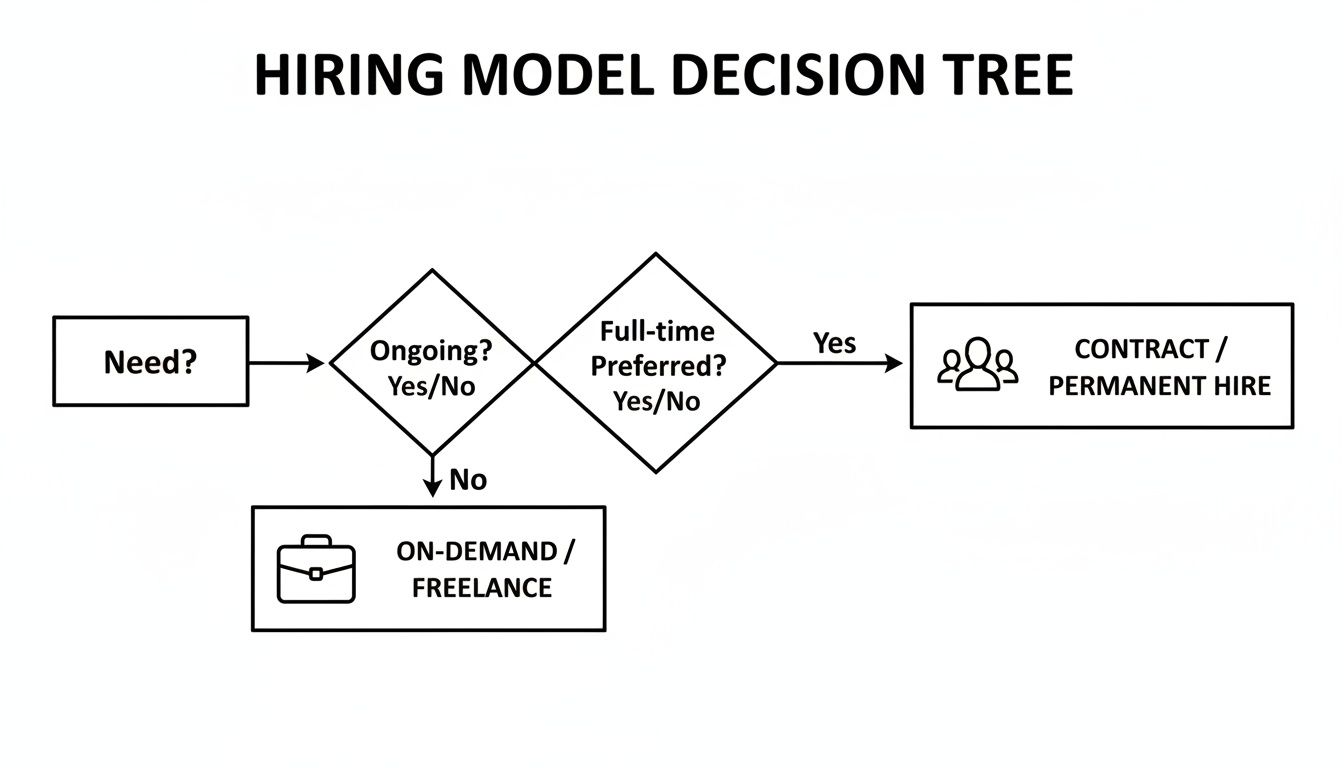
As you can see, short-term, specialised needs are a natural fit for on-demand talent, while roles that are longer-term and require deep integration are perfect for contract staffing.
Practical Scenarios and Recommendations
Let’s put this framework into practice with some real-world business challenges that CHROs face all the time. When you break down the situation, the best choice becomes much clearer.
Scenario A: Launching a New AI-Driven Product Feature Your team needs to develop and roll out a complex machine learning algorithm next quarter. The problem is, your in-house talent lacks the specific expertise in natural language processing to get it done right.
- Duration: Short-term (8-12 weeks).
- Skills: Highly specialised, niche AI/ML expertise.
- Budget: Project-based, tied directly to the product launch ROI.
- Integration: Minimal. The expert will work with the team but needs high autonomy.
- Recommendation: On-demand hiring. An elite AI specialist can parachute in, deliver the outcome quickly, and leave without any long-term commitment.
Scenario B: Scaling the Customer Support Team for the Festive Season You’re expecting a 40% spike in customer service tickets over the next four months during the festive rush. You need skilled reps to handle the load without adding permanent headcount.
- Duration: Medium-term (4 months).
- Skills: Professional, but fairly standard customer service skills.
- Budget: Operational, aimed at managing the seasonal workload cost-effectively.
- Integration: High. These reps must plug directly into your existing support workflows, systems, and team culture.
- Recommendation: Contract staffing. This lets you scale your team with qualified people who can slot into your operations seamlessly for a defined period.
The core idea here is alignment. You need to match the talent model not just to the role, but to the business objective, the financial structure, and the operational reality of the work itself.
By consistently applying these questions, you can build a more agile and strategically sound workforce. This approach empowers you to use both on-demand specialists and contract staff as complementary tools, deploying the right talent, in the right way, at precisely the right time.
Weaving Flexible Talent into Your Workforce

Simply picking a hiring model isn’t enough. To truly benefit from flexible talent, you need a smart integration strategy. Without one, you’re just creating silos where on-demand specialists and contract staff work in isolation, which kills collaboration and waters down their impact.
The real challenge is building a single, cohesive team where your permanent employees and contingent workers are all pulling in the same direction. It’s about shifting from a purely transactional relationship to one built on mutual respect and partnership. The aim should be to make everyone, regardless of their employment status, feel connected to the company’s mission.
This all starts with a concrete plan for onboarding, sharing knowledge, and fostering collaboration, each tailored to the realities of flexible work.
Tailoring the Onboarding Experience
A cookie-cutter onboarding process is a recipe for failure when dealing with flexible talent. Their needs are completely different from those of a permanent hire.
- For On-Demand Specialists: Speed and focus are everything. Give them immediate access to project documents, introduce them to key stakeholders, and get them set up on essential systems right away. The goal is to eliminate friction so they can start adding value from day one, not sit through a week of cultural orientation.
- For Contract Staff: This requires a bit more structure. While you still want it to be efficient, their onboarding should include introductions to the wider team, an overview of how your company communicates, and clear direction on their day-to-day role. This helps them slot into your existing workflows without a hitch.
A common mistake is treating flexible talent like outsiders. True integration happens when you give them the right level of access and context for their specific role, empowering them to contribute without getting bogged down by red tape.
Ensuring Effective Knowledge Transfer
One of the biggest risks with any temporary worker is knowledge drain. When a project ends, their valuable insights can easily walk out the door with them. That’s why a structured offboarding process is non-negotiable.
This should always include documented handover sessions, a central place for all project files, and a final debrief to capture what was learned. For an on-demand specialist, this could be a final presentation to key leaders. For contract staff, a detailed transition plan with their permanent colleagues is essential. This proactive step transforms a short-term engagement into a long-term asset for your organisation.
Fostering a Collaborative Hybrid Ecosystem
To create a seamless work environment, you have to break down the walls between permanent and contingent workers. Encourage open communication and make sure your flexible talent is included in relevant team meetings and project discussions. Their external perspective can often spark fresh ideas and challenge ingrained assumptions.
Technology is a massive help here. Vendor Management Systems (VMS) are brilliant for managing contract staff at scale, while Freelancer Management Systems (FMS) are specifically designed to handle engagements with on-demand specialists. These platforms give you the oversight needed to manage a blended workforce effectively, ensuring everyone is working toward the same objectives. By investing in both the right processes and the right tech, you can build a truly agile and high-performing hybrid team.
Frequently Asked Questions
As a CHRO, you’re constantly weighing the practicalities of new talent models. It’s natural to have questions. Here are some straightforward answers to the common queries we hear when leaders are deciding between on-demand hiring and traditional contract staffing.
What Are the Primary Legal Differences?
The key legal distinction in India boils down to the nature of the working relationship. An on-demand freelancer operates under a ‘contract for services’. Think of them as an independent business owner you’ve engaged for a specific outcome. They have a high degree of autonomy, typically use their own equipment, and aren’t embedded in your company’s day-to-day structure.
A contract employee, on the other hand, usually comes through a staffing agency and works under a ‘contract of service’. This relationship is much closer to traditional employment, affording them certain protections under Indian labour laws for things like minimum wages and working hours. Getting this classification wrong can lead to serious legal and financial headaches, so defining the role and its true requirements from the outset is non-negotiable.
How Should We Measure ROI?
You can’t measure the return on these two models with the same yardstick; their value propositions are completely different.
For an on-demand specialist, ROI is strategic. You’re measuring project-specific impact. Did we launch that new product faster? Did they solve a critical technical problem that was holding us back? What direct revenue did their expertise generate? It’s all about high-impact value creation.
For contract staff, ROI is operational. It’s about efficiency and stability. Here, you’re measuring cost savings compared to a permanent hire, the productivity you maintained during a seasonal surge, and the overall continuity of your business operations. One is about creating new value, the other is about optimising existing operations.
The simplest way to frame it is this: On-demand ROI asks, “What strategic value did we create?” while contract staffing ROI asks, “How efficiently did we manage our operational needs?” This clarifies the financial lens for each approach.
Can On-Demand Specialists Be Used for Longer-Term Needs?
While on-demand talent shines brightest on short-term, high-impact projects, you can absolutely engage them for longer periods. This often works well through phased assignments or retainer agreements, especially when a project’s timeline extends but its scope remains distinct from your core, day-to-day operations.
However, a word of caution for CHROs. If a role starts to blur into the core business, requiring deep, continuous integration and daily internal management over several months, it’s a signal. At that point, you’re better off considering a long-term contractor or even a permanent hire. Pushing an on-demand model into a core operational role for too long not only heightens your risk of misclassification but can also become less cost-effective over time. The trick is to always align the engagement model with the true nature and expected duration of the work.
At Taggd, we specialise in creating blended workforce strategies that drive business agility and growth. Our Recruitment Process Outsourcing solutions help you find the perfect mix of permanent, contract, and on-demand talent. Learn how we can build your future-ready workforce at https://taggd.in.