Think of on-demand recruitment services as your ace in the hole—a flexible hiring solution you can call upon exactly when you need it, without getting locked into a long-term contract. It’s like having a strategic, scalable extension of your own talent acquisition team, ready to jump in for fluctuating hiring demands, specific projects, or those sudden, rapid growth spurts.
Why On-Demand Recruitment Is Your New Strategic Advantage
In today’s unpredictable market, Chief Human Resources Officers (CHROs) are constantly juggling the need to align talent acquisition with the ever-changing demands of the business. Let’s be honest, traditional recruitment models, with their high fixed costs and slow-moving processes, often just can’t keep up. This is where a more agile approach isn’t just nice to have—it’s a critical business advantage.
Picture on-demand recruitment as a ‘talent cloud’ for your organisation. Much like cloud computing lets you scale your server capacity up or down in an instant, this model gives you a powerful, flexible resource you can deploy for a major product launch or pull back during a quiet quarter. This agility frees your organisation from the financial weight of a large, permanent in-house team or the expensive, sluggish process of working with traditional agencies.
The Shift Towards Agility and Precision
The modern business world runs on speed and adaptability. Waiting months to fill a critical role can mean losing a market opportunity or putting a key project on hold. On-demand recruitment tackles this head-on by providing specialised recruiters who can seamlessly integrate with your team and start delivering qualified candidates almost immediately.
This model is especially powerful for:
- Managing Seasonal Peaks: Quickly bring on the staff you need for busy periods without carrying that permanent overhead all year round.
- Meeting Project Deadlines: Assemble specialised project teams in a flash to ensure you deliver on time and execute flawlessly.
- Driving Strategic Growth: Scale your workforce to support a new market entry or product development without the usual recruitment lag.
This isn’t just a theoretical shift; it’s a trend that’s gaining serious momentum. In India’s dynamic market, on-demand recruitment services are booming as businesses increasingly use Recruitment Process Outsourcing (RPO) to meet urgent talent needs. The India Staffing and Recruiting market was recently valued at a massive USD 18.5 billion, a number largely driven by a surge in contractual workforce demands and project-based hiring. You can learn more about the growth of India’s recruiting market here.
By embracing a flexible RPO approach, CHROs can transform talent acquisition from a rigid cost centre into a responsive, strategic function that directly enables business growth and resilience in a fast-changing world.
Ultimately, this model empowers leaders to build a nimbler organisation—one that can respond to challenges and opportunities with the right people, at the right time, and at the right scale. It’s not just about filling roles faster; it’s about building a sustainable competitive edge through true workforce agility.
Understanding Your Recruitment Model Options
To really appreciate what on-demand recruitment brings to the table, we need to put it side-by-side with the models you’re already familiar with. Let’s step away from textbook definitions for a moment and use a simple analogy.
Think of your traditional in-house talent acquisition team as owning a fleet of company cars. It’s a huge upfront investment, demands constant maintenance, and, let’s be honest, many of those cars are often parked, collecting dust. They represent underutilised assets.
In stark contrast, on-demand recruitment is like having a premium ride-sharing service on speed dial. You don’t carry the cost of owning the fleet. You just summon the exact vehicle you need—whether it’s a nimble hatchback for a quick hire or a luxury SUV for a major project—the moment you need it. You only pay for the journey you take, which means peak efficiency without the dead weight of ownership. This model delivers a blend of speed, specialisation, and cost control that fixed models just can’t offer.
Comparing the Core Models
When deciding which hiring strategy to activate, CHROs need to weigh up several critical business factors. The right choice between on-demand services, a traditional RPO, contingent staffing, or your in-house team really boils down to the specific challenge you’re trying to solve. Each has its own strengths, but their effect on your company’s agility, costs, and strategic direction can be wildly different.
The image below gives a great visual of how a modern recruitment strategy is all about striking the right balance between agility, scalability, and cost.
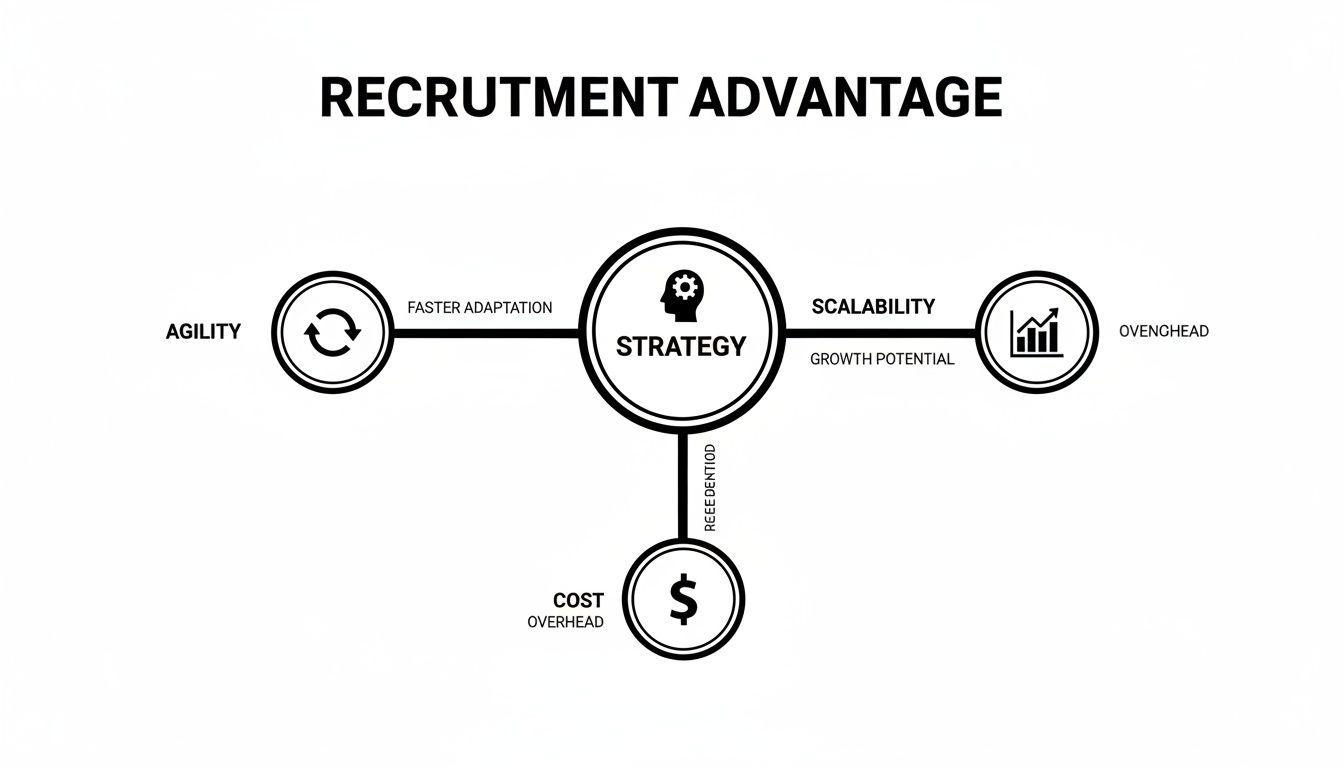
This really drives home the point that an effective talent strategy can’t be set in stone. It needs to be a living, breathing thing that lets you dial resources up or down while keeping a tight rein on your budget.
The core advantage of on-demand recruitment services is their ability to deliver specialist talent acquisition skills with surgical precision, hitting immediate business needs head-on without the long-term financial baggage of traditional hiring.
This kind of precision is a game-changer for projects on a tight schedule or for filling those niche roles that demand deep market knowledge your internal team might not have. It lets you pounce on market opportunities with a speed that can quickly become a serious competitive edge.
A Head-to-Head Breakdown
To make the differences crystal clear, let’s put these four models under the microscope and see how they stack up across the metrics that the C-suite really cares about. Getting these distinctions right is the key to building a truly flexible and powerful talent acquisition function.
For example, while on-demand hiring and contract staffing might look similar on the surface, their operational and strategic uses are poles apart. You can dive deeper into this in our detailed guide comparing on-demand hiring versus contract staffing.
To help you decide what fits best for different situations, we’ve created a direct comparison table.
Recruitment Model Comparison for Strategic CHROs
This table offers a straightforward comparison of how on-demand recruitment stacks up against the more traditional models, measured against the metrics that matter most for business impact.
| Metric | On-Demand Recruitment | Traditional RPO | Contingent Staffing | In-House Team |
|---|---|---|---|---|
| Cost Structure | Variable; Pay-per-project or per-hire. Highly predictable and tied directly to hiring activity. | Fixed; Long-term retainer or management fee. Consistent cost, regardless of hiring volume. | Variable; Percentage of salary. High cost per hire, paid only upon successful placement. | Fixed; Salaries and overhead. High fixed costs that are difficult to scale down. |
| Speed to Impact | Very High. Specialised recruiters are deployed quickly to address immediate, specific needs. | Moderate. Requires a longer setup and integration period for a comprehensive partnership. | High. Agencies can move quickly on individual roles but may lack deep integration. | Low to Moderate. Dependent on the existing team’s capacity and expertise for the specific roles. |
| Scalability | Excellent. Designed for rapid scaling up or down to match fluctuating business demands perfectly. | Good. Can scale, but often requires contract renegotiation and is less agile for short-term spikes. | Moderate. Good for individual roles but less effective for scaling entire teams or projects. | Poor. Scaling requires a lengthy and costly process of hiring and training new recruiters. |
| Strategic Alignment | High. Aligns with specific business projects and goals, acting as an integrated extension of your team. | Very High. Deeply embedded in the organisation, influencing long-term talent strategy and processes. | Low. Primarily transactional, focused on filling a specific vacancy rather than broader strategy. | Excellent. Fully aligned with company culture and long-term strategic goals by design. |
At the end of the day, this framework makes it clear there’s no single “best” model. A truly modern and resilient talent strategy is a blended one. Your dedicated in-house team is the engine, handling the core, predictable hiring. Meanwhile, on-demand recruitment services act as your turbo-boost, providing that crucial flexibility to power through growth phases, conquer specialised projects, and grab market opportunities the moment they appear.
Putting On-Demand Recruitment Into Practice
Moving from theory to tangible results is where the real value of any strategy becomes clear. For CHROs, the key to unlocking the potential of on-demand recruitment services is knowing exactly which business scenarios make them shine. This model truly excels in situations that demand speed, specialised expertise, and scalability—often all at once.
Think of it less as a replacement for your core team and more as a highly specialised task force you can bring in for critical missions. We’re not talking about everyday hiring needs. These are high-stakes situations where a talent gap translates directly into a missed opportunity or a hit to the bottom line. The focus shifts from just filling a role to achieving a specific, time-sensitive business outcome.

Common Scenarios Where On-Demand Excels
Certain challenges are practically tailor-made for an on-demand approach. By looking at these common use cases, you can start to spot similar high-impact opportunities within your own organisation.
- Rapidly Scaling a Tech Team: Imagine your company is launching a new flagship software product in six months. Your in-house team is already stretched thin, and you suddenly need 15 specialised developers with niche skills. An on-demand partner can deploy a dedicated tech recruitment team instantly, tapping into their existing talent pipelines to meet your aggressive deadline without derailing your internal team’s ongoing work.
- Filling Highly Specialised Roles: A critical, senior-level cybersecurity role has been vacant for months. Traditional methods aren’t cutting it, and the position is too specialised for most contingent agencies. An on-demand provider with deep expertise in the security sector can dedicate experienced sourcers to hunt for passive candidates, securing the exact talent needed to protect your organisation’s assets.
- Managing a Massive Seasonal Surge: Your e-commerce business needs to hire 200 customer service and warehouse staff for the festive season rush. This predictable but massive spike in hiring would overwhelm your HR department. On-demand services can manage the entire high-volume campaign—from sourcing and screening to onboarding—ensuring you are fully staffed to maximise holiday revenue.
This need for agility is a clear trend in the wider Indian market. For CHROs considering this model, the recruitment industry is forecasting 500,000 new jobs, with a 19% rise in hiring intent and a huge 40% surge in staffing early in the year. This growth is led by IT, which expects a 30-35% demand spike for specialised roles, signalling a clear need for flexible talent solutions. You can discover more insights into India’s 2025 recruitment landscape here.
The Strategic Impact on Business Outcomes
The true measure of success isn’t just about filling roles; it’s about the direct business outcomes you achieve. Each of these use cases connects directly to preventing revenue loss and capturing market opportunities.
The core function of on-demand recruitment is to act as a strategic lever, letting the business execute its plans without being held back by talent acquisition bottlenecks. It transforms hiring from a reactive necessity into a proactive driver of growth.
For instance, launching the new software on time lets the business capture a first-mover advantage. Filling that cybersecurity role mitigates significant financial and reputational risk. And staffing up for the festive season helps you avoid lost sales and poor customer experiences.
These examples show how this model contributes directly to the bottom line. If you’re looking to understand how this fits into a broader outsourcing strategy, it’s helpful to explore the nuances of different engagement types. Our guide on flexible RPO models explained provides more context for creating a blended talent acquisition strategy.
Ultimately, putting on-demand recruitment into practice means spotting these critical moments and having a partner ready to help you seize them.
Building a Successful On-Demand Partnership
Bringing on an on-demand recruitment partner is much more than just handing off a task; it’s about forging a strategic alliance. For this relationship to truly deliver, it has to move beyond a simple transactional exchange into a deeply integrated partnership. This requires a clear roadmap, from the initial scoping call to full team integration, ensuring both sides are perfectly aligned on goals, processes, and what success looks like.
The journey really begins with a foundation of mutual understanding. Your partner needs to become a genuine extension of your brand, living and breathing your company culture in every single conversation with a candidate. After all, this isn’t just about filling roles quickly. It’s about making sure the quality and fit of every new hire strengthens your organisation for the long haul.
Defining the Scope and Setting Expectations
Before a single candidate is ever sourced, the very first step is to establish a crystal-clear project scope. This initial discovery phase is absolutely crucial for preventing misunderstandings down the line and getting everyone on the same page about your exact hiring needs. Ambiguity is the enemy of an effective partnership.
Your initial conversations should meticulously outline:
- Specific Roles and Volume: Define the exact job titles, must-have qualifications, and the number of hires you’re targeting.
- Timelines and Urgency: Set clear deadlines for sourcing, interviews, and final offers. This helps manage everyone’s expectations from day one.
- Ideal Candidate Profile: Go beyond the job description. Talk about the soft skills, cultural traits, and experience level that truly define a successful hire in your company.
This level of clarity from the start allows your on-demand partner to deploy the right team of industry-specific recruiters and sourcers immediately. Instead of a slow ramp-up, they can tap into their established talent networks and start building a qualified candidate pipeline within days, not weeks.
Establishing Robust Governance and Communication
Once the scope is locked in, the focus shifts to building the operational framework that will govern the partnership. This means setting up structured communication channels and feedback loops to make sure collaboration is seamless. The goal is a “no-surprises” environment where information flows freely and consistently.
A successful on-demand partnership is built on a framework of transparency and accountability. Defining SLAs and establishing regular performance reviews transforms the relationship from a vendor service to a strategic collaboration focused on shared success.
Think of it as building the partnership’s central nervous system. This includes:
- Setting Clear Service Level Agreements (SLAs): Define measurable targets for key activities, like time-to-submit-candidates, interview-to-offer ratio, and hiring manager satisfaction scores.
- Structuring Regular Check-ins: Implement daily stand-ups or weekly review meetings to chat about progress, tackle any roadblocks, and recalibrate the strategy as needed.
- Creating Performance Dashboards: Use shared dashboards to track progress against your SLAs in real time. This gives both teams full visibility into the hiring pipeline.
This structured approach ensures your external recruiters operate like a seamless extension of your internal team. They should work directly within your existing systems, like your Applicant Tracking System (ATS), to maintain process consistency and data integrity. This integration minimises disruption and lets the team focus entirely on delivering results.
Ensuring Deep Cultural Alignment
This might be the most critical piece of the puzzle: making sure your on-demand team deeply understands and can authentically represent your company culture. An external recruiter who can’t speak genuinely about your Employer Value Proposition (EVP) can end up damaging your brand and attracting people who just won’t fit.
To get this right, the onboarding process has to be immersive. The partner team should spend real time with your hiring managers and key leaders to absorb the nuances of your work environment. This isn’t a box-ticking exercise; it’s about building genuine advocacy for your organisation. By investing in this cultural integration upfront, you ensure every candidate has a positive and consistent experience, which only strengthens your employer brand in the market.
Measuring the True ROI of Your Hiring Strategy
As a CHRO, you’re constantly asked to prove the business value behind every people-related initiative. When it comes to on-demand recruitment, that conversation has to go far beyond outdated metrics like ‘time-to-fill’. To build a solid business case, you need to speak the language of the C-suite, focusing on strategic Key Performance Indicators (KPIs) that draw a direct line between hiring agility and financial results.
This isn’t about just filling roles faster; it’s about measuring the real-world impact. We’re talking about the quality of the people you bring in, their direct contribution to business goals, and the satisfaction of the hiring managers who rely on them. It’s a shift from proving operational efficiency to demonstrating tangible business value.
Moving Beyond Traditional Metrics
The true return on investment (ROI) from an on-demand partnership is a mix of hard cost savings and the often-overlooked indirect value it creates. It’s about seeing the total impact on the business, not just what you saved in the recruitment budget. A powerful ROI calculation includes several critical factors that traditional models just don’t account for.
Think about the key financial levers you can pull:
- Reduced Agency Fees: By bringing in an on-demand partner for specific projects, you sidestep the hefty percentage-based fees that come with contingent agencies. This creates immediate, predictable savings right from the start.
- Minimised Productivity Loss: Every day a critical role stays empty, it’s a drain on the company—lost output, delayed projects, and a burnt-out team trying to pick up the slack. On-demand services compress that vacancy time, directly protecting productivity.
- Accelerated Revenue Gains: Filling roles faster means projects get over the line sooner, products launch on time, and new markets are entered without delay. This has a direct, measurable, and positive impact on the top line.
This more strategic approach to talent acquisition is rapidly gaining ground. The global recruitment outsourcing market, valued at USD 10.3 billion in 2024, is expected to surge to USD 25.8 billion by 2034. This growth is being fuelled by the efficiency boosts from modern tools like applicant tracking systems (ATS) and AI-powered screening. For more on this trend, you can explore the growth of the RPO market on Technavio.
A Framework for Strategic KPIs
To really get a grip on success, your KPIs need to tell the full story. Organising them by the type of value they deliver—efficiency, quality, and financial impact—gives you a complete picture of performance. This data-driven language is exactly what you need to demonstrate value in the boardroom.
Our guide on how to track and analyse the ROI of your recruiting efforts offers an excellent framework if you want to dive deeper.
The right KPIs are crucial for measuring how well your on-demand partnership is really working. The table below breaks down the essential metrics you should be tracking to gauge its true effectiveness.
Key Performance Indicators for On-Demand Recruitment
A breakdown of strategic KPIs to measure the effectiveness and business impact of your on-demand partnership.
| Category | KPI | Why It Matters |
|---|---|---|
| Efficiency | Time to Fill (by Role Complexity) | Shows how quickly your partner can respond to business needs, reducing costly vacancy periods. |
| Recruiter-to-Hiring Manager Ratio | Measures the efficiency of the recruitment process and indicates the support level your managers are receiving. | |
| Quality | Quality of Hire | Assesses new hire performance (e.g., via 90-day reviews) to ensure you’re hiring top performers, not just filling seats. |
| New Hire Retention Rate (12-Month) | A strong indicator of candidate fit and a successful onboarding process, which reduces long-term costs. | |
| Hiring Manager Satisfaction Score | Directly measures the service quality and effectiveness of the recruitment process from the end-user’s perspective. | |
| Financial Impact | Cost Per Hire vs. Agency Spend | Provides a clear, direct comparison of the cost savings achieved through the on-demand model. |
| New Hire Speed-to-Productivity | Measures how quickly new employees start adding value, linking recruitment directly to business output. |
By focusing on metrics like ‘Quality of Hire’ and ‘New Hire Speed-to-Productivity’, you shift the conversation from cost-per-hire to value-per-hire, proving that strategic recruitment is a revenue driver, not just a cost centre.
This comprehensive view helps you build a powerful narrative. It shows how on-demand services are not just filling roles but are actively fuelling business growth and improving the overall performance of the organisation.
How to Choose the Right On-Demand Recruitment Partner?
Your whole on-demand strategy lives or dies by the partner you choose. This isn’t just about finding another vendor for on-demand recruitment services; it’s about forging a strategic alliance that makes your organisation more agile and resilient. The right partner becomes a true extension of your team, getting to grips with your goals and representing your brand perfectly in the talent market.
Picking that partner requires a sharp, deliberate approach. You have to see past the polished sales pitch and really dig into the capabilities that matter. That means properly vetting their experience, their tech, and their knack for integrating smoothly with your own operations.

Core Criteria for Vetting Partners
Before you even think about signing a contract, your evaluation needs to focus on a few non-negotiables. These are the fundamentals that separate the tactical suppliers from the genuine strategic partners who deliver real, lasting value.
- Proven Industry Specialisation: Does the provider have a deep, demonstrable track record in your specific sector? A partner with experience hiring for fintech, for example, will understand the nuances of the roles far better than a generalist. Always ask for case studies relevant to your industry.
- Advanced Technology Stack: Modern recruiting is powered by technology. You need to ask about their use of AI-powered sourcing tools, candidate relationship management (CRM) systems, and analytics platforms. A tech-forward partner will find higher-quality candidates, and they’ll do it much faster.
- Verifiable Success Stories: Don’t just settle for testimonials. Ask to speak directly with their current or former clients who faced similar hiring challenges to yours. Hearing about their firsthand experience gives you invaluable insight into the partner’s communication style, problem-solving skills, and overall reliability.
These foundational checks are your first filter, ensuring you’re only considering credible, high-calibre providers.
Critical Questions to Ask Potential Partners
Once you have a shortlist, it’s time to go deeper with some pointed questions. The way they answer will reveal the substance behind their claims and give you a clear feel for what it would be like to work with them day-to-day.
Selecting a partner is an investment in your employer brand. The right firm will protect and enhance it with every candidate interaction, ensuring a positive experience that reflects your company’s values, whether a candidate is hired or not.
Here are the essential questions you must ask:
- How do you immerse your team in our company culture and Employer Value Proposition (EVP)? A great partner won’t just skim your website. They’ll have a structured process for truly understanding what makes your organisation a unique place to work.
- What is your approach to candidate sourcing beyond job boards? You’re looking for answers that include proactive headhunting, tapping into passive talent networks, and using sophisticated data analysis to find those hidden gems.
- How do you guarantee a positive and respectful candidate experience? Their process should be completely candidate-centric, featuring clear communication, timely feedback, and professional courtesy at every single stage. No exceptions.
- Can you describe your governance and reporting structure? The best partners offer transparent, real-time dashboards and hold regular strategy meetings. This ensures everyone is aligned and accountability is crystal clear.
By thoroughly vetting potential firms against these criteria, you can confidently choose a partner that doesn’t just fill your immediate hiring needs but also helps you build a more competitive and dynamic organisation for the long haul.
Of course. Here is the rewritten section, crafted to sound completely human-written and natural, following the provided style guide and examples.
Your Questions, Answered
As a strategic CHRO, you’re right to be thorough. Adopting a new talent model is a big decision, so let’s tackle the most common questions we hear about on-demand recruitment. I want to give you the clear, straightforward answers you need to make the right call for your organisation.
How Does the Pricing Actually Work?
One of the biggest reliefs for finance and HR leaders is the financial flexibility. It’s a world away from the rigid, long-term retainers you might be used to. With on-demand recruitment, you’re not locked into anything; the cost is tied directly to what you need, right now. This puts you firmly in control of your budget.
Most partners offer a few straightforward options:
Pay-Per-Hire: Simple and effective. You pay a set fee for each person you successfully hire. This works perfectly when you have a clear, defined number of roles to fill.
Project-Based Fees: This is your go-to for bigger initiatives, like scaling a new department or launching a product line. You agree on a fixed cost for the entire project, giving you complete budget certainty from the start.
Recruiter-on-Demand Subscriptions: Think of this as having an expert recruiter (or a whole team) on tap for a set period, like a month or a quarter. It’s a predictable cost that’s ideal for navigating those unpredictable peaks and troughs in hiring volume.
Can This Model Handle Our Niche or Senior Roles?
Absolutely. In fact, this is where a great on-demand partner really proves their worth. Tackling executive searches or finding that one-in-a-million technical expert isn’t just something they can do; it’s a core strength.
Top-tier on-demand firms aren’t generalists. They have deep benches of specialist recruiters with years of focused experience in specific sectors, whether it’s cybersecurity, life sciences, or niche engineering fields.
The real secret is their ability to tap into extensive networks of passive candidates. These are the high-calibre professionals who aren’t scrolling through job boards but are always open to the right opportunity when it’s presented by someone they trust. That’s how you fill complex, senior-level roles with the speed and quality your business demands.
How Do You Protect Our Employer Brand?
We know your company culture and employer brand are non-negotiable, and a reputable partner treats them that way. Protecting your brand starts with making cultural immersion their first priority.
It all begins with a deep-dive onboarding. Their team doesn’t just read your mission statement; they immerse themselves in your unique Employer Value Proposition (EVP). They’ll spend real time with your hiring managers and leaders to genuinely understand what makes your company a great place to work.
This ensures every single interaction a candidate has—from that first message to the final interview coordination—feels authentic, like it’s coming directly from your own team. This careful approach not only delivers a fantastic candidate experience but also actively strengthens your brand’s reputation in a competitive talent market.
Ready to build a more agile and responsive talent acquisition function? Taggd provides flexible on-demand recruitment services designed to meet your exact business needs. Discover how our solutions can give you a strategic advantage.