Hiring top-tier product engineers today feels like a paradox, doesn’t it? On one hand, headlines are full of talk about a cooling tech market. But for Chief Human Resources Officers (CHROs) on the ground, the reality is a fierce, head-to-head battle for a very specific kind of talent.
If you’re trying to build a world-class product engineering team, you know the old playbook just isn’t working anymore. Posting a job description and waiting for the perfect candidates to roll in is a recipe for failure, especially when you need to scale. The specialists you’re after, the ones fluent in AI, cloud infrastructure, and data science, aren’t actively scrolling through job boards.
This is a critical moment. It demands a completely new way of thinking about recruitment.
The Shifting Landscape of Product Engineering Recruitment

The current talent market is split. The demand for engineers who can build complex, game-changing products has never been higher, even as generalist tech hiring slows down. Legacy recruitment models crumble under this pressure, creating a massive bottleneck just when you need to be at your most agile.
Opportunity in a Complex Market
The data paints a very clear picture of this dynamic. While India’s broader tech hiring saw a 24% year-on-year slump at the start of 2026, the story inside Global Capability Centres (GCCs) was one of explosive growth. These specialised hubs, focused on building core product muscle, actually reported a 13% month-on-month increase in hiring. You can get more details on this trend in the full report on economic times.
What this tells us is that the talent market isn’t shrinking; it’s concentrating.
This trend signals two crucial things for enterprise leaders:
- The War for Niche Talent Is On: Filling generalist roles might be getting easier, but the competition for engineers who can build proprietary, high-value solutions is more intense than ever.
- GCCs Are Talent Magnets: These centres have become the new hotspots for experienced professionals, making them a critical focal point for any large-scale hiring strategy.
Building a modern recruitment engine is no longer just about filling seats. It’s a strategic imperative that directly impacts your product roadmap, your innovation pipeline, and your company’s position in the market. To help you navigate this, we’ve outlined a high-level framework that breaks down the core pillars of a successful strategy.
The Modern Product Engineering Recruitment Framework
| Strategic Pillar | Key Objective | Primary Challenge to Overcome |
|---|---|---|
| 1. Role Definition & Profiling | Create precise, compelling role profiles that attract specialists. | Moving beyond generic JDs to define roles by impact and outcomes. |
| 2. Strategic Sourcing | Find and engage passive candidates where they live online. | Shifting from reactive job postings to proactive talent community building. |
| 3. Technical Assessment | Accurately evaluate deep technical skills and problem-solving ability. | Designing assessments that mirror real-world challenges, not just theory. |
| 4. Hiring Workflow & Experience | Deliver a fast, transparent, and respectful candidate journey. | Eliminating process bottlenecks that cause top candidates to drop out. |
| 5. Employer Branding | Build a reputation as a top destination for engineering talent. | Communicating your unique engineering culture and challenges effectively. |
This framework isn’t just theory; it’s a practical guide for building a system that wins.
A scalable, data-informed recruitment strategy is no longer a competitive advantage; it’s a fundamental requirement for survival and growth. Your ability to attract and hire the right engineers directly impacts your product roadmap and market position.
This guide is your hands-on playbook. It’s designed to help CHROs build that modern recruitment engine from the ground up redefining roles, implementing sharp sourcing strategies, and integrating smart partnerships like Recruitment Process Outsourcing (RPO). The goal is to secure your talent pipeline not just for today, but to build a sustainable system that keeps you ahead for years to come.
Crafting Role Profiles That Attract Top Engineers

If your job descriptions read like a generic shopping list, you’ll only attract window shoppers. To get the attention of high-impact product engineers, you need to stop writing job descriptions and start crafting compelling role narratives. This shift in mindset is the first, most crucial step in levelling up your product engineering recruitment.
A role narrative goes way beyond a dry list of technical skills. It tells a story about the role’s purpose, its impact, and the potential for growth. Instead of just listing “Experience with Python and AWS,” it frames the challenge: “You will own the development of our real-time recommendation engine, architecting and scaling Python-based microservices on AWS to serve millions of users daily.”
The difference is profound. One describes a task; the other outlines a mission.
This approach immediately starts filtering your applicant pool for you. Engineers who are driven by impact and ownership will lean in, while those just looking for any job will move on. It’s your first line of defence against a diluted talent pipeline.
Moving From Skills Lists to Impact Maps
To build these narratives, your HR team must work hand-in-glove with technology leaders. The goal isn’t just to list required technologies, but to truly understand how those skills connect to the product roadmap. This means ditching the static, one-size-fits-all job description for a more dynamic skills matrix.
This matrix should map directly to where your product is headed. For instance, if your organisation is expanding into generative AI, your breakdown might look like this:
- Must-Have Skills: This is the non-negotiable stuff for your immediate roadmap. Think deep expertise in NLP libraries (like Hugging Face), hands-on experience with large language model (LLM) fine-tuning, and proficiency in vector databases.
- Performance Skills: These skills determine how well and how fast an engineer can deliver. This includes a strong background in MLOps, CI/CD for machine learning models, and advanced Python.
- Nice-to-Have Skills: These are the differentiators but not deal-breakers. Things like experience with specific cloud AI platforms or contributions to open-source AI projects fall into this bucket.
This structured approach grounds your role profile in business reality. It forces a conversation about what is truly essential versus what is simply preferred, which makes your search more focused and your evaluations far more consistent. It also stops that all-too-common scenario where a hiring manager rejects a great candidate over a non-critical skill.
Dissecting a Real-World Role Profile
Let’s break down how this works for a Senior Product Engineer role in a SaaS vertical. A traditional job description might focus on “5+ years of Java” and “experience in an Agile environment.” A role narrative, however, paints a much richer picture.
Role Profile Example: Senior Product Engineer (SaaS Platform)
Your Mission: You will be a core architect of our new multi-tenant analytics module, a greenfield project expected to increase customer retention by 15% over the next two years. You’ll have end-to-end ownership, from system design to deployment, directly influencing how our largest enterprise clients make business-critical decisions.
This opening immediately establishes impact and ownership. It connects the engineer’s work to a clear business outcome (a 15% retention increase) and gives them a powerful sense of purpose.
We’re looking for someone who thrives on solving complex data isolation and scalability problems. You’ll make key architectural decisions, mentor mid-level engineers, and champion best practices in code quality and testing. In your first six months, you will have delivered the foundational APIs for the analytics dashboard and established the CI/CD pipeline.
This next section outlines the growth trajectory and near-term expectations. It highlights mentorship opportunities and sets clear, achievable milestones, showing the candidate exactly how they will succeed and grow within the organisation. This detailed, outcome-focused approach is what separates a world-class product engineering recruitment function from the rest.
Sourcing Talent Beyond the Usual Job Boards
To win the race for top product engineers, you have to accept one fundamental truth: the best candidates aren’t looking for a job. They’re passive, deeply engaged in their current work, and you won’t find them scrolling through traditional job portals. This means a reactive, inbound-only strategy is doomed from the start.
Your product engineering recruitment function needs to become a proactive sourcing engine, finding and engaging talent where they actually live online.
Relying on job boards is like fishing in a crowded, overfished pond. The real opportunity lies in the vast ocean of online communities where engineers collaborate, share code, and build their reputations. Platforms like GitHub, GitLab, and Stack Overflow aren’t just code repositories; they’re living résumés. Your sourcers should be trained to look beyond keywords and spot genuine passion and expertise through commit histories, thoughtful pull requests, and contributions to meaningful open-source projects.
Similarly, niche communities on platforms like Discord, Reddit (think r/ExperiencedDevs), and specialised Slack channels are invaluable. But engaging here requires authenticity, not spam. Your team needs to participate in conversations, offer real value, and build relationships long before a role ever opens up.
Tapping into Emerging Talent Hubs
While Bengaluru remains a major tech centre, the talent map is expanding fast. The competition in tier-I cities is fierce, driving up costs and attrition. Smart organisations are now looking towards emerging tier-II cities, which have become goldmines for skilled, experienced professionals.
This shift is backed by hard data. As companies grapple with a severe AI talent crunch, with a projected shortfall of 1.4 million AI professionals by 2026, the search for skills has broadened. With only 16% of IT professionals currently possessing AI skills, a staggering 51% of AI/ML roles remain unfilled.
In response, a new hiring pattern has emerged. Startups have pivoted to hiring mid-career professionals, with 43% of new hires having 4-10 years of experience. Tier-II cities like Jaipur (40%), Indore (38%), and Mysuru (36%) are seeing a surge in this skilled talent pool. For more details on these trends, you can explore the full report on India’s evolving job market.
For CHROs, this signals a critical opportunity. A skills-first, geographically distributed sourcing strategy is no longer optional; it’s essential for building a resilient and scalable engineering team.
Building Your Brand Through Virtual Events
One of the most effective ways to attract passive talent is to bring the mountain to Muhammad. Instead of asking engineers to apply, invite them to participate in events that showcase your company’s technical challenges and culture.
These events build your employer brand organically and create a warm pipeline of pre-vetted candidates. Here are a few proven formats that really work:
- Virtual Hackathons: Host a 24 or 48-hour event focused on solving a real-world problem your teams are tackling. This gives you an unparalleled view of a candidate’s problem-solving skills, collaborative ability, and creativity under pressure.
- Tech Talks & Webinars: Invite your senior engineers to present on a complex project or a new technology they are exploring. This positions your company as a thought leader and gives potential candidates a direct look at the calibre of people they could be working with.
- “Ask Me Anything” (AMA) Sessions: Organise live Q&A sessions with your engineering leaders. This transparent format helps demystify your company culture and builds tremendous trust with the developer community.
These initiatives are all about giving before you ask. They provide value to the engineering community first, which in turn makes them far more receptive when your recruiters do reach out. For a deeper dive into modern sourcing techniques, check out our guide on the best candidate sourcing practices for tech hiring.
The goal is to build a sustainable sourcing engine that cuts your reliance on inbound applications and establishes your organisation as a premier destination for innovators.
Designing a Smarter Technical Assessment Process
How do you accurately vet technical talent without alienating them in the process? We’ve all seen it: the classic whiteboard interview, full of abstract algorithm puzzles that have little to do with the actual job. It’s a high-pressure, artificial setup that not only stresses out great candidates but also does a poor job of predicting who will actually succeed on your team.
The goal is to move past this outdated approach. We need to design an evaluation process that feels relevant, fair, and is a genuine predictor of on-the-job performance. When you ground your assessments in the real-world challenges your engineers tackle every day, something interesting happens. Candidates respect the process and value the experience, even if they don’t get the offer.
This shift turns the interview from a one-sided interrogation into a two-way diagnostic. You get a real glimpse into how a candidate thinks, communicates, and solves problems. At the same time, they get an authentic preview of your engineering culture and the kind of work they’ll be doing. It’s a powerful tool for both assessment and for selling your organisation to top talent.
Moving Beyond Whiteboards to Realistic Challenges
A strong assessment framework should be a multi-stage process, not a single, high-stakes coding test. Each stage should evaluate different competencies, giving you a much more holistic view of a candidate’s abilities by blending technical deep-dives with collaborative problem-solving.
From my experience, here are two formats that are far more predictive than any abstract algorithm quiz:
- The Pragmatic Take-Home Assignment: Give the candidate a small, well-defined problem that mirrors a task they’d actually do in the role. This could be anything from building a simple API endpoint to refactoring a snippet of legacy code. Be respectful of their time by setting a clear limit say, 2-4 hours. The code they submit is just one part of the evaluation; it’s also a powerful signal of their thought process, code quality, and ability to follow directions.
- The Collaborative System Design Session: This is not a “design Twitter” pop quiz. Present a realistic business problem that’s relevant to your domain. For instance: “How would you design a system to handle real-time inventory updates for our e-commerce platform?” Then, work through it with them on a virtual whiteboard. This is your chance to see their architectural thinking in action, how they navigate ambiguity, and how they respond to feedback and trade-offs.
When you ground your assessments in reality, you build a process that top engineers actually respect. For more on this, you can learn a lot from our guide on implementing a skills-based hiring approach.
Standardising Evaluation to Reduce Bias
A brilliant assessment process is useless without a standardised way to evaluate the results. Let’s be honest, unstructured interviews are magnets for “like-me” bias, where interviewers unconsciously favour candidates who think and act like them. Your best defence against this is a formal evaluation rubric.
This rubric shouldn’t be created in a vacuum. Develop it in partnership with your engineering leaders and tie it directly to the skills matrix you built for the role. It needs to clearly define what “good,” “average,” and “needs improvement” look like for every single key competency.
A well-designed rubric forces interviewers to back up their decisions with concrete evidence. It shifts the conversation from a gut feeling of “I liked this candidate” to an objective analysis like, “The candidate demonstrated strong API design skills by doing X, but struggled with Y.”
This data-driven approach doesn’t just lead to better, more consistent hiring decisions. It also allows you to provide concrete, constructive feedback to candidates you turn down, which does wonders for their experience and your employer brand.
Training Managers to Be Better Interviewers
At the end of the day, your process is only as good as the people running it. Many engineering managers are promoted for their technical chops, not their interviewing skills. As a CHRO, it’s on you to give them the training and tools they need to become truly effective interviewers.
This training has to be practical and focused on a few key areas:
- Conducting structured interviews using the rubric as a guide.
- Asking open-ended questions that uncover a candidate’s thought process.
- Recognising and mitigating unconscious bias in real-time.
- Acting as a coach, not an examiner, to create a positive, collaborative atmosphere.
When you invest in training your interviewers, you’re doing more than just improving your hiring accuracy. You’re turning every single interview into a positive touchpoint for your employer brand, a critical advantage in the ongoing war for top product engineering talent.
In the race for top product engineering talent, speed is your ultimate competitive advantage. A slow, confusing hiring process is the single biggest reason you’ll lose out on great engineers, who almost always have several offers on the table. Your workflow is a direct reflection of your company’s culture and a bad experience can torpedo a fantastic offer before you even get to make it.
To win, you have to treat your hiring process with the same discipline you apply to your product roadmap. This means setting firm, non-negotiable Service Level Agreements (SLAs) that build momentum and show you respect a candidate’s time. A slow process screams disorganisation. A fast, transparent one signals a high-performance culture.
Think about the message you’re sending. Leaving a great candidate hanging for a week tells them they aren’t a priority. A swift, decisive process shows you’re serious, organised, and ready to move.
Setting High-Velocity SLAs
Your SLAs are more than just internal targets; they’re your promise of a superior candidate experience. They hold everyone on your team accountable, from recruiters to hiring managers, turning a stressful waiting game into a predictable and positive journey. Vague timelines are a recipe for candidate anxiety and drop-offs.
Start by defining clear, aggressive targets for every stage of the process. Here’s what that could look like in practice:
- Initial Review: Application to first contact within 24 hours.
- Recruiter Screening: Completed within 3 business days of that first contact.
- Feedback Loop: All interview feedback must be submitted within 48 hours of the interview.
- Final Decision: Offer or decline communication happens within 5 business days of the final interview loop.
Your north star metric should be a total time-to-offer of no more than 21 days from initial contact. This is an ambitious goal, but it forces you to find and eliminate every bottleneck in your system.
Remember, these SLAs aren’t just for your internal dashboard. Share them with your candidates. Simply telling someone, “You can expect to hear back from our team within 48 hours,” builds incredible trust and immediately sets you apart from competitors who leave candidates in the dark.
This transparency is a game-changer. It manages expectations and shows candidates you value their time as much as your own.
This diagram breaks down a typical technical assessment flow, highlighting the key milestones you need to manage tightly to keep things moving.
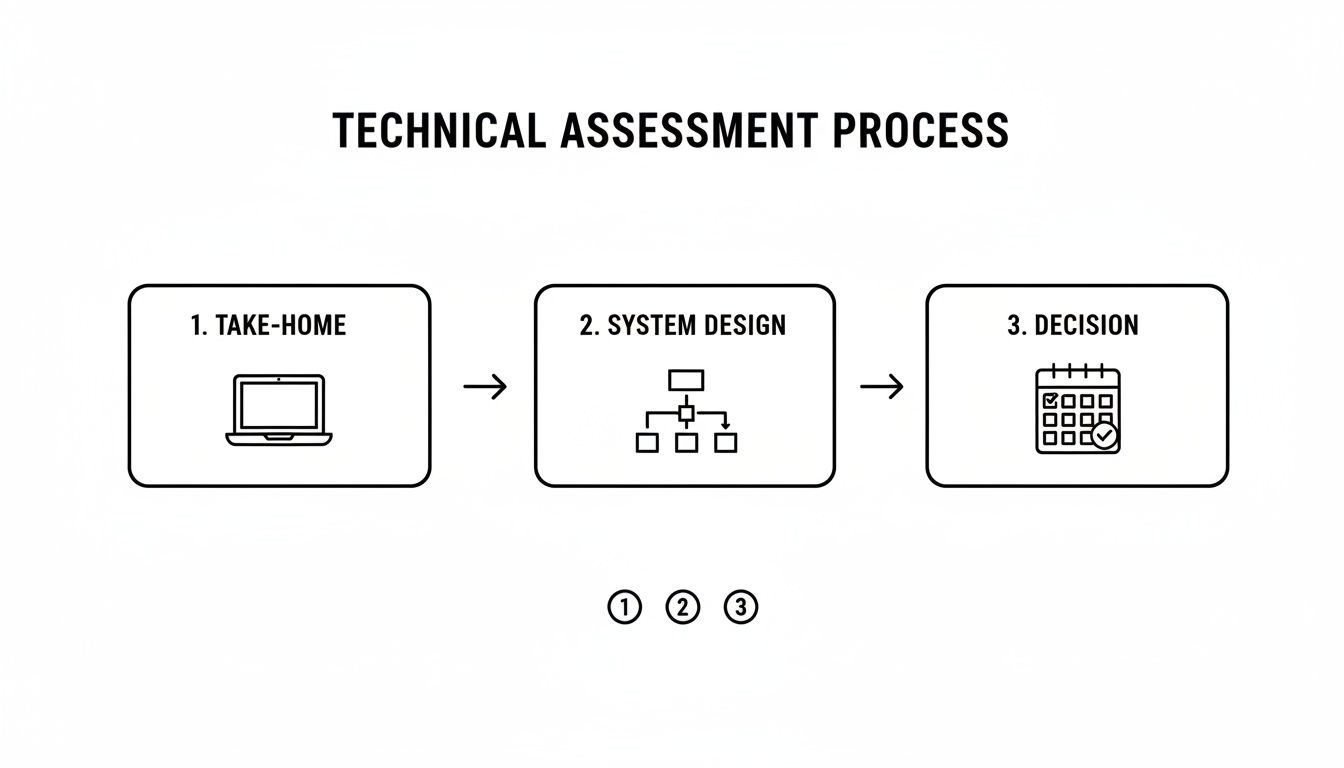
Visualising the process like this helps you spot potential delays before they happen, ensuring that critical steps like take-home assignment reviews or system design debriefs are scheduled and completed without losing momentum.
Sample SLAs for a High-Velocity Product Engineering Hiring Process
Mapping out your SLAs with clear ownership is crucial. This table breaks down key performance indicators and service level agreements designed to create a fast, efficient, and positive experience for every candidate. Ambiguity is the enemy of speed, and this structure removes it completely.
| Hiring Stage | Target SLA | Owner | Metric to Track |
|---|---|---|---|
| Application Review | 24 Hours | Recruiter | Time-to-Screen |
| Technical Phone Screen | 3 Days | Engineering Manager | Pass-Through Rate |
| Take-Home Assignment | 5 Days | Senior Engineer | Submission-to-Review Time |
| On-Site/Virtual Loop | 15 Days | Hiring Panel | Time-to-Decision |
| Offer Stage | 21 Days | HR & Hiring Manager | Offer Acceptance Rate |
With this structure, the “who’s responsible for this?” question that so often stalls progress simply disappears. The Recruiter is the driver, the Engineering Manager owns the technical bar, and the Hiring Panel is accountable for the final call. Everyone knows their part and is held to a clear timeline.
Keeping Candidates Warm with Proactive Communication
Even with the fastest process, there will be gaps. The secret is to manage these moments of waiting with proactive, informative communication. Silence breeds anxiety and gives candidates time to get excited about another offer.
Develop a few simple, clear communication templates to keep candidates engaged and informed.
- After Application: “Thanks for applying! We are reviewing your profile and will get back to you within 3 business days with an update.”
- Before an Interview: “Looking forward to our chat on Tuesday! You’ll be speaking with [Interviewer Name], our Lead Engineer, about [Topic].”
- After an Interview: “Great meeting you today. The team is consolidating feedback, and we will follow up with next steps within 48 hours.”
These small touchpoints make a massive difference. They transform the experience from a black box into a guided journey, reinforcing your image as an organised, candidate-centric organisation. In the end, a great candidate experience isn’t just a nice-to-have; it’s one of your most powerful closing tools.
Using an RPO Partner to Achieve Scalable Success
Let’s be realistic. When you need to hire dozens of specialised engineers, and you needed them yesterday, your in-house team will quickly get buried. This is the exact moment where a strategic Recruitment Process Outsourcing (RPO) partner becomes a powerful force multiplier, especially in the brutal arena of product engineering recruitment. It’s not about replacing your team; it’s about giving them specialised firepower.
An RPO partner brings two things you desperately need: immediate scale and deep expertise. Imagine a critical new product launch requires you to scale your AI team by 50 engineers. An RPO provider gives you the sheer bandwidth and specialised sourcing capability to hit that ambitious target without derailing your internal team’s focus on culture, retention, and executive hiring.
Choosing the Right RPO Model
Not all RPO solutions are built the same. You absolutely have to understand the different models to find a partner that actually aligns with your product engineering goals. A misaligned partnership will create more friction than it resolves.
The main RPO models you’ll encounter are:
- End-to-End RPO: This is the all-in solution where the partner manages your entire recruitment lifecycle, from sourcing and screening all the way to onboarding. It’s ideal when you need to build a new team from the ground up or if your internal talent acquisition function just isn’t mature enough yet.
- Project-Based RPO: This model is perfect for specific, time-bound initiatives, like that 50-engineer scaling scenario we just talked about. You get a dedicated team laser-focused on hitting a defined hiring target for a new product line or geographic expansion.
- On-Demand RPO: This model offers pure flexibility. It allows you to bring in recruiters as you need them to handle sudden hiring spikes or to hunt down talent with rare, niche skills. Think of it as an elastic extension of your own team.
For many CHROs, the real value of an RPO partner lies in the strategic advantages it unlocks: immediate access to a vast, pre-vetted talent pool, AI-powered sourcing that slashes time-to-hire, and the freedom for your internal team to focus on high-impact strategic initiatives.
This partnership is about more than just filling seats; it’s about building a sustainable talent pipeline that keeps feeding your growth. As you evaluate potential partners, understanding how RPO can improve your hiring results will give you a much clearer picture of the potential ROI.
The talent landscape in India is a prime example of where an RPO shines. In 2025, employability among B.E/B.Tech graduates hit a massive 71.5%, with Computer Science leading the charge at an impressive 78%. As a CHRO, this presents you with a huge pool of job-ready product engineers. The real challenge, however, is sifting through that pool to find those with the specialised skills your product teams demand.
This is where an AI-powered RPO bridges the gap. It excels at matching high-potential graduates with your very specific needs, dramatically cutting your time-to-hire. You can see for yourself how computer science is driving this employability surge. By integrating with a partner like Taggd, you tap directly into a ready-made ecosystem of talent, technology, and process excellence.
FAQs
Even with a solid playbook, a few tough questions always come up when you’re scaling your product engineering recruitment. Let’s tackle the ones CHROs ask me most often.
How Can We Compete With Startups for Top Engineering Talent?
This is a classic battle, but you can win it by playing a different game. Don’t try to out-startup the startups; you’ll lose. They offer equity and breakneck speed. You offer something they can’t: stability, a clear path for career growth, and the chance to solve complex problems for millions of users.
Shift the narrative. Frame your roles around the massive impact an engineer can have on your platform. Make sure your total compensation package is rock-solid, including things like a generous learning budget and long-term incentives. Your employer brand shouldn’t whisper, it should shout about delivering “innovation at scale,” giving engineers the best of both worlds.
What Are the Most Critical KPIs for Product Engineering Recruitment?
If you’re still just tracking time-to-hire, you’re missing the real story. The metrics that truly matter give you a 360-degree view of your entire recruitment engine’s health.
Focus on these:
- Offer Acceptance Rate: This tells you if your offers and your process are truly competitive. You should be aiming for over 90%. Anything less means something is broken.
- Quality of Hire: This is your north star metric. You can’t measure it in a week; track it through first-year performance reviews and retention rates to see if you’re hiring for long-term success.
- Sourcing Channel Effectiveness: Get granular here. You need to know which channels, whether it’s your own team’s direct outreach, employee referrals, or your RPO partner are consistently bringing you the best people.
- Candidate Net Promoter Score (cNPS): This is a direct pulse check on your candidate experience. A poor score is a red flag that your employer brand is taking a hit with every interaction.
An RPO is the right call when you need to bring in specialised recruiting firepower and scale up on demand. Think of it as a strategic move to fuel growth, especially when your internal team is swamped or you’re hunting for very niche skills.
When Is It the Right Time to Consider an RPO Partner?
Thinking about a Recruitment Process Outsourcing (RPO) partner shouldn’t be a last-ditch effort. It’s a proactive, strategic decision you make when you see certain signals.
Keep an eye out for these triggers:
- A major new project or a new GCC suddenly requires hiring a large number of engineers, fast.
- You’re hitting a wall trying to find talent with niche skills, like in specialised AI or cloud infrastructure domains.
- Your time-to-fill metric is consistently off-target, which is now causing real project delays.
- Your internal talent team is completely at capacity and can’t absorb any more hiring surges without something breaking.
Ready to build a hiring engine that can keep up with your product ambitions? Taggd’s AI-powered RPO solutions bring the specialised expertise and bandwidth you need to hit your targets without overwhelming your internal teams. Learn how we can accelerate your product engineering recruitment today.