Solving the R&D scientist shortage isn’t about a single magic bullet. It demands a sophisticated strategy that weaves together strategic acquisition, proactive retention, continuous development, and smart partnerships. For Chief Human Resources Officers (CHROs), this is a call to action: shift from reactive hiring to cultivating a sustainable talent ecosystem.
Confronting the Innovation Crisis in R&D Talent
The ever-widening gap between the demand for elite R&D scientists and the available talent pool is no longer just a recruitment headache. It has exploded into a direct threat to innovation, competitive advantage, and even national economic growth.
Companies all across India, from pharmaceuticals to biotechnology, are making a painful discovery. Their most ambitious projects aren’t stalling because of a lack of funding, but because of a shortage of the specialised human intellect needed to drive them forward.
Think of your R&D talent not as interchangeable cogs in a machine, but as a high-yield crop that needs constant, careful nurturing. A reactive approach—only planting seeds when the storehouse is empty—is a recipe for failure. What’s needed is a proactive, holistic strategy to ensure a sustainable harvest of innovation. This approach rests on a framework of four interconnected pillars that work in harmony to build a resilient talent pipeline.
The Four Pillars of a Resilient R&D Talent Strategy
To truly get ahead of R&D scientist shortages, CHROs must move beyond isolated tactics and adopt a unified framework. This model organises every action into four critical areas, ensuring that efforts to attract talent are matched by equally strong initiatives to retain and develop it. The core idea is simple: build an environment where the brightest scientific minds can thrive and do their best work.
This diagram shows how these four strategic pillars—Acquisition, Retention, Development, and Partnerships—are the foundation supporting the ultimate goal of innovation and growth.
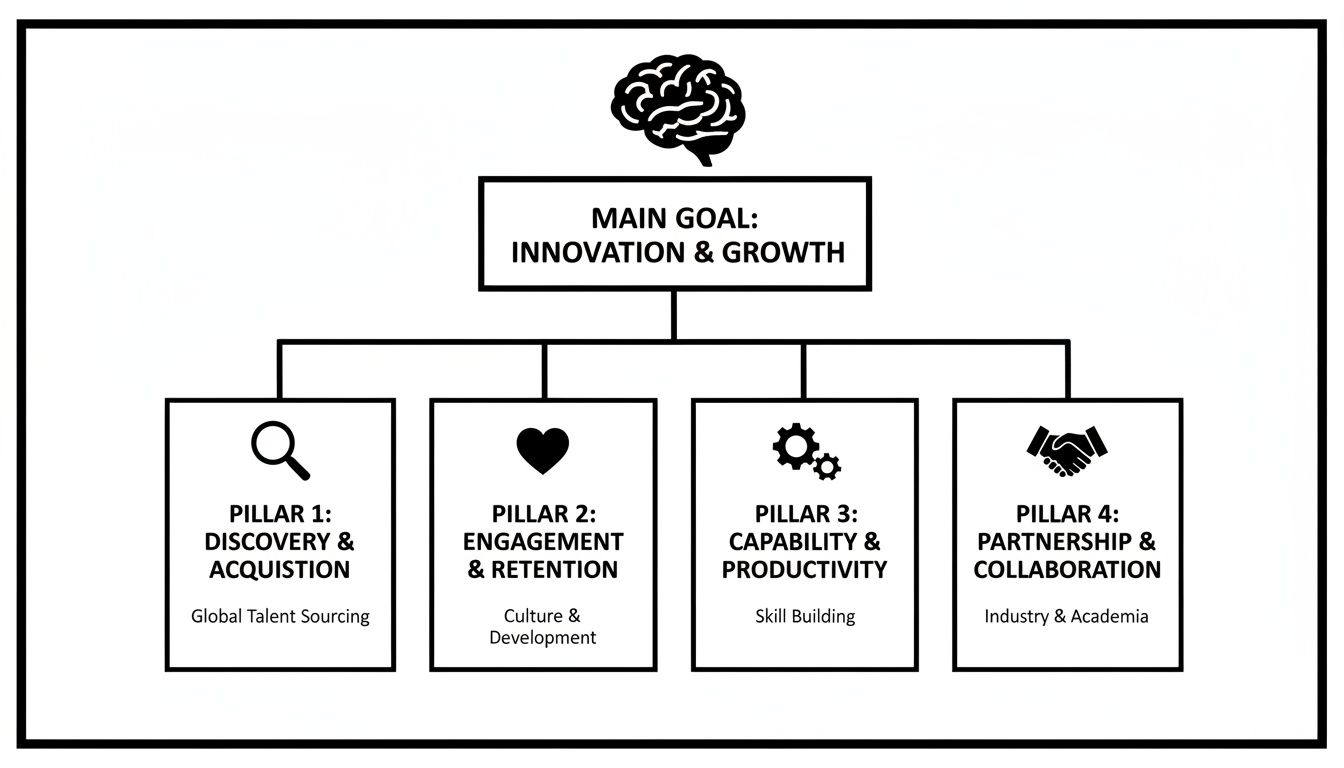
Each pillar represents a vital function, from finding new talent to nurturing the experts you already have. It underscores that a winning strategy requires a balanced, integrated effort.
Below is a table that summarises this framework, giving you a clear roadmap for the practical solutions we’ll explore throughout this guide. For those with a keen interest in specialised sectors, you might also find some valuable perspectives in the latest pharma hiring trends.
The Four-Pillar Solution Framework for R&D Talent Gaps
Here’s a high-level overview of the strategic pillars CHROs can implement to address the R&D scientist shortage and build a sustainable innovation engine.
| Strategic Pillar | Core Objective | Key Actions |
|---|---|---|
| Talent Acquisition | To attract and hire the best-fit scientific minds from a competitive global market. | Advanced sourcing, employer branding, global mobility programmes, university partnerships. |
| Talent Retention | To create an environment where top scientists are engaged, motivated, and committed. | Career pathing, competitive compensation, fostering an innovation culture, recognition programmes. |
| Talent Development | To continuously upskill and reskill the R&D team to meet future scientific demands. | Targeted training, mentorship programmes, funding for continuous learning, cross-functional projects. |
| Strategic Partnerships | To expand talent access and knowledge by collaborating with external organisations. | Academic collaborations, research incubator partnerships, specialised RPO integration. |
By focusing on these four areas simultaneously, organisations can create a powerful, self-reinforcing system that not only fills current vacancies but also builds a pipeline of talent for years to come.
Getting to the Root of the R&D Talent Shortage
To solve the R&D scientist shortage that’s holding back Indian innovation, we first need to look past the surface-level symptoms and get to the real, interconnected root causes. This isn’t just a simple case of not having enough graduates; it’s a systemic issue. The talent pipeline, our national infrastructure, and what the industry actually needs are dangerously out of sync. To build a smart, predictive workforce strategy instead of just reacting to hiring fires, we have to start by understanding these foundational problems.
The trouble really begins at the university level. Many traditional curricula just haven’t kept up with how fast modern R&D is changing. Today’s labs need people with a blend of skills that used to be completely separate.
Think about it: a biologist is now expected to be comfortable with data science and AI modelling. A chemist might need a solid grasp of bioinformatics to make a real impact. This growing disconnect means we’re producing graduates who know the theory but don’t have the specific, cross-functional skills companies need from day one.
The Skills Mismatch in Modern R&D
The gap between what’s taught in the classroom and what’s needed in the lab is becoming a chasm. Companies are no longer on the hunt for scientists with deep knowledge in just one area. They’re looking for “T-shaped” professionals—people who have their core specialisation but also a broad, practical understanding of other related fields.
This puts companies in a tough spot. They either have to spend a fortune on training new hires to get them up to speed or get into bidding wars for the very small pool of candidates who’ve already picked up these hybrid skills. The end result? Critical roles stay open for far too long, and the pace of innovation slows to a crawl.
We see this skills gap most clearly in a few key areas:
- Bioinformatics and Computational Biology: In everything from drug discovery to agricultural science, the ability to analyse huge biological datasets is no longer optional—it’s essential.
- AI and Machine Learning Application: Scientists need to be able to use AI models to predict experiment outcomes, make sense of complex data, and generally speed up the research process.
- Synthetic Biology and Biomanufacturing: These emerging fields demand a unique mix of biology, engineering, and automation skills that you rarely find taught in a single degree programme.
Chronic Underinvestment in National R&D
Looking beyond the educational pipeline, there’s an even bigger, national-level problem that stunts the growth of scientific talent: chronic underinvestment in the country’s R&D ecosystem. When the fundamental infrastructure for research is underfunded, it creates a ripple effect that hits the talent market hard.
This lack of investment means fewer research jobs, lower salaries, and limited opportunities for a real career path. For years, India’s gross expenditure on research and development (GERD) has been stuck at around 0.6–0.7 percent of GDP. That’s way below the global average and puts us far behind competitors like China, which invests 2.6 percent. To really grasp the scale of this problem, you can explore further details on India’s R&D investment strategy.
This sustained lack of funding sends a clear signal to our best scientific minds: if you want growth, impact, and good compensation, you might have to look elsewhere. It fuels a brain drain, pushing our most promising researchers towards countries with stronger, better-funded R&D environments.
For businesses here, the consequence is a much shallower domestic talent pool. It becomes incredibly difficult to lure experienced scientists back to India, and even harder to hold onto young talent who see a brighter future abroad. Without a strong national commitment to R&D, companies are left fighting over a limited supply of experts. Acknowledging this reality is the first, crucial step toward building a real solution.
Building a Sustainable R&D Talent Pipeline
Knowing why there’s a shortage of R&D scientists is one thing, but actually fixing it is another beast entirely. A reactive hiring strategy is like trying to fill a leaky bucket—it’s inefficient, frustrating, and never-ending.
The real answer lies in building a sustainable talent pipeline. This isn’t just about hiring; it’s an entire ecosystem designed to attract new scientists while also nurturing the brilliant minds you already have. This approach demands a mindset shift from one-off recruitment transactions to long-term relationship building. It’s about creating a steady flow of talent so you’re never caught off guard when a critical role suddenly opens up.
Cultivating Talent at the Source
The best talent pipelines start long before anyone even thinks about submitting a job application. The foundation? Forging deep, strategic relationships with universities and research institutions. And no, this goes way beyond just showing up at the odd career fair.
A truly robust university partnership programme involves getting your hands dirty:
- Sponsoring research projects that tie directly into your company’s innovation roadmap, giving you a sneak peek at the brightest emerging talent.
- Establishing internships and co-op programmes that function as extended, real-world interviews for promising students.
- Encouraging your senior scientists to act as guest lecturers or adjunct professors, which builds your brand and influence right where it matters most.
By weaving your organisation into the academic fabric, you stop being just another name on a list. You become a destination, a respected place for aspiring scientists to build their careers. Your recruitment transforms from a difficult hunt into a magnet for top graduates.
Building an Irresistible Employer Brand
In a market this tight, a good salary isn’t enough to woo the best scientific minds. Top researchers are drawn to companies with a compelling mission, a true culture of innovation, and a reputation for doing groundbreaking work. This is where a powerful employer brand becomes your most valuable recruitment asset.
Your brand has to scream what makes your R&D environment special. Is it the freedom to chase curiosity-driven research? Access to cutting-edge equipment? Or is it the chance to work on projects that genuinely change lives?
A strong employer brand acts as a beacon, signalling to the scientific community that your organisation is a place where innovators can do their life’s best work. It’s not just about marketing; it’s about authentically showcasing the intellectual vibrancy of your R&D culture.
Communicating this value proposition through scientific publications, conference presentations, and digital channels is non-negotiable. For a deeper dive into this process, our guide on talent pipeline development offers more detailed strategies.
Fostering a Culture of Retention
Getting talent through the door is only half the battle. The other, arguably more critical, half is keeping them. High turnover in an R&D department is devastating—it means lost knowledge, stalled projects, and a constant, costly recruitment cycle.
Retention starts by creating an ecosystem where scientists feel valued, challenged, and see a real future for themselves. This means having clear and compelling career ladders. Scientists need to see a path for growth that doesn’t shoehorn them into management if their true passion is at the lab bench. Creating dual career tracks—one for management and another for senior scientific experts—is a game-changer for retention.
On top of that, a commitment to continuous learning is absolutely essential. The world of science moves at lightning speed, and top talent is determined to stay at the forefront.
Here’s how to make growth a part of your company’s DNA:
- Provide a dedicated budget for attending international conferences and workshops.
- Offer subscriptions to leading scientific journals and crucial databases.
- Fund certifications and advanced training in hot fields like AI in drug discovery or computational biology.
Ultimately, a sustainable pipeline is built on an intellectually stimulating environment. When your scientists are surrounded by brilliant colleagues, backed by the right resources, and given the freedom to explore, they have very little reason to look elsewhere. Your organisation stops being just a workplace and becomes a true centre for innovation.
Future-Proofing Your Team with Upskilling and Partnerships

Building a sustainable talent pipeline isn’t just about bringing new people through the door. It’s about making sure the team you already have stays on the leading edge of scientific discovery. In the fast-moving world of R&D, today’s groundbreaking skill quickly becomes tomorrow’s baseline expectation.
Instead of getting dragged into a costly bidding war for a handful of external candidates, a forward-thinking CHRO looks inward first. This means fostering a culture of continuous learning where your scientists get the tools and opportunities they need to grow their skills right alongside industry advancements.
Targeted Upskilling for High-Demand Competencies
Generic, one-size-fits-all training programmes rarely hit the mark. To make a real impact, upskilling must be targeted, strategic, and tied directly to your organisation’s future R&D goals. The real objective is to close specific skill gaps that could otherwise put the brakes on innovation.
Take India’s biotechnology sector, for example. It’s currently wrestling with a serious talent shortage that directly limits its R&D growth. The most critical gaps are in highly specialised fields like bioinformatics, synthetic biology, and AI-enabled biotechnology. Without tackling these deficits head-on, the sector simply can’t hit its ambitious growth targets. You can find more insights on biotechnology hiring trends on taggd.in.
A smart upskilling framework always includes:
- Skill Gap Analysis: Regularly map your team’s current abilities against the skills you’ll need for upcoming projects and emerging technologies.
- Customised Learning Paths: Create individual training plans. Think of a biochemist learning Python for data analysis, or a molecular biologist gaining expertise in CRISPR gene-editing techniques.
- Hands-On Application: Theory isn’t enough. Set up internal projects or “lab sprints” where scientists can immediately use their new skills to solve real-world company problems.
This kind of internal investment transforms your current workforce into a more versatile and capable innovation engine, making you far less reliant on a fiercely competitive external market.
The Strategic Value of External Partnerships
While upskilling strengthens your team from within, strategic partnerships build a bridge to the outside world. They create a steady flow of fresh knowledge and emerging talent right into your organisation. These aren’t just recruitment channels; they’re essential for keeping your finger on the pulse of scientific innovation.
Think of it as cultivating an external R&D ecosystem that feeds directly back into your own. It’s a fantastic way to diversify your access to expertise and explore new research areas with minimal risk.
By collaborating with academic labs and research incubators, you gain early access to groundbreaking research and the brilliant minds behind it. This creates a direct pipeline of talent that is already familiar with your company’s focus and culture.
Effective partnerships can look like this:
- Academic Collaborations: Fund post-doctoral research or sponsor PhD programmes at top universities. In return, you get a first look at emerging talent and valuable intellectual property.
- Research Incubators: Partner with biotech or tech incubators to mentor startups. This gives you a window into disruptive technologies and a chance to spot potential acquisition targets or future star employees.
- Specialised Training Providers: Bring in external experts to deliver highly specific training on cutting-edge tools or methods that are too niche to develop in-house.
These relationships ensure your team is never working in a silo, but is constantly being enriched by outside ideas and a reliable stream of next-generation scientific talent.
Return on Investment Analysis: Upskilling vs. External Hiring
The classic “build versus buy” talent dilemma has massive financial and strategic consequences. More often than not, investing in your existing team delivers a far greater long-term return than constantly chasing new hires.
The table below breaks down the comparative ROI and shows exactly why upskilling should be a cornerstone of any intelligent talent strategy.
| Factor | Upskilling Existing Employee | Hiring New Specialist |
|---|---|---|
| Direct Costs | Lower (training fees, materials). | High (recruiter fees, high salary demands, sign-on bonus). |
| Time to Productivity | Shorter; employee already knows company culture and processes. | Longer; requires extensive onboarding and ramp-up period. |
| Cultural Fit | Proven; employee is an established part of the team. | Unknown; risk of poor fit, leading to early turnover. |
| Team Morale | High; signals company investment in employee growth and careers. | Can be disruptive; may cause resentment among existing staff. |
| Institutional Knowledge | Preserved and enhanced with new skills. | Lost if an existing employee leaves; new hire starts from zero. |
| Long-Term Impact | Builds a culture of learning and adaptability; increases loyalty. | Fills an immediate gap but can create a transactional talent culture. |
Ultimately, while external hiring can plug an immediate hole, upskilling builds a more resilient, loyal, and skilled workforce for the future. It’s an investment in your people that pays dividends in innovation and long-term stability.
Gaining a Competitive Edge with Specialised RPO Partners
When you’re trying to hire a particle physicist or a CRISPR gene editing expert, a generalist recruitment strategy just doesn’t cut it. It’s like trying to catch a specific, rare butterfly with a massive fishing net. You might catch something, but it’s unlikely to be what you’re actually looking for. This is where Recruitment Process Outsourcing (RPO) shifts from being a simple service to a powerful strategic weapon.
A true RPO partner isn’t just another agency you send job descriptions to. They operate as an extension of your own talent acquisition team, embedding themselves in your culture and goals. They bring a laser-focus and depth of expertise that’s almost impossible for an in-house team to match, especially when they’re busy juggling roles across the entire company.
Think about it: these specialised partners live and breathe the R&D world. They spend all day, every day, mapping out the talent landscape, building real relationships with passive candidates, and understanding the subtle differences in skills that separate a good scientist from a truly groundbreaking one. This deep-seated industry knowledge is their entire business.
Beyond the Job Board: Uncovering Hidden Talent
Specialised RPO providers do so much more than just post on job boards and sift through the applications that trickle in. Their real value is in tapping into the passive candidate pool—those top-tier scientists who are already succeeding in their roles and aren’t actively searching for a new job.
This is where their sophisticated sourcing tech and deep industry networks make all the difference.
- Advanced Sourcing Technology: RPO partners use powerful AI-driven tools that go beyond LinkedIn. They scan scientific publications, patent databases, and conference attendee lists to pinpoint experts with the exact skill sets you need.
- Deep Industry Networks: Their recruiters are often specialists themselves. You’ll find them at niche scientific conferences, building relationships with key opinion leaders and university department heads.
- Proactive Talent Pipelining: They build and nurture pipelines of qualified candidates long before you even have a vacancy. This dramatically shrinks your time-to-fill when a critical need suddenly arises.
This proactive, intelligence-led approach means they aren’t waiting for talent to come to them; they’re actively finding it. To see how this plays out in a high-stakes field, take a look at our insights on filling niche roles in the pharma industry through RPO.
This kind of focused expertise is vital in rapidly expanding sectors where demand is skyrocketing. India’s artificial intelligence industry, for example, is projected to hit Rs. 2,47,766 crore (US$28.8 billion) by 2025. The demand for talent is expected to reach 1 million professionals by 2026. While these growth figures are impressive, they can hide the severe R&D scientist shortages underneath, showing just how hard it is to find the experts needed to fuel that expansion. You can discover more insights about India’s science and technology landscape on ibef.org.
A Real-World Scenario: Scaling Amidst Fierce Competition
Let’s imagine a mid-sized biotech firm with huge plans for a new drug discovery platform. Their internal HR team, while great at corporate hiring, was out of its depth trying to find the rare mix of biochemists and machine learning specialists they needed. Key roles sat empty for over eight months, putting critical research timelines at risk.
The moment they brought in a specialised RPO partner, everything changed.
The RPO partner essentially became the biotech’s specialised R&D recruitment arm. They deployed a dedicated team of scientific recruiters who understood the complex roles, spoke the same language as the candidates, and already had relationships with talent in the field.
In just three months, the RPO team filled every critical position with high-calibre scientists. The results were clear and immediate:
- Time-to-Fill Reduced: The average time it took to fill senior scientist roles plummeted from 240+ days to just 75 days.
- Quality-of-Hire Improved: The new hires weren’t just technically brilliant; they were also fantastic cultural fits, leading to a 95% retention rate after one year.
- Internal Team Freed: With the heavy lifting of sourcing and screening off their plate, the internal HR team could finally focus on bigger-picture initiatives like onboarding and career development for the growing R&D division.
This story gets to the heart of what a specialised RPO partnership offers. It’s not about just filling jobs. It’s about building a real competitive advantage by accessing the right talent faster and more effectively than your rivals, helping you solve the R&D scientist shortages that are holding everyone else back.
Your Questions Answered: Making a Real Dent in the R&D Talent Gap
Even the best strategies hit a wall of practical questions. As a talent leader, you’re the one who has to navigate the tricky realities of turning a plan to fix your R&D scientist shortage into something that actually works. Let’s tackle some of the most common questions CHROs are asking right now.
Think of this as the playbook for moving your vision from the whiteboard to the real world. We’ll get straight to the point on everything from securing budgets to proving your efforts are paying off, helping you build an R&D team that’s not just staffed, but truly innovative and resilient.
Where Should We Start This Transformation?
The temptation is to jump straight into hiring, but the right place to start is with an honest look in the mirror. You need a clear, unfiltered picture of your current situation before you can launch any new initiatives. This isn’t just about counting open jobs; it’s about diagnosing the health of your entire talent ecosystem.
Kick things off by mapping your team’s current skills against where your R&D roadmap is headed. This skill gap analysis is your compass—it will immediately point to your most critical hiring and upskilling needs. At the same time, dig into the “why” behind your turnover. Use anonymous surveys and really listen during exit interviews. Is the problem pay? A dead-end career path? Or a culture that unintentionally stifles innovation?
Trying to solve the R&D talent shortage without knowing your specific weak points is like trying to navigate a new city without a map. You’ll burn a lot of fuel and energy but end up going in circles. A sharp diagnosis is always the first, most crucial step.
How Do We Justify the Investment?
Getting the green light for strategic talent initiatives means changing the conversation from cost to value. Don’t frame this as an expense. Position it as a vital investment to protect the company’s future revenue and innovation pipeline.
Back it up with hard numbers to build a business case your CFO can’t ignore:
- Calculate the Cost of Vacancy: Put a real number on what it costs to have a key R&D role sitting empty for months. Factor in delayed projects and missed market windows. A senior scientist role left vacant for six months can easily translate into millions in lost potential revenue.
- Compare Upskilling vs. Hiring Costs: Run the numbers. Show them that investing ₹5 lakh to upskill a loyal, high-potential employee is a smarter bet than spending ₹30 lakh+ to find, recruit, and onboard a new specialist from the outside.
- Highlight Retention Savings: Show, don’t just tell. A simple model demonstrating how even a 5% improvement in R&D staff retention can save the company a significant amount in replacement costs every year is incredibly powerful.
What Are the Key Metrics for Success?
You need to measure what matters. Proving the value of your work is essential for keeping the momentum going and fine-tuning your approach. Success here isn’t just about filling roles faster; it’s about building a more powerful innovation engine for the business.
Here are a few key performance indicators (KPIs) to keep your eye on:
- Time-to-Fill for Specialised Roles: If this number is consistently dropping, it’s a clear sign your sourcing strategies and talent pipeline are getting healthier.
- Quality of Hire: Look at the performance ratings and one-year retention rates of your new R&D hires. Are you bringing in people who perform well and stick around?
- Internal Mobility Rate: How many of your senior R&D roles are being filled by people you’ve promoted from within? This is the ultimate proof that your development and upskilling programmes are delivering.
- Innovation Velocity: This one is a bit tougher to measure directly, but you can use proxies. Track metrics like the number of patents filed or how quickly product development cycles are completed. This links your talent efforts directly to business output.
By focusing on these practical questions and their answers, you can shift from just talking about the problem to actively solving it, building a real, lasting competitive edge for your organisation.
At Taggd, we specialise in building the high-calibre R&D teams that drive innovation forward. Our expert RPO solutions are designed to solve your most complex scientific recruitment challenges. Discover how we can help you secure the talent you need to succeed by visiting us at https://taggd.in.