In India’s hyper-competitive talent market, speed isn’t just an advantage—it’s a survival strategy. For businesses grappling with intense demand for skilled professionals, rapid recruitment solutions India are no longer a ‘nice-to-have’. They are the engine of growth, often powered by Recruitment Process Outsourcing (RPO), enabling companies to slash hiring timelines, cut costs, and ultimately, bring better people on board, faster.
Why Slow Hiring Is No Longer an Option in India

Is your organisation staring at a mountain of open roles while your competitors snap up the best talent? You’re not alone. For Chief Human Resources Officers (CHROs) across India, the chasm between the explosive demand for talent and the sluggish pace of traditional hiring has widened into a critical business risk.
This pain is especially sharp in booming sectors where every single day a key role sits empty means lost revenue, delayed projects, and a weakened competitive edge. The pressure is immense to build teams at the speed of business, not at the speed of bureaucracy.
The Scale of India’s Talent Demand
The Indian recruitment scene is on fire. We’re looking at a staggering 500,000 new job opportunities projected across key sectors. Hiring intent has leaped by 19%, and staffing activities are forecast to jump by an incredible 40% in the early part of the year. This surge is most visible in IT (15-20% growth), manufacturing (25% increase), and e-commerce (25% rise), all of which cry out for more agile hiring models.
What does this mean on the ground? It’s a candidate’s market. Top professionals are fielding multiple offers, and a slow, clunky hiring process doesn’t just annoy them—it pushes them directly into the arms of a competitor who can move faster.
In this climate, a long time-to-hire isn’t just an HR metric anymore. It’s a direct threat to your business. Delays can stall innovation, mess up supply chains, and hurt customer service, all of which hit the bottom line hard.
Moving From Reactive to Proactive Hiring
The old “post and pray” method of recruitment is fundamentally broken. It’s a reactive stance that leaves your business exposed and playing catch-up. The only way forward is to adopt a more strategic, proactive framework.
This is precisely where rapid recruitment solutions India make a strategic difference. They provide a clear path to:
- Scale with Agility: Quickly ramp up hiring for that new project or market expansion without burning out your internal HR team.
- Slash Hiring Expenses: Cut down your reliance on expensive contingent agencies and get a much better handle on your cost-per-hire.
- Elevate Talent Quality: Get access to wider, pre-vetted talent pools and use data-driven insights to find the right fit, not just a warm body.
By shifting to a model like RPO, companies can transform their talent acquisition function. It stops being a reactive support centre and becomes a proactive engine for growth. As we’ve said before, the time to hire is the new business risk metric, and getting it right is non-negotiable for success.
Getting to Grips with How Rapid Recruitment Really Works
Let’s unpack what “rapid recruitment” actually means here in India. It’s easy to think it’s all about speed, maybe even being a bit hasty, but that couldn’t be further from the truth. Instead of just rushing the same old steps, rapid recruitment solutions India completely redesign the hiring process from the ground up, making it smarter and far more efficient.
Think of it this way: traditional hiring is like trying to navigate Mumbai traffic during peak hours. You’re stuck in endless stop-and-go, hitting bottlenecks you can’t predict or control. Rapid recruitment, on the other hand, is like hopping on a dedicated high-speed metro line. It’s built for speed, runs on a predictable schedule, and gets you to your destination without the chaos.
This modern approach isn’t about cutting corners. It’s about building an intelligent, accelerated hiring machine that actually improves the quality of your hires, not just how quickly you can get them on board.
The Engine Room of Rapid Recruitment
At its core, this speed comes from three key components working in perfect sync. They’re designed to eliminate friction and add a layer of predictive power to your talent strategy, all while being fine-tuned for India’s unique talent market and complex compliance rules.
- AI-Powered Sourcing and Screening: The search for talent begins far beyond the usual job portals. AI algorithms can sift through millions of profiles on professional networks, niche industry forums, and private databases to find passive candidates—the hidden gems who aren’t actively looking but are a perfect fit for your role. Modern AI can process applications up to 90% faster than a human can, instantly shortlisting top candidates based on skills, experience, and even cultural fit. This frees up your recruiters to do what they do best: engage with people.
- Optimised and Automated Workflows: Every manual step in the hiring process is a potential delay. Rapid recruitment meticulously maps out the entire candidate journey and automates the repetitive, time-consuming tasks. Think scheduling interviews, sending out updates to candidates, and collecting feedback from hiring managers. By creating a seamless flow, you ensure top candidates never feel like they’re in a black hole, which is critical when they likely have multiple offers on the table.
- Data Analytics for Smarter Decisions: Gut feelings are out; data is in. Every stage of the hiring funnel, from application to offer, generates a wealth of information. Analytics tools track crucial metrics like which sourcing channels are most effective, where candidates are dropping off, and what your interview-to-offer ratio looks like. This gives hiring managers a clear view of what’s working and what isn’t, allowing them to tweak their strategy in real-time.
Navigating the Indian Context
Simply plugging in a global model won’t work in India. A successful rapid recruitment solution has to be built with a deep understanding of local nuances. It must be able to handle the country’s vast geographic and linguistic diversity, sourcing talent effectively from Tier-2 and Tier-3 cities, not just the usual metro hubs.
The goal is not just to be fast, but to be intelligently fast. It’s about creating a recruitment process that is so efficient and data-driven that it delivers higher-quality candidates in a fraction of the time, giving your organisation a sustainable competitive advantage in the war for talent.
And of course, compliance with India’s intricate labour laws is non-negotiable. A truly effective solution bakes these compliance checks right into the workflow, making sure every hire is legally sound without slowing things down. It’s this blend of world-class technology and local expertise that makes rapid recruitment solutions India such a powerful tool for CHROs looking to build a future-ready workforce.
Choosing Your Hiring Model: RPO vs In-House Teams
As a CHRO in India, the hiring model you choose is a core strategic decision. It directly impacts your company’s ability to find and win the right talent. For most leaders, this choice boils down to two main paths: building a traditional in-house recruitment team or partnering with a Recruitment Process Outsourcing (RPO) provider. This is more than just an operational decision—it’s about choosing your approach to agility, cost, and expertise.
To really get to the heart of which model delivers the best results, we need to go deeper than a simple pros and cons list. It’s about looking at the real business outcomes each approach generates on the ground.
The In-House Advantage and Its Limits
Let’s be clear: an in-house team has some undeniable strengths. Your recruiters live and breathe your company culture, have direct lines to hiring managers, and are 100% focused on your organisation’s goals. This setup works beautifully in stable environments where hiring needs are predictable and consistent.
But the cracks in the in-house model start to show when things get unpredictable—a common reality in India today. What happens when your business decides to launch a new tech hub in Bengaluru or needs to triple its national sales force overnight? An internal team can quickly get swamped. Their capacity is fixed, and they often don’t have the specialised networks needed to tap into new talent markets at speed.
This is where the model strains. Ramping up an in-house team costs significant time and money, from hiring and training new recruiters to investing in the right sourcing tech. While you’re building that capacity, critical roles sit empty, and you miss out on business opportunities.
The fundamental challenge for in-house teams is scalability. They’re built for stability, not for the sudden, high-volume hiring sprints modern business demands.
RPO as a Strategic Growth Partner
This is exactly where rapid recruitment solutions in India, delivered through an RPO model, shine. A great RPO provider isn’t just another vendor; they become a deeply embedded extension of your HR function. They bring the scale, technology, and market know-how that are often difficult for in-house teams to build quickly.
Picture this: you need to hire 100 specialised software developers in Pune within ninety days. An in-house team of five recruiters would be completely overwhelmed. An RPO partner, on the other hand, can instantly assign a dedicated team of specialists who already have deep talent pipelines in that specific geography and tech stack, backed by a powerful technology platform.
This is what that accelerated, tech-driven approach looks like in practice.
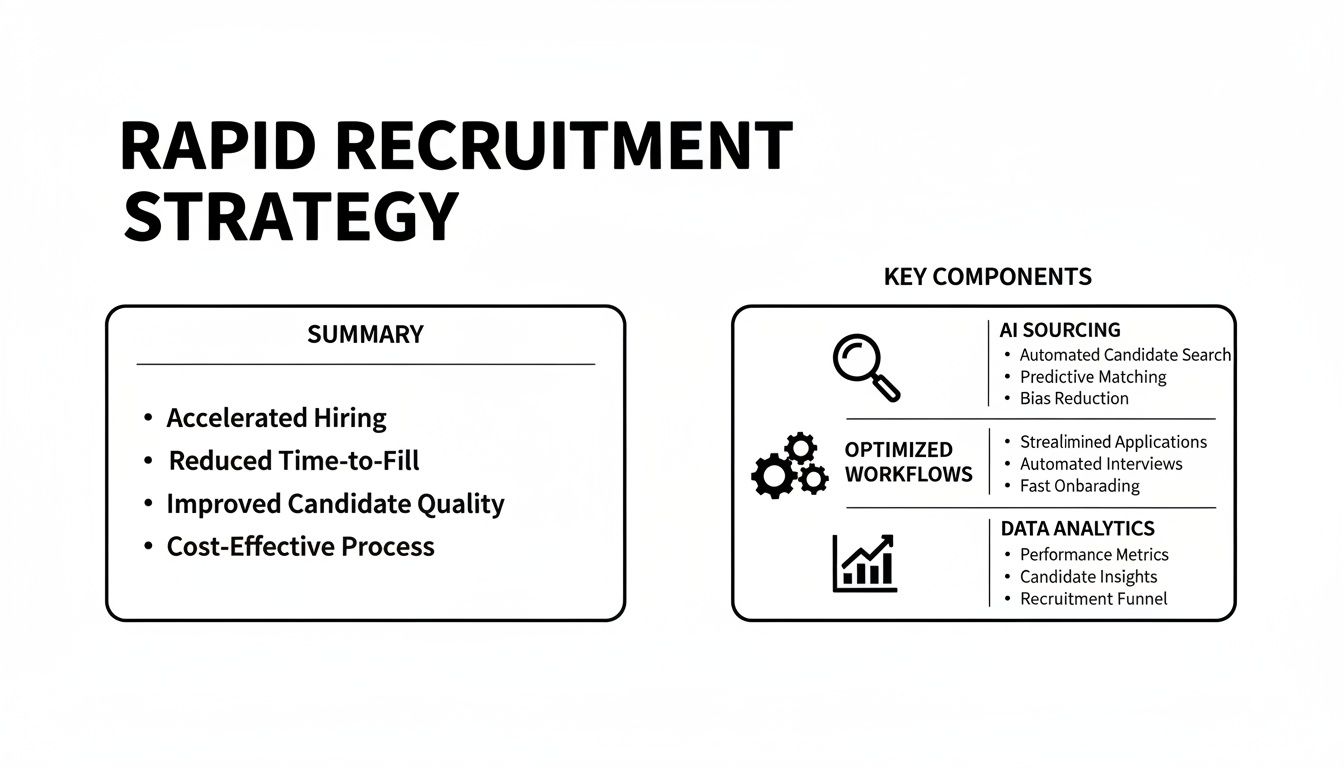
The image breaks down how technology-driven strategies like AI-powered sourcing, optimised workflows, and data analytics work together to accelerate the hiring process efficiently.
Essentially, an RPO model transforms recruitment from a fixed overhead cost into a flexible, on-demand service. This gives you the financial and operational freedom to seize market opportunities without the long-term burden of permanent headcount. The right RPO partner becomes a genuine strategic ally, aligning their work with your business goals and turning talent acquisition into a real competitive advantage. To dig deeper into this, you might find this analysis of the fastest hiring model for enterprise recruitment insightful.
The key difference is mindset. In-house recruitment is often seen as a cost centre to be managed. A strategic RPO partnership is an investment in growth, designed to deliver measurable returns through speed, quality, and scalability.
Head-to-Head: A Clear Comparison
To make the choice even clearer for CHROs navigating the Indian market, here’s a straightforward comparison of the models based on the metrics that truly matter.
Recruitment Model Comparison for the Indian Market
| Metric | Rapid RPO Solutions | In-House Recruitment | Contingent Agencies |
|---|---|---|---|
| Time-to-Hire | Significantly faster due to specialised teams, ready talent pools, and optimised tech. Can cut hiring cycles by up to 40%. | Slower, especially for niche roles or high-volume hiring, as capacity and market reach are limited. | Unpredictable. Fast for some roles, but inconsistent as they work with multiple clients simultaneously. |
| Cost-per-Hire | Lower overall cost thanks to economies of scale, process efficiencies, and reduced ad-hoc agency fees. Budgets are more predictable. | Higher fixed costs (salaries, benefits, tech licences). Costs can skyrocket during hiring surges. | Highest cost model, typically charging 15-25% of a candidate’s annual salary per hire. |
| Scalability | High. Can rapidly scale recruitment capacity up or down to match business needs without adding permanent headcount. | Low. Scaling is a slow and expensive process of hiring and training new internal recruiters. | Moderate. Can handle individual roles well but struggles to manage coordinated, high-volume projects effectively. |
| Talent Quality | Higher. Provides access to wider, passive talent pools and uses data-driven methods for better candidate-role fit. | Variable. Quality depends entirely on the skills, tools, and personal networks of the internal recruitment team. | Inconsistent. Quality can be a mixed bag as the focus is on speed and placement over long-term cultural fit. |
| Market Expertise | Deep expertise across industries and geographies in India, offering valuable, real-time market intelligence. | Limited to the organisation’s own industry and past experiences. Often lacks broader talent trend insights. | Specialised in certain sectors but lacks a holistic view of the talent market or your specific company culture. |
In today’s dynamic Indian business landscape, the agility, expertise, and sheer firepower offered by a dedicated RPO partner often provide a far more robust and responsive solution than a traditional in-house team or a collection of contingent agencies can deliver on their own.
Measuring the Real Impact of Fast Hiring
So, how do you prove that faster hiring is actually better hiring? Moving quickly is one thing, but if you aren’t tracking the right data, you’re just spinning your wheels faster. To build a solid business case for investing in rapid recruitment solutions in India, you have to look past the surface-level numbers and dig into the key performance indicators (KPIs) that really matter.
These metrics aren’t just figures for a dashboard; they’re the vital signs of your entire talent acquisition function. They give you the hard evidence to justify bringing on a strategic RPO partner and the data you need to hold them accountable for real, bottom-line results.
Time to Fill: The Ultimate Speedometer
Time-to-Fill is the most straightforward measure of your recruitment engine’s speed. It simply tracks the number of calendar days from when a job is approved to the moment a candidate says “yes” to your offer. In a market as hot as India’s, a long Time-to-Fill is a death sentence—it means you’re consistently losing your best prospects to competitors who can make a decision faster.
A top-tier RPO partner can slash this metric by up to 40%. How? They come prepared with pre-vetted talent pipelines, finely tuned workflows, and smart tech that vaporises administrative delays. It’s all about getting the right talent in the door before your rivals have even scheduled a second interview.
Cost per Hire: The Efficiency Gauge
Let’s be blunt: every single day a critical role sits empty, it’s costing you money. Whether it’s lost productivity or missed revenue opportunities, the bill adds up. Cost-per-Hire gives you a clear picture of your recruitment’s financial health by calculating your total investment (think advertising, recruiter salaries, agency fees) and dividing it by your number of hires.
This is where a strategic RPO partnership really shines. They bring economies of scale and dramatically cut your reliance on expensive contingent agencies, which can easily skim 15-25% of a candidate’s salary. This transforms your talent acquisition from a cost centre into a smart, predictable investment.
Quality of Hire: The True North Metric
What good is hiring fast and cheap if the people you bring on board don’t stick around or perform well? Quality-of-Hire is the ultimate measure of success, even if it’s a bit trickier to pin down. It’s usually a blend of a few key factors:
- 90-Day Retention Rate: This is your early warning system. If new hires are walking out the door within three months, it points to a serious mismatch in skills, culture, or expectations that a stronger process should have flagged.
- Hiring Manager Satisfaction: Are the people who actually work with the new hire happy? Regular, simple surveys with hiring managers give you direct feedback on whether the new employee is meeting—or even exceeding—expectations.
An effective rapid recruitment solution never sacrifices quality for speed. Instead, it uses data-driven assessments and deeper market insights to find candidates who are not just qualified on paper but are also a strong cultural fit, leading to better long-term performance.
The shift towards skill-based hiring in India is changing the game, with 60% of recruiters now prioritising technology and data science talent. This is where agile RPO partners excel, using AI to screen CVs, reduce bias, and tap into rich talent pools in tier-2 and tier-3 cities for specialised roles like software development. You can find more insights about the hiring trends shaping India on qureos.com.
Offer Acceptance Rate: The Final Hurdle
Finally, your Offer Acceptance Rate tells you a lot about the strength of your employer brand and the candidate experience you’re providing. If your top choices are consistently turning you down, that’s a major red flag.
This metric is a direct reflection of how competitive your offers are and how well your team connected with the candidate throughout the journey. A high acceptance rate is proof that your entire process is compelling enough to win the best talent in a fiercely competitive market.
How to Select the Right RPO Partner in India?
Choosing a provider for rapid recruitment in India isn’t just about picking a vendor; it’s about finding a strategic partner. The right Recruitment Process Outsourcing (RPO) partner becomes a true extension of your team, completely in sync with your business goals. Get it wrong, and you’re looking at missed targets and cultural clashes. Get it right, and you’ll supercharge your company’s growth.
This decision calls for a serious, structured evaluation. You have to look past the sales pitch and really dig into their capabilities, tech stack, and track record here in the Indian market. Think of this as your guide to asking the hard questions and picking a partner who will not only fill roles but actively drive your strategic success.
Evaluating Technical Capabilities and Industry Expertise
First things first, you need to look under the bonnet at the provider’s engine room: their technology and their market know-how. A modern RPO partner doesn’t just run on manpower; they operate with a sophisticated toolkit designed for speed and precision. Your job is to figure out if their tech is genuinely powerful or just marketing fluff.
Start by asking about their sourcing technology. Are they using AI-powered tools to unearth passive candidates who aren’t scrolling through job boards? Can they give you a client-facing dashboard with real-time analytics, offering a clear window into your recruitment funnel? These aren’t “nice-to-haves” anymore; they are essential parts of any effective rapid recruitment solutions India offering.
Next, you need to probe their industry and geographical expertise.
- Sector Specialisation: Do they have genuine success stories in your industry, whether it’s IT, manufacturing, or financial services? Insist on seeing case studies and speaking to references from companies that look a lot like yours.
- Local Market Knowledge: How well do they really know the talent landscape in key hubs like Bengaluru, Pune, or Hyderabad? Their ability to navigate local salary benchmarks and cultural nuances is absolutely critical.
- Compliance and Legal Acumen: Are they experts in Indian labour laws and statutory compliance? This is non-negotiable. Getting this wrong can expose your organisation to massive legal and financial risks.
A partner with only a surface-level understanding of your sector or region will inevitably struggle to deliver quality candidates quickly. They need to show a deep, embedded knowledge of your world.
Decoding Pricing Models and Service Level Agreements
Once you’re confident they have the right capabilities, it’s time to talk commercials. RPO pricing models can vary widely, so it’s vital to land on one that aligns with your business goals. You’ll typically see options like a management fee per hire, a fixed monthly retainer, or a hybrid of the two. Always insist on total transparency to avoid any nasty surprises down the line.
Just as important is the Service Level Agreement (SLA). This document is the foundation of your partnership. It defines what success looks like and sets clear metrics. A vague or weak SLA is a recipe for disappointment.
Your SLA should be a document of guarantees, not suggestions. It must contain specific, measurable, and time-bound commitments that hold the RPO partner accountable for delivering tangible results.
Demand crystal-clear terms for the key performance indicators that matter most. Don’t let them get away with fuzzy promises. Your SLA should explicitly define:
- Time-to-Fill: What is the guaranteed maximum number of days to fill different role types?
- Time-to-Shortlist: How quickly will you receive a pre-vetted shortlist of quality candidates for an open role?
- Quality-of-Hire: How will you measure this? Common metrics include 90-day retention rates or hiring manager satisfaction scores.
- Reporting Cadence: How often will you get detailed performance reports and analytics?
Nailing down these details upfront ensures everyone is on the same page about what success looks like. For a head start on your search, checking out a curated list of the best on-demand RPO providers in India can be a great way to benchmark potential partners. Making the right choice here is a foundational step in building a resilient and agile talent function for the future.
Putting Your Rapid Recruitment Strategy into Action

Making the switch to a faster, more agile hiring model isn’t just about tweaking a few processes. It’s a major organisational shift that needs a clear game plan, solid backing from leadership, and a well-defined roadmap to succeed. The real work begins long before you post a single job opening; it starts with building a rock-solid case for change internally.
Your first move is to craft a compelling business case that speaks the language of the C-suite. Forget HR jargon. Instead, connect the dots between slow hiring and real business pain points. Show them the numbers—how much money is being lost in delayed projects, missed sales targets, or production bottlenecks because key roles are sitting empty? This data-driven story turns hiring from a back-office function into a strategic business priority.
Once your business case is solid, it’s time to build your coalition. Don’t just stop at the top; your allies are everywhere. Getting finance leaders, department heads, and crucial hiring managers on board is essential for a smooth rollout and lasting success.
Define Your Scope and Launch a Pilot
Trying to change everything all at once is a classic recipe for disaster. Before you dream of a company-wide overhaul, you need to think smaller and smarter. The best approach? Start with a focused pilot programme.
Think of a pilot as your proof-of-concept. It’s your chance to get a quick win, show tangible value, and build unstoppable momentum. Pick a specific department or a handful of critical roles where the hiring pain is most acute. This contained experiment minimises risk while creating a powerful success story you can use to champion the change across the entire organisation.
A well-run pilot programme is your most powerful tool for change. It transforms abstract promises into concrete results, showcasing the real-world impact of rapid recruitment solutions in India and turning sceptics into your biggest supporters.
Ready to plan your pilot? Here’s a simple three-step approach:
- Pick the Right Battlefield: Choose a business unit where the results will be impossible to ignore. Think of a fast-growing tech team, a new sales division, or any area where speed-to-hire directly impacts the bottom line.
- Set Clear Targets: Define what success looks like with specific, measurable goals. Focus on improving core metrics like Time-to-Fill, Cost-per-Hire, and Quality-of-Hire for the roles within your pilot.
- Partner Up: Work closely with your chosen RPO provider and the hiring managers in the pilot department. Constant communication and a hand-in-hand approach are non-negotiable for a seamless execution.
Real-World Wins from Rapid Recruitment
When you get the strategy right, the impact is huge. While every company’s story is different, the pattern of success is consistent across industries in India.
Take a fast-growing tech start-up in Bengaluru, for example. They were falling behind their product roadmap because they just couldn’t hire engineers fast enough. By partnering with an RPO provider, they grew their core development team by 50% in a single quarter, slashing their time-to-market.
Or consider a major manufacturing firm that had to staff a brand-new production facility in Gujarat on a nail-bitingly tight deadline. By using rapid recruitment solutions India, they filled over 200 technical and operational roles in just 12 weeks. The plant opened ahead of schedule and under budget.
These stories show what’s possible when the right strategy, technology, and expertise come together. By building a strong business case, getting your key people on board, and proving the model with a smart pilot, you can make the leap. It’s time to move towards a faster, more intelligent hiring future and turn your talent acquisition function into a true engine for business growth.
Got Questions About Rapid Recruitment? We’ve Got Answers.
Even with a clear game plan, it’s natural for CHROs to have a few questions before making a big change to their hiring model. Let’s tackle some of the most common ones we hear about bringing rapid recruitment solutions to India.
Think of this as a quick chat to clear up any final doubts and really cement the value of building a faster, smarter talent acquisition function.
How Does Rapid Recruitment Maintain High Quality of Hire?
This is the big one. There’s a common myth that speed and quality are enemies. The truth? Modern rapid recruitment actually boosts the quality of your hires by upgrading the entire toolkit. Instead of just sifting through the usual applicants, advanced tech like AI-powered sourcing goes out and finds brilliant, best-fit candidates who aren’t even actively looking for a job.
It’s about expanding the talent pool beyond the obvious. On top of that, data-driven screening makes sure every single candidate is measured against the same objective standards. A real RPO partner doesn’t just fill seats; they sit down with your hiring managers from day one to define what “a great hire” truly means for each role, focusing on things that matter long-term, like performance and retention.
Is RPO a Good Fit for SMEs in India?
Absolutely. Recruitment Process Outsourcing isn’t just a game for the big corporations anymore. Today’s RPO models are incredibly flexible and scalable, which makes them a fantastic option for small and medium-sized enterprises (SMEs) across India.
You don’t have to go all-in. An SME could use project-based RPO to manage a sudden hiring spike for a new product launch, or bring in a selective RPO partner to handle a handful of those tricky, hard-to-fill niche tech roles. This gives SMEs access to top-tier recruitment technology and specialist expertise without the huge overhead of building a large in-house team, levelling the playing field so they can compete for top talent.
A key advantage for SMEs is gaining immediate access to a sophisticated recruitment engine that would otherwise take years and significant investment to build internally.
What Is a Typical RPO Implementation Timeline?
You might be surprised at how quickly you can get up and running. While the exact timeline depends on the scope, a well-managed implementation is faster than most people think. A focused pilot program, maybe for a single department, can often be launched within just 4-6 weeks.
This first phase usually involves mapping your current processes, plugging in the necessary tech, and getting your key people trained up. A full, organisation-wide rollout might take a bit longer, somewhere between 2-3 months. A good RPO partner will handle this transition so smoothly that you’ll see minimal disruption and start getting hiring results almost immediately.
Ready to transform your hiring from a cost centre into a strategic growth engine? Taggd delivers bespoke RPO services that provide the speed, quality, and scalability your business needs to win in the Indian market. Learn more about how we do it.