As a CHRO in the FMCG sector, you’re likely facing a recruitment challenge that feels fundamentally different from previous years. The supply chain has become a critical competitive advantage that can make or break your company’s market position.
The numbers tell the story: rising demand volatility, product lifecycles that have compressed from months to weeks, and omnichannel distribution that requires simultaneous optimization across retail, e-commerce, and direct-to-consumer channels. Your supply chain teams are expected to deliver speed, cost efficiency, and resilience- all at once.
Yet the talent to drive this transformation remains frustratingly scarce. Skill gaps are emerging across planning, logistics, and execution roles, and traditional hiring approaches are no longer keeping pace with business needs.
In short: FMCG supply chains now need digitally fluent, risk-aware, cross-functional talent, but hiring is still based on outdated titles and resumes. This gap is why roles stay open, teams burn out, and transformations stall.
This guide will help you understand the evolving landscape of FMCG supply chain hiring, identify the critical skills your teams need, and explore how strategic recruitment solutions can help you build the supply chain talent engine your business demands.
How FMCG Supply Chains Are Evolving
The FMCG supply chain of 2026 looks radically different from even three years ago.
Alt: FMCG industry trends
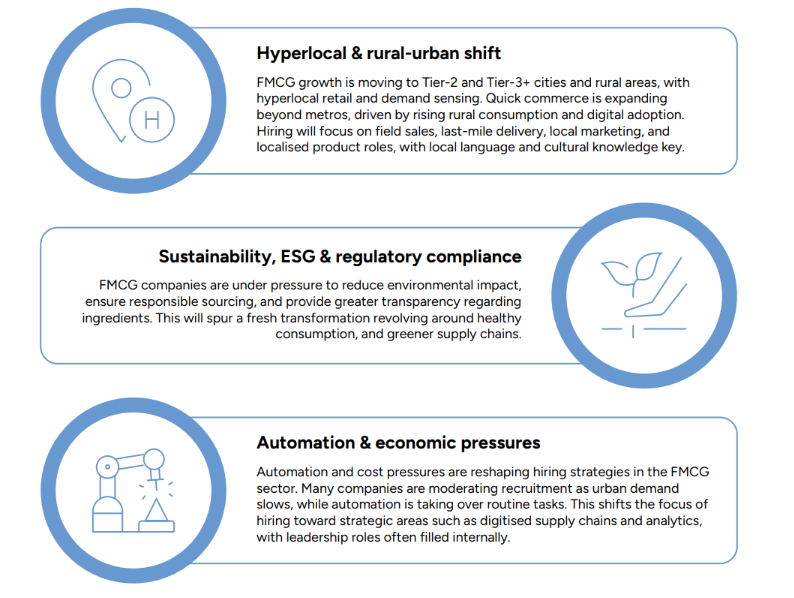
Three fundamental shifts are reshaping what your supply chain teams need to deliver:
From cost efficiency to agility and resilience: The pandemic taught us that the cheapest supply chain isn’t always the best one. Today’s FMCG leaders are investing in redundancy, flexibility, and speed-to-market capabilities that allow them to respond to disruptions without compromising service levels.
Technology-driven planning and execution: Digital transformation is no longer optional. Real-time visibility, predictive analytics, and automated decision-making are becoming baseline requirements. Your supply chain professionals need to be as comfortable with data platforms as they are with operations.
Increased focus on sustainability and risk mitigation: The FMCG trends, as highlighted in Taggd’s India Decoding Jobs Report 2026 show that ESG commitments, regulatory compliance, and consumer expectations around sustainability are adding new dimensions to supply chain decision-making. Your teams need skills that didn’t exist in traditional supply chain curricula.
These shifts mean that the supply chain professionals you hired five years ago may not have the capabilities you need today. The question for CHROs is how to close these gaps while keeping operations running smoothly.
Most In-Demand Roles in FMCG Supply Chain
The most in-demand FMCG supply chain roles include demand and supply planners, procurement and sourcing managers, warehouse and distribution heads, logistics and transportation managers, and supply chain analytics or digital transformation specialists.
These roles are critical for managing demand volatility, omnichannel distribution, cost optimization, and technology-led supply chain planning in 2026.
Here are the positions driving the most urgent hiring needs in 2026:
Demand Planners and Supply Planners
Demand and supply planners are responsible for balancing what customers want with what the business can realistically produce and deliver. They act as the nerve center of the FMCG supply chain, ensuring availability while minimizing excess inventory and cost.
These roles have evolved from spreadsheet-based forecasting to sophisticated statistical modelling and cross-functional orchestration. They’re the architects of your supply chain’s responsiveness.
Here are the roles and responsibilities of demand planners & supply planners:
- Develop accurate demand forecasts using statistical models, historical data, and market inputs
- Lead S&OP / IBP cycles to align demand, supply, and financial plans
- Manage demand volatility from promotions, seasonality, and new product launches
- Optimize production and replenishment plans to improve service levels and reduce inventory costs
- Collaborate closely with sales, marketing, manufacturing, and finance teams
- Collaborate closely with sales, marketing, manufacturing, and finance teams
Procurement and Sourcing Managers
Procurement and sourcing managers ensure uninterrupted access to raw materials and services at optimal cost, quality, and risk levels. In FMCG, they play a strategic role in supplier resilience, sustainability, and long-term value creation.
Beyond negotiating prices, these professionals also manage complex supplier ecosystems and drive sustainability initiatives through the supply base.
Here are the roles and responsibilities of procurement and sourcing managers:
- Develop and execute strategic sourcing and supplier management strategies
- Negotiate contracts focused on cost optimization, quality, and continuity of supply
- Manage supplier risk across geographies and categories
- Drive sustainability, ESG compliance, and ethical sourcing initiatives
- Monitor supplier performance and lead continuous improvement programs
Warehouse and Distribution Heads
Warehouse and distribution heads manage the physical backbone of the FMCG supply chain, ensuring products are stored, picked, and dispatched accurately and efficiently across multiple channels.
With automation, robotics, and complex fulfilment requirements across channels, these roles now require technology savvy alongside operational excellence.
Here are the roles and responsibilities of warehouse and distribution heads:
- Oversee warehouse operations, inventory accuracy, and order fulfillment performance
- Lead automation, robotics, and WMS implementation initiatives
- Optimize storage, picking, and dispatch processes across multiple channels
- Ensure compliance with safety, quality, and regulatory standards
- Manage warehouse teams and drive productivity improvements
Logistics and Transportation Managers
Logistics and transportation managers ensure products move quickly, safely, and cost-effectively from factories and warehouses to distributors, retailers, and end customers.
Route optimization, fleet management, and last-mile delivery expertise are critical as customer expectations around delivery speed continue to rise.
Here are the roles and responsibilities of logistics and transportation managers:
- Plan and optimize transportation networks, routes, and fleet utilization
- Manage logistics partners, carriers, and last-mile delivery operations
- Monitor delivery performance, costs, and service-level agreements
- Implement TMS and real-time tracking technologies
- Ensure cold chain integrity and regulatory compliance where applicable
Supply Chain Analytics and Digital Transformation Roles
These roles sit at the intersection of supply chain operations and technology. Their mandate is to use data, analytics, and digital platforms to improve planning accuracy, visibility, and decision-making across the supply chain.
Here are the roles and responsibilities of supply chain analytics and other roles that require digital transformation:
- Analyze supply chain data to improve forecasting, inventory, and network efficiency
- Build dashboards and decision-support tools for planners and leaders
- Lead digital transformation initiatives across planning, logistics, and warehousing
- Implement and optimize ERP, WMS, TMS, and advanced planning systems
- Partner with business teams to translate analytics insights into operational actions
Struggling to hire for these critical FMCG supply chain roles? Taggd’s FMCG hiring solutions help CHROs access skilled planners, procurement leaders, logistics experts, and digital supply chain talent- faster and at scale.
Top Skills in FMCG Supply Chain Hiring
As FMCG supply chains become more agile, digital, and risk-driven, the skills required to run them are changing fast.
Hiring today is less about traditional experience and more about the ability to manage volatility, use data for decision-making, and collaborate across functions.
The following skills define high-performing FMCG supply chain professionals in 2026.
1. Demand Planning & Forecasting Skills
Accurate demand planning is the foundation of supply chain efficiency. The best candidates bring expertise in statistical forecasting methods, Sales and Operations Planning (S&OP), and Integrated Business Planning (IBP) frameworks.
In FMCG, managing seasonality, promotional effects, and new product introductions requires sophisticated analytical skills combined with business judgment. Look for candidates who can explain how they’ve improved forecast accuracy and reduced stock-outs or excess inventory in previous roles.
2. Inventory Optimization & Network Planning
Inventory is where working capital meets customer service. Your inventory planning professionals need to balance these competing priorities across complex multi-node distribution networks.
The best candidates understand the mathematics of safety stock and reorder points but also grasp the business implications of service level decisions. Network planning capabilities- determining optimal warehouse locations, distribution flows, and last-mile strategies are increasingly valuable as FMCG companies expand their direct-to-consumer presence.
3. Procurement & Strategic Sourcing Skills
Procurement has evolved from a transactional function to a strategic capability. Today’s procurement professionals need strong negotiation skills and cost optimization expertise, but they also need to think about supplier diversification, resilience planning, and total cost of ownership.
Look for candidates who can discuss how they’ve managed supplier relationships during disruptions, negotiated long-term agreements that balanced cost and security of supply, or driven sustainability initiatives through procurement strategies.
4. Logistics & Distribution Management
FMCG logistics is becoming increasingly complex and technology driven. Route optimization and fleet management now rely on sophisticated algorithms and real-time data. Cold chain expertise is critical for categories like dairy, frozen foods, and fresh produce.
Last-mile delivery capabilities are essential as FMCG companies compete with e-commerce giants on delivery speed and convenience. The best logistics candidates combine operational experience with comfort using Transportation Management Systems (TMS) and emerging technologies like IoT and predictive maintenance.
5. Digital & Analytics Capabilities
This is perhaps the area where the skill gap is most pronounced. Your supply chain teams need fluency in ERP platforms like SAP and Oracle, along with specialized systems for warehouse management (WMS), transportation (TMS), and demand planning.
Beyond system knowledge, look for candidates who demonstrate data-driven decision-making capabilities- those who can build dashboards, interpret analytics, and translate data insights into operational improvements. The rise of artificial intelligence and machine learning in supply chain planning means candidates with these capabilities will be increasingly valuable.
6. Cross-Functional Collaboration
Supply chain decisions impact every part of your business, which means your supply chain leaders need exceptional collaboration skills. They must work effectively with sales teams to understand customer commitments, with marketing to anticipate promotional impacts, and with finance to optimize working capital.
The best supply chain professionals understand how to manage trade-offs between speed, cost, and service level and can communicate these trade-offs to stakeholders who may not have supply chain expertise.
7. Risk Management & Resilience Planning
Recent years have taught us that supply chain disruptions are not rare events but recurring challenges. Your teams need professionals who excel at scenario planning, who can quickly respond to disruptions, and who think proactively about geopolitical risks, climate impacts, and supplier vulnerabilities.
Look for candidates who can discuss specific situations where they’ve built contingency plans, managed through crises, or redesigned supply chains to reduce risk exposure.
8. Sustainability & Compliance Skills
ESG considerations are moving from nice-to-have to essential. Your supply chain teams need professionals who understand packaging optimization, green logistics, carbon footprint reduction, and circular economy principles.
Regulatory compliance across regions adds another layer of complexity- from food safety standards to labor practices to environmental regulations. Candidates who can navigate this landscape while maintaining operational efficiency are increasingly valuable.
FMCG Hiring Trends
The FMCG sector is entering FY 26–27 with cautious optimism and sharper hiring priorities. While overall hiring remains steady, companies are moving away from volume-driven recruitment toward selective, capability-led hiring focused on growth-critical functions.
FMCG hiring trends show that sales and marketing continue to dominate recruitment, accounting for nearly 63% of total hiring. However, this demand is no longer limited to urban markets.
FMCG companies are aggressively expanding into Tier-2, Tier-3, and rural markets, where rural households now contribute over 40% of premium FMCG sales. This has created strong demand for professionals who understand rural consumer behaviour, regional distribution networks, and last-mile execution.
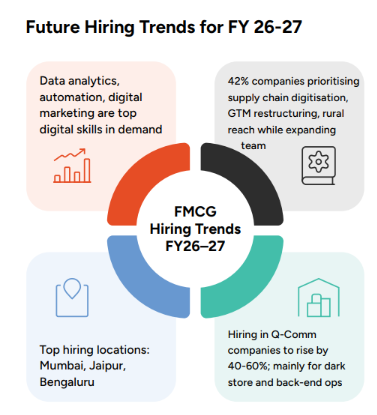
At the same time, the industry is seeing a sharp rise in demand for digital and analytics-driven skills. FMCG hiring trends show that expertise in data analytics, automation, digital marketing, AI-driven personalisation, and predictive analytics is becoming essential not just for growth, but for maintaining competitiveness in a crowded market.
Supply chain and go-to-market (GTM) functions are also undergoing rapid transformation. FMCG hiring trends show that 42% of companies are prioritising supply chain digitisation, GTM restructuring, and rural reach while expanding their teams. This shift is increasing demand for hybrid professionals who can combine operational expertise with digital fluency.
Another major trend is the rise of quick commerce (Q-commerce). Hiring in Q-commerce companies is expected to grow by 40–60%, particularly for dark store operations, backend supply chain roles, and fulfilment leadership. This is intensifying competition for logistics, warehousing, and planning talent across the FMCG ecosystem.
Alt: FMCG Hiring Trends
Source: India Decoding Jobs Report 2026
However, trends also show that companies that continue to rely on conventional hiring models risk slower expansion, higher attrition, and capability gaps in critical functions.
Let’s explore the recruitment challenges.
Why FMCG Companies Are Struggling to Hire Supply Chain Talent?
FMCG companies are facing a widening gap between the supply chain skills they need and the talent available in the market. Rapid digital transformation, rising demand volatility, and competition from e-commerce and tech-led companies have made experienced supply chain professionals harder to attract and retain.
As a result, traditional hiring approaches are no longer sufficient to meet today’s supply chain demands.
Let’s explore the factors that are making FMCG supply chain hiring particularly challenging in 2026:
Shortage of digitally skilled professionals: The intersection of supply chain expertise and digital capabilities is rare. Traditional supply chain professionals may lack data analytics skills, while data scientists often don’t understand supply chain operations. Finding candidates who bridge this gap is your most pressing challenge.
High attrition in planning and logistics roles: Supply chain professionals are in high demand across industries. FMCG companies are competing not just with each other but with technology companies, logistics providers, and e-commerce giants who can often offer higher compensation and more cutting-edge work environments.
Competition from e-commerce and D2C brands: Startups and digital-native brands are attracting supply chain talent with promises of innovation, rapid growth, and the opportunity to build supply chains from scratch rather than transform legacy operations. Your traditional FMCG advantages- stability, scale, established brands may not resonate with the next generation of supply chain leaders.
How FMCG Leaders Are Rethinking Supply Chain Hiring?
FMCG leaders are rethinking supply chain hiring by shifting from designation-based recruitment to skill-first hiring, investing in digital and analytics upskilling, enabling internal mobility, and aligning talent strategies with long-term business and supply chain transformation goals.
Skill-based hiring versus designation-based hiring: Rather than looking for candidates with specific job titles, focus on the competencies you need. A data analyst with supply chain interest might be a better demand planner than someone with a traditional supply chain background who lacks analytical skills. Create clear skill frameworks for each role and assess candidates against these capabilities rather than resume credentials.
Investing in analytics and digital capability building: Some CHROs are addressing the skill gap through aggressive upskilling programs. Partner with your supply chain leadership to identify high-potential professionals who have strong operational foundations and invest in developing their digital and analytical capabilities through structured training programs, certifications, and rotation assignments.
Internal mobility and cross-functional exposure: Your best supply chain talent might already be in your organization- just in different functions. Create pathways for sales planners, financial analysts, or operations managers to move into supply chain roles. Cross-functional experience often produces more effective supply chain leaders because they understand the broader business context.
The Role of RPO in FMCG Supply Chain Hiring
As supply chain hiring becomes more complex and urgent, many FMCG CHROs are turning to Recruitment Process Outsourcing (RPO) as a strategic solution. Here’s why RPO partnerships are particularly effective for supply chain talent acquisition:
Scalable hiring for seasonal and volume demand: FMCG businesses face predictable peaks around product launches, seasonal periods, and geographic expansions. RPO providers can rapidly scale recruitment capacity to meet these demands without requiring you to permanently expand your internal recruiting team.
Specialized supply chain talent pools: Leading RPO providers maintain deep networks of supply chain professionals across planning, procurement, logistics, and analytics roles. They know where this scarce talent lives, what motivates them, and how to engage them effectively- relationships that take years for internal teams to build.
Workforce planning and skill benchmarking: Beyond filling individual positions, RPO partners help you understand the evolving skill landscape. They can benchmark your requirements against market standards, identify emerging skill needs before they become critical gaps, and help you build talent pipelines that align with your three-to-five-year business strategy.
The best RPO relationships transform recruitment from a reactive, transactional process to a proactive, strategic capability that gives you competitive advantage in the war for supply chain talent.
Wrapping Up
As we move deeper into 2026, one truth is becoming increasingly clear: your supply chain’s competitive advantage will be determined less by your infrastructure and more by your talent. The FMCG companies that win in this environment will be those that can attract, develop, and retain professionals with the sophisticated skill sets this new era demands.
The challenge for CHROs is significant but not insurmountable. By adopting skill-first hiring approaches, building strategic partnerships with specialized recruitment providers, and creating development pathways that keep your supply chain talent engaged and growing, you can build the resilient, agile, digitally-enabled supply chain teams your business needs.
The supply chain talent war is here. The question is whether your recruitment strategy is ready for it.
Key FMCG Supply Chain Hiring Trends for 2026
As you plan your talent strategy for the coming year, keep these trends on your radar:
Rise of hybrid planner-analyst roles: The boundaries between planning and analytics are blurring. Expect to see more positions that combine demand planning responsibilities with advanced analytics capabilities. These hybrid roles can often deliver more value than hiring separate planners and analysts.
Increased automation and AI-led planning: As artificial intelligence takes over routine planning tasks, your human planners will need to focus on exception management, strategic decision-making, and algorithm oversight. Look for candidates who are comfortable working alongside automated systems rather than those who are threatened by them.
Growing importance of supply chain leadership roles: As supply chains become more strategic, Chief Supply Chain Officers and VPs of Supply Chain are gaining more influence and visibility. You may need to adjust compensation and positioning for these roles to attract transformational leaders rather than operational managers.
FAQs
What are the most important skills in FMCG supply chain jobs?
The most critical skills depend on the specific role, but across all supply chain positions, digital and analytical capabilities are increasingly essential. Demand planning requires statistical forecasting and S&OP expertise. Procurement needs negotiation skills and risk management capabilities. Logistics requires route optimization and technology platform knowledge. The common thread is that all roles now require comfort with data, technology, and cross-functional collaboration.
Which FMCG supply chain roles are hardest to hire?
Demand planners with strong analytical skills, supply chain data analysts, and digital transformation leaders are the hardest positions to fill. These roles sit at the intersection of supply chain domain expertise and digital capabilities- a combination that’s currently rare in the market. Experienced procurement professionals with sustainability expertise are also increasingly difficult to find.
How is technology changing supply chain hiring?
Technology is changing both the skills you need to hire for and how you hire. On the skills side, proficiency in ERP systems, analytics platforms, and emerging technologies like AI and IoT is becoming baseline. On the hiring process side, skills-based assessments, virtual simulations, and data-driven candidate evaluation are becoming more sophisticated. The best supply chain candidates are often passive job seekers, which means traditional job postings alone won’t reach them- you need proactive sourcing strategies.
Why is RPO effective for FMCG supply chain recruitment?
RPO providers bring specialized expertise, established talent networks, and scalable capacity that internal teams struggle to maintain. For supply chain roles specifically, RPO partners often have dedicated practice areas with recruiters who understand the technical requirements, speak the language of supply chain professionals, and have relationships across the industry. This specialization dramatically reduces time-to-hire and improves candidate quality for hard-to-fill positions.
Ready to Transform Your FMCG Supply Chain Hiring?
Hiring for critical FMCG supply chain roles shouldn’t feel like searching for unicorns. Taggd’s RPO-led FMCG hiring solutions help you access skilled planners, logistics experts, and supply chain leaders at scale.
Our specialized FMCG supply chain practice combines deep industry networks, skills-based assessment frameworks, and scalable recruitment capacity to help you build the supply chain teams that will drive your competitive advantage.
Connect with Taggd today to build talent pipelines aligned with future business needs.