Let’s be honest, in today’s cut-throat talent market, playing defence with reactive hiring is a recipe for falling behind. Talent acquisition consulting is the strategic offensive you need, shifting you from simply filling empty seats to building a workforce that’s ready for whatever comes next. It’s about creating a proactive, data-smart hiring engine that’s perfectly in tune with your business goals.
Why Talent Acquisition Consulting Is Your New Strategic Imperative
In a market this competitive, just having roles filled doesn’t mean you’re winning. The real victory is getting the right people in the right roles at the right time to actually push your business forward. Yet, so many organisations are caught in a reactive loop: post a job, sift through applications, and cross their fingers. This isn’t just inefficient; it’s a huge business risk.
Think of a talent acquisition consultant as the architect for your entire workforce strategy. Your internal team might be fantastic builders, handling the day-to-day hiring, but the consultant draws up the master blueprint. They dive deep into your business objectives, your position in the market, and your internal strengths and weaknesses to design a hiring framework built for the future.
This blueprint isn’t just about today; it’s engineered for resilience and growth, making sure your hiring can handle market swings and support your expansion plans. A consultant doesn’t just fill chairs; they build the foundational systems that consistently attract, assess, and land top-tier talent.
Moving Beyond Reactive Hiring
The cost of being reactive is painfully high, especially for specialised roles. Take India’s booming talent acquisition landscape, for example. A staggering 57% of Global Capability Centre (GCC) leaders flagged skill gaps as their biggest headache, which directly hit the financial performance for 37% of them. With the shelf life of digital skills now under three years, old-school hiring methods are taking three times longer to fill these crucial positions. You can get more of the story from the 2024 Zinnov Recruitment Benchmarking report.
This is precisely where a talent acquisition consulting engagement makes all the difference. A consultant helps you break free from a short-term, vacancy-filling mindset and embrace long-term workforce planning. They do this by:
- Finding the Real Problems: Getting to the root of why your time-to-fill is lagging or why your new hires aren’t a great fit.
- Sharpening Your Tech: Making sure your recruitment technology actually works together and gives you the best return.
- Boosting Your Employer Brand: Shaping a powerful story that pulls in the best people, even those who aren’t actively looking.
- Making Hiring Data-Driven: Using analytics to see what’s coming, predict your hiring needs, and build talent pipelines before you’re in a bind.
At its core, a consultant’s job is to link every single hiring action back to a real, measurable business outcome. They help turn the talent function from a cost centre into a powerhouse that gives you a genuine competitive edge.
Ultimately, this kind of partnership is about building a talent ecosystem that can sustain itself. It arms your organisation with the strategy, processes, and tools you need to not just fight the war for talent, but to win it.
Consulting vs RPO: Understanding Your Strategic Options
Navigating the world of talent solutions can often feel like choosing between a personal trainer and joining a high-end gym. Both can help you reach your fitness goals, but they play fundamentally different roles. The same is true when you compare talent acquisition consulting and Recruitment Process Outsourcing (RPO)—two powerful, but distinct, options for CHROs.
It’s easy to lump them together, but understanding what makes them unique is critical to making the right strategic move for your organisation. One is all about designing the blueprint, while the other excels at building the structure. Confusing the two can lead to mismatched expectations and wasted investment.
The decision often boils down to one central question about your current hiring process. Are your challenges strategic or operational?
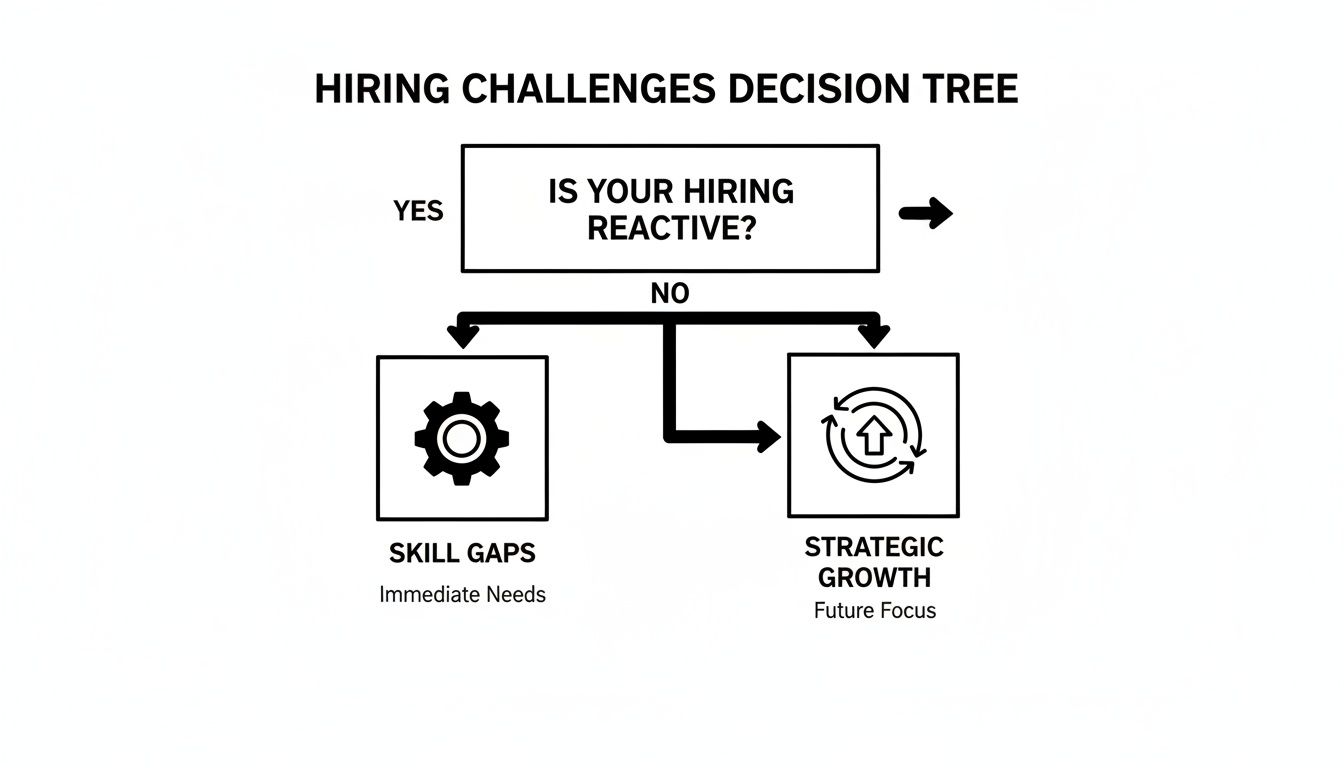
As the visual shows, a reactive hiring model often leads to persistent skill gaps. A proactive approach, on the other hand, is built to support strategic, long-term growth. This is the core difference between needing operational support versus strategic advice.
The Strategist and The Executor
Think of a talent acquisition consultant as the strategic brain of your hiring function. Their work is diagnostic and architectural. They don’t just fill roles; they get under the bonnet of your entire talent ecosystem—from your employer brand and candidate journey to your tech stack and internal workflows—to find the root cause of any issues. Their mission is to design a customised, optimised, and future-proof hiring master plan.
An RPO provider, on the other hand, is the operational muscle. They are the execution experts who take a well-defined process and run with it, delivering scale and efficiency. An RPO partner becomes a true extension of your team, managing the day-to-day recruiting lifecycle from sourcing and screening to onboarding. You can dive deeper into this by exploring everything you need to know about RPO in our detailed guide.
A consultant tells you what to build and why, providing the detailed schematics for a world-class hiring engine. An RPO provider takes those schematics and builds it for you, managing the construction with skill and precision.
Consulting vs Outsourcing: A Strategic Comparison
To make the distinction even clearer, let’s put their core functions side-by-side. The table below breaks down how each partner addresses different facets of your talent acquisition needs, helping you pinpoint where your organisation needs the most support.
| Function | Talent Acquisition Consulting (The Strategist) | Recruitment Process Outsourcing (The Executor) |
|---|---|---|
| Primary Goal | To diagnose problems, design strategy, and optimise the entire talent acquisition framework for long-term success. | To manage and execute the day-to-day recruitment process efficiently, filling roles at scale and meeting hiring targets. |
| Key Activities | Process audits, technology stack evaluation, employer brand strategy, competency modelling, and workforce planning. | Candidate sourcing, screening, interview scheduling, offer management, and reporting on recruitment KPIs. |
| Typical Engagement | Project-based, focusing on a specific challenge or a complete transformation over a defined period. | Long-term partnership, often lasting for years, to handle all or part of the organisation’s recruitment volume. |
| Success Metrics | Improved quality-of-hire, stronger employer brand perception, optimised tech ROI, and creation of a scalable hiring model. | Reduced time-to-fill, lower cost-per-hire, meeting hiring volume targets, and high hiring manager satisfaction. |
Ultimately, this isn’t about deciding which is “better,” but which is right for your current needs. Do you need someone to help fix a broken hiring process, or do you need a team to run your already-optimised process more efficiently?
Sometimes, the answer is a powerful hybrid approach. A consultant first redesigns the strategy, and an RPO partner is then brought in to execute it flawlessly.
How Consulting Unlocks True Organisational Potential
Bringing in a talent acquisition consultant isn’t just about tweaking your recruitment process. It’s about fundamentally rewiring your company’s ability to attract and keep the very people who will drive its future growth. It’s a shift from a reactive cost centre—always fighting fires—to a proactive, strategic unit that actually anticipates business needs and builds a real competitive edge. This is where the true, measurable value lies.
Imagine this: it’s Q1, but you already know your critical hiring needs for Q4 and have a warm pipeline of qualified, engaged candidates ready to go. This isn’t a fantasy. It’s the direct result of strategic workforce planning, a core benefit a consultant brings to the table. They help you see beyond the immediate vacancy and start mapping out future skill requirements based on your actual business roadmap.
This forward-thinking stance directly impacts the metrics that matter in the boardroom, turning abstract strategies into tangible results.

From Reactive Fire Drills to Proactive Workforce Planning
Too often, hiring kicks off with a frantic email from a manager whose team is already underwater. A talent acquisition consultant helps you break this cycle for good. They dig into market trends, your own growth projections, and potential attrition risks to build a predictive model for your talent needs.
This means you stop scrambling and start building. Instead of just throwing job posts out into the void, you’re cultivating talent communities and nurturing relationships with top professionals in your industry—long before you even have an open role.
The benefits of this shift are both immediate and substantial:
- Anticipating Future Skill Gaps: Pinpointing the exact skills your organisation will need in 12-24 months and creating a solid plan to acquire them now.
- Building Talent Pipelines: Developing a ready-to-engage pool of candidates for your most critical and hard-to-fill roles, which dramatically cuts down your time-to-fill.
- Data-Informed Decisions: Using predictive analytics to make smarter, more strategic hiring choices instead of just relying on gut feelings.
Optimising Your Recruitment Technology Stack
Let’s be honest, many organisations have a messy collection of recruitment tools that don’t talk to each other. This creates friction and gives a fragmented, incomplete view of the hiring process. A consultant acts as an architect for your technology stack, ensuring every single tool serves a purpose and works seamlessly with the others.
They’ll audit your current systems—from your Applicant Tracking System (ATS) to your Candidate Relationship Management (CRM) software—to identify redundancies, inefficiencies, and gaps. The goal is to create a unified ecosystem that provides clean data, improves the recruiter experience, and, most importantly, elevates the candidate journey. This kind of optimisation ensures you get the maximum return on your significant technology investment.
Elevating the Candidate Experience to Build a Magnetic Brand
In a cut-throat market, your candidate experience is a direct reflection of your employer brand. A clunky, impersonal, or slow hiring process will absolutely deter top talent and damage your reputation. A consultant views your entire recruitment process through the eyes of a candidate, meticulously mapping every single touchpoint to find areas for improvement.
A world-class candidate experience isn’t a ‘nice-to-have’; it’s a strategic weapon. It turns candidates into advocates, regardless of the hiring outcome, and builds a magnetic brand that passively attracts high-calibre talent.
By refining communication, streamlining application stages, and training hiring managers on how to conduct impactful interviews, a consultant helps you build a process that feels respectful and engaging from start to finish. This focus on experience is what wins the battles for in-demand skills. Ultimately, a strong employer brand lowers sourcing costs and improves the quality of your applicant pool over the long term. A partnership with a talent acquisition consulting firm directly connects these strategic improvements to the bottom-line metrics that define organisational success.
Choosing the Right Consulting Partner
Picking a talent acquisition consulting partner is one of the most important calls a CHRO can make. This isn’t just about finding another vendor; it’s about forging a strategic alliance. The right partner becomes an extension of your leadership team, bringing insights that can fundamentally reshape how you hire. The wrong one? A fast track to wasted budgets and strategic gridlock.
So, the evaluation process has to go way beyond the usual surface-level checks like scrolling through client logos or service brochures. You’re looking for a partner whose expertise, methods, and even cultural DNA snap into place with your organisation’s unique problems and future goals. This calls for a much deeper, more discerning look.
Focusing on Proven Industry Expertise
Generic, one-size-fits-all solutions are the enemy of real progress. Let’s be honest, the challenges of hiring in FinTech are a world away from those in manufacturing or pharmaceuticals. A consultant who doesn’t get the specific nuances of your sector—the key players, the skills that actually matter, and what top candidates really expect—is starting on the back foot from day one.
You need to demand proof of proven expertise in your specific industry. Ask for case studies that speak directly to the challenges you’re staring down right now. A consultant who already has a deep feel for your market can add value immediately, offering benchmarks and strategies that are already tailored for your world.
On top of that, think about their grasp of today’s workforce dynamics. By 2025, it’s estimated that 60 to 90 million Indians—that’s up to 15% of the workforce—will be working remotely. This is a massive shift. It means you need a partner with proven experience in building and running hiring strategies for a distributed workforce, allowing you to tap into this nationwide talent pool effectively. You can get more context by exploring insights on the shifting talent landscape from ZRG Partners.
Evaluating Their Data-First Methodology
The best consultants don’t run on gut feelings; they run on data. A truly strategic partner will lead with a data-first methodology. Any engagement should kick off with a thorough diagnostic audit of your current processes, metrics, and outcomes. They should be obsessed with measurement, tying every single recommendation back to tangible KPIs.
Their whole approach should be grounded in analytics, helping you get clear answers to critical questions like:
- Where are the real bottlenecks in our hiring funnel?
- What is the true cost of a bad hire in our most critical departments?
- Which sourcing channels are actually delivering the highest-quality candidates, not just the highest volume?
A partner who can’t clearly explain how they’ll measure the success of their work is a strategic risk. Look for consultants who think like business analysts, not just recruiters.
This data-driven mindset also applies to the technology they recommend. You want a tech-agnostic consultant. Their loyalty should be to solving your problems, not to selling a particular software package. A neutral advisor will look at your existing tech stack and suggest solutions that integrate smoothly and deliver the best ROI, no matter whose name is on the box.
Probing for Cultural Alignment and ROI
At the end of the day, the success of the partnership often comes down to cultural fit. A consultant’s style has to mesh with how your organisation gets things done. Are they collaborators who will build up and empower your internal team, or are they disruptors who might create friction and resistance? Getting this alignment right is absolutely critical for managing change and making sure their strategies actually stick for the long run.
To really vet a potential partner, you have to get past the standard sales pitch. Ask the tough questions that reveal how they solve problems and what they’ve actually delivered in the past.
Critical Questions to Ask Potential Partners
- Measuring Success: “How do you define and measure success for your recommendations? What specific KPIs will you be tracking for an engagement with us?”
- Navigating Complexity: “Tell me about your most complex implementation. What were the biggest challenges, and how did you navigate them to get results?”
- Demonstrating Value: “Walk us through a case study where you delivered a measurable ROI. What was the client’s initial investment, and what was the financial return they saw?”
- Handling Resistance: “How do you handle pushback from hiring managers or leaders who are resistant to changing processes they’ve used for years?”
The answers you get will tell you far more than a glossy brochure ever could. They will show you who has the strategic depth, the hands-on experience, and the collaborative spirit to become the partner your organisation truly needs to win the war for talent.
Measuring Success and Proving ROI to the C-Suite
Any significant investment, including talent acquisition consulting, has to be justified to the C-suite. And let’s be honest, they speak the language of numbers, not just anecdotes. To make your case, you need to move beyond “it feels like we’re hiring better” and build a powerful, data-driven story that proves the value of your partnership.
This isn’t about getting lost in complex financial models. It’s about drawing a straight line from the consultant’s work to real, tangible improvements in your hiring engine. By focusing on a few key performance indicators (KPIs), you can build a compelling argument that aligns perfectly with leadership’s focus on efficiency, quality, and strategic growth.
Defining Your Core Metrics
To really prove the value of the engagement, I recommend focusing on two critical buckets of KPIs. Each one tells a different, crucial part of the story, giving you a complete picture of the impact.
1. Efficiency Metrics (The Speed and Cost Story) These are your quick wins and the easiest metrics to track. They answer the simple but critical question: “Are we hiring faster and more cost-effectively?”
- Time-to-Fill: This is the classic. Track the average number of days from when a job is approved to when an offer is accepted. A good consultant should shrink this window by cleaning up your processes and building proactive talent pipelines.
- Cost-per-Hire: Tally up your total recruitment costs—agency fees, ad spend, tech subscriptions—and divide by the number of hires. As your strategy improves, this number should consistently trend downwards.
2. Quality Metrics (The Impact and Longevity Story) Speed is great, but it’s pointless if the people you hire don’t perform or leave within a few months. These metrics get to the heart of what matters: the quality of talent joining your organisation.
- Quality-of-Hire: This can be a combination of metrics. Look at the performance review scores of new hires after six or twelve months. You can also pair this with simple hiring manager satisfaction surveys.
- 90-Day Retention Rate: A high retention rate in the first three months is a brilliant indicator that you’re getting the role and culture fit right. It proves your selection process is actually working.
The ultimate goal of talent acquisition consulting isn’t just to fill roles faster, but to fill them with people who will stay, perform, and drive the business forward. This is the difference between filling a seat and making a strategic investment in human capital.
Calculating the Financial Return
With these metrics in hand, you can build a powerful ROI calculation. It’s about framing the investment in consulting against the financial gains you’ve made. India’s talent acquisition market is growing at a 9.9% CAGR, and for CHROs, the ROI case is becoming undeniable. Effective consulting can slash hiring times by 30-50% with the right tools, help you close critical skill gaps that cause financial hits for 37% of companies, and get new hires productive in 60-90 days instead of the typical 120+. To see how these shifts are shaping the landscape, you can read the full talent acquisition research report.
Your formula can be as straightforward as comparing the cost of the consultant to the value you’ve gained from lower attrition, faster time-to-productivity, and reduced hiring costs. For a deeper dive, our guide on how to track and analyse the ROI of your recruiting efforts has you covered.
This data-backed approach completely changes your conversation in the boardroom. You’re no longer just asking for a budget; you’re presenting a strategic business proposal with a clear and compelling financial upside.
Your Implementation and Change Management Roadmap
A brilliant strategy from a talent acquisition consulting partner is only as good as its execution. Let’s be honest, we’ve all seen insightful recommendations that end up as just another report gathering dust on a shelf. To avoid that fate, you need a structured roadmap and, just as importantly, a thoughtful approach to bringing your people along on the journey.
Turning strategy into day-to-day reality isn’t like flipping a switch. It’s more like carefully building a new foundation, one layer at a time. The real goal here is sustainable transformation, not just a quick fix.
Phase 1: Diagnostic and Strategy Formulation
This is where it all begins: getting everyone on the same page. Your consulting partner will work closely with your leadership and TA teams to do a deep-dive audit of your current processes, technology, and performance metrics. This isn’t just about pointing out what’s broken; it’s about digging into the root causes.
From these findings, the consultant shapes a practical, strategic plan. This roadmap lays out specific, actionable steps designed to tackle your unique challenges while aligning with the bigger business objectives. We’ll set clear goals and KPIs right here, so everyone knows exactly what success looks like.
Phase 2: Pilot Programme and Tech Integration
Instead of a disruptive, company-wide overhaul, the smartest move is to start small. A pilot programme, usually focused on a single department or a specific role type, lets you test-drive the new processes in a controlled environment. This is where theory meets the real world.
This phase is also the time to integrate any new recruitment technology. The focus is on creating a seamless workflow, training a small group of super-users, and gathering honest feedback. This allows you to make adjustments before a full-scale launch, minimising risks and building that crucial early momentum.
Securing buy-in is the most critical component of a successful rollout. A pilot programme creates internal champions who can attest to the new system’s benefits, making them powerful advocates when it’s time to expand.
Phase 3: Full-Scale Rollout and Training
With a successful pilot in the bag, it’s time to go big. This phase is all about communication and training. It’s not enough to just announce the change; you have to clearly explain the “why” behind it to everyone involved—especially your hiring managers.
This is where effective change management becomes your best friend. Proactively addressing concerns and showing people the direct benefits—like better candidates and faster hiring—helps get everyone on board. For a deeper dive, our guide on change management in HR offers some incredibly useful frameworks.
Phase 4: Continuous Optimisation
Implementation is not a one-and-done event. It’s an ongoing cycle of improvement. Once you’re fully rolled out, the focus shifts to tracking performance against the KPIs we set back in phase one. Regular check-ins with your consulting partner help you see what’s working and where you can make things even better.
This constant feedback loop ensures your talent acquisition function doesn’t just improve—it evolves. By building a culture of data-driven decisions and constant refinement, the partnership delivers lasting value far beyond the initial project, creating a truly agile and resilient hiring engine.
Your Questions Answered: A CHRO’s Quick Guide
Bringing in a strategic partner is a big decision, even for the most seasoned HR leaders. Here are some straightforward answers to the questions we often hear from CHROs, focusing on what this really means for the business and your bottom line.
What Does a Typical Engagement Look and Cost Like?
There’s no one-size-fits-all answer here, as every partnership is shaped around your unique challenges. A sharp, focused project—like optimising your recruitment tech or sharpening your employer value proposition—might take around three to six months. But if we’re talking about a full-scale transformation of your entire hiring ecosystem, you’re likely looking at a deeper partnership over 12 months or more.
Costs vary just as much. Some engagements are based on a fixed project fee, others on a retainer. The crucial thing is to see this not as an expense, but as a strategic investment. You should be weighing the cost directly against the ROI you’ll see from lower hiring costs, better staff retention, and getting new hires up to speed faster.
How Will a Consultant Work With My Internal TA Team?
Think of a good consultant as a coach and a force multiplier, not a replacement. Their job is to make your existing team better. They do this by introducing smarter strategies, providing high-level training, and rolling out more effective tools and processes. They’ll work shoulder-to-shoulder with your recruiters and leaders, building up your internal muscle.
The real goal here is to make your own team more effective and self-reliant for the long haul. A consultant gives you the blueprint and the initial push, but your team learns to own the system and continuously improve it. That’s how the benefits stick around long after the engagement ends.
This collaborative spirit is what gets everyone on board and makes the changes last.
Will We See Results Right Away?
You’ll get a mix of both immediate wins and long-term strategic gains. Some tweaks, like smoothing out a bottleneck in your interview process or fine-tuning a job ad campaign, can start showing results in just a few weeks, especially in reducing time-to-fill for specific roles.
However, the most powerful benefits of talent acquisition consulting are the ones that build momentum over time. Strengthening your employer brand or creating proactive talent pipelines for mission-critical roles aren’t overnight fixes. These are long-term plays that deliver compounding returns, giving you a lasting edge in a tough talent market. The best approach combines quick wins to build confidence with deep, foundational changes that set you up for years of success.
How Do I Know If I Need Consulting or an RPO?
This is a fundamental strategic question. It really boils down to where your problem lies.
If your core hiring processes are solid, but you simply don’t have the people-power to keep up with demand, a Recruitment Process Outsourcing (RPO) partner is probably what you need. RPO brings the operational horsepower to manage high hiring volumes without breaking a sweat.
On the other hand, if you’re stuck with persistent issues like high turnover, poor quality of hire, or a struggle to land specialised talent, that signals a problem with your strategy. This is where talent acquisition consulting comes in. A consultant will diagnose the root causes and help you redesign the entire framework before you even think about scaling up.
Ready to shift your hiring from a reactive cost centre into a strategic growth engine? Taggd has the expertise to help you design and implement a world-class talent acquisition strategy. Discover our RPO solutions and start building the workforce that will define your future.