For any CHRO today, the real difference between just filling a role and actually building a future comes down to one thing: understanding talent acquisition versus hiring. People often use these terms as if they’re the same, but they represent two completely different mindsets for building a workforce. One is a quick fix; the other is a long-term strategic investment in your company’s most important asset, its people.
From Reactive Recruiting to Proactive Talent Acquisition
Think about your company’s immediate hiring needs like planning tonight’s dinner. You pop over to the supermarket with a specific shopping list, grab what you need, and the immediate problem is solved. That’s traditional hiring. It’s tactical, reactive, and all about filling an empty seat as fast as possible. The goal is simple: close the current vacancy.
Now, let’s imagine a different way. Instead of a quick trip to the store, you’re running a farm. You’re analysing the soil, planning your crops based on what people will want to eat seasons from now, and nurturing seedlings to ensure a continuous harvest. That’s strategic talent acquisition. It’s a proactive, ongoing process of anticipating what skills you’ll need tomorrow, building pipelines of talent today, and cultivating an employer brand that naturally attracts top performers.
This shift in thinking isn’t just a nice-to-have anymore; it’s essential for survival and growth. A purely reactive hiring model leaves you scrambling when the market shifts or talent becomes scarce, often forcing you to compromise on quality just to get someone in the door. In contrast, a well-oiled talent acquisition strategy means you always have a pool of qualified, engaged people ready for the opportunities you haven’t even announced yet.
To truly appreciate the difference, it helps to put them side-by-side. The following table breaks down the core distinctions in mindset, process, and ultimate business impact.
Talent Acquisition vs. Traditional Hiring: A Strategic Comparison
| Aspect | Traditional Hiring | Strategic Talent Acquisition |
|---|---|---|
| Mindset | Reactive and short-term. Fills current, open roles. | Proactive and long-term. Builds a continuous pipeline of talent for future needs. |
| Focus | Filling an immediate vacancy as quickly as possible. | Attracting, engaging, and retaining top talent to meet long-term business goals. |
| Timeline | A linear process with a clear start (job opening) and end (hire made). | An ongoing, cyclical process that never really stops. |
| Process | Primarily driven by advertising open jobs and screening applicants. | Involves workforce planning, employer branding, and relationship-building with passive candidates. |
| Key Metric | Time-to-fill and cost-per-hire. | Quality of hire, pipeline strength, and long-term employee retention. |
| Business Impact | Fills an immediate operational gap. | Creates a sustainable competitive advantage through a superior workforce. |
As you can see, one is a transaction, while the other is a relationship. Hiring is a linear process that kicks off when a role opens and stops once it’s filled. Talent acquisition, on the other hand, is a continuous cycle woven directly into your overall business strategy.
This strategic approach involves several key activities that go far beyond just posting a job ad:
- Workforce Planning: Looking ahead to forecast future talent needs based on where the business is going, market trends, and potential skill gaps on the horizon.
- Talent Pipelining: Actively finding and building relationships with great passive candidates long before a specific role ever becomes available.
- Employer Branding: Shaping and communicating a compelling story about why your company is a great place to work, attracting the right kind of talent organically.
- Succession Planning: Identifying and developing your internal high-performers to fill future leadership and other critical roles from within.
When CHROs start treating talent acquisition as a core business function rather than a reactive HR task, something powerful happens. The workforce transforms from a cost centre into a genuine competitive advantage. This strategic pivot ensures the right people are in the right roles at the right time, ready to drive innovation and hit those long-term goals.
Building Your Talent Acquisition Framework with RPO
Moving away from a reactive hiring-on-demand mindset towards a proactive talent acquisition strategy is a big shift. It demands a solid, structured framework. This isn’t just about giving your recruitment department a new name; it’s about completely re-engineering the way you find and attract people to align with your long-term business goals. For a CHRO, bringing in a Recruitment Process Outsourcing (RPO) partner can be the catalyst that makes this transformation happen.
Think of your RPO partner not as a vendor you call when you have an empty seat, but as a strategic extension of your own team. They are the engine that drives your talent strategy, bringing in specialised expertise, technology, and market intelligence that would be costly and time-consuming to build from scratch. This partnership frees you up to focus on the big picture while they handle the complex, day-to-day work of modern talent acquisition hiring.
The flowchart below neatly captures this shift in thinking, from the short-term, transactional nature of hiring to the long-term, nurturing approach of talent acquisition.
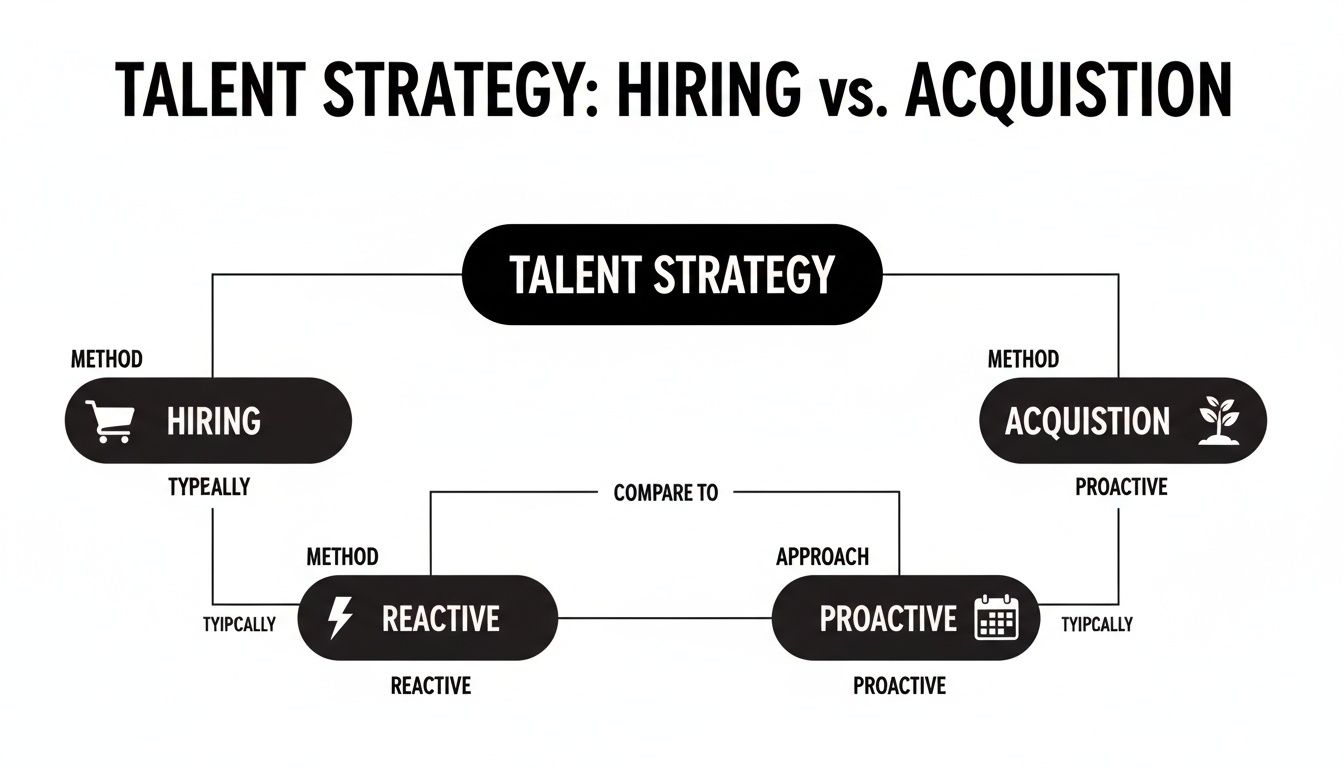
The difference is critical. One is like making a quick purchase to solve an immediate problem. The other is like strategically cultivating a garden to ensure a healthy harvest for years to come.
The Four Pillars of an RPO-Powered Framework
A strong talent acquisition framework is built on four essential pillars. A good RPO partner doesn’t just support these; they integrate deeply into each one, boosting your capabilities and driving real strategic outcomes.
1. Strategic Workforce Planning: This is where it all starts. It’s about looking at your business goals and forecasting the skills you’ll need in the future, identifying potential talent gaps before they turn into full-blown crises. An RPO partner brings crucial market intelligence to the table, mapping out talent availability and keeping an eye on what your competitors are doing to inform your strategy.
2. Proactive Sourcing and Pipelining: Forget waiting for applications to roll in. This pillar is all about actively finding and engaging with great people who aren’t even looking for a job. Your RPO team can build and nurture communities of talent for your most critical future roles. The result? A ready supply of qualified candidates who already know and like your brand.
3. Magnetic Employer Branding: Your employer brand is your secret weapon in the war for talent. A specialised RPO partner helps you define and broadcast your Employer Value Proposition (EVP) across every channel. They ensure your message is consistent, compelling, and attracts the right people for the right reasons.
4. Data-Driven Decision Making: In a modern talent strategy, gut feelings just don’t cut it. This pillar is all about using analytics to measure what truly matters—like the quality of your hires, the health of your talent pipeline, and the effectiveness of your sourcing channels. An RPO provides the tech and analytical know-how to turn raw data into actionable insights for continuous improvement.
An RPO partnership transforms talent acquisition from a cost centre into a genuine value-driver. By embedding expertise into each of these pillars, the RPO helps you build a predictable, scalable, and resilient talent engine that directly fuels business growth.
Establishing Governance and Alignment
For this partnership to truly work, you need a clear governance model. This isn’t about micromanaging your RPO partner; it’s about making sure their activities are perfectly aligned with your strategic objectives.
An effective governance model has a few key components:
- Shared Key Performance Indicators (KPIs): It’s time to move beyond old-school metrics like time-to-fill. Instead, co-create KPIs that measure strategic impact—things like quality-of-hire, diversity metrics in the talent pipeline, and hiring manager satisfaction scores.
- Regular Strategy Reviews: Set up quarterly business reviews (QBRs). This is where your leadership team and the RPO’s strategic leads get together to look at performance, discuss market trends, and tweak the talent plan as your business needs change.
- Clear Communication Cadence: Establish a rhythm of regular operational meetings, maybe weekly or bi-weekly, to manage day-to-day activities and keep execution smooth. This constant feedback loop stops small issues from becoming big problems and keeps everything on track.
This structured approach ensures your RPO partner functions as a true strategic ally. To dive deeper, you can learn more about how RPO aligns hiring to business goals and turns recruitment from a support service into a core business asset. By building a solid framework and a strong governance model, your organisation can finally stop reacting to talent shortages and start proactively shaping its own talent landscape.
Of course. Here is the rewritten section, crafted to sound human-written and match the expert, natural tone of the provided examples.
Navigating the Modern Indian Talent Landscape
For any CHRO in India today, the job market feels like a paradox. On one hand, you have a booming economy with a seemingly endless demand for new talent. On the other, there’s a stubborn, frustrating shortage of professionals who actually have the right skills for the job. It’s a high-stakes game where having a sharp talent acquisition hiring strategy isn’t just a “nice-to-have”, it’s your ticket to growth.
This talent crunch isn’t just a temporary blip; it’s a deep-seated challenge. A recent ManpowerGroup survey painted a pretty stark picture: in 2025, a massive 80% of Indian employers are expecting to struggle with finding skilled people. That number has been stubbornly high for the past three years, which tells you this is a chronic issue, even as India leads the world in hiring demand. For organisations like Talent Hired – The Job Store Private Limited, this data just confirms what we see on the ground every day. You can read more about it in the NDTV report on India’s talent shortage.
This all leads to a critical question: How do you win the war for talent when the talent pool itself feels like it’s shrinking? The answer is to stop seeing it as a problem and start treating it as a competitive advantage waiting to be unlocked.
The Problem of Plenty and Scarcity
Some sectors are feeling the heat more than others. The tech and IT industries are in a constant race for specialists in AI, machine learning, and cybersecurity, thanks to the relentless pace of innovation. At the same time, India’s big push into renewable energy has created a huge need for skilled engineers and project managers. And, of course, the healthcare and pharma sectors are always on the lookout for top-tier researchers and practitioners.
The real issue here is that old-school, reactive recruitment just doesn’t cut it anymore. Posting a job ad and hoping the perfect candidate magically appears is like fishing in a nearly empty pond with the wrong bait. It’s slow, inefficient, and often leads to expensive bad hires or, even worse, key roles sitting vacant for months. That’s a direct hit to your innovation, productivity, and your ability to deliver on your business goals.
The modern talent landscape demands a shift from being a “job filler” to a “talent architect.” Instead of just reacting to vacancies, leading CHROs are proactively building bridges to future talent, ensuring a steady flow of skilled professionals ready to meet tomorrow’s business needs.
RPO as the Strategic Solution
This is exactly where a strategic partnership with a Recruitment Process Outsourcing (RPO) provider can be a complete game-changer. A modern RPO partner does so much more than just find candidates; they offer a full-blown solution designed to tackle the market’s complexities head-on. They help you turn that scarcity problem into a real opportunity by fundamentally changing how you find and evaluate talent.
A sophisticated RPO partner addresses the talent crunch in three powerful ways:
- Expanding Access to Talent Pools: They don’t just stick to the usual job boards. They use advanced sourcing tech and deep market intelligence to dive into hidden and passive talent pools, building and nurturing communities of potential candidates so you have a continuous pipeline.
- Uncovering Hidden Potential: Using modern psychometric and skills-based assessment tools, an RPO can spot high-potential candidates that traditional CV screening would completely miss. It’s about focusing on what a candidate can do, not just what they’ve done in the past.
- Delivering Strategic Scalability: The Indian market is incredibly dynamic, and your hiring needs can swing wildly. An RPO gives you the agility to scale your recruitment muscle up or down based on project demands or market shifts, all without the fixed cost of a huge internal team.
By embedding these capabilities into your organisation, an RPO partner helps you build a talent engine that’s resilient, predictable, and high-performing. This proactive approach to talent acquisition hiring allows you to break free from the frustrating cycle of scarcity and build a workforce that’s genuinely ready for whatever comes next.
Leveraging Technology And Data For Smarter Hiring
In today’s world, modern talent acquisition runs on far more than just intuition and experience; it’s powered by a smart mix of technology and data. For a CHRO, getting the right tech stack in place is no longer a nice-to-have. It’s the engine that transforms your hiring process from a manual, administrative task into a data-driven, strategic powerhouse that fuels business growth. Without it, even the most brilliant talent acquisition hiring strategy can stall.
The journey begins by looking beyond the trusty Applicant Tracking System (ATS). An ATS is absolutely essential for managing applications, but it’s only one piece of a much bigger puzzle. The real magic happens when you build an integrated ecosystem of tools that talk to each other, especially within an RPO partnership where efficiency and deep insights are the name of the game.

Building Your Core Talent Tech Stack
Think of your tech stack like a well-oiled machine, where every gear and cog has a specific, vital role. A modern, RPO-backed setup typically weaves together several key components to create a smooth and intelligent hiring workflow.
- Applicant Tracking System (ATS): This is the foundation. An ATS automates and organises the entire application process, ensuring you stay compliant while creating a central database for all your candidates.
- Candidate Relationship Management (CRM): This is where you get proactive. A CRM lets your team build and nurture relationships with passive candidates, creating warm talent pipelines you can tap into for future roles. It’s about playing the long game.
- AI-Powered Sourcing Tools: Artificial intelligence can scan millions of profiles across countless platforms to unearth ideal candidates who aren’t even looking. This massively broadens your talent pool and cuts down sourcing time.
- Analytics and Reporting Platforms: These tools are your translators. They turn raw hiring data into clear, actionable insights, letting you track key metrics, spot bottlenecks, and make informed decisions to constantly refine your strategy.
When these systems are properly integrated, they give you a powerful, unified view of your entire talent landscape. This integration is where an RPO partner brings immense value, managing the technology and making sure all the parts communicate effectively to drive efficiency and deliver better results.
The Power of Predictive Analytics
Data is the lifeblood of any modern talent acquisition function. It shifts you from making decisions based on “gut feelings” to making them based on cold, hard evidence. By tracking the right Key Performance Indicators (KPIs), you can measure the true business impact of your hiring efforts and show a tangible ROI to the board.
Data analytics brings your talent strategy to life. It tells you not just what happened, but why it happened and what is likely to happen next, empowering you to be a proactive architect of your company’s future workforce.
For CHROs, the goal is to use data to tell a compelling story. For example, by analysing quality-of-hire data alongside your sourcing channel information, you can pinpoint exactly where your best-performing employees come from, and then double down on those channels. This strategic use of data is what separates good hiring from great talent acquisition hiring. If you’re looking to dive deeper, our guide on how predictive talent analytics can shape your workforce is a great place to start.
Key Talent Acquisition KPIs and Their Strategic Impact
To make your data truly meaningful, you need to focus on the metrics that actually matter. Below is a look at some of the most essential KPIs for a strategic CHRO and a breakdown of why they are so important.
A clear understanding of these KPIs helps you translate recruitment activities into business outcomes.
Key Talent Acquisition KPIs and Their Strategic Impact
| KPI (Key Performance Indicator) | What It Measures | Strategic Importance for CHROs |
|---|---|---|
| Quality of Hire | The value a new employee brings, often measured by performance ratings, retention, and manager satisfaction. | This is the ultimate measure of success. It directly links hiring outcomes to business performance and proves the long-term value of your talent strategy. |
| Time to Fill | The number of days from when a job is opened until an offer is accepted. | While a classic metric, it highlights operational efficiency. Consistently long times can signal process bottlenecks or a weak employer brand. |
| Source of Hire | The channel from which a successful candidate was sourced (e.g., referrals, job boards, direct sourcing). | This helps you optimise your recruitment marketing spend by investing in the channels that deliver the highest-quality candidates, improving ROI. |
| Cost Per Hire | The total cost of hiring a new employee, including advertising, technology, and recruiter time. | A key budget metric. It helps you manage expenses and, when paired with Quality of Hire, demonstrates the efficiency and value of your hiring function. |
Tracking these metrics isn’t just about creating reports; it’s about gaining the intelligence needed to make smarter, more strategic decisions.
By mastering your technology stack and focusing on these data-driven insights, you can elevate your role from an operational leader to a strategic partner. You’ll be able to prove that a world-class talent acquisition function is one of the most powerful drivers of sustained business success.
Uncovering Talent in Tier 2 and Tier 3 Cities
For too long, the story of India’s workforce has been centred on its major metropolitan hubs. But for forward-thinking CHROs, the map for talent acquisition hiring is being completely redrawn. The new frontier? The incredible, and often overlooked, potential of Tier 2 and Tier 3 cities. This isn’t a fleeting trend, it’s a fundamental shift in how smart companies build resilient, diverse, and cost-effective teams for the long haul.
What’s driving this change? A few powerful forces are at play. The normalisation of remote and hybrid work has finally untethered talent from a specific postcode, while leaps in digital infrastructure make seamless collaboration possible from virtually anywhere. At the same time, professionals are actively rethinking their priorities, happily trading the grind of metro life for the affordability and improved quality of life found in smaller cities.

The Rise of New Talent Hotbeds
Cities like Coimbatore, Jaipur, Kochi, and Ahmedabad are quickly becoming vibrant hotbeds for skilled professionals. We’re not just talking about one or two sectors, either; this boom spans everything from BFSI and IT to advanced manufacturing. These locations hold a rich pool of ambitious, highly capable talent that many of your competitors are still completely missing.
The numbers tell a compelling story. By 2025, cities like Ahmedabad, Kochi, and Aurangabad are on track to become vital talent centres. The remote work revolution alone has ignited a 28% year-over-year job surge in places like Coimbatore, proving that India’s hiring landscape is diversifying far beyond the usual suspects. With 57% of leaders reporting major skill gaps, and a staggering 60-73% shortfall in critical AI/ML roles, organisations are being pushed to explore these cost-effective talent pools.
This isn’t a challenge; it’s a massive opportunity. By expanding your talent acquisition hiring strategy into these regions, you can access fresh perspectives, build genuinely diverse teams, and secure a powerful competitive edge.
Navigating New Geographies with an RPO Partner
Of course, tapping into these emerging markets takes more than just posting a job ad online. It demands real, on-the-ground knowledge and a strategy tailored to the local culture. This is precisely where a Recruitment Process Outsourcing (RPO) partner with a strong regional footprint becomes your most valuable ally. A seasoned RPO can navigate the unique professional and cultural landscapes of these new geographies with the precision you need.
A localised talent acquisition strategy is no longer optional. It’s the key to unlocking vast pools of skilled talent that remain invisible to organisations focused solely on metropolitan centres.
An RPO partner brings the boots-on-the-ground expertise to:
- Establish a Local Employer Brand: They know how to craft and communicate your employer value proposition so it resonates with the local community, building credibility and attracting the right people from day one.
- Access Untapped Talent Pools: They have established networks and deep market intelligence, allowing them to connect you with incredible candidates who aren’t scrolling through mainstream job boards. It’s a first-mover advantage.
- Manage Regional Logistics: From running local hiring events to understanding regional salary benchmarks, an RPO handles all the operational headaches, ensuring your recruitment process is smooth, efficient, and effective.
To get a better sense of this shift, you can read also about the impact of non-Tier 1 cities on business and job growth. By embracing these rising cities, CHROs can build a more distributed, resilient, and dynamic workforce that’s truly ready for the future.
Aligning Your Employer Brand with National Growth
A powerful talent acquisition strategy can’t exist in a vacuum. For CHROs in India, it has to connect with the nation’s broader economic journey. It’s about seeing the bigger picture and positioning your organisation to ride the wave of national growth, rather than getting swept away by it.
The biggest driver of this change is India’s Production Linked Incentive (PLI) schemes. This isn’t just another policy announcement; it’s a massive, targeted investment designed to supercharge domestic manufacturing and build a more self-reliant economy. It’s creating a groundswell of opportunity for companies—and by extension, for talent.
Tapping into Policy-Driven Talent Waves
Understanding the sheer scale of this initiative is crucial. With a huge ₹1.97 lakh crore investment poured across 14 key sectors, India’s PLI schemes are expected to create over 6 million new jobs by 2025-26. This government push is dramatically impacting talent acquisition hiring in high-growth areas like manufacturing, electronics, pharmaceuticals, and automotive.
For CHROs, this is a golden opportunity to align hiring strategies with this policy-driven growth. You can tap into the booming opportunities in these high-potential areas, as detailed in recent analyses of hiring trends. You can explore more insights about what to expect from India’s hiring trends in 2025 and beyond.
This surge in demand, however, creates fierce competition for specialised skills. The companies that win won’t be the ones simply posting jobs. They’ll be the ones that craft a compelling narrative connecting their mission to India’s growth story.
Crafting a Resonant Employer Brand Narrative
This is where strategic employer branding becomes a core business function, moving beyond just recruitment marketing. It’s not enough to say you have great benefits; you need to show candidates how working for you means contributing to something much bigger.
Your Employer Value Proposition (EVP) must be shaped to resonate with professionals in these booming sectors. Here are a few actionable steps to consider:
- Highlight Your Role in Nation-Building: Frame job descriptions and career pages to show how a role in your electronics division, for instance, directly supports India’s goal of becoming a global manufacturing hub.
- Showcase Innovation and Impact: Candidates in fields like renewable energy are driven by purpose. Your brand messaging should focus on the innovative projects they’ll work on and the real-world impact their work will have on the country’s green transition.
- Partner for Amplification: An RPO partner with deep market knowledge can be your megaphone. They can amplify this tailored message across the right channels, making sure it reaches the niche talent pools being created by these government initiatives.
By consciously aligning your employer brand with the national agenda, you transform your organisation from just another company hiring to a destination for top talent looking to be part of India’s economic success story. This strategic positioning is critical for effective talent acquisition hiring in today’s market.
Common Questions on Strategic RPO Partnerships
When you’re a CHRO thinking about a significant move like partnering with a Recruitment Process Outsourcing (RPO) provider for your talent acquisition hiring, you’re bound to have some big questions. It’s a major strategic shift, after all. Let’s tackle some of the most common concerns head-on, so you can move forward with confidence.
How Do We Measure the ROI of This Shift?
Measuring the return on an RPO partnership goes far beyond just looking at the cost-per-hire. The real value shows up in metrics that tell a story about long-term business impact. A good partner will sit down with you from day one to define what success looks like and set clear benchmarks.
Think about these key indicators:
- Improved Quality-of-Hire: This isn’t just a gut feeling. You can track it through new hire performance reviews, see who’s getting promoted, and watch for lower turnover rates in that critical first year.
- Reduced Time-to-Fill for Critical Roles: Getting the right people into revenue-generating or mission-critical positions faster has a direct, positive effect on business continuity and growth. It’s that simple.
- Higher Hiring Manager Satisfaction: When your leaders are happy, it means the RPO is delivering candidates who don’t just have the right skills on paper but are also a fantastic cultural fit. That saves your managers an incredible amount of time and effort.
An effective RPO partner won’t just do the work; they’ll provide regular, data-rich reports that connect these talent metrics directly to real business outcomes, proving the strategic value of your investment.
How Do We Ensure an RPO Partner Aligns with Our Culture?
The secret here is to stop thinking of them as a vendor and start treating them like a true strategic partner. Success depends entirely on deep integration and a shared understanding of who you are as a company.
The onboarding process must be an immersive deep dive into your company culture, values, and employer value proposition. Your RPO’s recruiters should become authentic ambassadors of your brand in the market.
To make this happen, you need to set up regular communication, create shared KPIs that include cultural goals (like improving diversity in hiring), and build continuous feedback loops. This isn’t a “set it and forget it” relationship. It’s a collaboration that ensures their team represents your brand with the authenticity and precision it deserves.
What Is the First Step to Building This Framework?
Before you can build anything, you need a blueprint. The very first, practical step is to conduct a thorough talent audit alongside a strategic workforce plan.
Start by sitting down with your business leaders. Ask them to map out their strategic goals for the next one to three years. What objectives are they trying to hit, and what skills and roles will they need to get there? While you’re doing that, analyse your current workforce to pinpoint existing skill gaps, identify your high-potential employees, and flag any potential flight risks. This data-driven analysis is the foundation for your entire talent acquisition hiring strategy. It gives you a rock-solid business case for investing in a more proactive, future-focused approach to talent.
Ready to transform your hiring from a reactive necessity into a strategic advantage? Discover how Taggd can help you build a resilient, high-performing workforce with our expert Recruitment Process Outsourcing solutions. Learn more at taggd.in.