Let’s be honest, the old “post and pray” method of recruitment is broken. You can’t just throw a job description into the void and hope the perfect candidate stumbles upon it. In today’s market, the best people aren’t actively looking; they’re already employed, and they’re picky.
This is where talent marketing comes in. Think of it this way: your company already has a marketing team dedicated to attracting customers. Talent marketing applies those same principles—branding, engagement, and relationship-building—to attract, engage, and nurture the best candidates for your organisation. It’s a complete shift from reactive job-filling to proactively building an employer brand that top talent wants to be a part of.
Why Talent Marketing Is Your New Competitive Edge

Top performers now evaluate potential employers with the same critical eye they’d use for a major purchase. They’re scrolling through your company’s social media, reading employee reviews, and checking out your career page long before they ever see a job opening.
This means recruitment can no longer be a simple transaction. It has to be a relationship. Instead of scrambling when a vacancy pops up, a talent marketing approach creates an ongoing conversation with potential hires. The goal is to build a community of followers who are already sold on your company’s culture, vision, and opportunities.
Shifting From Reactive to Proactive Hiring
Imagine a sales team that only starts looking for customers after they’ve missed their quarterly target. It’s a recipe for chaos and poor decisions. Yet, this is exactly how traditional recruitment often operates—a frantic rush to fill an empty seat.
Talent marketing completely flips this script. It’s a strategic pivot that involves:
- Building a Talent Pipeline: Think of this as your bench strength. You’re nurturing a pool of pre-qualified, interested candidates who are ready to go when the right role opens up.
- Enhancing Employer Brand: You’re not just telling people you’re a great place to work; you’re actively showing them. This shapes the narrative and makes you an employer of choice.
- Improving Candidate Quality: When you attract people who believe in your mission, you get more than just skills. You get a strong cultural fit, which dramatically reduces turnover down the line.
To see just how different these two mindsets are, let’s break it down.
Traditional Recruitment vs Talent Marketing At a Glance
The table below highlights the fundamental differences between the old, reactive way of hiring and the modern, proactive approach of talent marketing. It’s a move from filling seats to building a sustainable talent ecosystem.
| Aspect | Traditional Recruitment (Reactive) | Talent Marketing (Proactive) |
|---|---|---|
| Focus | Filling immediate, open positions. | Building long-term relationships and talent pipelines. |
| Timing | Starts when a job vacancy occurs. | Always on; continuous engagement. |
| Audience | Active job seekers only. | Active and passive candidates. |
| Approach | Transactional (post job, screen, hire). | Relational (attract, engage, nurture, convert). |
| Goal | Fill the role as quickly as possible. | Attract the right talent that fits the culture and vision. |
| Metrics | Time-to-fill, cost-per-hire. | Quality-of-hire, employer brand strength, pipeline health. |
This shift isn’t just a “nice-to-have”; it’s a market necessity. The data backs this up. For instance, while India’s hiring intent is the second-highest globally, workforce engagement has plummeted to just 19%. Why? A major factor is a lack of visible career growth and flexibility. A powerful talent marketing strategy tackles these concerns head-on by showcasing clear growth paths and a supportive culture, turning your organisation into a magnet for ambitious professionals.
You can read more about the latest hiring trends in India to see how the landscape is evolving.
By treating candidates like customers, you transform recruitment from a reactive necessity into a powerful brand-building engine. This mindset is the cornerstone of a modern talent acquisition function.
This is especially critical in hyper-competitive sectors like tech and finance, where the war for talent is relentless. By investing in talent marketing, CHROs aren’t just filling jobs—they’re building a sustainable competitive advantage that secures the very people who will drive the business forward.
The Pillars of a Powerful Talent Marketing Strategy

A top-tier talent marketing strategy isn’t built on guesswork. It’s a carefully engineered machine with distinct, interconnected parts. Much like a well-built structure, it relies on strong foundations working in perfect harmony. For CHROs, understanding these components helps demystify the process, turning an abstract concept into an actionable plan.
Think of it this way: if your goal is to attract the best performers, you need more than just a job advert. You need a compelling story, a way to tell that story, a promise of a great experience, and a megaphone to ensure the right people hear it. These elements are the four core pillars that support a modern, effective talent acquisition function.
These pillars work together to create a cohesive system that attracts, engages, and converts candidates. Neglecting one pillar weakens the entire structure. A strong employer brand is useless without a content strategy to communicate it, and great content falls flat if the candidate experience is poor. Let’s explore each one.
Your Employer Brand: The Cornerstone
At the very heart of any talent marketing effort is your employer brand. This is your organisation’s core identity as a place to work. It’s the answer to the fundamental question every top candidate asks: “Why should I work for you?”
Your employer brand is built upon your Employee Value Proposition (EVP)—the unique blend of benefits and opportunities you offer. This isn’t just about salary; it includes career growth, company culture, work-life balance, and the impact of the work itself. An authentic EVP is critical, as research shows only about one-third of employees believe their organisation actually delivers on its promises.
- Define Your Identity: What makes your company a unique place to work? Is it the fast-paced innovation, the commitment to employee well-being, or the unparalleled learning opportunities?
- Communicate Consistently: Your brand voice must be consistent across all platforms, from job descriptions and social media posts to your career site content.
- Live Your Values: The most powerful brands are authentic. The internal employee experience must match the external message you are projecting to candidates.
A well-defined employer brand acts as your north star, guiding every other aspect of your strategy and ensuring every piece of communication is genuine and compelling.
Your Content Strategy: The Magnet
If your employer brand is your story, your content strategy is how you tell it. This pillar focuses on creating and sharing valuable, relevant content that showcases your company culture and EVP, acting as a magnet to draw in potential candidates.
This moves far beyond simple job postings. It’s about providing content that helps, informs, and engages your target audience, building a relationship long before they even think about applying. High-impact content turns passive observers into active followers and, eventually, enthusiastic applicants.
Your content strategy should aim to create fans of your company before they even become candidates. It’s about building a community of people who admire your brand and are eager to join when the right opportunity arises.
For example, a tech company might publish blog posts from their engineers discussing new technologies. A consulting firm could create videos showcasing “a day in the life” of a new analyst. The key is to provide a genuine glimpse into your organisation that resonates with the talent you want to attract.
The Candidate Experience: Your Promise
The candidate experience is where your employer brand meets reality. It’s the sum of all interactions a potential employee has with your company throughout the entire recruitment process, from their first click on your career site to their final interview.
A seamless, respectful, and transparent experience reinforces the promises made by your brand. On the flip side, a clunky, slow, or impersonal process can undo all your hard work, leaving a negative impression that candidates are quick to share. A positive experience can even turn a rejected applicant into a brand advocate.
Consider the entire journey:
- Awareness and Application: Is your career site easy to navigate? Is the application process mobile-friendly and straightforward?
- Communication and Engagement: Do you keep candidates informed of their status? Is your communication timely and professional?
- Interview and Feedback: Are interviews well-organised? Do you provide constructive feedback to candidates who aren’t selected?
This pillar ensures that the positive image you’ve built through your branding and content is backed up by a genuinely positive interaction, solidifying your reputation as an employer of choice.
Multi-Channel Distribution: Your Megaphone
Finally, even the best brand story and content are ineffective if they don’t reach the right audience. The fourth pillar is your distribution strategy—the megaphone you use to amplify your message across multiple channels where your target candidates are active.
This isn’t about being everywhere at once. It’s about being in the right places. For some roles, LinkedIn and professional networks are key. For others, niche online communities, industry forums, or even platforms like Instagram can be far more effective.
A strong distribution plan involves a mix of platforms tailored to your specific talent personas. This ensures your talent marketing efforts reach both active job seekers and, crucially, the passive talent who aren’t looking but might be tempted by the right opportunity. By strategically choosing your channels, you maximise the impact of your message and build a broad, engaged talent pipeline.
Building an Employer Brand That Attracts Top Performers
Your employer brand is the beating heart of your talent marketing. It’s far more than just a slick logo on your careers page; it’s what people really think about you as an employer. It’s the answer to the one question every top performer asks themselves: “Why should I bet my career on this company and not another?”
Getting this right means moving past vague statements like “we’re a great place to work.” It requires you to take a hard, honest look at what truly makes your company different. This is where your Employee Value Proposition (EVP) enters the picture. Think of the EVP as the clear, compelling promise you make to your people for the talent and dedication they bring every day.
In essence, your EVP is the unique DNA of your employer brand—the special mix of culture, benefits, career opportunities, and sense of purpose that no one else can copy.
Defining Your Employee Value Proposition
To build an EVP that actually connects with people, you first have to understand who you really are. This isn’t a marketing exercise cooked up in a boardroom; it’s a journey of discovery that starts with listening to your most important asset: your team.
Start by digging into what truly matters to them.
- What makes our culture stand out? Are you relentlessly collaborative, fiercely innovative, or built on a foundation of deep-seated support?
- What benefits do people genuinely value? Look beyond the pay cheque. Think about real flexibility, wellness programmes that make a difference, and budgets for professional growth.
- How do we actually help people grow their careers? Are there clear promotion tracks, solid mentorship programmes, or chances to work on exciting projects across different teams?
The answers to these questions are the pillars of your EVP. A powerful EVP isn’t about trying to be the perfect fit for everyone. It’s about being the undeniable choice for the right people. You can go deeper by checking out this complete guide on building an effective employer branding strategy.
This process is absolutely crucial in today’s market. In India, for example, overall attrition has settled down, but the fight for specialised talent in hot areas like AI and ML is fiercer than ever. Attrition in these roles can hit 20% in Global Capability Centres (GCCs), and a staggering 60% of new hires are poached from competitors. A strong EVP is your best line of defence.
Translating Your EVP into a Compelling Narrative
Once you’ve locked down your EVP, the next step is to weave it into memorable stories and a consistent visual identity. This is where your employer brand springs to life, turning abstract ideas into tangible messages that create a real emotional connection with candidates.
Your brand story needs to be authentic, consistent, and show up everywhere a candidate might interact with you.
An employer brand is the sum of every single experience a candidate has with your organisation. Consistency isn’t just a nice-to-have; it’s the whole game. A confusing or disjointed message kills trust before you even have a chance to build it.
To make sure your message hits home, you need to put genuine voices front and centre.
Leveraging Employee Stories for Authenticity
Your most believable and persuasive brand ambassadors are your own employees. Their real-life stories and experiences carry far more weight than any polished corporate spiel. Your job is to actively encourage them to share those experiences to build a rock-solid foundation of trust.
Here are a few simple ways to amplify their voices:
- Video Testimonials: Create short, punchy videos where team members talk about what they love about their role, their colleagues, and the company culture.
- Employee Spotlights: Feature employees on your company blog or LinkedIn, highlighting their career path and wins within the organisation.
- “Day in the Life” Content: Use social media stories or short-form videos to give candidates an unfiltered, behind-the-scenes glimpse of what it’s actually like to work with you.
By showcasing real stories from real people, you turn your employer brand from a corporate statement into a living, breathing testament to your company’s culture. This authenticity is the magnet that will pull in and keep the high-performers you need.
Crafting a Content and Channel Strategy That Converts
An incredible employer brand is just the start. It’s only as powerful as the stories you tell and where you choose to tell them. Think of your content and channel strategy as the engine driving your talent marketing—it turns your brand promise into real, tangible messages that grab the attention of both active job seekers and that elusive passive talent.
This isn’t about just firing off posts on social media and hoping for the best. It’s a calculated plan. You need to create content that genuinely connects with your ideal candidate personas and then share it in the places they already frequent online. The endgame? To build a steady pipeline of engaged professionals who already know and like your brand long before you even have a role open.
This simple journey below shows the three core stages of bringing your employer brand to life with a structured content approach.
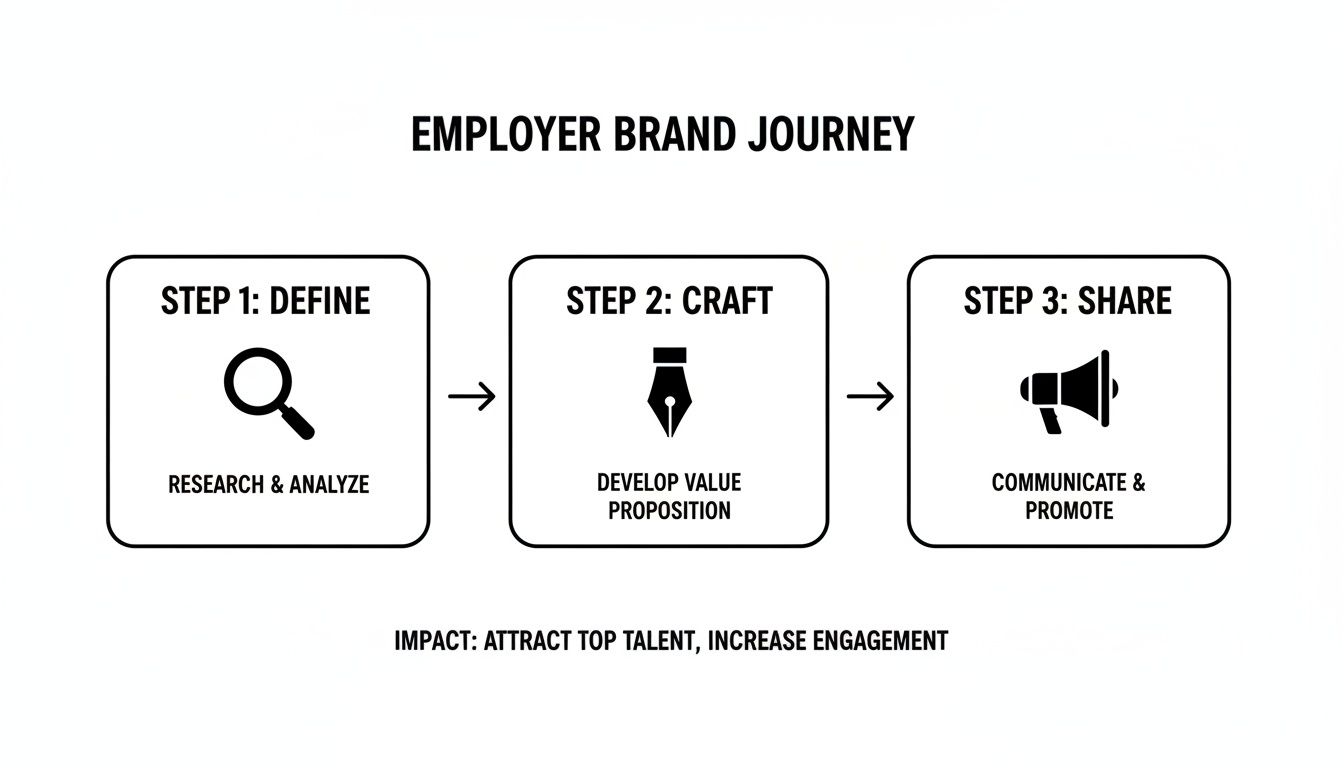
This Define, Craft, and Share flow is your roadmap. It helps you consistently turn your brand identity into compelling content that lands in front of the right people, every single time.
Matching Content to the Candidate Journey
Truly effective talent marketing meets candidates exactly where they are. Someone just hearing about your company for the first time needs a completely different message than someone who’s about to hit ‘apply’. When you map your content to the candidate’s journey, you create a far more personal and powerful experience.
Picture it as a funnel:
- Awareness Stage (Top of Funnel): At this stage, your content should be broad and engaging. The main goal is to introduce your brand, attract attention, and build familiarity. Great options here include engineer-led tech blogs, thought leadership articles from your executives, and videos that shine a light on your company’s mission and core values.
- Consideration Stage (Middle of Funnel): Now, candidates are sizing you up as a potential employer. Your content needs to give them a deeper, more authentic peek into your company culture. Think “day-in-the-life” videos, detailed career path guides, and employee testimonial blogs. These are perfect for showing what it’s really like to work with you.
- Application Stage (Bottom of Funnel): They’re on the verge of applying—you just need to reinforce their decision. Your content now must be crystal clear, persuasive, and make it easy to take the next step. This means well-crafted job descriptions, an easy-to-navigate careers page, and obvious calls-to-action that guide them through a smooth application process. You can learn more about the tools that power these efforts by exploring a modern recruitment marketing platform.
Selecting the Right Channels for Maximum Impact
Creating brilliant content is only half the battle. If no one sees it, it doesn’t matter. Getting your content in front of the right eyeballs is what actually drives results. Instead of a scattergun approach, you need to focus your energy on the platforms where your ideal candidates are most active.
A smart channel mix makes sure your message is heard loud and clear.
- Professional Networks (LinkedIn): For most professional roles, this is non-negotiable. It’s the perfect place for sharing company updates, leadership articles, and highly targeted job ads.
- Company Careers Page & Blog: This is your home turf. It should be the central hub for all your employer brand content, from in-depth articles to employee spotlights.
- Review Sites (Glassdoor): Candidates trust what their peers say. A lot. Proactively managing your presence here and encouraging current employees to share honest feedback is absolutely critical.
- Niche Online Communities: For highly specialised roles like software engineering or data science, forums like GitHub, Stack Overflow, or specific Slack communities can be goldmines for connecting with top-tier talent.
- Social Media (Instagram, X): These channels are fantastic for showcasing your company culture in a more informal, visual way. Think behind-the-scenes office tours, team event photos, and fun employee takeovers.
The most effective channel strategy isn’t about being everywhere; it’s about being in the right places consistently. Choose your platforms based on data, not just popularity, to ensure you’re reaching the talent that matters most to your organisation.
This strategic content approach is particularly vital in the Indian talent market. For instance, the 2025 Mercer Graduate Skill Index found that while 46.1% of graduates are job-ready for AI and ML roles, soft skills like critical thinking and communication are increasingly in demand. This insight points to a massive content opportunity: create stories that showcase exactly how your company develops these skills in its people, appealing directly to what the market is looking for. By delivering the right message on the right platform, you build a powerful narrative that nurtures a talent pipeline ready for your next hire.
Measuring What Matters in Talent Marketing

To really prove its worth and keep the budget flowing, your talent marketing strategy needs to be tied to clear business results. It’s all about shifting the talent function from a cost centre to a strategic partner that actually drives value. This means looking beyond old-school recruitment metrics that only tell half the story.
Sure, numbers like time-to-fill and cost-per-hire are still useful for keeping an eye on operational efficiency, but they don’t capture the full picture of your brand-building efforts. A truly data-informed approach borrows a page from the marketing playbook, focusing on analytics that track attraction, engagement, and the long-term quality of the people you bring on board.
This shift helps you show how your work isn’t just about filling roles faster, but filling them with better candidates who stick around longer and perform at a higher level.
Key Metrics for a Modern Talent Dashboard
Building a simple but powerful analytics dashboard is essential. Think of it as your real-time command centre, giving you a live view of how your strategy is performing so you can make smarter decisions on the fly. Your dashboard should feature a mix of metrics covering the entire candidate journey.
So, what should you actually be tracking? It’s not about measuring everything; it’s about measuring the right things. A well-designed dashboard tells a story, answering the crucial question: “How is our investment in talent marketing creating a stronger, more capable organisation?”
Here’s a breakdown of the KPIs that genuinely move the needle.
Essential KPIs for Your Talent Marketing Dashboard
| Metric Category | Key Performance Indicator (KPI) | What It Measures |
|---|---|---|
| Brand Awareness | Employer Brand Sentiment | The public perception of your company as a place to work, tracked via mentions and reviews on platforms like Glassdoor. |
| Engagement | Careers Page Conversion Rate | The percentage of visitors who apply for a role or join your talent network. This is a direct measure of your brand’s pull. |
| Pipeline Health | Talent Pipeline Growth | The increase in qualified, engaged candidates in your talent pool over time. A healthy pipeline means less last-minute scrambling. |
| Hiring Quality | Quality-of-Hire by Source | A game-changer. This links post-hire performance data back to the original source, showing which channels deliver top performers. |
These metrics give you a holistic view, connecting your marketing efforts directly to tangible business outcomes and empowering you to have strategic conversations with leadership, backed by solid evidence.
Using Data to Optimise Your Strategy
The real power of all this measurement lies in what you do with it. Your analytics should fuel a constant cycle of learning and improvement.
See a high bounce rate on a key job description? You know the content needs a rewrite. Is that big social media campaign getting tons of likes but no quality applications? It’s time to tweak your targeting or messaging.
By regularly reviewing these metrics, you can confidently:
- Allocate Your Budget Smarter: Justify putting more money into the channels that consistently deliver high-quality candidates.
- Refine Your Content: Figure out which messages and stories are actually hitting home with your ideal candidates.
- Improve the Candidate Experience: Spot and eliminate the frustrating roadblocks in your application process.
This analytical approach transforms talent marketing from just a series of creative campaigns into a predictable, scalable engine for attracting top performers. It elevates the entire conversation—moving you from simply filling jobs to strategically building the workforce that will drive your company’s future success.
When to Partner with an RPO for Talent Marketing
Let’s be honest: executing a sophisticated talent marketing strategy is a massive undertaking. It requires a rare mix of recruiting savvy, marketing flair, and data-driven thinking—a skill set that most in-house HR teams, understandably, don’t have on standby. This is exactly the point where bringing in a strategic partner becomes a game-changer.
Deciding to work with a Recruitment Process Outsourcing (RPO) partner isn’t about admitting defeat. Far from it. It’s a strategic move to fast-track your growth. If your team is already stretched thin, struggling to churn out consistent, engaging content, or flying blind without the right tools to measure campaign impact, that’s a clear sign you need specialised backup.
Think of an RPO as a natural extension of your team. They arrive with dedicated expertise, battle-tested frameworks, and the latest tech, allowing you to scale your talent marketing efforts immediately without the cost and complexity of building an entire marketing department from scratch.
Scaling Expertise and Resources
One of the biggest wins of engaging an RPO is getting instant access to specialised talent. A top-notch talent marketing function needs a whole crew: content creators, social media gurus, data analysts, and employer branding experts.
Hiring for each of these roles one by one is a slow, expensive process. A partnership gives you all that firepower from day one.
Think of an RPO as your talent marketing “special forces” team. They bring the precise skills, technology, and operational capacity needed to execute complex campaigns, allowing your core HR team to focus on strategic initiatives and candidate relationships.
This model is a lifesaver when you need to:
- Launch new initiatives quickly without a long ramp-up period.
- Scale hiring for rapid growth or expansion into new markets.
- Access advanced recruitment technology and analytics platforms without a major capital investment.
Driving Efficiency and Impact
A dedicated RPO partner does more than just tick boxes; they bring a strategic mindset focused on delivering results you can actually measure. Recruitment is their entire world, which means they’re constantly refining best practices and staying ahead of what’s next in the market.
They can take the entire talent marketing lifecycle off your plate, including:
- Content Creation: Developing compelling blogs, videos, and social media posts that bring your EVP to life.
- Channel Management: Running targeted campaigns on platforms like LinkedIn and Glassdoor to reach specific talent pools.
- Nurture Campaigns: Building automated email sequences to keep your talent pipeline warm and engaged.
- Analytics and Reporting: Providing clear dashboards that track key metrics and show a tangible return on investment.
By outsourcing these operational heavy lifts, you don’t just cut down on agency spending; you dramatically improve the quality and consistency of your talent attraction efforts. For a deeper dive into how this collaboration works, you can explore the various advantages of having an RPO partner to attract talent. Ultimately, this partnership frees your internal team to focus on what they do best, building a powerful hiring engine that fuels long-term business success.
Your Talent Marketing Questions Answered
Making the leap to a talent marketing model is a big move for any CHRO, and it naturally brings up some important questions. You’re shifting from the familiar rhythm of recruitment cycles to a more continuous process of building your brand and nurturing relationships. Let’s tackle some of the most common concerns head-on so you can navigate this change with confidence.
How Do We Find the Resources?
One of the first questions is always about resources. How can an already stretched HR team, busy with the day-to-day demands of hiring, suddenly become content creators and campaign managers? The secret is to start small and zero in on what makes the biggest impact.
You don’t need a fancy production studio to get started. Just empower your most passionate employees to share their own stories. A simple video testimonial shot on a smartphone or a quick blog post from a team lead about a recent project can be far more powerful and authentic than a polished corporate video.
How Do We Actually Measure the ROI?
Another big one: how do you prove the value of talent marketing to the board? Traditional metrics like time-to-fill just don’t tell the whole story. Success here needs a different lens, one that focuses on leading indicators that build long-term value for the business.
Instead of only tracking how fast you hire, start measuring what truly matters:
- Quality of Hire: This is the gold standard. Are the people you source through your talent marketing efforts performing better once they’re in the role? This directly connects your work to business outcomes.
- Talent Pipeline Growth: How many qualified, engaged candidates are in your talent community now compared to six months ago? A growing pipeline is a tangible asset, plain and simple.
- Careers Page Conversion Rate: Of the people who visit your careers page, what percentage actually take the next step, like applying or joining your talent network? This shows the magnetic pull of your brand.
Tracking these metrics proves you’re not just filling empty seats. You’re building a sustainable pipeline of high-quality professionals who are already bought into your brand before you even have a role for them.
We’re Overwhelmed. Where Do We Even Begin?
Staring at the whole strategy at once can feel daunting. The best advice is to resist the urge to do everything at once. Pick a single, high-priority pain point and start there.
For instance, if you’re constantly struggling to hire great software engineers, make that your pilot project. Create content just for them—maybe a blog series from your tech lead on the challenges they’re solving or a virtual Q&A session with the engineering team. This targeted approach lets you test what resonates, score some quick wins, and build momentum.
The goal isn’t perfection from day one. It’s about taking that first step, learning from the data, and constantly refining your approach. Authenticity will always outperform a perfectly polished but impersonal campaign.
By starting with one focused project, you can build a powerful business case for rolling out the strategy more widely. It’s an iterative process that makes the transition manageable and proves the power of talent marketing through real, tangible results.
Ready to put your talent marketing strategy into action and build a talent pipeline that gives you a competitive edge? Taggd can act as a seamless extension of your team, providing the specialised expertise needed to attract and engage top performers. Discover how our RPO solutions can transform your recruitment strategy at https://taggd.in.