Every CHRO knows the pressure: a critical role opens, the business is waiting, and the pipeline is empty. So the team posts the job, runs a campaign, and scrambles to fill the vacancy- only to find themselves in the same position three months later.
That cycle is not a sourcing problem. It is a strategy problem.
The organisations that escape this reactive loop are those that understand a fundamental distinction: the difference between talent marketing and recruitment marketing. Both are essential. Both serve the talent acquisition function. But they operate on entirely different timescales, target entirely different audiences, and are measured by entirely different standards of success.
Recruitment marketing is the tactical engine- designed to fill open roles fast by targeting active job seekers through performance-driven campaigns. Talent marketing is the strategic foundation- designed to build your employer brand, nurture passive talent, and create a self-sustaining pipeline of high-quality candidates long before any role opens.
In the simplest terms: recruitment marketing buys talent for today. Talent marketing builds the brand that earns talent for tomorrow.
For CHROs navigating India’s talent landscape- where employee attrition surged from 6% in 2020 to 20.3% in 2022 and passive talent makes up 72% of the workforce; understanding when to use each strategy, and how to integrate both, is no longer a theoretical exercise. It is the defining capability of a high-performing talent function.
This guide breaks down both disciplines in depth, compares them clearly, and gives you a practical integration roadmap that delivers results at every time horizon.
What Is Talent Marketing?
Talent marketing is the long-term, always-on practice of building your organisation’s reputation as a great place to work, nurturing relationships with potential candidates- particularly passive talent and creating a sustainable pipeline of engaged professionals who are ready to consider your opportunities when the time is right.
Unlike recruitment marketing, which is activated by a job opening, talent marketing runs continuously regardless of whether any roles are available. It is brand-first, relationship-first, and community-first. It treats potential candidates not as applicants to be converted, but as an audience to be cultivated.
The strategic logic is straightforward: if 72% of the talent market is passive- skilled professionals who are not actively looking but are open to the right opportunity- then a strategy that only targets the remaining 28% of active job seekers is, by definition, leaving the vast majority of your potential talent pool untouched.
Talent marketing is how you reach and engage that majority, building brand affinity and professional relationships over months and years so that when candidates do decide to make a move, your organisation is already on their shortlist.
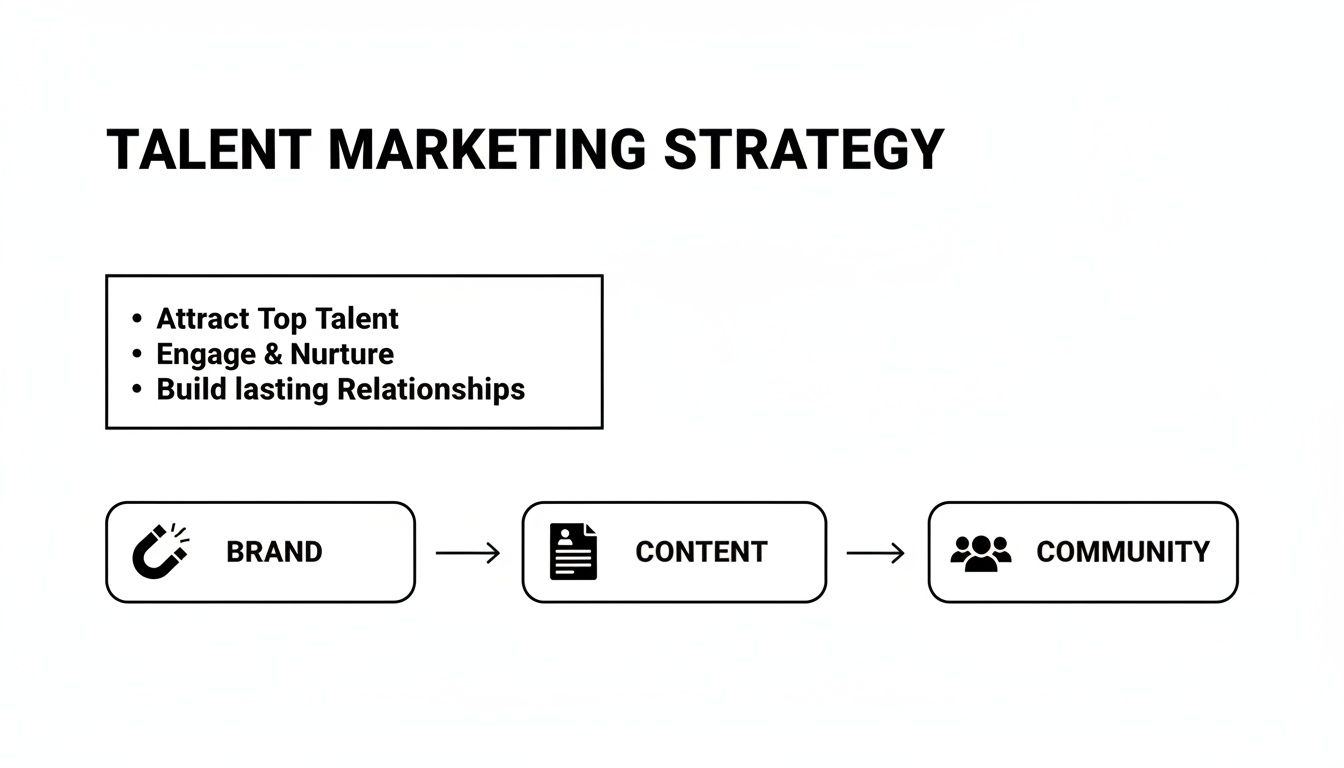
The Three Pillars of Talent Marketing
1. Employer Branding: The deliberate definition and communication of your organisation’s identity as a workplace- your culture, values, leadership, career opportunities, and why a top performer should choose to build their career with you rather than a competitor.
2. Content and Storytelling: The ongoing production of authentic, employee-led content that gives the talent market a genuine window into what it feels like to work at your organisation. This includes blog posts, day-in-the-life videos, career progression stories, and thought leadership content that positions your company as an employer worth paying attention to.
3. Talent Communities: The creation and management of engaged networks of potential candidates- via email newsletters, LinkedIn groups, professional events, or dedicated talent community platforms- where you deliver value, build relationships, and stay top-of-mind without the immediate pressure of a job application.

What Is Recruitment Marketing?
Recruitment marketing is the tactical, campaign-driven practice of attracting and converting active job seekers for specific, open roles. It applies marketing principles- targeted advertising, conversion optimisation, performance analytics- to the immediate challenge of generating a high volume of qualified applications within a defined timeframe.
Recruitment marketing is reactive by design. It is activated when a role opens and measured by how efficiently and cost-effectively it fills that role. The primary audience is candidates who are already in the job market: browsing job boards, updating CVs, and actively evaluating their next move.
This does not make it less sophisticated than talent marketing. Effective recruitment marketing requires precise audience targeting, compelling copy, optimised application flows, and rigorous performance analysis. But it operates on a different clock- weeks and months rather than months and years and answers a different question: not “How do we build our employer brand?” but “How do we fill this role, right now?”
Core Tactics in Recruitment Marketing
- Performance-based job advertising across specialised and high-traffic job boards
- Programmatic ad buying that automatically allocates budget to the best-performing channels
- Direct sourcing and proactive outreach on LinkedIn and professional databases
- Career site conversion optimisation- improving apply rates through UX, mobile experience, and chatbot assistance
- Email and SMS campaigns to re-engage candidates who started but did not complete an application
- Campus and career fair presence for early-career hiring campaigns
Talent Marketing vs Recruitment Marketing
Before diving deeper, this table captures the essential differences between the two disciplines:
| Attribute | Recruitment Marketing | Talent Marketing |
| Primary Goal | Fill open positions quickly | Build employer brand & talent pipeline |
| Audience | Active job seekers | Passive candidates + broader talent market |
| Timeline | Short-term, campaign-based (weeks/months) | Long-term, always-on (months/years) |
| Mindset | Transactional – Buy talent now | Relational – Build a talent community |
| Key Metrics | Cost-per-hire, Time-to-fill | Quality of hire, Brand sentiment, Pipeline strength |
| Primary Tools | Job boards, programmatic ads, ATS | Content, CRM, talent communities, employer brand |
| Risk of ignoring | Slow time-to-fill, high agency costs | Reactive hiring, poor quality of hire, high attrition |
The table shows just how different the underlying mindsets are. One is focused on the here and now; the other is building for the future. Understanding both and when to deploy each is what separates reactive talent functions from genuinely strategic ones.
Recruitment Marketing: The Tactical Engine for Immediate Hiring
Think of recruitment marketing as your sprint capability. It is engineered for speed, precision, and measurable ROI on a short timescale. Its singular mission is to generate qualified applicants for specific open roles—today, this week, this quarter.

For CHROs, a well-optimised recruitment marketing function is non-negotiable. Without it, time-to-fill spirals, agency dependency increases, and hiring managers lose confidence in the talent function’s ability to deliver. The good news is that modern recruitment marketing is highly measurable, continuously optimisable, and increasingly automated.
What Recruitment Marketing Does Well
- Captures active candidates who are already in the market and ready to apply
- Delivers fast, measurable results tied to specific business hiring timelines
- Enables precise budget attribution- you know exactly which channels are producing hires at what cost
- Scales efficiently for high-volume hiring events through programmatic automation
- Provides real-time performance data that can inform both immediate campaign optimisation and longer-term talent marketing strategy
The Metrics That Define Recruitment Marketing Success
Success in recruitment marketing is measured through hard, conversion-focused data. The core KPIs are:
- Time-to-Fill: Days from job requisition open to offer accepted. The lower, the better.
- Cost-per-Hire (CPH): Total marketing spend divided by hires generated. The primary ROI metric.
- Cost-per-Application (CPA): Spend per completed application, used to compare channel efficiency.
- Source of Hire: Which specific channels produced candidates who were ultimately hired.
- Apply Rate: The percentage of career site visitors who complete an application—a proxy for candidate experience quality.
Where Recruitment Marketing Alone Falls Short
The limitation of a recruitment-marketing-only approach becomes apparent in three specific situations. First, when roles are hard to fill because the active talent pool is simply too small—no amount of job board spend will generate applicants who do not exist in the active market. Second, when high attrition means you are constantly backfilling the same roles, creating an exhausting and expensive cycle of reactive hiring. Third, when your employer brand is unknown or negative, meaning campaigns reach candidates who either do not know you or have been deterred by poor reviews—leading to high CPA and low conversion.
In each of these situations, talent marketing is the answer recruitment marketing cannot provide.
Talent Marketing: The Strategic Foundation for Long-Term Talent Acquisition
If recruitment marketing is the sprint, talent marketing is the marathon that makes every future sprint faster and cheaper. It is the ongoing investment in building a brand that top professionals want to join, a community of engaged potential candidates who already know and trust your organisation, and a talent pipeline that means your next hire is never starting from zero.
Talent marketing requires patience. You will not see a 3x increase in applications in the first 30 days. What you will see, over 12 to 24 months of consistent investment, is a measurable improvement in candidate quality, a reduction in cost-per-hire, and a significant decrease in time-to-fill for roles where your pipeline has matured.
What Talent Marketing Does Well
- Reaches and engages the 72% of the talent market that is passive and invisible to recruitment marketing campaigns
- Builds brand equity that reduces ad spend costs over time- candidates who already trust you convert at higher rates and lower cost
- Creates a resilient talent pipeline that shortens future hiring timelines even for hard-to-fill roles
- Supports employee retention through internal mobility programmes that give existing talent a reason to stay and grow
- Generates authentic, employee-led content that outperforms corporate advertising in reach and credibility
Internal Talent Marketing: The Overlooked Retention Tool
One of the most underutilised applications of talent marketing is its use internally- not to attract candidates from outside, but to retain and develop the talent you already have. In the context of India’s attrition crisis, this is particularly significant.
Internal talent marketing applies the same principles of brand storytelling, community building, and career opportunity communication—but directs them at your existing workforce. It showcases internal mobility pathways, highlights upskilling programmes, and makes it easy for employees to discover new roles within the organisation before looking externally.
The evidence for this approach is compelling: organisations that have implemented talent marketplaces—dedicated platforms connecting employees with internal opportunities—report that 61% of users upskill for their current role responsibilities and 23% successfully transition to a new role internally. That is 84% of participants finding meaningful career development without leaving the organisation.
For CHROs dealing with recurring attrition in key roles, internal talent marketing can break the cycle: instead of constantly backfilling vacant positions with recruitment marketing spend, you are proactively growing and retaining the talent you already invested in.
The Metrics That Define Talent Marketing Success
Talent marketing metrics are influence-based rather than conversion-based. They measure the health of your brand and pipeline over time:
- Employer Brand Sentiment: Positive/negative ratio of mentions on Glassdoor, LinkedIn, and professional networks.
- Talent Pipeline Strength: Number of qualified, engaged candidates in your talent community CRM.
- Quality of Hire: Hiring manager ratings and 90-day performance scores of candidates sourced through talent marketing.
- Candidate Engagement Rate: Email open rates, content click-through rates, and community participation.
- Source of Influence: At hire, which brand touchpoints did the candidate engage with before applying? Often reveals talent marketing’s hidden contribution to recruitment.
How to Integrate Talent Marketing and Recruitment Marketing: A CHRO’s Roadmap
The question for most CHROs is not whether to do talent marketing or recruitment marketing. It is how to build a system where both work together- where data from your immediate hiring campaigns informs your long-term brand strategy, and a strong employer brand measurably improves the performance of your short-term hiring campaigns.
Done well, this integration creates a compounding effect: every rupee invested in talent marketing makes future recruitment marketing more efficient, and every recruitment campaign generates audience data that sharpens talent marketing targeting.
Step 1: Conduct a Full-Funnel Audit
Start with a clear baseline. Analyse your recruitment marketing performance by channel—which job boards, social platforms, and sourcing methods are producing the highest quality hires at the lowest cost? Then assess your talent marketing maturity: Do you have a defined EVP? A content programme? A talent community? What does your employer brand sentiment look like on Glassdoor and LinkedIn today?
This audit reveals both where your immediate bottlenecks are (informing recruitment marketing priorities) and where your long-term brand gaps are (informing talent marketing investment). Without this baseline, it is impossible to allocate budget intelligently or measure progress over time.
Step 2: Align HR and Marketing Teams Around a Unified Strategy
Integration is structurally impossible when HR and marketing operate as separate silos with separate goals. The most effective talent acquisition functions create a formal, cross-functional team that brings together talent acquisition, employer brand, content marketing, and people analytics. This team meets regularly, shares performance data across both recruitment and brand metrics, and makes joint decisions about campaign strategy and budget allocation.
In practice, this means marketing contributes channel expertise, design capability, and audience analytics. HR contributes candidate persona depth, EVP substance, hiring manager relationships, and funnel conversion data. Neither function has the full picture alone.
Step 3: Let Recruitment Data Feed Talent Marketing Strategy
Your recruitment marketing campaigns generate invaluable audience data that most organisations never use to inform their talent marketing. If your job descriptions mentioning flexible work arrangements receive 50% more applications than those that do not, that is not just a job ad insight- it is a signal about what your target audience values, which should directly influence your employer brand storytelling.
Build a formal process for converting recruitment marketing insights into talent marketing content briefs. High-performing job ad copy becomes the basis for employer brand messaging. The candidate questions asked most frequently in your chatbot become the topics for your next blog posts. The demographics of your highest-quality applicants define your talent community targeting strategy.
Step 4: Build Integrated KPIs That Measure the Full Talent Journey
One of the most common obstacles to integration is disconnected measurement. Recruitment marketing is measured by CPH and time-to-fill; talent marketing is measured by brand sentiment and pipeline size. Neither set of metrics tells the complete story.
Progressive organisations build integrated KPIs that connect the two disciplines:
- Brand-Influenced Hire Rate: The percentage of hires who engaged with at least one talent marketing touchpoint (blog, social content, talent community) before submitting their application through a recruitment marketing channel.
- Pipeline-to-Fill Rate: The proportion of open roles filled from the existing talent pipeline rather than cold sourcing- a direct measure of talent marketing’s contribution to recruitment efficiency.
- Cost Reduction Over Time: As brand equity grows, track whether CPH and CPA are declining year-on-year as a result of warmer inbound candidates.
Step 5: Align Budget Allocation With Business Priorities
There is no single correct budget split between talent marketing and recruitment marketing. The right allocation depends on your immediate hiring volume, brand maturity, and strategic horizon. As a general framework:
- High-volume, immediate hiring needs: Allocate 70–80% to recruitment marketing, 20–30% to talent marketing maintenance.
- Building brand in a competitive niche: Shift to 50–50 or even 40% recruitment marketing / 60% talent marketing until the pipeline matures.
- Mature brand in stable hiring conditions: Invest 40–50% in talent marketing to sustain pipeline health and further reduce future hiring costs.
Review this allocation quarterly. Business conditions change—a product launch may temporarily shift you toward recruitment marketing, while a period of stable hiring is the ideal time to invest in talent community building and employer brand content.
When to Use Each Strategy: A Scenario Guide for CHROs
Knowing the theory is one thing. Knowing which lever to pull in a given situation is what separates strategic talent leaders from tactical ones. Use this guide to match your current business challenge to the right approach:
| Business Scenario | Recommended Approach | Why |
| High-volume ramp-up (200 roles in 3 months) | Recruitment Marketing heavy (70–80%) | Speed and volume are paramount; target active candidates |
| Niche, hard-to-fill role (senior AI engineer) | Talent Marketing led | Passive talent pool; requires long-term community building |
| Reducing critical role attrition | Internal Talent Marketing | Focus on mobility, upskilling, and retention vs. backfilling |
| Entering a new market or city | Talent Marketing first | Build brand presence before jobs open to warm the pipeline |
| Scaling a known brand (tech/FMCG) | Balanced integration (50/50) | Leverage brand equity while running targeted campaigns |
| Unknown employer brand | Employer branding + Talent Marketing | Must build brand awareness before campaigns convert well |
Scenario Deep Dive 1: The High-Volume Ramp-Up
A fast-growing fintech company needs to hire 200 customer operations agents across three cities in 90 days. This is a recruitment marketing challenge. The focus must be on performance-based job advertising, rapid career site optimisation, and automated screening workflows that generate volume without sacrificing quality. Talent marketing content can support the campaign by showcasing culture and growth, but the primary investment should be in conversion-focused channels that reach candidates who are ready to apply now.
Scenario Deep Dive 2: The Hard-to-Fill Niche Role
An enterprise technology company needs to hire five Senior ML Research Scientists—a role where the total addressable talent pool is small, mostly passive, and highly sought after by every major employer in the sector. Blasting job boards will yield few results. The only viable strategy is a talent marketing approach: publishing thought leadership content that positions the company’s engineering culture and technical challenges, building a community of ML researchers through LinkedIn and technical forums, nurturing relationships over months before making any direct approach. The hire may take six to nine months, but the pipeline built in the process has lasting value for every future hire in that function.
Scenario Deep Dive 3: Solving the Attrition Cycle
A professional services firm is experiencing 22% annual attrition in its junior consulting population. Each vacancy triggers a recruitment marketing spend to backfill- a cycle that is simultaneously expensive and demoralising for the remaining team. The strategic answer is not more recruitment marketing spend. It is an internal talent marketing programme that maps clear career paths, communicates growth opportunities proactively, builds a culture of internal mobility, and reduces the resignation rate at its source. Reducing attrition from 22% to 15% in this population would likely save more than the entire talent marketing investment required to achieve it.
The Complete Metrics Framework for Talent Marketing and Recruitment Marketing
One of the most common gaps in talent acquisition functions is a metrics framework that only covers recruitment marketing efficiency while ignoring talent marketing influence. The following framework covers both:
| Metric | What It Tracks | Which Discipline |
| Cost-per-Hire (CPH) | Total spend ÷ hires made from a campaign | Recruitment Marketing |
| Time-to-Fill | Days from req open to offer accepted | Recruitment Marketing |
| Cost-per-Application (CPA) | Spend per completed application | Recruitment Marketing |
| Source of Hire | Which channels yield hired candidates | Both |
| Employer Brand Sentiment | Positive/negative mentions on Glassdoor, LinkedIn | Talent Marketing |
| Quality of Hire | Hiring manager rating of new hires at 90 days | Talent Marketing |
| Talent Pipeline Strength | No. of qualified, engaged candidates in CRM | Talent Marketing |
| Candidate Engagement Rate | Email opens, content clicks, community activity | Talent Marketing |
| Brand-Influenced Hire Rate | % of hires who engaged with brand content pre-apply | Integrated KPI |
| Pipeline Quality Score | Weighted rating of pipeline candidates by fit | Integrated KPI |
The integrated KPIs at the bottom of this table- Brand-Influenced Hire Rate and Pipeline Quality Score are the metrics that tell the full story. They quantify talent marketing’s contribution to recruitment outcomes in language that finance and executive leadership understand: cost reduction, time savings, and quality improvement.
Tools and Technology: Building Your Talent Marketing and Recruitment Marketing Stack
The technology ecosystem for both disciplines has matured significantly in 2026. The right stack depends on your organisation’s size, hiring volume, and strategic maturity- but these categories represent the core infrastructure for any integrated talent acquisition function:
| Tool Category | Examples | Primary Use |
| Programmatic Job Advertising | Joveo, Appcast, Recruitics | Automated job ad placement across boards |
| ATS + Recruitment CRM | Greenhouse, Lever, Manatal | Applicant tracking & candidate database |
| Talent Community Platform | Phenom People, Beamery, SmashFly | Nurture passive candidates via email & content |
| Employee Advocacy | EveryoneSocial, Bambu, LinkedIn Elevate | Amplify employer brand via employee networks |
| Employer Brand Analytics | LinkedIn Talent Insights, Glassdoor Analytics | Track brand sentiment & competitor benchmarking |
| Content & Video | Vouch, Loom, Canva | Create authentic employee stories at scale |
| Talent Marketplace (Internal) | RippleHire, Gloat, Fuel50 | Internal mobility, upskilling, retention |
| AI Candidate Engagement | Paradox (Olivia), Eightfold.ai | Conversational AI, automated matching & nurture |
| People Analytics | Visier, ChartHop, PeopleLogic | Workforce data, attrition prediction, ROI tracking |
Key Integration Principle
Tools only deliver value when they are connected. Your ATS should feed source-of-hire data into your people analytics platform. Your talent community CRM should pass engaged candidates into your ATS when a relevant role opens. Your employee advocacy platform should integrate with LinkedIn analytics so you can measure the employer brand impact of employee-generated content. Siloed tools with manual data transfers create both inefficiency and measurement blind spots.
For CHROs without a large dedicated TA technology team, the pragmatic approach is to start with two or three core platforms- typically an ATS, a talent community/CRM tool, and a people analytics capability and build integrations incrementally as the function matures.
The India Context: Why This Distinction Is Especially Critical for Indian CHROs
While the principles of talent marketing and recruitment marketing are universal, the Indian talent market presents a specific set of conditions that make the integration of both disciplines particularly urgent.
The Attrition Crisis
India’s employee attrition rate surged from 6% in 2020 to 20.3% in 2022- one of the steepest increases in any major economy. For CHROs, this creates a compounding problem: reactive recruitment marketing spend is required to backfill departures, but that spend addresses the symptom (the vacancy) rather than the cause (why talent is leaving). Talent marketing- particularly internal talent marketing focused on career pathways, mobility, and EVP communication- addresses the retention problem at its root, reducing the volume of vacancies that require recruitment marketing response.
The Passive Talent Majority
With 72% of India’s workforce classified as passive talent, organisations that rely exclusively on recruitment marketing are, by definition, competing only for the remaining 28% of active candidates. In high-demand functional areas- technology, data science, digital marketing, senior leadership- the competition for that active minority is intense, driving up CPH and reducing candidate quality. Talent marketing is the mechanism for accessing the passive majority, differentiating your employer brand in a crowded market, and building relationships with professionals before your competitors even know they are available.
The Talent Marketplace Opportunity
Research from RippleHire and other Indian talent technology providers highlights a specific opportunity: organisations that implement internal talent marketplaces- platforms that surface internal opportunities, skills development pathways, and lateral moves to existing employees- see measurable improvements in both retention and internal hire rates. In a market where external hiring costs are rising and attrition is high, the ROI on internal talent marketing investment can be faster and larger than equivalent investment in external recruitment marketing.
The Data Analytics Imperative
73% of Indian talent leaders are now investing in people analytics- a recognition that data-driven decision-making is no longer optional in a market of this complexity and competitiveness. The integration of talent marketing and recruitment marketing metrics- moving beyond CPH and time-to-fill to include brand sentiment, pipeline quality, and brand-influenced hire rate is the next frontier for Indian talent functions that want to demonstrate strategic value to their boards.

FAQs
What is the main difference between talent marketing and recruitment marketing?
Recruitment marketing is a short-term, campaign-driven strategy focused on filling specific open roles by targeting active job seekers through performance-based advertising and direct sourcing.
Talent marketing is a long-term, always-on strategy focused on building your employer brand, engaging passive candidates, and creating a sustainable talent pipeline before roles open. Recruitment marketing buys talent for today; talent marketing builds the brand that earns talent for tomorrow.
Which is more important: talent marketing or recruitment marketing?
Neither is more important in isolation- both are essential components of a complete talent acquisition strategy. Recruitment marketing delivers the short-term results needed to meet immediate business hiring demands. Talent marketing builds the brand and pipeline that makes future recruitment marketing more efficient and less expensive. The organisations that perform best over time are those that invest in both simultaneously, with budget allocation adjusted based on their current hiring priorities and brand maturity.
How should CHROs split their budget between talent marketing and recruitment marketing?
There is no universal formula, but a practical starting framework: if immediate hiring volume is high, allocate 70–80% to recruitment marketing and 20–30% to talent marketing. If the priority is building a pipeline for hard-to-fill roles or improving employer brand sentiment, shift to a 50–50 or 40/60 split in favour of talent marketing. Review the allocation quarterly and adjust based on hiring outcomes and brand sentiment data. As talent marketing investment matures and pipeline quality improves, recruitment marketing costs typically decline- creating budget that can be reinvested in further talent marketing.
How do you measure the ROI of talent marketing?
Talent marketing ROI is measured through leading indicators that show brand growth and pipeline health, connected to lagging indicators that show their impact on hiring outcomes. Key metrics include employer brand sentiment trends (positive mentions on Glassdoor and LinkedIn), talent pipeline strength (number of qualified candidates in your CRM), quality of hire scores for pipeline-sourced candidates, brand-influenced hire rate (percentage of hires who engaged with brand content before applying), and year-on-year changes in cost-per-hire as brand equity grows. The most powerful ROI case is a demonstrated reduction in CPH and time-to-fill over 12 to 24 months attributable to stronger brand presence and a larger pre-qualified pipeline.
What is an example of talent marketing in practice?
A technology company struggling to hire senior data scientists publishes a monthly technical blog authored by its own data science team, showcasing the complexity of the problems they solve and the quality of the team environment. They build a LinkedIn community of 2,000 data science professionals over 18 months, sharing content and engaging in technical conversations. When a senior role opens, rather than starting a cold sourcing campaign, they post to this community- and fill the role from a warm, already-engaged candidate within four weeks at a cost-per-hire significantly below their previous average. The talent marketing investment built the pipeline; the recruitment marketing activity converted it.
How does talent marketing help with employee retention?
Internal talent marketing- applying the same principles of content, community, and career opportunity communication to your existing workforce directly reduces attrition by making career development opportunities visible and accessible. When employees can clearly see growth pathways, find internal mobility opportunities through a talent marketplace, and feel genuinely connected to their organisation’s mission, the primary reasons for leaving (lack of growth, lack of visibility, feeling undervalued) are addressed proactively. Organisations using internal talent marketplaces report 61% of employees upskilling for broader responsibilities and 23% successfully transitioning to new internal roles reducing the recruitment marketing spend required to replace them.
What tools do I need to start talent marketing?
You do not need a full enterprise technology stack to begin. The minimum viable talent marketing toolkit includes: a talent community CRM or email platform to nurture candidate relationships (Beamery, Phenom People, or even a well-configured HubSpot), a content publishing capability (LinkedIn company page and a career blog), and an analytics dashboard to track brand sentiment and engagement. From this foundation, you can add employee advocacy tools, a talent marketplace platform, and deeper people analytics as the function matures and the investment case becomes clear.
Curious about more HR buzzwords like privilege leave, casual leave, leave encashment, relieving letter, resignation letter or more? Dive into our HR Glossary and get clear definitions of the terms that drive modern HR.
Explore Taggd for RPO solutions.