Tech team scaling solutions are more than just a hiring plan; they’re a strategic framework for expanding your technology workforce with the right mix of speed, cost-efficiency, and quality. This means moving beyond reactive hiring and proactively designing a talent ecosystem that blends your core in-house team with external partners like RPO providers, contractors, or global teams, to hit your business goals.
Why Your Old Hiring Playbook No Longer Works

As a CHRO, you’re on the front lines of a talent war where yesterday’s recruitment tactics just don’t cut it anymore. The challenge has shifted from simply filling open roles to scaling your entire technology function with precision and financial discipline. Your traditional, linear hiring models are struggling to keep up.
The problem is, those legacy methods were built for a much more predictable world. They break down when faced with the rapid product cycles, intense competition for niche skills, and volatile market demands that define today’s tech sector.
The Modern Scaling Dilemma
Your organisation’s success now depends on solving a critical trilemma: finding the right balance between speed, cost, and quality. If you lean too heavily on one, the other two inevitably suffer. Hire too fast, and quality drops. Squeeze the budget too hard, and you lose top talent to competitors who are ready to pay. This is exactly where modern tech team scaling solutions make their entrance.
The goal is to evolve your talent function from a rigid construction crew, building one floor at a time, to a dynamic special operations team. This new model allows you to deploy specialised units on demand, adapt to any project’s scope, and achieve objectives with surgical precision.
This shift demands a move from simply filling jobs to architecting a flexible talent ecosystem. The explosive growth in technology services highlights just how urgent this is. For instance, India’s tech industry is projected to hit $315 billion in revenue by FY26, a clear signal of the relentless demand for talent. You can discover more insights on how this expansion impacts hiring strategies and the adoption of AI at scale.
This guide provides a strategic snapshot of the primary scaling models. Before we dive deep into each one, the table below gives you a high-level comparison to get you thinking about which approach or blend of approaches is the best fit for your company’s goals.
A Quick Comparison of Tech Team Scaling Models
This table offers a strategic overview of the four primary models for scaling tech teams, compared across key factors crucial for CHRO decision-making.
| Scaling Model | Best Suited For | Level of Control | Speed to Implement | Cost Dynamics |
|---|---|---|---|---|
| In-House Hiring | Building core intellectual property and long-term culture. | High | Slow | High initial investment, lower long-term cost. |
| RPO | Rapid, high-volume hiring and scaling the core team. | High (Collaborative) | Moderate to Fast | Variable, based on volume and scope. |
| Contractors/Managed Services | Specific, project-based needs with specialised skills. | Medium | Fast | High short-term cost, no long-term overhead. |
| Nearshore/Offshore | Accessing global talent pools and cost optimisation. | Low to Medium | Moderate | Lower operational and salary costs. |
Each of these models offers a unique set of trade-offs. The real magic happens when you learn how to combine them, creating a hybrid approach that gives your organisation the ultimate flexibility to scale up or down as needed.
Choosing Your Tech Team Scaling Model
Picking the right model to scale your tech team is a lot like deciding on the architectural blueprint for your company’s future. Get this decision right, and you build on solid ground. A misstep here, however, can create foundational cracks that become a real headache to fix down the line.
This choice dictates almost everything that follows, from your budget and speed-to-market to the very DNA of your company culture. To make the right call, you need to understand the strategic trade-offs of each framework. There are four main models for expanding your tech workforce, and each has its own place. Let’s break them down so you can figure out which one, or which blend, truly aligns with your goals.
In-House Hiring The Bedrock of Your Culture
In-house hiring is the traditional path, and for good reason. It’s about directly recruiting full-time employees who become permanent fixtures in your organisation. Think of it as building your own professional kitchen from the ground up. It’s a serious upfront investment, but it gives you total control over every detail and helps you build a lasting identity.
This model is your best bet for:
- Developing core intellectual property that gives you a long-term competitive edge.
- Building a strong, unified organisational culture and growing future leaders from within.
- Roles that demand deep institutional knowledge and long-term commitment.
While this approach gives you maximum control and cultural alignment, it’s also the slowest and often most expensive way to get started. The recruitment cycle for specialised tech talent can drag on, and the overheads quickly add up, salaries, benefits, training, and infrastructure.
Recruitment Process Outsourcing For Accelerated Growth
Recruitment Process Outsourcing (RPO) is a strategic partnership where you hand over all or part of your permanent hiring function to an outside expert. Imagine hiring a master chef and their entire team to design, staff, and run your kitchen for you. They bring specialised expertise, proven processes, and a vast talent network to build your core team quickly, but to your exact specifications.
An RPO model is the perfect fit when you need to:
- Scale your permanent workforce fast for a new project or market expansion.
- Improve recruitment quality and efficiency without building a huge internal talent acquisition team.
- Tap into a broader, pre-vetted talent pool and take advantage of advanced sourcing tech.
RPO partners work as a true extension of your HR team. They embed themselves in your culture to make sure new hires aren’t just a technical match, but a strong cultural one, too. You get the scalability of an external partner with the quality focus of an internal team.
Contractors and Managed Services For Surgical Precision
Bringing in contractors or a managed service offers a flexible, project-based solution. This is like hiring a specialist caterer for a specific event, like bringing in a molecular gastronomy expert for a single VIP dinner. You get targeted expertise for a defined period to get a specific job done, without the long-term commitment of a full-time hire.
Managed services take this a step further. You outsource an entire function or project outcome to a third-party team that manages itself to deliver the result.
This approach offers unparalleled speed and access to niche skills, making it perfect for plugging immediate gaps or executing on projects that require specialised knowledge your current team lacks. However, it can be more costly on an hourly basis and requires careful management to ensure integration with your existing teams.
Nearshore and Offshore Teams For Global Talent and Cost Efficiency
Nearshoring (partnering with teams in nearby countries) and offshoring (in more distant ones) unlock access to global talent pools and can offer major cost advantages. This is like sourcing rare, high-quality ingredients from around the world to create a unique and cost-effective menu. You get access to skills that might be scarce or too expensive in your local market.
These models are powerful for:
- Cost optimisation, as salaries and operational expenses are often significantly lower in other regions.
- Accessing a vast, diverse talent pool, especially for popular technologies.
- Achieving 24/7 productivity by making different time zones work for you.
While this is an attractive option, it demands robust communication plans, cultural awareness, and strong project governance to overcome the challenges that come with time zones and distance. For a deeper analysis of how to balance these different approaches, you might find it useful to read more about various variable hiring models for scaling businesses.
Ultimately, the most resilient tech team scaling solutions often involve a hybrid strategy, artfully blending these models to match your organisation’s evolving needs.
Right, you’ve picked a scaling model. But making a choice is just the starting line. A successful scale-up needs more than a decision, it needs a meticulously planned, actionable roadmap.
This roadmap is what turns your big idea for scaling your tech team into a concrete project. It’s the difference between merely hoping for growth and engineering it with real precision.
Think of it as the blueprint for your company’s new high-performance hiring engine. You wouldn’t start building a skyscraper without detailed architectural plans, so you shouldn’t try scaling your tech team without a clear, phased approach. This plan gets every stakeholder on the same page, makes every action deliberate, and ensures every outcome can be measured. Let’s walk through the essential stages.
Stage 1: Conduct a Comprehensive Workforce Audit
Before you can build for the future, you have to get an honest look at where you stand today. The first move is a deep-dive workforce audit. This isn’t just about a headcount; it’s about mapping your current talent landscape against your future business goals.
This audit needs to answer some critical questions:
- Current Skills Inventory: What technical capabilities do we have right now, and where are the most glaring gaps?
- Performance Benchmarks: Who are our top performers, and what makes them successful in our culture? What are the common threads?
- Future Needs Projection: Looking at the product pipeline and business goals for the next 12-24 months, what new roles and skills will be absolutely essential?
This analysis gives you a stark, clear picture of the talent you have versus the talent you need. For instance, if your company plans to launch an AI-driven product, your audit should pinpoint the gap between your current data science capabilities and what’s required to actually deliver. This insight is the foundation for every other scaling decision you’ll make.
Stage 2: Define Success and Secure Executive Buy-In
With your audit done, the next job is to define what success actually looks like. These aren’t just fluffy HR metrics; they have to be business-centric key performance indicators (KPIs) that will get the attention of the C-suite. Vague goals like “hiring faster” just won’t cut it.
Instead, you need to define concrete, measurable objectives like:
- “Reduce time-to-productivity for new software engineers by 25%.”
- “Increase the percentage of new hires who meet performance targets in their first year to 90%.”
- “Achieve a 15% reduction in cost-per-hire for senior developers by partnering with an RPO.”
Once you have these metrics nailed down, it’s time to secure executive buy-in. Frame your proposal in the language of business outcomes, cost savings, faster time-to-market, and reduced risk. Show them exactly how this strategic scaling plan enables the company’s growth targets, turning HR from a cost centre into a strategic partner. An in-depth look at optimising IT workforce planning through RPO solutions can give you even more data to build a rock-solid business case.
Stage 3: Run a Pilot Programme
Before you commit to a full-scale, company-wide rollout, it’s always smart to run a pilot programme first. A pilot is your controlled test environment. It lets you validate your chosen scaling model and iron out any kinks on a smaller, lower-risk scale. This is your chance to pressure-test your assumptions before making a major investment.
A pilot programme is like a “soft launch” for your hiring strategy. It allows you to gather real-world data, refine your processes, and prove the model’s effectiveness with a small, dedicated project or team.
For example, if you’re thinking about an offshore model, start by outsourcing a single, non-critical project to a small offshore team. This lets you test everything from communication protocols and workflow integrations to quality standards.
The lessons you’ll learn from this pilot are invaluable. They provide the hard data and confidence you need to scale your efforts successfully across the entire organisation. This methodical approach ensures your large-scale implementation is built on proven success, not just theory.
Weaving AI into Your Scaling Engine
Scaling your tech team effectively isn’t just about human hustle anymore. The real game-changer today is creating a smart partnership between your people and technology, specifically, artificial intelligence. The goal is to build a high-velocity talent function where technology does the heavy lifting, freeing your team to focus on the human side of hiring.
This “Human + AI” model isn’t about replacing recruiters. It’s about giving them superpowers. Imagine your sourcing team manually digging through thousands of profiles for a niche developer role. It’s slow, tedious, and often riddled with unconscious bias. AI platforms, on the other hand, can analyse millions of data points in minutes, turning a week’s worth of sourcing into a single day’s work.
By integrating AI, you shift scaling from a reactive, manual headache to a predictable, data-driven system. This lets your human experts do what they do best: building relationships, gauging cultural fit, and delivering an unbeatable candidate experience.
Automating the Top of the Funnel
The biggest bottleneck in hiring is almost always at the very beginning, finding and engaging people who are actually qualified. This is where AI makes its most immediate and powerful impact. Modern sourcing tools can completely automate the repetitive, time-consuming tasks that tie up your recruiters’ day.
These platforms can:
- Proactively find passive talent who aren’t even looking but are a perfect match for your open roles.
- Automate the first outreach with personalised messages that warm up candidates before a recruiter ever steps in.
- Screen and score incoming applications against your job criteria, instantly creating a shortlist of the most promising people.
When you automate this top-of-funnel activity, you ensure a consistent, high-quality pipeline of talent is always flowing. This frees up your recruiters to pour their energy into the high-value work of interviewing and closing the best candidates. To dig deeper into this, you can learn more about the role of AI in recruitment and its benefits.
The roadmap below shows a straightforward, three-step process for piloting these kinds of tech-driven strategies in your own organisation.
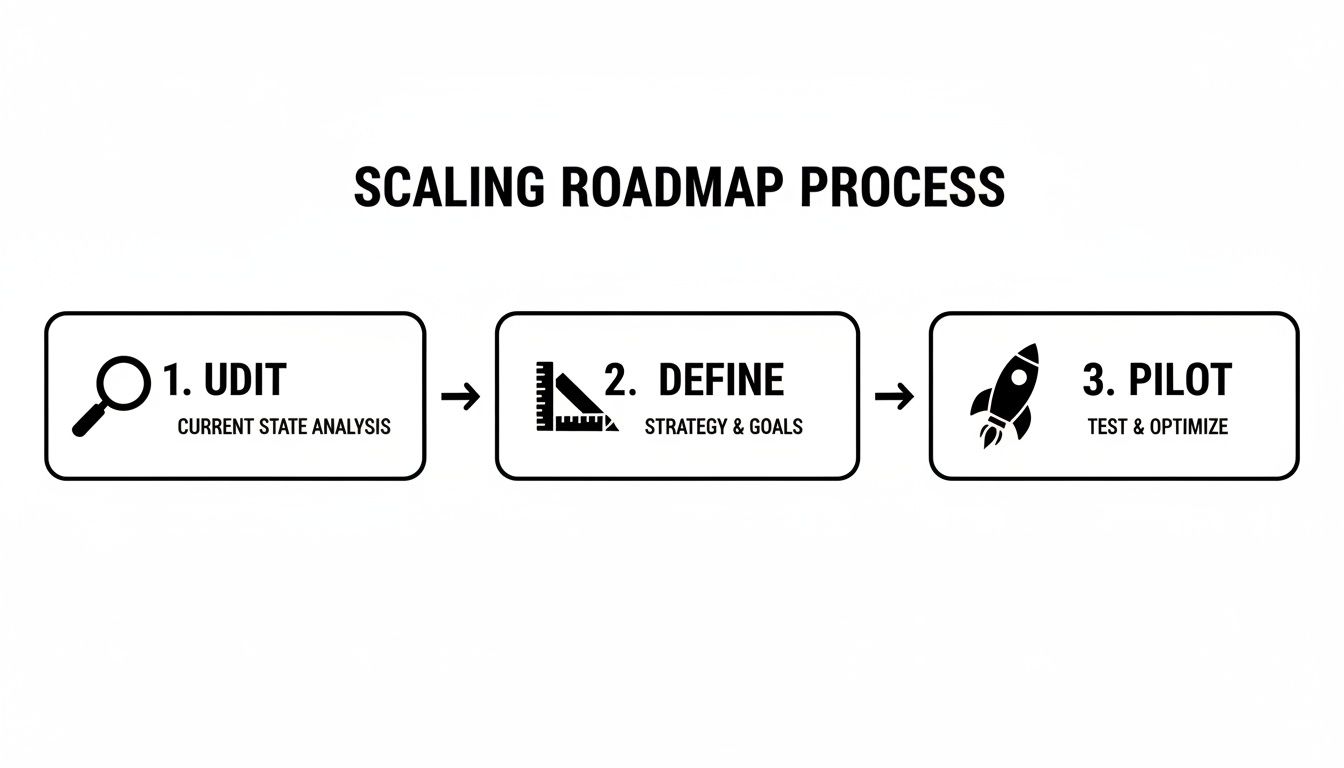
This simple flow, auditing what you do now, defining clear goals, and running a small-scale pilot, is the key to successfully bringing any new technology into your workflow.
The Power of a Centralised Tech Stack
While AI sourcing on its own is a huge help, you unlock its real power when it’s part of a centralised technology stack. At the very heart of this is your Applicant Tracking System (ATS). A modern ATS needs to be the single source of truth for every piece of hiring activity.
Beyond just the ATS, collaborative hiring tools and real-time data dashboards are simply non-negotiable today. These tools make sure everyone involved, from recruiters to hiring managers, is on the same page. They give you full visibility into every stage of the pipeline, which allows for real-time performance tracking and truly data-driven decisions.
This move toward ‘Human + AI’ teams is already well underway. India’s technology industry, for instance, added 1.35 lakh new employees in FY26, bringing its total workforce to 5.9 million. At the very same time, the sector was heavily investing in building up its AI capabilities.
This dual focus on both hiring people and building AI proves that top organisations are augmenting their teams with technology, not replacing them. Despite the headlines about automation, the industry actually saw a net positive hiring growth of 2.3%. This shows a clear trend toward building collaborative ‘Human + AI’ workforces, and you can read the full research about these IT industry trends and what they mean for workforce strategy. For CHROs, this is a critical turning point, proving that the future lies in smartly combining human expertise with technological muscle.
To get a real handle on scaling your tech team, you have to look past the vanity metrics. You know the ones, they look great on a dashboard but tell you almost nothing about the actual impact on the business. Peter Drucker’s famous line, “If you can’t measure it, you can’t manage it,” has never been more relevant. The goal here is to shift from being a reactive fire-fighter to a proactive workforce architect, and that demands a completely new set of strategic Key Performance Indicators (KPIs).
Sure, traditional metrics like time-to-hire are still part of the picture, but they don’t tell the whole story. A fast hire who underperforms or walks out the door within a year isn’t a win; it’s a net loss. What the C-suite really wants to see is how your talent strategy is directly fuelling business outcomes. That means focusing on metrics that measure genuine value.
Beyond Time-to-Hire: Key Strategic Metrics
To get a true measure of your scaling success, you need to track indicators that reflect quality, agility, and financial efficiency. These are the numbers that get your CEO and CFO to lean in, turning your HR function into a recognised driver of growth.
Start by prioritising these three core KPIs:
- Quality-of-Hire: This is the ultimate test of your recruitment efforts. You can track it by correlating new hire performance reviews at the six and twelve-month marks with their hiring source. When you see high retention rates among your top performers, that’s a powerful signal your scaling model is hitting the mark.
- Hiring Velocity: This metric isn’t just about speed; it’s about agility. It measures your talent function’s capacity to rapidly scale hiring efforts up and down in response to business needs, all without sacrificing quality. High velocity means you can staff a critical new project team in weeks, not months.
- Cost-per-Quality-Hire: This is a much sharper version of the old cost-per-hire metric. Instead of just tracking the total cost, you break it down by your chosen scaling model (in-house, RPO, offshore) and tie it directly to the performance of those hires. This finally reveals the true ROI of each channel.
By focusing on these metrics, the conversations you have with leadership become far more meaningful. You can clearly draw a line from an investment in a specific scaling solution to a more productive and stable engineering team.
Architecting Your Future Workforce
Armed with the right data, you can finally move from a reactive hiring cycle to strategic workforce planning. This isn’t about guesswork; it’s about using data to forecast your talent needs with real accuracy. This is what allows you to stay one step ahead of business demands, ensuring you have the right people ready at precisely the right time.
Think of strategic workforce planning as the difference between being the fire-fighter, constantly scrambling to put out hiring fires, and being the architect, designing a fire-resistant building from the ground up. One is a constant struggle; the other is a state of preparedness.
The process involves using predictive analytics to connect your business pipeline directly to your talent strategy. For instance, if the sales team projects a 30% increase in enterprise client contracts over the next year, workforce planning helps you calculate exactly how many more cloud engineers and cybersecurity specialists you’ll need, and when.
This data-first approach empowers you to make informed decisions about which scaling model to activate. You might realise that your core needs can be met with in-house hiring, but you’ll need to engage an RPO partner to quickly build a new team for an upcoming product launch. This proactive stance ensures your talent pipeline is always aligned with your company’s growth trajectory, making your tech team scaling solutions a powerful competitive advantage.
Protecting Your Culture During Rapid Growth

Scaling your tech team at lightning speed is the goal, but moving too fast without the right guardrails can do some serious damage. Hit the accelerator too hard, and you risk diluting the very culture that made you successful, watching quality slip, and burning out your best people. The unique spirit of your company can get completely lost in the shuffle of new faces.
Protecting that core identity isn’t just a “nice-to-have”; it’s a strategic move for long-term survival. The real challenge is keeping your culture intact while bringing on a flood of new people, whether they’re direct hires, talent from an RPO partner, or part of a global team. This requires a deliberate, heads-up approach.
Instilling Your Company DNA from Day One
A strong culture doesn’t just happen. You have to intentionally weave it into every single part of the employee journey, and that starts with a brilliant onboarding programme. This is your first and best shot at immersing new team members in your company’s mission, values, and unique ways of getting things done.
Think of your onboarding as a cultural deep dive, not just a mountain of paperwork. It should be a carefully structured experience designed to get across:
- Your Core Values in Action: Don’t just flash your values on a slide. Show new hires how those principles translate into real-world behaviours and decisions within the engineering team.
- The “Why” Behind the Work: Connect their specific role to the company’s bigger picture. Help them see exactly how their code or project directly impacts your customers and business goals.
- Unwritten Rules and Norms: Share the subtle stuff, how teams actually collaborate, the right way to give feedback, and how you celebrate wins together.
A solid onboarding programme makes sure every new hire, no matter how they were sourced, understands and starts contributing to your culture from their very first day.
Your culture is the operating system for your organisation. During rapid scaling, a weak culture leads to fragmentation and inefficiency, while a strong one acts as the glue that holds distributed and diverse teams together, ensuring everyone is working toward a shared vision.
Fostering Unity Across Distributed Teams
As your team spreads out, especially across different locations or with external partners, keeping that sense of a shared identity gets a lot harder. You can’t rely on hallway conversations to keep everyone on the same page anymore. Instead, you have to build clear communication rhythms and use technology to close the distance.
This means creating intentional points of connection:
- Regular All-Hands Meetings: Use video conferencing to pull everyone together. Share business updates, celebrate successes, and make everyone feel like part of one unified team.
- Dedicated Communication Channels: Set up specific channels in tools like Slack or Microsoft Teams for non-work chats to help build personal bonds and camaraderie.
- Virtual Team-Building Activities: Organise online events, from virtual coffee breaks to collaborative online games, to foster a real sense of community.
These practices are vital parts of modern tech team scaling solutions, making sure that distance doesn’t create a disconnect. By actively managing these cultural touchpoints, you can scale your workforce with confidence, knowing you’re protecting the very heart of your organisation.
Of course. Here is the rewritten section, crafted to sound completely human-written and natural, following the provided style guide and examples.
Answering Your Top Scaling Questions
As you start to put your company’s growth plans into motion, a few practical questions are bound to pop up. When you’re juggling modern tech team scaling solutions, there are a lot of moving parts, and we’ve found that CHROs often run into the same handful of concerns. Let’s tackle some of the most pressing ones with direct, no-nonsense answers.
How Can We Mix Different Scaling Models?
Combining different scaling models, what many call a hybrid approach, isn’t just possible; for any mature organisation, it’s practically essential. Think of it like a well-balanced investment portfolio. You wouldn’t put all your money into a single stock, so you shouldn’t bet your company’s future on just one hiring model.
A strategy we see work time and time again is to keep a core in-house team focused on your primary intellectual property and keeping your cultural DNA intact. You can then bring in an RPO partner to quickly and efficiently scale that core team during big growth spurts. At the same time, you might bring on contractors for highly specialised, short-term projects that demand niche skills your core team doesn’t have. This creates a smart, three-layered approach to talent.
The real secret is to map the right solution to the right business need. Use your in-house team for long-term value, an RPO for scalable growth, and contractors for surgical precision. This creates a talent ecosystem that’s both resilient and cost-effective.
What Is the Biggest Mistake to Avoid?
Without a doubt, the single biggest mistake is scaling without a rock-solid plan to protect your company culture. Too many leaders get so fixated on hitting headcount targets that they completely neglect the very thing that made their company a great place to work. Onboarding turns into a rushed checklist, and new team members, especially those from offshore or managed services partners, end up feeling disconnected and out of the loop.
This one oversight inevitably leads to:
- A drop in the quality of work as that crucial team cohesion starts to break down.
- Higher employee turnover, affecting both your new hires and your loyal, tenured staff.
- A diluted sense of purpose and a fragmented, disjointed company identity.
Before you even think about hitting the hiring accelerator, nail down your cultural onboarding process. Define your non-negotiable values and create communication rhythms that intentionally pull in every single team member, no matter what their employment model is. Always put culture first; it’s the glue that holds everything together when you’re growing fast.
Ready to build a resilient, scalable tech team without sacrificing quality or culture? Taggd‘s AI-powered RPO solutions provide the strategic partnership you need to hire top talent faster and more efficiently. Learn how we can help you build your future workforce today.