Top Skills in Demand for 2026: The job market in 2026 is being shaped by one clear force: skills are the new currency of career success. As industries accelerate their digital adoption, companies are no longer hiring just for experience. They’re hiring for future-ready capabilities that drive innovation and resilience.
According to Taggd’s India Decoding Jobs Report 2026, demand for advanced digital skills has surged by 42% year-on-year, with employers prioritizing talent proficient in AI, GenAI, data analytics, cloud engineering, cybersecurity, and automation. The report highlights that sectors such as IT & ITeS, BFSI, GCCs, Manufacturing, Healthcare, and E-commerce are rigorously building AI-first talent pipelines to stay competitive.
With AI and GenAI skills alone seeing a 3X rise in job postings, the talent landscape is undergoing a massive shift. Professionals who invest in upskilling today are expected to command 20–35% higher salaries and unlock new high-income career paths across domains like product management, data science, digital marketing, and intelligent automation.
In this guide, we break down the top skills in demand for 2026, why they matter, and how you can prepare yourself for high-income success in a rapidly evolving world of work.
Why Skills Matter More Than Ever
Here’s a reality check: job disruption will equate to 22% of jobs by 2030, with 170 million new roles set to be created and 92 million displaced, according to the World Economic Forum’s Future of Jobs Report 2025. But here’s the silver lining- this transformation is creating a net increase of 78 million jobs globally.
For India specifically, the story is even more exciting. The IT sector alone is projected to reach $26.73 billion in 2024, with an annual growth rate of 10.49% through 2029. What does this mean for you? Simple: the right high-income skills can be your ticket to financial freedom and career stability.
The Hard Truth About the Skills Gap
Before we dive into the top skills in demand in 2026, it’s important to understand why these skills matter more than ever. The pace of change in the workplace is no longer incremental, it’s exponential. Studies show that nearly 40% of skills required in most jobs will change by 2026, and 63% of employers already cite the widening skills gap as their biggest hiring barrier.
Industry data only reinforces this urgency. NASSCOM reports that India will require 1 million cybersecurity professionals by 2025, driven by rising cyber threats, AI-powered attacks, and massive digital transformation across sectoINR At the same time, India’s cloud talent pool is projected to grow 2.4X to nearly 1.5 million by 2025, supported by a steady 24% CAGR– yet demand still outpaces supply.
Add to this the growing push for AI and automation talent, as highlighted in Taggd’s India Decoding Jobs Report 2026, where skills in AI, GenAI, data engineering, cloud, and cybersecurity top employer priority lists across IT, BFSI, GCCs, manufacturing, and consumer tech. The message is clear: companies aren’t just looking for talent- they’re competing for it.
In simple terms, if you invest time in building the top skills in demand in 2026, you’re not just future proofing your career. You’re placing yourself in a seller’s market, where skilled professionals negotiate better roles, better pay, and better opportunities- because the demand far exceeds the supply.
The Top 15 High Demand Skills for 2026 and Beyond
The top 15 high-demand skills for 2026 and beyond include a mix of tech, business, and human skills: AI, GenAI, machine learning, data analytics, cloud computing, cybersecurity, DevOps, product management, digital marketing, UI/UX design, automation, blockchain, project management, communication, and critical thinking.
These skills are highly valued across IT, BFSI, manufacturing, GCCs, healthcare, and e-commerce, making them essential for future-ready and high-income careeINR
1. Artificial Intelligence and Machine Learning
AI isn’t coming- it’s already here. From ChatGPT revolutionizing how we work to AI-powered recommendations shaping what we buy, artificial intelligence is transforming every industry imaginable.
Salary Potential: Starting an artificial intelligence job as a fresher can fetch candidates salaries between INR 6 LPA and INR 12 LPA on average, while engineers with more than 6-10 years of experience can earn up to INR 25 LPA. Top earners? We’re talking INR 43 lakhs per year for experienced AI/ML engineer.
Industries Hiring:
- Finance: AI algorithms analyze market trends and automate trading
- Healthcare: Faster diagnosis, personalized treatment plans, and drug discovery
- E-commerce: Recommendation systems and personalized shopping experiences
- Manufacturing: Quality control and predictive maintenance
Real-World Impact: 80% of companies adopting AI and ML have reported increased operational efficiency and enhanced customer experiences.
Skills to Master:
- Python, R, TensorFlow, PyTorch
- Deep learning and neural networks
- Natural Language Processing (NLP)
- Computer vision
- Generative AI and Large Language Models (LLMs)
2. Data Science and Analytics
Every company today drowns in data but thirsts for insights. Data scientists are the translators who turn raw numbers into million-dollar decisions.
Taggd’s India Decoding Jobs Report 2026 highlights a sharp rise in demand for sata science and analytics talent, especially in sectors undergoing rapid digitization.
In core industries like mining, refining, and power, automation and data analytics are reshaping operations. Smart systems are cutting manual work and increasing the need for engineers, AI specialists, digital twins experts, and predictive maintenance professionals who can interpret sensor data and prevent costly downtime.
The shift toward “smart factories”, particularly in defense manufacturing is driven by Industry 4.0 technologies such as industrial IoT, robotics, and advanced automation. As a result, companies are aggressively hiring data engineers, systems integrators, process automation specialists, and industrial AI experts to keep these connected ecosystems running efficiently.
Even the fast-growing semiconductor sector is witnessing a surge in demand for AI/ML engineers, chip design specialists, data scientists, and cybersecurity professionals, as India ramps up its semiconductor fabrication and design capabilities.
In short, data is no longer just an asset, it’s the core of every strategic decision. And professionals who can convert massive datasets into intelligent, actionable insights are among the most in-demand, future-proof, and high-income talent pools for 2026 and beyond.
Salary Potential: India’s data analytics industry is set to hit $118.7 billion by 2026. Data scientists with AI skills earn an average of INR 13.3 LPA, with experienced professionals commanding between INR 12-28 LPA.
Industries Hiring:
- Retail: Customer behavior analysis and inventory optimization
- Banking: Fraud detection and risk assessment
- Healthcare: Patient outcome predictions
- Marketing: Campaign performance and ROI tracking
Essential Tools:
- SQL, Python, R
- Tableau, Power BI for visualization
- Excel (advanced functions)
- Statistical modeling
- Hadoop, Apache Spark for big data
Pro Tip: NASSCOM predicts a 300% surge in demand for data scientists between 2022 and 2030.
3. Cloud Computing
Cloud computing is the infrastructure powering India’s fastest-growing industries, from telecom and DeepTech to biotechnology and healthcare. Taggd’s India Decoding Jobs Report 2026 highlights cloud skills as one of the top skills in demand in 2026, driven by massive investments in digital transformation.
In biotechnology, the rise of AI-powered R&D is creating sharp demand for computational biology engineers, AI-driven drug discovery leads, and bioinformatics specialists. These roles rely heavily on cloud platforms to manage massive genomics datasets, run large-scale predictive models, and build automated R&D pipelines. Expertise in TensorFlow, PyTorch, cloud computing for healthcare, and workflow automation is becoming essential as biotech moves toward faster, more accurate, cloud-enabled drug development.
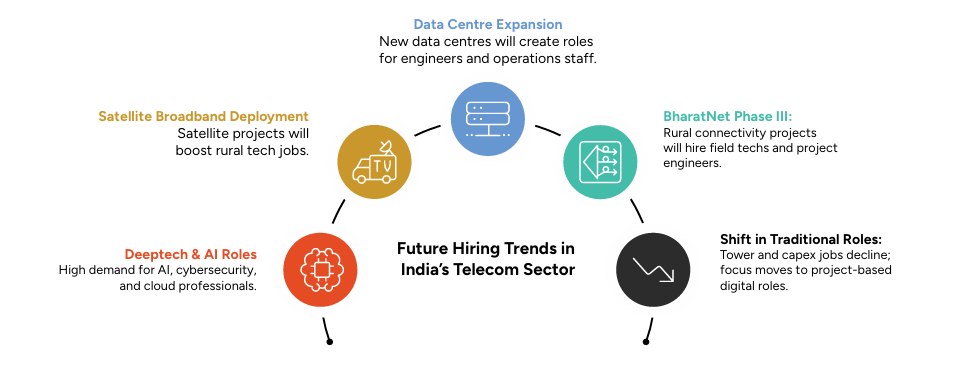
The telecom sector is undergoing a historic digital shift globally. Giants like AT&T, Deutsche Telekom, China Mobile, Vodafone, and NTT, employing over 1.7 million people worldwide, are investing billions into 5G, edge computing, fiber, cloud infrastructure, and AI integration.
- AT&T invested $24 billion in network upgrades (2024–25)
- China Mobile allocated $14.6 billion for 5G capex
- Deutsche Telekom earmarked $18 billion for fibre & cloud infrastructure
As India expands its telecom infrastructure- towers, fibre, M2M applications, IoT platforms, and broadband, the demand is soaring for cloud engineers, AI network specialists, cybersecurity experts, and edge computing architects. Telecom operators are integrating AI into network operations, predictive maintenance, and service automation, creating strong hiring needs for cloud-led roles.
With DeepTech India initiatives like the AI Centres of Excellence and Deeptech Fund of Funds, hiring for cloud, AI, and cybersecurity roles is expected to accelerate even further.
In short, cloud computing is the engine behind digital innovation, enabling scale, security, and intelligence across biotech, telecom, and every sector building the future.
Salary Potential: Cloud Architects in India start at INR 15+ lakhs annually. AI engineers in Bangalore average INR 11.8 LPA, with maximum packages reaching INR 21.4 LPA.
Industries Hiring:
- IT Services: TCS, Infosys, Wipro, HCL
- Startups: Nearly every tech startup runs on cloud infrastructure
- Government: Digital India initiatives
- Finance: Secure cloud banking solutions
Key Platforms:
- Amazon Web Services (AWS)
- Microsoft Azure
- Google Cloud Platform (GCP)
- Oracle Cloud
Geographic Hotspots: Bengaluru accounts for 39% of cloud jobs, Hyderabad for 23%, and Delhi/NCR for 17%.
4. Cybersecurity
Cybersecurity is emerging as one of the top skills in demand in 2026, fueled by rapid digitalisation across BFSI, IT, manufacturing, and global capability centres (GCCs). As companies scale their AI, cloud, and automation ecosystems, the threat landscape is expanding even faster, making cybersecurity talent indispensable.
GCCs are now driving BFSI tech hiring, with demand for AI/ML, data science, cybersecurity, and ERP specialists rising 11% year-on-year. As financial enterprises migrate to cloud-first operating models, protecting digital payments, real-time risk engines, and cross-border data flows has become a top priority.
Manufacturing is also entering a new era of connected factories. By 2026, global manufacturing hiring is expected to surge in emerging markets, especially for talent skilled in AI, robotics, industrial IoT, and cybersecurity. With smart factories running on integrated digital systems, the risk of operational cyberattacks, such as ransomware and industrial system breaches has never been higher.
The IT sector is experiencing an even more dramatic shift. With AI and GenAI spending projected to hit $6 billion by 2027 (33.7% CAGR), enterprises are moving from pilots to large-scale AI deployments. This transformation is driving urgent demand for:
- Cybersecurity analysts
- Cloud security architects
- AI security specialists
- Threat intelligence and SOC professionals
As automation takes over routine tasks, cybersecurity roles are becoming more strategic, intelligence-driven, and business-critical.
In short, cybersecurity is the core of digital trust, and one of the highest-paying, future-proof career paths of 2026 and beyond.
Salary Potential: Cybersecurity professionals earn INR 8-22 LPA depending on expertise and certifications.
Industries Hiring:
- Banking & Finance: Protecting sensitive financial data
- Healthcare: Securing patient records
- E-commerce: Safeguarding payment systems
- Defense & Government: National security
Critical Skills:
- Network security
- Ethical hacking and penetration testing
- Risk assessment
- Security protocols and compliance
- Incident response
Certifications That Pay: CEH (Certified Ethical Hacker), CISSP, CompTIA Security+
5. Digital Marketing
Digital marketing continues to rank among the top skills in demand in 2026, especially as FMCG and consumer brands accelerate their shift toward online-first growth. The FMCG sector alone has seen a 6% rise in entry-level hiring demand in just six months, signalling strong momentum for digital-native roles.
Nearly 23% of fresher opportunities in FMCG today come from e-commerce management, social commerce, data analytics, and digital marketing, highlighting how deeply digital channels now influence consumer buying behaviour. As brands double down on omnichannel retail, companies are hiring for specialised digital roles such as category analysts, trade-marketing executives, and inventory optimisation experts who can blend marketing with data intelligence.
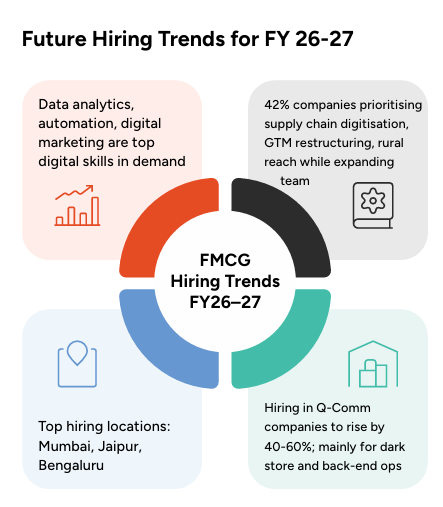
Sales and marketing remain the largest hiring segment in FMCG, accounting for 63% of all recruitment. A major driver behind this demand is the sector’s aggressive expansion into Tier-2, Tier-3, and rural markets. With over 40% of premium FMCG sales now coming from rural households, companies urgently need professionals who understand rural consumer insights, regional buying patterns, localised digital campaigns, and last-mile distribution models.
As social commerce, influencer-led launches, quick-commerce partnerships, and performance marketing reshape the FMCG playbook, digital marketers who can drive measurable growth will stay among the most in-demand and high-impact talent pools of 2026 and beyond.
Salary Potential: Digital marketing specialists earn INR 4-12 LPA, with senior roles commanding much higher packages.
Industries Hiring:
- E-commerce: Flipkart, Amazon, Myntra
- Retail: Both online and offline brands
- Media & Entertainment: OTT platforms, content creators
- Healthcare: Digital health services
High Income Skills Within Digital Marketing:
- SEO (Search Engine Optimization)
- Social Media Marketing
- Content Marketing
- Email Marketing
- PPC (Pay-Per-Click) Advertising
- Analytics (Google Analytics, Facebook Pixel)
- Video Content Creation
6. Full-Stack Development and DevOps
Full-stack development continues to be one of the top skills in demand in 2026, and the Pharma Skill Matrix makes this even clearer. India Decoding Jobs Report 2026 places Full-Stack Developers in the “Difficult to Hire + High Demand” quadrant- meaning companies urgently need this talent, but supply remains limited.
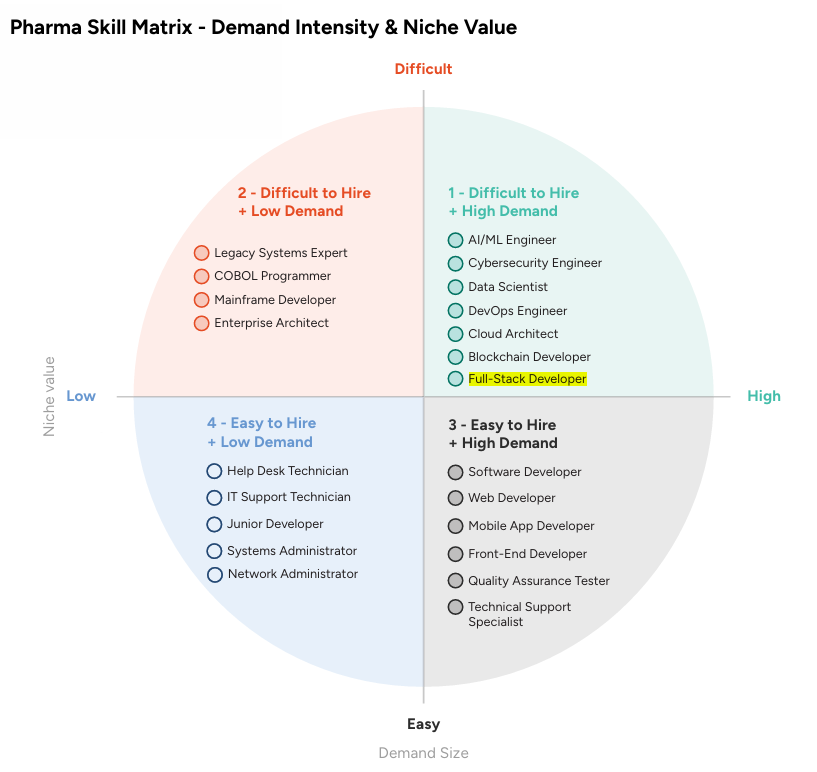
Modern organisations want developers who can handle both front-end and back-end, work across multiple frameworks, and collaborate with AI-enabled development tools.
As companies accelerate digital transformation, launch cloud-native platforms, and build scalable customer-facing applications, full-stack engineers are becoming essential across IT, BFSI, GCCs, healthcare, and even traditional sectors adopting digital pipelines.
Full-stack developers today are expected to work with:
- JavaScript frameworks (React, Angular, Node.js)
- Python, Java, or Go for backend architecture
- Cloud platforms (AWS, Azure, GCP)
- API integrations and microservices
- DevOps and deployment automation
Their versatility makes them highly valuable and difficult to replace.
With India’s tech ecosystem booming, GCC expansions rising, and enterprises moving toward AI-powered app development, full-stack development remains one of the most future-proof, well-paid, and universally in-demand skills in the market.
Salary Potential: Bureau of Labor Statistics projects a 22% increase in software developer jobs between 2025 and 2030. Full-stack developers in India earn INR 6-15 LPA on average, with experienced professionals making significantly more.
Industries Hiring:
- Tech Companies: Google, Microsoft, Amazon
- Startups: Fintech, Edtech, Healthtech
- Consulting Firms: Accenture, Deloitte
- Banks: Digital banking platforms
Must-Know Technologies:
- Frontend: HTML, CSS, JavaScript, React, Angular
- Backend: Node.js, Python, Java
- Databases: MongoDB, MySQL, PostgreSQL
- DevOps Tools: Docker, Kubernetes, Jenkins
7. Project Management
Project management is emerging as one of the top high-value skills in demand for 2026, especially across heavy engineering, oil & gas, smart manufacturing, and deep-tech sectors. As companies take on large, capital-intensive projects involving AI, smart manufacturing systems, additive technologies, electronic warfare solutions, and industrial automation, they need project managers who can operate at both technical and strategic levels.
In the oil & gas industry, project management is becoming mission-critical. More than 80% of manpower needs occur during construction and commissioning phases, making project managers essential for ensuring timelines, safety compliance, vendor coordination, and cost control. Because these phases are manpower-heavy and deadline-sensitive, recruitment now begins well ahead of project ramp-ups, with companies actively building talent pools and issuing early offers.
A major emerging trend is transparency around work conditions, rotations, career paths, and project timelines. This global-standard practice is becoming a key element of employer branding in India, helping companies attract and retain specialised project managers who are in short supply and high demand.
As industries deploy next-gen technologies, the role of project managers is expanding to include:
- Overseeing cross-functional teams (engineering, AI, automation, supply chain)
- Managing risk in complex environments
- Coordinating large-scale commissioning activities
- Integrating digital tools, dashboards, and predictive planning systems
- Ensuring smooth execution across global and remote sites
With massive capex investments coming into energy, infrastructure, defence, and smart manufacturing, project management is set to remain one of the most future-proof and high-impact skills in India’s hiring landscape.
Salary Potential: The Project Management Institute (PMI) predicts that India will need over 7 million new project managers by 2027. Project managers typically earn INR 8-20 LPA depending on industry and experience.
Industries Hiring:
- IT & Software: Managing software development projects
- Construction: Infrastructure and real estate projects
- Manufacturing: Supply chain and operations
- Healthcare: Hospital administration and health tech
- Consulting: Strategy and implementation projects
Professional Skills to Develop:
- Agile and Scrum methodologies
- Risk management
- Budgeting and resource allocation
- Stakeholder communication
- Leadership and team motivation
Top Tools: JIRA, Trello, Asana, Microsoft Project
Certifications: PMP, PRINCE2, Scrum Master, CAPM
8. UX/UI Design
Every app, website, and digital product needs to be intuitive and beautiful. Bad design loses customers; great design wins them.
According to India Decoding Jobs 2026 Report, UI/UX design continues to be one of the most in-demand creative-tech skills in 2026, driven by the rise of digital platforms, personalised user journeys, and the expansion of EdTech, e-commerce, and app-first businesses. Despite the slowdown in traditional advertising and marketing roles, UI/UX designers still make up a sizeable share of white-collar gig and full-time opportunities, especially as companies prioritise seamless digital experiences.
The gig economy is seeing strong earnings potential for UI/UX professionals, with demand increasing for designers who can build intuitive interfaces, user-friendly learning experiences, and mobile-first product flows. There’s also a surge in demand for creatives who understand regional language behaviours, accessibility, and micro-interactions- an increasingly important skillset in India’s multilingual market.
EdTech is amplifying this trend even further. Global leaders like Coursera, Udemy, Duolingo, Instructure, and Pluralsight are heavily hiring for roles in UX design, AI-powered product development, content localisation, and customer learning journeys, reflecting the sector’s shift toward gamification and personalised, data-driven learning.
With digital adoption accelerating across industries, UI/UX designers who blend creativity, product thinking, and user psychology will remain among the most future-proof and high-demand professionals in 2026.
Salary Potential: Web developers and UX designers earn INR 5-15 LPA, with senior designers and product leads earning significantly more.
Industries Hiring:
- Tech Companies: Creating user-friendly products
- E-commerce: Optimizing shopping experiences
- Gaming: Interactive game interfaces
- Fintech: Simplifying complex financial products
- Edtech: Educational app design
Core Competencies:
- User research and testing
- Wireframing and prototyping
- Visual design principles
- Information architecture
- Interaction design
Design Tools: Figma, Adobe XD, Sketch, InVision
Human Touch: This is one of the few tech skills that heavily relies on empathy and creativity- understanding what users want and how they think.
9. Blockchain Technology
Blockchain has moved far beyond cryptocurrencies, emerging as one of the most in-demand skills in 2026 across IT, agriculture, logistics, and digital governance.
India’s Skills Evolution Matrix from the India Decoding Jobs 2026 shows blockchain becoming a critical emerging skill in agriculture, used for farm-to-market traceability, supply chain verification, and ensuring transparency in crop quality, pricing, and distribution.
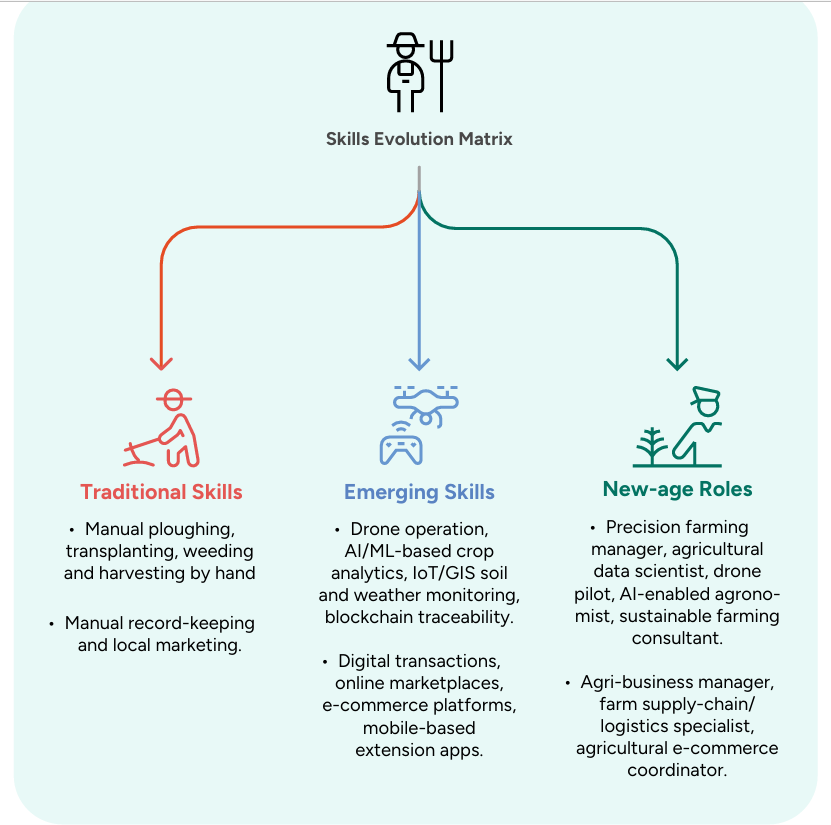
In agriculture, blockchain enables:
- Traceability of produce from farm to consumer
- Tamper-proof crop records for quality certification
- Transparent supply chains for exporters and processors
- Integration with IoT/GIS systems for soil, weather, and yield-based analytics
As digital marketplaces, mobile-based advisory apps, and agri-e-commerce platforms grow, blockchain-powered systems are becoming essential for ensuring trust, improving farmer income, and reducing fraud in procurement.
Beyond agriculture, the technology is a major growth engine for India’s IT sector. With the industry expected to add nearly 2 million new jobs by 2030, blockchain stands alongside AI and cloud computing as a top skill driving this expansion.
The government is also accelerating adoption. The FutureSkills PRIME programme (MeitY + NASSCOM) is upskilling India’s workforce in 10 emerging technologies, including blockchain, AI, IoT, and cybersecurity, clearly signalling blockchain’s importance in the future talent ecosystem.
With applications across finance, supply chain, smart contracts, healthcare, agri-tech, and public governance, blockchain expertise is rapidly becoming a future-proof, high-value skill for professionals who want to stay ahead in 2026 and beyond.
Industries Hiring:
- Banking & Finance: Secure transactions and smart contracts
- Supply Chain: Transparency and traceability
- Healthcare: Secure patient data management
- Government: Digital identity and record keeping
- Real Estate: Property transaction management
Key Concepts:
- Distributed ledger technology
- Smart contracts
- Cryptocurrency fundamentals
- Security protocols
- Ethereum, Hyperledger
Future Potential: The BFSI sector in India is experiencing a transformative boom in 2025, with blockchain technology emerging as a top skill due to its ability to enhance security, transparency, and efficiency.
10. Financial Analysis and Investment Management
Financial analysis and investment management skills are becoming top hiring priorities in the FMCG sector as companies shift toward profitability, capital efficiency, and smarter expansion. With Mumbai accounting for 28% of all FMCG hiring, mainly for finance and corporate roles, the demand for professionals skilled in budgeting, forecasting, ROI modelling, and investment planning is sharply rising.
As FMCG firms balance rising input costs with aggressive market growth, they need specialists who can:
- Analyse profitability across product lines
- Build investment cases for new plants, automation, and market entries
- Optimise working capital, cash flow, and inventory cycles
- Evaluate M&A opportunities and long-term financial risks
Bengaluru (22%) is emerging as the analytics hub, further boosting the need for finance talent skilled in data-driven decision-making, predictive models, and digital financial tools.
Together, financial analysis and investment strategy are turning into core FMCG leadership skills, shaping smarter capital allocation and enabling companies to scale efficiently in 2026.
Salary Potential: The financial services sector is expected to create 150,000 jobs by 2030. Investment analysts and financial managers earn INR 10-30 LPA depending on expertise.
Industries Hiring:
- Investment Banks: Goldman Sachs, Morgan Stanley
- Financial Services: HDFC, ICICI, Axis Bank
- Wealth Management: Portfolio management services
- Fintech Startups: Zerodha, Groww, Paytm Money
- Insurance: LIC, HDFC Life, SBI Life
Skills to Master:
- Financial modeling
- Advanced Excel
- Risk assessment techniques
- Market trend analysis
- Portfolio management
Certifications That Matter: CFA (Chartered Financial Analyst), FRM (Financial Risk Manager), CFP (Certified Financial Planner)
11. Sustainability and Green Skills
Companies are under growing pressure to meet environmental, social, and governance (ESG) goals. Forty-seven percent of businesses expect climate-change mitigation to impact their workforce strategy.
Further, as automakers push toward carbon-neutral factories and energy-efficient production, sustainability is emerging as one of the most in-demand skills in the automotive sector. Companies are redesigning their operations to reduce emissions, adopt recycling-led manufacturing, and comply with stringent global ESG norms.
This transition is creating strong demand for professionals trained in:
- Sustainability strategy & ESG reporting
- Carbon accounting and emissions management
- Green manufacturing and energy-efficient operations
- Battery chemistry and recycling technologies
- Robotics and data-driven production optimization
With the industry shifting aggressively toward clean mobility and circular manufacturing, sustainability expertise is becoming central to automotive growth and competitiveness in 2026.
Industries Hiring:
- Renewable Energy: Solar and wind power companies
- Manufacturing: Sustainable production practices
- Consulting: ESG advisory services
- Automotive: Electric vehicles and sustainable transport
- Government: Climate policy and implementation
High Demand Skills for the Next 10 Years:
- Carbon footprint measurement
- ESG compliance
- Renewable energy management
- Circular economy principles
- Environmental auditing
Job Titles: Environmental Engineer, Sustainability Consultant, Renewable Energy Specialist, ESG Analyst
12. Communication and Emotional Intelligence
Strong communication and emotional intelligence are becoming non-negotiable in modern workplaces, especially as hybrid teams grow and AI automates routine work.
According to LinkedIn’s 2024 Workplace Learning Report, communication and emotional intelligence rank among the top 5 most in-demand soft skills globally. Also, a study by the World Economic Forum (2025) predicts that 60% of jobs will require advanced interpersonal and emotional skills by 2027, as automation increases.
Teams with high EI leaders show 20–30% better performance, as per research by Harvard Business Review, due to stronger collaboration and lower conflict. In customer-facing industries (FMCG, Retail, BFSI), companies report a 25% reduction in churn when employees demonstrate strong empathy and communication skills.
Where It Matters Most
- People management
- Customer experience roles
- Sales and client-facing jobs
- Cross-functional collaboration in hybrid teams
Who Needs It: Everyone, from software engineers to CEOs.
Workplace Skills That Employers Value:
- Public speaking and presentations
- Written communication
- Active listening
- Conflict resolution
- Team collaboration
- Empathy and emotional intelligence
- Leadership and influence
Real Talk: Seven in 10 employers consider analytical thinking essential by 2025, but resilience, flexibility, and creativity continue to rise in importance as key social and emotional skills.
How to Improve: Join debate clubs, take online courses in communication, practice public speaking through platforms like Toastmasters, work on emotional awareness.
13. Low-Code/No-Code Development
Low-code and no-code platforms are reshaping how companies build tech solutions, making LCNC development one of the fastest-rising in-demand skills.
As per Gartner, by 2026, 65% of all app development is expected to use LCNC platforms. Indian enterprises adopting LCNC report 50–70% faster software deployment.
- Demand for LCNC talent is rising 30% YoY, especially in BFSI, IT, Healthcare, and eCommerce.
- Forrester forecasts $187 billion in global cost savings by 2030 through LCNC adoption.
Where It’s Most In Demand
- Process automation in HR, finance, and sales
- Building dashboards, CRMs, and workflow tools
- Rapid prototyping for non-tech teams
Industries Hiring:
- SMEs: Small businesses building custom solutions
- Marketing Agencies: Creating landing pages and automation
- HR Departments: Building internal tools
- Operations: Process automation
Popular Platforms: Bubble, Webflow, Zapier, Microsoft Power Apps, OutSystems
Special Skills Examples: Workflow automation, API integration, basic logic and conditionals, UI customization
14. Video Content Creation and Editing
With video dominating digital consumption, video creation and editing have become highly in-demand skills across industries.
Why This Is an In-Demand Skill
- 91% of businesses now use video as a core marketing tool (Wyzowl, 2025).
- Job posts with video-based employer branding see 34% higher application rates.
- Short-form video drives 82% of all global internet traffic, making video editors extremely sought after.
- India’s demand for video creators has grown 55% YoY, especially in FMCG, EdTech, SaaS, and eCommerce.
- Video-led training improves L&D completion rates by 40%.
Where It’s Most In Demand
- Social media, marketing & brand communication
- Learning & development
- Product demos and customer onboarding
- The creator economy and influencer-driven campaigns
Salary Potential: Content creators and video editors earn INR 4-12 LPA, with experienced professionals and those with personal brands earning significantly more.
Industries Hiring:
- Media & Entertainment: Production houses, OTT platforms
- Marketing Agencies: Brand storytelling
- E-learning: Educational content creation
- Social Media: Influencer marketing
- Corporate: Internal communications and training
Tools to Master: Adobe Premiere Pro, Final Cut Pro, DaVinci Resolve, After Effects
Bonus Skill: Understanding social media algorithms and what makes content viral.
15. Augmented Reality (AR) and Virtual Reality (VR)
Augmented Reality (AR) and Virtual Reality (VR) have rapidly moved from experimental technologies to mission-critical capabilities, making AR/VR development one of the most in-demand skills across manufacturing, coal mining, and EdTech sectors.
As per the Taggd’s India Decoding Jobs Report 2026, AR/VR Is Becoming a Most In-Demand Skill. Check out how-
- In manufacturing, AR/VR tools for maintenance, plant training, and digital-twin simulations are becoming standard. This shift is pushing demand for simulation specialists, digital-twin engineers, and AR-enabled maintenance experts.
- India’s coal sector, employing nearly 500,000 mine workers across 350 mines has already adopted VR safety training and simulator-based programs to upskill heavy earth-moving machinery (HEMM) operators.
- In EdTech, hiring is increasingly skills-driven rather than volume-driven, with companies prioritizing AR/VR capabilities to deliver immersive, personalized, and gamified learning at scale.
- The demand for gamification experts, AR/VR developers, 3D learning designers, and microlearning creators continues to rise as companies chase corporate upskilling contracts and learner engagement.
What Makes AR/VR a High-Growth, High-Payoff Skill
- AR/VR-enabled training reduces skill-development time by up to 40%, especially in technical roles.
- Companies using immersive training report a 70% improvement in learning retention compared to traditional methods.
- The global AR/VR market is expected to grow at 30%+ CAGR, directly influencing hiring demand.
Industries Hiring:
- Gaming: Immersive game experiences
- Education: Virtual classrooms and training
- Real Estate: Virtual property tours
- Retail: Try-before-you-buy experiences
- Healthcare: Surgical training and therapy
Skills Needed: Unity, Unreal Engine, 3D modeling, spatial computing, C# or C++
Industry-wise Most In-Demand Skills in 2026
The India Decoding Jobs Report 2026 reveals that AI, GenAI, automation, data analytics, cloud, and cybersecurity are the most in-demand skills across sectors, driving nearly every major hiring trend.
Industries are rapidly adopting Industry 4.0, digital transformation, sustainability frameworks, and advanced automation, creating a massive talent shift toward high-skill, tech-enabled roles.
Companies across core and emerging sectors are also facing acute challenges: talent shortages, high demand for niche digital roles, location constraints, and rising competition for specialised skills. This is where Taggd supports organisations with sector-specific talent intelligence, AI-enabled hiring, and India’s largest ready-to-hire talent pools, enabling employers to overcome capability gaps while accelerating time-to-hire.
Below is a detailed breakdown of the most in-demand skills in 2026- industry by industry.
Industry-wise Most In-Demand Skills in 2026
| Industry | Top In-Demand Skills (2026) |
| Automobile | Sustainability & ESG reporting, robotics operations, battery technology, data-driven manufacturing, carbon-neutral automation skills |
| Pharmaceutical | Computational biology, AI-driven drug discovery, bioinformatics, genomics data analysis, cloud tools for healthcare (TensorFlow, PyTorch) |
| Banking, Financial Services & Insurance (BFSI) | AI/ML, data science, cybersecurity, ERP, risk analytics, digital banking skills (high demand driven by GCCs) |
| Manufacturing | Automation, robotics, predictive maintenance, digital twins, AR/VR-based training, smart factory operations (Industry 4.0) |
| Information Technology (IT) | AI, GenAI, cybersecurity, cloud computing, blockchain, full-stack development, chip design, DevOps |
| Fast-Moving Consumer Goods (FMCG) | Digital marketing, e-commerce management, social commerce, category analytics, inventory optimization, rural market insights |
| Aviation | Predictive maintenance engineering, flight operations analytics, avionics tech, simulation training tools |
| Defense Manufacturing | AI, smart manufacturing, additive tech, electronic warfare systems, system integration, automation specialists |
| Semiconductor | AI/ML, chip design, VLSI, embedded systems, cybersecurity, clean-room manufacturing specialisations |
| Biotechnology | Genomics, AI-based R&D, bioinformatics, automation pipelines, drug modelling, data engineering for biotech |
| Chemicals | Process automation, safety engineering, industrial IoT, environmental compliance & sustainability tech |
| Education Technology (EdTech) | AI/ML engineering, gamification, AR/VR learning development, content localisation, UX/UI design |
| Medical Devices | Robotics, regulatory compliance, product design, quality engineering, healthcare software integration |
| Oil & Gas | Project management, safety automation, additive manufacturing, commissioning & construction operations |
| Telecom | 5G engineering, AI-based network ops, edge computing, cloud ops, cybersecurity, fibre & tower infra skills |
| Retail | Omnichannel operations, supply chain analytics, CRM systems, digital merchandising, e-commerce optimisation |
| Logistics | Supply chain tech, automation, warehouse robotics, route optimisation analytics, digital freight management |
| Agriculture | Blockchain-based traceability, smart farm data analytics, agri-IoT systems, digital supply chain skills |
Wrapping Up
The future of work is no longer defined by traditional job roles, it is shaped by skills that blend technology, strategy, creativity, and human intelligence. From AI, cybersecurity, full-stack development, and blockchain to sustainability, financial analysis, digital marketing, and AR/VR, the most in-demand skills for 2026 reflect a workforce that must be future-ready, data-driven, and innovation-focused.
As industries from FMCG and manufacturing to BFSI, IT, automotive, and energy accelerate digital transformation, the demand for specialised, high-value skills will only continue to rise. Professionals who upskill early will lead this new talent landscape, while employers who invest in continuous learning and capability building will stay ahead in an increasingly competitive market.
Toget deep insights, sector-wise hiring forecasts, emerging job families, salary benchmarks, and the most in-demand skills shaping India’s workforce, download the India Decoding Jobs Report 2026.
Your roadmap to smarter hiring, better workforce planning, and future-ready careers. Explore Taggd for RPO solutions, executive search, and consulting services to hire for most in-demand roles industry-wise.