
Your Guide to C2C Hiring in India
Put simply, Corp-to-Corp (C2C) hiring is a business-to-business deal. Your company brings on an independent professional who works through their own registered company. Instead of hiring an individual in the traditional sense, you’re actually contracting with their business for specialised services, usually for a specific project or a set period. It’s a model built for flexibility and getting your hands on very specific, niche skills when you need them.
What C2C Hiring Really Means for Your Business

Let’s say your company needs to build a new data analytics platform from scratch. The traditional route would be to hire a full-time data scientist. That means going through a long recruitment cycle, handling all the onboarding paperwork, and committing to long-term benefits and salary.
The C2C hiring model offers a different path. You could engage an expert consultant who runs their own business.
In this setup, you aren’t hiring a person—you’re contracting a service from their company. This shift is the heart of the C2C model. It completely changes the employer-employee dynamic into a client-vendor relationship, which carries some pretty big operational and financial advantages.
The Key Players in a C2C Arrangement
To really get your head around the C2C framework, you first need to understand the three main parties involved and what each one does. This structure is what keeps things clear and legally sound, setting it apart from a typical employment contract.
- The Client: This is you, your company. You have a specific need, a project to complete, or a skill gap that needs an expert to fill it for a limited time.
- The Vendor: This is the consultant’s own registered business. The vendor is the one responsible for their own taxes, insurance, and all the other administrative headaches.
- The Professional: This is the actual expert doing the work. Critically, they are an employee or owner of the vendor company, not yours.
This three-way structure is what makes C2C hiring what it is. Your contract is with the vendor, not directly with the professional, and that’s a legal distinction that matters.
How the C2C Hiring Process Works
Bringing a C2C consultant on board is less like a traditional HR process and more like a procurement and project management exercise.
Think of the C2C model as a form of strategic outsourcing for individual expertise. It allows businesses to tap into high-level talent for mission-critical tasks without the long-term commitment and overhead of a permanent hire.
Let’s walk through the typical flow:
- Identify the Need: Your team pinpoints a specific skill gap or project that’s either temporary or highly specialised. Maybe you need a cybersecurity expert for a six-month security audit.
- Define the Scope: You put together a detailed Scope of Work (SOW) document. This is your blueprint, outlining the project goals, deliverables, timelines, and how you’ll measure success. It’s the foundation of the C2C contract.
- Source the Talent: You find the right professional who operates their own corporation. This could be through specialised staffing agencies, your professional network, or even direct outreach.
- Execute the Agreement: Your legal team drafts a Master Services Agreement (MSA) and the specific SOW. The contract is signed between your company (the client) and the consultant’s company (the vendor).
- Onboard and Integrate: The onboarding is all about the project. The professional gets access to the systems they need and is briefed on the project, skipping the standard HR orientation.
- Manage and Pay: The professional gets to work, delivering on the SOW. The vendor company then sends invoices (often including GST) to your company, which are handled by your accounts payable team.
This model is a huge part of the modern workforce, echoing the rise of gig work opportunities and the growing hunger for flexible talent. By treating skilled professionals as business partners, C2C hiring helps companies stay nimble and react faster to what the market throws at them.
The Strategic Advantages of Adopting C2C Hiring

Bringing in C2C professionals isn’t just another way to fill a role; it’s a strategic pivot that can fundamentally change how your business operates. It injects a level of agility and financial common sense that traditional hiring struggles to offer, especially in a market as dynamic as India’s.
When you engage experts through their own businesses, you’re building a more fluid, responsive company. This structure allows you to react faster, jump on new opportunities, and adapt to market shifts without the heavy anchor of a fixed, permanent workforce.
Achieve Unmatched Workforce Agility
The real magic of C2C hiring lies in its scalability. You can expand or shrink your team based on what you need, right now.
Let’s say your e-commerce firm is eyeing a new product launch and needs to analyse a mountain of market entry data. It’s a crucial six-month project that calls for a senior data scientist with a very specific skill set. Hiring a full-timer would mean a long, drawn-out recruitment process and a permanent salary commitment for a temporary problem.
With the C2C model, you bring in that seasoned expert for exactly six months. When the project wraps up, the contract ends cleanly. No long-term overheads, no complicated offboarding. Simple.
This project-based mindset gives you incredible flexibility:
- Scale Up for Peaks: Seamlessly add specialists to your team to handle crunch times or tackle complex new projects.
- Scale Down Efficiently: Let contracts conclude naturally as projects wind down, keeping your core team lean without facing the pain of layoffs.
- Adapt to New Technologies: Bring in experts on emerging tech for specific initiatives without the need to retrain your entire permanent staff.
Drive Significant Cost Efficiencies
The financial upside of C2C hiring goes well beyond salary savings. Because you’re essentially partnering with another business, you sidestep a whole host of indirect costs that come with permanent employees.
The C2C model shifts the financial equation. It transforms fixed labour costs into variable project expenses, giving finance leaders greater control and predictability over the budget.
This means you get to bypass expenses tied to:
- Payroll Liabilities: You don’t have to manage Provident Fund (PF), Employee State Insurance (ESI), or other statutory contributions.
- Employee Benefits: The costs of health insurance, paid holidays, and retirement plans are handled by the vendor company, not you.
- Administrative Overheads: Think of all the time your HR and finance teams save on payroll and benefits administration for these professionals.
This model can even trim down your real estate costs. Many C2C professionals are well-versed in remote or hybrid work, meaning less demand for permanent desk space. This fits perfectly with what’s happening in the Indian office market. Enterprise co-working transactions in India booked over 103,000 seats in FY23, a 20% jump year-on-year, largely fuelled by the IT sector. With commercial rents soaring by 30-50% in major cities, the flexibility of C2C talent can lead to huge savings on brick-and-mortar. You can discover more insights about India’s office market trends.
Access a Niche Pool of Senior Experts
Perhaps the biggest win is the direct line C2C gives you to a highly skilled, entrepreneurial talent pool. Many of the best minds in the industry—people with years of deep, specialised experience—have chosen to work as independent consultants.
These aren’t folks scrolling through traditional job portals. They are business owners who thrive on solving tough problems for different clients. A C2C hiring strategy is your key to unlocking this exclusive network.
Imagine your company needs to implement a new ERP system. Through a C2C arrangement, you could engage a consultant who has already led five successful implementations for companies just like yours. You get their focused expertise for precisely how long you need it, ensuring your critical project is in the hands of a proven leader. This immediate infusion of top-tier talent can dramatically speed up timelines and deliver far better results.
How C2C Stacks Up Against Other Staffing Models
Picking the right way to bring talent on board is a huge decision. It doesn’t just affect your budget; it shapes your project’s success and how quickly your business can adapt. In India, you have a few paths to choose from—traditional full-time hires, freelancers, and the increasingly popular C2C hiring model. Understanding the real differences is crucial, and C2C stands out because it operates on a purely business-to-business level.
To really see where C2C shines, let’s put it side-by-side with the two other mainstays: W2 (your typical full-time employee) and independent contractors (freelancers). Each model comes with its own mix of control, cost, and paperwork.
This visual breakdown cuts right to the chase, showing the core differences between hiring through C2C versus the traditional W2 route.
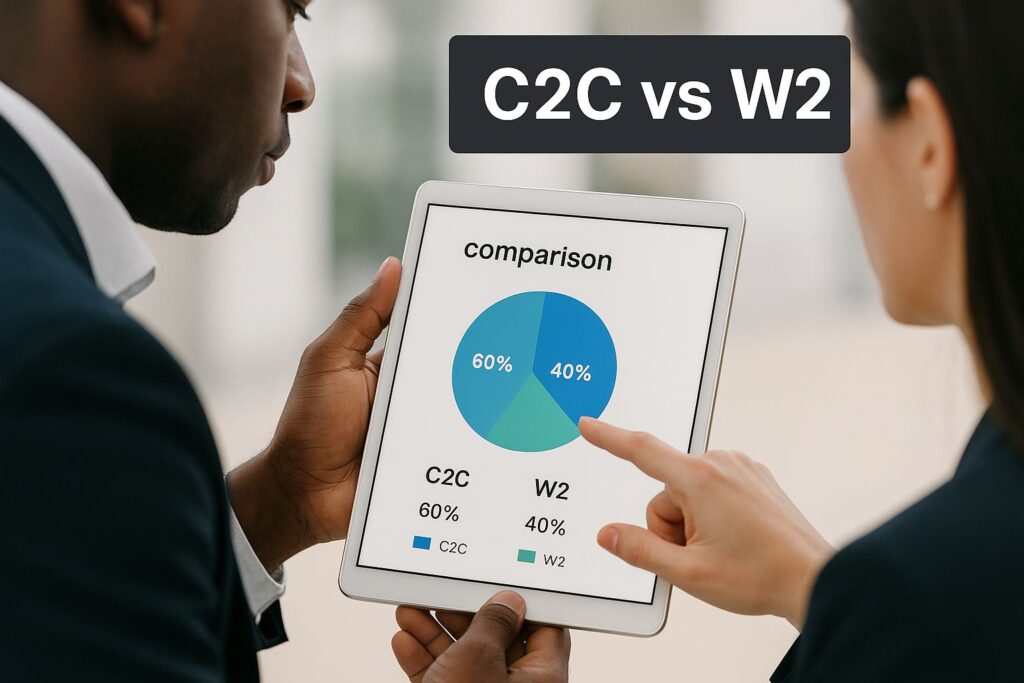
As the infographic makes clear, the C2C model neatly shifts all the administrative and tax headaches away from you, the client. This leaves you with a clean, project-focused relationship.
C2C Versus W2 (Full-Time Employment)
We all know the W2 model. It’s the classic employer-employee relationship where you hire someone directly onto your company’s payroll. This gives you maximum control over their work, but it also means maximum administrative load.
With a full-time employee, your company is on the hook for everything:
- Managing payroll, including Tax Deducted at Source (TDS) and Provident Fund (PF) contributions.
- Providing all the statutory benefits like paid leave, health insurance, and gratuity.
- Handling the entire HR lifecycle, from onboarding and training to performance reviews and offboarding.
C2C flips this script completely. Your agreement is with the consultant’s registered business, not the person. They are an employee of their own company, which means they handle their own taxes, benefits, and admin. For you, this means a massive reduction in overhead and a much lighter load for your HR team.
C2C Versus Independent Contractors
At first glance, C2C consultants and independent contractors (or freelancers) look pretty similar. Both offer specialised skills for specific projects, letting you avoid the long-term commitment of a full-time hire. But dig a little deeper, and you’ll find the legal and financial setup is worlds apart.
An independent contractor is a self-employed individual. When you hire one, you still have certain tax responsibilities, like deducting TDS from their payments. There’s also a constant, nagging risk of worker misclassification—if the relationship starts looking too much like traditional employment, you could land in hot water.
A C2C arrangement builds in a vital legal firewall. You’re not hiring an individual; you are contracting with a formal business entity (the vendor). This structure makes the business-to-business nature of the deal crystal clear, giving you a stronger legal footing and drastically cutting down on misclassification risks. The vendor company is responsible for all its own tax compliance, including GST, which keeps the financial side of things much tidier for you.
To make these distinctions even clearer, the table below provides a side-by-side comparison. And if you’re looking to understand the broader talent landscape, it’s also worth knowing the difference between RPO and a staffing agency, as each offers a different approach to finding the people you need.
C2C vs W2 vs Independent Contractor: A Comparison
| Feature | C2C (Corp-to-Corp) | W2 (Full-Time Employee) | Independent Contractor (Freelancer) |
|---|---|---|---|
| Relationship | Business-to-Business (Client to Vendor) | Employer-to-Employee | Business-to-Individual |
| Tax Liability | Vendor manages all its own taxes (GST, Income Tax, etc.) | Employer manages TDS, PF, and all payroll taxes | Client must deduct TDS from payments |
| Benefits | Vendor provides benefits to its own employee | Employer provides all statutory benefits | No benefits provided by the client |
| Admin Overhead | Minimal; handled by Accounts Payable as a vendor payment | High; fully managed by HR and Finance teams | Moderate; requires TDS compliance and tracking |
| Control Level | Focused on deliverables and project outcomes | High; direct control over tasks, methods, and hours | Focused on deliverables, less control over method |
| Onboarding | Simple and project-specific; mainly focused on system access | Comprehensive; includes company culture and HR processes | Project-specific; usually minimal integration |
Ultimately, choosing the right model comes down to your project’s specific needs, your tolerance for administrative work, and your long-term business goals. C2C offers a powerful, flexible alternative that gives you access to top-tier talent without the traditional burdens of employment.
Navigating C2C Legal and Compliance Requirements in India
Bringing talent on board through a C2C hiring model offers incredible flexibility, but it’s a path that comes with its own set of legal and compliance hurdles. This isn’t your typical employment arrangement with its well-trodden rules. The C2C framework is a business-to-business (B2B) engagement, and getting that structure right from day one is non-negotiable. It’s the only way to shield your organisation from some serious legal and financial heat.
For a lot of companies in India, this is where the confidence falters. The trick is to treat the relationship for exactly what it is: a formal service agreement between two separate businesses. Once those lines start to blur, you’re wading into risky territory, especially when it comes to worker misclassification.
Avoiding Employee Misclassification
The single biggest legal landmine in any C2C deal is having the consultant misclassified as an employee in disguise. If a tax authority or court decides the working relationship looks more like employment than a B2B contract, your company could be on the hook for back taxes, statutory benefits like Provident Fund (PF), and a heap of penalties.
To keep that legal line in the sand clear, you need to focus on control and integration:
- Control over Work: The C2C professional needs to have full autonomy over how they get the work done. Your concern should be the final deliverables you agreed upon in the contract, not micromanaging their daily schedule or working hours.
- Financial Independence: The consultant must operate like a real business. That means they use their own equipment, send you invoices for their services, and are free to take on work from other clients.
- Level of Integration: A C2C professional shouldn’t be woven into your company’s internal fabric. Steer clear of giving them internal job titles, looping them into employee performance reviews, or offering them perks reserved for your permanent staff.
A well-drafted Scope of Work (SOW) is your best defence against misclassification. It’s concrete proof that the engagement is all about the project and its outcomes, cementing that client-vendor dynamic.
Thinking of the C2C professional as a vendor is the right mindset. Their invoices should go through your accounts payable, just like any other supplier, and never, ever through your payroll system.
The Importance of GST Compliance
In India, you can’t talk about B2B transactions without talking about Goods and Services Tax (GST), and C2C agreements are no different. The consultant’s company is providing a taxable service to your company. Period. This makes GST compliance an absolute must, and it also serves as another layer of proof that this is a legitimate business relationship.
Your due diligence has to include verifying the consultant’s business registration and GST status. Make sure their invoices are properly GST-compliant, clearly showing their GSTIN (GST Identification Number) and the correct tax breakdown. For your business, this isn’t just about staying on the right side of the law; it’s also about claiming Input Tax Credit (ITC) on the services, which directly reduces your own tax bill. Getting GST wrong can lead to financial headaches and penalties for everyone involved.
Crafting an Ironclad C2C Contract
The C2C contract is the legal bedrock of the whole relationship. It’s often set up as a Master Services Agreement (MSA) with a specific SOW for each project. It needs to be crystal clear and detailed, leaving zero ambiguity that could hint at an employment relationship.
Here are the clauses that absolutely must be in your agreement:
- Clear Scope of Work (SOW): Spell out the project, all deliverables, the timelines, and how you’ll sign off on the work.
- Payment Terms: Detail the payment schedule (e.g., monthly, by milestone), the invoicing procedure, and all GST obligations.
- Intellectual Property (IP) Rights: State exactly who owns the IP created during the engagement. Typically, the client takes full ownership once the final payment is made.
- Confidentiality: A strong non-disclosure clause is essential to protect your company’s trade secrets and sensitive information.
- Independent Contractor Status: This is a critical one. The clause must explicitly state that the vendor is an independent contractor responsible for their own taxes, insurance, and benefits.
- Termination Clause: Clearly outline how and why either party can end the agreement, including required notice periods.
By carefully structuring your contracts and internal processes, you can tap into the agility of C2C hiring with confidence, knowing your business is fully compliant and legally protected.
A Practical Playbook for C2C Hiring Success
Executing a successful C2C hiring strategy isn’t about traditional recruitment. It’s much more about smart project management and building strong vendor relationships. You have to shift your mindset from hiring an employee to procuring a specialised service.
By building a structured framework, you can consistently find, vet, and manage top-tier C2C professionals. This ensures your projects get delivered on time and to the highest standard. This playbook gives you a clear, step-by-step process for making a C2C programme work, from the initial search to the final payment.
Finding and Vetting C2C Talent
First things first, where do you find these people? The challenge is locating professionals who are not just technical experts but also savvy business owners. These individuals often operate outside of typical job boards, so you need a more targeted approach.
Your sourcing strategy should focus on the channels where these entrepreneurial experts congregate:
- Specialised Staffing Agencies: Your best bet is to partner with firms that already have a deep network of vetted C2C consultants. They do the initial heavy lifting of screening, which saves you a ton of time.
- Professional Networks: Tap into platforms like LinkedIn by searching for consultants or founders of small consulting firms in your niche. You’d be surprised who you can find with a few smart searches.
- Industry Referrals: Don’t underestimate the power of your own network. A recommendation from a trusted contact is often the most reliable way to find high-quality, proven talent.
Once you’ve got a pool of candidates, the vetting process needs to be more than a standard interview. You’re not just checking their skills; you’re evaluating a potential business partner. The conversation should cover their technical prowess, of course, but also their entrepreneurial mindset. You need to know they can manage projects independently and deliver on the results defined in an SOW.
Streamlining the Onboarding Process
A C2C professional doesn’t need the standard company orientation, the welcome-to-the-team emails, or the HR induction. Their onboarding should be swift, targeted, and entirely project-focused. The goal is simple: get them productive as quickly as possible.
A streamlined onboarding process for a C2C consultant is a clear sign of a mature C2C programme. It shows respect for their time and focuses everyone’s attention on the project goals from day one.
Keep your onboarding checklist simple and direct:
- System and Tool Access: Grant them immediate access to all necessary software, platforms, and communication channels. No delays.
- Project Kick-off: Schedule one meeting with the key stakeholders to align on the SOW, deliverables, and timelines.
- Point of Contact: Assign a single, dedicated point of contact within your team to handle their questions and provide project guidance.
Forget the welcome kits and team-building exercises. This is all about efficiency. This approach also helps reinforce the important legal distinction that they are an external vendor, not an internal employee.
Managing the C2C Relationship Effectively
The day-to-day management of a C2C relationship really comes down to clear communication and sticking to the SOW. That document is your single source of truth for what’s expected. Schedule regular check-ins to review progress against milestones, not to micromanage their daily tasks.
Building a reputation as a great client is also crucial for attracting the best C2C talent in the future. What does that mean? Pay your invoices on time and respect their autonomy as a business owner. A smooth payment process, handled properly through accounts payable, reinforces the professional B2B nature of the engagement.
As more professionals choose flexible work, this reputation becomes a real competitive advantage. Just look at the rise of co-working spaces in India, projected to hit USD 829.2 million by 2033. It shows a clear trend toward the kind of flexible, independent work models that C2C hiring perfectly supports. You can learn more about how flexible workspaces are expanding across India.
For organisations looking to scale this model, understanding digital RPO for high-impact hiring can offer valuable insights. It helps you build the kind of efficient, tech-driven talent acquisition processes that perfectly complement a flexible workforce strategy.
Frequently Asked Questions
As the C2C hiring model starts making waves across India, it’s only natural that a few questions pop up. For many HR leaders and project managers, it feels like a big shift from the usual way of hiring, sparking curiosity about everything from its legality and practicality to how it really differs from other staffing models.
Let’s tackle the most common questions head-on. Our aim here is to give you clear, straight-to-the-point answers that cut through the noise, clear up any confusion, and help you feel confident about using this model for your business.
Is C2C Hiring Fully Legal in India?
Yes, C2C hiring is absolutely legal in India. But there’s a crucial catch: it has to be structured correctly. The whole thing rests on one key principle—the relationship must be a genuine business-to-business (B2B) agreement, not just an employment contract in disguise.
The legal framework is governed by the Indian Contract Act, 1872. To stay on the right side of the law and avoid any headaches with employee misclassification, your contract must be with the consultant’s registered business entity, not the individual. Think of this as the legal firewall that keeps C2C separate from traditional employment.
A solid C2C agreement will always spell out:
– The clear vendor-client relationship.
– The vendor’s full responsibility for their own taxes (like GST) and other statutory payments.
– A focus on deliverables and project outcomes, not on controlling the professional’s working hours or methods.
When you have these pieces in place, the C2C model becomes a perfectly legitimate—and incredibly effective—way to bring specialised talent on board.
How Can I Find Reliable C2C Professionals?
Finding top-notch C2C professionals isn’t like posting a job and waiting for résumés to roll in. These individuals are business owners, not active job seekers, so you have to know where to look. The trick is to tap into the networks where proven, entrepreneurial talent hangs out.
You can zero in on your search by focusing on these three main channels:
1. Specialised Staffing Agencies: This is often the quickest route. Partnering with agencies that have a dedicated C2C focus means you get access to their curated networks of pre-vetted professionals. It saves you a massive amount of time on sourcing and screening.
2. Professional Networking Platforms: Sites like LinkedIn are goldmines for this. Get comfortable with advanced search filters to find founders of small consulting firms, independent consultants, or professionals with those niche, high-demand skills you’re after.
3. Industry Referrals: Never, ever underestimate the power of your own network. A warm recommendation from a trusted colleague or industry peer often leads you straight to the most reliable and high-performing consultants you’ll ever work with.
The best C2C professionals are found through relationships and reputation, not job boards. Build a name for your company as a great client, and you’ll find top-tier talent starts coming to you.
What Is the Real Difference Between a Freelancer and a C2C Consultant?
This is easily one of the most common points of confusion, but getting it right is vital for legal and financial reasons. While both a freelancer and a C2C consultant offer project-based expertise, the real difference is all about their legal structure.
A freelancer (often called an independent contractor) is a self-employed individual. When you hire one, your company still has some obligations, like deducting Tax at Source (TDS). There’s also a bigger risk of employee misclassification if the working relationship isn’t managed with care.
A C2C consultant, on the other hand, is different because they operate through their own registered business—like a Private Limited Company or an LLP. Your agreement is with their company, not with them personally.
This might seem like a small detail, but it has huge implications:
| Feature | Freelancer (Independent Contractor) | C2C Consultant (Vendor) |
|---|---|---|
| Legal Entity | Individual | Registered Business |
| Contractual Party | The individual professional | The consultant’s company |
| Tax Obligations | Client deducts TDS | Vendor manages all their own taxes, including GST |
| Misclassification Risk | Higher; depends on control and integration | Lower; clear B2B relationship established |
In short, bringing on a C2C professional creates a much cleaner, more formal B2B transaction. It neatly shifts the administrative load of taxes and compliance onto the vendor’s business, which gives your company more legal protection and simplifies your finances. This robust structure is what makes C2C hiring such a scalable and powerful way to engage external experts.
At Taggd, we specialise in connecting businesses with elite C2C professionals to drive project success. Our Recruitment Process Outsourcing solutions are designed to help you build a flexible and expert workforce.