
Create a Strong Employer Value Proposition to Attract Talent
Think of an employer value proposition (EVP) as your company’s unique promise to its people. It’s the simple, compelling answer to the question, “Why should a talented person join us and, more importantly, stay with us?” An EVP is the total value an employee gets in return for their hard work, and it goes way beyond just a salary slip.
What Is an Employer Value Proposition, Really?
Let’s ditch the dry, corporate definitions. At its heart, an employer value proposition is the ‘deal’ you offer on the table. Picture a candidate weighing two similar job offers. The pay might be nearly identical, but one company’s deal feels richer, more fulfilling, and better aligned with their personal and professional ambitions. That gut feeling, that clear difference? That’s the EVP in action.
This deal isn’t just a laundry list of perks; it’s the entire ecosystem of support, opportunity, and experience that makes your organisation stand out. It’s the unwritten contract that says, “Here’s what you can expect from us, and here’s what we expect from you.” This value exchange is the bedrock of a strong, lasting employer-employee relationship.
More Than Just a Paycheque
While competitive pay is table stakes, a modern EVP recognises that today’s top talent is looking for much more. They want a place where they can grow, contribute to work that matters, and feel genuinely valued. Your EVP is what packages all of these elements into a single, attractive offer.
The key components of this ‘workplace deal’ usually include:
- Career Growth: Clear paths for promotion, learning programmes, and mentorship that show you’re invested in their future, not just their current role.
- Supportive Culture: A work environment built on respect, collaboration, and psychological safety—a place where people feel they truly belong.
- Unique Benefits: Everything from comprehensive health insurance and flexible hours to wellness stipends and generous parental leave.
- Work-Life Balance: Policies and a culture that actively help employees manage the juggling act between their professional and personal lives.
An EVP isn’t just a slick marketing slogan. It’s the authentic sum of your culture, your systems, and the daily experiences of your people. When what you promise on the outside matches the reality on the inside, you build trust and become a magnet for the right kind of talent.
The Bedrock of Your Employer Brand
Your employer value proposition is the internal truth that fuels your external employer brand. Think of it this way: your employer brand is how you advertise the ‘deal’ to the world, but the EVP is the actual substance of that deal. A flashy brand without a solid EVP to back it up is just an empty promise waiting to be broken.
Before you can build a talent strategy that works, you have to define what makes your company a genuinely great place to work. By articulating this promise clearly, you set the stage to attract candidates who aren’t just skilled, but who are the right fit for your vision and values.
Why a Strong EVP Is Your Competitive Advantage
So, we’ve defined what an employer value proposition is. But its real power isn’t just in the definition; it’s in the tangible business results it drives. A well-crafted, authentic EVP isn’t just a feel-good HR initiative. Think of it as a strategic asset, one that gives you a serious competitive edge in the talent market.
It essentially acts as a powerful magnet, pulling the right people to your organisation for all the right reasons.
When your EVP is clear, compelling, and consistently lived out, it completely flips your recruitment dynamic on its head. Instead of constantly chasing candidates, you start attracting them. This magnetic pull means top performers are more likely to seek you out, which can dramatically shorten your time-to-hire and cut down on how much you rely on costly recruitment agencies.
A Magnet for Top Talent
A strong employer value proposition helps you rise above the noise in a very crowded job market. It clearly shows what makes your company a uniquely rewarding place to work, speaking directly to candidates whose personal values and ambitions are in sync with yours.
This alignment doesn’t just fill a seat—it leads to a much higher quality of hire and a more engaged workforce right from day one.
Think about the ripple effect on your hiring funnel:
- Reduced Recruitment Costs: Organisations that truly deliver on their EVP can reach 50% deeper into the labour market, often without having to inflate salaries.
- Improved Offer Acceptance Rates: When a candidate’s journey from interview to offer lines up with the promise of your EVP, they are far more likely to choose your offer over a competitor’s.
- Faster Onboarding: New hires who joined because they genuinely believe in your value proposition tend to integrate much faster and become productive team members sooner.
Boosting Engagement and Retention
Getting talent in the door is only half the battle. Keeping your best people is where a strong EVP really proves its worth. It sets clear expectations from the start, and when you deliver on that promise consistently, it builds a deep foundation of trust and loyalty.
This is the secret to unlocking higher employee engagement and fighting back against costly turnover. An EVP that genuinely reflects your day-to-day workplace culture ensures there’s no gap between the promise and the reality. This authenticity is everything for retention.
A powerful employer value proposition is your best defence against employee turnover. Research shows that organisations that effectively deliver on their EVP can decrease annual employee turnover by nearly 70%.
The challenge of engagement is particularly sharp in India right now. Workforce engagement levels recently dropped to just 19%, which is the steepest decline recorded anywhere in the world. This slump highlights a critical need for Indian companies to define and deliver a compelling EVP to keep their teams committed and firing on all cylinders. You can explore the full report and learn more about these workforce engagement findings.
Building a Destination Employer Brand
Ultimately, your EVP is the foundation your entire employer brand is built on. It’s the substance and proof behind the brand story you tell the world.
A strong, authentic value proposition transforms your company from just another place to work into a “destination employer”—a place where the most talented people actively want to be. This reputation becomes a self-sustaining advantage, creating a positive loop where a great reputation attracts great people, who in turn make your reputation even better.
This solidifies your position as a leader in your industry, making it that much easier to win the continuous war for talent.
The Five Pillars of a Winning EVP
A powerful employer value proposition isn’t some grand, single statement. It’s more like a recipe, a combination of key ingredients that, when mixed just right, create the total employee experience. Think of it like building a house you’d be proud of; it needs a solid foundation, of course, but it also needs several strong pillars to hold everything up and make it appealing. A truly effective EVP rests on five such pillars, each one covering a critical part of the “deal” between you and your people.
Getting a handle on these five components—Compensation, Benefits, Career, Work Environment, and Culture—is the secret to crafting a value proposition that doesn’t just look good on paper but is also holistic and sustainable. Each pillar represents a core promise you’re making, and together they answer that all-important question: “Why is this a uniquely compelling place to work?”
This infographic offers a great visual breakdown of how these pieces fit together.
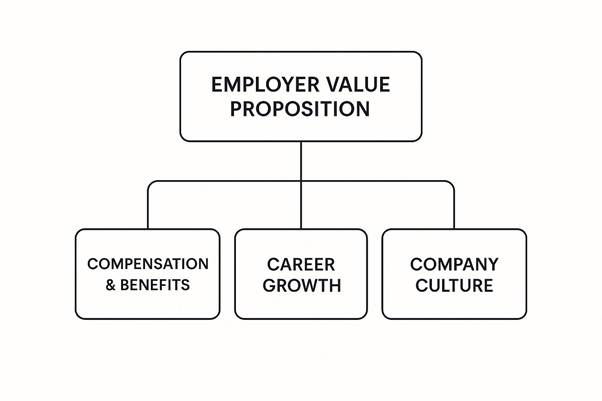
As you can see, it’s the combination of these key areas that forms the overarching promise you make to your employees. Let’s dig into each one.
The Five Pillars of a Modern Employer Value Proposition
To really grasp how these components work together, it helps to see them laid out. The table below breaks down each of the five pillars, explaining what they cover and giving concrete examples. This is your blueprint for building a comprehensive and appealing offer that resonates with today’s talent.
| Pillar | What It Covers | Examples |
| Compensation | The direct financial rewards for an employee’s work and contribution. | Competitive base salary, performance bonuses, sales commissions, profit sharing, stock options, equity. |
| Benefits | Indirect, non-wage compensation that supports well-being and security. | Health insurance, retirement plans (like PF), paid time off, parental leave, wellness stipends, tuition reimbursement. |
| Career | Opportunities for professional growth, development, and advancement. | Training programs, mentorship opportunities, clear promotion paths, internal mobility, challenging projects. |
| Work Environment | The physical and cultural setting where work gets done. | Flexible work hours, remote/hybrid options, modern office space, the right tech and tools, recognition programs. |
| Culture | The organisation’s values, beliefs, and behaviours—the “vibe” of the workplace. | Collaborative teamwork, transparent leadership, commitment to diversity and inclusion, a sense of purpose and mission. |
By ensuring each pillar is strong and well-defined, you create a balanced and attractive proposition that covers all the bases for potential and current employees.
Compensation
The most straightforward and tangible pillar is, of course, Compensation. This is the direct financial reward an employee gets for the work they do. But while it all starts with a competitive base salary, a robust compensation pillar goes much, much further.
It’s really about the entire financial package you put together to attract, retain, and motivate your top performers.
- Bonuses and Incentives: Performance-based bonuses and rewards that create a clear link between individual or team success and financial gain.
- Equity and Stock Options: Giving employees a real stake in the company’s long-term success creates a powerful sense of ownership.
- Fair Pay Practices: A commitment to transparent and equitable pay scales that actively work to eliminate bias and build deep-seated trust.
Benefits
Running a close second to compensation is the Benefits pillar. This covers all the non-wage offerings that support an employee’s health, financial future, and general well-being. This is where companies can really show they care about their people as individuals, not just as cogs in a machine.
Often, these perks are the deciding factor when a top candidate is weighing up multiple job offers.
A truly great benefits package anticipates employee needs beyond the basics. It’s a clear signal that the company is invested in the employee’s life, both inside and outside the office walls, fostering loyalty and reducing stress.
For instance, a modern benefits package might include comprehensive health insurance, solid retirement plans, generous parental leave, wellness stipends for gym memberships or mental health support, and even access to financial planning services.
Career
The Career pillar is all about growth, development, and looking ahead. The best talent is ambitious; they aren’t just looking for a job, they want a journey. This pillar directly answers their question, “Where can I go from here?” It’s your promise to invest in their professional future.
A strong career pillar is what turns a simple job into a long-term professional pathway.
Key elements here are:
- Learning and Development: Providing access to training, workshops, and certifications to build new, relevant skills.
- Mentorship Programmes: Connecting employees with experienced leaders who can offer guidance and champion their growth.
- Clear Advancement Paths: Having transparent criteria for promotions and actively encouraging internal mobility.
Work Environment
The Work Environment pillar is all about the physical and digital space where work actually happens, plus the policies that shape the daily grind. It’s about creating an atmosphere where people can do their best work comfortably and efficiently. This has become a massive focus with the rise of flexible and remote work.
This pillar addresses the practical, day-to-day realities of a role, zeroing in on things like flexibility, autonomy, and having the right tools to get the job done.
Culture
Finally, we have the Culture pillar—the very heart and soul of your organisation. It’s that collection of values, beliefs, and behaviours that defines “how we do things around here.” You see it in your leadership style, in how teams collaborate, and in the sense of community and belonging you build.
A strong culture is arguably the hardest thing for competitors to copy. Research from the Randstad Employer Brand Research (REBR) report highlights that the Indian workforce is increasingly seeking purpose-driven roles. Work-life balance and equity now stand shoulder-to-shoulder with salary as top drivers of an EVP. To win in this market, companies absolutely must build a culture that delivers on these evolving expectations. You can read the full research on India’s top employer brands to learn more.
How to Craft Your Authentic EVP

Putting together an Employer Value Proposition that actually works isn’t about brainstorming a clever slogan in a boardroom. It’s an act of discovery. It’s a process of unearthing the genuine, lived experiences that make your organisation a unique place to be. A truly authentic EVP is built, not just invented.
The goal is to land on a promise that is both aspirational and, crucially, true. It has to reflect the day-to-day reality for your current people while also being compelling enough to attract the future talent you need to grow. This means looking inward at your team and outward at the market.
This practical, step-by-step roadmap will guide you through building an EVP that is both powerful and genuine, ensuring it connects with the right candidates and stands the test of time.
Start by Looking Inward
First things first: listen to the people who know your company best—your employees. They are the living, breathing embodiment of your culture and your most reliable source of truth. Your mission here is to find out what they genuinely value about working for you, what keeps them coming back day after day.
To do this, you need to gather honest feedback from a few different angles.
- Employee Surveys: Use anonymous surveys to ask direct questions about what employees appreciate most. Cover everything from compensation and benefits to leadership, work-life balance, and career opportunities.
- Interviews and Focus Groups: Sit down for one-on-one chats with your high performers and hold small focus groups with diverse teams. These conversations let you dig deeper than any survey, exploring the real nuances of their experiences.
The most powerful insights often come from asking simple, open-ended questions like, “What’s the one thing you’d miss most if you left?” or “Describe a moment when you felt proud to work here.”
This internal audit gives you the raw material for your EVP. It helps you spot the recurring themes and emotional truths that define your workplace. Don’t shy away from the negatives, either; understanding the pain points is crucial for building a proposition that is realistic and credible.
Then Look Outward for Context
Once you have a clear picture of your internal reality, it’s time to see how you stack up against the competition. Your EVP doesn’t exist in a bubble; it needs to be distinctive to stand out in a crowded talent market. This external analysis provides that crucial context.
Start by researching your direct talent competitors—the companies you often lose candidates to. Check out their careers pages, read their employee reviews on platforms like Glassdoor, and see what they’re posting on social media. What promises are they making? What strengths are they shouting about?
This isn’t about copying them. It’s about finding your own unique space in the market.
- Analyse Competitor EVPs: Identify the key themes they focus on. Are they all competing on flexibility? On innovation? On career growth?
- Monitor Your Reputation: See what former and current employees are saying about you online. This gives you an unfiltered view of your perceived strengths and weaknesses.
By comparing your internal findings with this external analysis, you can pinpoint what makes you different. Maybe your competitors talk a big game about culture, but your data shows that your deep commitment to mentorship is a tangible differentiator. Finding these unique intersections is where the magic happens.
Synthesise and Define Your Core Themes
With all this rich data in hand, the next step is to bring it all together. Sift through your survey results, interview notes, and competitive research to identify the handful of core themes that keep popping up. These will become the pillars of your future EVP.
Look for the patterns. Did “a strong sense of community” come up in every single focus group? Do your surveys show that “opportunities to work on meaningful projects” is a major reason people stay? These are the unique, authentic attributes you can build on. The goal is to distil everything down to three to five core pillars that truly define your employee experience.
Craft Your Compelling EVP Statement
Finally, it’s time to articulate your findings in a clear, compelling EVP statement. This isn’t just a summary; it’s a powerful declaration of the promise you make to your people. It should be memorable, easy to understand, and emotionally resonant.
A great EVP statement is:
- Authentic: It must reflect the real experience of working at your company.
- Compelling: It should highlight what makes you uniquely attractive to your ideal candidates.
- Distinctive: It needs to set you apart from your competitors in the talent market.
Remember, this statement is the foundation for all your recruitment marketing and employer branding. It will guide how you write job descriptions, what you post on social media, and how you talk about your company to the world. It’s also a vital tool for assessing and hiring for cultural alignment, which is a critical part of making your EVP a reality. For more on this, you can check out our detailed guide on the 5 best practices for assessing and hiring a culture-fit candidate. This ensures the people you attract are truly set up to thrive in your environment.
Bringing Your EVP to Life in the Real World
Crafting a powerful employer value proposition is a huge achievement, but let’s be honest—it’s only step one. An EVP that just sits in a PowerPoint deck or a dusty strategy document isn’t doing anyone any good. To actually make a difference, your value proposition needs to be activated. It must be woven into the very fabric of your organisation and communicated consistently at every single touchpoint.
This is where the rubber meets the road. Activation is how you turn your EVP from a mere statement into a living, breathing part of your culture. It’s about making sure the experience you promise on the outside is the exact same one your employees feel on the inside, day in and day out.
This means embedding your EVP across the entire employee journey, from the very first time a candidate hears your company’s name to their last day and beyond.
Weaving Your EVP Into the Candidate Journey
Your EVP has to be the golden thread running through every interaction a potential hire has with your brand. It should be felt, not just read. The goal is to create a seamless and genuine experience that backs up your core promises from the very beginning.
Start by looking closely at these critical touchpoints:
- Job Adverts: Don’t just spit out a list of responsibilities. Use language that breathes life into your EVP pillars. If collaboration is a core value, describe projects in team-focused terms. If growth is your big promise, highlight specific learning paths and opportunities.
- Careers Page: This is your EVP’s home base. It’s where you prove your claims. Use real employee testimonials, day-in-the-life videos, and authentic stories to show people what it’s really like to work for you. Let your team be the voice of your brand.
- Interview Process: Every single interaction, from the first screening call to the final interview, should echo your company’s values. If respect is a core tenet, then every candidate should leave feeling valued and heard, whether they get the job or not.
When you consistently reinforce your message, you start attracting candidates who are not just skilled, but who are a genuine fit for what your organisation is all about.
Amplifying Your EVP Externally
Once you’ve got your internal house in order, it’s time to shout your employer value proposition from the rooftops. This is all about strategic storytelling, and your employees are your most powerful storytellers.
Your employees are your most credible marketing channel. Empowering them to share their genuine experiences builds a level of trust and authenticity that no corporate branding campaign can ever replicate.
Here are a few effective ways to amplify your message externally:
- Employee Stories: Feature your people on your blog or social media. Let them share their personal growth journeys, their favourite projects, or what they truly love about the company culture.
- Social Media Content: Think beyond just posting jobs. Share behind-the-scenes glimpses of team events, celebrate work anniversaries, and put a spotlight on employee achievements. Show, don’t just tell.
- Strategic Branding: Make sure your consumer brand and your employer brand are singing from the same hymn sheet. Every public-facing message should feel like it comes from the same authentic, unified company.
Empowering Leaders as EVP Champions
At the end of the day, the promise of your EVP is delivered by your leaders and managers. They are the ones shaping the daily reality for their teams, which makes them the most important champions of your value proposition.
You have to give them the tools to lead in a way that aligns with your EVP. This means training them on what the EVP actually means in practice and how their actions—from giving feedback in performance reviews to encouraging a healthy work-life balance—directly bring it to life. For a real-world example, check out how strategic leadership was used in this case study on building an employer brand for Covance.
When your managers live and breathe the EVP, it stops being a concept and becomes an undeniable reality for everyone.
Frequently Asked Questions
As you start to build out a compelling employer value proposition, it’s only natural for some practical questions to pop up. Getting a handle on these common queries is key to managing and measuring your EVP for the long haul, making sure it stays a powerful magnet for top talent.
Let’s dive into some of the most frequent questions we hear from leaders and HR professionals during the EVP process.
How Often Should We Update Our EVP?
An EVP isn’t something you can just set and forget. Think of it more like a living, breathing promise to your team—one that needs to adapt as your company and the market evolve. While you don’t need to reinvent the wheel every quarter, a regular check-up is crucial to keep it feeling genuine and relevant.
As a rule of thumb, plan to formally review your employer value proposition every 18-24 months. However, certain events should definitely trigger an earlier look:
– Major Market Shifts: A sudden economic downturn or a big swing in the talent market can completely change what candidates are looking for.
– Big Internal Changes: Things like a merger, an acquisition, or a major pivot in your business strategy all call for an EVP reassessment.
– Evolving Employee Feedback: If your engagement surveys or exit interviews start showing new trends or priorities, your EVP needs to catch up.
Can Small Businesses Actually Compete on EVP?
Absolutely! A smaller budget doesn’t mean you can’t have a killer employer value proposition. In fact, small and medium-sized enterprises (SMEs) often have unique strengths that bigger corporations just can’t match.
Instead of trying to win a salary war, lean into what makes you different:
– Real Impact and Autonomy: Offer your people a direct line of sight to how their work moves the needle and give them more ownership over their projects.
– Genuine Flexibility: SMEs are often more nimble, meaning you can offer truly flexible working arrangements that larger, more bureaucratic companies struggle with.
– A Close-Knit Culture: You can highlight the strong sense of community and direct access to leadership that’s often the heart of a smaller team.
For an SME, the EVP is all about culture, purpose, and seeing your direct contribution. These are incredibly powerful draws and often mean more to top talent than a slightly bigger paycheque from a faceless corporation.
How Do We Know If Our EVP Is Working?
Measuring the return on your EVP is critical. Success isn’t just a vibe; it’s something you can track with real, tangible numbers.
Here are a few key performance indicators you should be watching:
– Offer Acceptance Rate: A high acceptance rate is a great sign that your proposition is hitting the mark with the candidates you want.
– Quality of Hire: Keep an eye on the performance and retention of new hires who came on board after you launched your EVP. Are they thriving?
– Employee Engagement Scores: A strong EVP should naturally lead to a more engaged, motivated, and satisfied workforce.
– Voluntary Turnover Rate: When fewer people choose to leave, it’s a powerful signal that you’re delivering on the promises you’ve made.
Ready to build an employer brand that pulls in top-tier talent and fuels business growth? Taggdspecialises in Recruitment Process Outsourcing, helping you craft and activate a compelling EVP that delivers measurable results. Discover how we can transform your talent strategy.