
Boost Hiring Efficiency with a Recruitment CRM
Think of a recruitment CRM, or Candidate Relationship Management system, as your secret weapon for building a powerhouse talent network. It’s a proactive technology designed to help you build and nurture relationships with potential candidates long before you even have a job opening to fill. It’s less of a filing cabinet for applications and more of a living, breathing talent ecosystem.
What Is a Recruitment CRM and Why It Matters Now
In the past, hiring was mostly a reactive game. A position would open up, a job description would get posted, and recruiters would start the long process of sifting through a mountain of applications. This traditional method, usually managed by an Applicant Tracking System (ATS), is a bit like only going fishing when you’re starving—you just have to hope the right fish are biting at that exact moment.
A recruitment CRM completely flips this script.
It moves your hiring strategy from being transactional to being driven by proactive relationships. Instead of just waiting for people to apply, you start building a talent pool of qualified individuals who already know and like your brand. This community includes everyone from past applicants and employee referrals to promising passive candidates you’ve sourced from various channels.
This strategic shift is a game-changer in today’s competitive job market. The best talent is often passive; they aren’t actively job hunting but would be open to the right opportunity if it came along. A recruitment CRM is the perfect tool to keep these high-potential candidates engaged through targeted communication, sharing company news, and sending them content they’ll actually find valuable.
Recruitment CRM vs Applicant Tracking System (ATS)
It’s easy to confuse a Recruitment CRM with an Applicant Tracking System (ATS), but they serve fundamentally different purposes. An ATS is built to manage the chaos of active applications for open roles—it’s a workflow tool. A CRM, on the other hand, is a relationship tool for managing people who aren’t yet applicants. Think of it this way: a CRM is for building your audience, while an ATS is for managing the cast once the auditions start.
| Feature | Recruitment CRM (Proactive) | Applicant Tracking System (Reactive) |
| Primary Goal | Build and nurture relationships with potential future hires (passive candidates). | Manage and track active applicants through the hiring process for specific jobs. |
| Focus | Candidate engagement and long-term talent pooling. | Application processing and compliance for open roles. |
| Typical User | Recruiters, Sourcers, Talent Acquisition Leaders. | Recruiters, Hiring Managers, Compliance Officers. |
| Core Functionality | Email campaigns, talent pipelines, sourcing analytics, event management. | Job posting, application tracking, interview scheduling, offer management. |
| Analogy | A marketing tool for your employer brand. | A workflow tool for your hiring process. |
While both systems are crucial for a modern talent acquisition function, they address different stages of the recruitment lifecycle. A CRM fills the pipeline, and an ATS helps you manage it once candidates officially apply.
From Reactive to Proactive Hiring
The real magic of a recruitment CRM is how it manages the entire pre-application journey. It gives your team the power to organise talent into specific pipelines based on skills, experience, or potential future roles. This allows for incredibly personalised engagement that builds trust and keeps your organisation at the front of their minds.
Here are a few key capabilities that power this shift:
- Talent Pooling: Segmenting candidates into curated lists for future openings, so you always have a warm bench.
- Automated Nurturing: Sending personalised email campaigns to keep your talent pool engaged without manual effort.
- Comprehensive Profiles: Tracking every single interaction—from emails opened to events attended—for a complete 360-degree view of a candidate.
- Sourcing Analytics: Finally understanding which channels are actually delivering the best long-term talent, not just the most applicants.
This proactive approach doesn’t just get you ready for future hiring needs; it also massively improves your key performance metrics. When you build relationships over time, you create a pipeline of pre-vetted, interested candidates who are ready to talk the moment a role opens up. To build an effective strategy, it’s vital to stay updated on emerging trends. You can learn more about the latest innovations by exploring the top hiring trends to reinvent your recruiting strategy today.
A recruitment CRM transforms your talent pipeline from a static list into a dynamic community. It’s the difference between having a rolodex of contacts and cultivating a network of advocates for your brand.
The proof is in the numbers. The following infographic shows the tangible impact a recruitment CRM can have on the metrics that matter most.
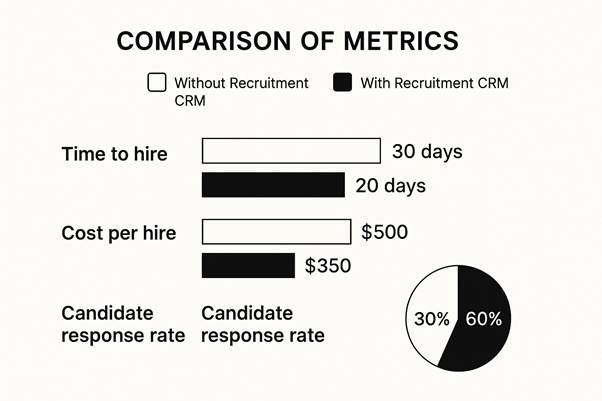
The data speaks for itself. Organisations that adopt a recruitment CRM can see a 33% reduction in time to hire while simultaneously doubling their candidate response rate. That kind of efficiency doesn’t just save money—it gives you a serious competitive advantage.
Exploring the Core Features of a Modern Recruitment CRM

While the big-picture idea of proactive talent management is compelling, the real magic of a recruitment CRM happens in its day-to-day features. These are the tools that take the abstract concept of a ‘talent ecosystem’ and make it a tangible, operational advantage for your recruiting team. Let’s pull back the curtain on the core functions that truly set a modern recruitment CRM apart from a basic contact list.
Think of these features like the instruments in an orchestra. Each has a specific job, but when they play together, they create a powerful and seamless hiring symphony. It’s this integrated approach that solves real-world recruiting headaches and truly elevates your talent acquisition strategy.
Centralised Talent Sourcing and Pooling
Today’s recruiters are pulling candidates from everywhere: LinkedIn, professional networks, job boards, employee referrals, and even old applicant files. A cornerstone of any good recruitment CRM is its ability to pull all these scattered sources into one unified, searchable talent pool. This immediately stops great candidates from getting lost in forgotten spreadsheets or siloed email inboxes.
Instead of starting every single search from square one, your team can tap into a living, breathing community of talent you’ve already built. This single source of truth becomes the foundation for every proactive move you make.
- Multi-Channel Sourcing: The system automatically pulls in and organises candidate data from dozens of platforms, creating a rich, diverse pipeline from the get-go.
- Employee Referral Tracking: It simplifies your referral programme by effortlessly tracking who referred whom, ensuring your team gives credit where it’s due and keeps employees engaged.
- Past Applicant Rediscovery: The CRM makes it simple to find and re-engage with those “silver medallist” candidates from past searches who could be the perfect fit for a new opening.
Advanced Search and Candidate Matching
Once you have all your talent in one place, the next challenge is finding the right person in that massive pool. This is where the powerful search functions of a recruitment CRM really shine. It’s like having a hyper-intelligent search engine built specifically for your talent pipeline.
These tools go far beyond just looking for keywords on a resume. They use a smart mix of boolean logic, skill tags, and even AI-powered matching to pinpoint the ideal candidates for roles you have now and roles you’ll have in the future.
For instance, a recruiter could instantly search for candidates tagged with “Java,” who have experience in “fintech,” and who also have a high engagement score, showing they’ve recently interacted with your company’s content. Trying to do that with traditional methods is nearly impossible and would take hours, not seconds.
A powerful recruitment CRM doesn’t just store candidate data; it makes that data intelligent and actionable. It helps you find the needles in the haystack before you even realise you need them.
Comprehensive 360-Degree Candidate Profiles
A resume is just a snapshot in time, a two-dimensional look at a career. A recruitment CRM, on the other hand, builds a dynamic, evolving profile for every single person in your talent pool. It acts as a living history of every interaction your organisation has ever had with a potential hire.
This 360-degree view gives recruiters the kind of context a static CV never could. It shows not just what a candidate has done, but how engaged and interested they are in your brand right now.
What a Candidate Profile Tracks:
- Communication History: Every email sent, opened, and clicked is logged, giving you a clear picture of their responsiveness.
- Interaction Timeline: Notes from phone calls, interviews, and any other touchpoints are recorded chronologically, creating a complete story.
- Engagement Score: The system often calculates a score based on these interactions, helping recruiters prioritise follow-ups with the warmest leads.
- Pipeline Status: Recruiters can see exactly which talent pipelines the candidate is in and where they stand in each process.
This depth of information empowers your team to have far more meaningful and personalised conversations. When you reach out, you’re not just another recruiter with a generic job description; you’re an informed contact who understands their specific history with your company. In a competitive market, that personalised touch is exactly what you need to attract and land top talent.
Key Benefits for Your Hiring Strategy

Let’s be clear: a recruitment CRM isn’t just a fancy digital address book. When used right, it delivers real, measurable results that directly impact your company’s bottom line and ability to compete for top talent. For HR leaders, this tool is a strategic lever, turning talent acquisition from a reactive cost centre into a proactive, value-driving powerhouse. The benefits aren’t just theoretical—they solve some of the most stubborn challenges in hiring today.
One of the first things you’ll notice is a huge drop in your time-to-hire. Every single day a key role sits empty, productivity and momentum take a hit. A recruitment CRM tackles this head-on by giving you an engaged, pre-vetted talent pool to tap into the moment a new position opens up. Instead of starting every search from square one, your recruiters can dip into a curated pipeline of warm candidates who already know and like your company. This alone can shave weeks off the hiring cycle.
And this newfound speed doesn’t mean you sacrifice quality. In fact, it’s the opposite. Building relationships over time consistently improves the calibre of people you bring on board. By nurturing these connections, you gain deeper insights into a candidate’s skills, ambitions, and cultural fit long before a formal interview ever takes place. When a role finally opens, you’re not just finding qualified people; you’re finding the right people who are already bought into your mission.
Elevate the Candidate Experience
In a market where top talent has plenty of options, the candidate experience is what sets you apart. A recruitment CRM is your secret weapon for delivering a personalised, high-touch journey for every potential hire, even when you’re dealing with hundreds of them. It automates communication so no one feels like they’ve been ghosted, sending tailored updates and relevant content to keep them interested.
This personal touch makes candidates feel valued, not like another resume in a massive pile. It builds a positive perception of your brand from the very first interaction—an impression that sticks, whether they get the job or not. A great experience can turn applicants into brand advocates.
By focusing on the relationship, a recruitment CRM ensures that even candidates you don’t hire today can become your biggest fans—or your best hires—tomorrow. It’s about playing the long game for talent.
Strengthen Your Employer Brand
Your employer brand is built one interaction at a time. A recruitment CRM is the engine that keeps those interactions consistent, professional, and on-message.
- Consistent Messaging: Use standardised communication templates so every candidate receives a clear, professional message that reflects your company’s values.
- Targeted Content: Share blog posts, company news, and industry insights with specific talent pools to showcase your expertise and position your company as a great place to work.
- Event Management: Seamlessly manage recruiting events, from webinars to campus fairs, and track who’s most engaged for targeted follow-ups.
This strategic communication builds a powerful story around your organisation, attracting top-tier talent who are drawn to your culture and vision, not just a job description.
Drive Strategic Workforce Planning
Perhaps the biggest long-term win from a recruitment CRM is the goldmine of data it provides. The platform becomes the central hub for all your talent efforts, offering insights that are crucial for strategic workforce planning. Finally, you can answer critical questions with data, not just gut feelings. Which sourcing channels bring in the best candidates? How long does it really take to fill certain roles? Where are the bottlenecks in our process?
This data-driven approach allows you to make smart decisions that align with your organisation’s growth goals. The rapid adoption of this technology in India underscores its strategic value. The recruitment CRM market in India generated sales of around USD 73 million recently and is projected to hit approximately USD 113 million by 2025. This points to a clear shift towards more strategic, data-backed hiring. You can dive deeper into these trends to understand the recruitment CRM landscape.
How AI and Automation Drive Recruiting Efficiency
If you think of a traditional recruitment CRM as your talent library, then artificial intelligence (AI) and automation are the expert librarians working around the clock. They don’t just store information; they actively find connections, manage the small stuff, and free up your recruiters to focus on what they do best—building genuine relationships. These technologies are the real engine powering modern recruiting.
Imagine your recruiters spending hours manually sifting through hundreds of resumes, trying to match keywords to a job description. It’s slow, tedious, and easy to miss the perfect candidate by mistake. AI completely changes this by handling the heavy lifting with incredible speed and accuracy.
This isn’t just a passing trend; it’s fast becoming the standard. The Indian recruitment software market, valued at about USD 80 million in 2024, is projected to hit USD 120 million by 2033. This growth is being fuelled by the adoption of digital hiring tools, with around 93% of Indian hiring managers already using AI for tasks like refining resumes. You can find more details by exploring the full recruitment software market report.
Automating the Repetitive to Unleash the Strategic
The most immediate win from automation in a recruitment CRM is getting rid of low-value, repetitive tasks. This isn’t about replacing recruiters; it’s about making them better at their jobs.
Think about the simple act of keeping candidates in the loop. Automation handles this flawlessly.
- Automated Email Campaigns: You can set up personalised email sequences to nurture your talent pools. A candidate interested in future marketing roles can automatically receive your company newsletter and relevant blog posts, keeping them engaged.
- Instant Candidate Replies: When someone applies, an automated yet personalised email can confirm their application was received, outline the next steps, and set clear expectations. It’s a small touch that instantly improves their experience.
- Interview Scheduling: Integrated scheduling tools can put an end to the endless email chains trying to find a time that works for everyone. The system just syncs everyone’s calendars automatically.
These automated workflows make sure no candidate falls through the cracks and every interaction feels professional and timely. This frees up your team from admin overload, letting them spend more time on strategic work like sourcing high-value candidates and conducting meaningful interviews.
AI and automation don’t remove the human element from recruiting. They remove the robotic tasks, allowing recruiters to be more human, strategic, and relational than ever before.
From Parsing Resumes to Predicting Success
AI’s role in a recruitment CRM goes far beyond just ticking boxes. It adds a layer of intelligence that helps you make smarter hiring decisions.
One of the most powerful examples is AI-powered resume parsing. When a resume enters your system, the AI instantly reads, understands, and pulls out key information—skills, experience, education—and uses it to build out the candidate’s profile. From there, it can intelligently match that profile against open roles or the ideal candidate personas you’ve created.
Beyond simple matching, some of the more advanced platforms use predictive analytics. By analysing data from your past successful hires, the AI can spot patterns and highlight new candidates who share similar traits, essentially flagging them as having high potential for success at your organisation. Of course, the rise of such powerful technology also sparks discussions about its broader effects on employment, a topic worth understanding as you integrate these tools. To dig deeper, you can explore the relationship between ChatGPT, AI, and potential job displacement in our detailed article.
Finally, integrated chatbots act as your 24/7 first point of contact. They can answer common candidate questions about benefits, company culture, or application status, providing instant support and qualifying leads without any recruiter having to step in. This ensures a great experience for candidates, no matter what time zone they’re in.
Implementing Your Recruitment CRM for Success

Successfully launching a recruitment CRM goes far beyond just installing new software. Think of it as a fundamental shift in how your entire team approaches talent acquisition. In my experience, the single most important factor for getting a strong return on your investment is viewing implementation as a change management project, not just a tech rollout. Without this mindset, even the most powerful platform can fall flat.
The groundwork begins long before you sign any contract. First thing’s first: define your business objectives with absolute clarity. What specific hiring challenges are you actually trying to solve? Maybe you’re looking to slash the time-to-hire for critical roles, build a pipeline for future leadership, or simply boost your employer brand. Having clear, measurable goals will guide every decision you make down the line.
Getting buy-in from your key stakeholders is just as critical. Your recruiting team and hiring managers will live in this system daily, and their enthusiasm will make or break the entire project. Involve them early, listen to their frustrations with the current process, and show them exactly how the new CRM will make their jobs easier and more impactful.
Planning for a Smooth Transition
One of the biggest hurdles that can trip up any new system launch is data migration. Moving years of candidate information from scattered spreadsheets or an old ATS can feel like a mammoth task, but a well-structured plan makes it entirely manageable. Remember, a clean, organised database is the bedrock of a high-performing CRM.
Start by auditing what you already have. What information is actually valuable and needs to come across? What’s outdated and can finally be archived? This is the perfect opportunity to cleanse your records and start fresh with high-quality data.
- Prioritise Your Data: Identify the most critical data sets to move first, like high-potential candidates from past searches or active talent pools you’ve been nurturing.
- Map Your Fields: Carefully map the data fields from your old system to the new one. This ensures no crucial information gets lost in translation.
- Plan for Downtime: Schedule the migration during a slower recruiting period to minimise disruption to your team’s day-to-day workflow.
A successful CRM implementation is built on a foundation of clean data and enthusiastic users. Neglect either, and you risk undermining the entire project before it even begins.
Driving Adoption Through Training and Support
Simply giving your team access to the new recruitment CRM isn’t enough. They need to understand its value and feel confident using it. This is where comprehensive, role-specific training becomes non-negotiable. Your recruiters need different training from your hiring managers, so be sure to tailor the sessions to their specific needs and daily tasks.
Choosing the right vendor is paramount here. Look for a partner who offers robust, ongoing support and has a deep understanding of the local market. The vendor should feel like an extension of your team, ready to help you navigate challenges and get the most out of the platform. The rapid growth of the CRM market in India, which includes sophisticated recruitment solutions, really underscores how vital this technology has become. India’s CRM market hit USD 2.3 billion in 2024 and is projected to reach USD 5.16 billion by 2033, largely driven by AI-powered platforms. You can find more insights by exploring the India CRM market growth.
Ultimately, a successful implementation ensures your team can fully use the tool to make their work more efficient. You can see these principles in action by exploring how the right recruitment platform eases digital hiring. This focus on user empowerment is what transforms a piece of software into a true strategic asset for your organisation.
Common Questions About Recruitment CRM
Even after seeing all the benefits laid out, stepping into the world of a recruitment CRM can still bring up a few questions. That’s perfectly normal. To help you feel completely confident, we’ve put together the most common queries we hear from HR leaders and answered them directly and practically.
Think of this as your quick-start guide, clearing up any lingering uncertainties so you can move forward with a solid plan.
What Is the Main Difference Between a Recruitment CRM and an ATS?
This is the number one question we get, and the answer comes down to their core purpose. An Applicant Tracking System (ATS) is a reactive tool. It’s built to manage the workflow for active job applicants who have applied for a specific, open role.
A recruitment CRM, on the other hand, is a proactive tool. Its whole reason for being is to build and nurture long-term relationships with a broad talent pool. This includes passive candidates—the talented folks who aren’t even looking for a job right now. The CRM is all about managing relationships, not just processing applications.
Here’s the simplest way to think about it: Your ATS manages the people applying to your jobs today. Your recruitment CRM manages the people you want to apply to your jobs in the future.
Your CRM builds that crucial talent pipeline. So, when a position does open up, you already have a ready-made list of warm, pre-vetted candidates. At that point, the ATS takes over to manage them through the formal hiring process.
Can a Small or Medium-Sized Business Benefit from a Recruitment CRM?
Absolutely. In fact, for small and medium-sized businesses (SMBs), a recruitment CRM can be a real game-changer, letting you compete for top talent against much larger companies. It helps you punch well above your weight by building a powerful employer brand and delivering a personal touch to the candidate experience, even with a smaller team and budget.
By automating your communication and building your own talent pool, you dramatically cut down your dependency on expensive job boards or recruitment agencies for every single hire. This makes your whole hiring process more sustainable and cost-effective in the long run.
Most modern, cloud-based recruitment CRM platforms offer flexible pricing models, making them both affordable and accessible for growing businesses that want to hire smarter, not just harder.
How Does a Recruitment CRM Integrate with Other HR Systems?
Seamless integration is a non-negotiable for any good recruitment CRM. These platforms are designed to be the central hub for your entire talent acquisition function, not just another silo of information. They are built from the ground up to connect with the other tools in your HR tech stack.
Common integrations include:
– Applicant Tracking System (ATS): This is the most critical link. It allows candidate data to flow smoothly from the CRM (the relationship-building phase) into the ATS (the application phase) without any tedious manual data entry.
– Human Resource Information System (HRIS): Once a candidate is hired, their profile information can be automatically pushed to your HRIS. This creates a seamless handover from candidate to new employee.
– Email and Calendar Platforms: Integrations with tools like Gmail and Outlook let recruiters sync their communications and schedule interviews directly from the CRM, keeping everything organised in one central place.
This web of connections ensures that data moves freely across your systems, killing off repetitive admin work and giving you a single, unified view of your entire talent lifecycle.
What Are the First Steps When Choosing a Recruitment CRM Vendor?
Picking the right vendor is a big decision that will impact your recruiting success for years. Rushing this process is a common mistake. Instead, you need a structured, thoughtful approach to make sure you find a genuine partner, not just a software supplier.
Here’s a simple, four-step process to get you started:
1. Define Your Needs: First things first, clearly map out your biggest recruiting challenges and your specific goals. Make a prioritised list of “must-have” features versus “nice-to-have” ones. This list becomes your scorecard for judging vendors.
2. Research and Shortlist: Look for vendors with a proven track record and strong customer support in your region. Dive into case studies and online reviews, then narrow your options down to a shortlist of two or three promising providers.
3. Request Live Demos: Schedule personalised demos with each vendor on your shortlist. Don’t settle for their standard sales pitch; ask them to show you exactly how their platform would solve your real-world recruiting problems. This is where you really test their metal.
4. Check Customer References: This is a vital final step that too many people skip. Ask each vendor for references from companies of a similar size and in a similar industry to yours. Speaking directly to a current customer about their experience with implementation, training, and ongoing support will give you priceless, unbiased insight.
Ready to transform your hiring strategy from reactive to proactive? Taggdprovides expert Recruitment Process Outsourcing solutions that leverage powerful technology to build the talent pipelines you need to win. Discover how we can help you hire smarter and faster.