
Unlocking Your Talent Intelligence Edge
Let’s be clear: talent intelligence isn’t just the latest HR buzzword. It’s a strategic shift that turns raw workforce data into a genuine competitive edge. This is about moving beyond the old, reactive way of recruiting and embracing a proactive, data-fuelled understanding of the talent landscape. It means knowing exactly where to find the best people, seeing what skills are coming around the corner, and building a team that’s ready for whatever the future holds.
What Is Talent Intelligence?
To cut through the jargon, think of it this way. Traditional recruiting is a bit like fishing with a single line in a vast ocean. You cast your line, hope for a bite, and maybe you get lucky. It’s slow, unpredictable, and often frustrating.
Talent intelligence, on the other hand, is like having advanced sonar that maps the entire talent ocean. It doesn’t just show you where the fish are; it tells you their species (skills), their migration patterns (career paths), and the overall health of the ecosystem (market trends). That jump from reactive hope to predictive strategy is the heart of what talent intelligence delivers.
For a CHRO, this changes everything. You’re no longer just filling seats as they become empty. You are the architect of the future workforce, building with precision and foresight.
From Data Points to Strategic Decisions
At its core, talent intelligence is the practice of gathering and analysing data from both inside and outside your organisation to make smarter people decisions. It’s all about connecting the dots between seemingly random pieces of information to see the bigger picture.
This means looking at a few key areas:
- Internal Data: This is the goldmine you’re already sitting on. Think about the information in your HRIS and Applicant Tracking System (ATS)—employee skills, performance reviews, tenure, and promotion rates.
- External Data: This is what’s happening outside your four walls. It includes wider market trends, what your competitors are doing, salary benchmarks, skill supply and demand, and even university graduation rates.
When you merge these two streams, you get a complete view that empowers you to act strategically. For example, you can pinpoint the critical skills your business will need in three years and start building those talent pipelines today.
Talent intelligence isn’t about replacing human intuition in HR; it’s about supercharging it with powerful data. It gives you the hard evidence to back your strategic direction and make confident, high-impact decisions that tie directly to business goals.
Why It Matters Now More Than Ever
The business world is in constant flux, which makes proactive workforce planning a necessity, not a nice-to-have. A strong talent intelligence function helps you anticipate these shifts instead of just reacting to them. This is fast becoming the centrepiece of HR strategy, especially in fiercely competitive markets.
Despite its growing importance, there’s still a gap in real understanding. A 2023 survey of CHROs in India revealed that while 72% of companies increased their investment in this area, 28% still couldn’t clearly define what it actually was. This just goes to show how urgent the need for clarity is. You can read the full research on talent intelligence adoption to get the complete picture.
Ultimately, this data-driven approach lets you answer critical business questions with confidence: Are we hiring the right people? Are we developing the skills we need to grow? Are we at risk of losing our best talent to the competition? With talent intelligence, you finally have the insights to give definitive answers.
The Strategic Impact of Talent Intelligence

Talent intelligence is what finally connects HR’s work to the company’s bottom line. It translates all our people-centric efforts into the language of the boardroom, giving CHROs the power to demonstrate real business outcomes that grab the attention of the CEO and CFO.
It’s about moving past standard HR metrics and showing exactly how a smarter talent strategy drives revenue, slashes costs, and builds a more agile organisation. This is where your function shifts from being seen as a cost centre to a core driver of business growth.
Let’s dig into the specific ways this capability makes a measurable difference.
Accelerating and Optimising Recruitment
Slow hiring is expensive. Every single day a critical role stays empty, you’re losing productivity, missing opportunities, and burning out the rest of the team. Talent intelligence tackles this head-on by transforming your recruitment function from a reactive fire drill into a proactive, data-informed engine.
By continuously mapping the external talent landscape and knowing where specific skills are concentrated, your team can build candidate pipelines long before a job requisition is even raised. This proactive sourcing dramatically shrinks the time it takes to find the right person when a role does open up.
The results show up in your most important recruitment metrics:
- Reduced Time-to-Hire: Recruiters aren’t starting from zero every time. They’re engaging with pre-vetted, interested candidates, filling crucial roles in a fraction of the time.
- Lower Recruitment Costs: A faster hiring cycle means less money spent on job ads, agency fees, and administrative churn. Proactive sourcing consistently delivers a better ROI.
- Improved Quality of Hire: Data helps you pinpoint the traits of your current top performers, allowing you to find external candidates with similar profiles who are set up for long-term success.
Unlocking Potential with Internal Mobility
Here’s a thought: your next great hire might already be on your payroll. The problem is, most organisations have massive blind spots when it comes to the full range of skills their employees possess. This leads to costly external searches for talent that was sitting in the next department all along.
Talent intelligence acts as an internal discovery tool, illuminating hidden skills, experiences, and aspirations within your current workforce. It moves you from guessing who might be a good fit to knowing with data-backed confidence.
By creating a living, breathing skills inventory, you can spot employees who are ready for a new challenge or have the adjacent skills needed for the roles of tomorrow. This data-driven approach fosters a culture of internal growth and gives your people clear career paths. Not only does this fill roles more efficiently, but it has a huge impact on morale and loyalty when people see a real future for themselves at the company.
Enhancing Employee Retention and Engagement
People stay where they feel valued. When employees know their skills are recognised and their growth is a priority, they are far less likely to look elsewhere. Talent intelligence provides the foundation to create these personalised development opportunities at scale.
By understanding an individual’s skills and career ambitions, you can suggest relevant training courses, mentorship pairings, or new project opportunities. This sends a powerful message: we are invested in your success. This strategic focus on skills is becoming more and more critical, a trend highlighted in recent studies on the Indian workforce. You can explore deeper insights into current trends in the India Skills Report 2023.
This personalised development doesn’t just boost happiness; it builds the exact capabilities your business needs to stay competitive. Ultimately, higher engagement leads directly to lower attrition, saving the company the immense cost and disruption of replacing experienced talent.
Building a Future-Ready Workforce
Perhaps the most powerful benefit of talent intelligence is its ability to see what’s coming. By analysing labour market trends, what your competitors are hiring for, and which skills are gaining momentum, you can anticipate the future needs of your organisation.
This foresight allows you to build a workforce that isn’t just equipped for today but is actively engineered for tomorrow’s challenges.
This proactive approach to workforce planning means you can make decisions now that will pay off for years to come. Whether that means launching an upskilling programme for an emerging technology or building a talent pipeline in a new market, talent intelligence gives you the strategic roadmap to stay ahead of the curve.
Building Your Talent Intelligence Framework
A powerful talent intelligence function isn’t something that just materialises overnight; it has to be built with purpose. Think of it like assembling a high-performance engine for your HR strategy. A solid framework needs distinct, interconnected parts all working in sync to turn raw data into strategic fuel for your business.
This entire structure rests on four essential pillars. By understanding how each one works and supports the others, you can create a robust system that delivers consistent, practical insights. This is the blueprint for moving beyond just collecting data to actively using it as a real competitive advantage.
Let’s break down these four foundational pillars.
Pillar 1: Data Aggregation and Sourcing
The first and most fundamental pillar is gathering your data. You can’t analyse what you haven’t collected. This stage is all about pulling together vast and varied information from both inside and outside your company to create a single, unified source of truth about the talent landscape.
Imagine trying to solve a puzzle with only half the pieces. That’s exactly what happens when you depend solely on internal data. A comprehensive talent intelligence strategy has to combine multiple sources to paint the complete picture.
- Internal Data: This is your own proprietary information—the data you already have. It includes employee performance records from your HRIS, candidate histories from your ATS, and skills assessments from learning platforms.
- External Data: This is what gives you market context. It covers everything from labour market reports and competitor hiring trends to salary benchmarks and social media data that shows which skills are in demand.
Bringing these different sources together is the first critical step toward building a truly predictive capability.
Pillar 2: AI-Powered Analysis and Enrichment
Once you have all the raw data, the next pillar is about turning that chaos into clarity. This is where technology, especially artificial intelligence, takes centre stage. AI algorithms can sift through massive datasets far beyond what any human could manage, identifying subtle patterns and connections that would otherwise stay hidden.
This isn’t just about sorting information; it’s about enriching it. The technology analyses raw numbers to uncover meaningful trends about skill adjacencies, career progression pathways, and talent supply and demand in specific regions. It transforms a simple list of job titles into a dynamic map of capabilities.
For example, AI can analyse thousands of public profiles to see which skills are commonly found together, helping you write more accurate job descriptions or design better upskilling programmes. This analytical power is what turns a data lake into a wellspring of strategic insight.
A robust talent intelligence platform is fuelled by a diverse mix of data. Here’s a look at the key sources you’ll want to tap into:
Key Data Sources for Talent Intelligence
| Data Source Category | Specific Examples | Strategic Insight Gained |
| Internal Systems | HRIS, ATS, Performance Reviews, Skills Inventories | Understand internal mobility, identify high-potentials, spot skill gaps before they become critical. |
| Public Web Data | Professional Networks (e.g., LinkedIn), Company Career Pages, Job Boards | Track competitor hiring, map talent hotspots, understand real-time supply and demand for skills. |
| Labour Market Data | Government Statistics, Salary Benchmarking Sites, Economic Reports | Gain macro-level insights into workforce trends, compensation norms, and regional talent availability. |
| Academic & Learning Data | University Enrollment Data, Online Course Platforms, Industry Certifications | Predict future talent pipelines, identify emerging skills, and see what the next generation of workers is learning. |
By weaving these sources together, you create a rich tapestry of information that provides a truly holistic view of the talent ecosystem.
Pillar 3: Actionable Insight Generation
Data is useless without interpretation. The third pillar, generating actionable insights, is the crucial human element in this framework. It’s the process of translating the patterns and trends uncovered by AI into clear, strategic recommendations that leadership can actually act upon.
This is the bridge between the technical and the strategic. It’s all about answering the “so what?” question. For instance, your data might show that a key competitor is rapidly hiring for a specific skill set in Bengaluru.
The insight isn’t just that this is happening. It’s the strategic recommendation that follows: should we accelerate our own hiring in that region, increase compensation to retain key talent, or launch a targeted upskilling initiative to build that skill internally?
This pillar ensures your talent intelligence function delivers clear, direct value to the business.
Pillar 4: Workflow Integration
The final pillar is all about making these insights accessible and operational. The most brilliant analysis in the world is worthless if it just sits in a dashboard that nobody uses. Workflow integration focuses on embedding talent intelligence directly into the daily processes and decision-making loops of your HR teams and business leaders.
This means the insights show up exactly where and when they’re needed most.
- For Recruiters: This could mean automatically suggesting a list of high-potential internal candidates directly within the ATS when a new role is opened.
- For L&D Managers: It might involve highlighting emerging skill gaps within a department and recommending relevant training modules from your learning platform.
- For Succession Planning: It provides data-backed candidates for critical leadership roles, reducing bias and improving the quality of your talent pipeline.
This integration is what makes talent intelligence a seamless part of how your organisation operates, not just another report to read.
The following infographic illustrates the main categories of tools that support these pillars.
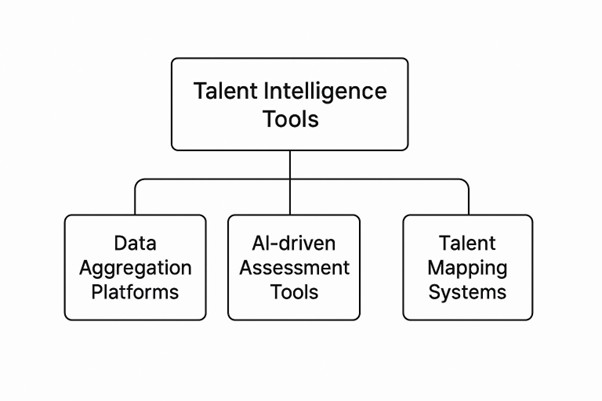
This visual shows how different systems address specific needs, from gathering data to assessing talent and mapping the market. Together, these four pillars create a cyclical, self-improving system where data informs action, and the results of that action generate new data, continuously refining your organisation’s talent strategy.
Putting Talent Intelligence into Action
Moving from theory to practice is where the real magic happens. Kicking off a talent intelligence initiative isn’t just about buying new software; it’s a strategic shift. It requires a thoughtful, structured game plan to make sure you’re solving real business problems and adding clear value right from the start.
This section is your practical roadmap, built for HR leaders ready to spearhead this change. Think of it as a playbook for creating a truly data-driven talent function, one step at a time.
Step 1: Define Clear Business Objectives
Before you even glance at a data dashboard, you have to start with the “why.” What specific, high-stakes business challenge are you trying to tackle? A fuzzy goal like “improve hiring” just won’t cut it. Your objectives need to be sharp, measurable, and tied directly to what the organisation cares about most.
For example, are you struggling to find enough skilled engineers for a critical product launch? Is the main goal to slash employee turnover in your top sales roles by 15%? Or maybe you need to build a leadership pipeline in a new international market you’re expanding into next year?
Nailing down these objectives does two crucial things. First, it gives your initiative a clear direction and a finish line, so you know what success looks like. Second, it helps you sell the value of talent intelligence in a language your C-suite colleagues will actually listen to and get behind.
A successful talent intelligence strategy isn’t about the data you have; it’s about the questions you can answer. Start with the most pressing business questions, and let them guide your entire implementation process.
Step 2: Assemble a Cross-Functional Team
Here’s a secret: talent intelligence is not just an HR project. Its success hinges on collaboration across the entire business. Your implementation team needs to bring together stakeholders from different departments to ensure the insights you generate are relevant and, more importantly, actionable.
Your core team should look something like this:
- HR Leadership: To provide the strategic vision and champion the project from the top.
- Recruitment: The people on the front lines who will use this data every day for sourcing and hiring.
- IT and Data Analytics: The technical wizards who will handle data integration, security, and the underlying tech.
- Business Unit Leaders: To provide crucial context on specific talent needs and drive adoption within their teams.
Getting this mix of people in the room ensures you have the technical muscle, strategic oversight, and business buy-in needed for a smooth rollout.
Step 3: Conduct a Data and Technology Audit
You’re probably sitting on more data than you think. The next step is to take stock of your existing systems and data sources. This means mapping out exactly where your talent data lives—from your HRIS and Applicant Tracking System (ATS) to performance reviews and employee engagement surveys. For many, thinking about how recruitment process outsourcing can help in high-impact hiring driven by data can also uncover external data streams you could tap into.
The goal here is simple: understand what you have, spot the gaps, and get a real sense of your data quality. Is your job architecture consistent across departments? Is valuable skills data properly structured, or is it buried in thousands of unstructured CVs? Answering these questions now helps you build a realistic plan for cleaning and integrating your data—the bedrock of any successful talent intelligence platform.
Step 4: Launch a Focused Pilot Programme
Trying to boil the ocean by implementing talent intelligence across the entire organisation at once is a recipe for disaster. A much smarter approach is to start small with a focused pilot programme. Pick one of the business objectives you defined in step one and launch a project with a tight scope.
For instance, you could focus the pilot on a single, notoriously hard-to-fill role or within one specific business unit. This approach lets you:
- Showcase Quick Wins: Nothing builds momentum like a clear, measurable impact in a short time. This is how you get executive buy-in for a wider rollout.
- Test and Refine Your Process: A pilot is a safe space to learn, make mistakes, and iron out the kinks in your approach before going big.
- Build Internal Champions: When a business unit leader sees a direct benefit, they become your most powerful advocate for broader adoption.
The success of your pilot is the foundation of your business case for taking the initiative company-wide.
Step 5: Develop a Scalable Rollout Plan
Once your pilot has proven its worth, it’s time to map out a full-scale organisational rollout. This plan should be phased, tackling different business units or strategic priorities in stages. You can use all the lessons you learned from the pilot to build a comprehensive strategy.
This final stage is about creating clear governance for your talent data, setting up ongoing training to make sure people actually use the new tools, and establishing a continuous feedback loop to keep refining your strategy. By following this deliberate, step-by-step process, you can transform talent intelligence from a buzzword into a powerful, practical capability that drives lasting business impact.
Navigating the Technology Landscape
Choosing the right technology to power your talent intelligence strategy can feel like wading through a crowded marketplace. Every vendor promises game-changing insights, making it tough to separate genuine value from clever marketing. To make a smart investment, you first need to understand the different kinds of solutions out there and how they actually fit with where your organisation is today.
This isn’t just about buying a piece of software; it’s about picking a partner that can grow with you. Let’s break down the main categories of tools to give you a clearer picture of the landscape and help you ask the right questions.
All-in-One Talent Intelligence Platforms
First up are the big, comprehensive platforms. Think of these as the central nervous system for your entire talent strategy. They’re built to manage everything from end to end—pulling in data, analysing it, generating insights, and plugging into your daily workflows, all within one system.
These platforms are a great fit for mature organisations ready to go all-in on a data-driven approach. They connect all your disparate data sources—your internal HRIS, your ATS, and external market data—to give you a single, holistic view of the talent ecosystem.
- Ideal Use Case: A large enterprise wanting to consolidate its tech stack and create a single source of truth for every talent decision, from workforce planning to competitive intelligence.
- Key Benefit: They offer a seamless, integrated experience. This cuts down on the friction between different HR functions and gives you a powerful, 360-degree view of both your internal and external talent pools.
Specialised Best-of-Breed Tools
Next, you have specialised, or “best-of-breed,” tools. Instead of trying to do everything, these solutions focus on doing one thing exceptionally well. You might find a tool that’s purely for mapping your organisation’s skills, another dedicated to diversity and inclusion analytics, or one that dives deep into salary benchmarks.
These tools are perfect if you have a specific, urgent problem to solve. They’re also great for adding a powerful new capability to your existing HR tech stack without needing to rip and replace the whole system.
Choosing a specialised tool allows you to target a high-priority business challenge with surgical precision. It’s a strategic way to demonstrate immediate value and build momentum for a broader talent intelligence initiative.
For instance, a company struggling with retention could bring in a tool focused on internal mobility and career pathing. This would help them better identify and develop the talent they already have. Because these tools are so focused, they often deliver much deeper and more nuanced insights in their specific area.
Features Within Existing HR Systems
The third category isn’t a standalone product. Instead, it’s the new talent intelligence features being added to the systems you already use, like your Human Resource Information System (HRIS) or Applicant Tracking System (ATS). Many of the major HR tech providers are now embedding AI-powered analytics and skills-matching directly into their platforms.
This can be a fantastic starting point for organisations just beginning their journey. The biggest advantage is how easy it is to get started—you’re just switching on a new module in a system your team already knows, which dramatically lowers the barrier to adoption. This approach can help you learn more about how our recruitment platform eases digital hiring.
The trade-off, however, is that these built-in features are often less powerful than dedicated platforms. They might only look at your internal data, which means you miss out on crucial insights from the broader external market. It’s a great first step, but you might find yourself needing a more robust solution as your strategy matures.
This is especially true in fast-moving markets. For example, India saw a massive 263 percent jump in its AI talent concentration between 2016 and 2023—the highest growth rate in the world. Having a tool that can track such rapid external shifts is critical. You can discover more about global talent trends to see how different regions are evolving.
Ultimately, picking the right tech comes down to a clear understanding of your strategic goals, your budget, and your team’s current capabilities. Whether you go for an all-in-one platform, a specialised tool, or new features in your existing systems, the key is to choose a solution that solves your most pressing problems today and sets you up for success tomorrow.
Frequently Asked Questions
As CHROs and talent leaders start to get serious about a talent intelligence strategy, a few key questions always pop up. Let’s tackle them head-on. Getting clear on these points is the first step to building confidence and making sure your move to data-driven talent acquisition is a smooth one.
How Is Talent Intelligence Different from People Analytics?
This is the big one, and probably the most common question we hear. They sound similar, and both use data, but they’re looking in completely different directions.
Think of it this way: People analytics is like a microscope. It’s focused inward on your current employees. You’re using it to understand what’s happening inside your company—things like why your top salespeople are leaving after two years, which L&D programmes are actually working, or who your high-flight-risk employees are. It’s all about optimising the workforce you already have.
Talent intelligence, on the other hand, is the telescope. It looks outward at the entire market, while also connecting that view to your internal data. It’s built to answer the big, strategic questions. “Where is the best place in the country to find the AI skills we’ll need in three years?” or “How much are our competitors really paying for this role, and why are we losing candidates at the offer stage?”
In simple terms, people analytics helps you manage and improve the team you have today. Talent intelligence shows you where to find and how to win the team you’ll need for tomorrow.
One helps you run a tight ship internally. The other gives you the market-wide map you need to navigate the future of your talent supply chain.
How Can We Ensure the Ethical Use of Talent Data?
This isn’t just a priority; it’s non-negotiable. As we get our hands on more powerful data, our responsibility to use it ethically and transparently grows right along with it. This is about more than just staying compliant—it’s about building and keeping the trust of your people.
A solid ethical framework isn’t complicated. It comes down to a few core ideas:
– Be Transparent: Tell your employees what data you’re collecting and how you’re using it to make decisions. When people understand the “why,” it demystifies the whole process and builds trust.
– Stay Compliant: This is table stakes. You have to strictly follow data privacy laws like GDPR and local Indian data protection regulations. That means keeping data secure, anonymising it when you can, and using it only for the reasons you collected it.
– Supercharge Human Judgment, Don’t Replace It: The point of talent intelligence is to give your recruiters and hiring managers better information, not to have a robot make the final call. Data and AI should surface insights, flag potential biases, and offer objective recommendations, but the final decision should always rest with a trained human professional.
When you position data as a tool for creating fairer opportunities, you build a culture where technology supports great decision-making, rather than taking people out of the loop.
How Does Talent Intelligence Support Diversity and Inclusion?
Honestly, a data-driven approach is one of the most powerful ways to move your Diversity and Inclusion (D&I) goals from talk to action. For too long, hiring has been shaped by gut feelings and unconscious bias, which—even with the best intentions—often leads to a less diverse workforce. Talent intelligence gives you a way to replace that guesswork with objective facts.
Here’s how it helps in the real world. By analysing market data, you can uncover and connect with talent pools from underrepresented groups that your usual sourcing methods completely miss. For example, the data might point you to specific universities, cities, or even online communities with a high concentration of diverse talent in a particular field.
It also shines a bright light on your own internal processes. You might discover that candidates from a certain demographic are dropping out at a specific interview stage, or that one group is being promoted much slower than their peers. Once you can see these patterns in the data, you can take precise, targeted action to fix the root cause.
This is how D&I transforms from a well-meaning corporate initiative into a measurable business strategy that helps you build a truly equitable and high-performing workforce from the ground up.
Ready to transform your talent strategy from reactive to predictive? At Taggd, we specialise in data-driven Recruitment Process Outsourcing that builds future-ready workforces. Discover how our expertise can give you a competitive edge.