
A CHROs Guide to Virtual Campus Hiring
So, what exactly is “virtual campus hiring”? In simple terms, it’s about recruiting students from universities and colleges through digital channels, ditching the old-school on-campus events. Think virtual career fairs, online assessments, and video interviews to find and hire fresh talent from anywhere. It’s a smart, cost-effective, and scalable way to handle recruitment drives without the logistical headaches.
Building Your Virtual Campus Hiring Blueprint
Making the leap to a virtual campus hiring model is about more than just swapping a physical career fair for a series of Zoom calls. It calls for a thoughtfully crafted blueprint, one that’s directly tied to your organisation’s bigger picture. Before you even start looking at tech platforms or planning your outreach, you need to lay a solid foundation. This means shifting the conversation from a simple cost-cutting move to a strategic talent imperative.
A strong blueprint always starts by connecting your hiring goals with the company’s long-term vision. You need to ask the tough questions. Are we building a pipeline for future leaders? Are we hunting for specific, hard-to-find tech skills? Or is the main goal to cast a wider net and improve diversity by reaching talent in tier-2 and tier-3 cities? The answers will shape every single decision you make from here on out.
Aligning Strategy With Business Goals
The very first step is to draw a straight line from your recruitment targets to tangible business outcomes. For example, if the company’s five-year plan includes a major expansion of its data science division, your virtual hiring goal should be laser-focused: identify and attract the top 5% of data analytics graduates from a curated list of universities.
This kind of alignment makes it so much easier to get real buy-in from key stakeholders, like department heads and the finance team. Don’t just pitch virtual hiring as a recruitment project; frame it as the solution to their most pressing problems.
- For Department Heads: Explain how going virtual gives them access to a more diverse, skilled talent pool, helping them hit project deadlines and drive innovation.
- For the Finance Team/CFO: Present a clear return on investment (ROI). It’s not just about saving on travel and event costs. Highlight the bigger wins, like a higher quality of hire and lower first-year attrition rates.
The current economic climate only makes this case stronger. Campus hiring in India is bouncing back, with 73% of organisations expecting moderate to high business growth. This wave of optimism, especially in sectors like financial services and life sciences, means the competition for top graduates is heating up. You can read more about these campus hiring sentiment improvements on ET HRWorld.
Defining Your Success Metrics
Once everyone is on the same page, you need to define what success actually looks like. The old-school metrics like “cost-per-hire” or “number of offers” just don’t cut it anymore. A truly strategic virtual campus programme measures quality and long-term impact.
The ultimate goal isn’t just to fill seats. It’s to bring on board the future leaders who will propel the company forward. This requires a fundamental shift from volume-based metrics to value-based indicators of success.
This process flow shows the core stages of building your blueprint, from strategy and alignment all the way through to measurement.
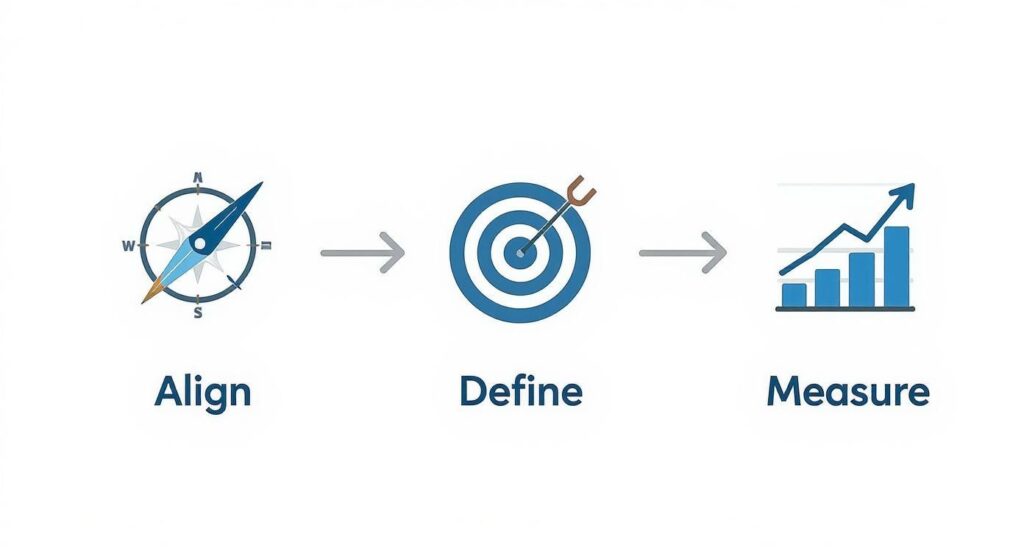
As the visual shows, a solid plan has to start with business alignment, move to clear targets, and finish with a robust way to measure what matters.
Before launching your programme, it’s wise to summarise these strategic components. A simple table can help keep everyone aligned on the core objectives and how you’ll measure them.
Key Strategic Pillars for Virtual Campus Recruitment
| Strategic Pillar | Key Objective | Example Metric |
|---|---|---|
| Business Alignment | Ensure hiring goals directly support long-term company objectives. | Percentage of hires filling critical skill gaps identified in the 3-year business plan. |
| Talent Quality | Attract and hire high-potential candidates who will perform and grow. | Average performance rating of campus hires after 12 months. |
| Diversity & Inclusion | Widen the talent pool to include underrepresented geographies and backgrounds. | Percentage increase in applications from Tier-2/Tier-3 cities. |
| Candidate Experience | Create a seamless and engaging hiring journey to boost offer acceptance. | Offer acceptance rate compared to previous years or industry benchmarks. |
| Operational Efficiency | Reduce costs and time-to-hire without compromising on quality. | Reduction in cost-per-hire by 25%; decrease in hiring cycle time by 15%. |
Thinking through these pillars ensures your approach is comprehensive and tied to real business value.
Here are a few more metrics you should consider weaving into your blueprint:
- Quality of Hire: Track performance ratings of campus hires at the one-year mark. Are they meeting or exceeding expectations?
- First-Year Retention Rate: High retention is a fantastic indicator that you’re matching the right candidates to the right roles and culture.
- Diversity Metrics: Measure representation from different regions, backgrounds, and genders at every stage of the hiring funnel.
- Offer Acceptance Rate by University: Dig into this data. It tells a powerful story about your employer brand’s strength on different campuses. For more on this, check out our guide on how campus collaborations can aid recruitment efforts.
By getting this strategic blueprint right from the start, you’re setting up your virtual campus programme to be more than just a logistical change—it becomes a powerful engine for achieving your most important business goals.
Assembling Your Virtual Recruitment Tech Stack
The technology you choose is the very backbone of your entire virtual campus hiring programme. Get it right, and you create a seamless, impressive experience for candidates. Get it wrong, and you’re looking at a clunky, disjointed process that causes top talent to drop out in frustration. This isn’t just about picking software; it’s about architecting a smooth digital journey for both your team and your future hires.
The cornerstone of any modern recruitment setup is, of course, the Applicant Tracking System (ATS). Think of it as your digital command centre. A good ATS does more than just warehouse resumes; it streamlines workflows, automates communication, and gives you the data you need on your hiring funnel.
But in a virtual world, its real power comes from how well it plays with other tools. A poorly integrated system creates data silos and tedious manual work. Imagine your recruiters having to download candidate lists from a virtual event platform and then painstakingly upload them into the ATS. It’s a recipe for inefficiency and errors. When you’re evaluating an ATS, its integration capabilities should be at the top of your checklist.
Choosing Your Core Platforms
Your tech stack will ultimately be a few key components working in harmony. The aim is to build an ecosystem where information flows effortlessly from one stage to the next—from that first touchpoint at a virtual career fair right through to the final offer letter.
Here are the essential platforms to consider for your virtual campus hiring machine:
- Virtual Event Platforms: These are your digital auditoriums for career fairs, info sessions, and webinars. Look for features that actually drive engagement, like live Q&A, breakout rooms for one-on-one chats with recruiters, and branded virtual booths that give a real flavour of your company culture. Platforms that provide detailed analytics on student attendance and engagement are worth their weight in gold.
- Assessment and Proctoring Tools: To evaluate skills from a distance, you need robust assessment software. For your tech roles, this could be a platform with live coding challenges. For others, it might involve situational judgement tests or case study simulations. The key is to find a tool that offers a fair and secure environment without being overly intrusive for the candidate.
- Video Interviewing Software: This can range from simple one-way video submissions (where candidates record answers to preset questions on their own time) to live, panel-style interviews. Find tools that plug directly into your ATS. This makes scheduling and collecting feedback a straightforward process for your busy hiring managers. For a deeper look, check out our guide to ease the online recruitment process for HR professionals.
A truly effective tech stack isn’t just a collection of fancy tools. It’s an integrated ecosystem designed to remove friction. The candidate should feel like they’re on a single, continuous journey, not being bounced between disconnected systems.
Making Smart Tech Decisions
The right technology for you will depend heavily on your specific needs, like your hiring volume and budget. A large multinational aiming to hire thousands of graduates will have vastly different requirements than a start-up looking for a select few.
Let’s look at a real-world scenario. An IT services firm in Bengaluru needed to hire 500 software developers from campuses across South India. Their old process was painfully manual and slow.
They invested in an ATS with strong API capabilities, allowing them to integrate a virtual assessment platform and an automated scheduling tool. This tech trio let them screen thousands of applicants with coding tests, automatically shortlist the top performers, and schedule interviews with available managers—all without a single manual intervention. The result? They slashed their time-to-hire by a massive 40% and got rave reviews on the candidate experience.
This brings us to artificial intelligence (AI) in recruitment. AI-powered tools can be incredibly useful for high-volume resume screening or for chatbots that answer common candidate questions 24/7. But it’s vital to be realistic. An AI scheduling bot can be a huge time-saver. Relying on AI to make final shortlisting decisions, however, can introduce bias and overlook promising candidates with unconventional backgrounds.
The smart approach is to use AI to augment your team’s capabilities, not to replace human judgement. Pilot these tools on a smaller scale, measure their impact, and then decide on a wider rollout.
Crafting an Unforgettable Candidate Experience

In the virtual campus hiring world, your digital presence is your employer brand. Full stop. Every single touchpoint—from the first Instagram post a student scrolls past to the final offer (or rejection) email—shapes their view of your company.
Let’s be honest, crafting a memorable candidate experience isn’t just a nice-to-have anymore. It’s often the single deciding factor that convinces top graduates to choose you over a competitor, even when the salary offers are nearly identical. This means you have to move beyond just broadcasting job openings. The real goal is to build a community and a genuine connection before a candidate even thinks about hitting “apply.” It’s about showing them what it’s like to work with you, not just telling them.
Building Authentic Digital Connections
Authenticity is your secret weapon. Today’s graduates grew up online; they can spot polished, overly-corporate messaging from a mile away and are completely turned off by it. What they really want are raw, real insights into your company culture.
So, how do you deliver that? Think about creating content that feels personal and unscripted. Instead of a slick, high-production video on company values, why not share a casual, phone-shot clip of a recent hire talking about their first big, challenging project? These unpolished moments build trust and relatability far more effectively than a glossy brochure ever could.
Here are a few practical ways we’ve seen companies foster these connections:
- Interactive Q&A Sessions: Host “Ask Me Anything” (AMA) sessions on platforms like Instagram Live or LinkedIn. Get your team leads or even last year’s campus hires on camera. This direct access demystifies your company and gives students a space to ask the questions they really want answered.
- Partnerships with Student Bodies: Team up with student-run clubs and organisations for targeted webinars or workshops. A hands-on coding workshop hosted with a university’s computer science society, for example, instantly positions you as an industry expert and builds incredible goodwill.
- Day-in-the-Life Content: Use short-form video on YouTube Shorts or Instagram Reels to show a realistic glimpse into your work environment. This type of content is ridiculously shareable and fantastic for building your brand organically. You can find more ideas on how to scale your employer branding with online recruitment events in our detailed guide.
A great virtual candidate experience makes a student feel seen and valued, not like just another number in an applicant tracking system. Personalisation and a human touch are what transform a standard process into a memorable journey.
This connection-first strategy is becoming even more critical as the Indian talent pool gets more competitive. The India Skills Report 2025 highlights how initiatives like the National Education Policy (NEP) and Digital India are successfully reshaping the workforce. With projections showing that over 50% of students will have access to industry-aligned vocational training by 2025, you’ll be competing for graduates with in-demand skills in AI, cybersecurity, and data science. Discover more insights from the India Skills Report 2025.
Keeping the Process Human and Transparent
All the engaging outreach in the world can be completely undone by a cold, faceless, automated hiring process. The key is to inject a human touch at every single stage, reinforcing your company culture through your actions, not just your words.
Clear, consistent, and empathetic communication is simply non-negotiable. When a candidate submits an application, an automated confirmation is fine, but the next message needs to feel more personal. Set clear expectations about timelines right from the start—and then actually stick to them. If a delay is unavoidable, a quick, honest update can prevent a lot of frustration and keep top talent from dropping out of your pipeline.
Let’s look at a real-world scenario. A candidate spends hours on a tough online assessment but doesn’t make it to the next round.
- The Forgettable Experience: They get a generic, automated rejection email two weeks later. End of story.
- The Unforgettable Experience: Within a week, they receive a personalised email. It acknowledges their effort on the assessment and offers one or two high-level, constructive feedback points. The email also invites them to join a talent community for future openings.
That small gesture of providing feedback transforms a negative outcome into a positive brand interaction. That candidate is now far more likely to reapply down the road and, just as importantly, share their positive experience with their friends. This human-centric approach ensures every single applicant—hired or not—leaves with a positive impression of your organisation.
Executing Flawless Virtual Assessments and Interviews

This is it—the moment of truth. After all the hard work attracting a strong pipeline of candidates, the assessment and interview stages are where you separate the truly exceptional graduates from the merely good ones.
The real challenge here is designing a remote evaluation process that’s not just effective and fair. It must also reinforce the positive, engaging candidate experience you’ve worked so hard to build up to this point.
Designing Assessments That Reveal True Potential
Let’s be honest: standard multiple-choice tests just don’t cut it anymore. They might screen for baseline knowledge, but they completely fail to reveal a candidate’s real-world problem-solving skills, creativity, or collaborative spirit. Leading organisations are moving towards more dynamic, interactive assessment methods to get a genuine feel for a candidate’s skills in action.
To accurately gauge a graduate’s capabilities, your assessments need to mirror the kinds of challenges they’ll actually face on the job. This approach gives you a much richer, more authentic understanding of their skills than a simple test score ever could. It also provides candidates with a realistic preview of the work, which can significantly improve retention down the line.
Think about incorporating these more engaging formats:
- Interactive Coding Challenges: For tech roles, forget asking for a finished solution. Use live coding platforms to see how a candidate thinks, debugs, and navigates a problem in real-time. It’s far more insightful.
- Virtual Case Studies: Hand your business or consulting candidates a real-world business problem. Give them a set time to analyse it and present their recommendations, just like they would in a client-facing scenario.
- Mini-Hackathons or Group Projects: Need to evaluate teamwork? Organise short, time-bound group projects. This is the perfect setting to observe how candidates communicate, delegate tasks, and work together to hit a common goal under pressure.
Of course, a major concern in any virtual assessment is maintaining integrity. But instead of relying on invasive proctoring software that makes candidates feel like they’re under surveillance, focus on designing assessments that are inherently difficult to cheat on. Case studies and unique problem-solving tasks are much harder to game than standard knowledge-based tests.
The goal of a virtual assessment should be illumination, not interrogation. Create an environment where candidates can genuinely showcase their skills and problem-solving abilities, free from unnecessary technological stress or the feeling of being watched.
This focus on practical, applicable skills is more critical than ever. Recent findings from Mercer | Mettl’s India Graduate Skill Index 2025 revealed that only 42.6% of Indian graduates are considered overall employable, highlighting a significant skills gap. By designing assessments that test real-world application, you can more effectively pinpoint the candidates who are truly ready to hit the ground running. You can explore the full India Graduate Skill Index 2025 research for deeper insights.
To help you choose the right approach, here’s a quick look at how different virtual assessment methods stack up.
Virtual Assessment Method Comparison
| Assessment Method | Best For Evaluating | Pros | Cons |
|---|---|---|---|
| Interactive Coding Challenges | Technical proficiency, problem-solving, debugging skills | Provides a real-time view of a candidate’s thought process; highly predictive for tech roles. | Requires specialised platforms; can be intimidating for some candidates. |
| Virtual Case Studies | Analytical thinking, business acumen, communication skills | Simulates real job tasks; gives candidates a preview of the role. | Can be time-consuming to develop unique case studies and evaluate responses. |
| Gamified Assessments | Cognitive abilities, decision-making, behavioural traits | Highly engaging for candidates; provides objective, data-driven insights. | Development can be costly; may not be suitable for all types of roles. |
| Asynchronous Video Interviews | Communication skills, personality, cultural fit | Flexible for candidates; allows for standardised screening at scale. | Lacks the real-time interaction of a live interview; can feel impersonal. |
| Group Projects / Hackathons | Collaboration, teamwork, leadership potential, problem-solving | Excellent for observing soft skills in a practical setting. | Logistically complex to organise and fairly evaluate individual contributions. |
Ultimately, the best strategy often involves a blend of these methods, tailored to the specific role and the competencies you need to assess.
Training Managers for Virtual Interview Excellence
A hiring manager who’s a rockstar at in-person interviews can easily struggle to replicate that success through a screen. The subtle, non-verbal cues we subconsciously rely on are often lost in a video call, making it much harder to build rapport and accurately assess crucial soft skills. You can’t just assume they’ll adapt; proactive training is non-negotiable.
Your training programme needs to equip managers to overcome these common virtual hurdles. Focus on practical skills for creating a genuine connection, asking insightful questions, and mitigating the sneaky biases that can creep into digital interactions.
Your training modules should cover:
- Building Rapport Digitally: Teach managers to start interviews with a few minutes of real, informal conversation to put candidates at ease. Simple things—smiling, making eye contact with the camera (not just the screen), and using active listening cues—make a world of difference.
- Probing for Soft Skills: Standard questions won’t be enough. Train your team to use behavioural questions that force candidates to give concrete examples. “Tell me about a time you had to collaborate with a difficult team member on a project” is far more revealing than “Are you a team player?”
- Avoiding Digital Bias: Unconscious biases, like affinity bias (favouring someone you have something in common with) or halo/horn effects (letting one good or bad trait overshadow everything else), can be amplified in a virtual setting. Structured interviews, where every candidate is asked the same core questions and scored on a consistent rubric, are one of the most powerful tools for ensuring fairness.
Finally, make sure technology is an enabler, not a barrier. Before any interview, send both the candidate and the hiring manager a simple tech-check guide. This should include quick tips on testing their camera and microphone, ensuring a stable internet connection, and finding a quiet, well-lit space. It’s a small step that can prevent technical glitches from derailing a great conversation, keeping the focus squarely on the candidate’s potential.
Right, let’s talk about what happens after the offers go out. A top-notch virtual campus programme isn’t a “set it and forget it” machine. It’s a living, breathing part of your talent strategy that needs to learn and get smarter every single year.
To do that, you have to measure what actually matters. This is where a lot of teams go wrong. They get caught up in vanity metrics—like the total number of applications—that feel good but don’t drive real strategic decisions.
The whole point isn’t just to create a report on last season’s numbers. It’s about finding insights that will make next year’s programme sharper, more efficient, and more tightly aligned with what the business actually needs. Tracking the right Key Performance Indicators (KPIs) turns your campus hiring function into a powerful engine for constant improvement.
Moving Beyond Vanity Metrics
First things first: we need to redefine what success looks like. A flood of applications might seem impressive, but it tells you nothing about the quality of that talent pool or how smooth your process was. It’s time to shift your focus to metrics that show you the true health and impact of your programme.
A well-designed dashboard is your command centre here. It doesn’t need to be overly complicated, but it should give you an instant, at-a-glance view of your most critical data points. This way, you can spot trends and flag areas for improvement without drowning in spreadsheets.
Here are the essential KPIs you absolutely should be tracking:
- Offer Acceptance Rate by University: This one is incredibly revealing. If you see a low acceptance rate from a target, top-tier university, that’s a red flag. It could signal an issue with your employer brand on that campus, or maybe your offers just aren’t hitting the mark compared to the competition.
- Pipeline Diversity at Each Stage: Don’t just look at the diversity of your final hires. You need to track the representation of candidates from different backgrounds, genders, and regions at every single step of the funnel—from application to assessment to the final interview. A big drop-off at any particular stage points to a potential bias you need to fix.
- Quality of Hire: This is the ultimate proof of success. How are your campus hires performing 12 months down the line? Look at their performance reviews. Are they meeting or exceeding expectations? Are they getting promoted faster than their peers? This data creates a direct line between your recruitment efforts and long-term business value.
- Source of Hire Effectiveness: Where are your best candidates actually coming from? Is it that partnership with a specific student club, a targeted LinkedIn campaign, or a particular virtual event? Knowing this allows you to double down on what works and stop wasting budget on what doesn’t.
Creating a Continuous Improvement Cycle
Data is only valuable if you do something with it. Your KPIs and all that rich candidate feedback should feed directly into a structured cycle of analysis, action, and review. This creates a powerful feedback loop that ensures your campus hiring strategy stays ahead of the curve year after year.
The most successful virtual hiring programmes are built on a foundation of curiosity. They constantly ask “Why?”—Why did our acceptance rate drop at this college? Why are we losing diverse candidates after the assessment stage? Why are hires from this source performing better? The answers to these questions are where true optimisation begins.
Imagine your data shows that candidates from Tier-2 cities have a fantastic assessment pass rate, but very few are accepting your offers. That insight should kick off a series of actions. Maybe you need to do a better job of explaining your relocation support, or perhaps you could host specific webinars for these candidates to address their unique questions. Then, in the next hiring cycle, you can measure the impact of those changes.
The Power of Post-Programme Surveys
Quantitative data tells you what is happening. Qualitative feedback tells you why.
One of the most powerful tools in your arsenal is the anonymous post-programme survey. It’s your chance to get honest, unfiltered feedback directly from the candidates who went through your process.
Make sure you survey everyone—both the candidates who accepted your offer and, just as importantly, those who declined. Understanding why someone chose a competitor is often more valuable than hearing why they chose you.
Your survey should touch on the entire experience:
- Application and Communication: How easy was it to apply? Was our communication clear and timely throughout the process?
- Virtual Events and Outreach: Did our virtual career fair give you a genuine feel for our company culture? Was the content actually engaging?
- Assessments and Interviews: Did the online assessments feel fair and relevant to the role? Did you feel like you could build a real connection with your interviewers over video?
- Overall Impression: What is the one thing we could do to make our virtual hiring process better?
When you combine the hard data from your dashboard with the rich, human insights from these surveys, you build a complete picture. This holistic view is what allows you to move from simply running a virtual campus programme to truly mastering it, ensuring it delivers exceptional talent and a strategic advantage for years to come.
Frequently Asked Questions
Pivoting to virtual campus hiring is a big shift. It’s bound to bring up questions for any CHRO or TA leader. It’s more than just a process change; it’s a strategic decision. It’s completely natural to want a clear picture of the practical side, the potential roadblocks, and what success actually looks like.
Let’s tackle some of the most common questions we hear from organisations across India as they make this move.
How Can We Ensure a Fair Process for Students with Unequal Tech Access?
This is probably the most important question to get right, especially when you’re recruiting from every corner of India. The key to fairness and equity isn’t about forcing everyone through the same funnel—it’s about building flexibility into your process.
Instead of insisting on live video interviews at rigid times, offer alternatives. Give candidates the option of asynchronous (one-way) video interviews they can record when their connection is stable. Or, go old-school with a simple telephonic interview for those in low-connectivity areas. When it comes to assessments, make sure your platform partner is mobile-first and light on data usage.
A fair process isn’t about forcing every candidate into the same rigid workflow. It’s about providing multiple pathways to the same destination, allowing every student to showcase their talent without being penalised for technological limitations.
Proactive communication makes all the difference here. Send out a simple tech-check guide before any interaction. More importantly, clearly state that you have alternatives available and encourage students to reach out if they think they’ll face an issue. This one simple step can completely change the candidate experience.
Will We Lose the Personal Connection of On-Campus Fairs?
It’s a valid concern. The chaos of a career fair might be hectic, but it feels personal. The fear is that “virtual” just means “impersonal.” But with the right approach, you can actually forge deeper, more authentic connections online. You just need to shift from broad, one-to-many announcements to focused, one-to-few conversations.
Think beyond the standard virtual career fair booth.
Host smaller, targeted webinars for specific engineering departments or student clubs.
Organise informal “Ask Me Anything” (AMA) sessions with your recent graduate hires.
Get a senior leader to host a candid chat about their career journey.
These formats create space for genuine dialogue. They give students a real feel for your company culture in a way that shouting over the noise at a crowded fair never could. The goal is to create multiple, meaningful touchpoints that make each cand
How Do We Measure ROI on a Virtual Hiring Programme?
The ROI of virtual campus hiring goes far beyond just saving money on travel and event logistics. That’s the low-hanging fruit. The real, strategic value is in the talent you gain access to.
When building your business case, track these core areas:
– Expanded Talent Pool: What’s the percentage increase in applications from Tier-2 and Tier-3 cities? How many new universities are now on your radar? This is about reach.
– Improved Efficiency: Track your time-to-hire and cost-per-hire. A 20-30% reduction in these areas is a very realistic target for most organisations making the switch.
– Quality of Hire: This is your north-star metric. Keep a close eye on the one-year performance ratings and, crucially, the retention rates of your virtual hires. High retention is the ultimate proof that you’re making better, more sustainable matches.
By focusing on these value-driven metrics, you can clearly show your stakeholders that going virtual isn’t just a cost-cutting tactic. It’s a strategic investment in acquiring better, more diverse talent that will drive the business forward.
Ready to transform your graduate recruitment? Taggd specialises in designing and executing high-impact virtual campus hiring programmes that deliver exceptional talent.