Hiring for accounts payable used to be straightforward. You were essentially looking for someone to fill a back-office role, processing invoices and paying bills. That world is long gone. Today, effective accounts payable hiring is about finding strategic finance professionals who can handle complex digital workflows.
It’s about recruiting talent who bring a smart blend of traditional accounting skills and a real comfort with automation, AI, and data analytics. These are the people who will drive business value, not just process transactions.
The New Reality of Accounts Payable Hiring

The idea of accounts payable as a simple invoice-processing function is completely outdated. For any Chief Human Resources Officer (CHRO) today, building a future-ready AP team means facing a function that has been completely transformed by AI, automation, and complex global compliance. Your hiring strategy has to keep up.
This evolution turns AP from a transactional cost centre into a strategic financial hub. The modern AP professional doesn’t just pay the bills. They analyse spending patterns, manage crucial vendor relationships, and actively mitigate financial risks.
The Widening Skills Gap
One of the biggest hurdles in accounts payable hiring is the growing gap between old-school skills and what the business needs now. I’ve seen countless organisations realise their AP teams are simply unprepared for this technological shift. The data backs this up: while only a handful of AP processes use AI today, a massive 40% of businesses plan to adopt it by 2026.
This creates an immediate, urgent need for professionals who are genuinely skilled in:
- AP Automation Platforms: Hands-on experience with tools that automate invoice capture, matching, and payment scheduling is now a baseline requirement.
- ERP Systems: Deep, practical knowledge of platforms like SAP, Oracle, or Coupa is still absolutely core to the role.
- Data Analytics: The ability to look at financial data, interpret it to spot trends, identify anomalies, and prevent fraud is incredibly valuable.
- Vendor Management: You need people with strong communication skills who can build and sustain positive, productive supplier relationships.
For CHROs, the takeaway is crystal clear: A reactive approach to accounts payable hiring is a serious liability. You have to proactively hunt for talent with a forward-looking skillset to maintain a competitive edge and ensure your company’s financial resilience.
Market Forces Reshaping Talent Demands
Global and local market dynamics are also squeezing the talent pool. In India, for instance, the explosive growth of digital payments has massively accelerated the demand for tech-savvy finance professionals. This surge has dialled up the competition for candidates who can confidently manage high-volume, automated payment environments.
As a CHRO, your job is to see these changes coming and adapt your hiring playbook accordingly. This guide will give you the framework to properly define roles, source top-tier talent, and build an AP team that not only keeps pace but actually drives your organisation forward. Your success in accounts payable hiring will have a direct, measurable impact on your company’s financial control and operational efficiency.
Defining the Modern AP Role with a Competency Matrix
You can’t hit a target you can’t see. Before you write a single job post or screen a CV, you need to know exactly what a top-performing accounts payable professional looks like for your organisation. This means moving past outdated job descriptions that just list off transactional duties.
The modern AP role is a hybrid, blending financial savvy with a strong grasp of technology and sharp analytical skills. A vague description like “processes invoices” will only attract candidates stuck in a transactional mindset. But if you articulate the strategic value “manages vendor payment cycles to optimise cash flow and uses automation to drive efficiency” you completely change the game. That small shift in language dramatically elevates the quality of talent you attract.
Moving from Job Duties to Core Competencies
The most effective way to define any role, especially one as nuanced as AP, is by building a competency matrix. This framework goes far beyond a simple task list. It maps the specific skills, knowledge, and behaviours needed for success at different levels of seniority. It’s a blueprint not just for hiring, but for performance management and career pathing, too.
A well-structured competency matrix brings objectivity and consistency to your hiring process. It forces everyone involved to evaluate candidates against the same critical criteria, slashing bias and leading to much better hiring decisions. For a deeper look at how to build these frameworks, check out our guide on creating a skills matrix.
A competency matrix turns hiring from a subjective guessing game into a strategic, data-driven process. It’s the foundational tool that aligns recruitment with real business needs, ensuring you hire for future performance, not just past experience.
Mapping Skills Across Seniority Levels
Your AP team’s needs will vary hugely by role. An AP Clerk needs meticulous attention to detail for data entry. A Senior Analyst, on the other hand, needs the analytical firepower to dig into spend data and spot cost-saving opportunities. Your competency matrix has to reflect this progression.
For instance, being proficient with an ERP system like SAP or Oracle NetSuite is a core requirement across all levels, but the depth of that knowledge changes. A junior team member just needs to know how to get tasks done in the system. A senior analyst should be able to troubleshoot complex issues, understand system integrations, and even spearhead process improvement projects.
This detailed mapping helps you craft incredibly precise interview questions and assessments. It also gives candidates a clear picture of what’s expected and shows them a real path for growth within your organisation.
A Practical Competency Matrix for AP Roles
To make this tangible, let’s look at a sample matrix. This is the kind of tool that helps you visualise the different skill expectations for an AP Clerk, a Specialist, and a Senior Analyst. Think of it as your guide for building a truly effective accounts payable hiring strategy.
Here’s a breakdown of how competencies evolve across different AP roles.
Accounts Payable Competency Matrix
| Competency Area | AP Clerk (0-2 Years) | AP Specialist (2-5 Years) | Senior AP Analyst (5+ Years) |
|---|---|---|---|
| Technical Proficiency | Accurate data entry in ERP; basic use of automation tools (e.g., invoice scanning). | Proficient 3-way matching; manages exceptions in ERP; comfortable with various AP software. | Advanced ERP skills (reporting, configuration); leads automation tool implementation and optimisation. |
| Analytical Skills | Identifies basic invoice discrepancies. | Analyses vendor statements for reconciliation; identifies duplicate payments. | Conducts spend analysis; develops KPIs; identifies trends for fraud detection and process improvement. |
| Communication | Responds to internal payment status queries. | Manages routine vendor communications and resolves payment issues. | Negotiates with vendors; communicates complex financial data to senior leadership. |
| Problem-Solving | Follows procedures to resolve known, simple errors. | Independently investigates and resolves complex invoice and payment disputes. | Proactively identifies systemic process flaws and designs solutions to prevent future issues. |
This matrix becomes your North Star. It ensures every stakeholder, from recruiters to hiring managers, is perfectly aligned on what “good” looks like for each role.
In a competitive talent market where skilled professionals are in high demand, this clarity is a critical asset. In India, for example, accounts payable specialists command an average base salary of ₹466,776. What’s telling is that mid-career professionals earn 16% more than their early-career counterparts, showing the premium companies place on experience and advanced skills. Make sure your compensation is competitive by staying on top of the latest AP salary trends.
Building a Winning Talent Sourcing Strategy
Finding exceptional accounts payable talent isn’t a passive exercise; it’s an active hunt. You can’t just post a job and expect high-performers to flock to your door. A winning accounts payable hiring process depends on a powerful, multi-channel sourcing strategy that actively seeks out the right people.
This means looking both inward and outward. Your next AP star might already be working within your organisation, just waiting for the right opportunity to step up. At the same time, you need a robust external strategy to capture top talent from the wider market.
Cultivating Talent From Within
Before you even think about external job boards, look at your existing talent pool. Promoting internal candidates is a proven way to reduce hiring costs, shorten onboarding time, and significantly boost employee retention and morale.
Your finance or accounting-adjacent teams are a goldmine. Look for individuals who demonstrate:
- Meticulous Attention to Detail: Someone in an administrative or data entry role who consistently produces error-free work.
- A Knack for Problem-Solving: An employee who doesn’t just flag issues but actively suggests solutions.
- Curiosity About Technology: A team member who is always the first to master a new software tool or shows interest in process automation.
Creating clear career pathways from junior finance roles into the AP team is a powerful retention tool. It shows your employees that you are invested in their growth, turning a job into a long-term career.
Expanding Your External Search Beyond Job Boards
While platforms like Naukri and LinkedIn are essential, relying on them alone means you’re competing in the most crowded, and often most expensive, talent pools. To gain an edge in accounts payable hiring, you must diversify your sourcing methods. Our complete guide on recruitment sourcing methods offers a broad look at different approaches you can take.
Think more strategically. Where do skilled AP professionals gather, both online and offline? Consider tapping into:
- Professional Finance Networks: Actively participate in forums and groups associated with organisations like the Institute of Finance & Management (IOFM).
- Targeted Digital Campaigns: Use specific, long-tail keywords in your job advertisements that speak to candidates with skills in ERP systems (like SAP or Oracle) and AP automation software.
- Niche Accounting Conferences: Events like the IMA Accounting & Finance Conference are excellent for networking with motivated, high-calibre finance professionals.
Your employer brand is your secret weapon. Craft messaging that speaks directly to finance professionals by showcasing growth opportunities, your commitment to new technology, and the strategic importance of the AP function in your organisation.
Unlocking Potential With Recruitment Process Outsourcing
At some point, the scale and complexity of your hiring needs may outgrow your internal capacity. This is especially true when you need to hire for specialised skills in high-volume, or when your time-to-hire is hurting business operations. This is the strategic moment to consider a Recruitment Process Outsourcing (RPO) partner.
An RPO provider like Taggd doesn’t just find candidates; we become an extension of your hiring team. We bring an extensive, pre-vetted database of finance talent, AI-powered matching technology that identifies the best-fit candidates with speed and precision, and deep market intelligence.
This approach transforms your recruitment from a fixed cost centre into a flexible, on-demand resource. You gain immediate access to a wider talent pool and a team of experts dedicated to your accounts payable hiring success, allowing your HR team to focus on broader strategic initiatives.
The diagram below breaks down the typical hierarchy of roles you’ll be sourcing for within the AP function.
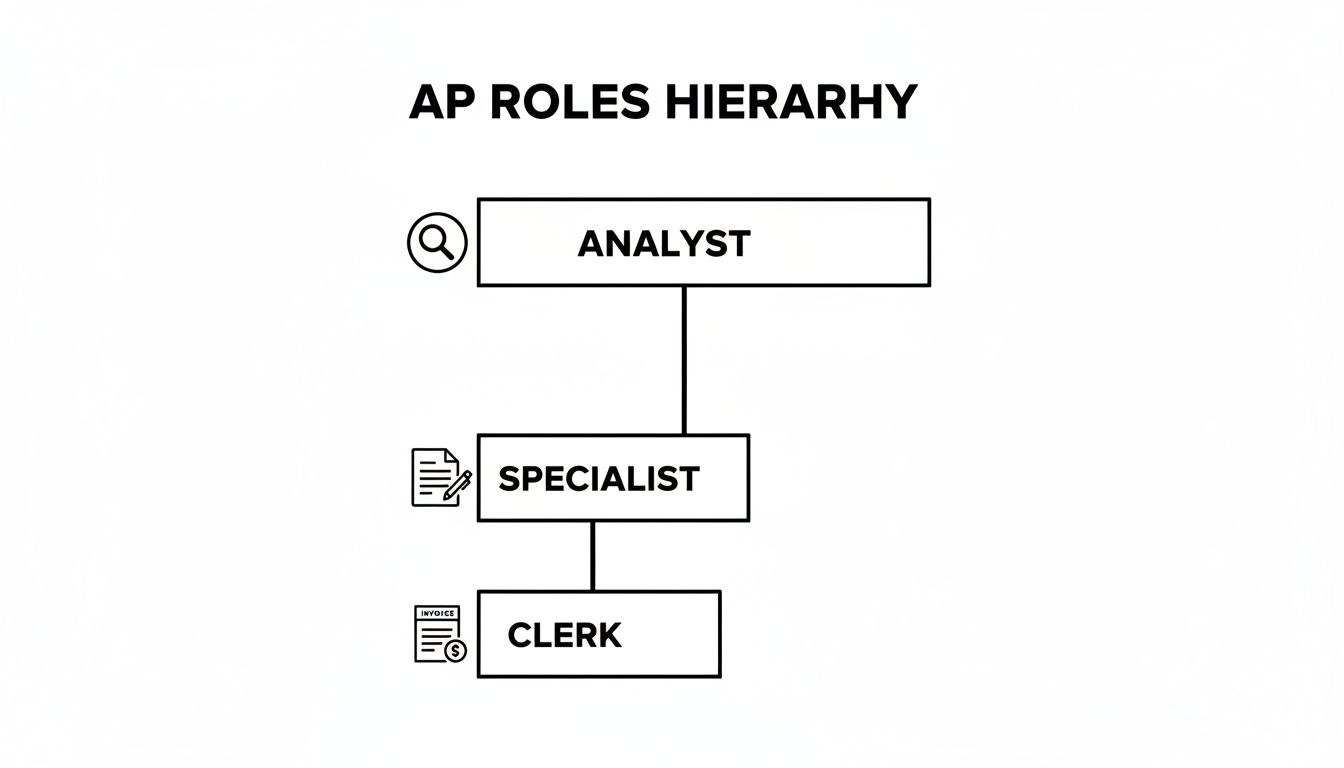
As you can see, the roles progress from transactional to strategic responsibilities. This is why a nuanced sourcing strategy is so vital for finding the right skills at each level of the AP ladder.
Designing a Smarter Screening and Assessment Process
Once your sourcing strategy has delivered a strong pipeline of candidates, the real work begins. How do you cut through the noise and move beyond the CV to pinpoint the people who will actually thrive on your modern accounts payable team? The answer lies in a smarter screening and assessment process—one that swaps gut feelings for data-backed decisions.
This isn’t about just ticking boxes. It’s about creating a structured framework that gives your hiring managers a consistent, fair way to evaluate every single candidate against the competency matrix you’ve already built. The goal is to design assessments that genuinely test for real-world abilities, not just abstract knowledge.
Creating Skills Tests That Reflect Reality
Forget generic aptitude tests. They won’t tell you if a candidate can handle the intense pressure of a high-volume AP department. Your assessments have to be customised to the specific demands of the role. A well-designed test acts as a clear window into a candidate’s true capabilities, making your accounts payable hiring process a much better predictor of on-the-job success.
An effective skills test should simulate the tasks they’ll face every day. Think about including scenarios that test a candidate’s ability to:
- Perform a 3-Way Match: Give them a sample purchase order, a goods receipt note, and an invoice with a subtle error. Then, ask them to spot the discrepancy.
- Navigate an ERP System: A short, timed exercise in a test environment of your ERP (like SAP or Oracle) can quickly reveal their genuine comfort level with the software you use.
- Apply Accounting Principles: Present a realistic situation involving accruals or pre-payments and ask how they would record it according to GAAP.
You want to see their skills in action, not just hear about them. You can learn more about how to structure these evaluations in our detailed article on creating an effective aptitude test.
Your assessment process should be a preview of the job itself. By testing for practical skills, you not only validate a candidate’s expertise but also give them a realistic glimpse into the role, which helps manage expectations from day one.
Spotting Red Flags During Resume Screening
Even before you get to the testing phase, a meticulous CV screen can help you filter out candidates who are unlikely to be a good fit. You need to be on the lookout for common red flags that signal a potential mismatch.
Here are a few things to watch for:
- Vague Accomplishments: Phrases like “involved in invoice processing” are far less convincing than “processed 500+ invoices weekly with a 99.8% accuracy rate.” Specifics matter.
- Lack of Tech Keywords: A modern AP professional’s CV should be peppered with the names of specific ERP systems, automation tools, or data analysis software. No mention of tech is a major warning sign.
- Unexplained Career Gaps: While not always a deal-breaker, significant gaps need to be addressed during the interview to understand the full story.
- Job Hopping: A history of multiple short-term stints could point to issues with performance, adaptability, or fitting into a company’s culture.
These markers help you invest your time and energy where it counts, on candidates who show a clear history of high performance and a modern skillset.
Implementing an Interview Scorecard
To drive consistency and root out unconscious hiring bias, an interview scorecard is an absolute must-have. It gets every interviewer aligned on what to look for and provides a structured way to capture feedback, which makes those debrief sessions infinitely more productive.
Your scorecard should be a direct reflection of your competency matrix, with clear sections for technical skills, analytical abilities, communication, and cultural fit. For a senior analyst role, for example, you’re not just confirming they have the skills; you’re assessing their potential to lead. This is critical, as market data shows that senior analysts in accounts payable represent a key hiring demographic in India, commanding average salaries of ₹13.4 lakhs. You can explore this maturing talent pool further by reviewing the latest salary data and insights. A solid scorecard ensures you’re evaluating for that high-value potential, not just basic competence.
You’ve navigated the market, assessed the skills, and finally made the hire. But securing that top accounts payable professional is only half the battle. The real work begins now.
All your recruitment efforts can unravel in a matter of weeks if you don’t have a solid plan to turn that new hire into a long-term, high-performing team member. A weak onboarding process is the fastest way to see your investment walk out the door.

This isn’t about just ticking off boxes on an HR checklist. A strategic onboarding plan is what transforms a promising candidate into a fully integrated part of your finance engine. That initial period sets the entire tone for their career with you.
Designing an Effective 90-Day Onboarding Plan
The first 90 days are absolutely critical. A well-thought-out plan acts as a roadmap, systematically building your new hire’s confidence and competence. It’s about much more than just software training; it’s about weaving them into your company’s culture and connecting them with the right people.
I always suggest breaking it down into distinct phases:
- Days 1-30: Building the Foundation. This first month is all about the essentials. Get them comfortable with your core systems and walk them through your company’s procure-to-pay cycle in detail. Make sure they have a firm grasp of the key policies and compliance rules that will govern their day-to-day work.
- Days 31-60: Focusing on Integration. Now it’s time to broaden their horizons. Set up meetings with key people they’ll be working with in procurement, treasury, and other departments. Start giving them small, manageable projects to build up their practical skills and boost their confidence.
- Days 61-90: Driving Towards Autonomy. By this point, your new hire should be handling their main responsibilities with less and less hand-holding. The focus now shifts to providing constructive feedback, setting their first performance goals based on key metrics, and opening a dialogue about their future career path.
A structured 90-day plan isn’t just about training; it’s a strategic tool for engagement. It shows your new hire that you are invested in their success from day one, which dramatically accelerates their path to full productivity and strengthens their commitment to the organisation.
Upskilling Your Team for the Future of AP
Onboarding takes care of the new arrivals, but what about the team you already have? The world of accounts payable is changing fast, and keeping your existing team’s skills sharp isn’t a nice-to-have—it’s a business necessity.
You need to focus your training efforts on areas that will have the biggest impact on your bottom line. This means practical, hands-on training for new automation tools that cut down on manual work and data analytics software that can help spot new ways to save money. These are the skills that make your team more effective and your business more competitive.
For instance, when you roll out a new AI-powered invoice processing tool, the training shouldn’t just be a “how-to” session. You have to explain the why, how this change frees them from repetitive tasks and elevates their roles to focus on more strategic analysis and problem-solving.
Measuring What Matters with AP KPIs
You can’t improve what you don’t measure. Key Performance Indicators (KPIs) are essential for turning vague goals like “be more efficient” into concrete targets. They give you objective data on your AP team’s performance and its real impact on the business.
Here’s a look at some of the most important KPIs every modern AP team should be tracking.
Key Performance Indicators (KPIs) for AP Teams
| KPI | Description | Industry Benchmark |
|---|---|---|
| Cost per Invoice Processed | The total cost of the AP department divided by the number of invoices processed. This is a core efficiency metric. | Varies by automation level; best-in-class teams are below ₹150 per invoice. |
| Invoice Cycle Time | The average time it takes from when an invoice is received to when it is approved for payment. | Top performers achieve this in under 5 days. |
| Days Payable Outstanding (DPO) | A measure of the average number of days it takes for a company to pay its suppliers. | A healthy range is typically between 30 and 60 days, depending on industry. |
| Early Payment Discount Capture Rate | The percentage of early payment discounts offered by vendors that the company successfully captures. | A high rate (over 70%) indicates strong process control and cash management. |
Tracking these metrics gives you the power to pinpoint bottlenecks, celebrate successes, and make smart, data-driven decisions about where to invest in technology and training.
Proven Tactics for AP Talent Retention
High turnover in the AP department isn’t just a headache; it’s incredibly expensive and disruptive. Keeping your best people on board requires more than just a competitive salary. While fair pay is the foundation, a clear path for growth and a sense of being valued are what truly secure loyalty.
In India’s competitive job market, the demand for skilled accounts payable clerks has kept salaries strong, with a national average of ₹3,58,363. But you’ll see big differences in hiring hotspots like Chennai and Gurgaon, where pay is higher. Interestingly, while technology is a major focus, only 7% of AP processes use AI today, though 40% plan to by 2026. This points to a massive opportunity for upskilling your team. You can dive deeper into these trends in the latest salary report to make sure you’re staying competitive.
To hold onto your top AP talent, you need to connect compensation to a clear career path. Show them what their future looks like at your company whether that’s a promotion to a senior analyst role, a team lead position, or a move into another area of the finance department. Regular performance reviews, mentorship opportunities, and investing in their professional growth are powerful signals that you’re committed to them for the long haul.
FAQs
Even the best playbook can’t cover every single question that pops up when you’re hiring for a role as crucial as accounts payable. As a CHRO, you’re looking for straight-to-the-point answers to the real-world challenges you face. I get it.
So, let’s dive into some of the most common questions I hear from leaders just like you.
What Are the Most Critical Skills for an Accounts Payable Candidate in 2026?
The game has completely changed. While core accounting knowledge is still the foundation, the real difference-makers now are technology proficiency and analytical thinking. A resume showing experience with ERPs like SAP or Oracle is just the price of entry.
The true standout candidates are the ones who have hands-on experience with AP automation platforms. Their ability to pick up new software isn’t just a “nice-to-have”, it’s non-negotiable. Look for evidence of this in their history. Were they part of a system migration? Did they help roll out a new tool? That’s gold.
But tech skills without critical thought are just empty calories. The most valuable people are those who use the tools to think.
- Analytical Prowess: Can they do more than just process invoices? Look for their ability to run spend analysis, spot potential fraud, and actually suggest ways to improve your processes. That’s where the real business value lies.
- Problem-Solving Evidence: Don’t let them get away with generic answers. Ask for specific examples. A candidate who can walk you through how they used data to find a cost-saving opportunity is worlds more valuable than someone who just talks about their processing speed.
- Essential Soft Skills: And let’s not forget the basics. Meticulous attention to detail and clear, professional communication for vendor management are still the absolute pillars of a top-tier AP professional.
How Can We Compete for Top AP Talent on a Tight Budget?
If you can’t be the market leader on salary, you have to lead with opportunity. This is an incredibly powerful move in accounts payable hiring, because the best candidates are driven by more than just the paycheque. Your secret weapon? A clear commitment to technology and professional growth.
Top AP pros are hungry to get their hands on automation, AI, and advanced analytics. If you can show them your modern tech stack and how they’ll get to use it, your offer can suddenly look much more attractive than a higher-paying job at a company stuck in the dark ages.
When your budget is tight, career growth becomes your best currency. A clear, tangible career path showing how a specialist can become a senior analyst or a team lead, proves you’re investing in their future, not just filling a vacancy.
Don’t forget to sell the whole package:
- Flexibility: In the post-pandemic world, hybrid models and flexible work schedules carry immense weight. This can easily be the factor that tips the scales in your favour.
- Culture: A strong, supportive culture where the finance team is viewed as a strategic partner, not just a cost centre, is a massive selling point.
- Performance Incentives: For more senior roles, think about performance bonuses. Tying compensation to hitting measurable goals, like achieving specific efficiency gains or cost-saving targets, shows that you value and reward high-impact work.
When Is It Time to Use an RPO Partner for AP Hiring?
Bringing in a Recruitment Process Outsourcing (RPO) partner is a strategic play, not a panic move. There are a few clear signals that tell you it’s the right time to make that call.
First, think high-volume hiring. If you’re building out a shared services centre or need to fill a dozen AP roles at once, an RPO brings a level of efficiency and process discipline that’s nearly impossible for an in-house team to match. They’re built for scale.
Second, you should look to an RPO when you’re hunting for specialised skills. This is especially true for those hard-to-find experts in AP automation, data analytics, or specific ERP modules. Good RPO providers have deep, pre-vetted talent pools filled with these professionals.
Third, if your time-to-hire is dragging on and starting to hurt day-to-day operations, it’s time for backup. An AI-powered RPO can slash your hiring timeline, getting qualified people in the door before operational bottlenecks become critical. Delays in AP hiring can create serious business headaches.
Finally, an RPO model offers financial agility. If you’d rather shift your recruitment costs from a fixed overhead to a predictable, variable expense, outsourcing gives you exactly that. It lets you ramp your hiring efforts up or down with business needs, without the long-term burden of a large internal team.
At Taggd, we specialise in becoming a strategic extension of your team, using AI and deep market intelligence to solve your most complex hiring challenges. If you’re ready to accelerate your accounts payable hiring and secure the talent that will drive your business forward, discover how Taggd’s RPO solutions can help.